
Most visitors to Tokyo know Sensō-ji, the great Kannon temple in Asakusa. Fewer notice that the stone post at its gate calls it Kinryūzan Sensō-ji, "Golden Dragon Mountain Sensō Temple", although Asakusa is as flat as a tabletop. In Kyoto, Kiyomizu-dera ends in the same character for "temple" but is read dera, not ji. Japanese temples usually carry several names at once, stacked like titles before a person’s name, and each layer has its own history: a "mountain name" borrowed from Chinese Zen, a "hall name" that once meant a walled compound or a retired emperor’s palace, the temple name proper, and the nicknames that worshippers have used for centuries. Once you can separate the layers, the inscriptions on gateposts, plaques and temple stamps start to make sense, and a name can even hint at a temple’s age and school.
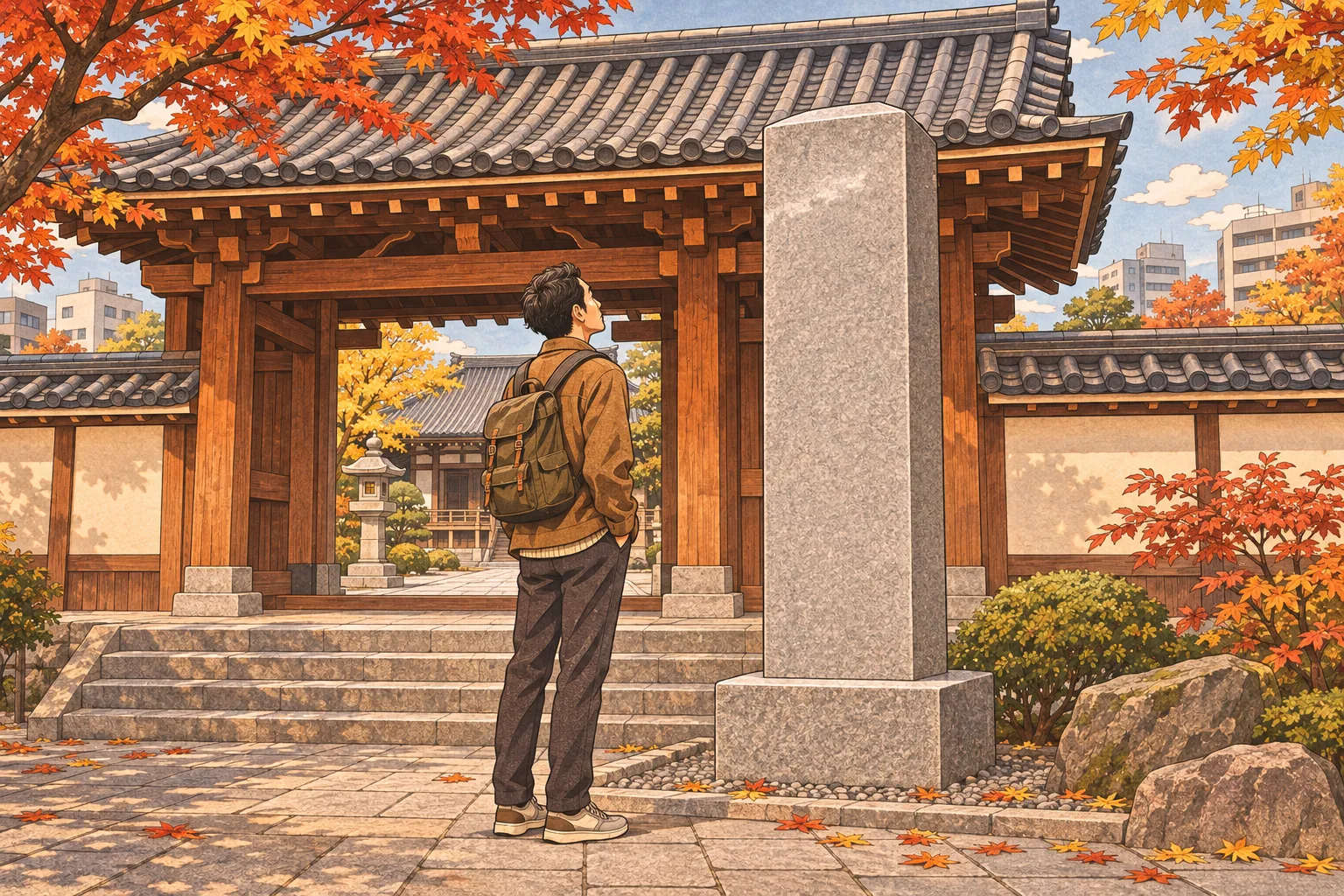
The gatepost at a temple entrance: a tall square stone pillar, with the temple’s layered names inscribed down its face.
01The anatomy of a full name
Take Zōjō-ji, the large temple beside Tokyo Tower. Its full name is San’enzan Kōdoin Zōjō-ji. The first part, San’enzan, is the sangō, or mountain name. The middle part, Kōdoin, is the ingō, the hall name. The last part, Zōjō-ji, is the jigō, the temple name. On the stone post at the gate, a further line usually sits above all this, stating the school and the temple’s rank within it, in this case "Great Head Temple (daihonzan) of the Jōdo School". Read from top to bottom, a full gatepost inscription therefore runs: school, rank, mountain name, hall name, temple name.
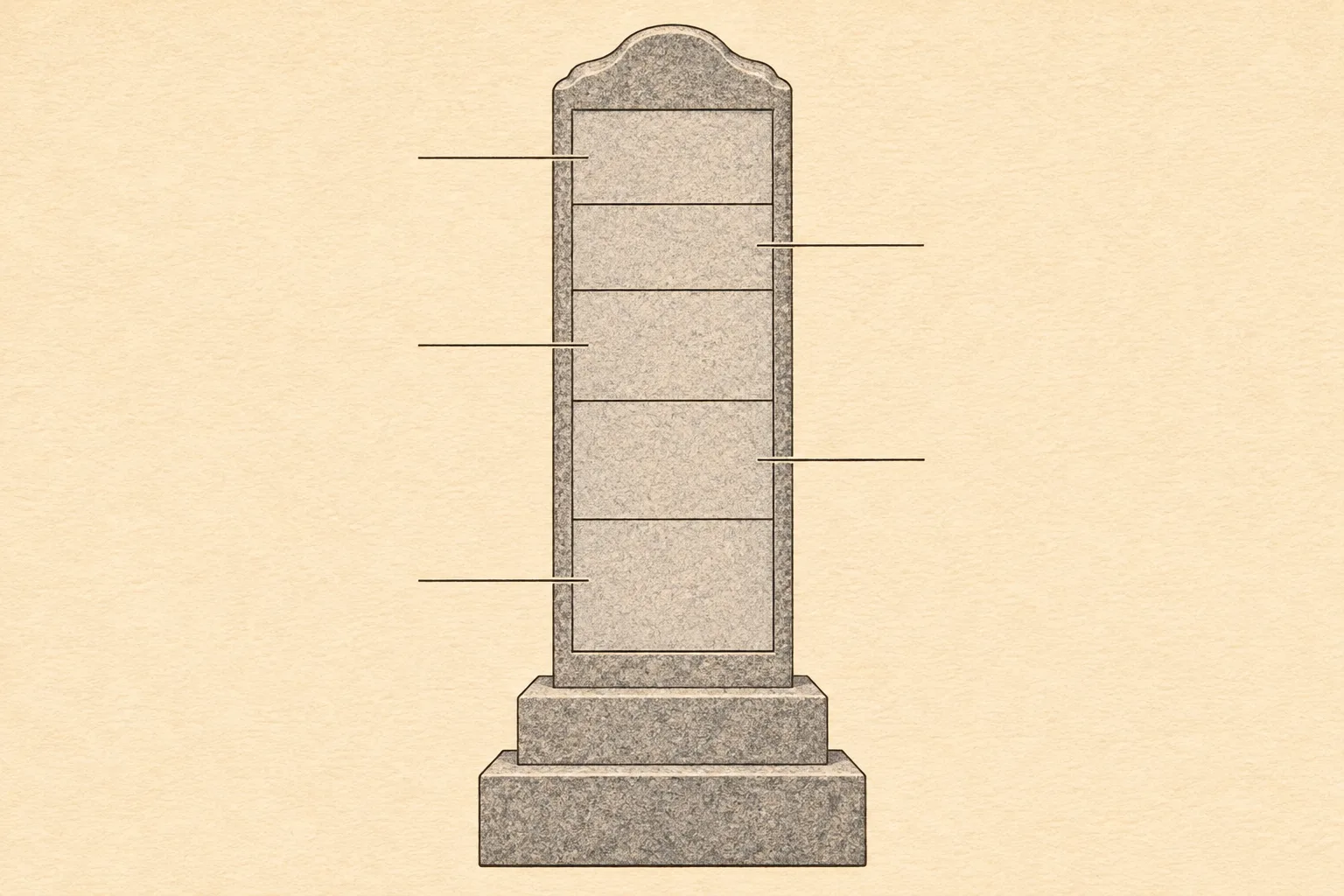
The five parts of a full gatepost inscription, top to bottom: school, rank, mountain name, hall name, temple name. For Zōjō-ji the last three read San’enzan, Kōdoin, Zōjō-ji.
Not every temple has all three names. Many of Nara’s oldest temples, such as Tōdai-ji, Hōryū-ji and Kōfuku-ji, have only a temple name, because they were founded before the mountain-name custom reached Japan. Several famous Kyoto temples are known only by a hall name: Chion-in, Shōren-in, Sanzen-in. Small temples may be called simply "such-and-such hermitage" or "such-and-such hall". The full three-part formula is most common among temples founded from the Kamakura period (1185–1333) onward, or whose names were formalised in the Edo period (1603–1868).
In daily speech almost nobody uses the full name. Tokyoites call Sensō-ji "the Asakusa Kannon". Kyoto people call Kiyomizu-dera, formally Otowasan Kiyomizu-dera, simply Kiyomizu-san, as if it were an acquaintance. The full name appears on the temple’s seal, on ritual documents, on the signature line of a temple stamp and on the gatepost. It works rather like a name on an official register, while the nickname is what friends call you.
02Mountain names: why flat temples are "mountains"
Some mountain names are literal. Enryaku-ji is Hieizan Enryaku-ji because it stands on Mount Hiei above Kyoto, where the monk Saichō built his first hermitage. Kongōbu-ji is on Mount Kōya, where Kūkai founded his monastic centre. For these temples the mountain and the institution are so tightly bound that Japanese speakers often just say "Hiei" or "Kōya" to mean the temple, or even the whole school.
But Sensō-ji, Zōjō-ji and hundreds of temples in the middle of cities also have mountain names. The habit comes from China. Many of China’s great monasteries stood on famous peaks, such as Wutai, Tiantai and Jingshan, and people referred to a monastery by its mountain: to "go up Tiantai" meant to go to the temple there. In the Song dynasty, when Chan (Zen) Buddhism flourished, a master appointed abbot of a monastery was said to "reside on" its mountain, and monks used mountain names as the normal way of referring to temples, whether or not the temple was on a slope. Japanese monks such as Eisai and Dōgen studied in Song China, and Chinese masters such as Lanxi Daolong and Wuxue Zuyuan came to Japan in the thirteenth century. They brought the whole apparatus of Zen monastic life with them, mountain names included. Kenchō-ji in Kamakura is formally Kofukusan Kenchō Kōkoku Zenji, and Engaku-ji is Zuirokusan Engaku Kōshō Zenji, "Auspicious Deer Mountain".
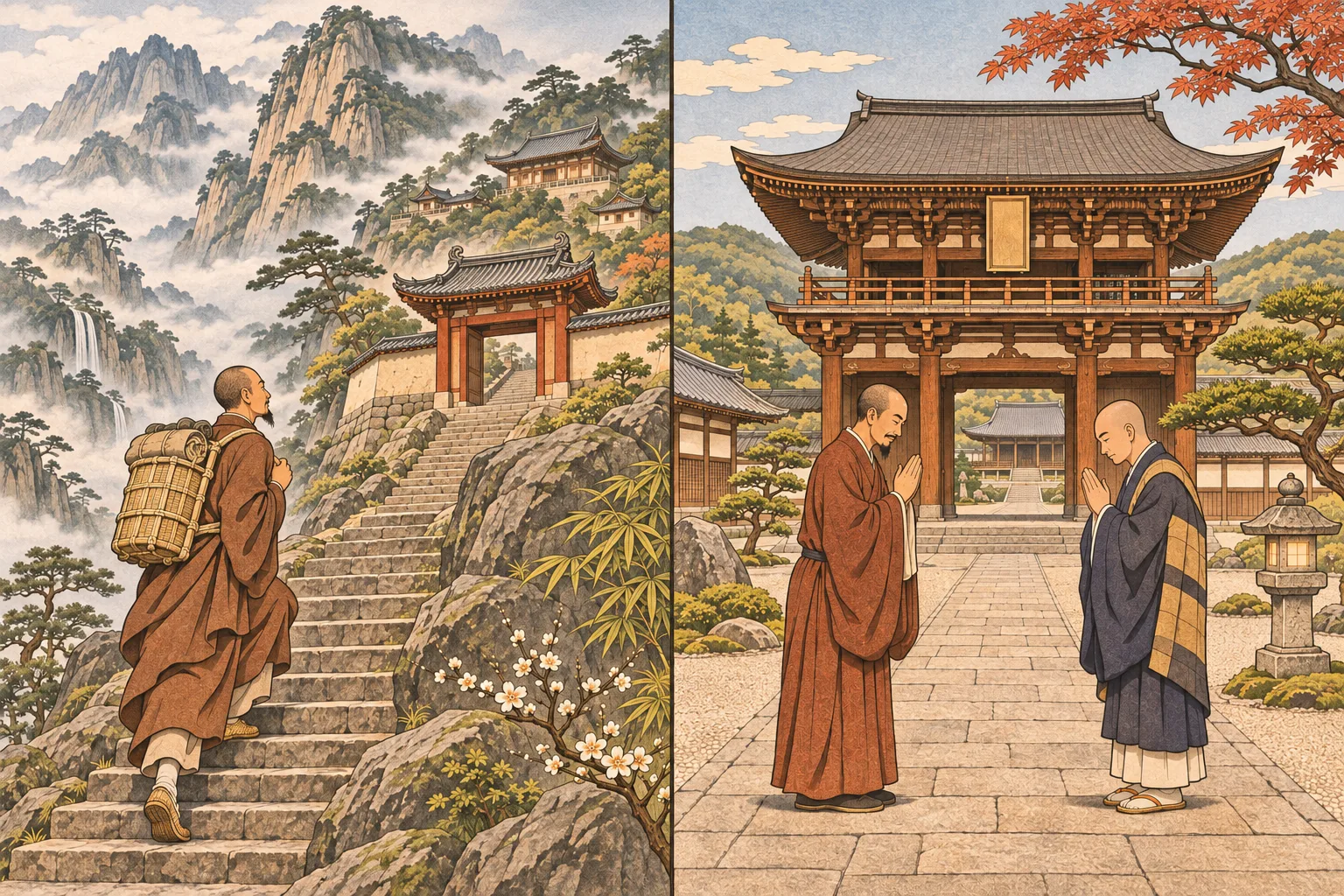
Left: Song China, where great monasteries stood on famous peaks and were called by their mountains. Right: Kamakura Japan, where Chinese Chan masters brought the Zen system, mountain names included. (artist’s impression)
Other schools soon followed. Today most temples of the Pure Land, Nichiren and True Pure Land schools have mountain names. Ancient temples sometimes acquired one later. Kiyomizu-dera’s Otowasan is taken from Mount Otowa behind it and from the Otowa waterfall that runs beneath its main hall, so it is a local name. Sensō-ji’s Kinryūzan is tied to its founding legend: according to the temple’s tradition, on the day the Kannon image appeared about a thousand pine trees sprang up overnight, and three days later a dragon with golden scales descended from the sky into the grove.
Mountain names tend to fall into a few types. Some are real place names: Hieizan, Kōyasan, Minobusan for Kuon-ji, Naritasan for Shinshō-ji. Some are auspicious words: Golden Dragon, Auspicious Deer, Auspicious Dragon, Jewel. And some borrow another mountain’s prestige. The best example is Kan’ei-ji in Ueno, whose mountain name is Tōeizan, "Eastern Hiei". Our article on Tendai explains why the shogunate modelled it on Mount Hiei, guardian of Kyoto’s unlucky northeast. Even its temple name copies the model: Enryaku-ji was named after the Enryaku era, and Kan’ei-ji after the Kan’ei era in which it was founded.
Mountain names are usually read with the Sino-Japanese reading san or zan; whether the sound voices depends on what comes before. Hieizan and Kinryūzan take zan, while Kōyasan and Naritasan take san. When the mountain name is a native Japanese place name, the first part keeps its native reading, as in Otowasan. When in doubt, follow the kana the temple prints on its own signs.
You will usually see the mountain name on the main gate. Zen temples and many others hang a plaque high on the gate, and the characters on it are very often the mountain name. The link runs deep in the language: the main gate is the sanmon, "mountain gate"; entering a monastery is "entering the mountain"; and the head temple of a school is its sōhonzan, the "general head mountain".
03Hall names: from walled compounds to retired emperors
The character in originally meant an enclosure surrounded by walls. In the great Nara temples, besides the main hall and the pagoda, there were many walled sections with their own functions: storehouses, sutra libraries, living quarters. Each could be called an in. The Shōsō-in, the famous treasure house in Nara, was originally one of Tōdai-ji’s storage compounds.
In the Heian period (794–1185) the word gained a second sense. When an emperor abdicated, he moved into a palace outside the imperial compound, and palaces carried names like Reizei-in or Suzaku-in. Since it was impolite to use a sovereign’s personal name, people referred to a retired emperor by his residence, and "in" became a title for retired emperors themselves; the period when they held real power is called insei, "rule from the cloister". Aristocratic mansions could also be called in, and many nobles turned their villas into temples late in life. Byōdō-in at Uji was a villa owned by Fujiwara no Michinaga; his son Yorimichi converted it into a temple in 1052 and built the Phoenix Hall the following year.
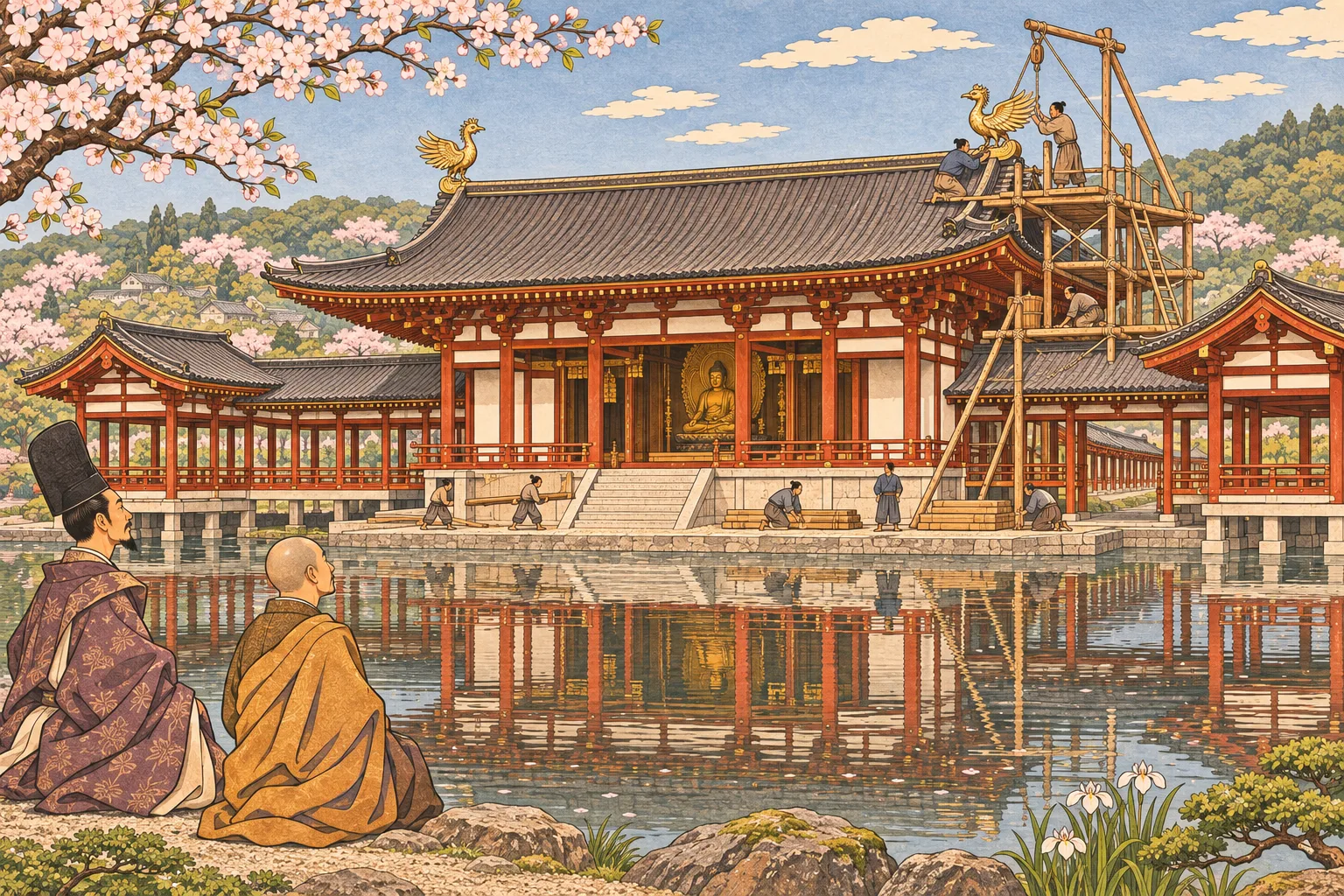
A villa becomes a temple: the Amida hall of Byōdō-in at Uji nears completion the year after the villa was converted in 1052, and workers set a phoenix on the roof ridge. This is the building now called the Phoenix Hall. (artist’s impression)
From the medieval period on, in was also used for the sub-temples that grew up inside large monastic complexes, each with its own wall, hall and line of monks or patron family. Mount Hiei, Mount Kōya and the big Nara temples contained dozens of them. Some later became independent and kept the name. In Zen temples these sub-temples are called tatchū, and their names typically end in -in or -an.
So a temple named "something-in" usually has one of three origins: a converted aristocratic or imperial residence, like Byōdō-in or Sanzen-in; a cloister that began within a larger complex and later stood alone, like Chion-in or Shōren-in; or a sub-temple still attached to a larger one. In the Edo period many temples also inserted a hall name between mountain and temple name to produce the three-part formula, as with Zōjō-ji’s Kōdoin. Some schools ranked in above or below ji, but the rules varied by school and period.
Do not confuse this with the ingō in a posthumous Buddhist name. Many Japanese receive a kaimyō, a Buddhist name given after death, and the most elaborate ones begin with "something-in". That ingō is a title attached to a person, carved on the gravestone and the memorial tablet. The temple’s ingō is the name of a place, hung over a gate. The two are related: originally only emperors and great lords who had founded a temple or a hall would be known after death by its name. The shogun Ashikaga Takauji, for instance, was known after death as Tōji-in-dono, sharing the name of Tōji-in, the temple he had founded, which became the burial temple of the Ashikaga shoguns. Over the centuries the title spread down the social scale, and today whether a posthumous name includes an ingō depends mainly on the family’s relationship with, and donations to, their temple. An "-in" over a gate names the temple; an "-in" on a gravestone names the person buried there.
04Temple names, and the puzzle of ji and dera
The last element is the temple name proper, "something-ji". The character for "temple" originally meant a government office in China. According to a well-known tradition, when the first Buddhist monks from Central Asia reached Luoyang, they lodged at the office that received foreign envoys, and the residence later built for them was called White Horse Temple. From then on the character meant a Buddhist monastery.
In Japanese this character has two readings: the Sino-Japanese ji and the native tera, which voices to dera after another word. A useful rule of thumb, true in most cases, is that when the temple name is a formal Sino-Japanese compound, it is read ji; when it comes from a native place name or a popular nickname, it is often read dera. Tōdai-ji, Hōryū-ji, Enryaku-ji, Tōshōdai-ji and Ninna-ji are formal Sino-Japanese names, read ji. Kiyomizu-dera, Ishiyama-dera, Hase-dera and Mii-dera begin with a native place name or word, read dera.
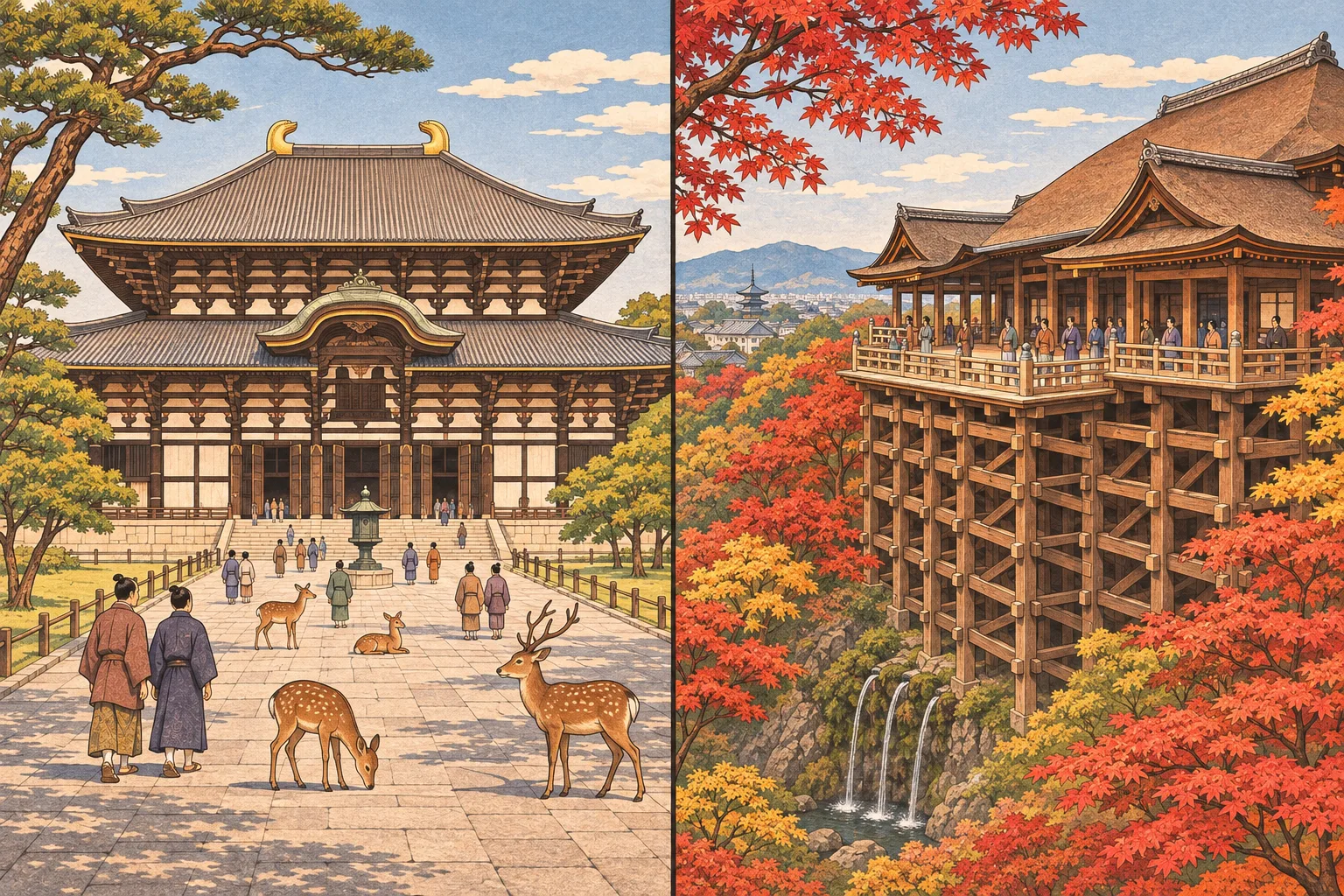
Left: Tōdai-ji in Nara, a formal Sino-Japanese name read with -ji. Right: Kiyomizu-dera in Kyoto, built on a native place name and read with -dera.
The rule makes sense once you know where the names came from. In ancient Japan, a temple officially recognised by the court received a formal name in dignified Chinese vocabulary, such as "Protect the Nation" or "Prosperity of the Dharma", and such names were naturally read the Chinese way. Ordinary people, meanwhile, referred to a temple by where it was: the temple at Kiyomizu, the temple at Ishiyama, the temple at Hase. Many temples have both kinds of name. Mii-dera in Ōtsu is formally Onjō-ji. The old Asuka-dera in Nara prefecture was formally Hōkō-ji. The famous "Mountain Temple", Yamadera, in Yamagata is formally Risshaku-ji. In each case the formal name takes ji and the popular one dera.
The exceptions, though, are many, and no rule replaces checking. Sensō-ji is the clearest: the district is read Asakusa, natively, but the temple reads the same two characters the Chinese way, Sensō. Tō-ji in Kyoto, literally "East Temple", is read Tō-ji, not Higashi-dera. Murō-ji in Nara uses a native place name, Murō, yet takes ji. Kōsan-ji in Kyoto gives its own reading as Kōsan, although most people say Kōzan. Ryōan-ji is normally read that way, though dictionaries also list Ryūan-ji. Some cases do follow the rule neatly: Kurama-dera, Taima-dera and Akishino-dera all begin with place names and take dera, and Daigo-ji takes ji. The rule gives you a good first guess; the temple’s own kana gives you the answer.
Temple names themselves come from a handful of sources. Some take the name of an era, which is generally said to have required special imperial permission and was a mark of high status: Enryaku-ji, Ninna-ji, Kennin-ji, Kenchō-ji, Kan’ei-ji. Some use words from scripture or doctrine: Hokke-ji ("Lotus"), Kōmyō-ji ("Radiant Light"), Jōdo-ji ("Pure Land"). Some state a purpose: Gokoku-ji ("Protect the Nation"), Kōfuku-ji ("Promote Blessings"). The provincial temples of the eighth century, known as Kokubun-ji, were formally called "Temples for the Protection of the Nation by the Four Heavenly Kings of the Golden Light Sutra"; "Kokubun-ji" was only the generic label. And some, as we have seen, are simply place names.
Zen temples often end their formal names with Zenji, "Zen temple", and a long formal name sometimes contains an auspicious phrase in the middle. Nanzen-ji’s full name, Zuiryūzan Taihei Kōkoku Nanzen Zenji, includes "Great Peace, Prosperous Nation" before the temple name, a phrase that was originally the name of a Song Chinese era. The longer the formal name, the more likely you are looking at a Zen temple patronised by the court or the shogunate in the Kamakura or Muromachi periods.
05Monzeki: temples with imperial abbots
Walk past certain temple walls in Kyoto and you will see five parallel white lines running along the plastered surface. These sujibei, "lined walls", indicate rank, and five lines is the highest. They are most often seen at monzeki temples, whose abbots were once imperial princes or sons of the highest noble houses. Inside, the buildings often resemble a small palace more than a monastery: a shinden, a reception hall in court style, chrysanthemum or other crests on roof tiles and doors, painted sliding panels and refined gardens.
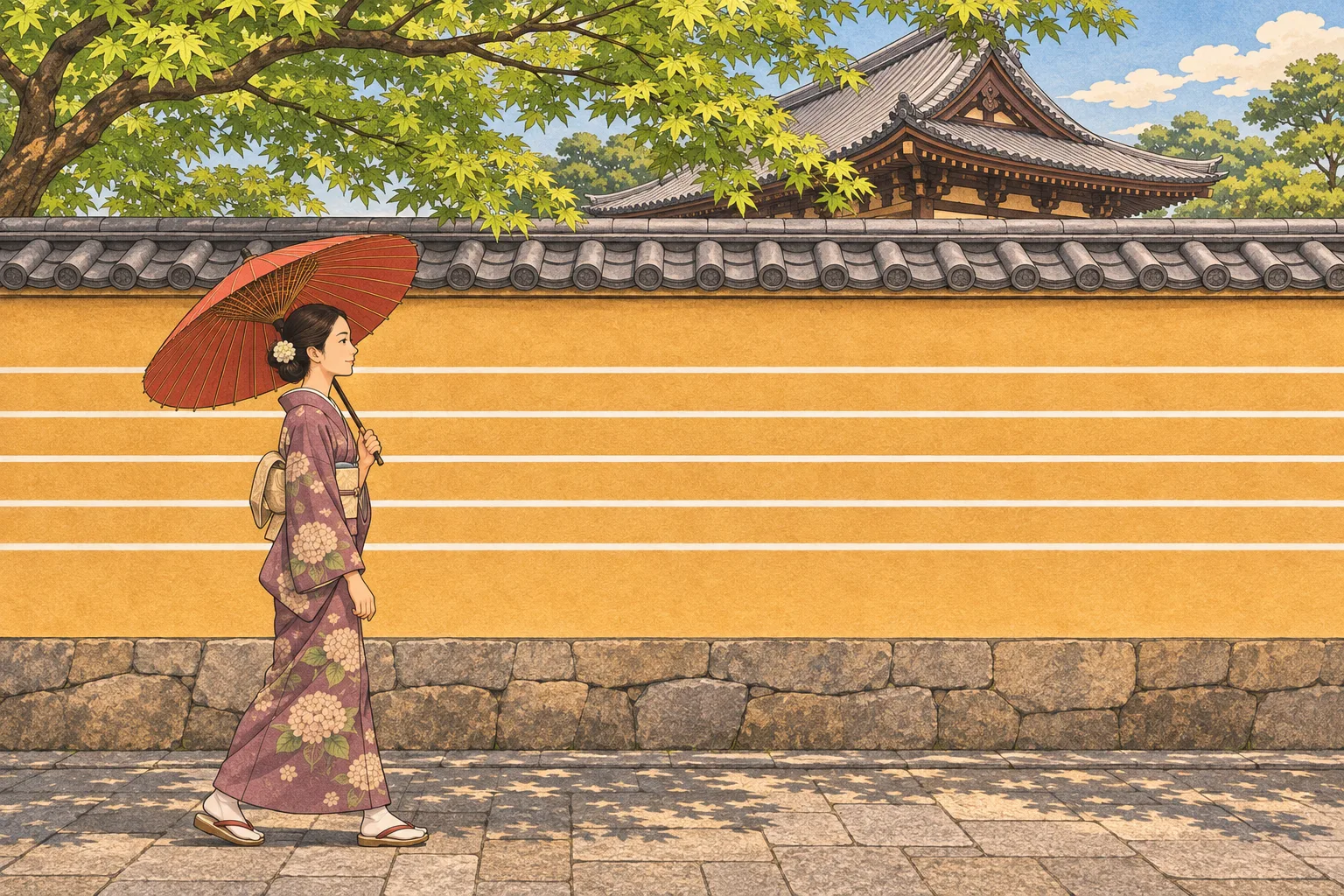
A sujibei, the lined wall of a monzeki temple. The number of white lines shows rank, and five is the highest.
The word monzeki originally meant the lineage passed down from a founder. From the mid-Heian period it came to mean a temple whose abbot was of imperial or top aristocratic birth, and also that abbot himself. The usual first example is Ninna-ji. Begun at the wish of Emperor Kōkō, it was dedicated by Emperor Uda in 888. Uda later abdicated, took the tonsure at the temple in 899, and in 904 moved into a residence he built within it. That residence was called Omuro, "the honoured chamber", and Ninna-ji is still called Omuro today. Many of its later abbots were imperial princes.
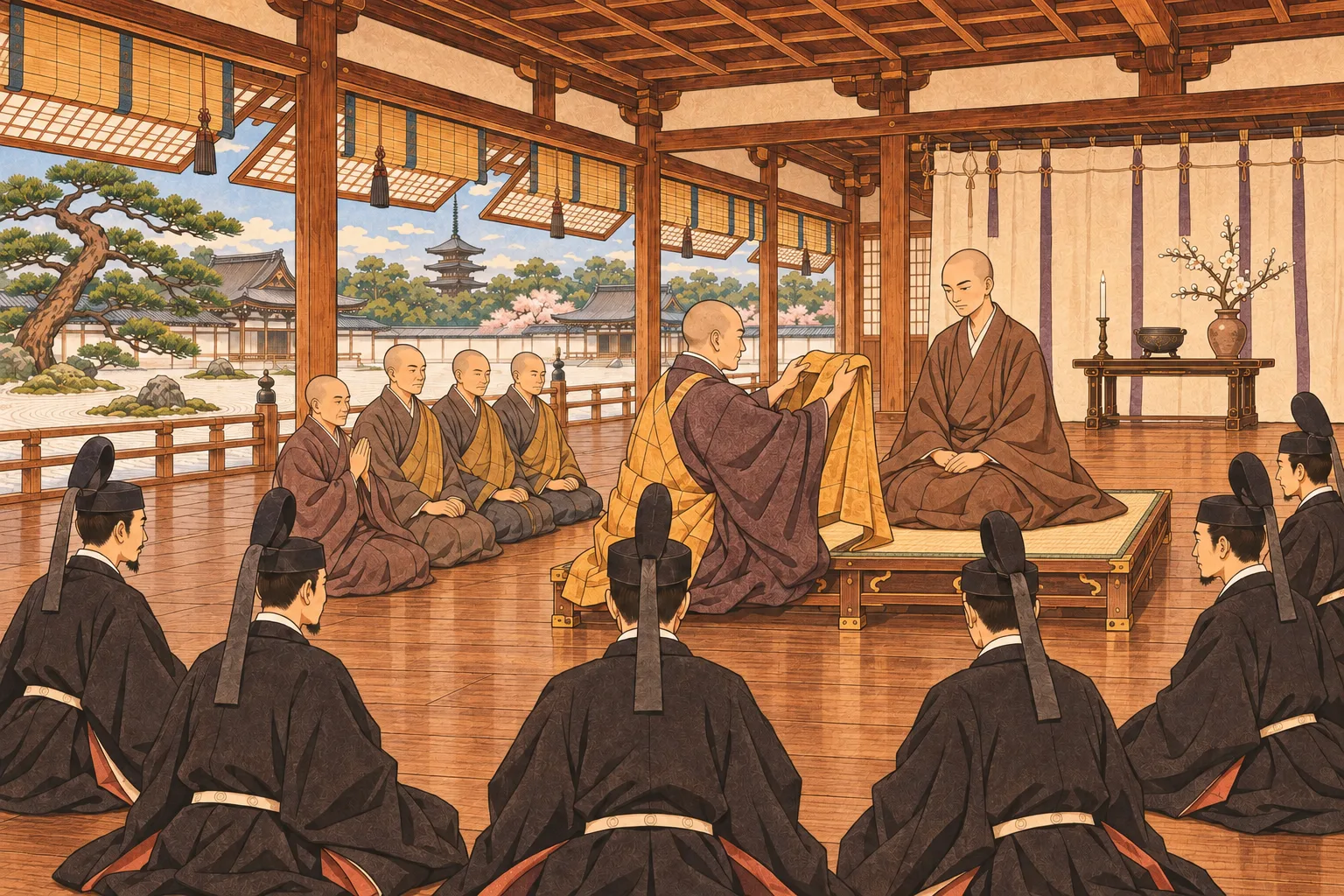
In 899 the retired Emperor Uda took the tonsure at Ninna-ji. He later built a residence inside it, the Omuro, and Ninna-ji became the usual first example of a monzeki temple. (artist’s impression)
Under the Edo shogunate, monzeki were sorted into grades, largely by the abbot’s birth: miya monzeki for imperial princes, sekke monzeki for sons of the regental Fujiwara houses, and lower grades below. The Tendai school had three celebrated monzeki in Kyoto: Shōren-in, Sanzen-in and Myōhō-in. In the Shingon school, Daikaku-ji, converted from Emperor Saga’s detached palace, is known as the Saga Palace. From the mid-seventeenth century the abbot of Kan’ei-ji in Edo and Rinnō-ji in Nikkō was always an imperial prince, giving the shogun’s capital its own imperial priest. Hongan-ji, the head temple of the True Pure Land school, was granted monzeki status in 1559, a sign of how powerful the school had become in the age of warring states. There were also convents headed by imperial princesses and noblewomen, known as ama monzeki or "nuns’ palaces", such as Chūgū-ji in Nara and Hōkyō-ji in Kyoto.
The arrangement suited both sides. Imperial and noble families had more children than they had positions to give, and placing younger sons and daughters in great temples secured prayers for the family and a hand in the temples’ estates and appointments. The temples, in turn, gained prestige at court. The result is that monzeki temples today hold some of the finest court-style architecture and painting in Kyoto. The Meiji government abolished the monzeki title in 1871, and imperial family members no longer entered religious life. Some temples later resumed using the word as a historical title. When you see "Monzeki" on a gatepost now, it means "once headed by princes", and the five white lines on the wall are the visible trace of that rank.
06Head temples, branch temples, sub-temples, lodgings, hermitages and halls
Almost every temple in Japan belongs to a school and sits somewhere in its hierarchy. At the top are the head temples, honzan; beneath them are branch temples, matsuji. The relationship existed in the Middle Ages, but the Tokugawa shogunate formalised it. From the 1630s it required each school to compile registers listing head temples and their branches, and it made every household register with a local temple. Head temples controlled branch temple appointments and ranks; branch temples paid dues and took instructions. The network still exists, though no longer enforced by the state; under postwar religious-corporation law the old head-and-branch terms were replaced by "comprehensive" and "comprehended" bodies.
Above plain honzan you will meet daihonzan, "great head temple", and sōhonzan, "general head temple". Usage differs between schools, but broadly the sōhonzan is the single highest temple of a school, usually tied to its founder, and daihonzan are major temples just below it, each heading a large group of branches. The Jōdo school’s sōhonzan is Chion-in in Kyoto, with Zōjō-ji in Tokyo among its daihonzan. The Nichiren school’s sōhonzan is Kuon-ji on Mount Minobu, with Ikegami Honmon-ji in Tokyo among its daihonzan. The Sōtō Zen school has two daihonzan of equal standing, Eihei-ji in Fukui and Sōji-ji in Yokohama. Rinzai Zen is divided into more than a dozen branches, each with its own daihonzan, such as Myōshin-ji, Kennin-ji and Nanzen-ji. The two main True Pure Land branches call Nishi Hongan-ji and Higashi Hongan-ji simply their honzan. Hongan-ji also maintains betsuin, regional branch temples; Tsukiji Hongan-ji in Tokyo was long one of them, before becoming a temple directly administered by the Hongwanji branch in 2012. These titles are carved above the name on the gatepost, so the post tells you at once where the temple stands in its school.
Inside the great temples are smaller units. A tatchū is a sub-temple of a Zen monastery. When a founding abbot or eminent master died, his disciples built a small cloister beside his memorial stupa to tend it; the word means roughly "beside the stupa". These cloisters grew into independent sub-temples clustered around the main compound. Daitoku-ji and Myōshin-ji in Kyoto each have more than twenty, such as Daisen-in, Kōtō-in and Taizō-in, with their own abbots’ quarters, gardens and tea rooms. Many of Kyoto’s most famous dry gardens are in fact in sub-temples.
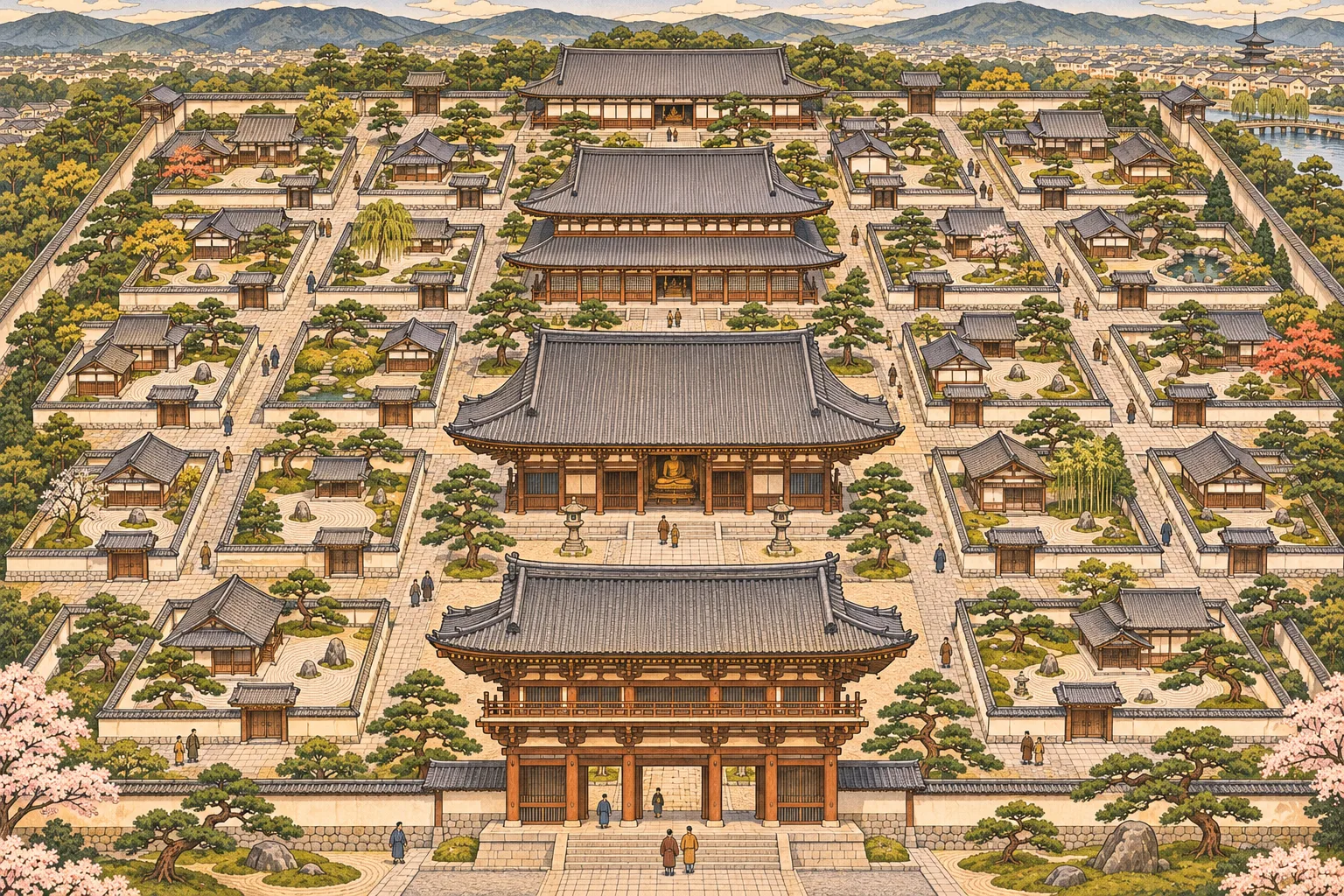
A great Zen temple and its tatchū: gate, Buddha hall, Dharma hall and abbot’s quarters along the axis, and around them the walled sub-temples, each with its own gate and garden.
A bō was originally a monk’s lodging. On Mount Hiei and Mount Kōya the many lodgings formed the basic unit of monastic life, and on Kōya dozens of temples still take in pilgrims as shukubō, temple lodgings. The word also came to mean the monk himself, which is why a Buddhist priest is colloquially obōsan. An an is a hermitage, originally a grass hut where a recluse monk or poet lived; temples named "-an" are usually small, though some Zen sub-temples also use the word. A dō is a hall, and some temples are known by their most striking building. Sanjūsangen-dō in Kyoto, "the hall of thirty-three bays", is formally the main hall of Rengeō-in, named for the number of spaces between the pillars along its front. Rokkaku-dō, "the hexagonal hall", in central Kyoto is formally Chōhō-ji, named after the shape of its main hall’s floor plan.
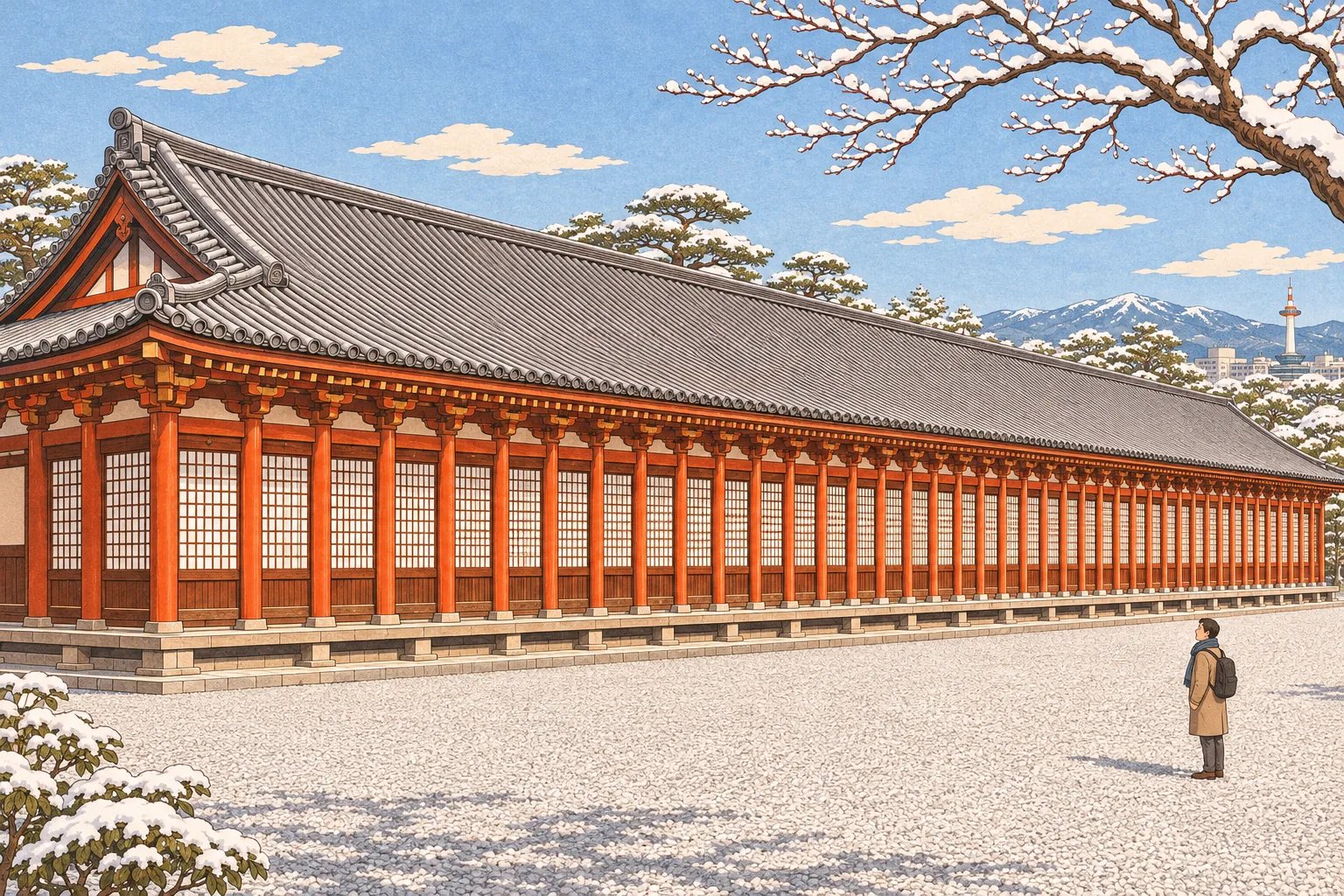
Sanjūsangen-dō in Kyoto, "the hall of thirty-three bays". The count of bays along the front of one very long building became the name people use.
07Nicknames: Fudō, Kannon, Daishi and "-san"
A temple’s nickname is often far better known than its formal name. Kinkaku-ji, "Temple of the Golden Pavilion", is formally Rokuon-ji; Ginkaku-ji, "Silver Pavilion", is Jishō-ji. Both nicknames began as the name of one building. Saihō-ji, west of Kyoto, is known as Koke-dera, "the Moss Temple", for its garden carpeted in moss. Koke-dera uses a native reading and dera, as the rule in section 4 predicts; Kinkaku-ji and Ginkaku-ji, though nicknames, are read the Sino-Japanese way with ji, so nicknames do not always take dera.
A second group of nicknames names the main object of worship. "Something Fudō" is a temple whose principal image is Fudō Myōō, the fierce Immovable Wisdom King: Shinshō-ji at Narita is "Narita Fudō" or "Narita-san", Ryūsen-ji in Meguro is "Meguro Fudō", Kongō-ji at Takahata is "Takahata Fudō". "Something Kannon" is a temple of the bodhisattva of compassion, as with the Asakusa Kannon. "Something Daishi", "Great Teacher", usually refers to a Shingon temple honouring Kūkai, known as Kōbō Daishi: Heiken-ji in Kawasaki is "Kawasaki Daishi" and Sōji-ji in Adachi, Tokyo, is "Nishiarai Daishi". Both are famous for prayers to ward off misfortune and draw huge crowds at New Year. The same pattern gives "Shibamata Taishakuten" for Daikyō-ji, the Nichiren temple in Shibamata dedicated to the deity Taishakuten. Such names tell worshippers immediately whom they are going to visit and what they might pray for.
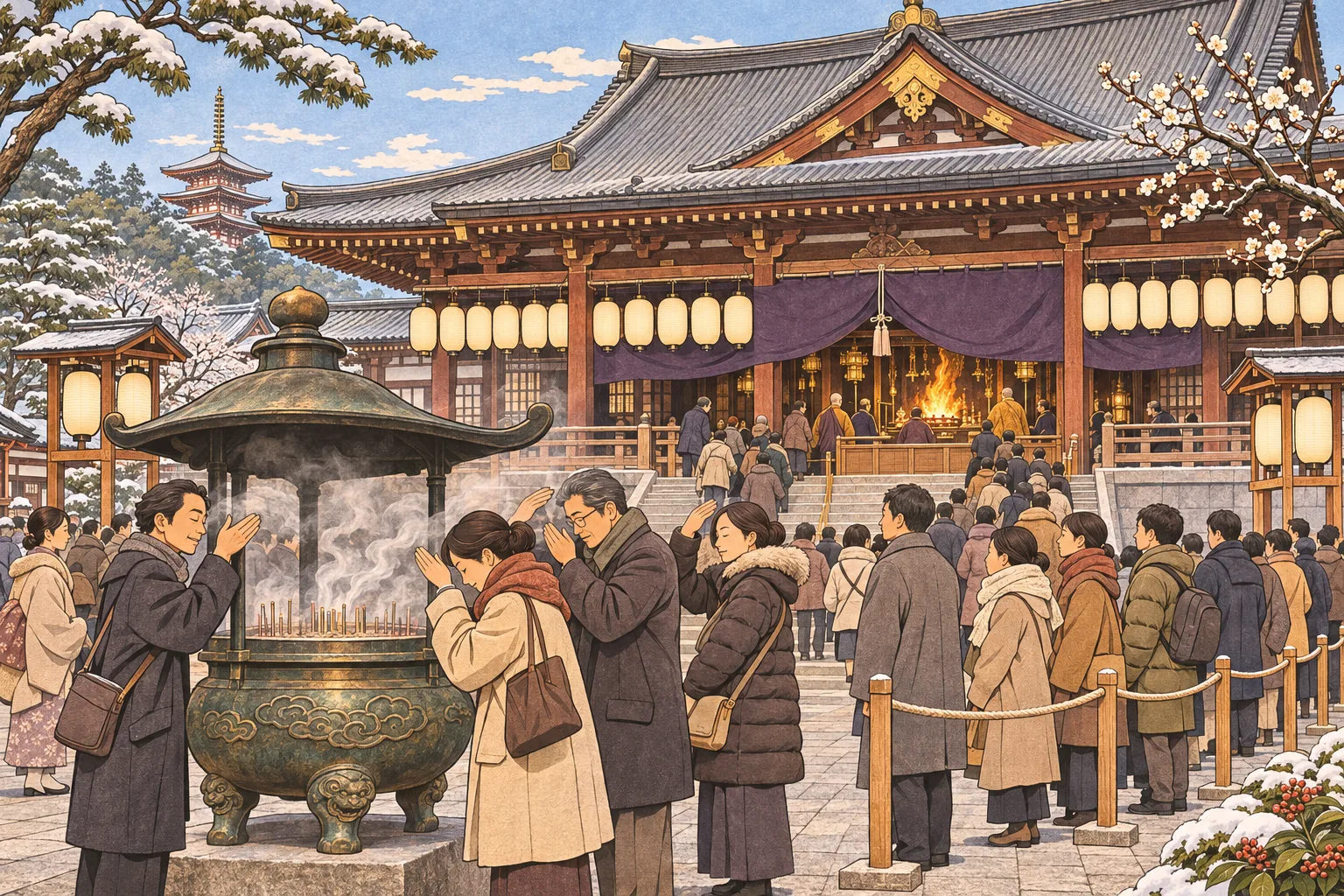
New Year at a "Daishi" temple known for warding off bad luck: worshippers queue to the main hall and waft smoke from the incense burner over themselves, while a fire burns inside.
A third group adds the friendly suffix -san. Kyoto people speak of Kiyomizu-san, of Ohigashi-san and Onishi-san for the Eastern and Western Hongan-ji, and of Rokkaku-san. In Nara, Tōdai-ji is often simply Daibutsu-san, "Mr Great Buddha". In Nagano people say Zenkōji-san. Calling a temple -san treats it like a neighbour.
A fourth case is where nickname and formal name trade places. Tō-ji was founded as one of two official temples guarding the gate of the new capital Heian-kyō, on the east side, opposite a West Temple that has long since vanished. In 823 the court gave it to Kūkai as a centre for Shingon. It also bears the name Kyōō Gokoku-ji, "Temple for the Protection of the Nation by the King of Teachings", which is the name of its religious corporation today and is listed in most dictionaries as its formal name, in an even longer full form. Yet documents from the Heian period onward consistently called it Tō-ji; treating Kyōō Gokoku-ji as the formal name and Tō-ji as a nickname dates only from the Meiji era. The temple still presents itself to the public as Tō-ji, and its mountain name is Hachimanzan. Finally, mountain names often stand in for temples altogether: "Eizan" for Enryaku-ji, "Kōya" for the hundred-odd temples on Mount Kōya, "Minobu" for Kuon-ji.
08Side by side: gateposts, plaques and stamps
The same temple’s names appear in three places, each with its own conventions.
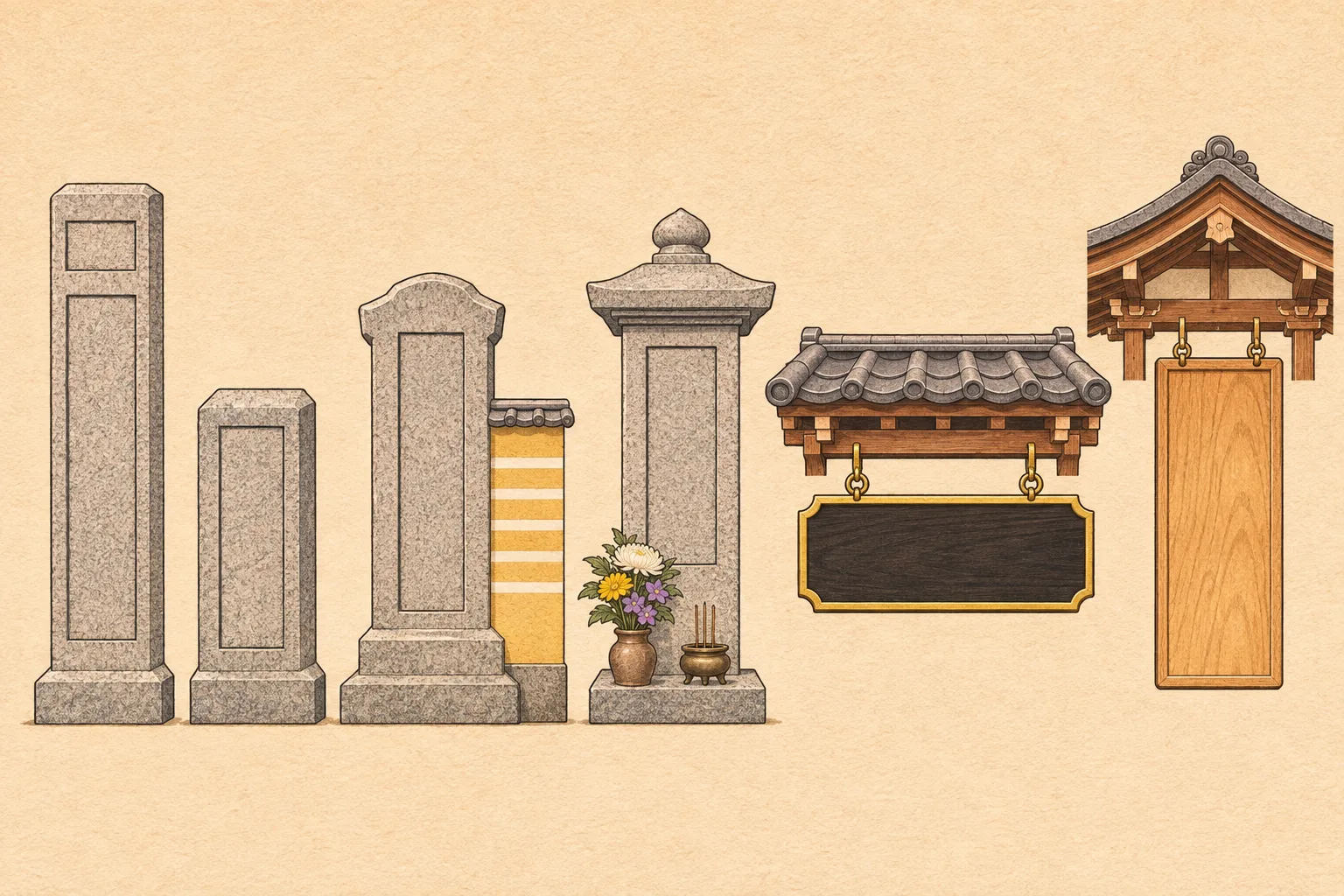
Where the names appear. Left to right: a standard gatepost with school and name; a post with the temple name only; a monzeki post beside a five-lined wall; a post naming the main image, with flowers and incense; a horizontal plaque on a gate; a vertical plaque on a main hall.
The first is the gatepost, jihyō, a tall square stone pillar standing at the entrance or at the start of the approach, sometimes taller than a person, inscribed vertically. Typically a line of smaller characters at the top states the school and rank, such as "Rinzai School Head Temple" or simply "Jōdo School"; below, in large characters, comes the temple’s name, either the full mountain-and-temple form or just the temple name. The sides may record the date of erection or the donor. Some posts read "Monzeki"; others put the main image first, as in "Fudōson" or "Kanzeon". This is the fastest place to read a temple’s school and status.
The second is the plaque, hengaku, hung on the gate or the front of the main hall. The plaque on the main gate very often shows the mountain name, as with "Kinryūzan". The plaque on the main hall may show the temple or hall name, or a poetic name for the building: Kannon halls often carry "Hall of Great Compassion" or "Hall of Perfect Penetration". Plaques were often written by famous monks, calligraphers or emperors; a plaque in an emperor’s own hand is a chokugaku, frequently framed in gold. So beneath the gate you often look up at the mountain name, and only inside do you meet the temple name.
The third is the temple stamp, goshuin, collected in a booklet. What a goshuin contains is covered in our guide to goshuin; here it is enough to say where the names fall. The large central characters usually name the main image or the hall. The temple’s name, sometimes with its mountain name, is brushed at the lower left under the temple’s seal, and the small seal at the upper right often carries the mountain name, or a pilgrimage-route number. So on one page the mountain name tends to sit in the top-right seal, the temple name in the lower-left ink, and the main image in the centre. Put a goshuin beside the gatepost and the gate plaque and you can usually reconstruct the whole set of names.

Where the names fall on a goshuin page: the small seal at upper right often carries the mountain name or a route number, the large centre gives the main image or hall, and the temple’s name and seal sit at lower left.
Names can also hint at a temple’s school, though only as a tendency. Names containing myō ("wondrous") or hon ("original"), or words such as Hokke ("Lotus"), Kuon ("eternal") or Risshō, are common among Nichiren and related Lotus temples: myō comes from the title of the Lotus Sutra, Myōhō Renge Kyō, and hon from the "original teaching" that Nichiren stressed. Myōken-ji, Myōkaku-ji and Honpō-ji in Kyoto and Ikegami Honmon-ji in Tokyo are examples, and Honnō-ji, famous for the death of Oda Nobunaga, also belongs to a Lotus lineage. A formal name ending in Zenji, or a main temple surrounded by many "-in" and "-an" sub-temples, usually means Rinzai or Sōtō Zen. Words like Kōmyō ("radiant light"), Gokuraku ("paradise"), Raigō ("welcoming descent"), Saihō ("the western direction") or Jōdo ("Pure Land") are common in Pure Land temples, because they refer to Amida Buddha’s paradise in the west. Henjō, Kongō ("diamond"), Myōō or Daishi point more often to Shingon. A full three-part "mountain-hall-temple" name usually indicates a temple founded or renamed from the Kamakura period on, while a temple name with no mountain name is often an ancient Nara or Heian foundation. None of these is a rule; many words are shared across schools, and the school’s name on the gatepost settles the question.
Laid side by side, the layers separate cleanly. The mountain name, "something-zan", hangs on the gate and comes from Chinese Zen custom. The hall name, "something-in", is either the temple’s own name or a middle element, and is not the same as the ingō on a gravestone. The temple name, "something-ji", is read ji when it is formal Sino-Japanese and dera when it comes from a place name or nickname, with many exceptions. A monzeki is a temple once headed by princes, often marked by five white lines on its walls. Tatchū, bō, an and dō are smaller units within or beside the great temples. And "Fudō", "Daishi" and "-san" are what the worshippers call them.
More deep dives on this topic
 Four Ranks of Buddhist StatuesStep out of the sunlight into a Japanese temple hall and your eyes take a moment to adjust.
 Mudras and AttributesIn the half-light of a Japanese temple hall, the face of a Buddha is often hard to make out.
 Niō and the Four Heavenly KingsWalk up to almost any large Buddhist temple in Japan and the first figures you meet are not serene Buddhas but two furious, nearly naked giants flanking the gate.
 PagodasWalk up the stone lanes of Higashiyama in Kyoto and the Yasaka Pagoda rises over the tiled roofs of the old townhouses; ride the bullet train into Kyoto Station and the dark…
 The GaranMost visitors to a Japanese temple experience it as a sequence: a gate, a path, a big hall, perhaps a pagoda off to one side.
 How Buddhist Statues Are MadeWalk through the temples of Nara and Kyoto and you will meet Buddhas that are gold, black, chalky grey, or the warm brown of old wood.
 Reading Temple NamesMost visitors to Tokyo know Sensō-ji, the great Kannon temple in Asakusa.
 Shōjin RyōriThe first thing many visitors eat at a temple lodging on Mount Kōya is a small, pale square that wobbles on a lacquer dish.
 A Night in a TempleMost temples in Japan close their gates at dusk.
- Back to the main article: Japanese Buddhism →