
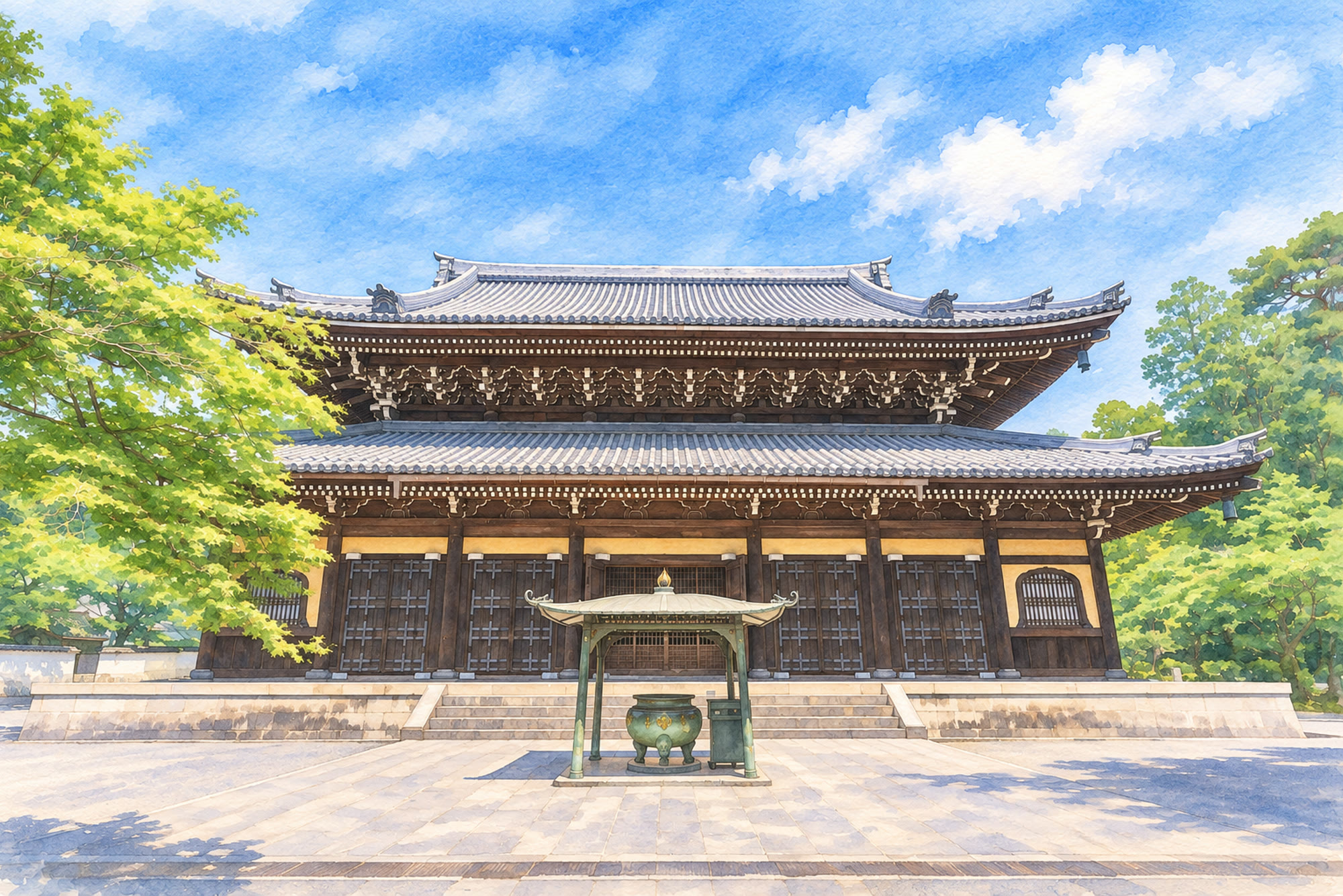
Nanzen-ji is the head temple of the Nanzen-ji branch of Rinzai Zen, standing at the foot of the Higashiyama hills in Sakyō Ward, Kyoto. It grew out of Retired Emperor Kameyama’s detached palace and is usually counted as Japan’s first Zen temple founded at imperial wish. In the Muromachi period Ashikaga Yoshimitsu placed it above the Five Mountains ranking of Zen monasteries, making it the senior Zen house in Japan. Today its towering gate, dry garden and brick aqueduct draw a steady stream of visitors.
01From palace to monastery
In 1264 Kameyama built a villa here, the Zenrinji-dono. In 1291 Kameyama, by then a tonsured retired emperor, gave the villa over to Zen and invited Mukan Fumon of Tōfuku-ji to serve as founding abbot. Mukan died soon after taking up the post, and the buildings were largely raised under the second abbot, Kian Soen. The temple’s full name is said to have become Taihei Kōkoku Nanzen Zenji in the Shōan era (1299–1302).
In 1334, under his Kenmu government, Emperor Go-Daigo named Nanzen-ji first among the Five Mountains. In 1386, when Yoshimitsu added his new Shōkoku-ji to the ranks, he lifted Nanzen-ji to a special place above all five.
02Fire and revival
Nanzen-ji burned several times in the Muromachi period, and after the Ōnin War broke out in 1467 almost the entire complex was lost. Revival came in the early Edo period under Konchiin Sūden, Tokugawa Ieyasu’s Zen adviser, who became abbot and rebuilt the temple with shogunal and daimyo backing. Most of the main buildings seen today date from or were moved here in that era.
Early Meiji land confiscations cut the estate sharply. In the late 1880s a branch of the Lake Biwa Canal was routed straight through the grounds, and its aqueduct, once controversial, became a favorite sight.
03What you see today
The Sanmon gate was donated in 1628 by Tōdō Takatora in memory of his retainers killed in the 1615 summer campaign at Osaka. About 22 meters tall, it is an Important Cultural Property, and it is the stage for the kabuki scene in which the outlaw Ishikawa Goemon gazes from its upper story and declares the view "superb." The abbot’s quarters, the Large and Small Hōjō, are a National Treasure. The Large Hōjō is a former imperial palace building moved here in 1611, by temple tradition the Seiryōden and by another account an audience hall from the palace of a retired imperial lady; the Small Hōjō is said to have come from Fushimi Castle. Inside are Kanō-school sliding-door paintings; the dry landscape garden in front, nicknamed "Tiger Cubs Crossing the Water," is traditionally attributed to Kobori Enshū and is a national Place of Scenic Beauty. The Dharma Hall burned in 1895 and was rebuilt in 1909.
The precinct also holds Nanzen-in, on the site of Kameyama’s palace, and subtemples such as Konchi-in and Tenju-an; the garden of Konchi-in is a Special Place of Scenic Beauty. The aqueduct, finished in 1888, became a national Historic Site with the Lake Biwa Canal in 1996 and, in 2025, a National Treasure as one of the Lake Biwa Canal Facilities (as of 2026).
Nanzen-ji
01A temple that began as a villa
Nanzen-ji sits where the eastern hills of Kyoto meet the flat ground of Okazaki. Walk up from the Keage end and the first things you notice are pines, old stone walls and a wooden gate of almost unreasonable size. The temple is the head of the Nanzen-ji branch of Rinzai Zen, with several hundred affiliated temples across Japan, and for most of its history it held the highest rank of any Zen monastery in the country. It did not start as a monastery at all. It started as a retired emperor’s country house.
That retired emperor was Kameyama. A son of Emperor Go-Saga, he took the throne in 1259 in place of his elder brother Go-Fukakusa, abdicated in 1274 in favor of his own son Go-Uda, and then governed from retirement, as retired emperors of the period often did. Go-Saga had never settled which of his two sons’ lines should hold the throne, and the quarrel that followed split the imperial house into two branches, the Daikakuji line descended from Kameyama and the Jimyōin line descended from Go-Fukakusa. For a time the two branches alternated on the throne by agreement; in the fourteenth century the split hardened into the open rivalry of the Northern and Southern Courts. Nanzen-ji belongs, by origin, to the Daikakuji side of that story.
In the middle of the Kamakura period Kameyama built a detached palace at the foot of the hills here, called the Zenrinji-dono after the neighboring temple of Zenrin-ji, better known today as Eikandō. The palace had an upper and a lower compound. The upper one survives, much changed, as the subtemple of Nanzen-in; the lower one became the ground on which the main temple stands.
02Ghosts, a Zen master and a gift
The temple’s own tradition explains the conversion with a story. Strange things, it says, began to happen in the new palace at night, and the household was terrified. Kameyama called in eminent monks of the older schools to perform rites, without result. Finally he sent for Mukan Fumon, a Zen monk of Tōfuku-ji. Mukan moved in with his disciples and did nothing special: he and his monks simply sat in meditation and kept their ordinary routine. The disturbances stopped. Impressed, Kameyama turned to Zen and decided to give the palace to Mukan as a monastery.
The story is a piece of temple lore meant to display the power of Zen practice, and nobody needs to take it literally. What it records accurately is a shift. Zen had arrived in Japan as the religion of the shogunate in Kamakura and of warriors; by the late thirteenth century it was being taken up at court.
Mukan Fumon came from Shinano province. After training in the older Buddhist teachings he spent many years studying in Song China, and on his return he taught at Tōfuku-ji in Kyoto, in the lineage of that temple’s founder, Enni. In 1291 Kameyama, who had by then taken Buddhist vows and become a cloistered retired emperor, formally converted the Zenrinji-dono into a Zen temple and installed Mukan as founding abbot. Mukan was around eighty and died in the twelfth month of that year by the lunar calendar, which fell in early 1292 by the Julian calendar. He was later given the posthumous title Daimin Kokushi.
Nanzen-ji is usually described as the first Zen temple in Japan founded at an emperor’s wish. The great Zen houses before it, such as Kenchō-ji and Engaku-ji in Kamakura, had been founded by the Hōjō regents, and Kennin-ji and Tōfuku-ji in Kyoto by warrior or aristocratic patrons. A former emperor giving his own residence to Zen was a statement about how far the new school had come.
03Building the monastery
The real work of turning a villa into a monastery fell to the second abbot, Kian Soen, who took over in 1292. A monk from Shinano, he had studied under Mugaku Sogen and Mukan among others, and was Mugaku’s dharma heir. With Kameyama’s support he spent some fifteen years raising the core buildings of a Zen compound: a Buddha hall, a Dharma hall, a gate and a monks’ hall. He is generally regarded as the practical founder of the temple’s layout.
The temple was first called Ryūanzan Zenrin Zenji and is said to have been renamed Zuiryūzan Taihei Kōkoku Nanzen Zenji in the Shōan era (1299–1302). "Nanzen-ji" is the short form. Taihei kōkoku, roughly "great peace and a flourishing realm," marks it as a temple founded to pray for the state.
Kameyama died in 1305 at the age of 56. Part of his remains were interred at Nanzen-in, where a tomb holding them can still be seen. The temple was not just a property he handed over; it was where he chose to rest.
04First of the Five Mountains, then above them
The Five Mountains (gozan) were an official ranking of the leading Zen monasteries, modeled on the state temple system of Southern Song China. A version of the list existed by the end of the Kamakura period, but its membership and order changed repeatedly.
After the fall of the Kamakura shogunate in 1333, Emperor Go-Daigo, who was Kameyama’s grandson and belonged to the Daikakuji line, reorganized the ranking under his short-lived Kenmu government and in 1334 put Nanzen-ji at the top, with Daitoku-ji ranked alongside it. His regime collapsed within a few years and Ashikaga Takauji founded the Muromachi shogunate, which revised the list several times; Nanzen-ji generally kept its leading place.
The decisive change came under the third Ashikaga shogun, Ashikaga Yoshimitsu. Yoshimitsu had built a great new monastery, Shōkoku-ji, next to his palace in Kyoto and wanted it among the Five Mountains. The problem was that there were only five places, all occupied. In 1386 he solved it by lifting Nanzen-ji out of the ranking altogether and setting it "above the Five Mountains," as the head of the whole system. That freed a slot for Shōkoku-ji. The Kyoto list then ran Tenryū-ji, Shōkoku-ji, Kennin-ji, Tōfuku-ji and Manju-ji, with a separate list of five for Kamakura. Nanzen-ji’s special rank held for the rest of the Muromachi period and was still recognized under the Tokugawa.
The rank meant more than prestige. Monks of the Five Mountains served the Muromachi shoguns as diplomats, drafters of documents and the country’s leading scholars of Chinese learning; Five Mountains literature, ink painting and Neo-Confucian study all grew up in their circles. The abbot of Nanzen-ji was appointed by the shogunate, often for a short term, and holding the post was the summit of a Zen monk’s career.
05The gate that came down
Rising status brought enemies. The older Buddhist establishment, above all the great Tendai monastery of Enryaku-ji on Mount Hiei, looked on the Zen houses with suspicion, and in the late 1360s the tension broke into one of the best-known clashes of the age.
Nanzen-ji was raising money for a new two-story gate and had set up toll barriers nearby to collect fees from travelers. In 1367, according to a courtier’s diary of the time, monks of Onjō-ji (Mii-dera) wrecked the barriers and killed a Zen monk, and the shogunate retaliated by burning Onjō-ji’s own barriers; another account has the quarrel begin when a page from Onjō-ji was killed at the barrier. The abbot, Jōzan Sozen, then wrote Zoku shōbōron, a fierce polemic attacking Enryaku-ji and Onjō-ji. Enryaku-ji responded in its customary way: from 1368 its monks repeatedly carried the sacred palanquins of the Hie Shrine into the capital and demanded that Jōzan be banished (at one point along with Shun’oku Myōha of Tenryū-ji) and that Nanzen-ji’s new gate be torn down.
The shogun Yoshimitsu was still a boy, and power lay with his deputy, the kanrei Hosokawa Yoriyuki. The shogunate at first refused and had the imperial palace guarded, but with the court urging compromise and the pressure unrelenting, it gave way step by step: Jōzan was exiled to Tōtōmi, and in the seventh month of 1369 the gate was demolished, after which the abbots of the Kyoto Five Mountains resigned their posts. The episode is a reminder that even with court and shogunate behind it, Zen in the fourteenth century still had to reckon with the armed religious power of Mount Hiei. Nanzen-ji’s first main gate, donated by Saionji Sanekane in 1295, burned in 1447; the gate that stands today was not built until 1628.
06Fire and war
The Muromachi centuries were hard on the buildings. Records describe a great fire in 1393 that destroyed much of the complex, and after rebuilding there was another in 1447. The worst came with the Ōnin War. When fighting broke out in Kyoto in 1467, the eastern hills were drawn in and Nanzen-ji was burned almost to the ground.
In the century of civil war that followed, the Ashikaga shoguns lost the means to support the Five Mountains. Nanzen-ji kept its title but little else; a few subtemples carried on, and the main halls were not rebuilt. That is why nothing you see in the temple today survives from the Kamakura or Muromachi periods.
07Konchiin Sūden and the Tokugawa revival
The revival is tied to one man: the monk Ishin Sūden, usually called Konchiin Sūden after the subtemple where he lived. The son of Isshiki Hidekatsu, a shogunal retainer from a branch of the Ashikaga clan, he entered Nanzen-ji as a boy and made his name through scholarship and a fine hand with documents. He became abbot of Nanzen-ji in 1605 and in 1608 was summoned to Sunpu to serve Tokugawa Ieyasu.
At Ieyasu’s side Sūden drafted laws and diplomatic letters. He had a hand in the codes that regulated the warrior houses, the imperial court and the Buddhist temples, and he handled correspondence with Korea and with states in Southeast Asia. In 1614 he was among those on the shogunate’s side in the dispute over the inscription on the great bell of Hōkō-ji, the affair that served as a pretext for the campaign against the Toyotomi at Osaka. His influence earned him the nickname "the prime minister in black robes." After Ieyasu’s death he served the second and third shoguns, Tokugawa Hidetada and Tokugawa Iemitsu, and in 1619 was appointed sōroku, overseeing the Rinzai temples of the Five Mountains system and below.
Sūden used his position to bring money and support from the shogunate and the daimyo to Nanzen-ji. In 1605 he moved his subtemple, Konchi-in, into the Nanzen-ji precinct as his residence, and later arranged for the main buildings to be reconstructed or moved in from elsewhere. Without him the temple would probably not have become a complete monastery again in the early Edo period. He died in 1633, aged 63 or 64 (65 by the traditional count). Konchi-in still has the garden and tea room laid out for him by Kobori Enshū and a small shrine to the deified Ieyasu.
08The great gate, a general and a thief
The building that dominates any visit is the Sanmon, the main gate. It was donated in 1628 by Tōdō Takatora, lord of Tsu in Ise, as a memorial to the men of his house killed in the summer campaign at Osaka in 1615. About 22 meters high, it is a two-story gate five bays wide with three passageways. The upper story, called the Gohōrō, houses a crowned Shaka Buddha with the sixteen arhats, along with statues of Konchiin Sūden, Tokugawa Ieyasu and Tōdō Takatora and memorial tablets for the senior Tōdō retainers; its ceiling paintings of heavenly beings and phoenixes are attributed to Kanō Tan’yū and Tosa Tokuetsu. The gate is an Important Cultural Property.
Takatora was one of the great castle builders of his age and a famous survivor, who served a series of lords, including the Azai and the Toyotomi, before attaching himself to Ieyasu around the time of Sekigahara and winning his lasting trust. He was over seventy when he paid for the gate and died two years later.
The gate’s fame, though, belongs to someone who never climbed it. In the kabuki play Sanmon Gosan no Kiri, first staged in the late eighteenth century, the bandit Ishikawa Goemon sits on the upper story of the Nanzen-ji gate with a long pipe, looks out over the capital in spring and exclaims, "Zekkei kana, zekkei kana!" — "What a view, what a view!" A spring view worth a thousand gold pieces, he goes on, is a paltry thing: to his eye it is worth ten thousand. The scene is pure theater. The real Goemon was boiled alive at the Sanjō riverbank in Kyoto in 1594, more than thirty years before this gate went up. The playwright borrowed the temple’s name and imagined a gate for his hero. Even so, the line has stuck, and climbing to the upper story to look out over the city has become part of almost every visit.
09Palace halls and tiger cubs
Behind the gate stands the Dharma Hall, and behind that the abbot’s quarters, the Large Hōjō and the Small Hōjō, designated together as a National Treasure.
The Large Hōjō is a building of the imperial palace in Kyoto, granted to the temple and reassembled here in 1611. Which building it was is less certain: temple tradition says the Seiryōden, the emperor’s residential hall, built in the Tenshō era, while the view now generally favored identifies it as the audience hall of a nyōin palace, the residence of an imperial lady of retired-empress rank. The Small Hōjō dates from the Kan’ei era and is said to be a structure from Fushimi Castle. Both show the ornate palace architecture of the Momoyama period, a good deal grander than the usual Zen abbot’s residence.
The sliding doors inside carry Kanō-school paintings, 124 panels of which are designated Important Cultural Properties: birds and flowers, figures and landscapes in the Large Hōjō, and in the Small Hōjō a famous series of forty tiger panels traditionally attributed to Kanō Tan’yū. One of them, a tiger bending to drink, is known as the Mizunomi no Tora.
The garden to the south of the Hōjō is a dry landscape of raked white gravel, with rocks of varying size and clipped shrubs set against an earthen wall. It is nicknamed Tora no Ko Watashi, "Tiger Cubs Crossing the Water," after a Chinese fable in which a tigress must ferry three cubs across a river, one of which will eat the others if left alone with them, and so has to make several trips back and forth. The garden is traditionally attributed to Kobori Enshū and is a national Place of Scenic Beauty.
10Meiji losses and the Lake Biwa Canal
The Meiji Restoration hit the temple again. Land confiscations in the early 1870s stripped it of most of its estate, and the anti-Buddhist mood of the time made things worse; some former temple land later became the villa district of Okazaki. In 1895 the Dharma Hall burned. It was rebuilt in 1909, and the coiled dragon on its ceiling was painted at that time by Imao Keinen.
The mark the Meiji era left most visibly is the Lake Biwa Canal. When the capital moved to Tokyo, Kyoto lost population and trade at an alarming rate. Kitagaki Kunimichi, governor of Kyoto Prefecture, backed a scheme to bring water from Lake Biwa through the mountains to the city, for transport, irrigation, industry and eventually power. The engineer in charge was Tanabe Sakurō, fresh out of the Imperial College of Engineering. Work began in 1885 and the first canal opened in 1890. At Keage it produced one of Japan’s earliest commercial hydroelectric plants and an inclined railway that carried boats up and down the slope on carts.
One branch of the canal had to cross the temple grounds. The solution was an arched aqueduct of brick and granite, the Suirokaku, completed in 1888. A Western-style brick structure in an ancient Zen precinct struck some people at the time as an intrusion. Over the years the arches weathered into the woods and stone walls around them, and the aqueduct is now among the most photographed spots in the temple. It was designated a national Historic Site as part of the canal in 1996, and in 2025, together with the first three canal tunnels and the Keage incline, it was designated a National Treasure under the name Lake Biwa Canal Facilities (as of 2026).
The canal’s water also fed the gardens of the villas around the temple. Murin-an, just to the west, was built in the 1890s for Yamagata Aritomo, and its stream is drawn from the canal; many of the modern gardens of the Okazaki and Nanzen-ji area depend on the same source.
11A walk through the precinct
Coming from Keage, you pass first the Chokushimon, the gate for imperial messengers, originally the Hi no Gomon gate of the imperial palace, granted to the temple in 1641 in the reign of Empress Meishō. An Important Cultural Property, it is now opened only when a new abbot is installed.
Next is the Sanmon. From below you can take in the massive pillars and stacked brackets; from the upper story the view takes in the city, the western hills and the great torii of Heian Jingū. This is the "superb view" Goemon was talking about.
Beyond the gate is the Dharma Hall, the 1909 rebuilding, usually viewed from outside. A path behind it leads to the Hōjō, where you can see the paintings and the Tiger Cubs garden.
Southeast of the Hōjō is the aqueduct. The path under its arches leads up to Nanzen-in, the site of the upper compound of Kameyama’s palace. Its present abbot’s hall was rebuilt in 1703 with funds from Keishōin, mother of the shogun Tokugawa Tsunayoshi, but the pond garden is thought to keep the layout of the Kamakura period, which would make it one of the few gardens in Kyoto with roots that old; it is designated a Historic Site and Place of Scenic Beauty. The tomb with part of Kameyama’s remains is here too, and standing by the pond it is not hard to picture the place as a retired emperor’s retreat in the hills.
Back near the main gate, Konchi-in lies to the west. Its Crane and Tortoise Garden, attributed to Kobori Enshū, is a Special Place of Scenic Beauty; its small Tōshōgū shrine honors Ieyasu; and its Hassōseki tea room is counted among the three celebrated tea rooms of Kyoto. To the south, the subtemple of Tenju-an, the memorial temple of Mukan Fumon, was revived by Hosokawa Yūsai in 1602 and has both a dry garden and a pond garden.