
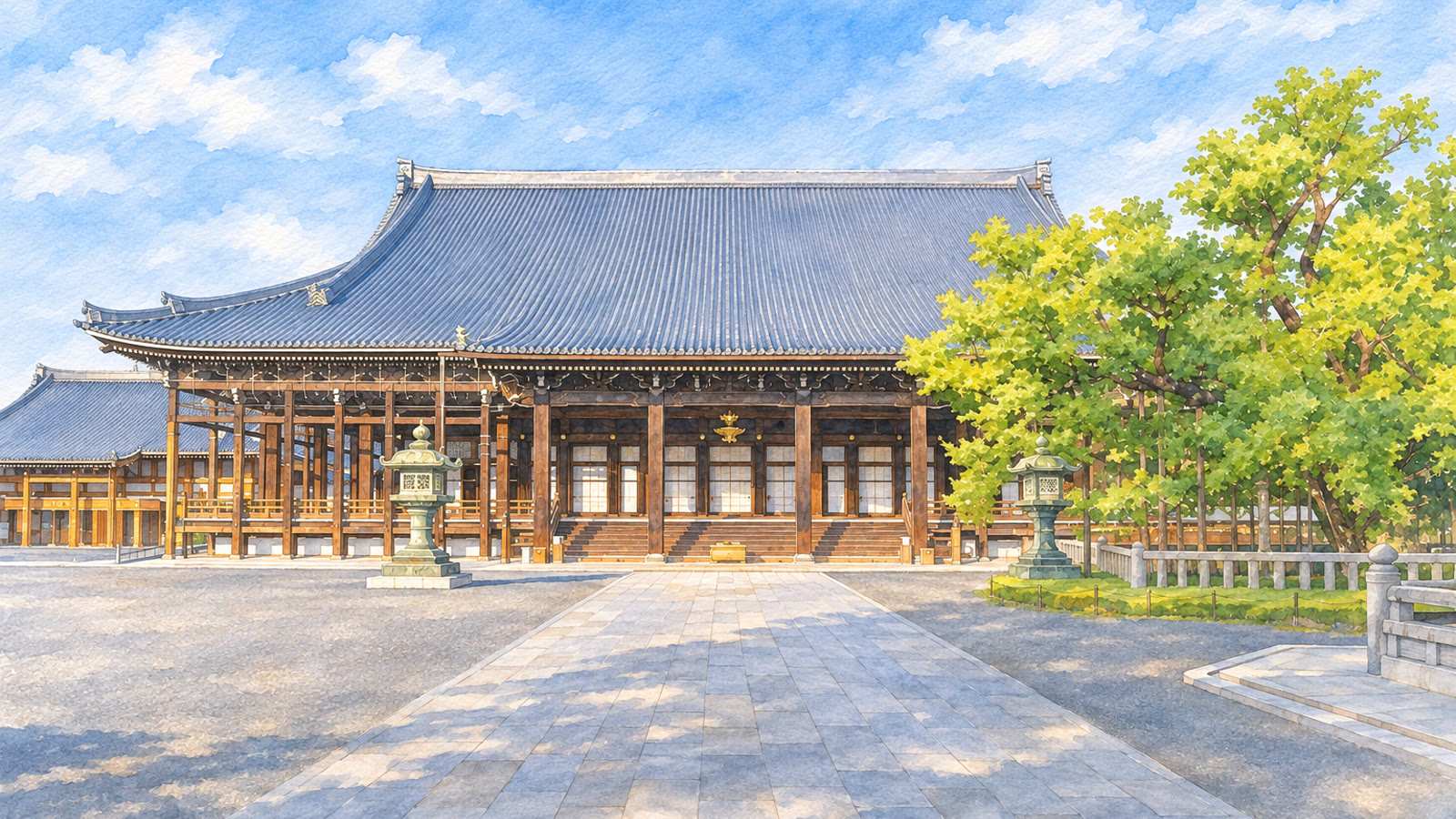
Nishi Hongan-ji, formally Ryūkoku-zan Hongan-ji, is the head temple of the Jōdo Shinshū Hongwanji-ha, the largest branch of True Pure Land Buddhism. It stands on Horikawa-dōri in Shimogyō Ward, Kyoto, a short walk north-west of Kyoto Station. The temple enshrines the image of Shinran, founder of the school, and serves as the center of about ten thousand affiliated temples (as of 2014). Its two great halls and its gate, reception rooms and pavilion from the late sixteenth and early seventeenth centuries make it one of Kyoto’s best places to see early modern temple architecture.
01A Temple That Kept Moving
Hongan-ji began as a grave. Shinran died in Kyoto in 1263, and in 1272 his daughter Kakushinni built a memorial chapel for his remains and image at Ōtani in the eastern hills. Under his great-grandson Kakunyo, the third head, the chapel turned into a temple and, probably in the early fourteenth century, took the name Hongan-ji. Rennyo, the eighth head, turned the community into a mass movement in the later fifteenth century. After monks of Mount Hiei wrecked the Ōtani site, he worked from Yoshizaki in Echizen and then from Yamashina, outside Kyoto. Yamashina Hongan-ji was burned in 1532, and the headquarters moved to Ishiyama in Ōsaka. After leaving Ōsaka in 1580, it passed through Saginomori in Kii, Kaizuka in Izumi and Tenma in Ōsaka before Toyotomi Hideyoshi granted it land at Rokujō Horikawa in Kyoto in 1591. It has stayed there since.
02West and East
When the eleventh head, Honganji Kennyo, died in 1592, a dispute over the succession split the community. Hideyoshi ordered Kennyo’s eldest son Kyōnyo to step down in favor of his younger brother Junnyo. In 1602 Tokugawa Ieyasu gave Kyōnyo land a few blocks to the east, where he founded a rival headquarters. The original temple on Horikawa became known as Nishi ("West") Hongan-ji, and Kyōnyo’s as Higashi ("East") Hongan-ji. During the Edo period Nishi Hongan-ji opened a seminary for its clergy, the institution from which Ryukoku University descends.
03What You See Today
The Founder’s Hall (Goeidō) dates from 1636 and the Amida Hall (Amidadō) from 1760. As in other Shin temples, the hall for Shinran is larger than the hall for the Buddha. The Founder’s Hall went through a full restoration between 1999 and 2009, and both halls were designated National Treasures in 2014. The Karamon gate, the Shoin reception halls, the Kuro-shoin, the Hiunkaku pavilion and the North Noh Stage are also National Treasures, and the Kokei garden beside the Shoin is a Special Place of Scenic Beauty. The gate, the Shoin and the pavilion are often said to have come from Fushimi Castle or Hideyoshi’s Jurakudai palace, but none of these stories is firmly supported: the gate’s style points to the early seventeenth century, the Shoin was rebuilt in 1618 after a fire the year before, and the pavilion’s date and origin remain unsettled, though recent research mostly places it in the early Edo period. Since 1994 Nishi Hongan-ji has been part of the World Heritage listing Historic Monuments of Ancient Kyoto.
Nishi Hongan-ji
01Two Halls on Horikawa
Walk ten or fifteen minutes north-west from Kyoto Station and the traffic of Horikawa-dōri runs alongside a long plastered wall broken by heavy wooden gates. Inside is a wide courtyard of pale gravel and two enormous wooden halls standing side by side. This is Nishi Hongan-ji, formally Ryūkoku-zan Hongan-ji, the head temple of the Jōdo Shinshū Hongwanji-ha (the denomination uses this older spelling of its own name).
Visitors who know a little about Japanese temples often notice something odd. The larger of the two halls is not the one that houses the Buddha. The Amida Hall (Amidadō), which enshrines Amida Buddha, the principal object of worship, is the smaller building. The bigger one is the Founder’s Hall (Goeidō), and at its heart is a wooden image of Shinran, the thirteenth-century monk whose teaching founded the school. In most Buddhist traditions that ratio would be reversed. In Shin Buddhism it is normal, and the reason lies in how Hongan-ji began: not as a temple built around a statue, but as a grave.
A few blocks to the east, on Karasuma-dōri, stands a second temple of similar size called Higashi Hongan-ji. Two temples sharing one name are the result of a succession quarrel at the end of the sixteenth century. To understand what stands in front of you, it helps to follow Hongan-ji through more than three centuries of moving from place to place before it came to rest here.
02Shinran and the Ōtani Mausoleum
Shinran was born in 1173 and trained as a young monk on Mount Hiei, the great monastic complex north-east of Kyoto. He left to become a disciple of Hōnen, who taught that ordinary people could be reborn in Amida’s Pure Land simply by entrusting themselves to Amida’s vow and calling his name, the practice known as nenbutsu. In 1207 the court cracked down on Hōnen’s movement. Hōnen was exiled, and Shinran was sent to Echigo on the Sea of Japan coast. Shinran married, raised a family, and described himself as "neither monk nor layman". He spent about twenty years preaching in the Kantō region before returning to Kyoto in later life to write, above all his major doctrinal work, the Kyōgyōshinshō.
Shinran never set out to found a large temple. His followers met in small local halls called dōjō. He died in Kyoto on the twenty-eighth day of the eleventh month of Kōchō 2, which corresponds to January 9, 1263 in the Julian calendar, at the age of 89 (90 by the traditional count). He was cremated in the eastern hills and his remains were buried at Ōtani, on the slopes of Higashiyama.
In 1272 his youngest daughter, Kakushinni, working with followers from the Kantō, moved the remains a short distance north and built a small hexagonal chapel to house them together with an image of Shinran. The land belonged to Kakushinni, but much of the money came from the eastern followers, and the chapel was understood to belong to the whole community. Kakushinni and her descendants served as its caretakers. Every later head of Hongan-ji descends from that line of caretakers.
The image of Shinran in today’s Founder’s Hall is known in the temple as the goshin’ei, the "true likeness". According to temple tradition it was carved during or shortly after Shinran’s lifetime, and one story holds that ash from his cremation was mixed into its lacquer. Neither claim can be proved, but they explain why the Founder’s Hall matters so much: people come here to meet Shinran himself.
03Kakunyo Names the Temple
Kakushinni’s grandson Kakunyo, counted as the third head, wanted to turn the chapel into a proper temple with his own family at the center of the Shin community. He wrote biographies of Shinran, including an illustrated life, and stressed a line of authority that ran from Shinran through his grandson Nyoshin to Kakunyo himself. Probably in the early fourteenth century the chapel began to be called Hongan-ji, "Temple of the Original Vow".
The name was grander than the institution. Many leading Shin congregations in the provinces did not accept Kakunyo’s leadership, and rival Shin temples such as Bukkō-ji and Senju-ji often drew more followers than Hongan-ji did. For more than a century it remained a modest, often poor temple in the eastern hills of Kyoto.
04Rennyo Builds a Movement
The change came with Rennyo, the eighth head, born in 1415. He wrote short, plain letters explaining Shin teaching in everyday Japanese, later collected as the Ofumi (or Gobunshō) and still read aloud in services today. He handed out hanging scrolls inscribed with the nenbutsu, giving every village meeting hall something to worship before, and he organized lay believers into regular gatherings. In Ōmi and the Hokuriku region along the Sea of Japan the number of Hongan-ji followers grew rapidly.
Success brought enemies. In 1465 armed monks from Enryaku-ji on Mount Hiei wrecked Hongan-ji at Ōtani. Rennyo left Kyoto and in 1471 founded a new base at Yoshizaki in Echizen, in present-day Fukui Prefecture. Followers flocked there and a settlement grew up around it. Within a few years Hokuriku believers were caught up in local warfare, and in 1475 Rennyo left Yoshizaki. In 1488 followers in Kaga joined local warriors to overthrow the provincial governor Togashi Masachika, beginning roughly a century of rule by the Kaga Ikkō Uprising. Rennyo had repeatedly told his followers to respect secular authority, but Hongan-ji was now more than a religious body.
From 1478 Rennyo built a new Hongan-ji at Yamashina, just east of Kyoto. It was surrounded by earthworks and moats; inside were the Founder’s Hall, the Amida Hall and the head’s residence, and around them lived followers, craftsmen and merchants in what was called a temple town (jinaimachi). This arrangement of two halls side by side, with a town attached, became the pattern for every later Hongan-ji. Rennyo died in 1499 at the age of 84 (85 by the traditional count).
05Yamashina, Ōsaka and the Ishiyama War
In 1532 Hosokawa Harumoto, allied with Rokkaku Sadayori of Ōmi and the Lotus (Hokke) sect believers of Kyoto, attacked and burned Yamashina Hongan-ji. The young head Shōnyo, then in his teens, moved to Ishiyama in Ōsaka, where Rennyo had founded a small branch temple in his last years. For nearly fifty years Ishiyama Hongan-ji, on the northern tip of the Uemachi plateau and protected by rivers on three sides, served as the headquarters, and its temple town grew into a prosperous city.
In 1570 the eleventh head, Honganji Kennyo, went to war with Oda Nobunaga. The struggle, known as the Ishiyama War, lasted about ten years and drew in followers from Ise-Nagashima to Echizen and Kaga, as well as alliances with the Mōri and other lords. (The story of the Ōsaka site is told separately on the page for the remains of Ishiyama Hongan-ji.) In 1580, through the mediation of Emperor Ōgimachi, Kennyo accepted peace and in the fourth month left Ōsaka for Saginomori in Kii Province.
The settlement split the temple’s leadership. Kennyo’s eldest son, Kyōnyo, refused to leave and held out with some followers until the eighth month; after he left, the buildings went up in flames. Kennyo disowned him, and father and son were reconciled only two years later. That rift would reopen after Kennyo’s death.
06Wandering, and Hideyoshi’s Grant
After Ōsaka, Hongan-ji moved like a community in exile. From Saginomori it went in 1583 to Kaizuka in Izumi, and in 1585 Toyotomi Hideyoshi gave it land at Tenma in Ōsaka, close to the castle he was building. Hideyoshi could keep an eye on the temple, and the temple drew merchants and population to his new city.
In 1591 Hideyoshi was remaking Kyoto. He enclosed the city with the earthen rampart called the Odoi and gathered many temples into a single district along Teramachi. Hongan-ji received different treatment: a large plot at Rokujō Horikawa, inside the city, where it could rebuild its headquarters on a grand scale. This is the site you are standing on. Kennyo moved the community here, the two halls went up, and a temple town of shops selling rosaries, altar fittings and robes grew outside the gates. Some of those shops still line the streets in front of the temple.
Kennyo lived in Kyoto for little more than a year. He died in 1592 at the age of 49 (50 by the traditional count).
07The Split into West and East
Kyōnyo succeeded his father, but his position was weak. Some senior retainers had not forgotten his defiance at Ōsaka, and Kennyo’s widow, Nyoshun-ni, favored her third son, Junnyo. In 1593 she presented Hideyoshi with a letter, written by Kennyo years earlier, naming Junnyo as heir. Hideyoshi first ordered Kyōnyo to hand over the headship after ten years; according to the usual account, Kyōnyo’s supporters argued so stubbornly that Hideyoshi ordered him to retire at once. Junnyo became the twelfth head. Historians still debate the letter’s authenticity and Hideyoshi’s motives, but the outcome was clear.
Kyōnyo kept a large following that continued to regard him as the rightful head. After Hideyoshi’s death he drew close to Tokugawa Ieyasu, and in 1602 Ieyasu granted him land at Karasuma Shichijō, a few blocks east, where he built his own headquarters. From then on there were two Hongan-ji: Nishi (West) on Horikawa, and Higashi (East) on Karasuma. Today Nishi Hongan-ji heads the Hongwanji-ha and Higashi Hongan-ji heads the Ōtani-ha.
The familiar explanation is that Ieyasu deliberately divided the organization that had defied Nobunaga for a decade. That view is widespread, but Ieyasu and Kyōnyo had long been in contact and Kyōnyo’s side was itself seeking independence, so some historians see the split as serving both parties. Whatever the motives, no single Hongan-ji would ever again command all Shin followers in Japan.
08The Founder’s Hall and the Amida Hall
Little of the first Horikawa temple survives. A fire in 1617 destroyed the main buildings, including the Amida Hall, the Founder’s Hall and the audience hall, and the present complex is generally thought to date from rebuilding during the Edo period.
The Founder’s Hall was rebuilt in 1636. Facing east, it measures roughly 62 meters across the front and 48 meters deep and rises about 29 meters, making it one of the largest surviving wooden buildings in Japan. Shinran’s image sits at the center, with portraits of the successive heads to either side. The floor is covered with tatami, and more than a thousand people can sit together facing the founder to chant and listen to sermons. The hall was built for gathering, and its broad, uncluttered interior shows it.
The Amida Hall came more than a century later, in 1760. It enshrines a standing image of Amida, flanked by portraits of the seven Indian, Chinese and Japanese masters whom Shin Buddhism counts as its patriarchs, along with Prince Shōtoku. A covered corridor links the two halls; worshippers usually pay respects at the Amida Hall first and then move to the Founder’s Hall.
Between 1999 and 2009 the Founder’s Hall underwent the largest restoration in its history, with every roof tile lifted and the timber frame inspected piece by piece. In 2014 both halls were designated National Treasures. In front of the Founder’s Hall stands a huge ginkgo whose branches spread low and wide, like roots turned upside down; it is called the "upside-down ginkgo". Temple lore says that during Kyoto’s great fire of 1788 it sprayed water and saved the hall.
09Gate, Halls, Pavilion and Stage
The other side of Nishi Hongan-ji is its lavish decoration, often cited as a showcase of Momoyama-period taste.
The Karamon, on the south side of the precinct, is a gate with curved Chinese-style gables covered in brightly painted carvings: lions, mythical beasts, peonies and figures from Chinese legend, set off with gilded metalwork. It is said you could spend the whole day looking at it, so it is also called the Higurashi-mon, the "gate where the day goes by". Temple tradition long held that it came from Fushimi Castle, or from Hideyoshi’s Jurakudai palace or the Hōkoku shrine, but none of these claims is supported by firm evidence. Its style points to the early seventeenth century, which rules out the Jurakudai story; it was already at the temple before the fire of 1617, and its exact origin remains unclear. It is a National Treasure.
The Shoin were where the head received important visitors. The main audience chamber is called the Kō-no-ma, the "Hall of Wild Geese", after the geese carved in its transoms, and its sliding doors and walls carry gold-ground paintings by artists of the Kanō school. These rooms too were once said to come from Fushimi Castle, but that is folklore: the temple rebuilt the Shoin in 1618, after the fire of 1617, and around 1633 moved it westward and turned it ninety degrees, giving it its present layout. The Shoin and the more private Kuro-shoin are National Treasures. In front of the audience hall lies the Kokei garden, a dry landscape named after the Tiger Ravine at Mount Lu in China and planted with cycads; it is a Special Place of Scenic Beauty.
In the south-east corner of the grounds, beside a pond in the Tekisui-en garden, stands the Hiunkaku, the "Floating Cloud Pavilion". Its three stories differ in size and roof form and are set off-center, giving it a light, irregular look. It is often grouped with the Golden and Silver Pavilions as one of Kyoto’s three great pavilions. Tradition says it was moved here from the Jurakudai, but no reliable record supports this. Recent research mostly places its construction in the early Edo period, between the 1610s and 1640s, while others suggest it came from another of Hideyoshi’s late residences in Kyoto; neither its date nor its origin is settled. It is a National Treasure.
North of the Shoin is the North Noh Stage. An ink inscription dated 1581 was found on its timbers, and it is usually described as the oldest surviving Noh stage; it too is a National Treasure. The inscription does not necessarily date the building itself, and one view holds that the stage was moved here between 1615 and 1624; what is certain is that it stood here by the early Edo period. The heads of Hongan-ji were keen patrons of Noh, and performances are still held at certain ceremonies.
Taken together, these buildings show that the heads of Hongan-ji in the early Edo period lived with the ceremony of great lords and court nobles as well as serving as religious leaders.
10The Edo Head Temple and the Shinsengumi
Under the Tokugawa shogunate, Nishi Hongan-ji became a stable and enormous institution, linked to thousands of branch temples across Japan. In 1639 it founded a seminary to train clergy and study doctrine, later called the Gakurin. Reorganized in modern times, it became Ryukoku University, whose Ōmiya campus just south of the temple keeps Western-style lecture buildings from the Meiji period.
In the north-east corner of the precinct stands the Drum Tower (Taikorō), a two-story building once used to beat out the hours and summon monks. In the spring of 1865 the Shinsengumi, the shogunate’s police force in Kyoto, moved their headquarters from Mibu to the temple’s northern assembly hall and the area around the Drum Tower. They drilled and even fired cannon in the grounds, much to the temple’s distress. It is generally thought that they also meant to keep watch on a temple with close ties to Chōshū, the shogunate’s leading opponent. In the summer of 1867 they moved to Fudōdō village, and the temple is said to have helped pay for their new quarters. The Drum Tower is an Important Cultural Property, and the temple likes to point out marks on its pillars said to be sword cuts from those years.
11The Modern Temple
The anti-Buddhist movement after the Meiji Restoration hit many temples hard. The Hongwanji-ha adapted relatively quickly, sending clergy to study religion in Europe, founding schools and social welfare work at home, and following Japanese expansion with missions overseas.
The most striking modern figure is Ōtani Kōzui, the twenty-second head. While in Europe he conceived the idea of tracing the route by which Buddhism had reached East Asia, and between 1902 and 1914 he organized three expeditions into Central Asia, known as the Ōtani expeditions, which brought back manuscripts and artefacts from Xinjiang, Dunhuang and elsewhere. The collections were later dispersed among institutions in Japan, Korea and China. In 1914 Kōzui resigned as head over the temple’s financial troubles.
Near the temple’s front stands the Dendōin, a striped building of red brick and granite designed by the architect Itō Chūta and completed in 1911, originally as the new head office of a Shin Buddhist life insurance company in which Hongan-ji was the largest shareholder. Its domes and strange stone beasts mix Western, Islamic and Indian motifs, reflecting how Japanese thinkers of the time imagined the Buddhist homeland. It was designated an Important Cultural Property in 2014.
In 1994 Nishi Hongan-ji became part of the World Heritage listing Historic Monuments of Ancient Kyoto.
12A Walk Around the Temple
Enter from Horikawa-dōri through the Founder’s Hall Gate and the Founder’s Hall is straight ahead. Stop for a moment at the upside-down ginkgo, then take off your shoes and go in. Sit on the tatami and take in the scale of a building made for crowds: a high ceiling, few pillars, soft light, and at the center the inner sanctuary where Shinran’s image sits among gilded fittings glowing in the dimness.
Follow the corridor to the Amida Hall, the other pole of Shin devotion. Back in the courtyard, look at the two roofs side by side and consider what it means for the founder’s hall to outsize the Buddha’s.
In the north-east corner is the Drum Tower where the Shinsengumi were quartered. Then walk round to the street on the south side to find the Karamon, and give it the time its nickname suggests. Behind the walls beyond it lie the Shoin, the Kokei garden and the Hiunkaku.
Finally, leave by the front gates and walk past the old shops selling altar goods and rosaries, the descendants of the temple town Hideyoshi’s grant created. A few blocks east is Higashi Hongan-ji. Seeing both temples is the best way to grasp a history that began with a grave, wandered for three centuries, and ended in two.