
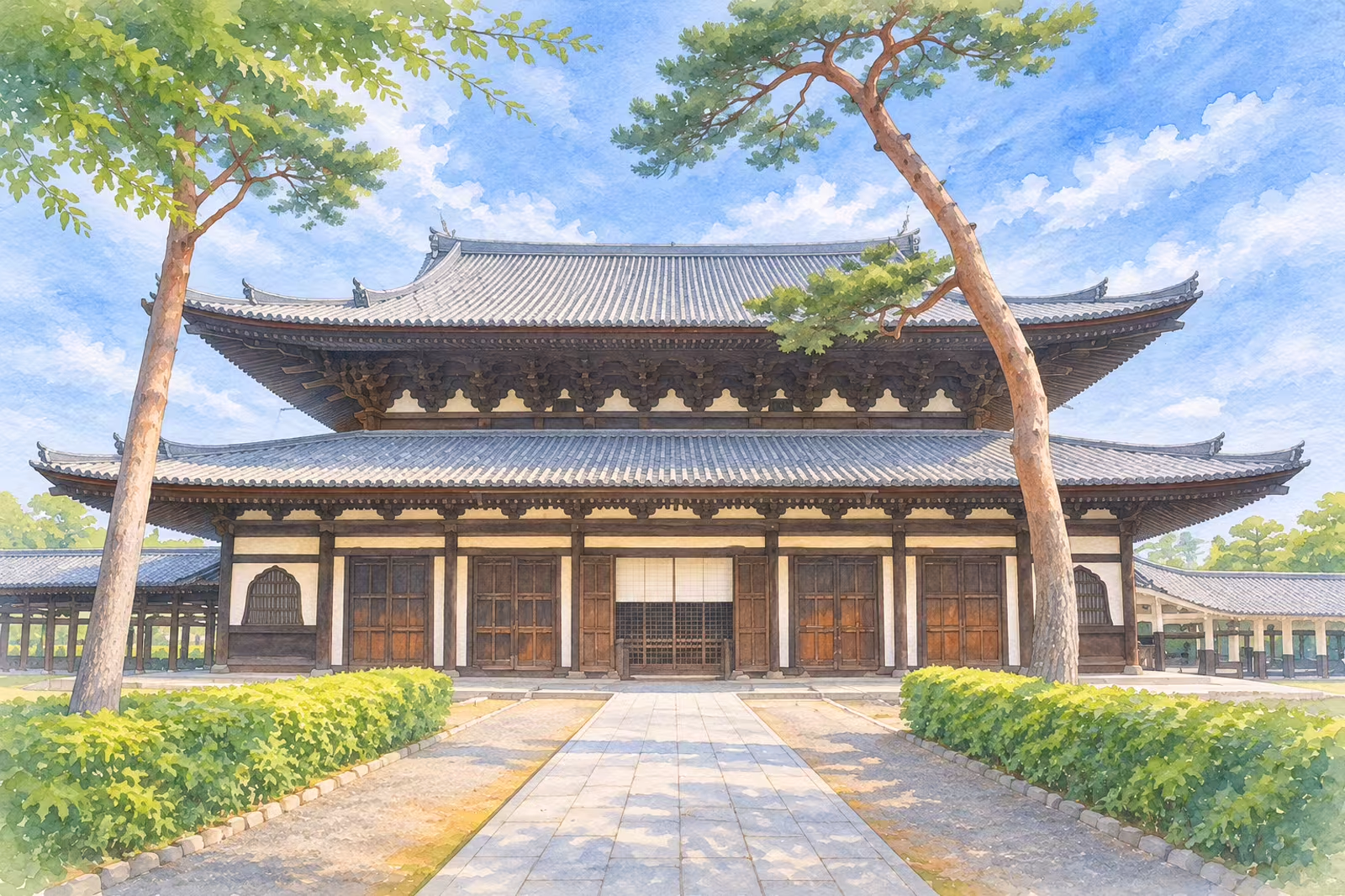
Shōkoku-ji, in Kamigyō Ward, Kyoto, stands just north of the Kyoto Imperial Palace and is the head temple of the Shōkoku-ji branch of Rinzai Zen. Founded by Ashikaga Yoshimitsu at the end of the fourteenth century, it ranked among the Five Mountains of Kyoto in the Muromachi period and served as the center from which the shogunate administered Zen temples. Kinkaku-ji (Rokuon-ji) and Ginkaku-ji (Jishō-ji) are both its outlying sub-temples.
01Yoshimitsu’s great monastery
In 1382 Yoshimitsu began building the temple near his residence, the Palace of Flowers, and the main work was finished in 1392. The name comes from his office at the time, Minister of the Left, for which the old Chinese title was xiangguo, read shōkoku in Japanese. The late Musō Soseki was honored as founder, while his disciple Shun’oku Myōha actually led the project. When the ranking of the Five Mountains was revised in 1386, Shōkoku-ji was placed second.
The temple’s Rokuon-in housed the Sōroku, the office that oversaw appointments and affairs across the Five Mountain temples, which put Shōkoku-ji at the heart of shogunal religious administration. Yoshimitsu also raised a seven-story pagoda in the grounds, completed in 1399 and by one account about 109 meters tall; lightning burned it down in 1403. The temple was a major base for Muromachi ink painting as well, and Josetsu, Shūbun and Sesshū all had ties to it.
02War, fire and rebuilding
During the Ōnin War in 1467, heavy fighting took place around Shōkoku-ji and most of the temple burned. It was rebuilt several times and burned again more than once, including in the Great Tenmei Fire of 1788. None of the original buildings survive, and the old precinct was far larger than today’s; part of it is now occupied by Dōshisha University and other institutions.
03What you can see today
The Dharma Hall was rebuilt by Toyotomi Hideyori in 1605 and is generally considered the oldest surviving Dharma Hall in Japan; it is an Important Cultural Property. Its ceiling bears a coiled dragon painted by Kanō Mitsunobu, and a clap at the right spot produces an echo, earning it the nickname "the crying dragon." The grounds also hold a late sixteenth-century bathhouse (an Important Cultural Property), an abbot’s quarters and founder’s hall rebuilt in the nineteenth century, and several active sub-temples.
The Edo-period painter Itō Jakuchū was closely connected with Shōkoku-ji and donated his thirty-scroll series Colorful Realm of Living Beings to the temple; the set was later presented to the imperial household. Jakuchū and Ashikaga Yoshimasa, among others, have graves here. The Jōtenkaku Museum, opened in 1984, holds and exhibits treasures of Shōkoku-ji, Kinkaku-ji and Ginkaku-ji.