
At a glance
How Eisai and Dōgen brought Zen to Japan, how Rinzai koan practice differs from Sōtō just-sitting, and how Zen temples shaped gardens, tea and ink painting.
- Zen took shape in China and reached Japan in the 12th and 13th centuries, dividing into the Rinzai, Sōtō and Ōbaku schools.
- Japan still has more than 20,000 Zen temples; Sōtō alone has over 14,000, more than any other single denomination.
- Eisai brought back Rinzai Zen and the habit of drinking matcha; Dōgen went to Song China in 1223 and later founded Eihei-ji.
- Rinzai practitioners work on koan while sitting; Sōtō teaches "just sitting", facing the wall.
- One period of zazen lasts as long as a stick of incense, about 40 minutes, with walking meditation in between.
Most visitors meet Zen before they know they have. It is in the raked gravel at Ryōan-ji, the bowl of matcha after a temple visit, the tofu simmering in a Kyoto restaurant near Nanzen-ji, the single brushed circle hanging in a tea room. Behind all of these is a school of Buddhism that came to Japan from Song-dynasty China in the late 12th and 13th centuries and still runs more than 20,000 temples. This piece explains what Zen practitioners are actually doing when they sit, how the two great schools, Rinzai and Sōtō, differ, how zazen works in the body, and how a traveler can step into a Zen temple and try it.
01What Zen Is For
The word Zen is the Japanese reading of the Chinese chan, itself a shortening of the Sanskrit dhyāna, meditation. Every school of Buddhism meditates; Zen made meditation the center of everything. Its tradition describes itself as "a special transmission outside the scriptures, not founded on words and letters, pointing directly at the human mind." Awakening, in this view, cannot be learned from a book. It has to be realized in one’s own experience and confirmed by a teacher who has realized it too, so that the teaching passes from mind to mind in an unbroken line.
Zen tells its origin through a story. The Buddha, preaching on Vulture Peak, said nothing and simply held up a flower. Only his disciple Mahākāśyapa smiled, and the Buddha declared that he had passed on to him the "treasury of the true Dharma eye." Historians think the story was composed in China centuries after the Buddha, but it captures what Zen values: a wordless moment of recognition rather than doctrine.
The lineage then runs to Bodhidharma, an Indian monk said to have arrived in China around the 6th century and to have sat facing a cave wall for 9 years. In Japan he became Daruma, the round red figure with blank eyes sold at temples. You paint in one eye when you make a wish and the other when it comes true; election winners do this on television. In China, Chan grew through figures such as the Sixth Patriarch Huineng and branched into several "houses." Two of them reached Japan and survived: the Linji school, named for the 9th-century master Linji Yixuan (Rinzai Gigen in Japanese), and the Caodong school (Sōtō), named for the masters Dongshan Liangjie and Caoshan Benji.
The practice itself is plain. You sit. You arrange your body, settle your breath, let your mind quiet, and in that stillness see your own nature directly. Zen temples also treat work as practice. A rule attributed to the Tang master Baizhang, "a day without work is a day without food," made sweeping, chopping wood and cooking part of the path. That attitude, giving full attention to ordinary tasks, is one of the reasons Zen left such a mark on Japanese crafts and daily life.
02Crossing the Sea: Eisai, Dōgen and the Warriors of Kamakura
Bits of Chan teaching reached Japan in the Nara and Heian periods, but they did not take root. The real beginning came in the Kamakura period (1185–1333), when Japanese monks once again sailed to China and found that nearly every great monastery of the Southern Song was a Chan monastery.
The first to bring back a working Rinzai lineage was Myōan Eisai (also read Yōsai, 1141–1215). Trained as a Tendai monk on Mount Hiei, he went to China twice and on the second trip received transmission in the Huanglong branch of the Linji school. Back in Japan he founded Shōfuku-ji in Hakata, on Kyūshū. The Tendai establishment saw the new school as a threat, so Eisai wrote Kōzen gokokuron, "The Promotion of Zen for the Protection of the Nation," and looked for patrons in the new warrior government at Kamakura. Hōjō Masako, widow of the first shogun, founded Jufuku-ji for him, and the second shogun, Minamoto no Yoriie, sponsored Kennin-ji in Kyoto, now the oldest Zen temple in the city. Kennin-ji at first combined Zen with Tendai and esoteric practice, a cautious approach. Eisai also popularized powdered green tea, and late in life wrote Kissa yōjōki, "Drinking Tea for Health." The chronicle Azuma kagami records that when the third shogun, Minamoto no Sanetomo, was suffering after a night of drinking, Eisai brought him a bowl of tea and a copy of the book.
Dōgen (1200–1253), the founder of Japanese Sōtō, went further. Born into the Kyoto aristocracy and orphaned young, he became a monk on Mount Hiei and was troubled by a question: if all beings already have Buddha nature, as the sutras say, why practice at all? He studied at Kennin-ji under Eisai’s disciple Myōzen, and in 1223 the two sailed for China. There Dōgen eventually found Rujing at the Tiantong monastery near Ningbo, a strict Caodong teacher who made his monks sit late into the night. According to the traditional account, Dōgen heard Rujing scold a dozing monk that practice means "dropping off body and mind," and at those words he was awakened. His answer to his old question became the heart of his teaching: practice is not a means to enlightenment; practice and realization are one.
Returning in 1227, Dōgen wrote Fukan zazengi, "Universal Recommendation for Zazen," a short guide to sitting meant for anyone, and founded Kōshō-ji at Fukakusa, south of Kyoto. The older Kyoto schools were hostile, and in 1243 he accepted an invitation from a warrior patron, Hatano Yoshishige, to move into the mountains of Echizen, present-day Fukui. The temple he built there was renamed Eihei-ji, and it remains the head temple of Sōtō, a complex of halls climbing a slope among enormous cedars, deep in snow each winter. Dōgen’s Shōbōgenzō, written in Japanese rather than classical Chinese, is often counted among the most demanding works of Japanese thought. He also wrote Tenzo kyōkun, "Instructions for the Cook," which includes a memory from China: Dōgen found an elderly, bent-backed monastery cook drying mushrooms (some read it as seaweed) in the blazing sun and suggested he leave it to a junior. The old man replied that others are not him, and that if not now, then when? Dōgen took it as a lesson that cooking is practice as much as sitting is.
What secured Zen in Japan was the patronage of the Hōjō family, who ran the Kamakura shogunate as regents. Hōjō Tokiyori invited the Chinese master Lanxi Daolong (Rankei Dōryū) and built Kenchō-ji in Kamakura, a great monastery modeled on Jingshan, one of the leading Chan monasteries of the Southern Song, which became the stronghold of Song-style Zen in Japan and is often called the first temple in Japan built entirely on the Song monastic model. His son Tokimune invited Wuxue Zuyuan (Mugaku Sogen) and founded Engaku-ji. Tokimune faced two Mongol invasions, and according to tradition, before the second one Mugaku gave him a piece of calligraphy reading only "Do not worry." Stories like this have been embellished over time, but the attraction for warriors was real. Zen asked for decisiveness and composure in the face of death rather than elaborate ritual and scholarship. The Chinese monks also brought Song architecture, calligraphy, painting, cuisine and learning, which made Zen temples Japan’s main window on continental culture for the next two centuries.
03Rinzai: Koan, the Five Mountains and Many Lineages
Rinzai Zen is best known for the koan. The word originally meant a public legal case. In Zen it refers to an exchange between a master and a student, recorded and then handed to later students as something to break through. The most common first koan is "Zhaozhou’s dog." A monk asked the Tang master Zhaozhou whether a dog has Buddha nature. Zhaozhou answered, "Mu," no. Doctrine says all beings have Buddha nature, so why "no"? The student is not supposed to work out an explanation. Instead he or she sits with "Mu," pours everything into it, and keeps going until reasoning is exhausted and something gives way. The 18th-century master Hakuin Ekaku added a koan of his own that has become famous worldwide: "Two hands clap and there is a sound. What is the sound of one hand?"
In a Rinzai training monastery, students go alone to the teacher’s room, often several times a day, to present their understanding of the koan. This private interview is called dokusan or sanzen. The teacher may listen to a single sentence and ring a bell to dismiss the student. When one koan is passed, the next is given. Most of the cases come from Song-dynasty collections such as the Blue Cliff Record (Hekiganroku) and the Gateless Barrier (Mumonkan). Hakuin and his successors organized them into a graded curriculum, and that system is still used in Rinzai monasteries today. Rinzai sitting therefore has a distinctive tension. You sit holding a question.
Institutionally, Rinzai was for a time the most prestigious Buddhism in Japan. The Ashikaga shoguns of the Muromachi period copied a Song system called the Five Mountains (Gozan), ranking the leading Zen temples of Kyoto and Kamakura. Kyoto’s five were Tenryū-ji, Shōkoku-ji, Kennin-ji, Tōfuku-ji and Manju-ji; Kamakura’s were Kenchō-ji, Engaku-ji, Jufuku-ji, Jōchi-ji and Jōmyō-ji. Nanzen-ji was placed above them all. A central figure in this world was Musō Soseki (1275–1351), adviser to Ashikaga Takauji, who persuaded the shogun to build Tenryū-ji to console the spirit of the emperor Go-Daigo. Musō was also a great garden maker; the pond garden at Tenryū-ji and the gardens of Saihō-ji, now called the Moss Temple, are associated with him. Gozan monks were accomplished writers of Chinese poetry and prose, served the shogunate as diplomats and drafters of letters to China and Korea, and produced a body of writing known as Gozan literature.
Outside the official system stood Daitoku-ji and Myōshin-ji, the so-called rinka temples, which emphasized rigorous sitting and koan training over literary culture. Daitoku-ji produced the eccentric poet-monk Ikkyū Sōjun and later became the spiritual home of the tea masters. Myōshin-ji expanded steadily through the 16th and 17th centuries and became the largest Rinzai branch, with thousands of affiliated temples. Every living Rinzai lineage in Japan traces back through three generations of late Kamakura masters, Nanpo Shōmyō, Shūhō Myōchō (founder of Daitoku-ji) and Kanzan Egen (founder of Myōshin-ji), and through Hakuin, who revived the school in the Edo period.
This is why "Rinzai" today is not one organization but more than a dozen independent branches, conventionally counted as 14, each centered on a head temple: Myōshin-ji, Kenchō-ji, Engaku-ji, Nanzen-ji, Tenryū-ji, Shōkoku-ji, Kennin-ji, Tōfuku-ji, Daitoku-ji and others. They share teaching and practice but are administratively separate. Nearly every great Zen temple a visitor sees in Kyoto is the head of one of these branches, ringed by smaller sub-temples called tatchū.
A third Zen school arrived much later. The Ming Chinese monk Yinyuan Longqi (Ingen Ryūki) landed in Nagasaki in 1654 and later founded Manpuku-ji at Uji, south of Kyoto, establishing the Ōbaku school. Manpuku-ji still looks like a Ming monastery, its chanting keeps a Chinese reading that is said to be close to Ming-era pronunciation, and its vegetarian cuisine, fucha ryōri, is served Chinese-style around a shared table. The Japanese name for green beans, ingen-mame, is said to come from Ingen himself. Ōbaku is small, but it brought a fresh wave of Chinese culture into Edo-period Japan.
04Sōtō: Just Sitting, from Eihei-ji to the Village Temple
If Rinzai sitting holds a question, Sōtō sitting lets go of every question. Dōgen called it shikantaza, "just sitting." You do not sit to become enlightened, and you do not hold a koan in mind. For Dōgen, the upright posture of zazen is itself the posture of a Buddha; when you sit correctly, realization is already present. Dōgen knew the koan literature thoroughly and wrote about it at length, but in Sōtō it is not a meditation technique.
The two schools also differ in a way you can see from the doorway. Sōtō practitioners sit facing the wall, in memory of Bodhidharma. Rinzai practitioners sit with their backs to the wall, facing each other across the hall.
Dōgen preferred to train a small number of serious monks in the mountains. Sōtō became a mass movement through Keizan Jōkin, fourth in the line counting Dōgen himself as the first (d. 1325), who founded Sōji-ji on the Noto Peninsula and absorbed popular prayer rituals and ceremonies into Zen practice. Keizan’s disciples spread out across the provinces, by one account as far as the northeast, the Kantō and Kyūshū, and in the Muromachi period Sōtō took hold mainly among farmers and local warriors. Its monks gave precepts to ordinary people and performed their funerals, bringing monastic ritual into village life; to this day the giving of precepts and the guiding words to the deceased, called indō, are the core of a Sōtō funeral. By one view, much of the shape of Japanese Buddhist funerals in general, including the posthumous precept name, or kaimyō, owes something to Sōtō practice. After a fire in 1898, Sōji-ji moved to Tsurumi in Yokohama in 1911, and today it shares the status of head temple with Eihei-ji.
Because of these rural roots, Sōtō is now the largest single Buddhist denomination in Japan by number of temples, around 14,000, roughly twice as many as all the Rinzai branches combined. Drive through rural Japan and the temple with the bell tower, the graveyard behind it and a sign reading "Sōtō-shū" is very likely the family temple, or bodaiji, of the households around it, where their graves are tended and their ancestors’ tablets kept. For most Japanese, Sōtō is first the temple that handles funerals and memorial services, and only second a school of meditation.
Above this network, Sōtō maintains strict training monasteries. The meditation halls of Eihei-ji and Sōji-ji house young trainee monks, many of them sons of village temple priests, for whom a period of training there is the path to one day taking over the family temple. By the usual account, the two head temples take in large numbers of young monks each year, who stay from one to several years.
05Zazen: Posture, Breath and Mind
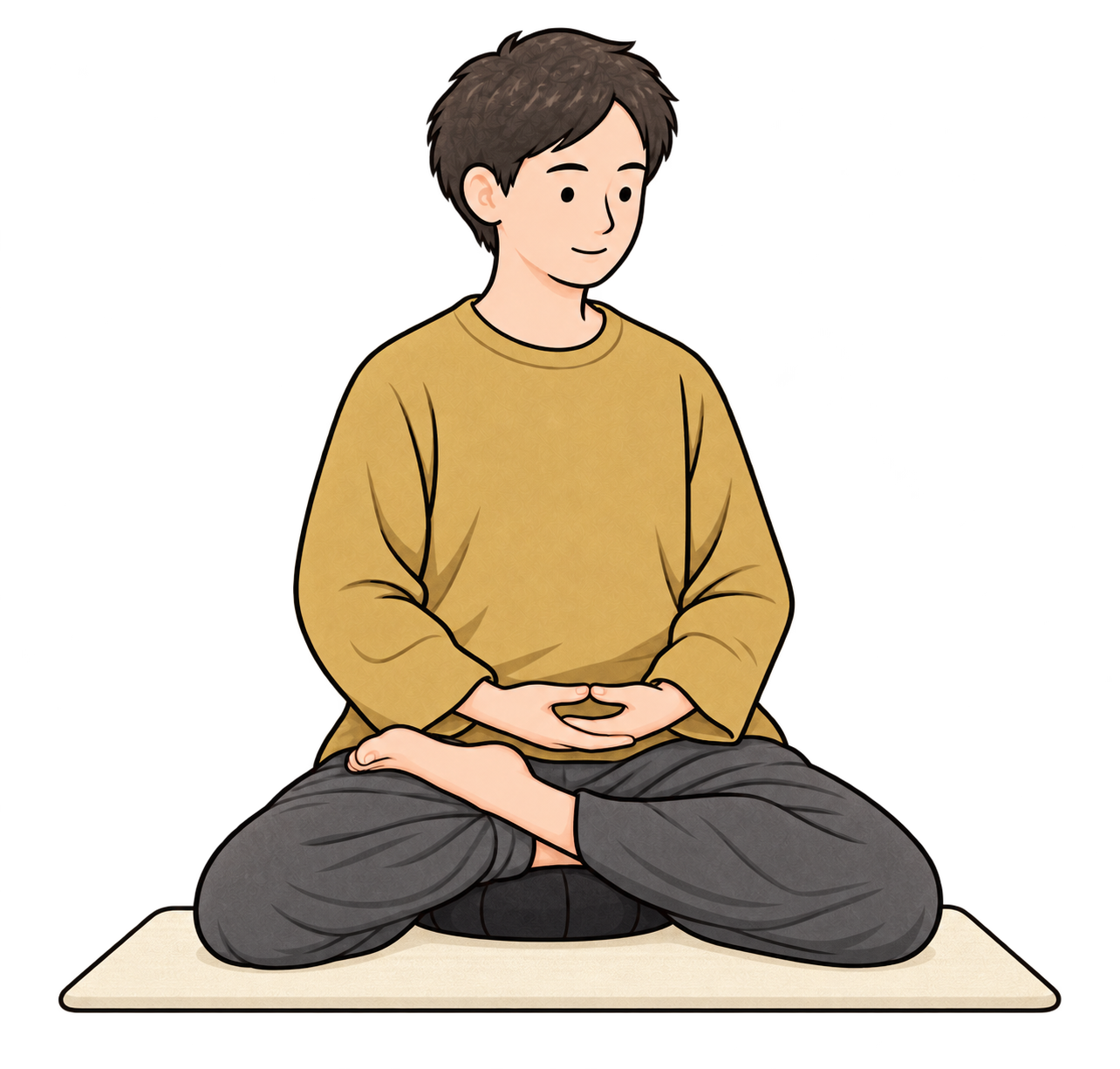
Rinzai and Sōtō sit in almost the same way. On a flat square mat, the zabuton, you place a round cushion, the zafu, and sit on its front half so that both knees touch the mat. The body rests on a tripod of buttocks and knees. The classic leg position is the full lotus, kekka fuza: right foot on the left thigh, left foot on the right thigh. If that is impossible, the half lotus, hanka fuza, places just one foot on the opposite thigh. Beginners may kneel in seiza with the cushion between their feet, or sit on a chair; temples that welcome visitors usually have chairs ready.
Once seated, straighten the spine as if a string were drawing the crown of your head upward, tuck the chin slightly, and line up ears with shoulders and nose with navel. The hands form the cosmic mudra, hokkai jōin: the right hand palm up near the lap, the left hand resting on it, the tips of the thumbs lightly touching to make an oval in front of the lower belly. The eyes stay half open, resting on the floor about 1 meter ahead. Temples insist on this: closed eyes invite drowsiness and daydreams. Close the mouth and let the tongue rest against the roof of the mouth. Before settling, sway the body side to side in gradually smaller arcs until you find the center, then stop.
Breathe through the nose, naturally, letting the breath grow slow and deep and settle into the lower abdomen, the area called tanden. A common method for beginners is counting the breath, susokukan: count one on the out-breath, two on the next, up to ten, then begin again; if you lose count, start over at one. Thoughts will come, about yesterday, about the ache in your knee, about dinner. You do not chase them away and you do not follow them. When you notice you have drifted, return to the breath. Zen teachers describe this as adjusting body, breath and mind, in that order. Get the posture right, and the breath deepens and the mind follows.
A traditional sitting period lasts as long as one stick of incense takes to burn, about 40 minutes. Between periods comes walking meditation, kinhin. In Sōtō it is extremely slow, half a step for each full breath, a practice called isoku hanpo; in Rinzai it is generally brisker, by some accounts close to a jog.
- 1
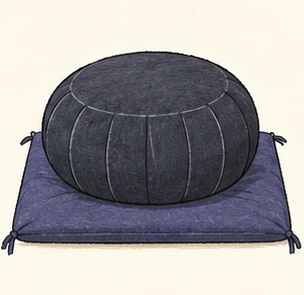 A square mat on the floor, with a round cushion on top.
- 2
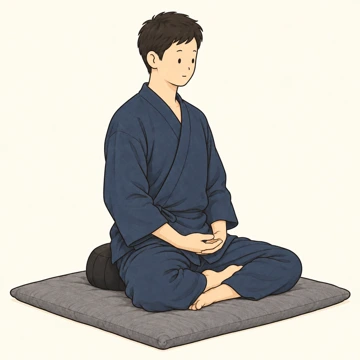 The cushion goes under the buttocks only; buttocks and both knees support the body.
- 3
 Hands form the meditation mudra: left hand on the right, thumb tips lightly touching.
- 4
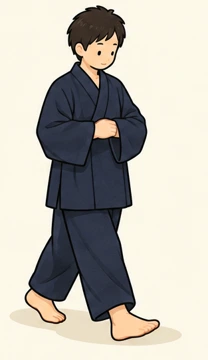 Between periods, rise for kinhin, walking slowly around the hall.
The image many people carry away is the flat wooden stick, the kyōsaku (pronounced keisaku in Rinzai). A monk walks the hall with it, and when he sees someone slumping or nodding off, he strikes the muscles of the shoulder with a loud crack. In meditation sessions for the public, the stick is usually requested rather than imposed. When the monk stops in front of you, you place your palms together, bow, and lean your head to one side to expose the shoulder; after the strikes you bow again in thanks. People often say the shoulder feels looser afterward and the mind sharper. It is meant as encouragement, not punishment; the stick is said to stand for the encouragement of Monju, the bodhisattva of wisdom.
06A Day in a Zen Monastery
Real monastic training is far stricter than an hour of public zazen. Trainee monks are called unsui, "clouds and water," for the way they once wandered from teacher to teacher. A newcomer arrives at the monastery gate in straw sandals with his belongings, and must wait, bowed over his pack at the entrance, for days, in a test called niwazume. He is refused and sent away and is expected to stay anyway. When admitted, he spends further days alone sitting facing a wall in a small room, tangazume, before being allowed into the meditation hall.
The day starts long before dawn with a bell, by monastery and visitor accounts usually at three or four in the morning. Monks wash, sit, chant morning sutras and eat breakfast: rice gruel and pickles. Lunch is rice, soup and a simple side dish. The gruel is said to come typically with pickled plum and pickled daikon, and lunch with miso soup and one or two side dishes. The evening meal is called yakuseki, "medicine stone." Under the monastic rule against eating after noon, Zen monks once held a warmed stone against the belly to ward off hunger and cold at night; that stone was the yakuseki, and the name passed to the evening meal. Eating is itself a practice. Each monk has a set of nested bowls, called ōryōki in Sōtō. Unwrapping them, receiving the food, eating, cleaning the bowls with hot water (by some accounts wiping them with a slice of pickled daikon and drinking the rinse water) and wrapping them up again all follow a precise sequence performed in silence. Before the meal comes a chant, the Five Reflections, reminding the monks how much labor went into the food and asking whether their own conduct makes them worthy of it.
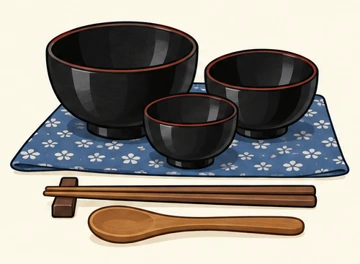
A set of nesting bowls with chopsticks, spoon and cloth; after the meal they are washed, stacked and wrapped (illustration).
Morning and afternoon bring samu, physical work: sweeping, polishing corridors, tending vegetables, splitting wood, cooking. The long wooden corridors of a Zen monastery shine from daily wiping; Eihei-ji is the example usually given. Rinzai monks also go out on takuhatsu, begging rounds, walking in small groups of 3 or 4, spaced out one behind another in order of seniority, under wide bamboo hats, calling out a long "hō" (dharma) as they go, and accepting offerings. Begging rounds are said to be most common on winter mornings, and in Kyoto you can still sometimes see them pass.
Rinzai monasteries hold sesshin, intensive retreats of about a week, at regular intervals through the training seasons, by the usual account once a month. Work is reduced and the days are filled with sitting and interviews; some monks continue sitting through the night. The most demanding is Rōhatsu sesshin, from December 1 to December 8, the date on which, by tradition, the Buddha attained awakening at the sight of the morning star.
Monastery food developed into shōjin ryōri, Buddhist vegetarian cuisine. It uses no meat or fish and avoids pungent plants such as garlic and green onions, building flavor from tofu, sesame, vegetables, kelp and dried shiitake. In Kyoto you can eat it at Shigetsu, the restaurant run by Tenryū-ji, and at restaurants near the great Zen temples, and some of Myōshin-ji’s sub-temples are said to serve it too; yudōfu, tofu simmered in kelp broth, is a specialty around Nanzen-ji. Dōgen told monastery cooks to guard the temple’s food and goods as carefully as their own eyes, and that care became part of the spirit of Japanese cooking.
07Zen and Japanese Aesthetics
In the Muromachi period Zen temples were the cultural centers of elite society, and a great deal of what is now called traditional Japanese culture took shape in them or around Zen monks.
The most visible legacy is the garden. In front of the abbot’s quarters of many Zen temples lies a rectangle of white gravel with a few stones, a karesansui or dry landscape garden. There is no water; the raked patterns in the gravel stand for it, and stones stand for mountains and islands. At Ryōan-ji, 15 stones in five groups of 5, 2, 3, 2 and 3 sit in a walled rectangle of gravel, and it is often said that from any point on the veranda at least one stone is hidden behind another. Who made the garden and when is not settled, and the readings people have offered, a tigress carrying her cubs across a river, islands in the sea, the character for "mind," are all later interpretations; the temple does not offer an official one. At Daisen-in, a sub-temple of Daitoku-ji, the dry garden works like a landscape scroll laid on the ground: rocks for steep mountains and deep ravines, a gravel stream that springs from them and runs on, widening, toward a gravel sea; by one account the rocks also include a waterfall and a stone boat. These gardens are made to be sat in front of, and after a while of looking, the viewer grows quiet, which is the same thing zazen asks for.
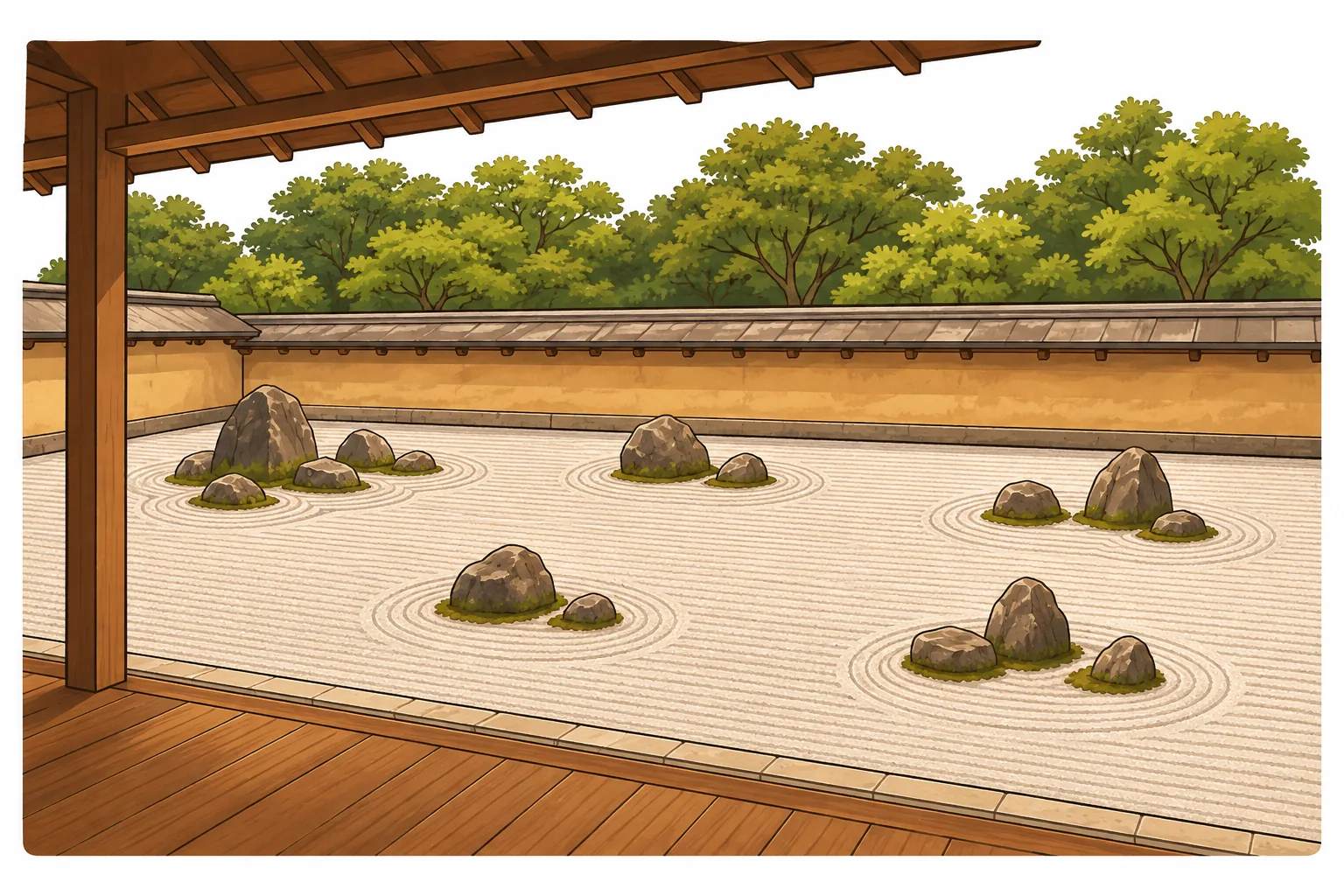
Ryōan-ji's rock garden from the veranda: raked white gravel and fifteen stones in five groups (illustration).
The tie with tea runs deepest. Eisai brought tea back from China, and Zen monasteries had their own etiquette for serving it. In the 15th century Murata Jukō, traditionally said to have studied with Ikkyū, began moving tea away from lavish gatherings toward small, plain rooms. Sen no Rikyū gave the tea ceremony essentially its present form. Rikyū practiced Zen at Daitoku-ji and paid for the upper story of its main gate, the Kinmōkaku, where a statue of him was later installed. Toyotomi Hideyoshi took offense that he would have to walk beneath Rikyū’s feet to enter, and the affair is counted among the reasons Hideyoshi ordered Rikyū’s suicide in 1591. The most prized scroll in a tea room is a bokuseki, a piece of calligraphy by a Zen monk, perhaps "Every day is a good day" or the single character "Mu," before which host and guests sit and drink. The phrase "tea and Zen have one taste" comes from this world.
Ink painting arrived with Zen as well. Chinese Chan painters of the Song and Yuan dynasties worked in pale ink and empty space, painting landscapes, bamboo and Bodhidharma, and Japanese monks learned from them and went their own way. Sesshū Tōyō, trained as a painter-monk at Shōkoku-ji, traveled to Ming China and returned to produce some of the high points of Japanese ink painting. Zen monks also painted ensō, a circle drawn in a single stroke that can mean enlightenment, emptiness or simply a tea bowl, depending on the viewer. In the Edo period, Hakuin and Sengai Gibon produced great numbers of Zen paintings in a rough, often funny style. Sengai’s picture of a circle, a triangle and a square has never been convincingly explained.
Noh, the martial arts and haiku are often linked to Zen too. The monk Takuan Sōhō wrote Fudōchi shinmyōroku, "The Mysterious Record of Immovable Wisdom," for the sword master Yagyū Munenori, arguing that a swordsman’s mind must never stop on the opponent’s blade; it became a classic of the idea that sword and Zen are one. Matsuo Bashō studied Zen with the monk Butchō, and his haiku, which catch an entire world in a moment, are often read in a Zen light. Still, each of these arts has its own history, and the idea that all Japanese beauty is Zen is a modern one.
Its chief promoter was D. T. Suzuki (Suzuki Daisetsu, 1870–1966), a lay Rinzai practitioner who trained at Engaku-ji. Writing in English from the early 20th century, in books such as Essays in Zen Buddhism and Zen and Japanese Culture, he introduced Zen to a broad Western readership and also taught Japanese readers to see their own culture through Zen. After the Second World War, Zen caught on in the United States. The Sōtō priest Suzuki Shunryū arrived in San Francisco in 1959 and founded the San Francisco Zen Center; his talks, collected as Zen Mind, Beginner’s Mind, shaped a generation of American practitioners. The English word zen, now a casual adjective for anything calm and uncluttered, comes from the Japanese pronunciation. Later, scholars documented how much of the Japanese Zen establishment had supported Japan’s wars, and how the pairing of Zen and samurai spirit had been used to serve militarism. In 1992 the Sōtō school issued a formal statement of repentance and apology for its wartime cooperation.
08Visiting a Zen Temple
The easiest places to start are Kyoto, where most of the Rinzai head temples stand, and Kamakura, where Zen first took hold in Japan.
In Kyoto, Nanzen-ji has a massive main gate you can climb for a view over the eastern hills, and a red-brick aqueduct from the Meiji era running through its grounds. Tōfuku-ji’s Tsūten-kyō bridge is one of the city’s great autumn-leaf spots, and the gardens around its abbot’s hall were designed in 1939 by Shigemori Mirei, with a checkerboard of moss and stone that is pure modern design inside a medieval temple. Tenryū-ji in Arashiyama has Musō’s pond garden borrowing the wooded hills behind it as scenery. Myōshin-ji is a temple town of some 40 sub-temples around its central halls; one of them, Taizō-in, is known for its gardens and for owning Josetsu’s Catching a Catfish with a Gourd, a National Treasure of early ink painting. At Daitoku-ji, Daisen-in and Ryōgen-in let you look closely at dry gardens and the traces of tea culture. At Ryōan-ji, arrive at opening time; with fewer people on the veranda you can actually feel the weight of the gravel.
A few things are worth recognizing in any large Zen temple. You enter through the sanmon, the main gate, whose name is read as the "gate of three liberations." Behind it come the Buddha hall and the Dharma hall, then the abbot’s quarters. The ceiling of the Dharma hall is often painted with a great dragon among clouds, a protector of the teaching that also "rains down the Dharma." Kanō Tan’yū’s dragon at Myōshin-ji seems to stare at you from every angle; at Shōkoku-ji, clapping under the dragon produces a ringing echo, and it is called a "crying dragon." The meditation hall, the bathhouse and even the latrine, tōsu, are places of practice with their own rules, and some temples open these old buildings to visitors as cultural properties.
- 1Sanmonthe “gate of three liberations”
- 2Buddha hall
- 3Dharma hallceiling often painted with a dragon among clouds
- 4Abbot’s quarters
The main buildings of a large Zen temple, in order from the entrance inward.
If you want to sit, many temples run zazen sessions for the public. In Kyoto, sub-temples such as Ryōsoku-in at Kennin-ji, Shunkō-in at Myōshin-ji and Shōrin-ji at Tōfuku-ji offer zazen experiences, Shunkō-in among them with English instruction. They last about an hour, with an explanation, a short sitting and sometimes a bowl of matcha. In Kamakura, Kenchō-ji and Engaku-ji both hold zazen meetings open to the public. Farther afield, at Eihei-ji in Fukui you can walk the halls climbing the mountainside, and the temple accepts lay people for a one-night zazen stay, sitting and chanting morning sutras with the monks; Hakujukan, an inn by the gate, also arranges zazen for its guests. Sōji-ji in Yokohama also holds zazen sessions anyone can join. Across Japan, many ordinary Sōtō temples hold regular zazen meetings, though usually only in Japanese.
Wear loose, dark clothes, not short skirts or tight jeans, and clean socks, since shoes come off at the door. Bow with palms together as you enter and leave the hall, and step in with the left foot. Do not talk, and leave your phone off. If your legs go numb, you may shift quietly. If you do not want the stick, you do not have to ask for it. The hardest part is usually not the pain in your knees but the 40 minutes of doing nothing except sitting, hearing the incense ash drop, a crow in the distance, the faint breathing of the person beside you. When you stand up and walk back out, the garden often looks sharper than it did when you came in.