
At a glance
How yōkai went from Heian spirits to Edo picture books and Mizuki Shigeru’s manga, why kappa love cucumbers, and where to find them in Japan today.
- Yōkai tend to haunt particular places such as bridges, ferry crossings, mountain paths and old houses, often appearing at dusk.
- Toriyama Sekien published Gazu hyakki yagyō in 1776, fixing how many yōkai have looked ever since.
- The water in the dish on a kappa’s head is its source of strength; it loves cucumbers, which is why cucumber rolls are called kappa-maki.
- Mizuki Shigeru’s Kitarō gave many yōkai that had only names the look they have today.
- Mizuki Shigeru Road in Sakaiminato runs about 800 meters and, as of 2026, is lined with 178 bronze yōkai statues.
Japan has a word for the things that go bump in the night, and a remarkably long list of them. Yōkai, usually translated as "monsters," "spirits," or "goblins," include the kappa that drags children into rivers, the long-nosed tengu of the mountains, shape-shifting foxes, an umbrella that hops on one leg, and a wall that blocks your way home in the dark. Some are frightening, many are absurd, and almost all of them are tied to a particular kind of place. This piece explains what yōkai are, how they went from medieval terrors to Edo-period entertainment to the stars of modern manga, why the kappa looks different from one river to the next, and where a visitor can go to meet them.
01What Counts as a Yōkai
The word yōkai is written with two characters meaning roughly "bewitching" and "strange." It sounds ancient, but as an everyday term it is fairly modern. People in the Edo period (1603–1868) more often said bakemono or obake, "things that transform." Courtiers of the Heian period (794–1185) spoke of mononoke, the invisible presences that possessed people and made them ill, a word many readers now know from Miyazaki Hayao’s film Princess Mononoke. Gathering all of these under the single label "yōkai" and studying them as a category was largely the work of Meiji-era scholars around the turn of the twentieth century.
A yōkai is not quite a ghost and not quite a god. The folklorist Yanagita Kunio drew a famous distinction: a ghost (yūrei) follows a particular person, usually someone who wronged it, and appears late at night; a yōkai haunts a particular place, a bridge, a ford, a mountain pass, an old house, and bothers whoever happens by, often at dusk, the uncertain hour between day and night. Later scholars have found plenty of exceptions, but the core insight holds. Yōkai belong to the landscape. This river has a kappa; that mountain has a tengu; on that slope something rolls down at people after dark.
The line between yōkai and the gods of Shinto, the kami, is also blurry. Kami have gentle and violent sides; they bless when worshipped properly and curse when neglected. Folklorists have often described yōkai as kami who have fallen from worship, and the traffic goes the other way too: a vengeful spirit that is enshrined and placated can become a protective deity. The most famous case is Sugawara no Michizane, a ninth-century minister who died in exile. Lightning strikes and deaths in the capital were blamed on his angry spirit, and he was eventually enshrined as Tenjin, now the kami of scholarship to whom students pray before exams. This is why the typical Japanese response to a troublesome spirit is less exorcism than negotiation: give it a shrine, give it offerings, make an agreement.
Finally, yōkai tend to have fixed, drawable shapes. A one-eyed boy monk, a woman whose neck stretches across the room, an old paper umbrella with a single eye and a long tongue. That visual quality, more than anything, explains what happened to them later.
02Demons, Night Parades, and Haunted Tools
The oldest Japanese monster is the oni, usually translated "demon" or "ogre." In early texts the oni is barely described at all; it is an unseen source of calamity, and one long-standing theory derives the word from on, a reading of the character for "hidden." The familiar image, horns, wild hair, a tiger-skin loincloth, an iron club, took shape later under the influence of Buddhist pictures of hell. The usual explanation for the horns and tiger skin comes from directional lore: the northeast, the unlucky "demon gate" (kimon), corresponds to the zodiac signs of the ox and the tiger.
Nights in Heian Kyoto were very dark, and courtiers believed that on certain nights a procession of demons and monsters marched down the city’s avenues. To meet this hyakki yagyō, the "night parade of a hundred demons," meant sickness or death. Tale collections like the twelfth-century Konjaku monogatari include stories of people who stumbled into it. Aristocrats consulted calendars of unlucky days and relied on onmyōji, diviners trained in yin-yang cosmology, of whom Abe no Seimei became the legendary model. The suave, almost superhero Seimei of modern novels, films, and games is mostly a later creation, built up over centuries of legend and given its current form by Yumemakura Baku’s novels in the late twentieth century.
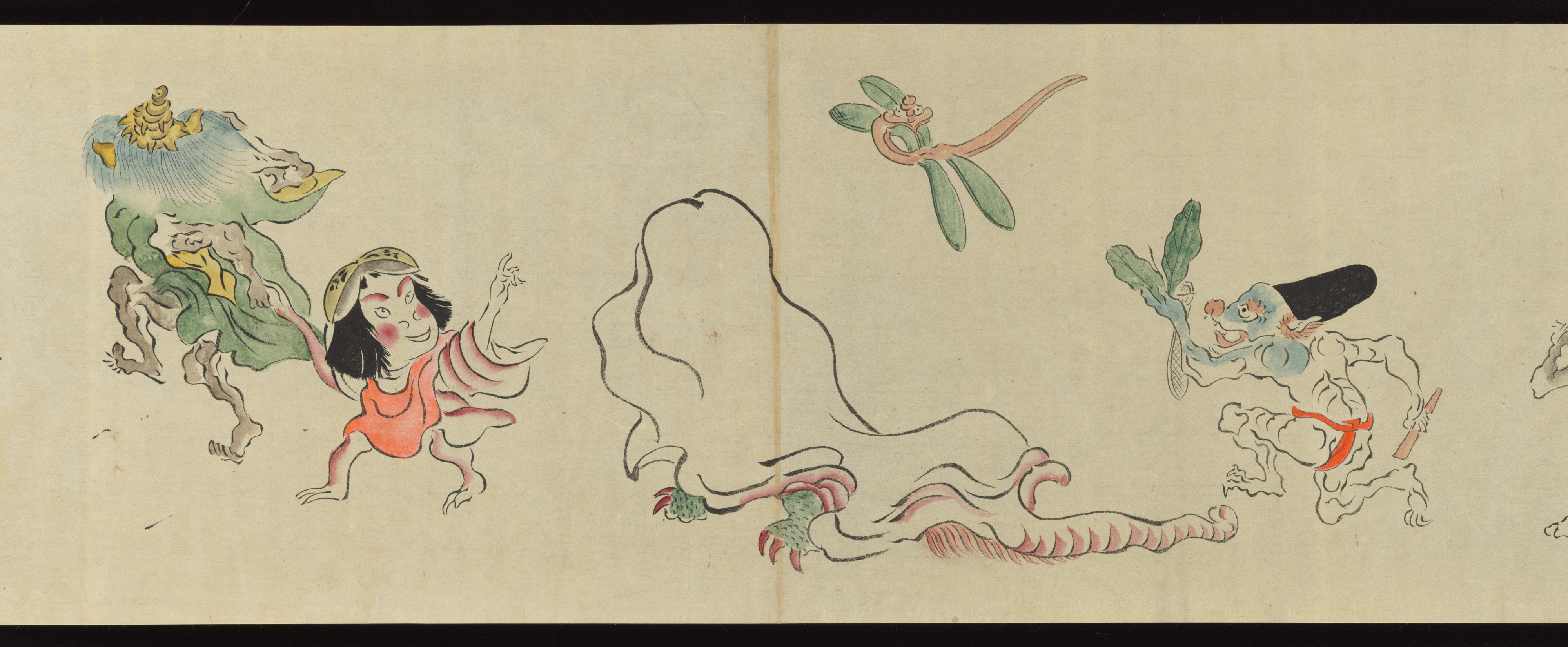
In the medieval period the night parade found its way onto paper. The most celebrated version, the Hyakki yagyō emaki owned by Shinjuan, a subtemple of Daitoku-ji in Kyoto, is traditionally attributed to the painter Tosa Mitsunobu. Its monsters are mostly worn-out household objects: cooking pots, kettles, and other everyday utensils, all sprouting arms and legs and marching cheerfully through the night. Such creatures are called tsukumogami. According to one tradition, an object that survives a hundred years acquires a spirit; another tale explains that tools thrown out in the year-end cleaning grow resentful of their ungrateful owners and turn into monsters. Behind the joke lies a very Japanese intuition, that a thing used long enough stops being merely a thing.
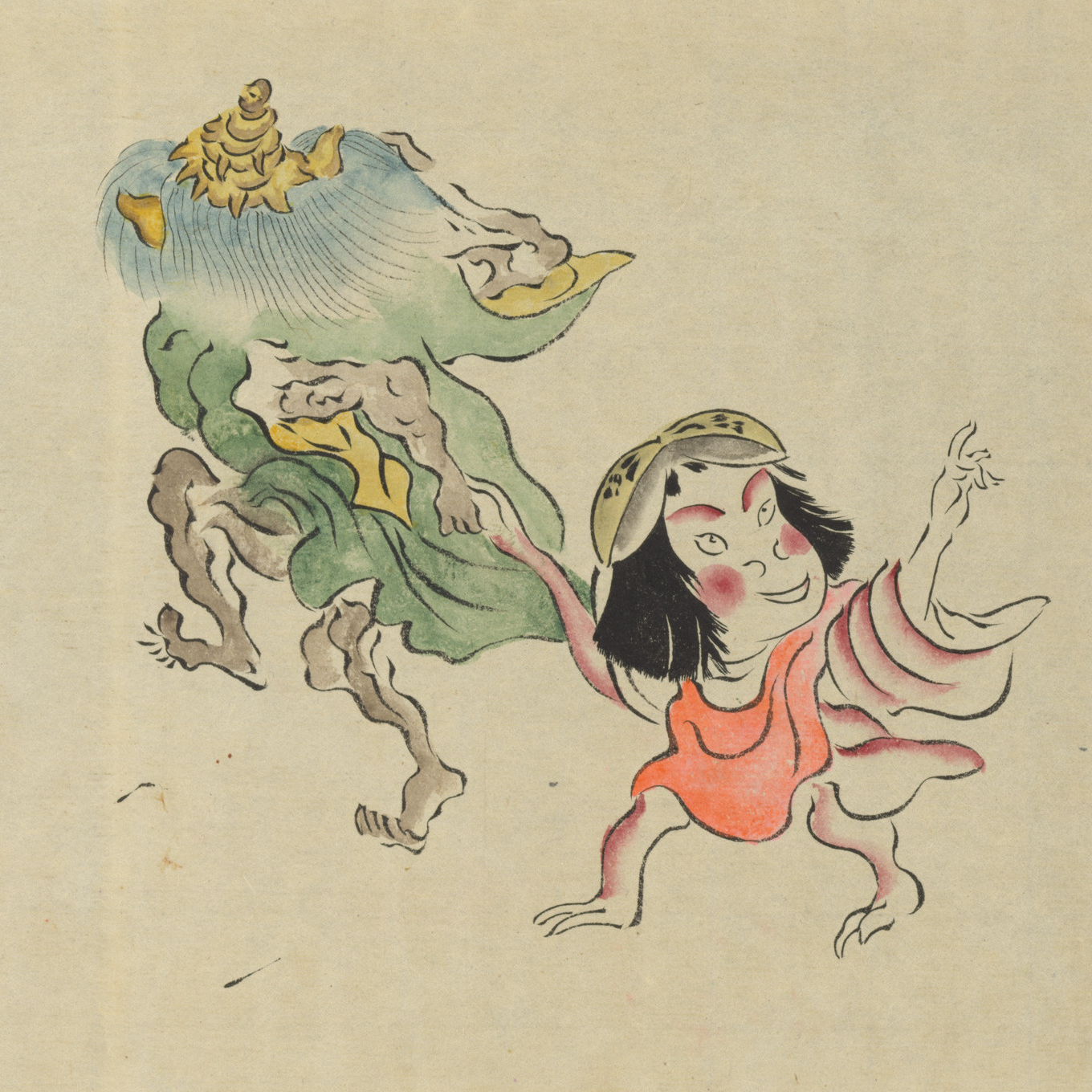
Detail from a later Night Parade scroll: odd creatures with arms and legs striding along in procession.The Metropolitan Museum of Art, Tachibana Gadō, Night Parade of One Hundred Demons (1892, ink and color on paper), detail
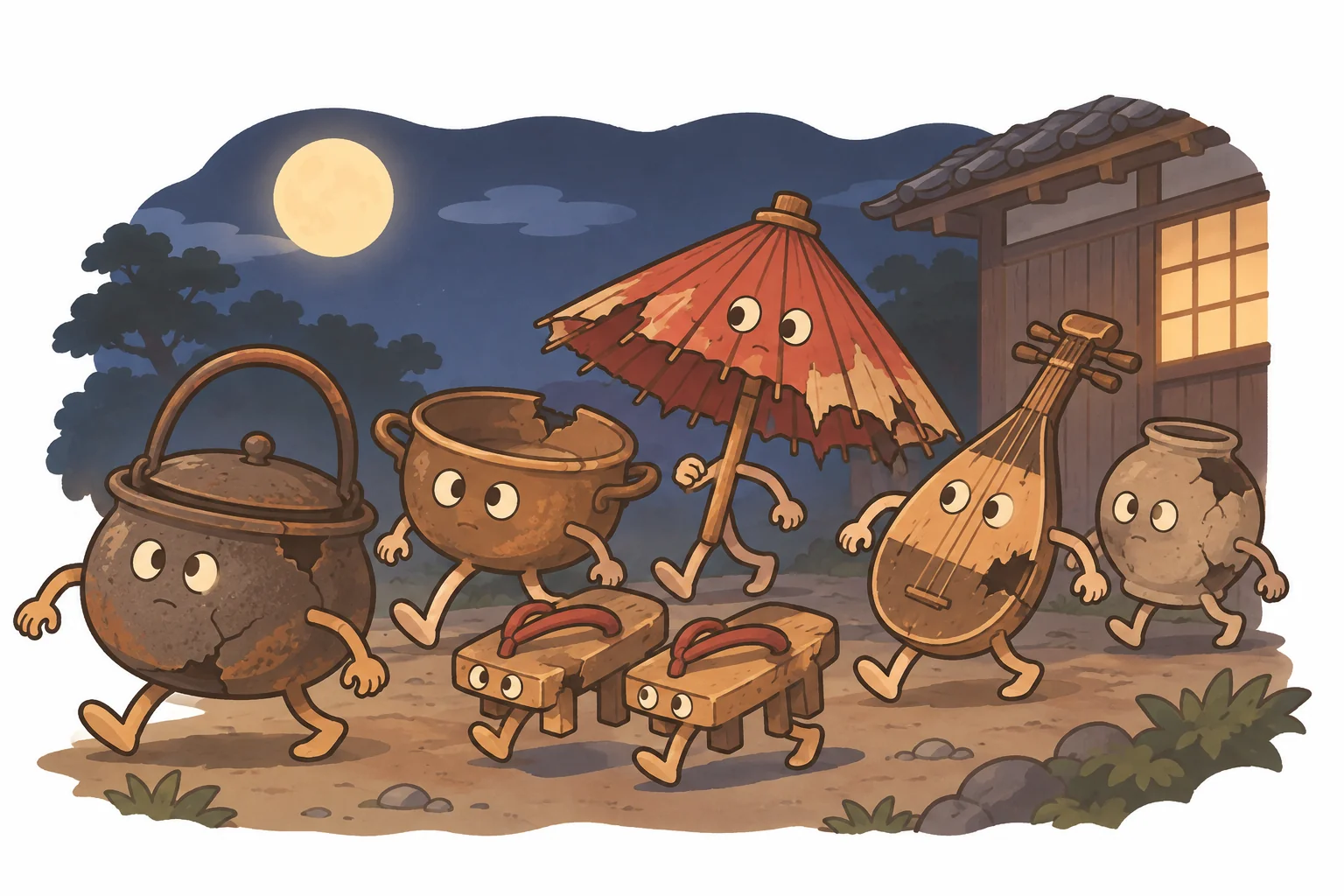
Tsukumogami on the march at night: old pots, kettles, sandals, umbrellas and a biwa grown arms and legs (illustration).
Medieval warrior legends are full of monster-slaying too. Minamoto no Raikō and his four retainers climb Mount Ōe to kill the demon king Shuten Dōji. His retainer Watanabe no Tsuna cuts the arm off an oni at the Ichijō Modoribashi bridge in Kyoto. The beautiful court lady Tamamo no Mae is exposed as a nine-tailed fox and flees to the plain of Nasu, where she turns into the poisonous Killing Stone. Retold in noh, puppet theater, and kabuki, these became stories every Japanese person knows.
03The Edo Period: Monsters as Entertainment
Yōkai went mainstream in the Edo period. Cities were crowded and increasingly well lit, books were cheap, and fear of the supernatural turned into a pleasure people paid for.
The most famous pastime was hyaku monogatari kaidankai, the gathering of a hundred strange tales. On a summer night, friends would meet in a room lit by a hundred wicks. Each person told a ghost story and then extinguished one light. When the hundredth story was told and the room went dark, something was supposed to appear, which is why sensible groups reportedly stopped at ninety-nine. The link between ghost stories and summer has never been broken: Japanese television, theaters, and museums still schedule horror for July and August, with the old justification that a good chill is the best air conditioning.
The man who fixed the look of many yōkai was the artist Toriyama Sekien. In 1776 he published Gazu hyakki yagyō (The Illustrated Night Parade of a Hundred Demons), followed by several sequels. Each page shows one creature, labeled with its name and sometimes a short note. Some came from folk belief, some from Chinese books, and a good number appear to be Sekien’s own inventions, often built on puns and wordplay. The result worked like a field guide, and artists, writers, and manga creators have mined it ever since. When you see a yōkai in a modern picture book, there is a good chance its ancestor is in Sekien.
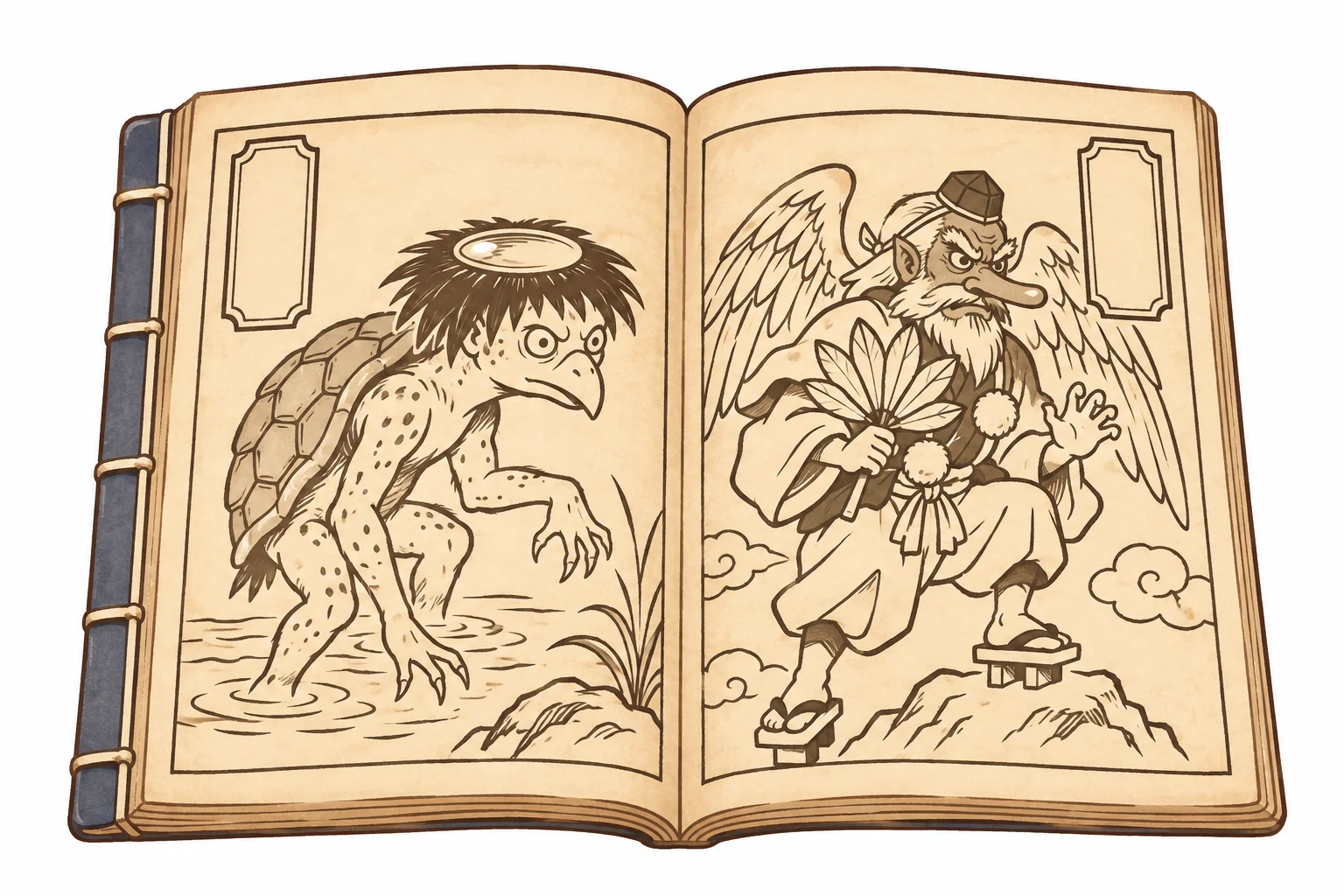
An open Edo yōkai catalogue, one creature per page: a kappa and a tengu, each with a name box (illustration).
Woodblock prints followed. Katsushika Hokusai produced a series called Hyaku Monogatari, including a startling image of the ghost Oiwa from the kabuki play Yotsuya Kaidan with her face formed from a torn paper lantern. Utagawa Kuniyoshi’s triptych of a giant skeleton looming over a warrior, from the tale of the sorceress Takiyasha, is one of the most reproduced images in Japanese art. Cheap illustrated fiction showed yōkai as comic figures, sometimes worrying that nobody was scared of them anymore. There were yōkai board games (sugoroku), card games, and toys. The scholar Kagawa Masanobu has described this as the moment yōkai moved from "reality," something to be feared, to "fiction," something to be collected and played with.
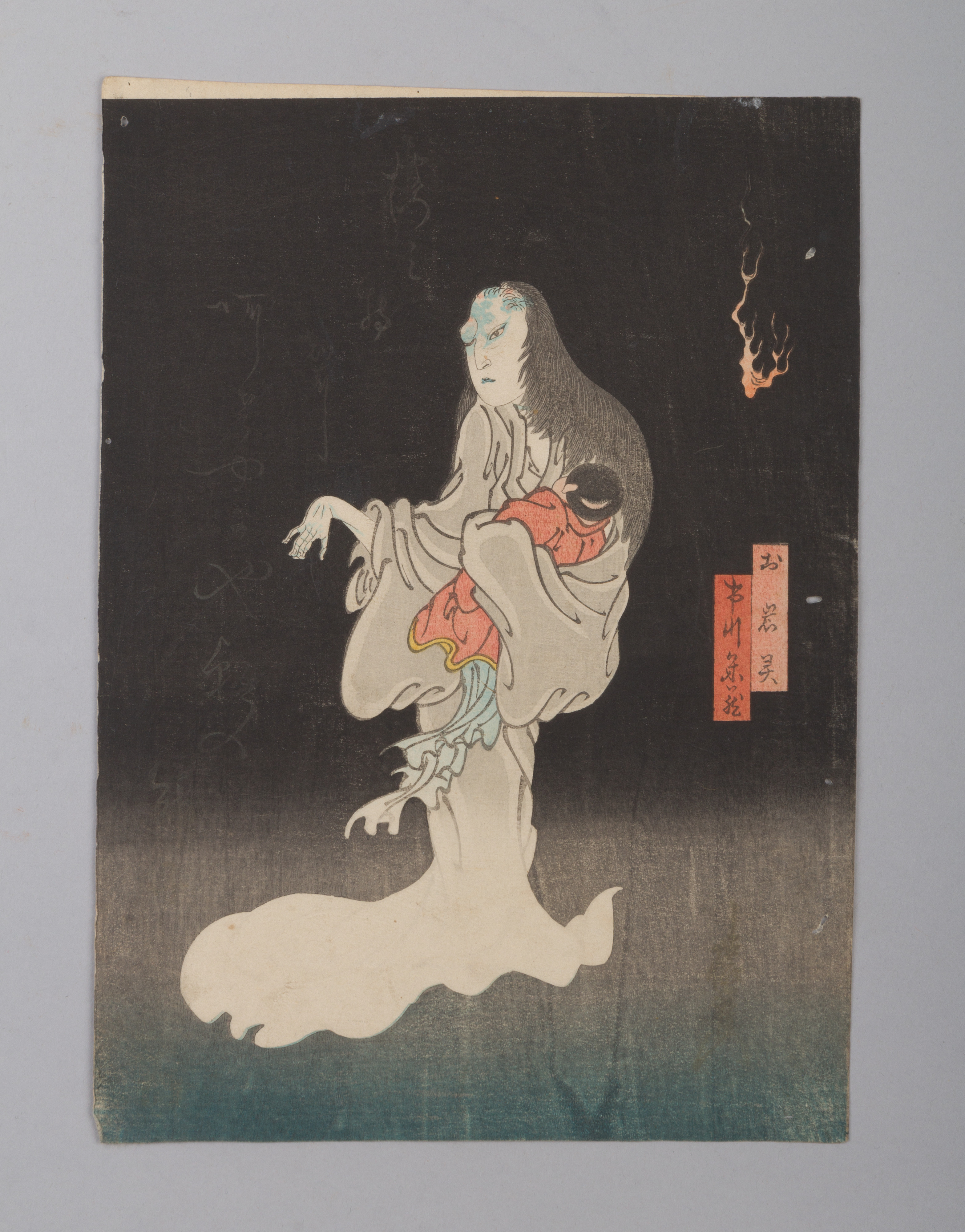
An 1865 actor print: Ichikawa Yonezō as Oiwa, the ghost of the Yotsuya kaidan.The Metropolitan Museum of Art, Enjaku, Ichikawa Yonezō as Oiwa (1865, woodblock print)
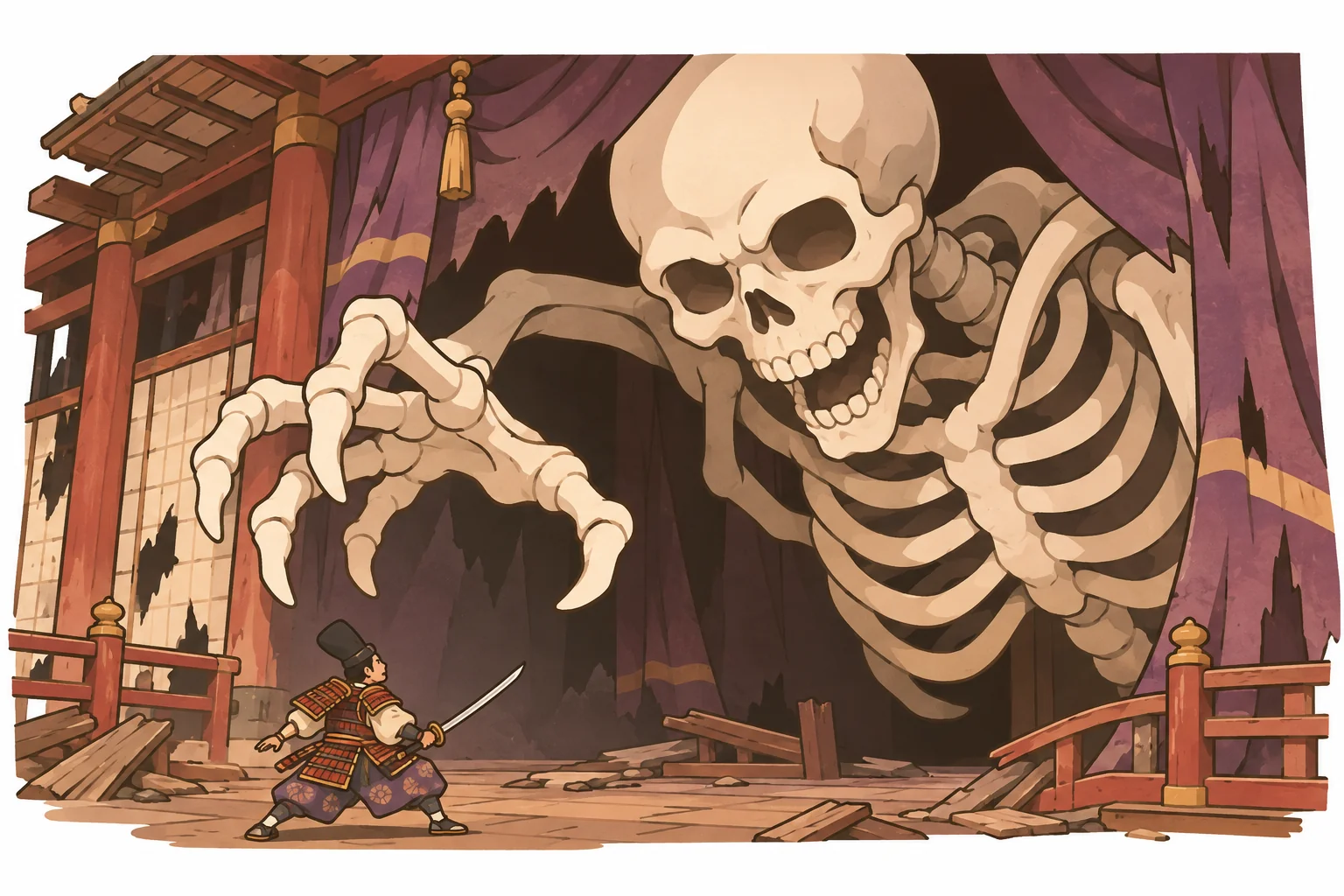
An ukiyo-e-style spectacle: a giant skeleton leans from a ruined palace's blinds over tiny warriors below (illustration).
The perfect Edo yōkai is the tōfu kozō, the tofu boy: a child in a wide straw hat standing by the road on a rainy night, holding a block of tofu on a tray. He does nothing harmful. There is no old legend behind him; he seems to have been born in the popular publishing of the late eighteenth century, and he was a hit. By this point a yōkai could exist simply for fun.
04The Kappa
Ask Japanese people to name one yōkai and many will say kappa.
The standard kappa is the size of a child, green or reddish brown, with a turtle-like shell, webbed hands and feet, a beak, and a dish-shaped hollow on top of its head that holds water. That water is the source of its strength; spill it and the kappa goes weak. Folk advice for anyone challenged by a kappa follows from this: bow politely. The kappa, being well-mannered, will bow back, the water will pour out, and you will win.
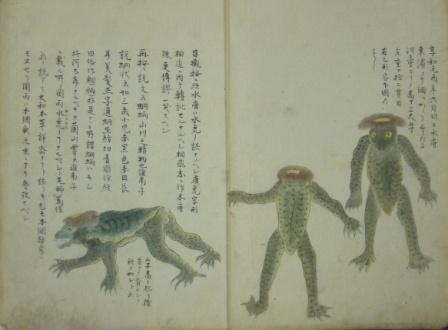
Kappa in a late-Edo manuscript: dish on the head, shell on the back, and no two alike.
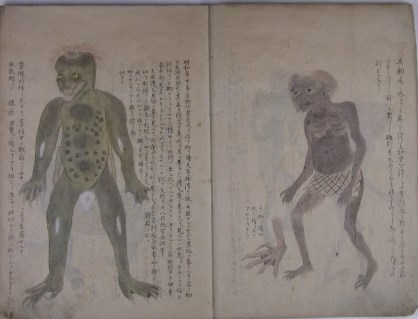
Two more kappa from the same manuscript, looking very different from each other.
Nishio City Iwase Bunko Library, Suiko kōryaku (1836 copy, originally compiled 1820)
Kappa have specific tastes. They love cucumbers, which is why a cucumber sushi roll is called a kappamaki. In some places families once threw the first cucumbers of summer into the river as an offering, so that the children would swim safely. Kappa love sumo and pranks. Their most frightening habit is to pull swimmers underwater and extract the shirikodama, an imaginary ball-shaped organ, through the anus. That gruesome detail likely reflects what people saw on the bodies of the drowned. Underneath the strangeness, kappa stories did practical work: they kept children away from deep water.
Another common type of story makes the kappa a creature you can deal with. A kappa tries to drag a horse into the river and is instead dragged back to the stable; or a kappa reaching for mischief has its arm cut off by a samurai. Either way it comes back in tears, begging for its arm, and promises never to harm people again. As thanks it leaves a written apology or the secret formula for a bone-setting salve. Temples, shrines, and old families in many parts of Japan claim to own a mummified kappa hand, a kappa’s written pledge, or a family medicine first taught by a kappa. In these tales the kappa is less a monster than a tricky neighbor who can be bargained with.
The name "kappa," however, is a later standardization. Before modern media spread one image nationwide, every region had its own water creature with its own name and character. "Kappa" was the eastern word, from the Kantō area around Edo. In the Kansai region people said gatarō or kawatarō, "river boy." Kyūshū had garappa, hyōsube, kawarō, and more. Parts of Tōhoku used medochi; parts of the Hokuriku coast used mizushi. Looks varied too: some were hairy like monkeys, some scaly, some more like otters or turtles than the shelled figure of the Edo picture books.
Kyūshū is especially rich in kappa lore. One legend says a kappa chief named Kyūsenbō led his clan across the sea from China and settled on the Kuma River in what is now Kumamoto. After the warlord Katō Kiyomasa campaigned against them, they were driven out and moved north to the Chikugo River, where, the story goes, the lord of Kurume let them stay on condition that they harm neither people nor livestock. Kappa stories still cluster around the Suitengū shrine in Kurume, head shrine of all Suitengū in Japan, and in the town of Tanushimaru upstream, which has a kappa-shaped train station. In parts of Kyūshū, kappa are said to come down into the rivers in spring and go up into the mountains in autumn, where they become yamawarō, mountain children. Folklorists have connected that seasonal migration with the old farming belief that the mountain deity descends each spring to become the god of the rice fields.
Tōno, in Iwate Prefecture, has a kappa of its own. Yanagita Kunio’s Tōno Monogatari (The Legends of Tōno, 1910) notes that the kappa there have red faces rather than green, and tells of a kappa that tried to drag a horse, brought down to the pool to cool off, into the water, was dragged back to the stable instead, and hid under an overturned feed trough until a hand was spotted poking out. The villagers debated killing it and finally let it go after it promised never again to bother the village horses. Behind Jōken-ji temple in Tōno is a small stream called Kappabuchi, the kappa pool, with a little shrine. Denshōen, a folk museum a short walk away, sells a tongue-in-cheek "kappa capture permit," and visitors dangle a cucumber from a fishing pole in hopes of a bite.
The modern kappa has a literary and commercial life as well. Akutagawa Ryūnosuke published the novella Kappa in 1927, a satire in which a psychiatric patient describes his time in the land of the kappa. He took his own life later that year, and the anniversary of his death is known as Kappaki, Kappa Day. The painter Ogawa Usen, who lived beside Ushiku Marsh in Ibaraki, painted so many kappa that they became his best-known subject. The cartoonist Shimizu Kon drew round, cheerful kappa for the advertising of Kizakura, a sake brewer in Fushimi, Kyoto. After Shimizu died in 1974, the cartoonist Kojima Kō took over and made the Kizakura kappa sleeker and more flirtatious, and for many Japanese that smiling kappa, with its jingle, is the default. Tokyo’s Kappabashi kitchenware street has a golden kappa statue and plays up the connection, though the place name is usually written with characters meaning "raincoat," and its origin is explained in several competing ways: one story says retainers of a nearby samurai estate hung raincoats they made as a side job to dry on the bridge; another says that when a local man named Kappaya Kihachi paid to dredge the area’s drainage canals in the early nineteenth century, kappa came out at night to help. The temple where Kihachi is buried, Sōgen-ji, is still nicknamed the Kappa Temple.
05Tengu, Foxes, and Things on the Night Road
If kappa rule the water, tengu rule the mountains. The commonest image today is the daitengu: red face, enormously long nose, the robes of a mountain ascetic, and a feather fan. The other type, the karasu tengu or crow tengu, has a beak and wings. The word originally came from China, where it referred to a meteor. In Japan the tengu was first a Buddhist demon who tempted monks into pride, then merged with the image of the yamabushi, the mountain ascetics of Shugendō, and became a lord of the deep mountains. The most famous tengu lives on Mount Kurama north of Kyoto, where, legend says, the boy Minamoto no Yoshitsune learned swordsmanship from the great tengu Sōjōbō. Closer to Tokyo, Mount Takao is tengu country; the temple Yakuō-in near the summit is full of tengu statues. Tengu were also blamed for kamikakushi, "spiriting away," when children vanished and later returned. In the early nineteenth century a boy named Torakichi claimed to have been taken by a tengu for training, and the nativist scholar Hirata Atsutane interviewed him at length and published the results as Senkyō ibun.
Foxes (kitsune) and tanuki are animals that shape-shift. A fox might become a beautiful woman to seduce a man, lead night travelers in circles, or possess a person, a condition called kitsunetsuki. At the same time foxes are the messengers of the rice deity Inari, and the stone foxes at Inari shrines belong to worship, not monster lore. Tanuki, raccoon dogs, are comic by comparison. They drum on their bellies under the moon, and in the tale Bunbuku Chagama a tanuki turns itself into a tea kettle, is put on the fire by a monk, and, too hot to keep up the disguise, lets its tail show. Shikoku is famous for tanuki stories, above all the Awa tanuki war near Komatsushima in Tokushima, in which the tanuki Kinchō battles a rival clan. In Studio Ghibli’s Pom Poko, tanuki fighting development in the hills outside Tokyo send for help from the elders of Shikoku, and the sixth Kinchō makes an appearance. The ceramic tanuki of Shigaraki in Shiga Prefecture, with straw hat, sake flask, and huge belly, now stand outside restaurants all over Japan as good-luck charms.
Many yōkai are really names for experiences. Footsteps following you on a dark road are betobeto-san; step aside and say "after you," and they will pass. An invisible wall that suddenly blocks your way is nurikabe. The echo in a mountain valley is yamabiko answering you. In snow country, the yuki-onna, snow woman, appears in blizzards, beautiful and lethal. The rokurokubi stretches her neck at night, the kasa-obake is an old umbrella with one eye and one leg. Giving a vague fear a name, and then a face, turns it into something you can talk about and even laugh at.
New yōkai keep appearing. Around 1979 a rumor swept Japanese elementary schools about the kuchisake-onna, the slit-mouthed woman, who wears a surgical mask and asks, "Am I pretty?" before revealing a mouth cut to the ears. Hanako-san, the girl who lives in the school toilet, is another. They are urban legends, but people understand them in the same way they understood yōkai.
06From Superstition to Manga
After 1868 the Meiji government pushed modernization, and yōkai became superstition to be stamped out. The philosopher Inoue Enryō founded what he called yōkaigaku, "yōkai studies," collecting reports of strange events from all over the country and explaining them through science and psychology in lectures and books. People called him Dr. Yōkai. He wanted to make the monsters disappear; instead he left an enormous archive and helped make "yōkai" the standard word.
Yanagita Kunio went the other direction. He was less interested in whether yōkai were real than in what they revealed about the lives and beliefs of ordinary people. Tōno Monogatari, based on stories told to him by Sasaki Kizen, a young man from Tōno, is spare and matter-of-fact. Alongside the kappa it includes mountain men, people spirited away, and the zashiki warashi, a child-like spirit that lives in old houses. While it stays, the family prospers; when it leaves, the house falls into ruin. Iwate still trades on that story.
At almost the same time, a foreigner carried Japanese ghosts to the world. Lafcadio Hearn, born in Greece to an Irish father and a Greek mother and raised in Dublin, came to Japan in 1890, taught in Matsue, married Koizumi Setsu, the daughter of a samurai family, and became a Japanese citizen under the name Koizumi Yakumo. Setsu retold old stories to him, and he rewrote them in English. Kwaidan (1904) includes "The Story of Mimi-nashi-Hōichi," about a blind biwa player whose ears are torn off by ghosts, "Yuki-Onna," and "Mujina," about a faceless creature on a dark road. For more than a century it has been many Western readers’ first encounter with the subject.
The person who did most to shape yōkai for modern Japan was the manga artist Mizuki Shigeru. Born in 1922 and raised in Sakaiminato in Tottori Prefecture, he grew up hearing yōkai stories from an old woman who helped in the household, known as Nonnonbā. Drafted in the Second World War, he was sent to Rabaul on the island of New Britain, where he lost his left arm in an air raid. After the war he worked in kamishibai street theater and rental-library manga, and in the 1960s found success with Hakaba Kitarō, later renamed GeGeGe no Kitarō. The first anime came in 1968, and new versions have appeared roughly once a decade since. Kitarō is the last survivor of a ghost tribe; he has lost his left eye, his hair hangs over the empty socket, and his father survives as Medama-oyaji, a talking eyeball who sometimes rides inside it. His friends include the sly Nezumi-otoko (rat man), Neko-musume (cat girl), the sand-throwing hag Sunakake-babā, the crying old man Konaki-jijī, the flying cloth Ittan-momen, and Nurikabe. Mizuki drew heavily on Sekien and on folklore collections, and he gave faces to many yōkai that previously had only names; Ittan-momen and Nurikabe look the way they do because Mizuki drew them that way. Much of the modern mental catalog of yōkai is his. He died in 2015 at ninety-three (ninety-four by the traditional count).
From there yōkai spread through popular culture. Miyazaki Hayao’s My Neighbor Totoro and Spirited Away draw on yōkai atmosphere; the bathhouse in Spirited Away serves the "eight million gods" and assorted spirits. The game Yo-kai Watch, released in 2013, set off a collecting craze among children once its anime began the following year. The demons of Demon Slayer are new inventions, but they sit squarely in the long tradition of the oni.
07Where to Meet Yōkai in Japan
The obvious pilgrimage is Mizuki Shigeru Road in Sakaiminato, Tottori Prefecture. Walk out of JR Sakaiminato Station and an 800-meter shopping street is lined with 178 bronze statues of yōkai (as of 2026), from Kitarō and Medama-oyaji to obscure regional creatures, each with a name plate. The road was laid out in 1993 with 23 statues and has kept growing; it is now one of the most visited spots in the San’in region. At the far end is the Mizuki Shigeru Memorial Museum. The JR Sakai Line trains from Yonago are painted with Kitarō characters, and each station has a yōkai nickname. The street is lively by day; since a 2018 renovation, lights after dark project yōkai silhouettes onto the pavement, and once the shops close that is the time for a slow walk.
Tōno in Iwate is a quieter experience. The countryside of rice fields, L-shaped farmhouses (magariya), and small rivers still resembles the world of Tōno Monogatari. At the Tōno Monogatari no Yakata you can hear storytellers recite folk tales in the local dialect, and then visit Kappabuchi. A bicycle or rental car is the best way to get around.
In Miyoshi, Hiroshima Prefecture, the Yumoto Kōichi Memorial Japan Yōkai Museum opened in 2019, built on a large collection donated by the folklorist Yumoto Kōichi: scrolls, prints, toys, and games. Miyoshi has its own yōkai story, the Inō mononoke roku, in which a young samurai named Inō Heitarō, usually said to have been sixteen (the counting method is unclear), spends a whole month facing a different monster each night without losing his nerve. In Kyoto, the Ichijō Modoribashi bridge sits near Seimei Shrine, and the Taishōgun shopping street near Kitano calls itself Yōkai Street; shopkeepers display homemade monsters outside their doors, on the claim that this was the route of the tsukumogami night parade.
If you are only in Tokyo, Mount Takao makes an easy half-day trip, with tengu statues along the trail and at Yakuō-in. Kappabashi is worth a stop for the golden kappa. In summer, check the listings of art museums for yōkai or ghost-painting exhibitions, which appear almost every year and often include original Kuniyoshi and Hokusai prints and ghost paintings normally kept in temple storerooms.
There is no special etiquette for yōkai hunting, with one exception. Many of these legends are still part of local life, and kappa shrines, tengu shrines, and fox mounds are often tended by the people who live nearby. Take pictures, enjoy the jokes, but leave the offerings and the sacred ropes alone. The whole point of giving these things names and building them little shrines was to get along with them.