At a glance
What kami are, how to read a torii, a shrine and a household kamidana, how Shinto went from Buddhist fusion to State Shinto, and what a shrine visit involves.
- Shinto has no founder and no core scripture; at its center is ritual offering to the kami, preceded by purification (harae).
- The "eight million kami" simply means countless: mountains, old trees, great rocks and even the dead can be revered as kami.
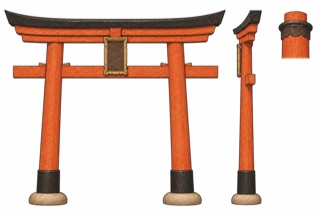
- Torii fall into two families: the straight-beamed shinmei type and the myōjin type, whose top beam curves upward above a second beam.
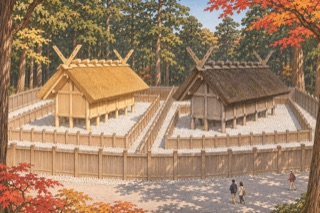
- Every 20 years Ise Shrine rebuilds its main sanctuaries on an adjacent site; the 62nd rebuilding took place in 2013.
- The standard way to pray is two bows, two claps and one bow; a few shrines such as Izumo Taisha use four claps.
Almost every visitor to Japan walks through a torii gate within a day or two of arriving, often without quite knowing what it marks. Behind it there is usually a gravel path, a stone basin of running water, a few very old trees and a modest wooden hall. This is a Shinto shrine, and there are more than eighty thousand of them across the country, from the vast forest precinct of Ise to a roadside box the size of a birdhouse. Shinto has no founder, no scripture that believers study, and very little doctrine, and most Japanese people will tell you they are not religious. Yet the same people visit a shrine at New Year, bring their newborns to be blessed, have their new cars purified and keep a small shelf of shrine talismans high on a wall at home. This piece explains what the kami are, why shrines look the way they do, how Shinto came to be what it is today, and how to make sense of what you see when you visit one.
01A Religion of Practice
Most of the world’s large religions can point to a founder and a sacred book. Shinto has neither. It grew out of the rituals that communities across the Japanese islands performed for mountains, rivers, rocks, trees, ancestors and the forces of weather. Once wet-rice farming took hold in the Yayoi period, roughly from the first millennium BCE, those rituals became tied to the agricultural year: prayers for a good harvest in spring, thanks and offerings of new rice in autumn. The word "Shinto," written with characters meaning "the way of the kami," came later. It appears in the Nihon shoki, a court chronicle completed in 720, where it is used to distinguish native worship from the newly arrived Buddhism.
Because it does not rest on a revelation, Shinto cares far less about belief than about action. People rarely ask whether someone "believes in Shinto." They simply rinse their hands at a shrine, bow, clap, and ask a priest to bless a building site before construction. Scholars often describe it as a religion of matsuri, a word that means both festival and the act of serving the kami. A matsuri, at its core, is hospitality: the kami is invited, offered food and sake, entertained with music and dance, addressed with prayers called norito, and then sent back.
All of this depends on purity. The central negative idea in Shinto is not sin but kegare, pollution. Death, blood and illness produce it, and ordinary life accumulates it the way a house accumulates dust. It is not a moral failing, and it can be removed through harae, purification, using water, salt, the white paper wand called a haraegushi and spoken formulas. Much of what happens at a shrine, from the hand-washing basin to the priest’s waving wand, is about returning people to a clean, bright state in which they can meet the kami.
This focus on practice also explains why Shinto sits so comfortably alongside other religions. A Japanese family may hold a wedding at a shrine, a funeral at a Buddhist temple and a Christmas dinner at home without feeling any contradiction. Shinto has traditionally looked after the life of the community and the turning points of living: birth, growing up, marriage, harvest, building, the new year. Death and the afterlife were, for most of Japanese history, left to Buddhism.
02What the Kami Are
The Japanese word kami is usually translated as "god" or "deity," but neither fits well. The most quoted definition comes from Motoori Norinaga, an eighteenth-century scholar who spent more than thirty years writing a commentary on the Kojiki, the oldest Japanese chronicle. In his view, anything that is extraordinary, possesses superior power and inspires awe can be called kami. That awe includes the frightening as well as the good. A great mountain, a waterfall, a huge camphor tree, thunder, a fox, a snake or a person whose angry spirit refuses to rest can all be kami.
Japanese speak of yaoyorozu no kami, the "eight million kami," meaning simply countless. Some of them are figures from mythology with names and stories, recorded in the Kojiki (712) and the Nihon shoki (720): Amaterasu Ōmikami, the sun goddess; her violent brother Susanoo; Izanagi and Izanami, the couple who created the islands; Ōkuninushi, who built up the land of Izumo. The imperial house traces its descent from Amaterasu, a claim that would shape Shinto’s political fate in the modern era.
Most kami are humbler. Every neighborhood has its ujigami, a tutelary kami who protects the local community, and the people who live in its territory are its ujiko, literally "children of the clan deity." Some kami were once human beings. Sugawara no Michizane, a ninth-century scholar and statesman, died in exile in Kyūshū in 903; when lightning and disasters then struck the capital, the court concluded that his angry spirit was responsible and enshrined him as Tenjin, the heavenly deity. Over the centuries he became the patron of learning, and today students crowd Kitano Tenmangū in Kyoto and Dazaifu Tenmangū in Kyūshū before entrance exams. Tokugawa Ieyasu, the founder of the last shogunate, was enshrined after his death in 1616 as Tōshō Daigongen and worshiped at the lavish shrine at Nikkō. The idea that powerful or resentful dead can be calmed by being honored as kami runs deep in Japanese religion.
Many kami are inseparable from a place. Ōmiwa Shrine in Nara has no main sanctuary at all; worshipers pray through the hall toward Mount Miwa behind it, because the mountain itself is the kami’s body. The island of Okinoshima, out in the strait between Kyūshū and Korea, is considered so sacred that the whole island is treated as a shrine. Archaeologists recovered some 80,000 ritual offerings there dating from the fourth to the ninth centuries, and the island and associated sites of Munakata Taisha were listed as a UNESCO World Heritage site in 2017.
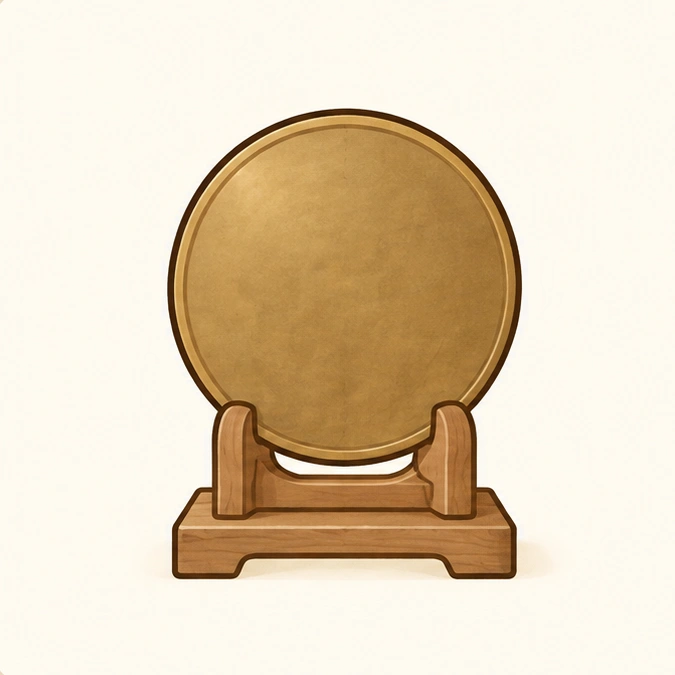
Shrines generally have no images; the kami dwells in a shintai such as a mirror, hidden inside the sanctuary.
Shinto shrines generally have no images of the kami. The kami is thought to dwell in a shintai, an object such as a mirror, a sword, a stone or a paper wand, kept wrapped and hidden inside the sanctuary. Even priests rarely see it. What visitors do see are the kami’s messengers. Inari shrines are guarded by stone foxes. At Kasuga Taisha in Nara, the deer that wander the park and bow for crackers are regarded as messengers of the kami. Hachiman is associated with doves, and the Kumano shrines with the three-legged crow Yatagarasu. The most widespread shrine networks, those of Inari, Hachiman, Tenjin and Kumano, each count thousands of branch shrines, and each has a story of its own.
 Deep diveDivine Messengers and KomainuWalk into almost any Shinto shrine and an animal meets you before anything else does.7 chapters
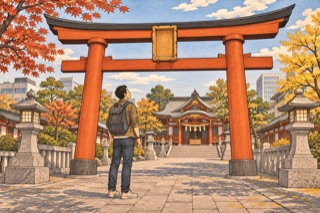 Deep diveReading Shrine NamesWalk up to almost any Shinto shrine in Japan and look at the wooden plaque hanging from the torii gate or the main entrance.8 chapters
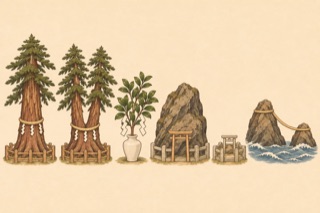 Deep diveSacred Trees and StonesWalk into almost any Shinto shrine and something older than the buildings is usually waiting for you.9 chapters
03Reading a Shrine: Torii, Approach and Halls
A shrine begins at its torii. The basic form is two upright posts, a top crossbeam called the kasagi, and a lower tie beam called the nuki that passes through the posts. It has no doors and cannot be closed. Its job is not to keep anyone out but to mark a boundary: beyond this point is the realm of the kami. Many Japanese pause and bow slightly before passing through a torii, and turn and bow again when they leave, as they might at the entrance to someone’s home.
There are dozens of named torii styles, but most fall into two families. The shinmei torii is the plainest: straight posts, a straight top beam, usually of unpainted wood. The torii at Ise Shrine belong to this type (though their posts lean slightly inward), and they have the clean austerity of a brushstroke. The myōjin torii has a top beam whose ends curve upward, with a second beam, the shimaki, beneath it, slightly inward-leaning posts and often a central plaque bearing the shrine’s name. Most of the bright vermilion gates you see across Japan are variations on this type. Among the variants are the ryōbu torii of Itsukushima, whose two main pillars are each braced by a smaller post in front and behind, four braces in all; the sannō torii of Hiyoshi Taisha near Lake Biwa, which carries a small triangular gable on top; and the triple mitsu-torii at Ōmiwa Shrine.
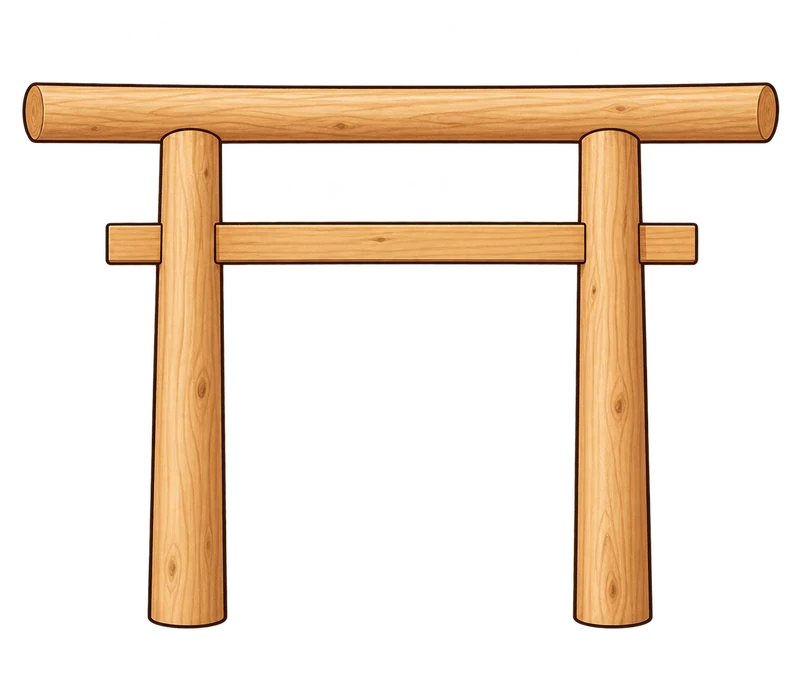
Shinmei type: straight top beam, upright posts, usually unpainted wood.
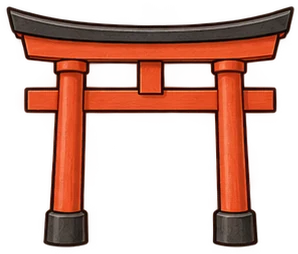
Myōjin type: upturned top beam with the shimaki beneath and a central plaque, usually vermilion.
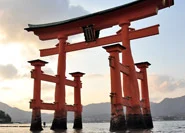
Itsukushima Shrine’s great torii at high tide. The present gate, built in 1875, stands in the sea under its own weight.
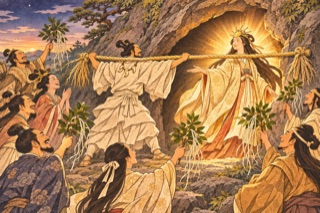
No one knows for certain where the name or the form came from. "Torii" can be read as "bird perch," and a popular explanation links it to the myth in which the kami lure the sun goddess out of the cave where she has hidden by setting roosters crowing. Others compare it to the torana gateways of Indian Buddhist stupas, the ornamental huabiao columns of China or the red gates of Korea. All of these are hypotheses. The word is attested in Heian-period texts, by one account first in the Kōtai Jingū gishikichō, a record of Ise submitted in 804, early in the period, and the vermilion color that most people now associate with torii is generally linked to lacquer and pigment techniques that came with Buddhist architecture. Red is also traditionally thought to ward off evil.
Two torii are worth a special journey. The great torii of Itsukushima Shrine on Miyajima stands in the sea off the island, seeming to float at high tide and reachable on foot across the sand at low tide. The present gate, completed in 1875, is about 16.6 meters tall, and its main pillars are massive camphor trunks. It is not sunk into the seabed, though pine piles are driven in beneath its pillars; it stands by its own weight of some sixty tons, helped by stones packed into the box-shaped upper beams. It was wrapped in scaffolding for repairs from 2019 to 2022. At Fushimi Inari Taisha in Kyoto, the effect is the opposite of solitary grandeur. Thousands of vermilion torii stand almost shoulder to shoulder along the paths up Mount Inari, forming tunnels of orange light; across the whole mountain there are said to be around ten thousand. Each was donated by a person or a company, whose name and the date are painted in black on the back. The custom spread in the Edo period, and you can still pay to dedicate one, priced by size. Inari began as a kami of rice and became a kami of business prosperity, so these tunnels are in effect several centuries of merchants’ prayers and thank-you notes.
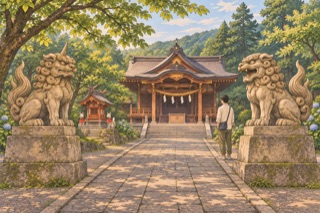
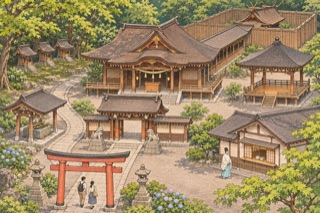
Beyond the torii runs the sandō, the approach. It is often covered in gravel, which crunches underfoot. The center of the path is said to belong to the kami, so worshipers tend to walk slightly to one side. Along the way you will usually meet a pair of guardian lion-dogs called komainu, one with its mouth open and one with it closed, representing the sounds "a" and "un," the beginning and end of all things. At Inari shrines they are replaced by foxes, often holding a jewel, a key or a sheaf of rice in their mouths.
Next comes the temizuya, a stone basin with water flowing from a bamboo pipe or a dragon’s mouth, with long-handled ladles laid across it. This is a miniature version of misogi, the ancient practice of purifying oneself by immersion in a river or the sea. Further in stand the main buildings. In most shrines the front building is the haiden, the worship hall, where visitors make their offering and pray. Behind it is the honden, the sanctuary where the kami resides, which ordinary visitors do not enter. Between them there is sometimes a heiden, a hall for presenting offerings. Thick ropes of rice straw, called shimenawa, hang across entrances and around sacred trees and rocks, with zigzag strips of white paper called shide hanging from them. Both mark the edge of sacred space. An old tree wrapped in shimenawa is a shinboku, a sacred tree.
- 1Toriibeyond it, the realm of the kami
- 2Sandōthe center belongs to the kami; walk to one side
- 3Komainuone mouth open, one closed
- 4Temizuyaa miniature version of misogi
- 5Haidenmake an offering and pray
- 6Heiden (sometimes)for presenting offerings
- 7Hondenwhere the kami resides; not entered
Laid out from the entrance inward: visitors pray at the haiden, while the honden behind it, where the kami resides, is not entered.
Shrine buildings come in a few ancient styles. The shinmei-zukuri of Ise, the taisha-zukuri of Izumo and the sumiyoshi-zukuri of Sumiyoshi Taisha in Ōsaka are thought to preserve the look of Japanese architecture before Buddhist influence: raised floors, straight lines, thatched or cypress-bark roofs, crossed finials called chigi projecting from the ends of the ridge, and short logs called katsuogi laid across it. Later styles followed, such as the nagare-zukuri, with a front eave that sweeps far forward over the steps (by some accounts also shaped by Buddhist temple architecture), now the most common shrine style in Japan, and the hachiman-zukuri, generally thought to show temple influence, with a front hall and a rear hall joined under connected roofs.
 Deep diveToriiA torii is two posts and one or two crossbeams, with no doors, no walls and no lock.8 chapters
 Deep diveShrine ArchitectureMost visitors to a Shinto shrine photograph the torii gate, the vermilion pillars and the bell rope in front of the hall, and leave thinking they have seen the shrine.8 chapters
 Deep diveShimenawa, Shide and GoheiWalk into almost any Shinto shrine in Japan and you will pass under a rope.9 chapters
04Ise and Izumo
As of the end of 2024 Japan had more than 80,000 shrines. Of them, two hold a special place.
Ise Jingū in Mie Prefecture is officially called simply Jingū, "the Shrine." It consists of the Inner Shrine, Naikū, dedicated to Amaterasu, and the Outer Shrine, Gekū, dedicated to Toyouke, the kami of food who provides Amaterasu’s meals, together with 123 smaller affiliated shrines. By custom, pilgrims visit Gekū first. At Naikū you cross the Uji Bridge over the clear Isuzu River and walk through towering cryptomeria to the main sanctuary, which is enclosed by four layers of wooden fences. Visitors pass through the outermost fence and pray at the gate of the second, catching only a glimpse of thatched roofs, plain cypress finials and gold fittings beyond.
What makes Ise unique is the Shikinen Sengū, the ritual rebuilding. Every twenty years the main sanctuaries are reconstructed exactly on an adjacent plot, the kami is transferred to the new buildings in a night-time ceremony, and the old ones are dismantled. Tradition dates the first rebuilding to 690, in the reign of Empress Jitō. Apart from an interruption of more than a century during the civil wars of the fifteenth and sixteenth centuries, it has continued ever since; the 62nd took place in 2013, and the 63rd is planned for 2033. Timber must be prepared years in advance, and carpenters pass their skills on by actually building the shrine once a generation. Instead of making a building last forever, Ise keeps it forever new, an ideal expressed in the word tokowaka, "eternally young."
In the Edo period, a pilgrimage to Ise was the dream of a lifetime for ordinary people. Agents called oshi organized pilgrim associations across the country and delivered Ise talismans to households. Every few decades a mass pilgrimage, the okage mairi, swept the country, with millions on the road, some of them servants and children who left without telling their masters or parents and survived on alms along the way. The busy streets of Oharai-machi and Okage Yokochō in front of Naikū today recreate that pilgrim-town atmosphere, with shops selling akafuku, a sweet rice cake topped with red bean paste.
Izumo Taisha in Shimane Prefecture is dedicated to Ōkuninushi. In myth he ceded the land he had built to the descendants of Amaterasu, and in return a great palace was built for him. The present main hall rises about 24 meters, the tallest surviving shrine sanctuary in Japan, and tradition says the ancient hall stood twice that height. In 2000, excavations in the precinct uncovered the bases of enormous pillars, each made of three cedar trunks bound together, giving that tradition some support. At Izumo the standard etiquette also differs: two bows, four claps and one bow. In the tenth month of the old lunar calendar, the rest of Japan calls the month Kannazuki, "the month without kami," because the kami are said to have gone to Izumo to confer about the fates and relationships of human beings. In Izumo it is Kamiarizuki, "the month with kami." Ōkuninushi is consequently revered as a kami of good relationships, and many young visitors come to pray for a partner.
05From Buddhist Fusion to State Shinto
The Shinto you see today is the result of more than a thousand years of entanglement with Buddhism and with the state.
In the late seventh and eighth centuries, the centralized imperial state created a Department of Divinities, the Jingikan, and brought important shrines into a system of state rites. The Engishiki, a code of procedures completed in 927, includes a register listing 2,861 shrines that received official offerings. Shrines named in it are still proudly called shikinaisha, and inclusion is the main proof of a shrine’s antiquity.
At almost the same time, Buddhism was spreading rapidly, and the two traditions began to merge, a process known as shinbutsu shūgō. Temples built shrines for protective kami, shrines acquired attached temples, and monks chanted sutras before the kami. By the Heian period a theory called honji suijaku, "original ground and manifest traces," held that the buddhas and bodhisattvas were the true forms and that the kami were their local manifestations, sent to save the people of Japan. Hachiman became Hachiman Daibosatsu, "Great Bodhisattva Hachiman," and the kami of Kumano were identified with buddhas such as Amida and given the title gongen, "provisional manifestation." For most of the medieval and early modern periods, shrines and temples shared grounds and staff, and the mountain ascetics of Shugendō worshiped kami and buddhas together. This blended state was the norm in Japanese religion for roughly a millennium.
There were countercurrents. In the fifteenth century, Yoshida Kanetomo, a priest of Yoshida Shrine in Kyoto, promoted what he called Yuiitsu Shinto, "One-and-Only Shinto," which made the kami primary and Buddhism secondary. In the Edo period, scholars of the kokugaku or "national learning" movement, Motoori Norinaga chief among them, studied the Kojiki to recover what they believed was an ancient Japanese way untainted by Buddhism and Confucianism. Their ideas fed into the movement to restore the emperor to power.
The Meiji Restoration brought the sharpest break. In 1868 the new government issued orders separating kami from buddhas: Buddhist images were to be removed from shrines, Buddhist titles such as gongen and bosatsu were banned for kami, and monks could no longer run shrines. A wave of anti-Buddhist destruction known as haibutsu kishaku followed in many regions, and countless statues, scriptures and temples were destroyed. The five-story pagoda of Kōfuku-ji in Nara is said to have been put up for sale for a trivial sum before it was spared. The clear line between shrines and temples that visitors see today is largely a product of the past 150 years.
The Meiji state then declared shrines to be "the nation’s rites," placed them under government administration and funded the major ones. It also argued that shrine worship was a civic duty rather than a religion, which allowed it to require reverence from everyone, Buddhists and Christians included. Schools enshrined portraits of the emperor and the Imperial Rescript on Education, and shrines were built across Japan’s colonies and occupied territories. This system, later called State Shinto, became bound up with militarism and war. Yasukuni Shrine in Tokyo began in 1869 as Tokyo Shōkonsha, a shrine for soldiers who died fighting for the new government in the Boshin War, and grew into the place where Japan’s war dead are enshrined. Its enshrinement of convicted Class A war criminals in 1978 has made visits by Japanese politicians a recurring diplomatic issue with China and South Korea.
In December 1945 the Allied occupation issued the Shinto Directive, severing all ties between the state and shrines. In February 1946 most shrines joined a new religious corporation, the Association of Shinto Shrines (Jinja Honchō), and Shinto began again as an ordinary religious body. As of the end of 2023 the association included roughly 78,000 shrines and regards Ise as its supreme sanctuary, while a number of shrines remain independent.
06The Kamidana: A Shrine at Home
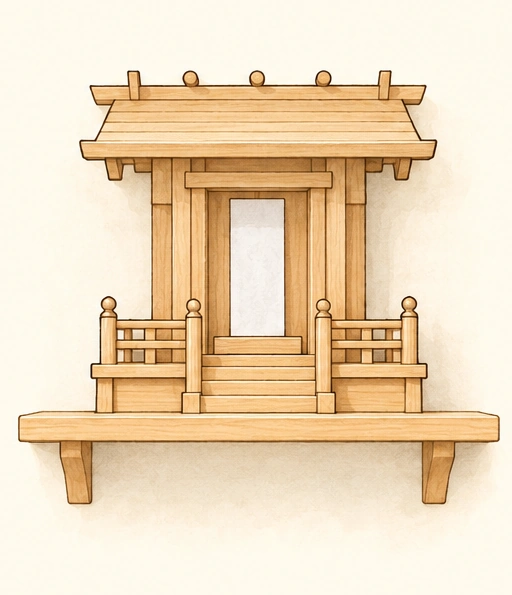
Shinto does not live only in shrines. Many Japanese households, especially older homes and family businesses, have a kamidana, literally a "kami shelf": a small wooden shelf fixed high on a wall of the living room, holding a miniature shrine.
The heart of a kamidana is the ofuda, a talisman of wood or paper, wrapped in white paper and inscribed with the name of a kami. It is understood as a share of the kami’s presence, carried home from a shrine. A standard three-door miniature shrine holds three ofuda: in the center the Jingū taima, the talisman of Ise inscribed with the name of Amaterasu; on the right as you face it, the ofuda of the local tutelary shrine; and on the left, that of any other shrine the family particularly reveres. If the miniature shrine has only one door, the three are stacked, with Ise’s in front. In the Edo period the oshi of Ise carried these talismans to households all over Japan; since the Meiji era the Grand Shrine has produced them centrally and distributed them through local shrines, and handing them out at the end of the year is still a major task for neighborhood priests.
Where the shelf goes matters. It should be above eye level so that people look up to it, ideally facing south or east toward the sun. It should not hang over a doorway or next to a toilet, nor in a corridor where people constantly pass. If there is another floor above, so that people would walk over the kami’s head, families paste a slip of paper reading 雲 ("cloud") or 天 ("heaven") on the ceiling above the shelf, as if to say that only sky lies overhead. Sprigs of evergreen sakaki stand in vases on either side, a short shimenawa hangs across the front, and sometimes there is a small mirror.
Every morning someone in the household sets out fresh rice, salt and water, adding sake, vegetables or fish on the first and fifteenth of the month and on festival days. Then they stand before the shelf and bow twice, clap twice and bow once, greeting and thanking the kami as they would at a shrine. Ofuda are replaced every year. The old ones are returned to the shrine after New Year and burned in bonfire festivals such as dondo-yaki in mid-January, along with the year’s New Year decorations.
- 1
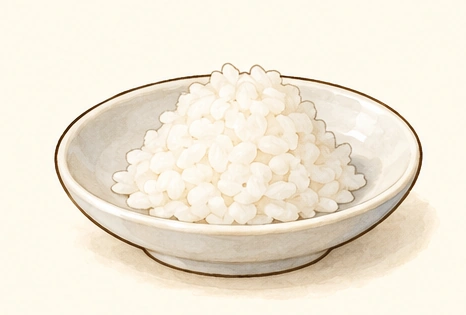 Fresh rice.
- 2
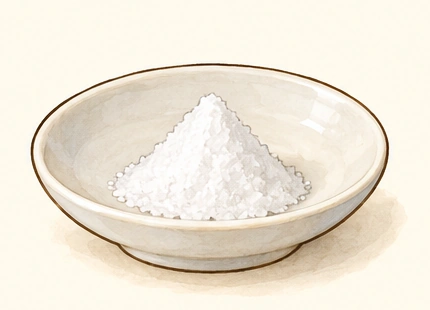 Salt.
- 3
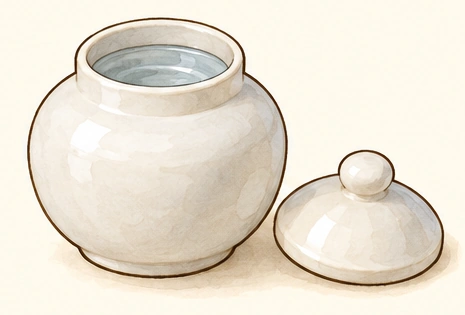 Water.
- 4
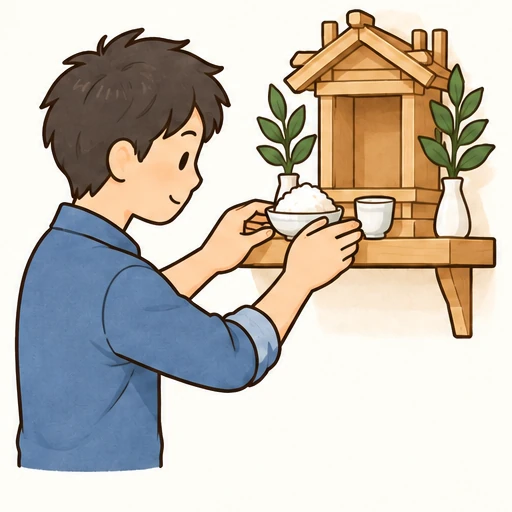 Set the rice, salt and water on the shelf, between the sprigs of sakaki.
- 5
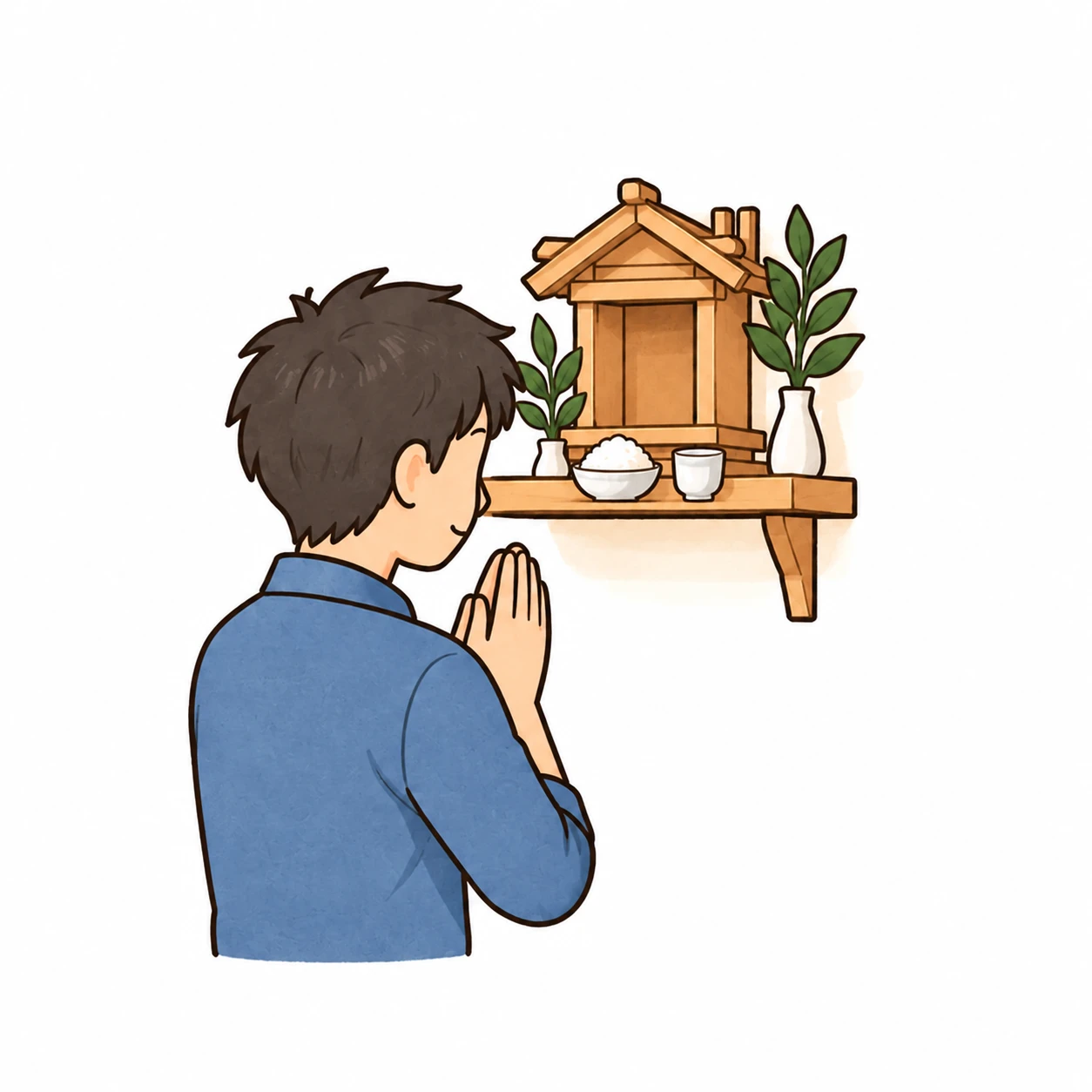 Bow twice, clap twice and bow once, greeting and thanking the kami.
A kamidana is not the same as a butsudan, the Buddhist altar that holds memorial tablets for a family’s dead, and many homes have both. The kamidana is placed high and concerns protection and prosperity; the butsudan sits lower and is where the family remembers its ancestors. When someone in the household dies, the traditional practice is to cover the kamidana with white paper and suspend offerings for a period, because death brings pollution. Young people in city apartments seldom have a kamidana today, but you will see them constantly in restaurants, shops, factories, sumo stables and construction company offices, and there are now simple wall-mounted holders for a single ofuda. That little wooden shrine with paper streamers and green leaves above the counter of an izakaya is the owner’s kamidana.
07Matsuri: The Shrine at Full Volume
Visit a shrine on an ordinary day and you see Shinto at its quietest. The loudest days are festivals. The essential part of a matsuri takes place in the sanctuary, where priests present food offerings and read norito, and the public usually does not see it. The parade is the other half: the kami is moved into a portable shrine, a mikoshi, and carried through the streets by the people of the parish so that it can see its territory and spread its power along every lane. Bearers chant and deliberately shake the mikoshi, which is said to invigorate the kami inside.
Kyoto’s Gion Matsuri, the festival of Yasaka Shrine, traces its origin to 869, when an epidemic swept the capital and people erected sixty-six halberds, one for each province, in a rite to pacify the spirits thought to cause disease. Today it runs through the whole of July, and its high points are the processions of the yamahoko floats on July 17 and 24, when enormous wooden floats, the tallest rising more than 20 meters from the wheels to the tip of their poles, are hauled by hand through the city and turned at intersections by sliding them over split bamboo. With Tokyo’s Kanda Matsuri and Ōsaka’s Tenjin Matsuri, it is counted among Japan’s three great festivals.
Shrines also offer the kami entertainment called kagura. At a large shrine this may be a slow dance by miko, shrine maidens in white robes and red trousers, holding bells and fans. In the countryside kagura grew into masked theater that retells myths. The all-night yokagura of Takachiho in Kyūshū and the fast-paced Iwami kagura of Shimane, in which a great serpent coils across the stage breathing smoke and fire, are both well known.
08Visiting a Shrine
If you have only one chance to visit a shrine properly in Japan, here is how it usually goes. At the torii, stop, take off your hat and bow slightly, then pass through to one side rather than straight down the middle. At the temizuya, take the ladle in your right hand, fill it, and pour water over your left hand. Switch hands and rinse your right. Switch back, pour a little water into your cupped left palm and rinse your mouth with it, never touching the ladle to your lips. Rinse your left hand once more, then tilt the ladle upright so the remaining water runs down the handle, and put it back. One scoop of water should be enough for the whole sequence. Since the pandemic, some shrines have removed the ladles and simply let water run from a pipe; follow whatever arrangement you find.
- 1Ladle in right hand: rinse the left
- 2Switch hands: rinse the right
- 3Switch back: rinse your mouth from the left palmnever touch the ladle to your lips
- 4Rinse the left hand once more
- 5Tilt the ladle upright to rinse the handle, put it back
One scoop of water is enough for the whole sequence; where the ladles have been removed, follow whatever arrangement you find.
At the worship hall, bow lightly and drop a coin into the offering box. The amount is up to you; many people choose a five-yen coin because go-en also sounds like the word for a fortunate connection. If there is a bell, shake the thick rope to ring it. Then bow deeply twice, clap twice at chest height, keep your palms together for a moment of silent prayer, and bow once more. This "two bows, two claps, one bow" became the standard form only in the modern era; Izumo Taisha and Usa Jingū, among a few others, use four claps. Traditionally you first tell the kami your name and address, then give thanks, and only then make your request.
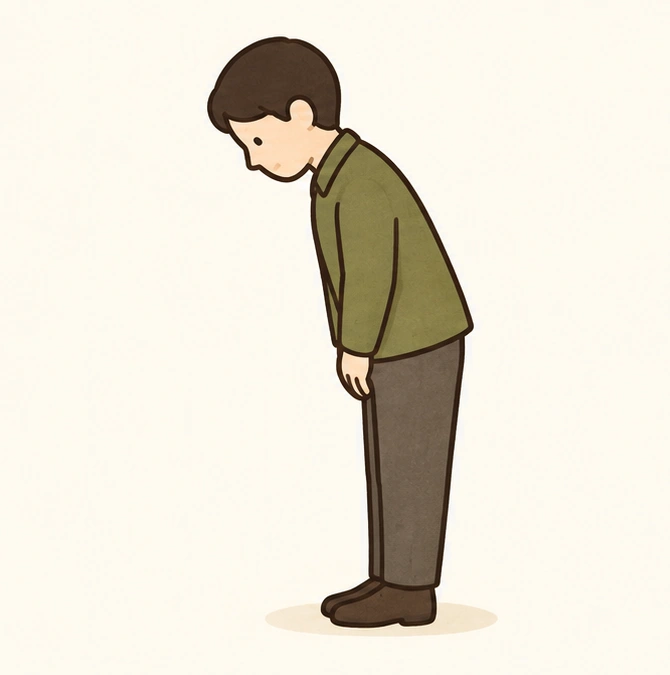
Bow deeply twice before the worship hall.
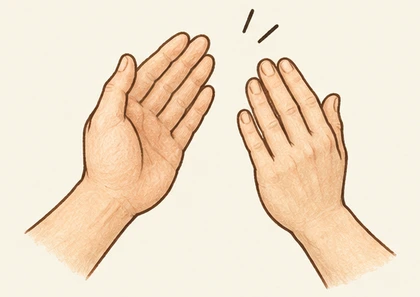
Clap twice at chest height, pray with palms together, then bow once more.
Afterward, stop at the counter where shrine items are offered. Omikuji are paper fortunes ranging from great blessing to great misfortune; if you draw a bad one, tie it to the rack or tree provided and leave it behind. Omamori are amulets in brocade pouches for safe driving, exam success, safe childbirth or finding love. Ema are small wooden plaques on which you write a wish and hang it up. Goshuin are calligraphed and stamped seals that record your visit, and collecting them in a special book has become very popular. Each of these deserves its own explanation.
A few things to keep in mind: do not enter the sanctuary or fenced areas, do not photograph priests or miko during rituals without permission, and check notices before photographing the main hall, which some shrines forbid. Eating while walking on the approach is frowned upon. Some Japanese avoid shrines while in mourning, a custom rooted in the idea of pollution, usually for fifty days.
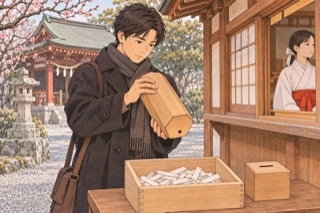
Shrines also mark the stages of Japanese life. About a month after birth, parents and grandparents bring the baby to the local shrine for hatsumiyamairi, its first shrine visit. Around November 15, boys aged three and five and girls aged three and seven (by traditional count, though many families now use actual age) are dressed in kimono for shichi-go-san, "seven-five-three," and you will see them clutching long bags of red-and-white chitose-ame candy. The Shinto wedding, in which a priest presides and the couple exchange three rounds of sake, is younger than it looks: it became popular only after the crown prince, later Emperor Taishō, married before the palace sanctuary in 1900, and Tokyo shrines then designed a version for ordinary couples. People in their yakudoshi, years considered unlucky (traditionally 25, 42 and 61 for men, and 19, 33 and 37 for women, counted in the old way with a person being one year old at birth), go to a shrine for purification. Before a house is built, a priest performs a jichinsai on the empty lot, enclosed by four bamboo poles and a rope, to greet the kami of the land and ask permission.
And at New Year almost everyone goes. In the first days of January, crowds queue for an hour or more in the cold at Meiji Jingū in Tokyo, which drew around three million visitors in the first three days of 2009 by the National Police Agency’s count, to toss a coin and clap twice. Many people make that hatsumōde visit at Buddhist temples like Naritasan Shinshō-ji or Kawasaki Daishi instead, and few worry about the difference.