
Walk into almost any Shinto shrine in Japan and you will pass under a rope. It may be thick as a tree trunk or thin as a washing line, golden-green and fresh or grey with weather, and it will almost always carry a few strips of white paper folded into zigzags. The rope is a shimenawa, the paper is shide, and together they do one simple job: they say "on this side, ordinary ground; on that side, something else." The same paper, mounted on a stick, becomes a gohei offered on the altar or an ōnusa wand that a priest swings over your head. This guide takes the pieces apart: the main rope shapes, the nearly five-tonne giant at Izumo, the folding schools behind the paper zigzags, the places ropes get tied, and the giant grass ring that appears at shrine gates every June.
01A Line, Not a Knot
The oldest story about a sacred rope comes from the Kojiki, Japan’s eighth-century chronicle of myths. The sun goddess Amaterasu, offended by her brother, shuts herself in a cave called the Ama-no-Iwato, and the world goes dark. The other gods hold a noisy festival outside; when she peeks out to see what the fuss is about, one god pulls her into the open and another, Futodama, stretches a rope across the cave mouth behind her, telling her she may not go back. The rope in the text is called a shirikume-nawa, usually understood as a straw rope whose ends are left uncut and tucked in rather than trimmed off.
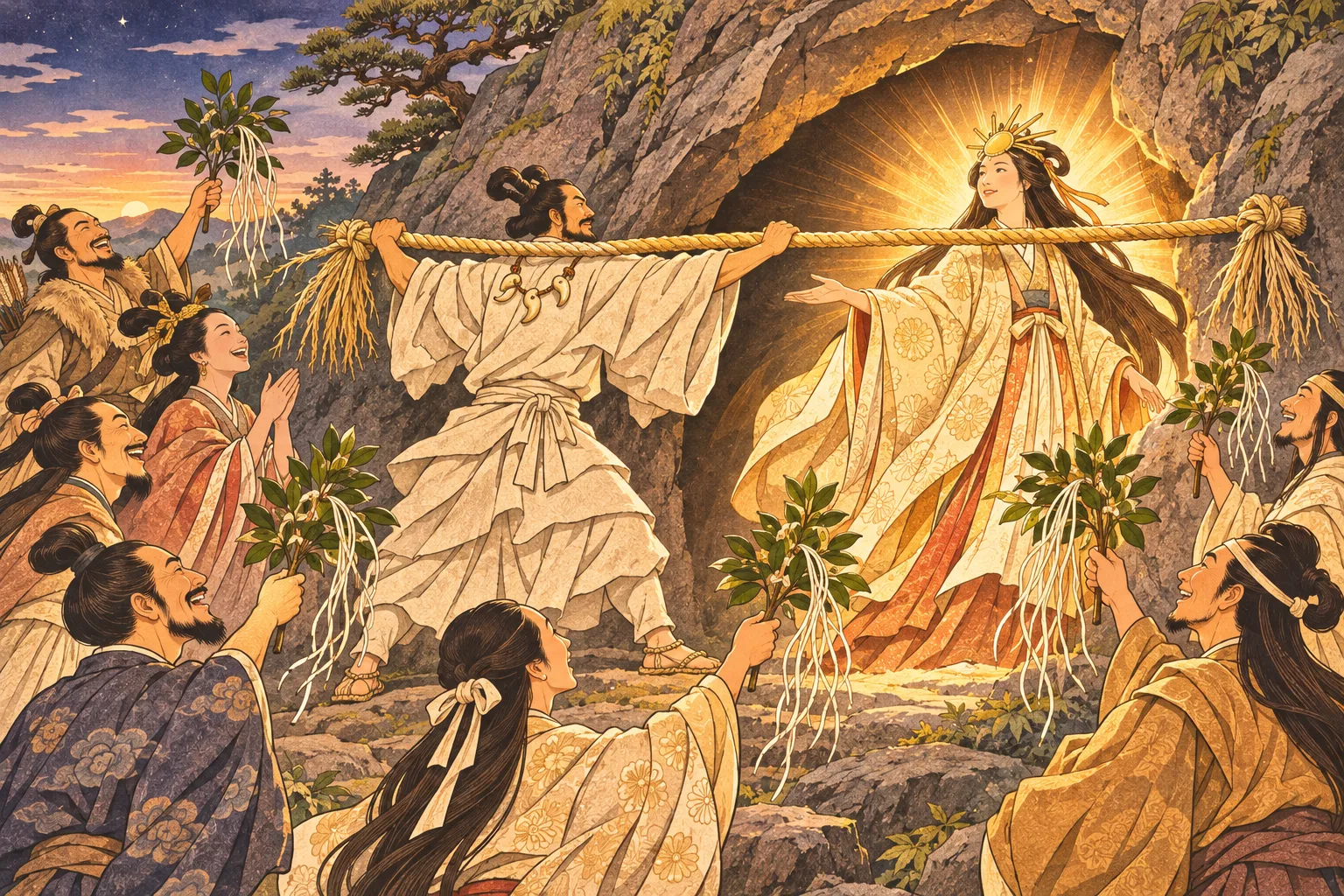
As Amaterasu steps out of the cave, a god stretches a rope across the entrance behind her so that she cannot go back in: the first sacred rope, as the Kojiki tells it. (artist’s impression)
That rope does not tie anything up. It draws a boundary. This is still the core of what a shimenawa means: inside the rope is a place belonging to a kami (a Shinto deity or spirit), or a place that has been purified; outside is the everyday world, with its everyday dirt. A rope can mark the entrance to a shrine, enclose a sacred tree, frame a rock where a god is believed to descend, or fence off a building site for a single morning’s ceremony.
The word itself has several spellings, all pronounced shimenawa. One borrows Chinese characters meaning roughly "pour and connect"; one uses the character for "sign" or "mark"; and one is written with the numbers seven, five and three, usually explained by the bunches of straw that hang off certain ropes in groups of seven, five and three. The verb shimeru carries the sense of claiming or enclosing, so there is a hint of "this space is taken" in the name.
Most Japanese people today treat shimenawa without much theology. You don’t step over one, you don’t tug it, and you lower your voice a little when you pass under it. Many households hang a small rope decoration on the front door at New Year and put a fresh rope on the household altar, which is less a statement of belief than a seasonal habit, like changing curtains.
02Straw, Hemp and a Backwards Twist
The classic material is rice straw. Rice is the crop that Japanese ritual is built around, and a rope of rice straw hung before a kami is, in part, the harvest given back. The best ropes are not made from the dry yellow straw left after harvest. Instead, rice is cut green in summer, before the grain ripens, and dried slowly so it keeps a pale green-gold colour. Some communities grow rice for this alone; the makers of Izumo’s great rope grow glutinous varieties in their own paddies. A newly hung rope made this way looks bright and smells faintly of hay; after a year in the sun it fades to a dusty brown.
The other traditional material is asa, hemp fibre. Hemp was the everyday cloth of ancient Japan and was thought to have purifying power, so it turns up throughout Shinto ritual: in some ropes, in the tassels of priests’ wands, and in the thick bell-ropes (suzu-no-o) that worshippers shake at the hall of worship. One view holds that hemp was once the usual rope material and that straw became standard only after post-war laws restricted hemp growing.
Shimenawa are usually twisted in the opposite direction to ordinary rope. Everyday straw rope in Japan is generally twisted to the right; sacred rope is hidari-nai, left-twisted, which is usually explained as a way of setting the sacred apart from the mundane. What counts as "left" depends on who you ask (the twister’s hands, or the direction the spiral runs when you look at the finished rope) and village rope-makers often have their own house rules.
Making a big rope is a community job. In late autumn or early winter, people gather in a shrine yard or village hall. Several workers twist bundles of straw into thick strands, others stuff more straw into the core to give the rope its belly, and finally the strands are wound together and the surface trimmed of stray ends. In many places the rope is replaced every year at the end of December. The old one goes back to the shrine and is burned in mid-January, along with pine decorations and other New Year ornaments, in bonfires known as sagichō or dondo-yaki.
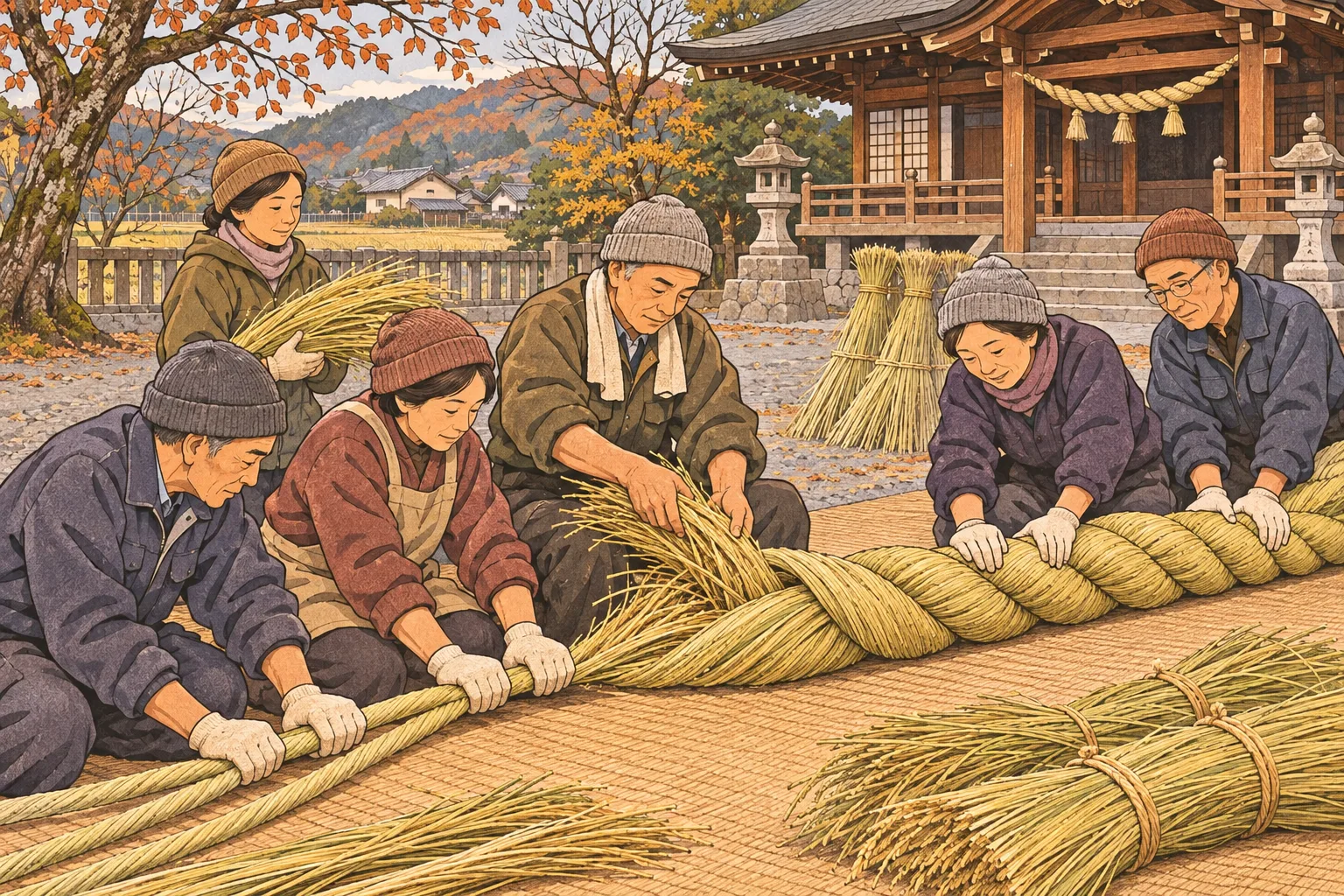
Villagers gather in front of their shrine in late autumn to make a big rope, twisting rice straw into thick strands and then twisting the strands together.
That cycle has become harder to keep up. Modern combine harvesters chop straw as they cut, so long unbroken stalks are scarce, and the people who know how to twist a large rope are ageing. Many shrines now hang synthetic ropes made of polyethylene or vinyl fibres dyed to imitate straw. They survive years of rain and sun without rotting. Up close you can usually tell: real straw has uneven thickness, broken ends and a colour that shifts with age, while the synthetic version has suspiciously uniform "stalks" and barely fades. Some shrines use synthetic rope in exposed spots and straw for the main hall; others refuse plastic altogether.
03Four Shapes to Recognise
Japan has dozens of local names for rope shapes, but most of what you will see at a shrine falls into four families.
The daikon-jime is named after the daikon radish. As the term is generally used, it is fat in the middle and tapers at both ends, like a spindle or a cigar. Hung between two posts, it sags into a heavy curve with the thickest part at the lowest point. Large shrines often hang this type under the eaves of the hall of worship.
The gobō-jime is named after burdock root. Strictly it means straw bound tightly into a long, slim rod, slimmer than a daikon rope; at shrines today the name usually means a rope that tapers steadily from a fat end (moto, the root, where the twisting starts) to a thin end (sue, the tip). Because it is lopsided, it raises an obvious question: which side does the fat end go on? (More on that in the next section.)
The maedare-jime, "front-hanging rope", is a name used somewhat loosely from region to region, but it generally means a rope defined less by itself than by what dangles from it. The rope itself is fairly even and can be quite slim. Hanging from it at intervals are bunches of straw with neatly trimmed ends, called tare ("hangings"). Bunches are often arranged in odd numbers, three, five or seven, which is usually given as the source of the "seven-five-three" spelling of shimenawa. Many shrines alternate straw bunches and paper zigzags along the same rope, so from a distance it reads as a row of gold and white.
The wakazari, "ring decoration", is a short length of rope bent into a loop, with a tuft of straw left hanging and often a paper strip tucked in. It fits in your hand. At New Year people hang them in the kitchen, by the well, on the storehouse or toilet door (places associated with the small household gods), and these days sometimes on a car’s front grille or a bicycle basket. At shrines they tend to be plain: a straw circle and a single strip of paper.
There are other forms too, such as a rope fat at both ends and narrow in the middle, shaped like an hourglass drum, or ropes with knots of straw bunched along their length. But if you ask three questions (Is the rope symmetrical or lopsided? Does straw hang from it? Is it stretched straight or bent into a ring?) you can place almost any rope you meet.
04Izumo’s Giant and the Left–Right Question
The rope everyone photographs is the one at Izumo Taisha in Shimane Prefecture, hanging across the front of the Kagura-den, the hall used for ceremonies and sacred dances. It is 13.6 metres long, weighs about 4.7 tonnes and measures some 8 metres round at its fattest, hung about 5 metres off the ground. It is made of two enormous straw ropes twisted together, fattest a little left of centre, where it is as thick as a large tree trunk, and narrowing towards both ends. Facing the hall, the left end is a blunt, tightly bound stump; the right end tapers away to a point. Three huge bell-shaped straw tassels hang beneath it, with paper shide between them. Standing underneath, you see the two strands spiralling round each other and the whole mass sagging overhead. It is replaced every six to eight years, most recently in July 2026, by a shimenawa cooperative in the town of Iinan, inland in Shimane, whose people have made Izumo’s big ropes since the late 1950s or early 1960s. They grow the rice, cut it green in midsummer, build the core and wrap it, then twist two huge ropes into one with a crane and many hands before it travels by truck to Izumo and is lifted into place by crane. The shrine also has a smaller rope on its main worship hall, 6.5 metres long and about a tonne. Many visitors toss coins up at the big rope, hoping one will stick and bring luck. The shrine says plainly that this is no part of its tradition: the rope marks sacred ground, and throwing money at it is disrespectful.
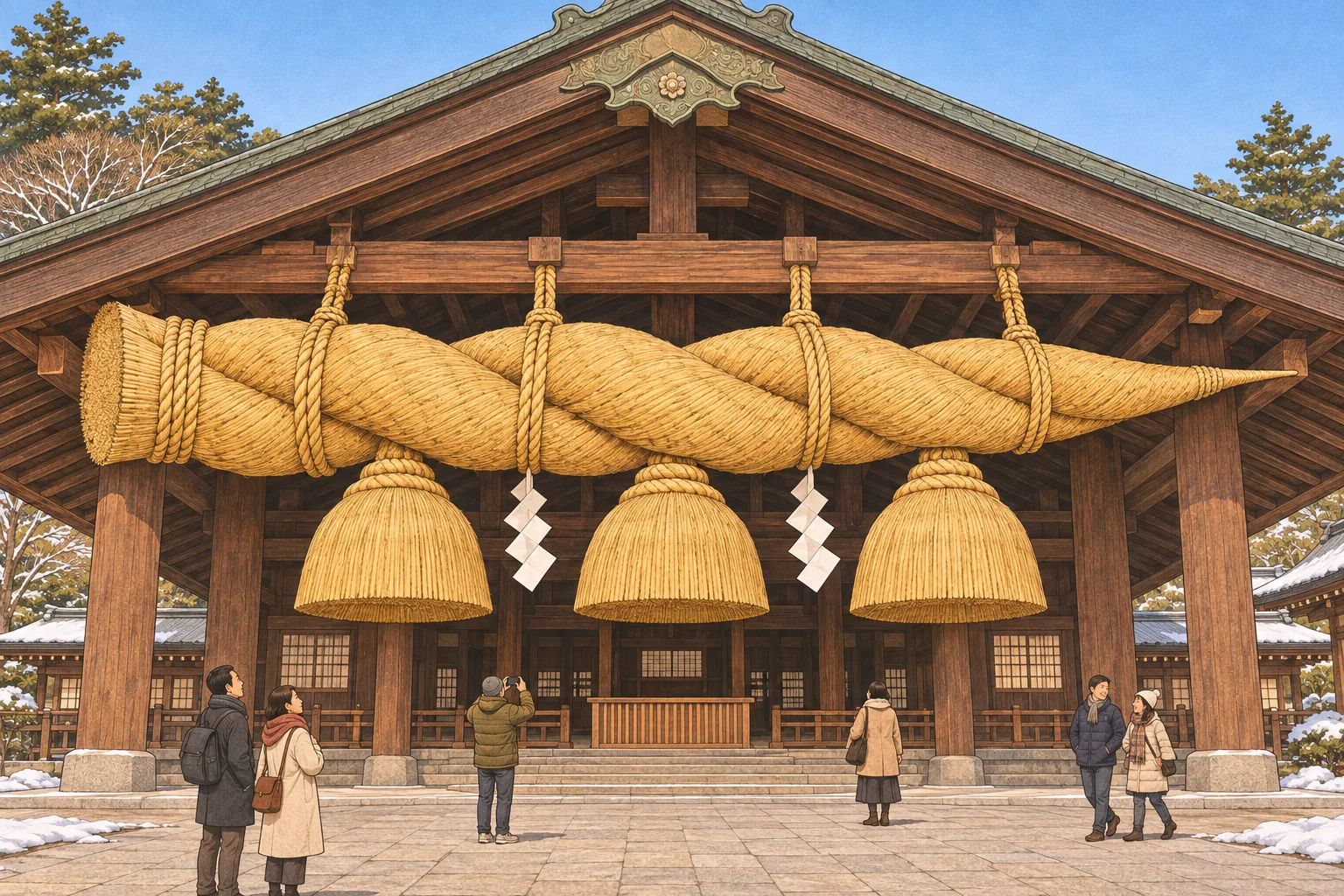
The great rope of the Kagura-den at Izumo Taisha: 13.6 metres long and about 4.7 tonnes. The left end is a blunt stump, the right end tapers to a point, and three straw tassels hang below.
Izumo is also famous for hanging its rope "backwards". At most shrines the end where the twisting starts, the moto, sits on the right as you face the shrine, and the finishing end on the left; on a lopsided rope that puts the fat end on the right. The reason is that shrine Shinto generally treats the right side, as you face the kami, as the senior one. Seen from the kami’s own position, that is its left hand, which is why the rule is often summed up as "the left is senior".
At Izumo Taisha, and at a few other shrines, the twisting starts on the left as you face the hall: the blunt stump at the left end of the Kagura-den rope is its starting end. That is what the "reversal" means. It concerns where the rope begins, and since the starting end is blunt and the finishing end pointed, the rope’s tips are the easiest way to see it. The shrine’s own explanation is that Izumo has always ranked the left side, as you face the kami, above the right. In the main sanctuary, the most exalted of the five guest deities, Amenominakanushi, is enshrined on the far left, and Edo-period ritual records show the higher-ranking offerings being placed to the left as one faces the kami. So the rope starts on the senior left side and finishes on the right. Other explanations circulate, such as the fact that Ōkuninushi’s seat inside the main hall faces west rather than towards the front, but these are not the shrine’s account. And some observers note that the "standard" orientation is not entirely uniform from place to place. On site, the fun is simply to find the blunt starting end and work out where you are standing.
05Shide: Two Cuts, Several Folds
The white zigzags on a shimenawa look improvised, but they follow a set method. A rectangle of paper, often hanshi calligraphy paper or the thicker hōsho paper, is cut partway across from one edge, then cut again from the opposite edge, parallel to the first, so that the sheet becomes a single strip doubling back on itself. Each segment is then folded forward or down, and the strip drops in steps, like a lightning bolt.
The number of steps gives the name. Four steps is the most common. Eight steps is fuller and more elaborate and tends to appear on larger offerings or more formal occasions. There are also simple two-step versions.
Why the zigzag? One explanation is lightning. The Japanese word for lightning, inazuma, literally means "rice’s spouse", from an old belief that thunderstorms helped the rice grow, so a lightning-shaped paper suggests a good harvest. Another holds that the shape simply makes a longer, more visible strip that can still be folded small. A third traces shide back to yū, white fibre stripped from paper-mulberry bark, which was hung from branches of the sacred sakaki tree in early rituals. In the cave story, the gods hang white and blue cloth offerings from a sakaki in front of the cave. Paper later took the fibre’s place.
Different lineages cut and fold shide differently. The names most often given are the Yoshida school, the Shirakawa school and the Ise school. The first two are named after families with great influence over Shinto ritual from the medieval period into the Edo era: the Yoshida, hereditary priests of Yoshida Shrine in Kyoto, and the Shirakawa, who since the Heian period had held the post of head of the court Department of Divinities. During the Edo period the Yoshida issued licences to local priests across the country and the Shirakawa granted credentials of their own, and their paper-cutting habits are generally thought to have travelled with them. The Ise style is usually said to follow the practice of the Grand Shrine of Ise.
The cutting patterns differ in where the cuts start, how many there are, and which way the folds go. In some patterns cuts alternate from left and right so the strip drops symmetrically; in others the cuts are concentrated on one side so the paper hangs to one side; some leave an uncut tab at the top for tucking into the rope; some trim the last segment to a point. Individual shrines add their own variations, and the shide on a shrine’s rope may not match the shide on its altar wands. Telling the schools apart at a glance is close to impossible for most visitors, Japanese included. What you can easily see is the number of steps and whether the paper falls evenly or leans one way.
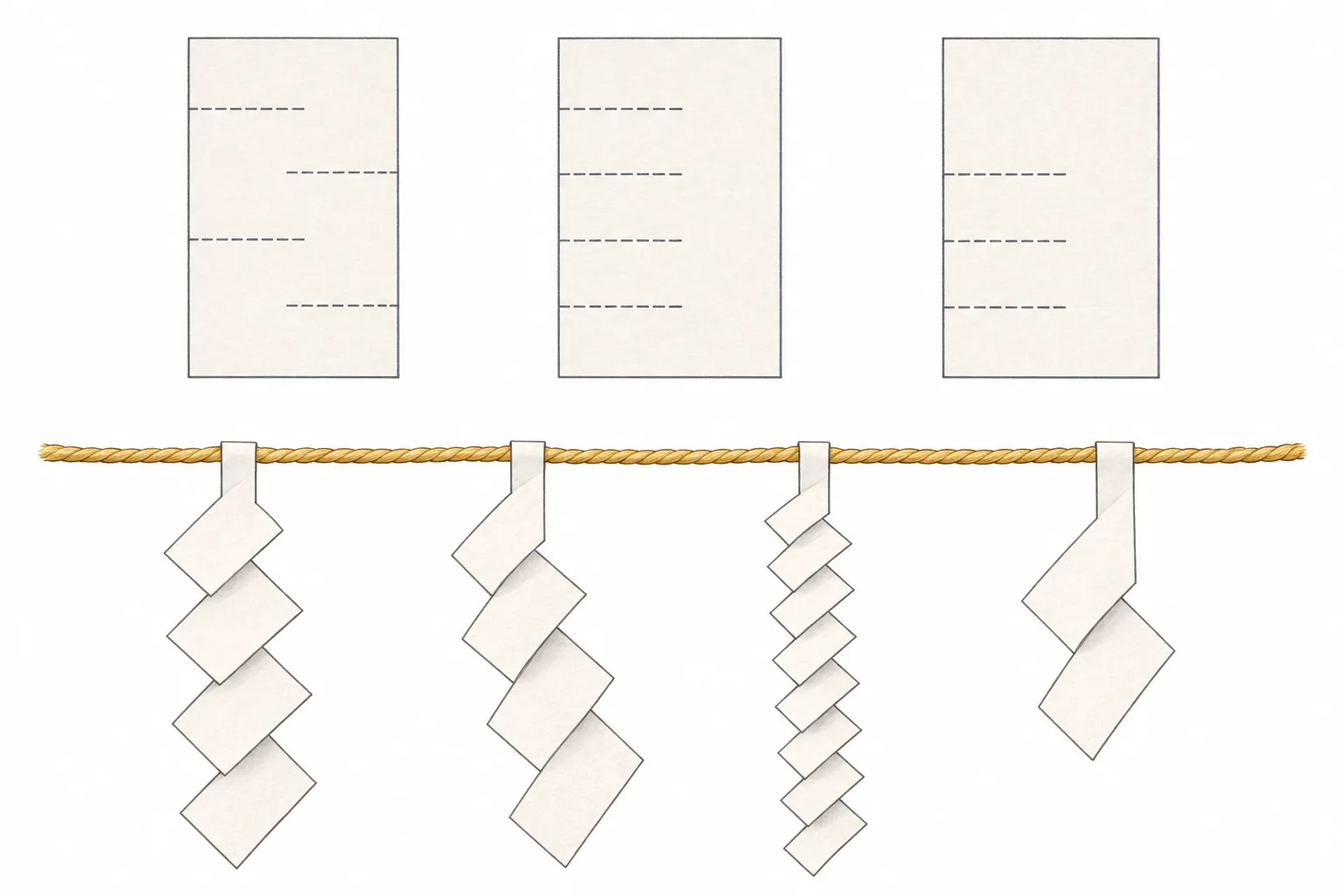
Top row: sheets of paper with the cuts shown as dashed lines, alternating from both sides on the left, all from one side in the other two. Bottom row, from left: a four-step shide that drops evenly, a four-step one that leans to one side, an eight-step and a two-step.
Shide go onto a rope by tucking the uncut top end between the rope’s twisted strands, which grip it tight. They are usually renewed with the rope, and soggy or yellowed paper is swapped out as needed. In late December you can often see a priest at a table with a long blade and a cutting board, slicing stacks of paper for the coming year.
06Side by Side
Put the ropes next to each other and the distinctions become easy.
The daikon rope is symmetrical: thin, fat, thin. The burdock rope is lopsided: fat at one end, thin at the other, and the first thing to check is which end is where. The front-hanging rope may be thin and even, but it has a fringe of trimmed straw bunches, often in sevens, fives and threes, with paper strips between them. The ring is small and circular, with a tail of straw, and lives on door frames and kitchen walls rather than shrine halls. Izumo’s Kagura-den rope is full-bellied, with one blunt end, one pointed end and three huge hanging tassels; its shape is not what sets it apart, its orientation is: the blunt starting end is on your left.
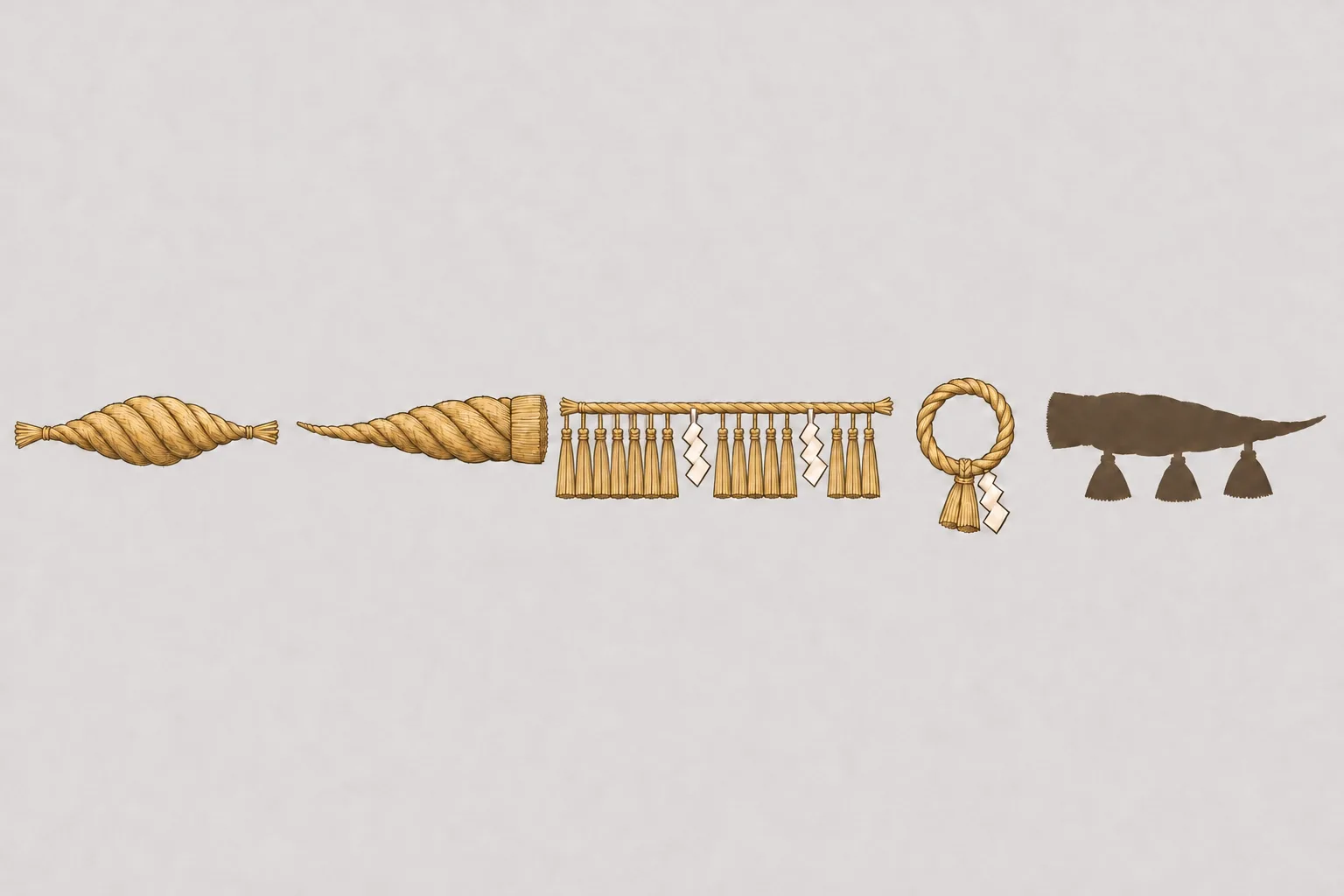
From left: daikon-jime (fat in the middle, thin at both ends), gobō-jime (fat end on the right), maedare-jime (a thin straight rope hung with straw and shide), wakazari, and the outline of Izumo’s Kagura-den rope with its blunt end on the left.
For paper, count the steps first: four or eight. Then look at the fall: symmetrical or leaning. Then look at the top: is there a tab tucked into the rope? White is standard; gold, silver and five-colour paper are mostly reserved for altar wands.
Finally, look at what the paper is attached to. On a rope, it is shide. A pair of shide clamped into the split top of a thin wooden stick and stood upright on a base is a gohei. A big bundle of shide and hemp fibre bound to a stick and held by a priest is an ōnusa. Same paper, three different jobs.
07Gohei and Ōnusa: Paper on a Stick
Gohei is an honorific name for heisoku, and it shares its roots with heihaku, the old general term for offerings to the kami. Heihaku covered clothing, weapons, food and sake, but cloth was the classic example: in ancient times the court presented silk, hemp cloth and bark fibre to shrines as gifts to their kami. Over the centuries cloth gave way to paper, and the offering took the form we see today: a straight, unpainted stick, its top split, with two shide clamped into the split so that one hangs to each side. The gohei stands in a small base on the altar or deep inside the sanctuary. It is both a gift and a place where the kami can alight; at some shrines a gohei is itself the object in which the deity is believed to reside. Gohei come in white, gold, silver or five colours, and at some festivals a row of five-colour gohei makes a vivid line.
Folk religion took paper offerings further. In some mountain villages, people cut their own gohei for the mountain god or field god and stick them in the earth at the edge of a paddy, and some local traditions cut elaborate paper figures resembling people or animals.
The ōnusa, also called haraegushi, is a wand for purification. It is a branch of sakaki or a plain wooden rod with a large bundle of shide and a hank of hemp fibre tied to the top, so it looks like a shaggy white mop. Nearly every Shinto ceremony begins with shubatsu, purification. The priest stands facing the people or objects to be purified and swings the wand to the left, to the right and to the left again, three strokes in all, while those being purified bow their heads. The paper and hemp make a soft rustling sound. You will see this at weddings, at the blessing of a new car, at a child’s shrine visit, and at the start of a building-site ceremony.
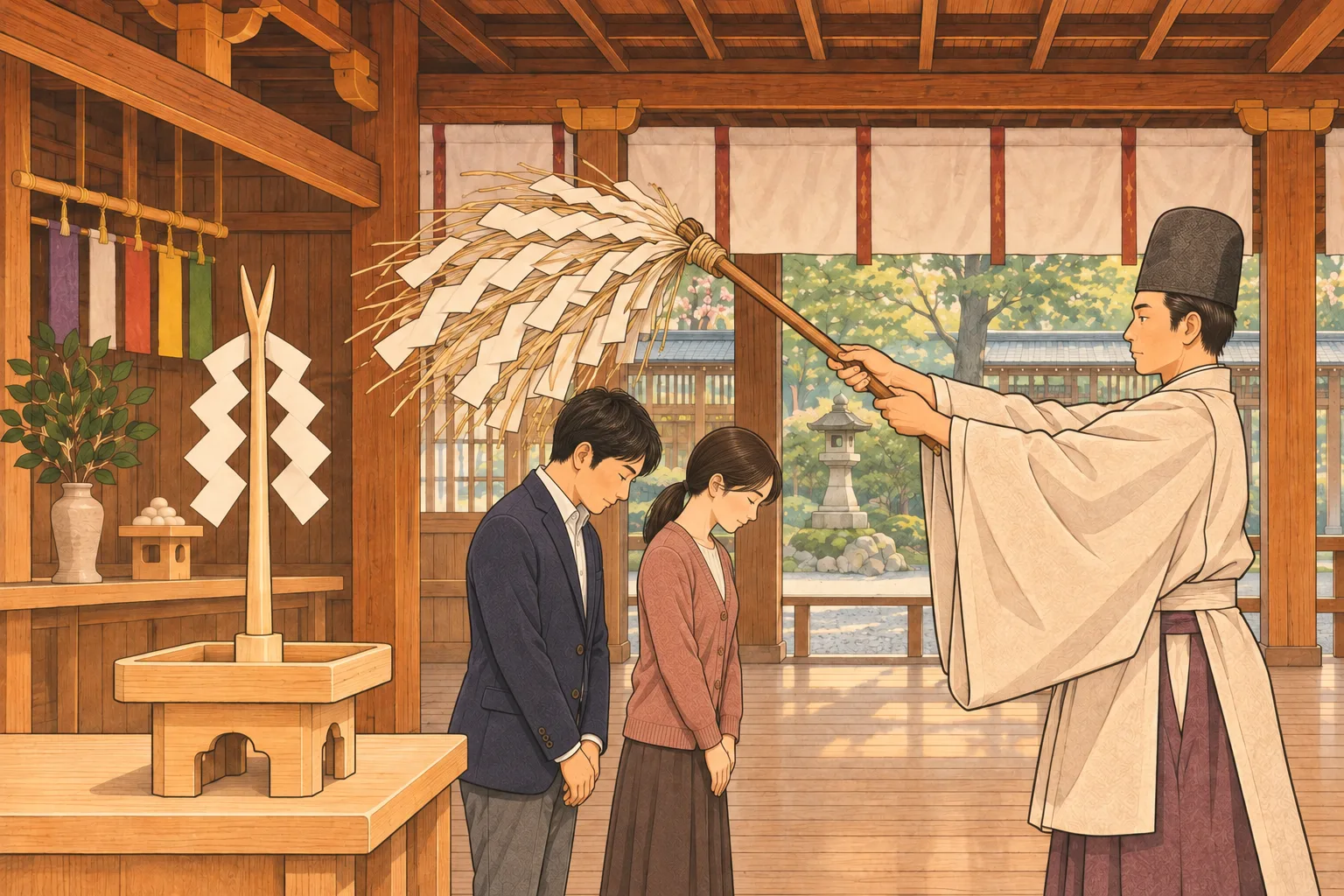
Left: a gohei, a slim wooden rod with a pair of shide in its split top, set on a stand. Right: the priest swings an ōnusa, a rod tied with a thick bundle of shide and hemp.
One confusing detail: ōnusa can be written with the characters for "big hemp", which can also be read taima. The paper charms that the Grand Shrine of Ise distributes for household altars are called Jingū taima, but they are flat wooden or paper talismans, not wands. And the "hemp" in both cases refers to fibre, not the drug.
There is also a portable form called kirinusa: paper and hemp cut into tiny pieces and scattered in the four directions or over a person.
08Where Ropes Go
Where a shimenawa hangs tells you what kind of place it is.
On a torii gate, it marks the threshold of the shrine grounds. Under the eaves of the hall of worship (haiden), it hangs between you and the interior. You ring the bell, drop your coin and clap outside the rope; the space beyond belongs to the kami.
On a sacred tree, the rope is wrapped once round the trunk at roughly chest-to-head height and tied off at the front, usually facing the approach path, with shide tucked in. Once roped, the tree is not climbed or cut. Huge old trees need very long ropes.
Around an iwakura, a rock where a deity is believed to descend, the rope either encircles the stone or runs across its face. Some mountain iwakura are marked by nothing more than a thin cord and a few slips of paper, easy to walk past.
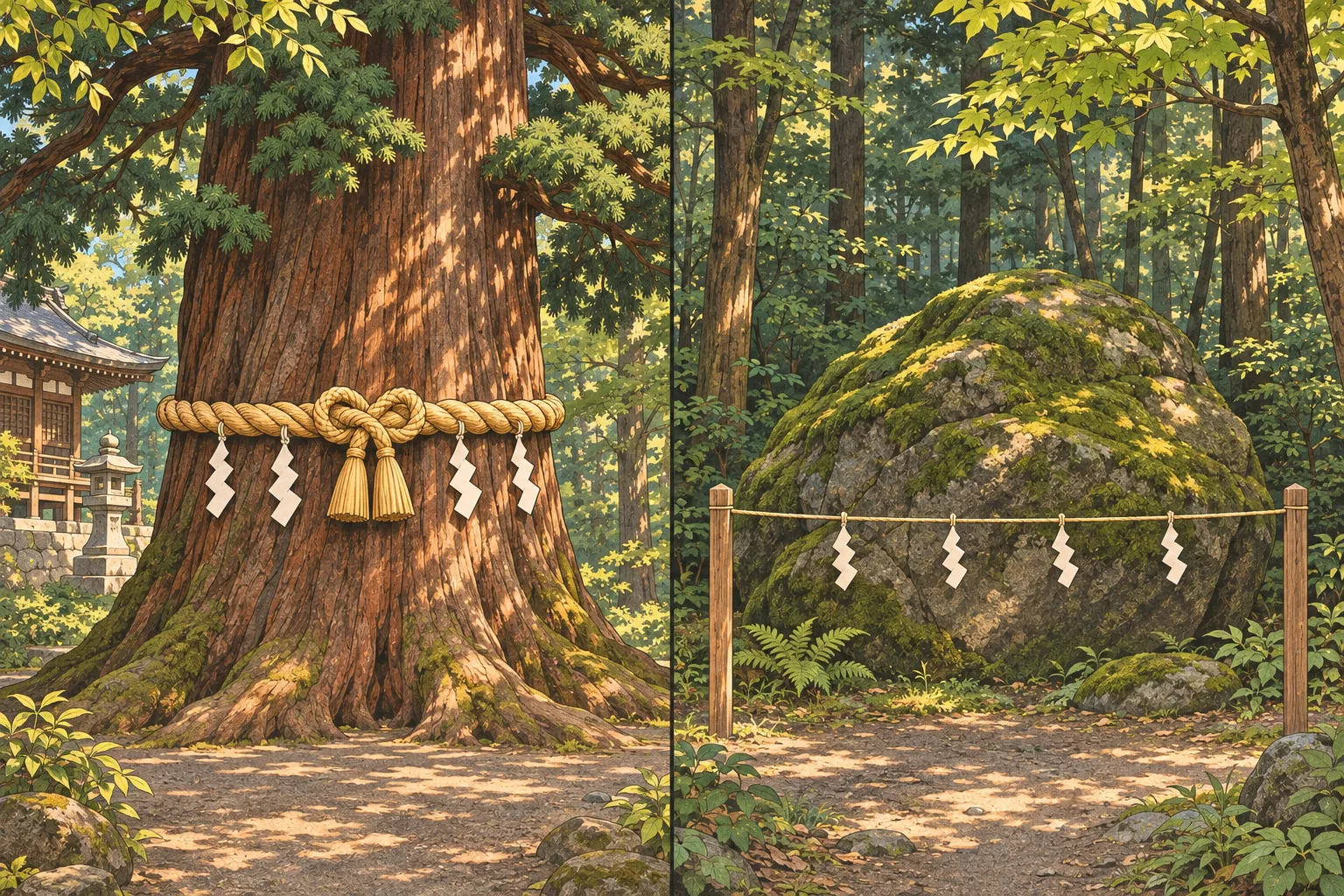
Left: a sacred tree, with the rope wrapped once round the trunk, knotted at the front and hung with shide. Right: an iwakura, marked by a thin rope strung across in front of the rock.
The most famous roped rocks are the Meoto Iwa, the "Wedded Rocks", in the sea off Futami Okitama Shrine in Ise, Mie Prefecture. A larger rock about nine metres high and a smaller one about four metres are joined by five ropes, each about 35 metres long and 10 centimetres thick. Wind and waves wear the ropes out, so they are replaced three times a year, on 5 May, 5 September and a day in mid-December; on those days parishioners haul the new ropes out to the rocks, and visitors on the shore can help pass the rope along by hand. Other "wedded rocks" around Japan are roped in a similar way.
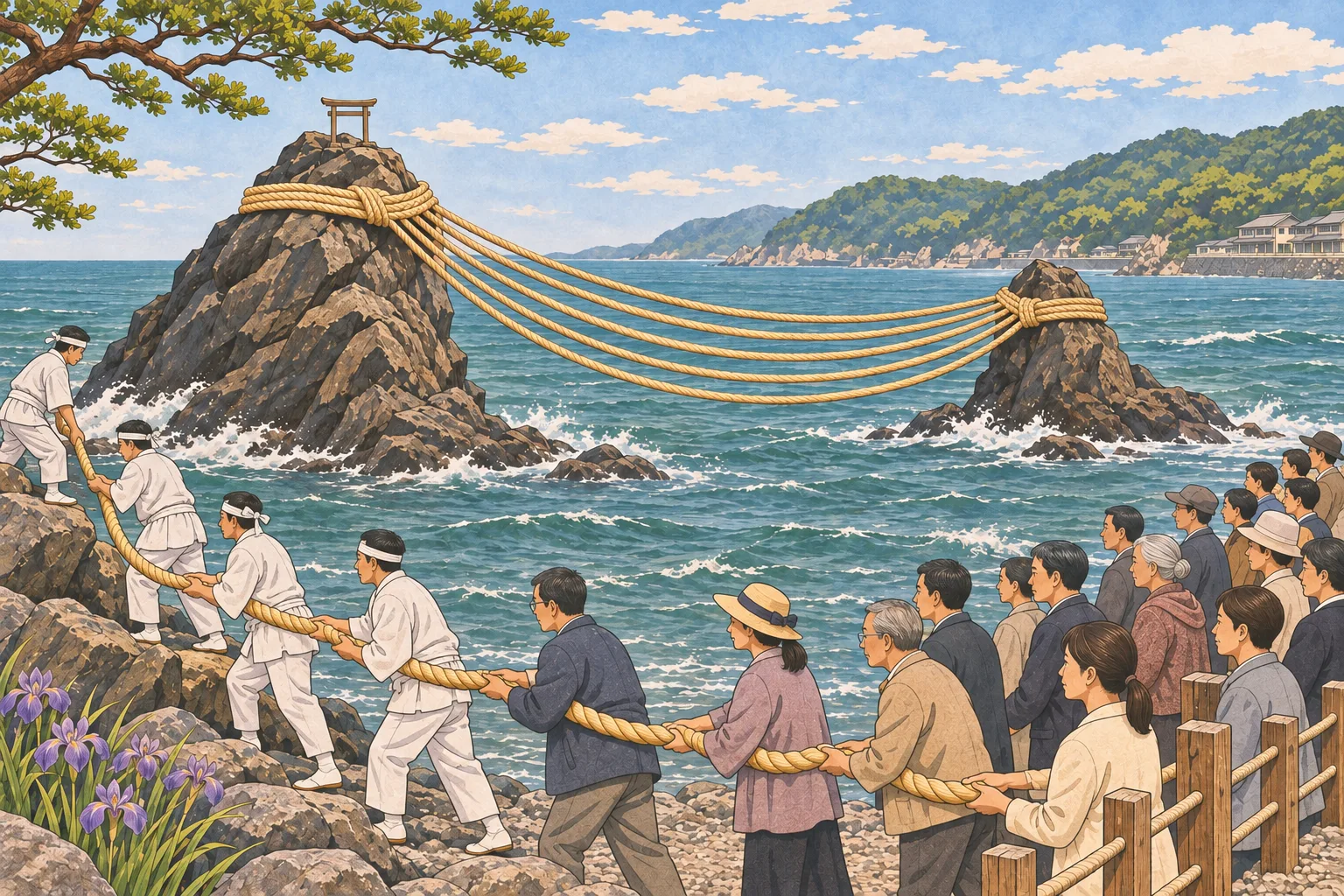
Replacing the ropes at the Meoto Iwa off Futami Okitama Shrine: five ropes join the two rocks, parishioners haul the new one out, and visitors on the shore pass it along by hand.
Waterfalls can be roped too. In Wakayama Prefecture the Nachi Falls are themselves revered as the deity of Hirō Shrine, a branch shrine of Kumano Nachi Taisha. A shimenawa about 26 metres long is strung across the lip of the falls and replaced twice a year, in July before the Nachi Fire Festival and again at year’s end, by priests on safety lines who climb to the top. From below it is a thin line above the falling water.
The thick white rope a sumo yokozuna ties over his embroidered ceremonial apron for his ring-entering ceremony is also regarded as a shimenawa, with shide hanging at the front.
And then there is the jichinsai, the groundbreaking ceremony held before construction. In the middle of the site, four freshly cut bamboo poles with their leaves still on (imidake) are set at the corners of a square, and a shimenawa with shide is strung between them. For the length of the ceremony that square is a shrine: a sacred branch stands inside, offerings are laid out, the priest purifies the ground and reads a prayer, and the owner and builders step forward one by one to offer branches of sakaki. Afterwards the rope and bamboo come down. Walk past a new building site in a Japanese city early on a weekday morning and you may still catch one.
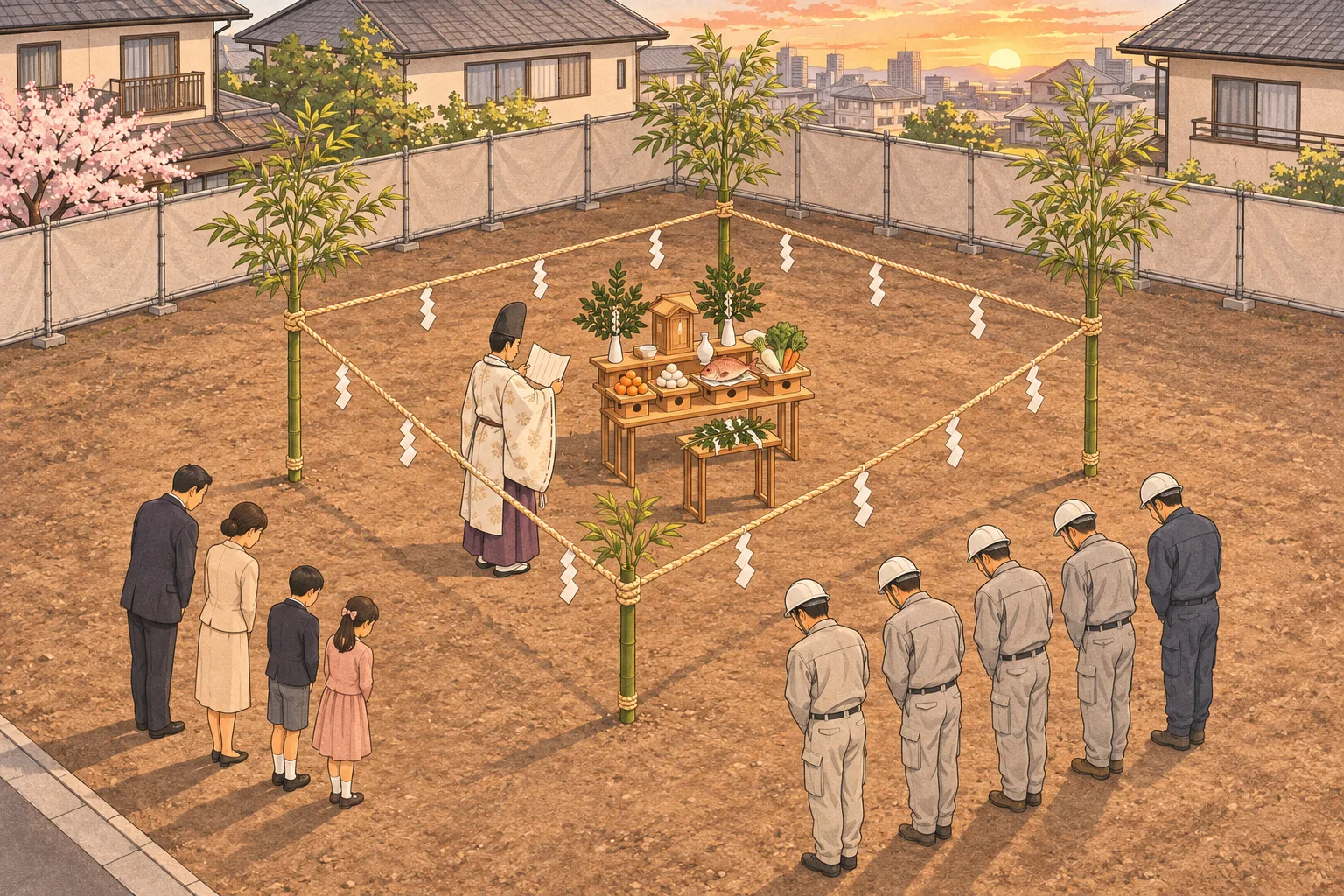
A jichinsai: four leafy bamboo poles, the imidake, mark a square on the building site, a shimenawa with shide runs between them, and the altar stands inside.
09The Grass Ring: Chinowa and the Great Purification
At the end of June, and at some shrines at the end of December, a huge ring of grass appears under the torii or in front of the hall of worship. This is the chi-no-wa, often two or three metres across, big enough to walk through upright. It is made of chigaya, a tough wild grass cut from riverbanks and hillsides by shrine parishioners, bound in thick bundles around a bamboo frame. Up close it smells of dry hay.
The ring belongs to the Ōharae, the Great Purification, held twice a year: Nagoshi-no-Ōharae on 30 June and Toshikoshi-no-Ōharae on 31 December. The idea is to clear away the impurities and wrongs accumulated over the past six months. In ancient times the court held the rite at the Suzaku Gate of the palace, where an official of the Nakatomi clan read out a long prayer known as the Ōharae-no-kotoba. The text, preserved in the tenth-century Engishiki law code, lists offences against heaven and earth and then describes how they are swept by rivers into the sea, swallowed by the tides, blown away to the underworld and vanish. Shrines still recite a version of it today; it takes several minutes and has a steady, chant-like rhythm. Visitors also write their name and age on a paper doll called a katashiro, rub it over their body, breathe on it, and hand it in; the dolls are later floated away or burned.
The ring comes from a legend recorded in a surviving fragment of the Bingo Fudoki, an early provincial gazetteer, preserved because the thirteenth-century Shaku Nihongi quoted it. A travelling god named Mutō asked two brothers for a night’s lodging. The rich younger brother (usually called Kotan Shōrai) refused; the poor elder brother, Somin Shōrai, took him in and fed him millet. When the god returned, he had Somin’s daughter tie a small ring of chigaya grass around her waist, and that night everyone else was wiped out. The god then revealed himself as Susanoo, Amaterasu’s storm-god brother, and promised that in future epidemics anyone who claimed descent from Somin Shōrai and wore a grass ring at the waist would be spared. The original rings were small and worn on the body; the big walk-through ring at shrine gates came later. (Somin Shōrai also gives his name to New Year door charms, a separate story.)
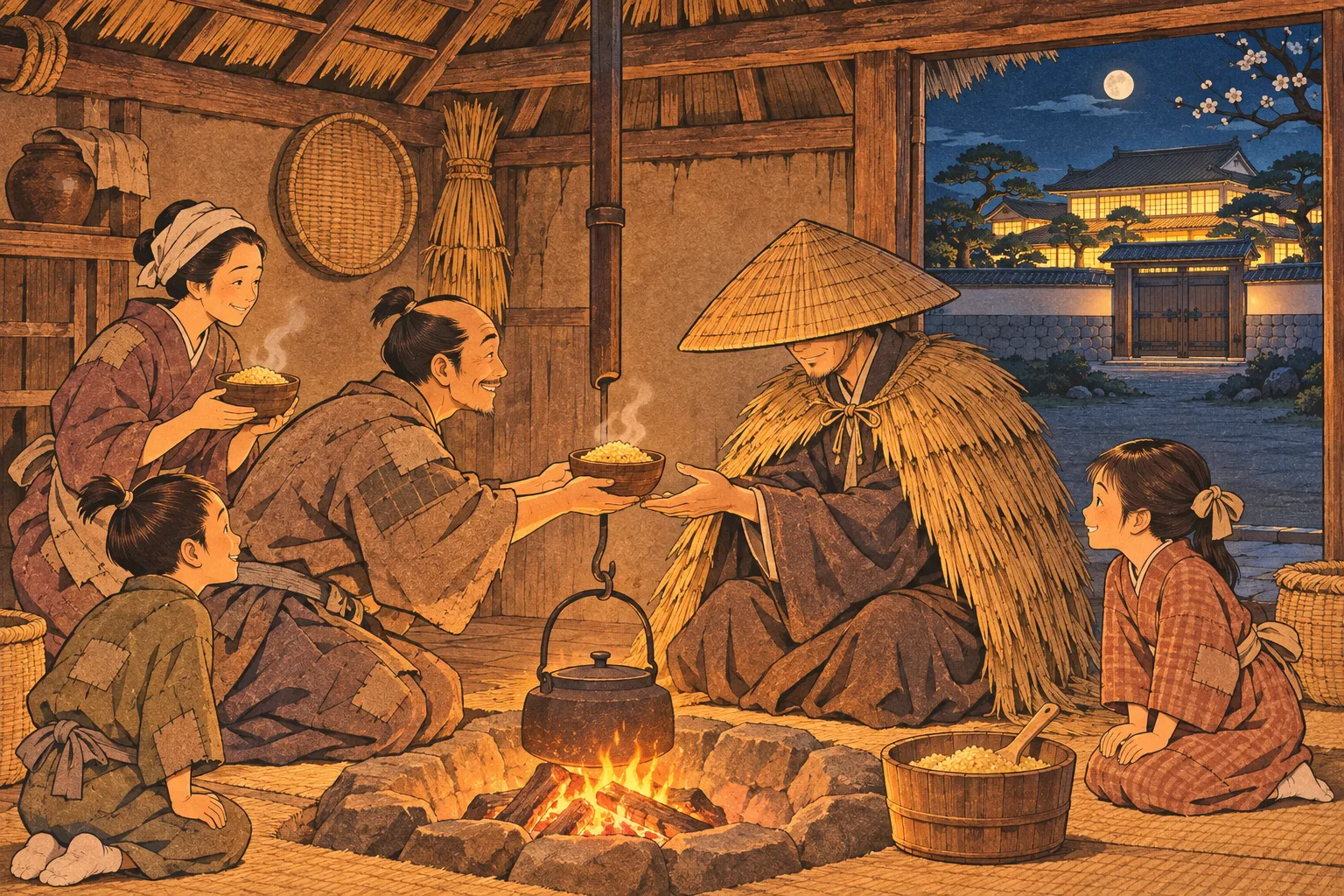
The legend behind the grass ring: the poor Somin Shōrai takes in the travelling god and serves him millet, while the rich brother who refused lives in the mansion outside. (artist’s impression)
There is a customary way to pass through, with small variations from shrine to shrine. Some shrines first have you sprinkle yourself with kirinusa. Stand in front of the ring and bow. Step through left foot first and walk round to the left, back to the front. Bow again, step through right foot first and circle to the right. Bow a third time, step through left foot first and circle left. Your path traces a sideways figure eight. At many shrines you then step through once more, left foot first, and walk straight on to pray at the hall; at others you go to the hall after the third loop. Many shrines post a diagram beside the ring. Some people recite an old poem as they walk, which says that whoever performs the summer purification will have their life lengthened by a thousand years.
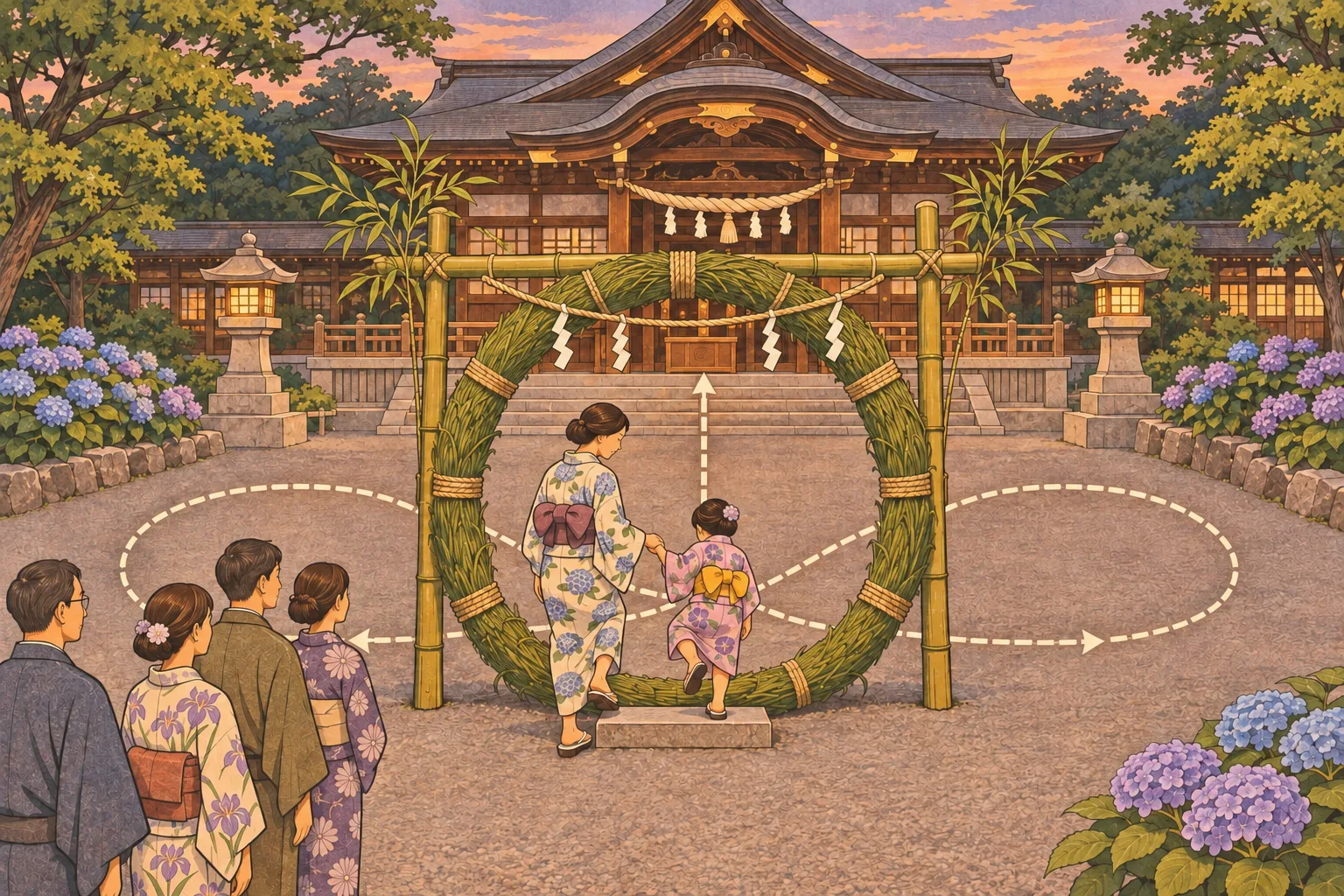
Passing through the chinowa: circle to the left, then to the right, then to the left again. The dashed line on the ground traces a sideways figure eight before the path goes straight on to the hall.
On a June evening the line moves slowly: parents steering small children round the loops, grandparents counting under their breath. A few people pluck a stalk to take home as a charm, though many shrines ask them not to, or the ring would soon be bald. In December, many shrines skip the ring and just collect the paper dolls.
More deep dives on this topic
 ToriiA torii is two posts and one or two crossbeams, with no doors, no walls and no lock.
 Divine Messengers and KomainuWalk into almost any Shinto shrine and an animal meets you before anything else does.
 Shrine ArchitectureMost visitors to a Shinto shrine photograph the torii gate, the vermilion pillars and the bell rope in front of the hall, and leave thinking they have seen the shrine.
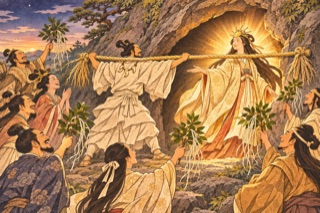 Shimenawa, Shide and GoheiWalk into almost any Shinto shrine in Japan and you will pass under a rope.
 Reading Shrine NamesWalk up to almost any Shinto shrine in Japan and look at the wooden plaque hanging from the torii gate or the main entrance.
 OmikujiNext to the counter where a Japanese shrine sells its charms, there is usually a wooden box or a hexagonal canister and a small slot for coins.
 Shinto Priests and MikoSpend a morning at a large Japanese shrine and you will see two kinds of people in old-fashioned dress.
 Shikinen Sengū and ZōtaiWalk up to the main sanctuary of the Inner Shrine at Ise and you will notice, just beside it, an empty plot exactly the same size.
 Sacred Trees and StonesWalk into almost any Shinto shrine and something older than the buildings is usually waiting for you.
- Back to the main article: Shinto →