
A torii is two posts and one or two crossbeams, with no doors, no walls and no lock. It is also the single most recognisable shape in Japan: it marks shrines on maps, stands at the edge of rice fields and in the middle of office districts, and rises out of the sea at Miyajima. Look at a dozen of them and you start to notice that they are not all the same. Some are bare pale wood with a dead-straight top; some are lacquered vermilion with a top beam that curves up at the ends like a temple roof. Some wear black rings at the tops of their posts, some carry a little triangular gable, some stand in tunnels of thousands. Each of these differences has a name and, usually, a story. This guide takes a torii apart, sorts the main styles into families, and explains how to tell them apart from the path.
01The Anatomy of a Torii
Start with an ordinary vermilion torii and read it from the top down.
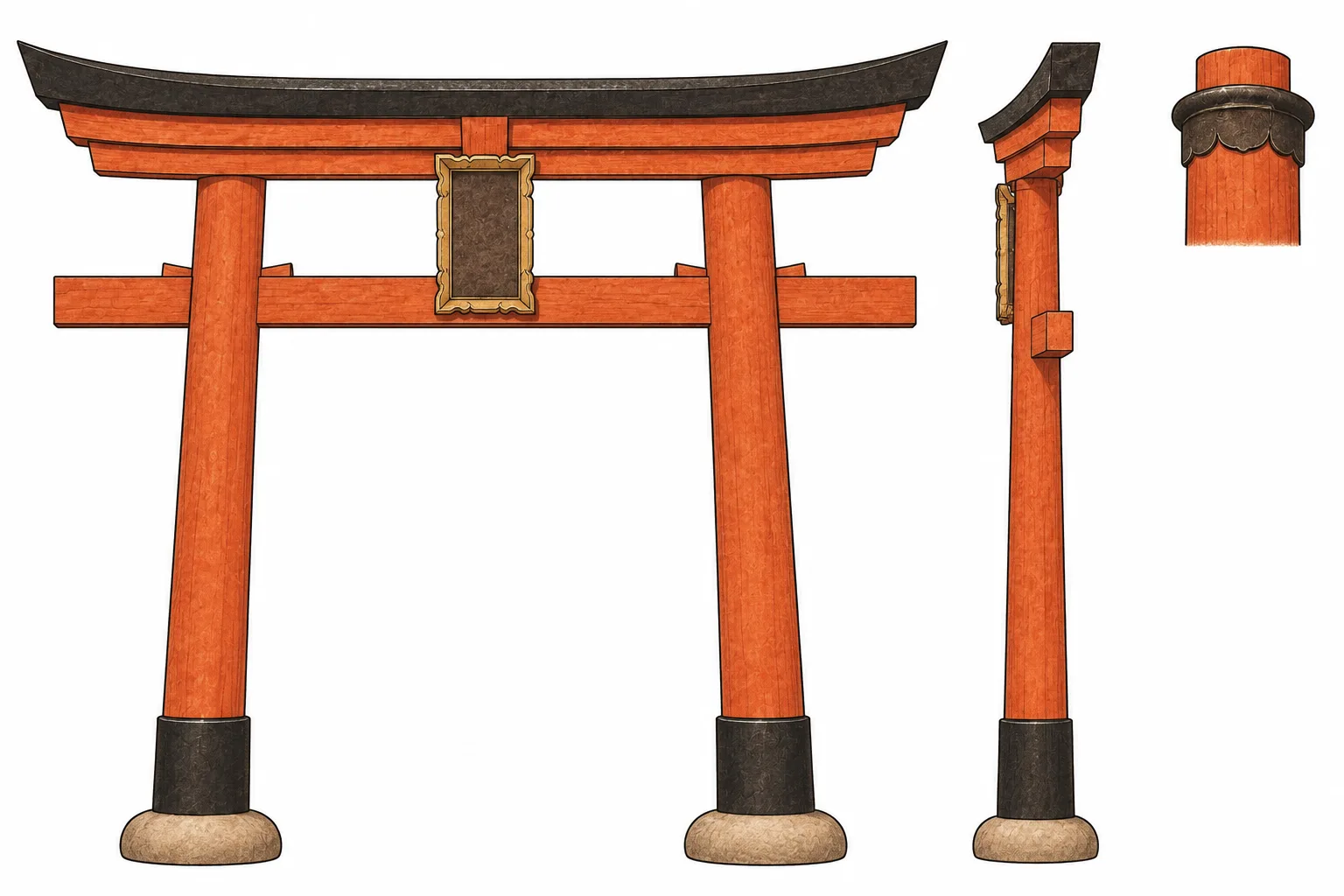
A vermilion torii from the top down: kasagi, shimaki, the central gakuzuka carrying the plaque, the nuki passing through the posts, the posts, the black nemaki sleeves and the rounded kamebara bases. Centre: the side view. Upper right: a daiwa ring at the top of a post.
The long uppermost beam is the kasagi, literally "hat wood". It caps the whole structure and acts as a rain shield, throwing water off its ends before it can soak into the joints below. On well-made torii the top of the kasagi is sheathed in copper or covered with a separate board, and the cut ends may be capped in metal. On many torii the kasagi sweeps gently upward toward each end. This upward curve, called sori, is what gives the gate its lift.
Directly beneath the kasagi, and running parallel to it, many torii have a second beam called the shimaki. Seen from the side, the two beams look like a thick ruler laid on a thinner one. Whether a torii has a shimaki or not is the first thing to check when you are trying to place it in a family.
Lower down, a second horizontal member runs between the posts. This is the nuki, the "piercing beam", and it really does pierce: it passes through mortises cut right through the posts, locking them together. Whether the nuki stops flush with the posts or sticks out beyond them is a key identifying detail. Where it emerges, a small wooden wedge called a kusabi is often driven in to tighten the joint, so from a distance you see a little block sticking out of each post.
Between the upper beams and the nuki, at the exact centre, there is often a short vertical strut, the gakuzuka. Its structural job is to stop the upper beams sagging in the middle. It is also where the shrine hangs its name plaque, the hengaku, a vertical tablet bearing the shrine’s name in large brushed characters. On many torii the plaque covers the strut almost completely. Shrines like to have these plaques written by people of rank; the one on the great stone torii at Nikkō Tōshōgū is traditionally attributed to Emperor Go-Mizunoo.
The two uprights are simply the hashira, posts. Most are round, though octagonal and square posts exist. On many torii the posts are not quite vertical but lean slightly inward toward the top, a splay called korobi. It makes the gate look planted, like someone standing with feet apart.
On some torii a thick ring sits between the top of each post and the beams above it, like a heavy bracelet. This is the daiwa, and it is closely associated with Inari shrines.
Finally, look at the feet. Many torii posts do not go straight into the ground but stand on a rounded base called a kamebara, "turtle belly", for its swelling shape; it is also nicknamed manjū, after the round steamed bun. Early kamebara were built up in plaster, later ones carved from stone. Their purpose is practical: to keep the wooden post off damp earth. Some posts also wear a black sleeve of metal or lacquered wood at the base, the nemaki, which protects the foot of the post and looks from a distance like a pair of black boots.
Once you know these seven parts, a torii stops being a single symbol and becomes a set of features you can check one by one: straight or curved top, one top beam or two, nuki flush or projecting, central strut or none, rings or none, posts upright or leaning, extra supports or none.
02The Shinmei Family: Straight Lines and Bare Wood
Most torii fall into two broad families, Shinmei and Myōjin.
The Shinmei family is defined by straightness. The kasagi is a straight beam with no upward curve. There is no shimaki beneath it. Most have no central strut. The posts usually stand vertical. These torii are usually left as unpainted wood, and they are generally regarded as preserving an older, simpler form.
The basic Shinmei torii consists of two round posts, a round kasagi, and a nuki that stops flush inside the posts. It is the gate of countless small neighbourhood shrines dedicated to the sun goddess Amaterasu, often called Shinmei-sha. It is easy to walk past, but once you know it you see it everywhere: two pale posts and a single bar at the corner of a residential street. Tokyo Daijingū near Iidabashi, founded as a place in Tokyo to worship Ise from afar, has one at its entrance, unpainted and plain among the office blocks.
The Ise torii, also called the Jingū torii, is the refined version used at Ise Jingū, the shrine complex dedicated to Amaterasu. Its giveaway is the kasagi: instead of a round log it has a five-sided cross-section, with a ridge running along the top like the peak of a roof, and its ends thicken very slightly so that they seem to lift. As on a plain Shinmei torii, the nuki stops flush with the posts; it is tightened by wedges driven in from the inner faces of the posts, and the posts lean slightly inward. At Ise the torii are rebuilt along with the shrine buildings every 20 years in the ritual reconstruction known as Shikinen Sengū, using Japanese cypress (hinoki). The old timber is reused. The two large torii at either end of the Uji Bridge, the bridge that leads into the Inner Shrine, are made from the munamochibashira, the free-standing ridge-supporting pillars, of the previous main sanctuaries: the inner torii from the Inner Shrine’s, the outer one from the Outer Shrine’s. After another 20 years they move again, to stand as torii at the Higashi-oiwake junction in Seki-juku and at the old Shichiri ferry landing in Kuwana.
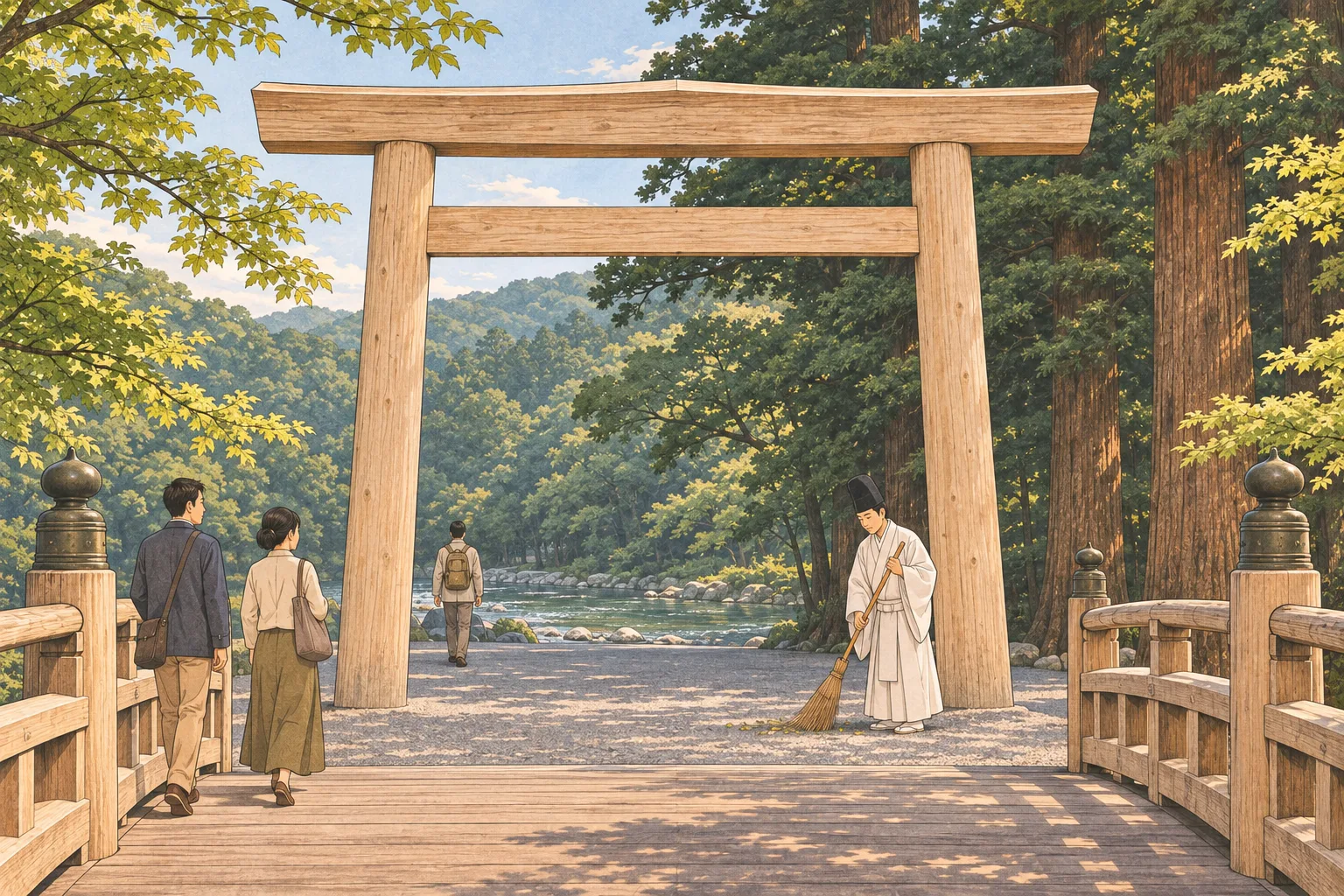
The torii at the end of the Uji Bridge at Ise: bare wood, a straight kasagi with no shimaki beneath it, and a nuki that stops flush with the posts.
The Kashima torii takes its name from Kashima Jingū in Ibaraki Prefecture. Like the Shinmei torii it has a straight, round kasagi, no shimaki and upright posts, but its nuki is a squared beam that projects beyond the posts and is usually secured with wedges. Those two small additions are why it is sometimes described as a step between the Shinmei and Myōjin families. The great torii at Kashima was a stone gate until the 2011 Tōhoku earthquake brought it down; in 2014 it was rebuilt in wood from four cedars grown in the shrine’s own forest.
The kuroki torii, "black wood" torii, is the most primitive of all: logs with the bark still on, roughly jointed. Kuroki means unbarked wood, as opposed to shiraki, white or peeled wood. The best-known example stands at Nonomiya Shrine in the Sagano bamboo groves of western Kyoto, a low brown gate of unbarked oak (kunugi) beside a brushwood fence. Nonomiya was where imperial princesses purified themselves before going to serve at Ise, and a famous chapter of The Tale of Genji is set there. Because bark-covered logs rot quickly, a kuroki torii has to be replaced every few years.
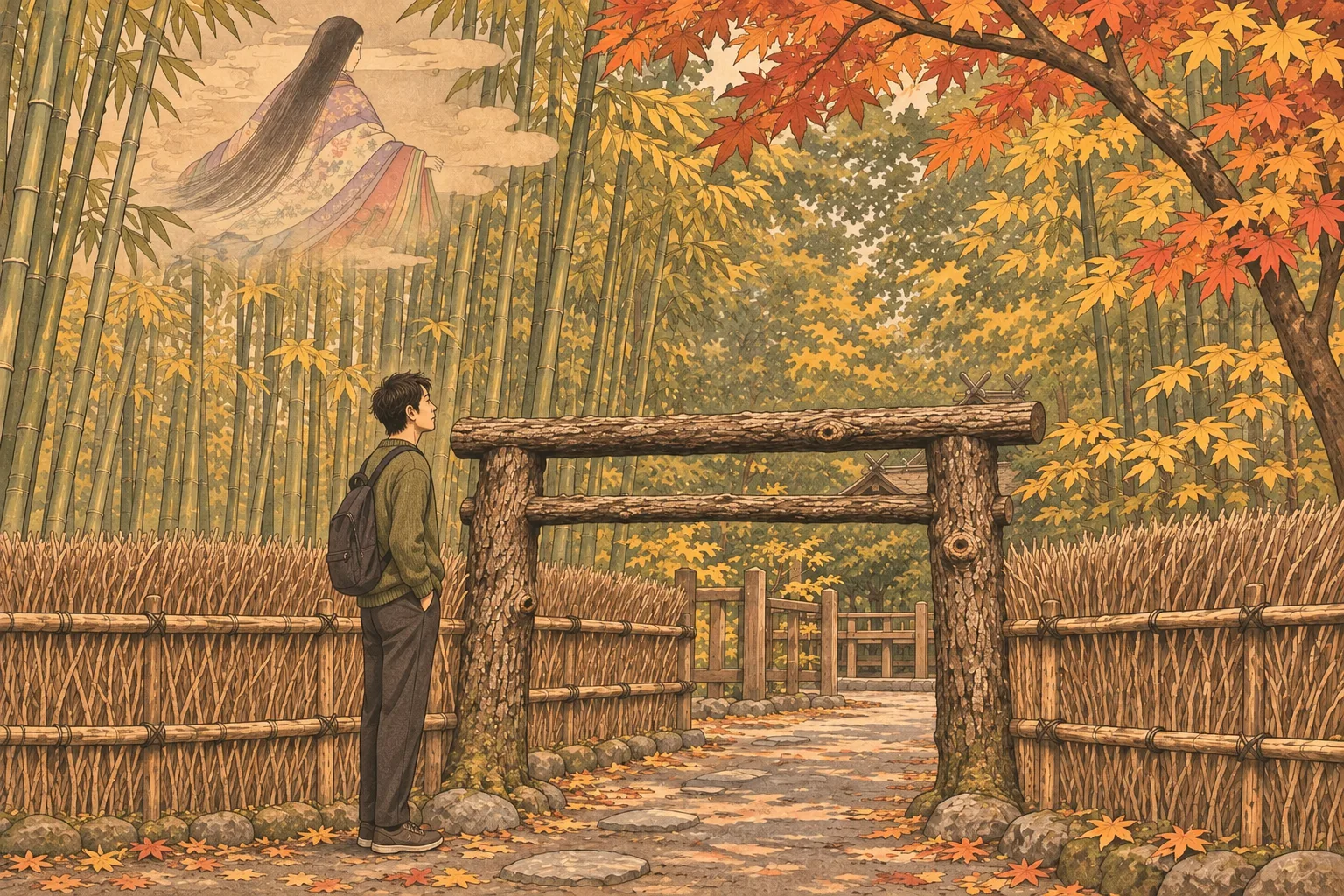
The kuroki torii at Nonomiya Shrine in Sagano, Kyoto: logs with the bark still on, beside a low brushwood fence. The Heian lady at upper left recalls The Tale of Genji.
03The Myōjin Family: Curves, Struts and Vermilion
The Myōjin family is the torii most people picture. If you photographed a red torii in Japan, it was almost certainly one of these.
Point by point, it reverses the Shinmei family. The kasagi curves upward at the ends. There is a shimaki beneath it. The nuki projects beyond the posts. A central strut holds a name plaque. The posts lean inward and often stand on kamebara bases. Most are painted vermilion, frequently with the top of the kasagi in black. The form is generally thought to have existed by the Heian period and spread widely from the medieval period onward, during the long centuries when Shinto and Buddhism were practised together, and the curving eaves-like top and red lacquer clearly echo Buddhist gate architecture.
The Myōjin torii itself is the standard model with all those features and nothing else. Most other styles in this family can be described as a Myōjin torii with one thing added or changed. A clear example to study is the early Edo-period stone torii outside the south gate of Yasaka Shrine in Kyoto, restored and re-erected in 1666 after an earthquake: unpainted, but with every Myōjin feature, from the curving kasagi and shimaki to the plaque strut and leaning posts.
The Inari torii, also called the daiwa torii, adds the rings at the tops of the posts. It is the standard gate of Inari shrines, led by Fushimi Inari Taisha in Kyoto, and usually comes with black nemaki at the foot of each post: vermilion body, black boots, black-topped beam. Rings appear on other styles too, often on the Ryōbu torii below, so treat them as a strong hint, not proof.
The Sannō torii is the easiest to spot: a triangular gable, the gasshō, sits on top of the kasagi like a small pitched roof. It belongs to the Sannō cult centred on Hiyoshi Taisha at the foot of Mount Hiei near Kyoto, a cult closely bound to the great Tendai temple of Enryakuji on the mountain above; the gable is traditionally explained as a symbol of the union of Buddhism and Shinto. In Tokyo, Hie Shrine in Nagatachō, near the parliament building, has a striking Sannō torii at the foot of its steps.
The Ryōbu torii, also called the four-legged torii or gongen torii, braces each main post with two shorter posts, one in front and one behind, called chigobashira or hikaebashira, joined to the main post with short tie beams. From the side, each leg looks as though it is walking on crutches. Many Ryōbu torii, Itsukushima’s among them, also carry daiwa rings at the post tops. Ryōbu refers to Ryōbu Shinto, a school of thought that linked shrine deities with the two great mandalas of Shingon Buddhism. The great torii in the sea at Itsukushima is the most famous example, and the extra legs are what keep it standing in the tide.
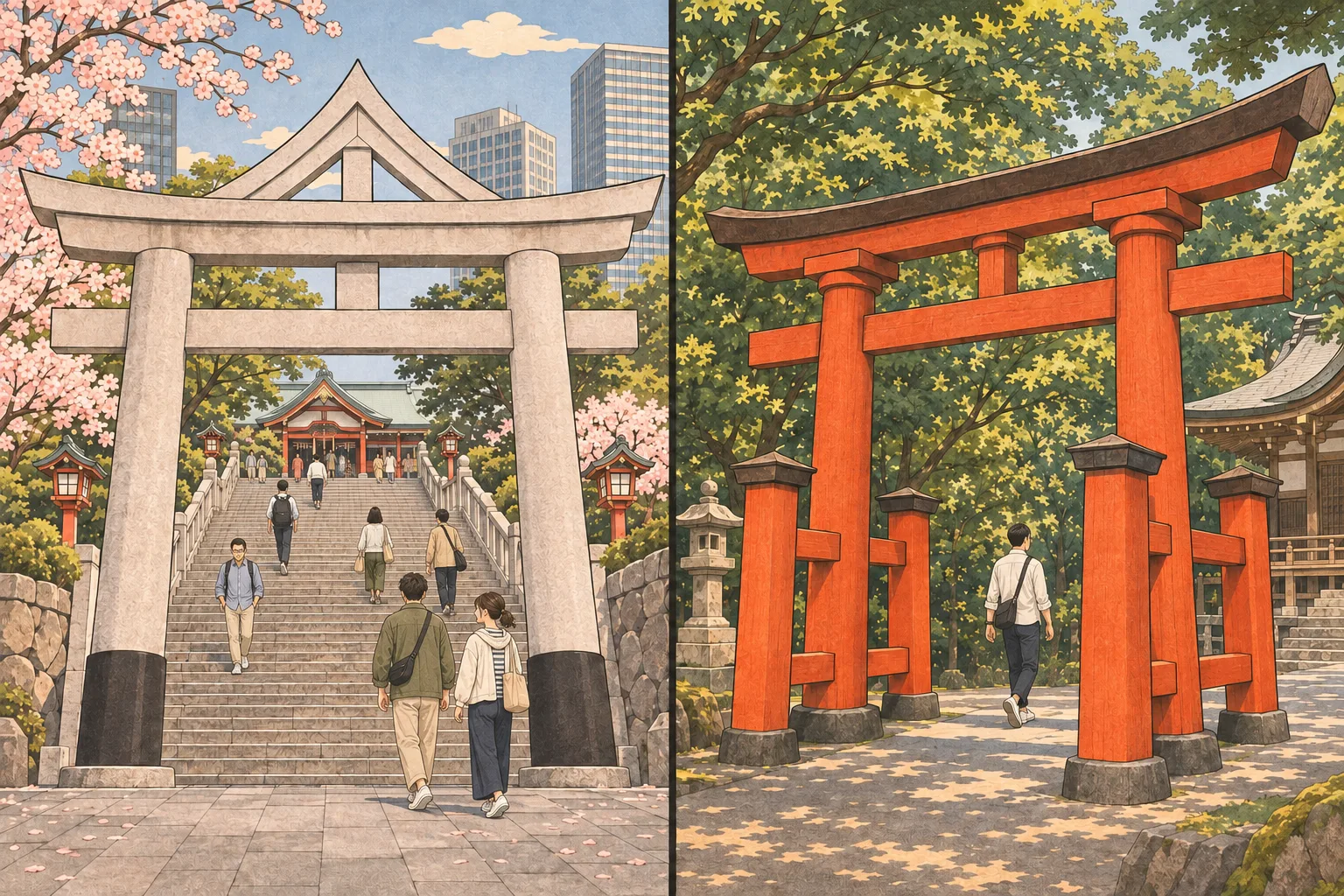
Left: the Sannō torii at the foot of the steps of Hie Shrine in Tokyo, with the triangular gasshō on top of the kasagi. Right: a Ryōbu torii, each main post braced by a shorter post in front and behind.
The Miwa torii, or mitsu-torii, "triple torii", joins three gates into one: a central Myōjin-style torii flanked by two smaller ones, their tops stepping down like the outline of a mountain. The central opening is fitted with doors. It belongs to Ōmiwa Shrine in Sakurai, Nara Prefecture, which has no main sanctuary at all because the deity is understood to dwell in Mount Miwa itself. The triple torii stands behind the worship hall, marking the line between people and the sacred mountain, and it cannot be seen from the front of the hall. A visible example stands at nearby Hibara Shrine.
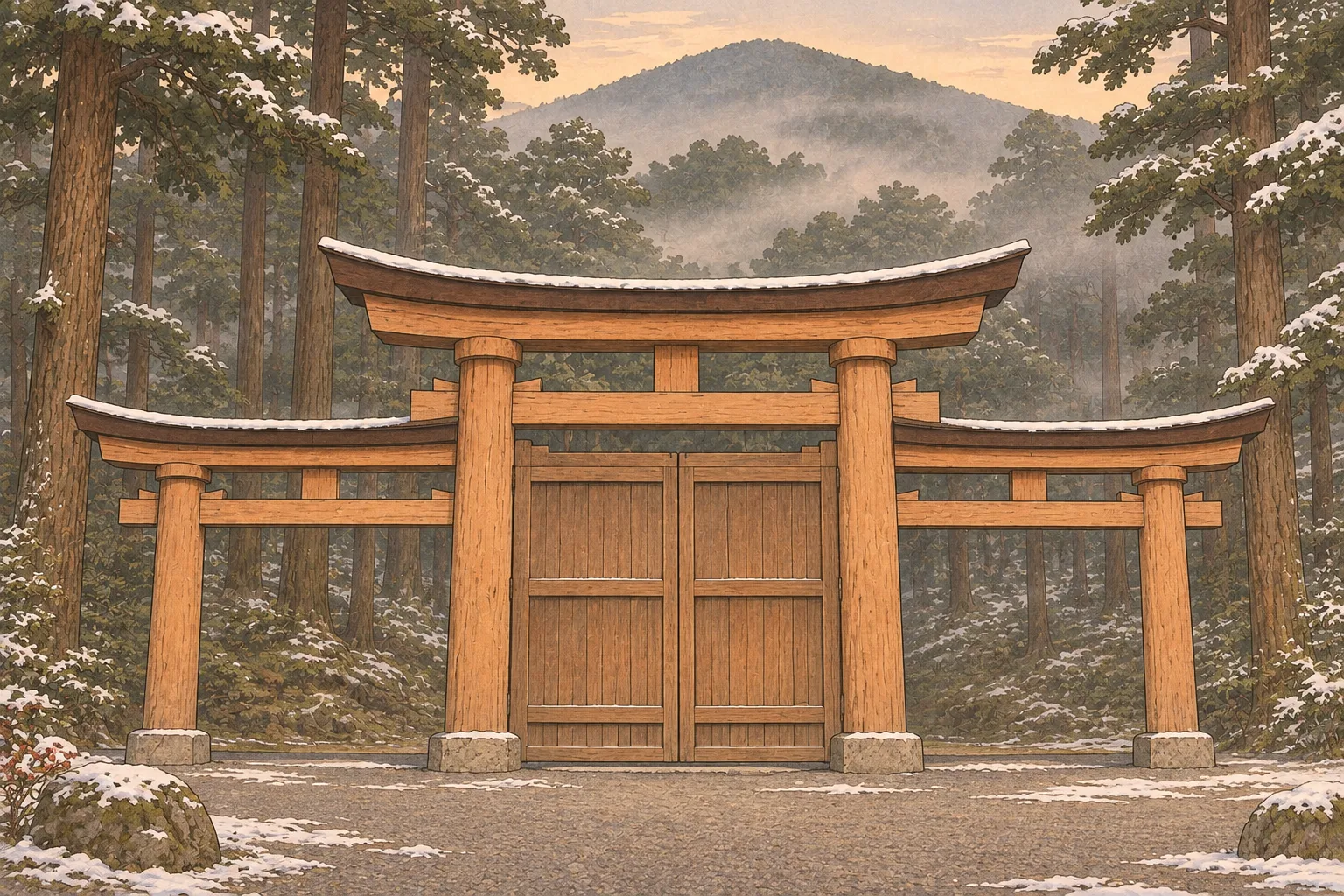
A Miwa torii: a central gate flanked by two smaller ones and joined into one, with doors in the middle opening. Mount Miwa rises behind.
The Kasuga torii, named for Kasuga Taisha in Nara, has a shimaki, a central strut, slightly leaning posts and a projecting nuki wedged on both sides of each post, so it is usually grouped with the Myōjin family (some classifications put it with the Shinmei family instead), but its kasagi is straight, with no upward curve. The ends of the kasagi and shimaki are cut off vertically. The first torii on the approach to Kasuga Taisha is the model. It is usually painted vermilion, and by one account it was the first torii style to be painted vermilion. A red torii with a ruler-straight top is a good sign you are looking at a Kasuga torii.
The Hachiman torii is nearly identical to the Kasuga torii. The difference is in the ends of the top beams: Kasuga ends are cut vertically, Hachiman ends are cut at a slant, with the top edge longer than the bottom so that the cut face looks down and outward. Iwashimizu Hachimangū, on a hill south of Kyoto, is the usual reference. To tell these two apart you have to walk round to the side and look at the beam ends, which makes this the hardest pair in the whole family.
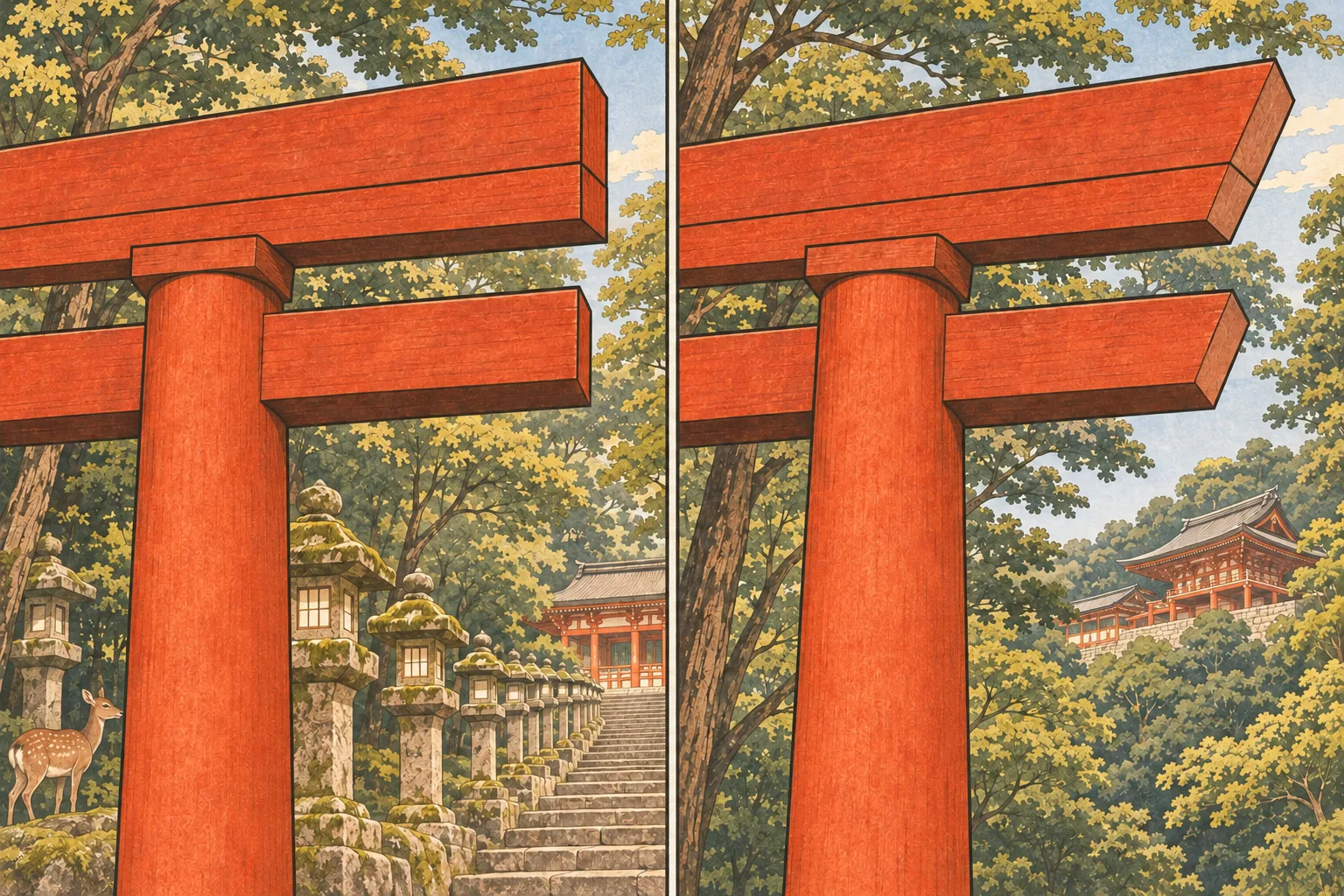
The ends of the top beams. Left: a Kasuga torii, cut vertically. Right: a Hachiman torii, cut at a slant, with the top edge longer than the bottom.
04A Field Guide: Telling Them Apart
All of this sounds like a lot to memorise, but in practice you can sort torii by asking a few questions in order.
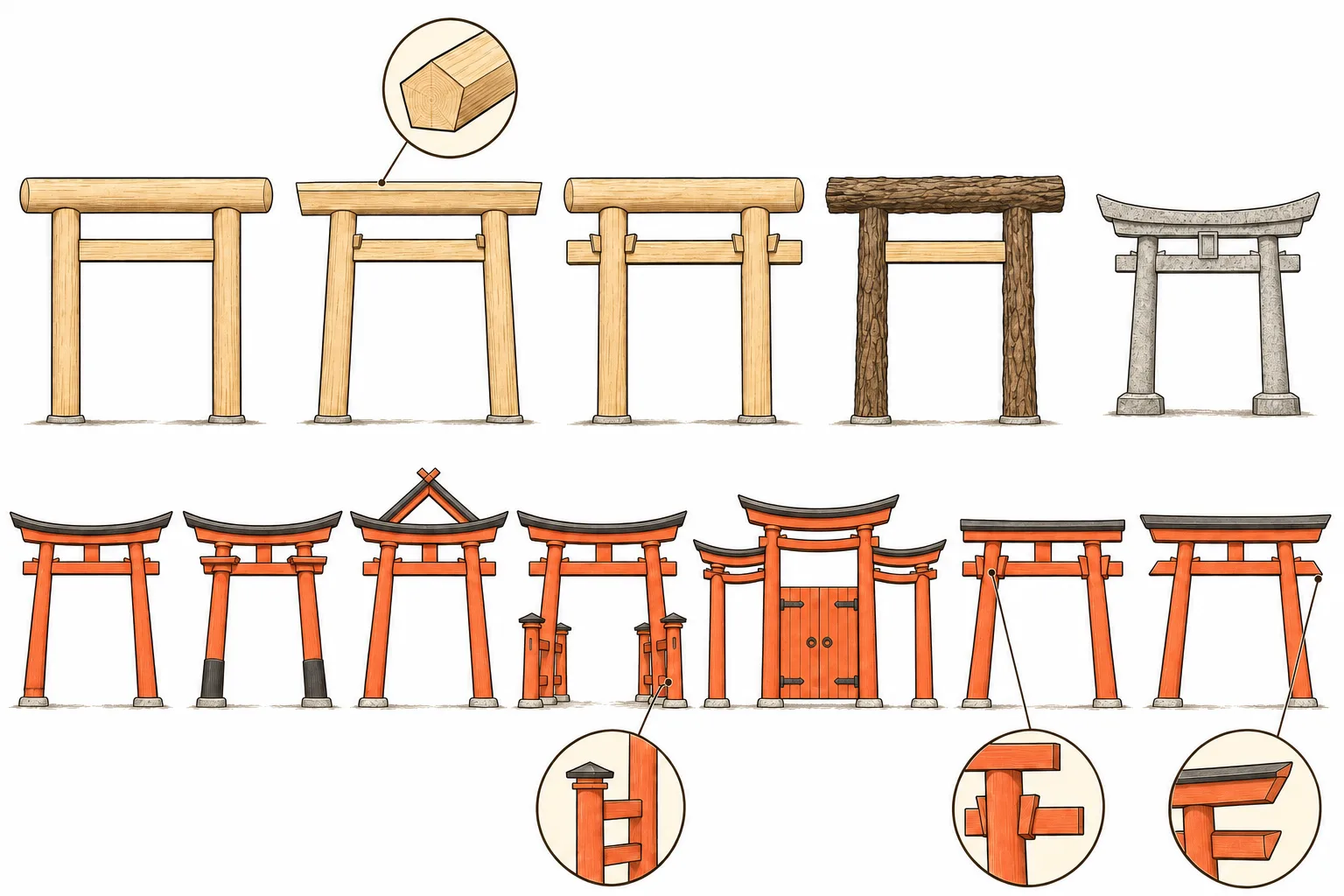
Top row, from left: Shinmei, Ise (the circle shows its five-sided kasagi), Kashima, kuroki, and a stone Myōjin torii. Bottom row, from left: Myōjin, Inari, Sannō, Ryōbu, Miwa, Kasuga, Hachiman; the circles show the Ryōbu support posts, the vertical Kasuga beam end and the slanted Hachiman one.
First: is the top line straight or curved, and is there one top beam or two? A single straight beam means the Shinmei family. Two beams, the upper one curving, means the Myōjin family. This is visible from the far end of the approach: one family draws a ruler line against the sky, the other a slight smile with a second line beneath it.
For a Shinmei-family torii, look next at the kasagi and the ends of the nuki. A five-sided, ridged kasagi, a flush nuki and slightly leaning posts mean Ise. A round kasagi with a squared nuki poking out and wedged means Kashima. A round kasagi, a flush nuki and upright posts mean plain Shinmei. Bark still on the logs means kuroki, whatever the details.
If there are two top beams but the upper one is straight, you are looking at the in-between pair: Kasuga if the beam ends are cut vertically, Hachiman if they are cut at a slant. Classifications disagree on where these two belong, some putting them in the Myōjin family and others in the Shinmei family, because they mix Myōjin parts with Shinmei straightness.
If the upper beam curves, check what has been added. Small extra posts front and back: Ryōbu (often with rings at the post tops too). Rings at the post tops but no extra posts: Inari. A triangle on top: Sannō. Three gates joined, with doors in the middle: Miwa. None of these: Myōjin.
Two pairs trip people up. The first is Inari versus Ryōbu. Both may have rings at the post tops; the difference is at the feet, where a Ryōbu torii has a short support post in front of and behind each main post. From straight on, those support posts hide behind the main posts, so step to the side before calling a ringed torii Inari. The great torii at Itsukushima, with rings and four support posts, is the classic Ryōbu example.
The second trap is colour. Shinmei torii are usually bare wood and Myōjin torii usually red, but there are plenty of stone, bronze and unpainted Myōjin torii, and painted Shinmei ones. A grey granite Myōjin torii still has a curving kasagi and a shimaki. Read the lines and parts first; colour comes last.
Why so many styles? Partly because the great shrines each developed their own form, and the form travelled with the cult: when Inari, Sannō or Hachiman deities were enshrined in new places, their torii came with them. Partly because of centuries of Shinto-Buddhist fusion, during which upturned eaves, red lacquer, rings and plaques migrated from temple gates onto torii, producing the Myōjin family, while Ise, which held itself apart from Buddhist influence, kept its straight lines and bare cypress. After the government ordered the separation of Shinto and Buddhism in the late 1860s, some shrines are said to have rebuilt their torii in Shinmei style to remove Buddhist associations, so the styles you see today also carry traces of that policy.
05Wood, Stone, Bronze, Concrete, and the Colour Red
The first torii were wooden, and the best still are, usually hinoki cypress or sugi cedar, with whole trunks for the posts of large gates. Wood decays, so a torii has always been something to be maintained and periodically rebuilt. Ise’s 20-year cycle is the extreme case; most shrines repair or replace a torii when the post feet rot or the paint fails.
Stone torii go back at least to the Heian period, but became common only in the Edo period (1603–1868), when merchants, domain lords and village associations donated them. A very old stone torii in Yamagata Prefecture, known as the Motoki stone torii, is generally dated to the Heian period and counted among the oldest torii surviving anywhere; it is squat and heavy, with the kasagi and shimaki carved from one block. At Shitennōji in Osaka, a Buddhist temple, a stone torii erected in 1294 stands at the west gate, its plaque declaring the spot to be the eastern gate of the Western Paradise. It is a reminder that before the separation of the 1860s, torii were not confined to shrines. At Nikkō Tōshōgū, the great stone torii donated in 1618 by the lord Kuroda Nagamasa was made of stone shipped from his domain in northern Kyushu, and is among the largest stone torii of the Edo period. Stone torii are normally left unpainted, grey or buff, and if you look closely you can often see the joints where the kasagi was assembled from several blocks.
Bronze torii are rarer and were generally gifts from lords or wealthy patrons. Over time the metal darkens to brown or green, and the post bases and beam ends can carry cast decoration impossible in wood or stone. Nikkō has one of these too, a bronze torii from the early Edo period standing deeper inside the precinct, in front of the Yōmeimon gate.
In the modern era steel and reinforced concrete took over for large torii. Reinforced concrete torii appeared in the Taishō period (1912–1926); concrete is cheap and durable, and from the Shōwa period onward many shrines replaced their wooden gates with concrete ones, painted vermilion or grey; from a distance you can rarely tell. The great vermilion torii in front of Heian Shrine in Kyoto, completed in 1929, is reinforced concrete and about 24 metres tall, and was the largest in Japan when it was built. At Ōyunohara, the river flat that was the original site of Kumano Hongū Taisha in Wakayama, a dark, almost black steel torii about 34 metres tall was completed in 2000 and now stands among the rice fields. Small shrines and donated miniature torii are now often stainless steel, aluminium or even plastic.
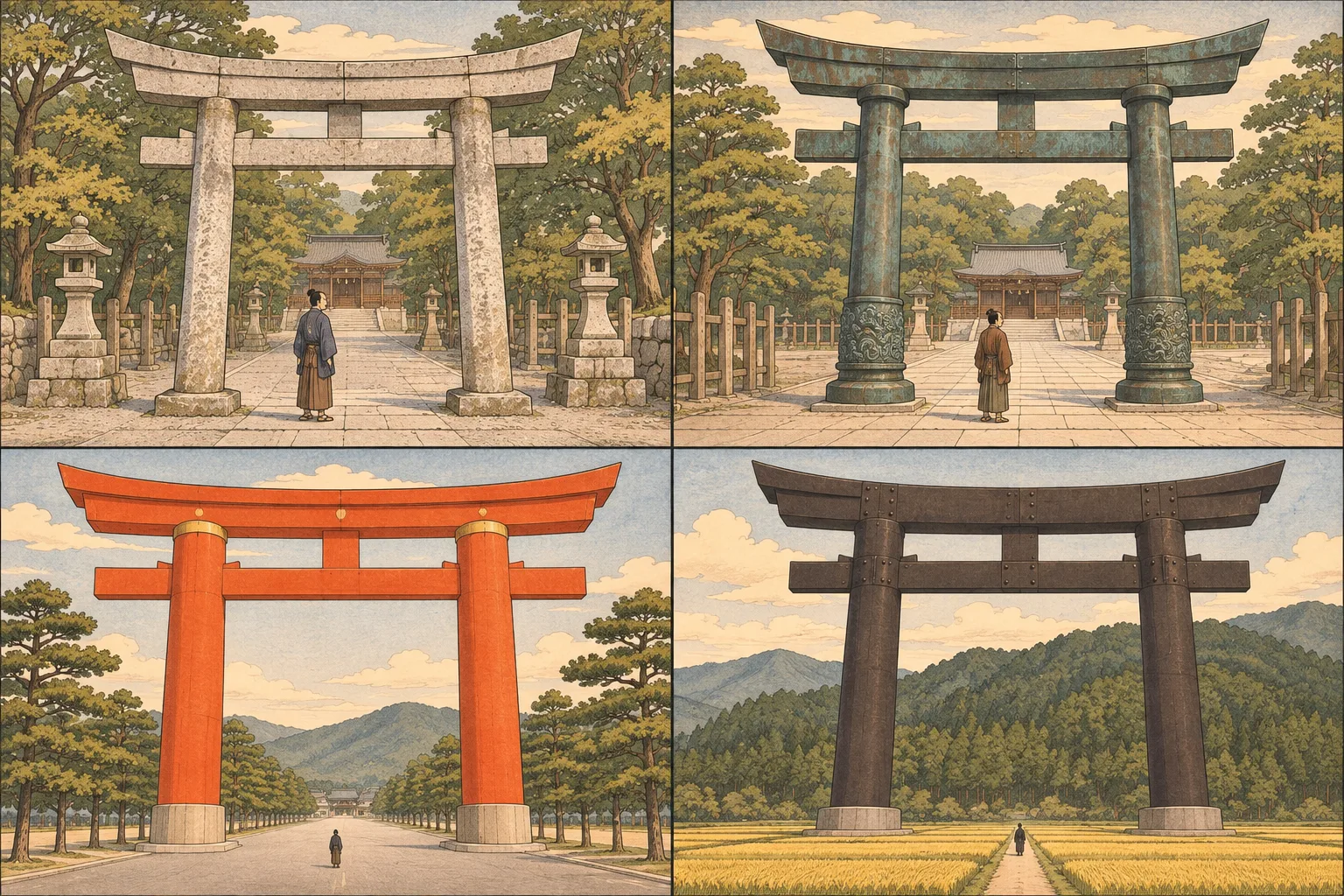
Four materials. Top row, from left: stone, and bronze weathered green. Bottom row, from left: a great vermilion torii in reinforced concrete, like the one at Heian Shrine, and a dark steel torii among rice fields, like the one at Ōyunohara.
The vermilion itself has a history. Traditionally it was ni, a pigment based on cinnabar (mercury sulphide), or sometimes red lead; modern torii use synthetic paint. Three explanations for the colour are usually offered, and they are not exclusive. One is practical: mercury-based pigment helps protect wood against rot and insects. One is symbolic: red has long been associated in Japan with warding off evil and with life and the sun, and red pigment was already used in tombs of the Kofun period. The third is historical: vermilion lacquer arrived with Buddhist architecture from the continent, where temple gates and pillars were painted red, and shrines adopted it during the centuries of Shinto-Buddhist fusion. Inari shrines are especially attached to the colour and often explain it as representing the power of abundant harvests. The black often painted on the top of the kasagi is simply more weather-resistant, and it sharpens the gate’s silhouette.
06Thousands of Gates, and One in the Sea
Many torii are not built by the shrine at all but donated by worshippers, either to ask for something or to give thanks once it has been granted. The donor’s name, address and the date are cut or painted on the posts. On many shrine approaches you will see a series of torii of different sizes and ages, each one a separate person’s vow.
Fushimi Inari Taisha in Kyoto took this to its limit, with some ten thousand torii said to stand on Mount Inari. The densest stretch, the senbon torii or "thousand torii", begins behind the main hall as two parallel tunnels. The merchants’ choice of gift rested on a pun: a torii is something you pass through, and they hoped their wishes and their business would "go through" too. Walking up, you see only red; the light is chopped into stripes by the posts. Coming down, you see the backs of the posts, covered in black brushed characters: the word hōnō, "donated", company names, personal names, dates. Sizes range from knee-high to large enough for a vehicle. When a torii rots it is removed and a new donor’s gate goes up in its place, so the tunnel is constantly being renewed, and the gate standing in a given spot today may not be the one that stood there ten years ago. At the small shrines scattered over the mountain, piles of palm-sized miniature torii, wishes written on them in marker pen, have been left by people who could not afford a full-size one.
The other extreme stands in the sea: the great torii of Itsukushima Shrine on Miyajima, about 16.6 metres tall, built in 1875 and standing under its own weight of about 60 tonnes. The gate is a Ryōbu torii, and its four support posts spread the load so that it can stand in the tide without its pillars being sunk into the seabed: the footings are packed with pine piles and capped with stone slabs, and the gate simply rests on them. It also has daiwa rings at the post tops. Camphor trees large enough for the main pillars are hard to find. The present gate has usually been counted as the eighth since the Heian period, though recent research puts it at the ninth. It stands about 200 metres out from the front of the main sanctuary, and at low tide, standing at its feet among the barnacles and shells clinging to the posts, you reach only a fraction of the way up a single pillar. Each side carries a plaque: the seaward one reads "Itsukushima Shrine", the one facing the shrine gives an older way of writing the island’s name.
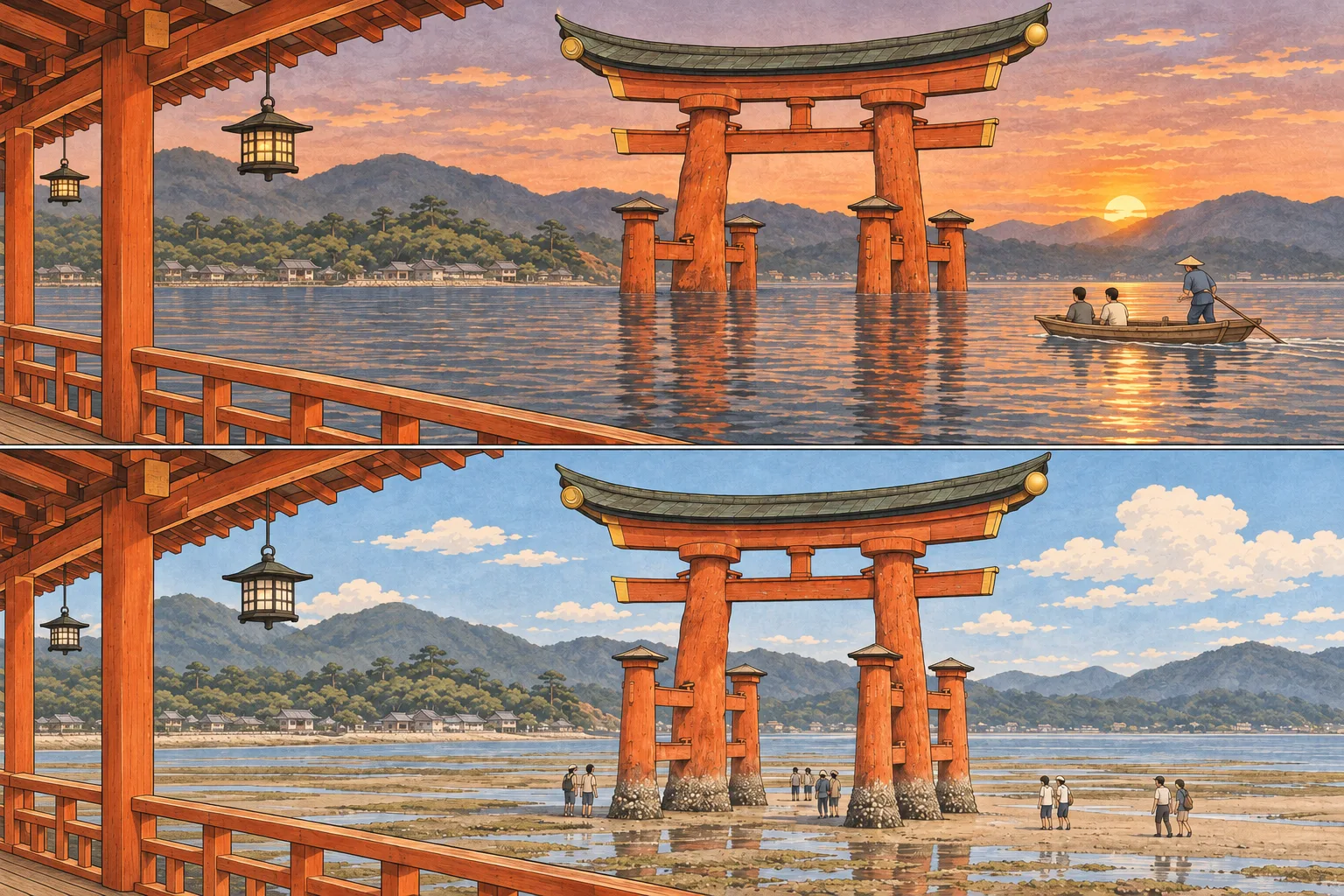
The great torii of Itsukushima Shrine, about 16.6 metres tall. Top: at high tide it stands in the sea. Bottom: at low tide visitors walk out to its feet.
The whole shrine stands over the water because the island itself was regarded as sacred, and building on its land was avoided; the halls were pushed out into the tidal zone instead, and the great torii was the gate you passed through when arriving to worship by boat. Taira no Kiyomori, the twelfth-century warrior who rose to dominate the court, poured patronage into Itsukushima and gave the shrine its basic layout.
The tunnel and the sea gate make the same point. A torii marks the entrance to a place, not the door of a building. It has no walls on either side and nothing to close. Fushimi turns a whole mountain path into an entrance; Itsukushima puts the entrance in the sea and leaves the whole island inside.
07Where the Name Comes From
The word may first appear in an Ise ritual record submitted in 804, though some date the first reliable use to a document of Ōtori Shrine in Izumi Province from 922; its origin is unknown. Written with the characters for "bird" and "to stay", torii could be read as "where birds perch". In the Kojiki and Nihon shoki, when the sun goddess Amaterasu hides in a cave, the gods set "long-crying birds of the eternal land", roosters, crowing to lure her out, and a later tradition makes the torii their perch. The myth says nothing about a perch, so this is an explanation added afterwards, but it is often linked to the chickens kept at some shrines, including the ones that strut along the paths at Ise.
Another theory works from sound: torii from tōri-iru, "to pass through and enter", later written with characters that matched the sound. It fits what a torii does, but there is little linguistic evidence for it.
The comparative theories look further afield. The stone gateways around the great stupa at Sanchi in India have two posts and several crossbeams, and torana has a similar ring. China has its memorial archways, Korea its red-arrow gates (hongsalmun). Some scholars point to village gates topped with carved birds in parts of Southeast Asia and southwestern China, where birds were thought to carry messages between heaven and earth. These comparisons place the torii in a wider family of ceremonial gateways, but none has been proven to be its direct ancestor, and whether such gates existed in Japan before the Nara period, or what they were called, is unclear.
08Passing Through: Etiquette at the Gate
Because a torii marks the move from ordinary ground into the space of a deity, there is a customary way to pass through. None of it is enforced, and shrines differ on details, but the basic pattern is consistent.
Stop at the torii, take off your hat and bow slightly, pass through to one side rather than down the middle, and turn and bow again when you leave. The bow at the torii is called ichiyū, a shallow inclination much lighter than the deep bows at the worship hall. The centre of the approach, the seichū, is said to be the path of the deity. If you need to cross it, some people dip their head slightly as they pass the centre line, or step outside the torii to change sides. Some shrines suggest stepping through with the foot farther from the centre, the left foot if you are on the left side, so that your body naturally turns inward rather than putting your back to the shrine, but practice varies and nobody will mind.
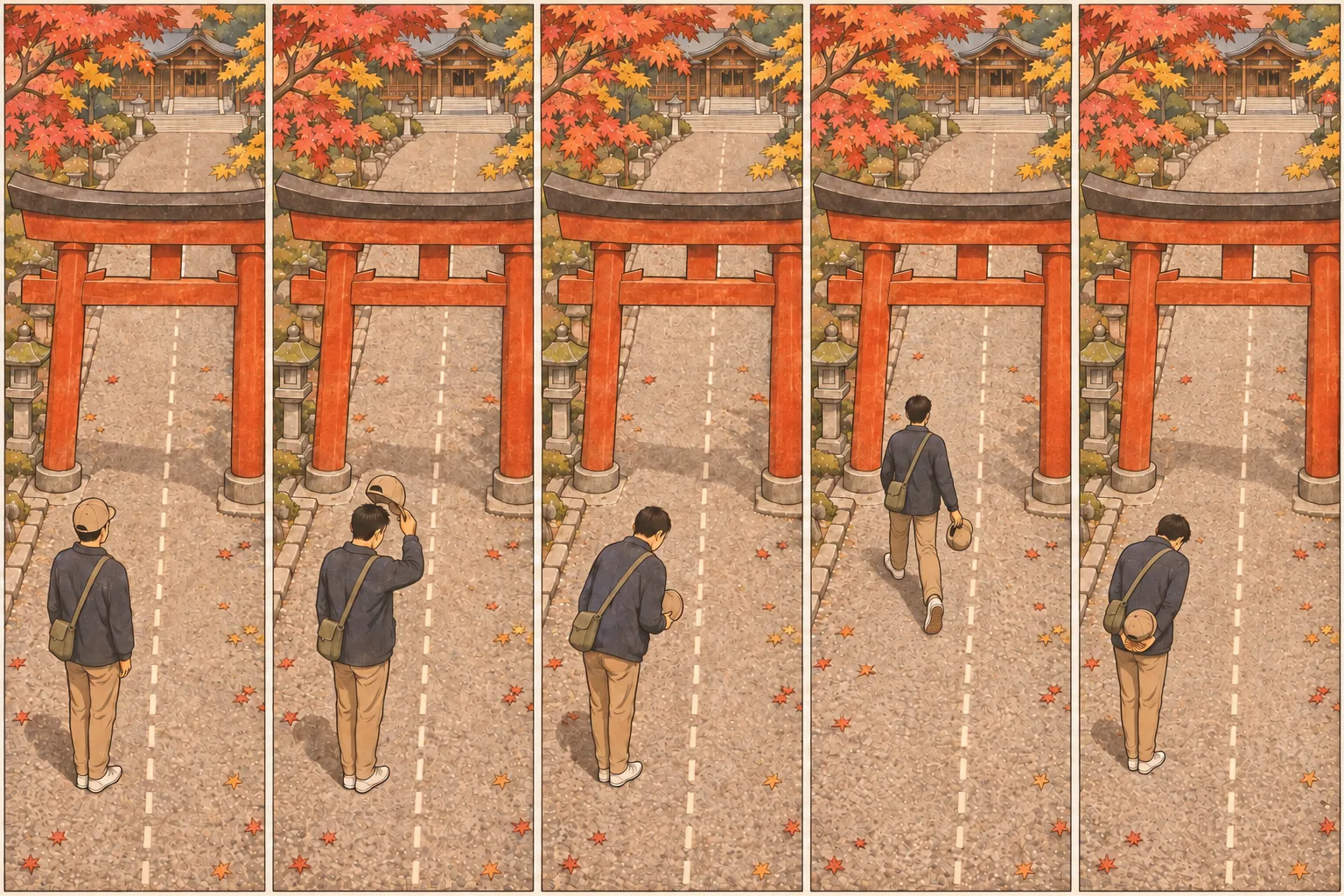
Passing through, from left: stop at the torii, take off your hat, bow slightly, walk through to one side, and bow again when you leave. The dashed line marks the seichū, the centre of the approach.
A large shrine may have several torii in a row, counted from the outside as the first, second and third torii; strictly you bow at each, though most people only bother at the first and last.
There are older customs too. During a period of mourning after a death in the family, known as kichū, people traditionally avoid passing through torii and visiting shrines; some will pray from outside the gate instead. The custom of tossing pebbles onto a torii’s nuki or kasagi, where a stone that stays put was supposed to mean a wish granted, is now discouraged by shrines because it damages the wood and the stones fall on people.
Photographing torii is fine; they are outdoors and open to everyone. Just do not block the path, climb on the bases, or lean on the posts for a pose. And if you notice a small torii painted on a wall in an alley or a car park, it is not a shrine. It is a warning, relying on the respect people feel for the shape, not to dump rubbish or relieve themselves there.
More deep dives on this topic
 ToriiA torii is two posts and one or two crossbeams, with no doors, no walls and no lock.
 Divine Messengers and KomainuWalk into almost any Shinto shrine and an animal meets you before anything else does.
 Shrine ArchitectureMost visitors to a Shinto shrine photograph the torii gate, the vermilion pillars and the bell rope in front of the hall, and leave thinking they have seen the shrine.
 Shimenawa, Shide and GoheiWalk into almost any Shinto shrine in Japan and you will pass under a rope.
 Reading Shrine NamesWalk up to almost any Shinto shrine in Japan and look at the wooden plaque hanging from the torii gate or the main entrance.
 OmikujiNext to the counter where a Japanese shrine sells its charms, there is usually a wooden box or a hexagonal canister and a small slot for coins.
 Shinto Priests and MikoSpend a morning at a large Japanese shrine and you will see two kinds of people in old-fashioned dress.
 Shikinen Sengū and ZōtaiWalk up to the main sanctuary of the Inner Shrine at Ise and you will notice, just beside it, an empty plot exactly the same size.
 Sacred Trees and StonesWalk into almost any Shinto shrine and something older than the buildings is usually waiting for you.
- Back to the main article: Shinto →