
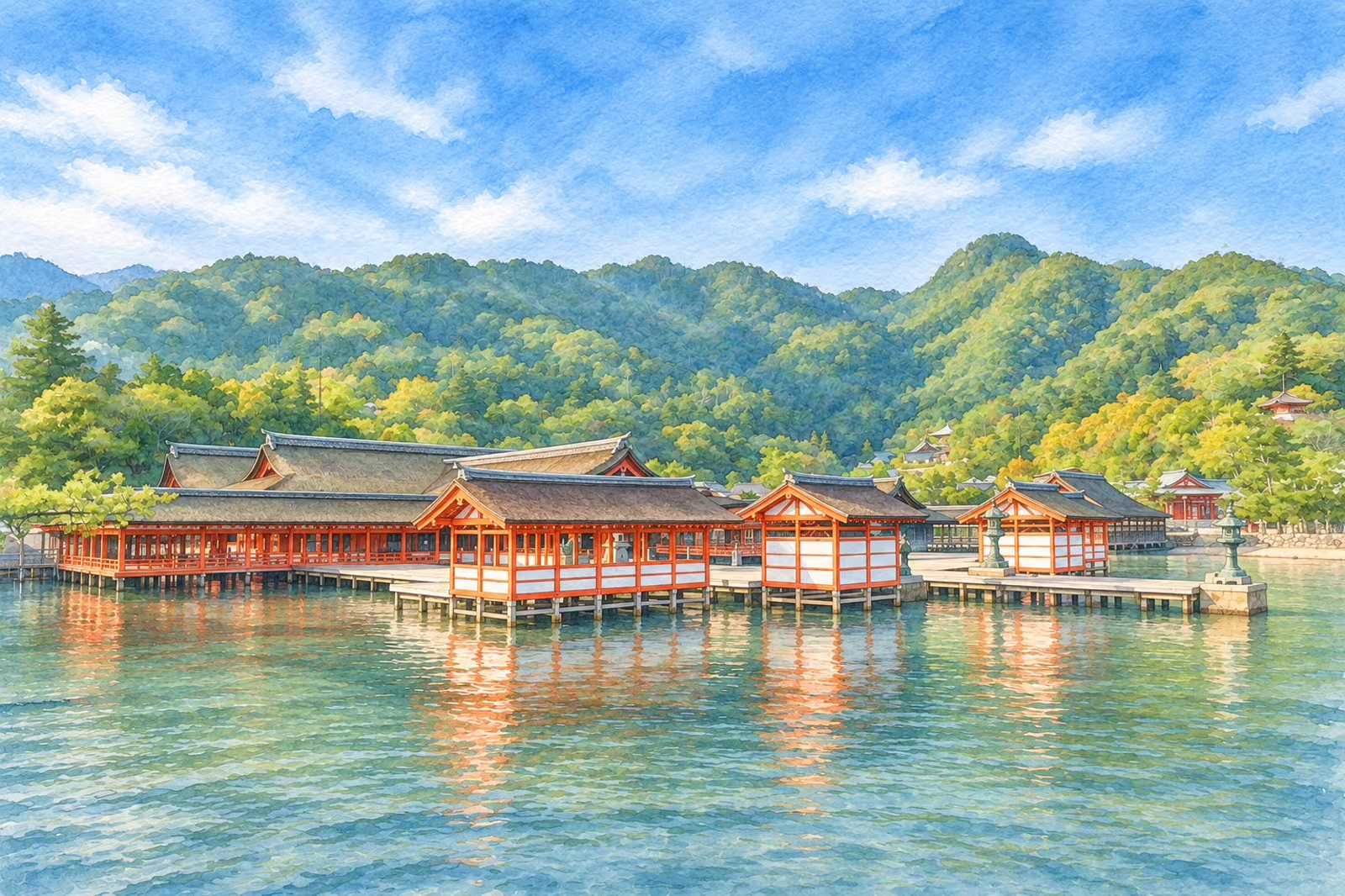
Itsukushima Shrine stands on the island of Itsukushima, usually called Miyajima, in the city of Hatsukaichi, Hiroshima Prefecture. Its buildings are set over the tidal flats on the island’s north shore, so that at high tide the vermilion corridors and halls seem to float on the sea. The great torii standing in the water is one of the best-known sights in Japan. In 1996 the shrine and the primeval forest of Mount Misen behind it were inscribed together as a World Heritage Site.
01Origins and Taira no Kiyomori
The island has long been regarded as the dwelling place of the gods, and the island itself is an object of worship. According to shrine tradition, the shrine was founded in the late 6th century, in the reign of Empress Suiko, by a local chieftain named Saeki no Kuramoto, and it enshrines the three Munakata goddesses. In the 12th century Taira no Kiyomori, then governor of Aki Province, became a devoted patron. Around 1168 he gave the shrine its basic layout: halls linked by corridors in imitation of an aristocratic shinden-zukuri residence. The richly decorated sutra scrolls known as the Heike Nōkyō, dedicated by the Taira clan, are now a National Treasure. The retired emperors Go-Shirakawa and Takakura made pilgrimages here, and for a time the shrine was closely tied to the court in Kyoto.
02After the Taira
After the fall of the Taira, the shrine burned more than once in the early 13th century and was rebuilt following the plan of Kiyomori’s day. In 1555 Mōri Motonari defeated Sue Harukata on the island at the Battle of Itsukushima, and the Mōri became important patrons. The great sutra hall known as Senjōkaku, ordered by Toyotomi Hideyoshi, was left unfinished at his death and still stands incomplete. In the Edo period Itsukushima became famous as one of the Three Views of Japan, and pilgrims and sightseers came in large numbers.
03What can be seen today
The Main Sanctuary, the Offering Hall, the Worship Hall, the Purification Hall, the Marōdo Shrine and the corridors are designated National Treasures; the great torii, the Noh stage, the five-story pagoda and Senjōkaku are Important Cultural Properties. Most of the present buildings are reconstructions or repairs dating from the 13th century through the Edo period. The current torii, completed in 1875, is about 16 meters tall and stands on the seabed under its own weight; it underwent major repairs from about 2019 to 2022. Built over the sea, the shrine is constantly exposed to typhoons and salt water, and repair work has never really stopped.
Itsukushima Shrine (Miyajima)
01Between Land and Sea
Most visitors first see Itsukushima from the deck of the ferry that crosses from Miyajimaguchi on the mainland. The vermilion torii gate (the gateway that marks the entrance to a Shinto sacred precinct) stands in open water, and behind it a long, low complex of halls and corridors seems to float on the bay. Come back six hours later and the picture has changed completely: the tide has drained away, the sea floor is wet sand, and people are walking out to touch the gate’s pillars.
That daily transformation is the key to the place. Itsukushima Shrine was built not on the island but in the intertidal zone in front of it, and almost everything about its history, from its founding to the way its floors are laid, follows from that choice.
The island is officially Itsukushima but almost universally called Miyajima, "shrine island." It lies in the western part of Hiroshima Bay and now belongs to the city of Hatsukaichi. In the seventeenth century the Confucian scholar Hayashi Gahō listed it with Matsushima and Amanohashidate as one of the three most remarkable sights in the country, the origin of the phrase Nihon Sankei, the Three Views of Japan. In 1996 the shrine, the sea in front of it and the forested slopes of Mount Misen behind it were inscribed together as a UNESCO World Heritage Site.
02An Island Treated as a God
The shrine is dedicated to three sea goddesses, Ichikishimahime, Tagorihime and Tagitsuhime, known collectively as the Munakata goddesses after the great shrine at Munakata in northern Kyūshū where they are also worshipped. They protect seafarers, which suits a shrine that sits on the Inland Sea, the main water route linking Kyūshū, Shikoku and the old capital region for well over a thousand years.
The usual explanation for the shrine’s position is that the island itself was regarded as sacred, a divine body that people should not cut into or build upon. The name Itsukushima is generally thought to derive from an old word meaning "island where the gods are worshipped." Instead of clearing ground on the island, the builders set the halls on the tidal flat, between the sacred mountain and the sea.
The shrine’s own tradition dates its founding to 593, in the reign of Empress Suiko, when a local chieftain named Saeki no Kuramoto is said to have established it in response to a divine message. That is a foundation legend. Firmer evidence appears in the ninth century, when the official history Nihon Kōki mentions the deity of Itsukushima in an entry for 811, and in the tenth-century Engishiki, whose register of shrines lists Itsukushima among the major shrines of Aki Province. By the late Heian period it was the ichinomiya, the highest-ranking shrine, of Aki. The Saeki family served as its hereditary priests.
03Taira no Kiyomori Arrives
The man who turned a respected provincial shrine into a national one was Taira no Kiyomori (1118–1181), the warrior-courtier who dominated Japanese politics in the 1160s and 1170s. In 1146 Kiyomori was appointed governor of Aki. The Taira fortunes rested heavily on the Inland Sea: on trade with China, on control of the shipping lanes and on suppressing (or absorbing) pirates. Aki sat squarely on that route.
The Tale of the Heike, the great war chronicle of the Taira’s rise and fall, tells a story about how the connection began. After Kiyomori finished rebuilding a pagoda at Mount Kōya, an old monk appeared and told him that the shrines of Kehi in Echizen and Itsukushima in Aki were manifestations of the cosmic Buddha Dainichi, that Itsukushima had fallen into neglect, and that if he restored it he would rise higher than any other subject. Kiyomori did, and he did. The tale is a moral story written after the family’s destruction, but it captures how contemporaries saw the bond between the Taira and the island’s gods.
Working with the chief priest Saeki no Kagehiro, Kiyomori sponsored a lavish rebuilding. By around 1168 the shrine had taken on the form we recognize: a main sanctuary and a secondary shrine linked by long covered corridors, all raised on pillars over the tidal flat, laid out in the manner of a Heian aristocrat’s mansion. A petition Kagehiro sent to the court in 1168 already describes buildings on this scale; it does not mention Kiyomori himself, and his role rests mainly on shrine tradition and later accounts. The buildings standing today are later reconstructions, but they follow this twelfth-century plan.
Kiyomori brought the culture of the capital with him. Tradition credits him with introducing bugaku, the stately court dance accompanied by gagaku music, from Shitennō-ji temple in Ōsaka, and with originating the Kangensai, the summer festival in which musicians play court music aboard boats on the bay.
04The Heike Nōkyō
In 1164 Kiyomori and members of his family dedicated to the shrine a set of illuminated sutra scrolls now called the Heike Nōkyō, "the sutras dedicated by the Heike." There are thirty-three scrolls: the twenty-eight chapters of the Lotus Sutra, each on its own scroll, several related sutras, and a dedicatory prayer in Kiyomori’s own hand. In the prayer he explains that each member of the clan copied one scroll.
The set is among the most sumptuous objects to survive from the Heian period. The paper is dyed and scattered with flakes of gold and silver, the frontispieces show Buddhist scenes and courtly figures, and the rollers, fittings and bronze box are fine metalwork. It is a National Treasure, and the originals are rarely displayed. In the Taishō and early Shōwa periods the craftsman Tanaka Shinbi made a meticulous full set of copies, and these are often what exhibitions show.
05Emperors on the Inland Sea
At the height of Taira power, retired emperors made the long journey to the island. In 1174 the cloistered Retired Emperor Go-Shirakawa visited with his consort Kenshunmon’in, who was the younger sister of Kiyomori’s wife. In 1180 Retired Emperor Takakura, Kiyomori’s son-in-law, made Itsukushima the destination of his first pilgrimage after abdicating. Tradition required a new retired emperor to visit established shrines near the capital first, and the great temples and shrines of the Kyoto region were outraged. He returned to the island that September. A courtier in his party, Minamoto no Michichika, wrote an account of the voyage.
Within weeks of his first visit, Prince Mochihito and Minamoto no Yorimasa rose against the Taira, opening the Genpei War. Kiyomori died in 1181, and in 1185 the Taira were destroyed at the sea battle of Dan-no-ura.
The shrine outlived its patrons. The Kamakura shogunate continued to support it, and after the Jōkyū War of 1221, in which the Saeki priests had sided with the court, the shogunate gave the chief priesthood to Fujiwara no Chikazane, a former governor of Suō. His descendants held the post for about three centuries, until the line ended in 1541.
06Fire and Rebuilding
Two fires, in 1207 and 1223, destroyed much of the complex. Each time it was rebuilt with support from the court and the shogunate, and the reconstruction completed around 1241 fixed much of the layout seen today.
In the sixteenth century control of the island passed through the hands of the Ōuchi clan, their usurper Sue Harukata and finally the Mōri. Each sponsored repairs. The present main sanctuary (honden) dates from 1571 under Mōri Motonari (the Agency for Cultural Affairs describes the work as a major repair), while the main shrine’s offering and worship halls date from the 1241 rebuilding. The corridors were rebuilt between the late Muromachi and Momoyama periods, and the arched Sorihashi bridge in 1557 by Motonari and his heir Mōri Takamoto.
So what you walk through is not the twelfth-century shrine itself but a faithful succession of rebuildings: the plan, the vermilion pillars, the cypress-bark roofs and the proportions have been reproduced again and again.
07The Battle of Itsukushima
The island’s most famous moment of violence came in 1555.
Four years earlier, Sue Harukata, the leading retainer of the Ōuchi family of Suō, had overthrown and driven to suicide his lord, Ōuchi Yoshitaka. Mōri Motonari, a minor lord from inland Aki, at first cooperated with Sue but broke with him in 1554. Sue had far larger forces. Motonari’s answer was to lure him onto Itsukushima, where numbers would count for less. He built a small fort, Miyao Castle, near the shrine and let it be known that its loss would be a disaster for him.
Sue took the bait and landed a large army, traditionally put at about 20,000 men, which camped on the hill of Tōnooka just behind the shrine and besieged the fort. On the night before the first day of the tenth month of Tenbun 24 (October 16, 1555 in the Julian calendar; the era name changed to Kōji later that month, so the date is often given as Kōji 1), in a storm, Motonari crossed to the far side of the island with a much smaller force of a few thousand (accounts range from about 3,000 to 4,000), landed at Tsutsumigaura and marched over the ridge of Bakuchio. At dawn his men fell on Sue’s camp from behind while a second force under his son Kobayakawa Takakage attacked from the sea, with the Murakami pirate fleets generally thought to have helped close off the sea. Crammed on a narrow strip of land, Sue’s army collapsed. Sue fled to the west of the island, found no boat, and took his own life.
The victory made the Mōri the masters of western Honshū.
Because blood had been spilled on sacred ground, Motonari is said to have had the bloodstained soil removed, the shrine corridors washed with seawater and purification rites performed. The island long observed strict taboos against death and birth: the dead were taken across the strait for burial. The battle tested those rules severely.
08Hideyoshi’s Unfinished Hall
On the small hill just north of the shrine stands a huge, airy hall known as Senjōkaku, the "hall of a thousand mats." In 1587 Toyotomi Hideyoshi ordered it built as a sutra hall for monthly mass recitations of scripture, usually said to have been in memory of the war dead, entrusting the project to the monk Ankokuji Ekei. Hideyoshi died in 1598 before it was finished, and work stopped. It has stayed that way: there is no ceiling, and the front is open. After the separation of Shinto and Buddhism in 1868 its Buddhist images were moved to Daigan-ji and it became Toyokuni Shrine, dedicated to Hideyoshi. Its floor area actually works out to about 857 mats. Its rafters are hung with wooden rice paddles and votive plaques left by generations of visitors.
Beside it rises the five-story pagoda, built in 1407, over 29 meters tall and painted vermilion, mainly in the Chinese-derived Zen style with Japanese elements. On another slope stands a two-story Tahōtō pagoda of 1523.
09Gods and Buddhas
For most of its history Itsukushima was a Buddhist as well as a Shinto holy place. Mount Misen is said to have been opened as a site of ascetic practice by the monk Kūkai in 806, and a hall near the summit keeps a fire that, by tradition, has burned since his time. Temples such as Daigan-ji, which oversaw construction and repair of the shrine buildings for centuries, and Daishō-in stood close by.
Under the Edo shogunate the island belonged to the Asano lords of Hiroshima. A town of merchants and innkeepers grew up around the shrine, and Miyajima became one of the best-known pleasure and pilgrimage spots on the Inland Sea. The Noh stage dates from this era: Fukushima Masanori donated a stage in 1605, and the present one was rebuilt in 1680 by the domain lord Asano Tsunanaga. It is the only Noh stage in Japan that stands over the sea.
The Meiji government’s order of 1868 separating Shinto and Buddhism changed the island. Buddhist images were removed from the pagoda, Senjōkaku became a Shinto shrine, and shrine and temples were put under separate management.
10The Great Torii
The present Great Torii was erected in 1875 and is usually counted as the eighth since the Heian period (some counts make it the ninth). It stands about 200 meters from the main shrine and is roughly 16 meters high. The two main pillars are made from camphor trees several centuries old.
The pillars are not sunk into the sea bed. Instead, the sea bed was reinforced with wooden piles and topped with foundation stones, and the gate simply stands on them under its own weight, about 60 tonnes, including some 7 tonnes of stones packed into the box-like upper beam. Four smaller supporting legs, two in front and two behind, give it a stable footprint; this six-legged form, called ryōbu torii, has been used here since the mid-sixteenth century.
The plaque facing the sea reads "Itsukushima Shrine"; the one facing the shrine gives the old spelling "Itsukishima Shrine." Both are usually attributed to the brush of Prince Arisugawa Taruhito. The torii recently underwent a long restoration, during which it was shrouded in scaffolding, a reminder that a wooden gate standing in salt water needs regular care.
11Built for the Waves
A wooden building over the sea has to survive storms. The shrine’s builders found ways to let the sea pass rather than resist it. The floorboards of the corridors are laid with small gaps so that at high tide water can rise through them, relieving the pressure that would otherwise lift the boards. Many floor sections are not rigidly fixed. Pillars rest on stone bases.
Damage has still been frequent. In September 1945 the Makurazaki typhoon sent debris flows from Mount Misen down the Momijidani valley into the west side of the shrine, damaging the Hirabutai platform and corridors. In 1991 a typhoon blew down the Noh stage, which was rebuilt with its old timbers. In 2004 another typhoon toppled the Left Music Pavilion, a National Treasure, and damaged dozens of other buildings. Repair is a permanent part of the shrine’s life.
12A Walk Through the Shrine
Visitors enter by the east corridor. The corridors run for about 300 meters in all; the official survey counts 107 bays, though 108 is the figure usually quoted. First comes the Marōdo Shrine, a subsidiary shrine to five male deities, built with the same sequence of halls as the main shrine: sanctuary, offering hall, worship hall and purification hall.
The corridor leads to the main shrine. In front of its purification hall the broad Hirabutai platform extends out over the water, with the raised Takabutai dance stage at its center, where bugaku is performed. From the end of the platform you look straight down the axis of the shrine to the Great Torii. The main sanctuary behind the worship hall is the one of Mōri Motonari’s time; visitors pray at the worship hall and do not enter. The main shrine and Marōdo Shrine buildings and the east and west corridors are designated National Treasures.
Following the west corridor out, you see the steep arched Sorihashi bridge, once reserved for imperial envoys, and near the exit the Noh stage standing over the water. Both are Important Cultural Properties.
Beyond the shrine are the treasure hall, the hill with Senjōkaku and the five-story pagoda, and the paths and ropeway up Mount Misen. From the summit the Inland Sea spreads out below, scattered with islands: the same sea lanes Kiyomori’s ships sailed.
If you can, come back at low tide and walk out to the torii. Standing at the foot of a camphor pillar, looking back at the shrine’s stone bases and stilts exposed on the sand, you can see plainly how the whole place has been set, for more than eight centuries, between one tide and the next.