
At a glance
How the rise and fall of the Taira became a Buddhist tale of impermanence, how blind biwa singers carried it, and where to see and hear it today.
- It tells of some twenty years at the end of the 12th century, as the Taira clan rose to dominate the court and then perished at sea.
- Its opening lines on "the bell of Gion Shōja" are in Japanese school textbooks, and almost everyone can recite them.
- It first spread as a chanted tale performed by blind biwa priests, an art called heikyoku.
- The standard text today, the Kakuichi version, was fixed in 1371 by Akashi Kakuichi.
- At Dan-no-ura in 1185, the Nun of the Second Rank leapt into the sea holding the boy emperor Antoku, eight by traditional count.
The Tale of the Heike (Heike monogatari) tells how the Taira clan rose to dominate Japan in the twelfth century and then, within a single generation, was hunted down and drowned in the sea. It is Japan’s great war epic, but it is also a long meditation on impermanence, and for centuries it was not read so much as heard, chanted by blind monks who accompanied themselves on the biwa, a short-necked lute. Knowing the story opens up a surprising amount of Japan: Noh plays, kabuki, place names in Kyoto and Kōbe, a famous ghost story, even a modern anime. This introduction covers the story, its best-loved episodes, the performers who carried it, the instrument they played, and where you can still meet the Heike today.
01The Bell of Gion Shōja
Almost every Japanese person can recite the opening lines, which are taught in middle school:
Gion shōja no kane no koe, shogyō mujō no hibiki ari. Sara sōju no hana no iro, jōsha hissui no kotowari o arawasu.
The sound of the bell of the Jetavana monastery echoes the impermanence of all things; the color of the sāla flowers reveals that the prosperous must decline. The proud do not last; they are like a dream on a spring night. The mighty fall at last, no more than dust before the wind.
The images are Buddhist. Gion Shōja is the Japanese name for Jetavana, the monastery where the Buddha taught, and the sāla trees are those under which he died. Before a single warrior appears, the listener has been told how everything will end. The phrases shogyō mujō ("all things are impermanent") and jōsha hissui ("the flourishing must fade") have passed into everyday Japanese; a sports commentator might use them about a fallen dynasty of champions.
The passage also shows why the work sounds the way it does. It is written in wakan konkōbun, a style that mixes the weighty vocabulary of classical Chinese with the softer grammar of Japanese, and it moves in balanced, chantable phrases. The whole work was shaped for the voice.
02Rise and Fall
The "Heike" are the Taira, a warrior house; Heike simply means "the Taira family." Their great figure is Taira no Kiyomori. In two short conflicts in the capital, Kiyomori backed the winning side in the Hōgen Disturbance of 1156, then in the Heiji Disturbance of 1159 destroyed his chief rival, Minamoto no Yoshitomo, head of the Minamoto, or Genji. Kiyomori became Grand Minister of State in 1167, and his daughter Tokuko married Emperor Takakura. Her son became Emperor Antoku, making Kiyomori grandfather to the throne. Taira kinsmen filled the high offices; one of them is remembered for saying that anyone who was not a Taira was hardly human.
The first part of the Heike dwells on this arrogance. Kiyomori is shown as willful and cruel, humiliating courtiers, monks and even the retired emperor Go-Shirakawa. Resistance builds. In 1180 Prince Mochihito issued a call to arms against the Taira, and two Minamoto leaders took it up: Yoshitomo’s son Minamoto no Yoritomo in the east, and his cousin Kiso Yoshinaka in the mountains of Shinano. The same year Kiyomori moved the capital to Fukuhara, near modern Kōbe, only to move it back within months.
In 1181 Kiyomori died of a fever. The tale describes a heat so intense that water poured on him turned to steam, and has him ask not for prayers but for Yoritomo’s head to be hung before his grave. After that the Taira lose steadily. In 1183 Yoshinaka marched on the capital, and the Taira fled west, taking the child emperor and the imperial regalia with them. Yoshinaka was soon destroyed in turn by Yoritomo’s brothers, Noriyori and Yoshitsune. In 1184 Yoshitsune won at Ichi-no-tani, near Kōbe, in the tale’s telling leading horsemen down a cliff the Taira thought impassable. In 1185 he drove them from Yashima on Shikoku.
- 1156Hōgen Disturbance
- 1159Heiji Disturbance: Kiyomori destroys Yoshitomo
- 1167Kiyomori becomes Grand Minister of State
- 1180Mochihito’s call to arms; Yoritomo and Yoshinaka rise; capital to Fukuhara
- 1181Kiyomori dies of a fever
- 1183Yoshinaka takes the capital; the Taira flee west
- 1184Ichi-no-tani
- 1185Yashima
- 3rd month, 1185Dan-no-ura: the Taira fall
Fewer than twenty years separate Kiyomori’s rise to Grand Minister in 1167 from the fall at Dan-no-ura in 1185.
The end came at Dan-no-ura, in the narrow strait between Honshū and Kyūshū, in the third month of 1185. When the tide turned against them, the Taira collapsed. Kiyomori’s widow, the Nun of the Second Rank, took Antoku, aged six (eight by traditional count), in her arms and leapt into the sea, telling him that there was a capital beneath the waves too.
The work does not stop at the battle. Antoku’s mother, Kenreimon’in, also jumped but was pulled from the water. She became a nun and lived out her days at Jakkō-in, a small temple at Ōhara in the hills north of Kyoto. The final chapter describes Go-Shirakawa’s visit to her there, and her account of having passed through all six realms of Buddhist rebirth in a single life. The evening bell of Jakkō-in tolls during that visit, and readers often hear it as an answer to the bell of the opening line; the book closes with Kenreimon’in’s death.
03The Episodes People Remember
What keeps the Heike alive is less its grand arc than its many small, sharply drawn scenes.
After Ichi-no-tani, the Minamoto warrior Kumagai no Jirō Naozane chases down a Taira rider on the beach, throws him to the sand and pulls off his helmet to take his head. He finds a boy of sixteen or so, the age of his own son. He wants to let him go, but other Minamoto riders are coming, and he kills him in tears. On the body he finds a flute, and realizes that the music heard from the Taira stronghold at dawn had come from this boy’s party. He was Taira no Atsumori. The tale says the experience turned Kumagai toward the religious life. The scene is the most retold episode in the work.
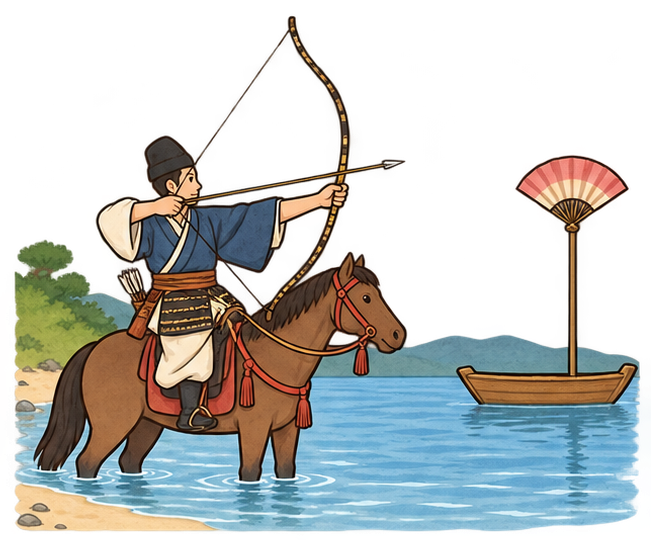
At Yashima, the Taira set a fan painted with a red sun on a pole at the prow of a boat and dared the Minamoto to hit it. The young archer Nasu no Yoichi rides into the surf, prays, and shoots; the arrow strikes about an inch above the fan’s rivet and the fan flutters down onto the waves in the evening light while both armies cheer. It is the brightest moment in a dark book.
Other stories are quieter. Giō, a dancer favored by Kiyomori, is cast aside for a newcomer, Hotoke, and forced to perform for her rival. Giō, her sister and her mother become nuns at Saga, west of Kyoto, and later Hotoke, seeing her own future in Giō’s fate, joins them. The monk Shunkan, exiled to a remote southern island for plotting against the Taira, learns that his companions have been pardoned and he has not, and runs into the surf after the departing ship. At Dan-no-ura, Kiyomori’s son Tomomori, having seen everything there was to see, puts on two suits of armor and goes into the sea. The famous image of Tomomori sinking with an anchor comes later, from the play Yoshitsune senbon zakura.
04The Biwa Priests
No one knows who wrote the Heike. The earliest account appears in Essays in Idleness (Tsurezuregusa), which says that a former governor of Shinano named Yukinaga composed it and taught it to a blind man named Shōbutsu to perform. It cannot be confirmed, but it captures something true: from the start, writing and performance went together.
In the Kamakura and Muromachi periods the story was spread by biwa hōshi, "biwa priests": blind performers with shaven heads and monk’s robes who chanted the tale at temples, aristocratic houses and in the streets. The art is called heikyoku, or Heike biwa. Because it was learned by ear and passed from teacher to student, every lineage’s text differed a little, and the Heike survives in an unusual number of versions. Scholars divide them broadly into recitation texts and longer "reading texts," such as the Engyō-bon and the greatly expanded Genpei jōsuiki.
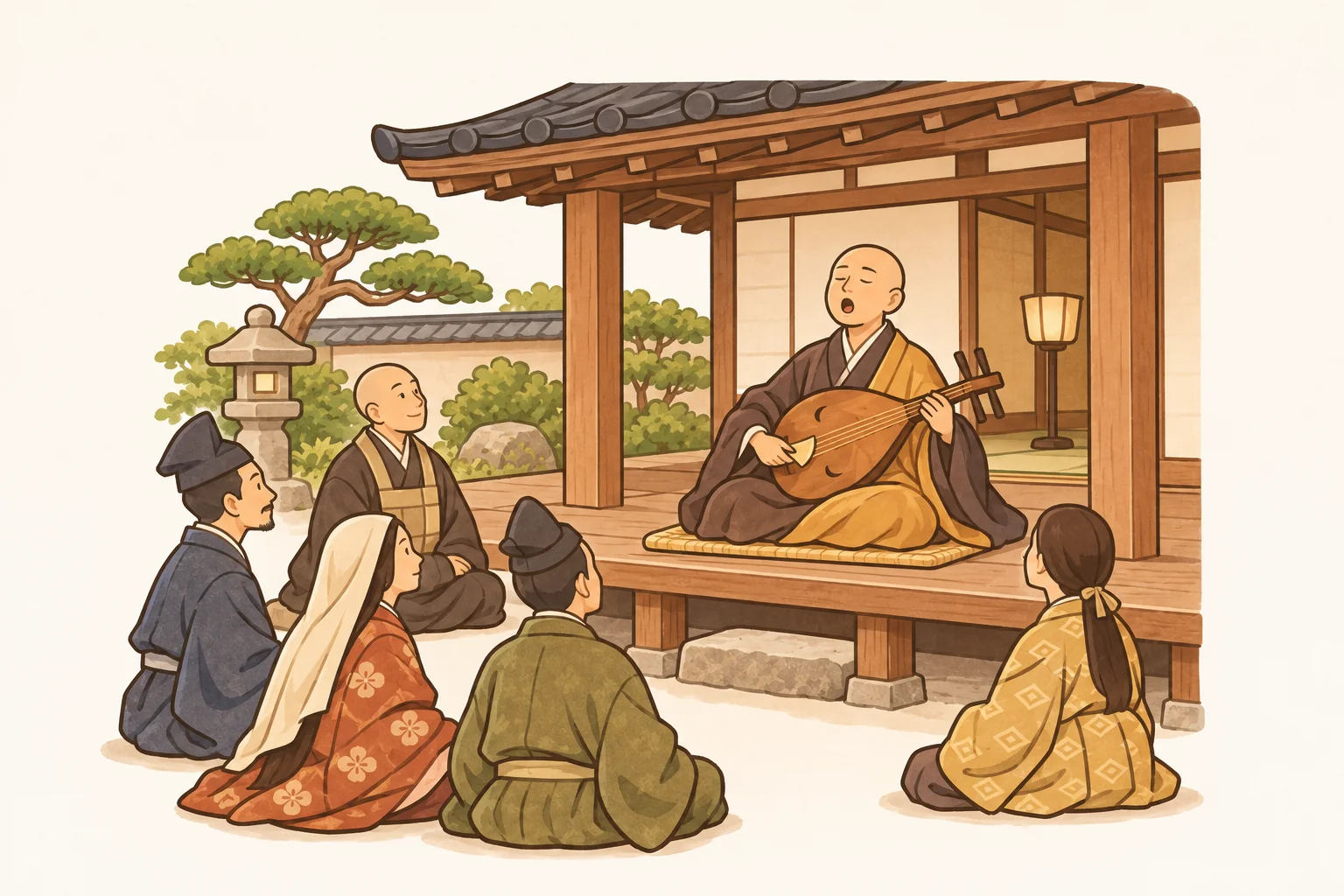
A blind biwa hōshi with shaven head and monk's robes chanting the Heike to listeners (illustration).
The standard text today is the Kakuichi version, fixed in 1371 by the blind performer Akashi Kakuichi. Kakuichi was also a leading figure in the guild of blind performers, the Tōdōza, which came to enjoy protection from the Ashikaga and later the Tokugawa shogunate. Through it, blind men gained ranks such as kengyō and earned livings in heikyoku, koto music and acupuncture.
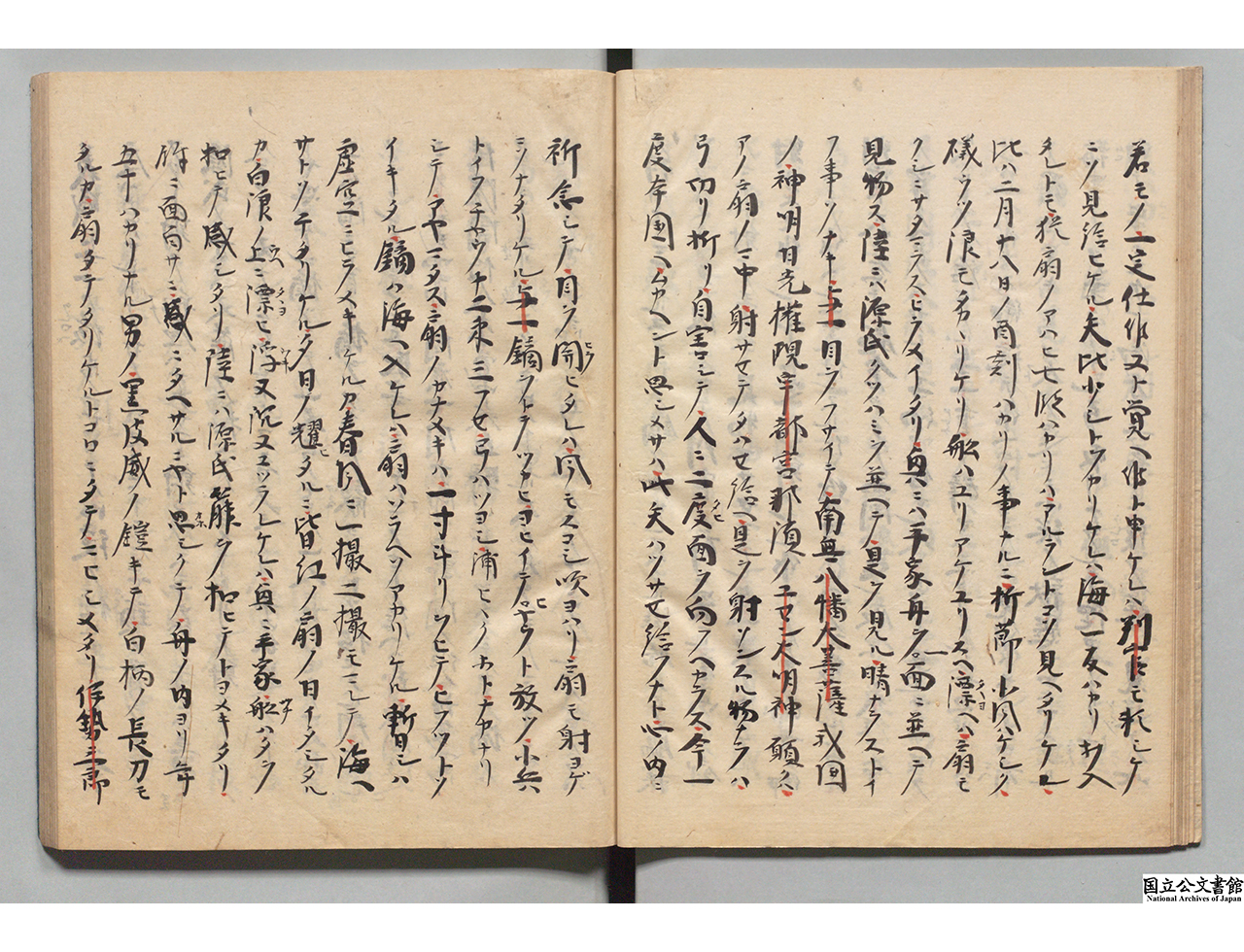
The fan-shooting episode in a 1590 manuscript copy of the Kakuichi version, made by Bonshun.
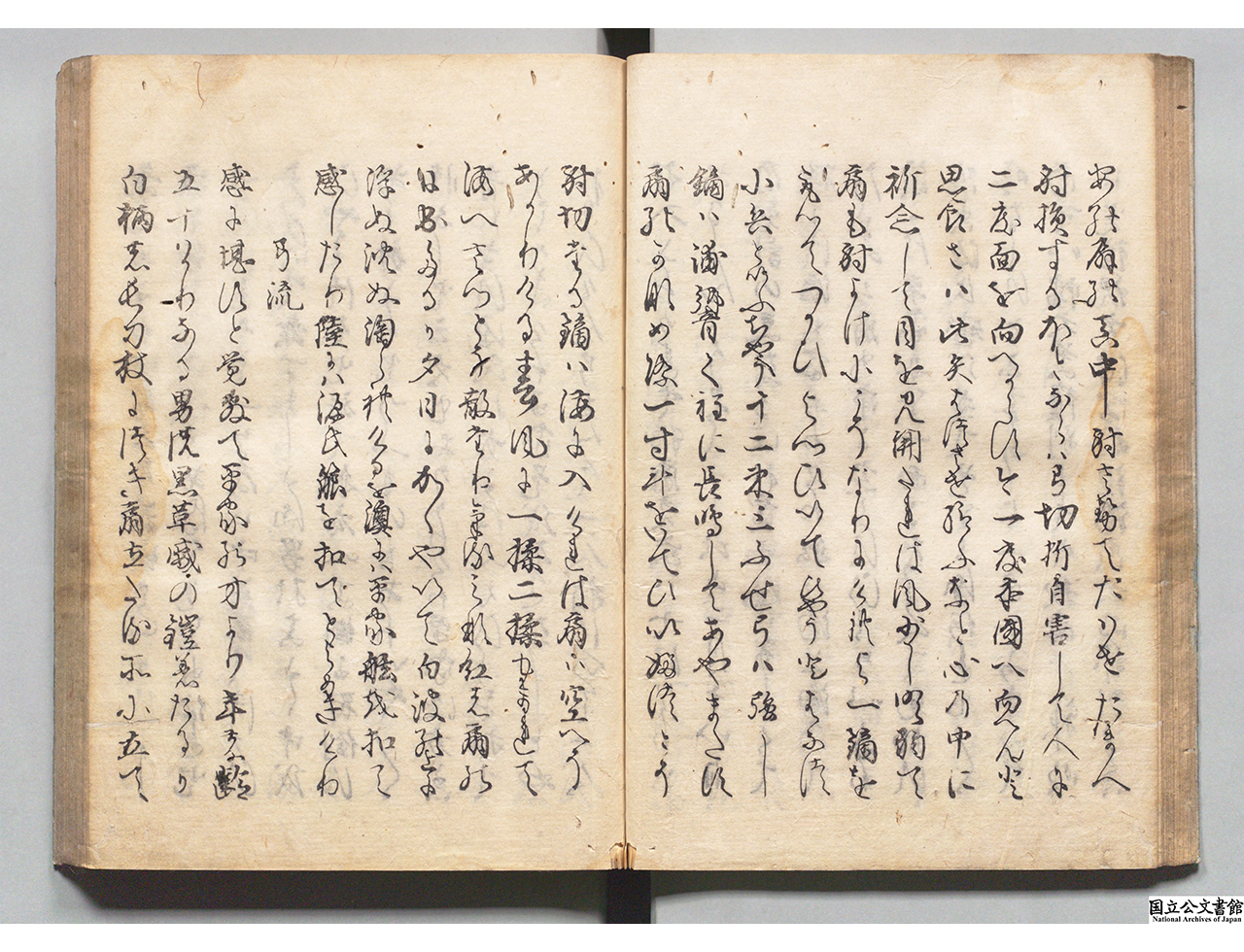
The same episode in the Shimomura movable-type edition, printed in the Keichō era (1596–1615).
National Archives of Japan: The Tale of the Heike, Kakuichi text, Bonshun manuscript (1590, 091-0006); Shimomura movable-type edition (Keichō era, 125-0001)
In performance, voice and instrument take turns rather than sounding together. The performer chants a passage, then plays a short interlude on the biwa that marks the section and sets the mood, then chants again. The voice shifts between something close to speech and something close to song; battle scenes move quickly, laments stretch out. Listeners did not need to catch every word to follow.
The biwa priest also entered folklore. In Kwaidan (1904), Lafcadio Hearn retold the story of Hōichi the Earless: a blind biwa player at Amida-ji temple near Dan-no-ura is summoned night after night to perform the battle for an audience that turns out to be the Taira dead. To hide him, the priest paints sutras over his entire body but forgets his ears, and the ghostly samurai, seeing only the ears, tears them off. For many Western readers this was their first encounter with the Heike.
05The Biwa Itself
The biwa came to Japan from the continent, a cousin of the Chinese pipa and, further back, of lutes from Central and West Asia. It was in Japan by the Nara period; the Shōsōin treasury in Nara preserves an inlaid five-stringed lute from Tang China, the only surviving example of its kind. Over the centuries the instrument branched into several types that look alike but sound and function very differently.
The gakubiwa is the oldest. Used in gagaku, the court orchestral music, it is large, with four strings, held horizontally and played with a small plectrum. In the ensemble it does not carry the melody; it sweeps broken chords at the start of each measure, working with the zither to mark the music’s slow rhythmic frame.
The mōsō biwa, "blind monk’s biwa," belongs to blind priests in northern and southern Kyūshū, who used it to accompany sutras and rites for household and kitchen gods. The Heike biwa, used for heikyoku, is similar in form to the gakubiwa but smaller.
The two types most often heard on stage today developed later. The Satsuma biwa is associated with the Satsuma domain in southern Kyūshū, where it is said to have been used to train young samurai in character, with songs of war and moral instruction. It has a very large plectrum and tall frets. Pressing the string down between the frets raises the pitch and allows bends and vibrato, and the plectrum often strikes the body as well as the string, producing a percussive crack. The sound is hard and dramatic. The Chikuzen biwa, formed in Fukuoka in the Meiji era, uses a smaller plectrum and a softer tone, often with five strings; it became popular with women players and leans toward lyrical repertoire.
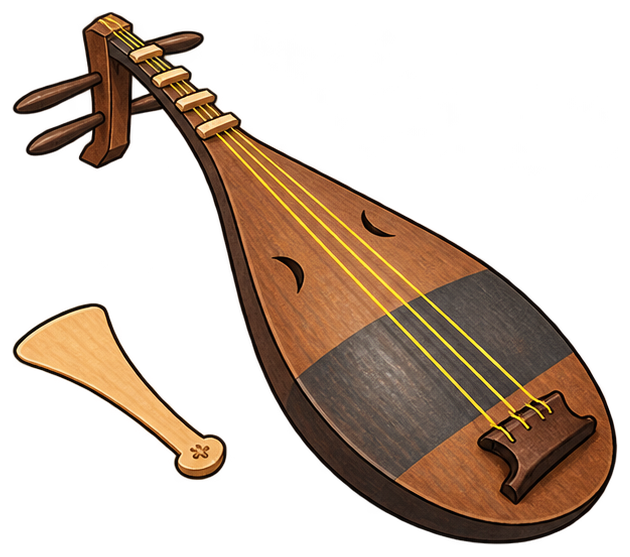
Gakubiwa: four strings and a small plectrum, used in gagaku.
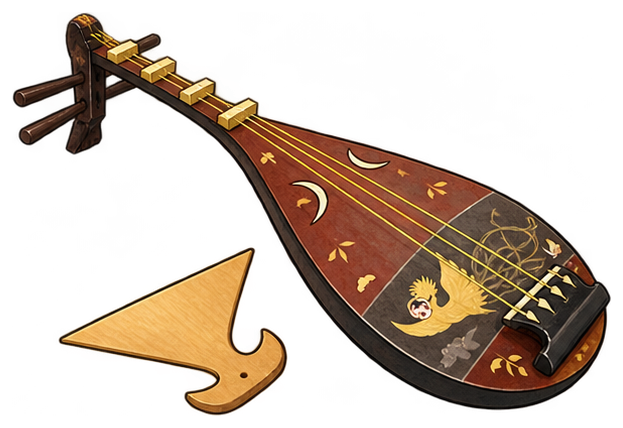
Satsuma biwa: tall frets and a very large plectrum.
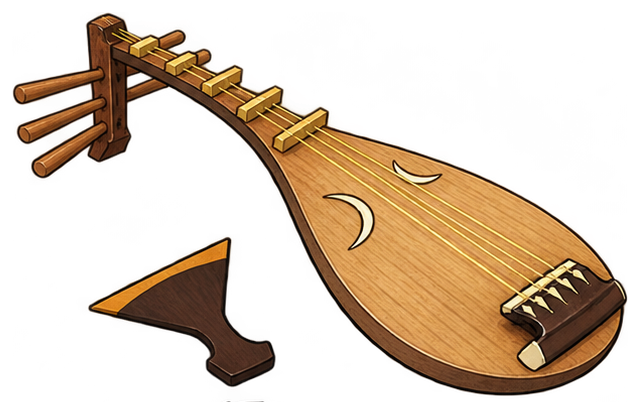
Chikuzen biwa: often five strings, with a smaller plectrum.
Both styles keep the old alternation of voice and instrument, with a single performer as singer and accompanist. The biwa opens the piece, bridges sections and drives the climaxes. Favorite pieces include Dan-no-ura and Atsumori.
In 1967 the biwa reached the concert hall. Takemitsu Tōru’s November Steps, for biwa, shakuhachi and orchestra, was premiered in New York with Tsuruta Kinshi on Satsuma biwa and Yokoyama Katsuya on shakuhachi. Western audiences heard, perhaps for the first time, how much of the biwa’s music lies in the resonance and silence after a single stroke.
06From Noh to Anime
The Heike became a quarry for later Japanese art. Zeami, the great Noh playwright, advised that plays about Genpei generals should follow the Heike closely, and a whole category of "warrior plays" draws on it: Atsumori, Kiyotsune, Tadanori, Yashima. In them a dead warrior returns as a ghost and tells a traveling monk about his last moments. In the Edo period the puppet theater and kabuki turned the material into long, plot-heavy dramas such as Ichinotani futaba gunki and Yoshitsune senbon zakura, in which Kumagai and Tomomori get new and more complicated fates.
The Heike is often paired with The Tale of Genji, written some two centuries earlier: one the world of court romance and melancholy, the other of warriors and impermanence. Together they stand for two moods in classical Japanese culture.
In modern times, Yoshikawa Eiji’s novel Shin Heike monogatari was a postwar bestseller, and NHK’s year-long historical dramas have returned to the period repeatedly, including Taira no Kiyomori in 2012. In 2021–22 director Yamada Naoko’s anime The Heike Story, based on Furukawa Hideo’s modern Japanese translation, added a young biwa-playing girl who can see the future, putting the singer of the tale inside the story. It introduced the Heike to a new generation, and the English translations by Helen Craig McCullough and Royall Tyler remain the best ways in for readers.
07Following the Heike Today
Kyoto is the place to begin. The Rokuhara district in Higashiyama was once the Taira’s base, and Rokuharamitsu-ji temple holds a seated statue traditionally identified as Kiyomori. In Saga, Giō-ji is a tiny moss-covered hermitage named after the dancer, lovely in autumn. Jakkō-in at Ōhara, where the tale ends, is a half-day trip that pairs naturally with Sanzen-in; its main hall burned in 2000 and has been rebuilt.
Further west, Itsukushima Shrine on Miyajima, with its great torii standing in the sea, was patronized and rebuilt by Kiyomori and holds the Heike nōkyō, lavishly decorated sutra scrolls the clan dedicated there. Suma-dera in Kōbe has a memorial to Atsumori and a flute said to be his. At Yashima, near Takamatsu, you can look down over the bay where Yoichi shot the fan.
The journey ends at Shimonoseki. Akama Shrine enshrines the drowned Emperor Antoku and has a small hall for Hōichi and the graves of the Taira. Below it lies the Kanmon Strait, the waters of Dan-no-ura; a park on the shore has statues of Yoshitsune and Tomomori, and from there you can watch the tidal current race through the channel. In early May the shrine holds the Sentei-sai festival (still held every year as of 2025), in which women dressed as court ladies cross a temporary bridge to worship, a custom said to recall Taira court ladies who stayed on in the area after the defeat and, disguised as courtesans, came to pray for the dead emperor.
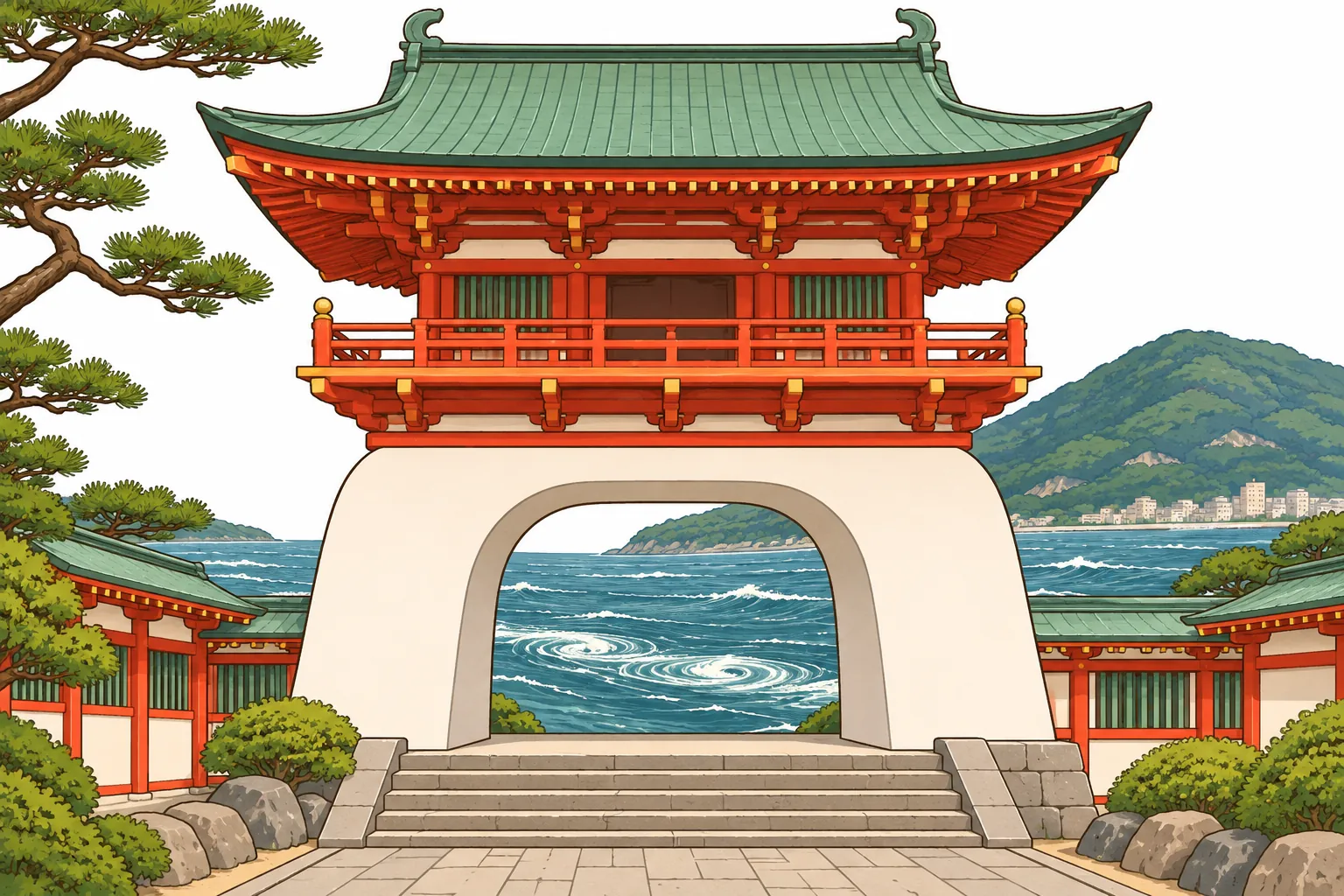
The vermilion Suitenmon gate of Akama Shrine in Shimonoseki, the fast-flowing Kanmon Strait beyond (illustration).
To hear the biwa, look for Satsuma or Chikuzen biwa recitals, which are held fairly regularly in Tokyo, Fukuoka and Kagoshima. True heikyoku has very few living performers and is heard only at occasional special concerts. It helps to read the Atsumori episode first. Then, when the plectrum slaps the body of the instrument and the hall falls silent, you will know what the singer is about to say.