
The mountains of the Kii Peninsula, spanning Wakayama, Nara, and Mie prefectures, have long been regarded as a dwelling place of gods and buddhas. In 2004 the "Sacred Sites and Pilgrimage Routes in the Kii Mountain Range" were inscribed as a UNESCO World Heritage Site, made up of three sacred sites (Yoshino and Ōmine, the Kumano Sanzan, and Kōyasan) and the routes that link them. This page covers Kōyasan, Kumano, and the old roads between them.
01Kōyasan
Kōyasan is a mountain basin about 800 meters above sea level in northern Wakayama Prefecture. In 816 Kūkai, later known as Kōbō Daishi, received permission from Emperor Saga to found a training center for Esoteric (Shingon) Buddhism here. Kūkai died on the mountain in 835, but later believers held that he did not die and instead remains in eternal meditation at Okunoin, where monks still bring him meals every day.
Today more than 100 temples stand on the mountain, many of them also offering lodging to pilgrims, so that the whole place forms a small temple town. The Danjō Garan was the center of Kūkai’s original plan; its vermilion Konpon Daitō pagoda was rebuilt in 1937. Kongōbu-ji is the head temple of the Kōyasan Shingon school. Along the approach to Okunoin, the cedar forest holds what are said to be more than 200,000 gravestones and memorials, including the graves of many Sengoku-period daimyo. Women were barred from the mountain until 1872.
02The Kumano Sanzan
The Kumano Sanzan, the "three mountains of Kumano" in southern Wakayama, are the shrines Kumano Hongū Taisha, Kumano Hayatama Taisha, and Kumano Nachi Taisha, together with Seiganto-ji temple next to Nachi Taisha and the Nachi Falls, about 133 meters high. Under the combined worship of kami and buddhas, Kumano came to be seen as a Pure Land on earth. From the mid-Heian period, pilgrimages to Kumano by retired emperors and courtiers became popular. Retired emperors Shirakawa, Toba, Go-Shirakawa, and Go-Toba all made the journey many times, Go-Shirakawa reportedly more than 30 times. Warriors and commoners later followed.
Hongū Taisha originally stood on Ōyunohara, a sandbank in the Kumano River. After a flood in 1889 destroyed most of its buildings, it was moved to its present site in 1891.
03The Pilgrimage Routes
The roads to Kumano are known together as the Kumano Kodō. The main ones are the Nakahechi over the mountains from Tanabe, the coastal Ōhechi, the Kohechi from Kōyasan, and the Iseji from Ise. Many small shrines called Ōji line the Nakahechi. On the Kōyasan side, the Chōishi-michi leads from the foot of the mountain to the Danjō Garan, marked by stone posts set roughly every 109 meters. In 2016 further sections of the routes were added to the World Heritage listing.
Kōyasan and Kumano
01Two Holy Places in One Mountain Range
The Kii Peninsula is the large, rugged block of land that hangs south of Ōsaka, Nara and Kyoto. Its southern half is almost all mountain: steep ridges covered in cedar and cypress, deep river valleys, and some of the heaviest rainfall in Japan. Long before Buddhism reached Japan, people here treated waterfalls, great rocks and mountain peaks as places where gods lived, and the region kept a reputation as a land on the edge of the ordinary world.
In 2004 UNESCO listed the "Sacred Sites and Pilgrimage Routes in the Kii Mountain Range" as World Heritage. The listing has three centers: Yoshino and Ōmine, the home of the mountain ascetics of Shugendō; Kōyasan, the headquarters of Shingon Buddhism; and the Kumano Sanzan, the three great shrines of Kumano. It also includes the paths that link them, which is unusual: the old pilgrim roads are as much part of the heritage as the buildings. This guide covers Kōyasan and Kumano, which were linked historically by a mountain trail called the Kohechi and by a steady flow of pilgrims who visited both.
02Kūkai and the Founding of Kōyasan
Kōyasan ("Mount Kōya") is not a single peak but a high basin about 800 meters above sea level, ringed by low summits. Later Buddhists compared the ring of eight peaks to the petals of a lotus flower, with the monastery town sitting at its center.
The man who chose this place was Kūkai (774–835), a monk better known by his posthumous title Kōbō Daishi. Born on the island of Shikoku, he studied in the capital, abandoned an official career, and wandered the mountains as an ascetic. In 804 he sailed to Tang China with a Japanese diplomatic mission. In the capital Chang’an he became the disciple of Huiguo, a master of Esoteric Buddhism (a form of Buddhism built on ritual, mantra and the visual diagrams called mandalas). Huiguo transmitted his full teaching to Kūkai and died soon after. Kūkai, who had been expected to stay in China for twenty years, came home in 806 with sutras, mandalas and ritual implements.
Back in Japan, Kūkai won the favor of Emperor Saga. In 816 he petitioned the court for the land at Kōya, explaining that he had walked through it as a young man and found it ideal for meditation, far from the distractions of the city. Permission was granted that summer. Kūkai went up the mountain himself in 818, ritually consecrated the boundaries of the site the following year, and began building. He called the complex Kongōbu-ji.
Two legends explain how he found the place, and you will meet both on the mountain. In one, Kūkai met a hunter with a black dog and a white dog who led him to Kōya; the hunter was a local god, Kariba Myōjin, who introduced him to the goddess of the land, Niu Myōjin, and she gave him the mountain. Both deities are still honored as Kōyasan’s guardians, at Niutsuhime Shrine in the valley below and at a shrine inside the main temple precinct. In the other, Kūkai threw a three-pronged ritual implement, a sanko, eastward from China before sailing home, and later found it caught in a pine tree at Kōya. A pine growing at that spot is still pointed out today.
Building went slowly. Kūkai spent most of his later years in Kyoto, where in 823 the emperor gave him Tō-ji temple as a base, and the great pagoda he planned for Kōya was only finished by his successors.
03The Eternal Meditation of Kōbō Daishi
Kūkai died on Kōyasan on the twenty-first day of the third month of 835, aged 62 by Japanese reckoning. In Shingon belief he did not die at all. He entered nyūjō, eternal meditation, and remains seated in his mausoleum deep in the forest at Okunoin, praying for all living beings while he awaits the coming of the future Buddha, Maitreya.
The belief grew over the following centuries. In 921 Emperor Daigo granted Kūkai the title Kōbō Daishi, "Great Teacher Who Spread the Dharma," at the request of the abbot Kangen. A famous story, told in later biographies, says that Kangen went to the mausoleum to report the honor, opened the chamber, and found the master sitting as if alive, his hair grown long; Kangen shaved his head and dressed him in new robes.
Because the Daishi is believed to be present, monks still bring him meals twice a day. The ritual, called shōjingu, is carried out in the open: monks carry a wooden box of food across the bridge to the mausoleum, and visitors gather to watch.
04Okunoin: The Cemetery in the Forest
The walk to the mausoleum is the most famous experience on Kōyasan. From the first bridge, Ichinohashi, a stone path runs about two kilometers through a forest of huge cedars to the Gobyōbashi bridge in front of the mausoleum. Along the way stand more than two hundred thousand gravestones, memorial towers and monuments.
People wanted to be close to Kōbō Daishi. From the medieval period, it was believed that those buried or memorialised near him would be saved with him when Maitreya came. Emperors, aristocrats, warlords, merchants and ordinary villagers all sent ashes, bones or memorials here. The result is a crowd of rival names: the sixteenth-century warlords Takeda Shingen and Uesugi Kenshin, who fought each other for years, are both here; so are Oda Nobunaga and Akechi Mitsuhide, the general who betrayed and killed him, and memorials for the Toyotomi family. In the twentieth century, companies added memorials of their own, some of them very odd in shape.
Before the mausoleum stands the Tōrōdō, the Hall of Lamps, filled with hanging lanterns. Two lamps are said to have burned without interruption for about a thousand years. One is the "poor woman’s lamp," given, according to legend, by a poor woman who cut and sold her hair to buy it. The other is credited to the monk Kishin Shōnin, who revived Kōyasan in the eleventh century. Beyond the Gobyōbashi bridge is the most sacred ground; photography is forbidden, and visitors bow before crossing.
05Decline and Revival
Kōyasan did not flourish continuously. For long periods Tō-ji in Kyoto was the real center of Shingon, and Kōya was subordinate to it. In 994 lightning set off a fire that destroyed most of the temple buildings, and for a time the mountain was nearly deserted.
The revival began in the early eleventh century under the monk Jōyo, called Kishin Shōnin, who rebuilt halls and promoted faith in the living Daishi. In 1023 Fujiwara no Michinaga, the most powerful courtier of his age, made a pilgrimage to Okunoin. Retired emperors followed, among them Shirakawa and Toba, and their gifts restored Kōya’s fortunes.
In the twelfth century the monk Kakuban, backed by Retired Emperor Toba, built a new temple on the mountain and tried to combine Shingon with devotion to Amida Buddha. Conflict with the established monks became violent, and Kakuban withdrew to Negoro at the foot of the mountains. His school grew into the Shingi branch of Shingon, and Negoro-ji later became a heavily armed power in its own right.
Another force that spread Kōya’s fame was the Kōya hijiri, wandering holy men who traveled the country raising funds, chanting the name of Amida and carrying the bones of the dead back to Okunoin. Much of the cemetery’s social range, from lords to farmers, comes from their work.
The Tale of the Heike, the great medieval epic of the wars between the Taira and Minamoto clans, links Kōya and Kumano in a single episode. Taira no Koremori, grandson of the Taira leader Kiyomori, slipped away from his clan’s army, climbed Kōyasan, took the tonsure under a former retainer who had become a monk there, then walked to Kumano, prayed at the three shrines, and drowned himself in the sea off Nachi.
06The Pilgrim Path of Stone Markers
The Kamakura shogunate, established in the late twelfth century, protected Kōyasan. Hōjō Masako, widow of the first shogun Minamoto no Yoritomo, founded a temple for him that became Kongō Sanmai-in; its two-story pagoda of 1223 is the oldest building on the mountain and a National Treasure.
From the same period comes the Chōishi-michi, the main old route up the mountain. It begins at Jison-in in the valley town of Kudoyama, where Kūkai’s mother is said to have lived because women could not climb the mountain. Every chō (about 109 meters) along the path was once marked by a wooden post. In the thirteenth century they were replaced with stone markers shaped like five-ring stupas, a project usually credited to the Kōya monk Kakkyō. Donors ranged from Retired Emperor Go-Saga, the shogunal regent Hōjō Tokimune and the powerful vassal Adachi Yasumori down to ordinary people. The project was vowed in 1265 and completed in 1285. There are 180 markers from Jison-in to the central temple precinct and 36 more to Okunoin; most of those standing today are the Kamakura-period originals. The path is about 22 kilometers long and can still be walked.
07Kumano: Three Shrines, One Pure Land
Kumano lies in the far south of the peninsula. Its three great shrines are some distance apart. Kumano Hongū Taisha stands in the mountains on the middle reaches of the Kumano River. Kumano Hayatama Taisha is at Shingū, the town at the river’s mouth. Kumano Nachi Taisha sits on a mountainside near the coast, beside Japan’s tallest single-drop waterfall, the 133-meter Nachi Falls, which is itself worshipped as a deity.
Each shrine began with its own gods, but over time all three came to enshrine the same group, known as the Kumano Gongen. Gongen means "provisional manifestation": under the medieval fusion of Buddhism and Shinto, the gods of Kumano were understood as local appearances of Buddhas. The main god of Hongū was Amida, the Buddha of the Western Pure Land; the god of Hayatama was Yakushi, the healing Buddha; the god of Nachi was the Thousand-Armed Kannon, whose paradise was believed to lie across the southern sea. Kumano itself came to be seen as a pure land on earth. In an age when aristocrats worried constantly about rebirth, that made it the most desirable pilgrimage in Japan.
Kumano also has an older sacred story. The early chronicles say that the legendary first emperor, Jinmu, landed at Kumano on his campaign to conquer Yamato, and was guided through the mountains by a three-legged crow, the Yatagarasu. The crow is still Kumano’s emblem, and Japanese football fans will recognize it from the national team badge.
08"Ants on the Road": The Imperial Pilgrimages
The retired emperor Uda visited Kumano in 907, the first recorded imperial pilgrimage. The great age came under the "cloistered rule" of the late eleventh and twelfth centuries, when retired emperors held real power. Shirakawa first went in 1090, guided by the monk Zōyo, who was then made overseer of the three shrines. The usual figures are nine pilgrimages for Shirakawa, twenty-one for Toba, thirty-four for Go-Shirakawa and twenty-eight for Go-Toba. Counting retired emperors and imperial women, there were around a hundred imperial pilgrimages before the last, by Retired Emperor Kameyama in 1281.
The route ran by boat down the Yodo River from Kyoto to the coast near today’s Ōsaka, then south along the Kii Peninsula to Tanabe. From there the pilgrims turned inland on the mountain road now called the Nakahechi and climbed to Hongū. They went down the Kumano River by boat to Shingū, followed the coast to Nachi, and crossed back over the mountains to Hongū before retracing their steps. A round trip took about a month. Along the way stood many small subsidiary shrines called ōji, traditionally the "ninety-nine ōji," where the party stopped to make offerings, recite sutras and sometimes hold poetry gatherings. Takijiri-ōji, where the Nakahechi leaves the river, marked the entrance to Kumano’s sacred land.
The poet Fujiwara no Teika accompanied Go-Toba in 1201 and kept a diary. He complained of rain, exhaustion and illness all the way, which makes it one of the liveliest records of what the journey was actually like. In 1221 Go-Toba launched a failed rising against the shogunate, the Jōkyū War, and was exiled; imperial pilgrimages fell away after that.
Pilgrimage did not end with the emperors. Warriors, provincial landholders and then commoners went in such numbers that people spoke of the ari no Kumano-mōde, the "ants’ pilgrimage to Kumano," lines of pilgrims as endless as ants. A network of guides called sendatsu led groups from their home regions, and Kumano priests called oshi housed and prayed for them. Female preachers known as Kumano bikuni traveled with painted scrolls showing heaven and hell, explaining them to women and urging them to make the journey. Kumano’s printed talismans, the goō hōin, whose characters are drawn with crows, were used by samurai as paper for sworn oaths; breaking an oath written on one was said to kill a crow at Kumano.
09Warriors, Wanderers and the Open Gate
The Kumano shrines were run by a hereditary family of administrators, the Kumano bettō, who also commanded a fleet. In the war between the Taira and Minamoto, the bettō Tanzō had to choose a side. According to the Tale of the Heike, at a shrine in Tanabe he set red cocks (for the Taira) against white cocks (for the Minamoto) before the gods; the white won every bout, and he led the Kumano navy to fight for the Minamoto at Dan-no-ura in 1185. Tōkei Shrine in Tanabe, named for the cockfight, was added to the World Heritage listing in 2016.
Kumano was known for turning no one away. Unlike many sacred mountains, it accepted women, and it did not ask about status or ritual purity. In 1274 the itinerant monk Ippen secluded himself in prayer at Hongū and, according to his biography, received a message from the Kumano god: hand out the Amida invocation slips to everyone, whether they believe or not, whether pure or impure. Ippen treated this as the founding moment of his Ji school and spent the rest of his life wandering the country.
The hot-spring village of Yunomine near Hongū belongs to the same world. A medieval story tells of Oguri Hangan, a lord murdered and returned from the dead in a broken, starving body, who was pulled to Yunomine in a cart by strangers and restored by its waters. Tsuboyu, a tiny bathhouse in the river there, is still in use.
At Nachi there was a stranger practice. Monks of Fudarakusan-ji temple set out to sea in sealed boats, sailing south toward Kannon’s paradise with no means of return. A stone monument outside the temple lists more than twenty such voyages between 868 and 1722; a replica boat is on display.
10Kōyasan under the Warlords and the Shogunate
By the sixteenth century Kōyasan was a landholding power with fighting men. Oda Nobunaga quarreled with it in 1581, hunted down Kōya hijiri across his territory and laid siege to the mountain. His death at Honnō-ji the following year ended the threat.
In 1585 Toyotomi Hideyoshi invaded Kii, burned Negoro-ji, and demanded Kōyasan’s submission. The monk Mokujiki Ōgo negotiated a surrender that saved the mountain, and Hideyoshi went on to become a generous patron. He built Seigan-ji temple in memory of his mother. In 1595 his nephew and former heir Toyotomi Hidetsugu was banished to Kōyasan and ordered to commit suicide there, at Seigan-ji; the room where this is said to have happened is shown at Kongōbu-ji today.
Under the Tokugawa shoguns, daimyo families across Japan formed ties with particular Kōya temples, which became their family temples and lodged their retainers and subjects on pilgrimage. The third shogun Tokugawa Iemitsu completed the Tokugawa Mausoleum in 1643, with shrine halls for his grandfather Ieyasu and his father Hidetada.
For more than a thousand years women were barred from the mountain. They could go only as far as the Nyonindō, "women’s halls," at each entrance, and pray toward the inner temples from there. The ban was lifted in 1872, under the Meiji government. One women’s hall survives at the Fudōzaka entrance.
11The Modern Era
In 1869 Seigan-ji was merged with a neighboring temple and renamed Kongōbu-ji. The name that had once covered the whole mountain now became the name of a single head temple.
The Meiji government’s separation of Buddhism and Shinto hit Kumano hard. Shrines that had been half Buddhist for a thousand years had to remove their Buddhist halls and images. At Nachi, one hall survived as a temple, Seiganto-ji, which is why a Buddhist temple and a Shinto shrine still stand side by side there.
In August 1889 catastrophic rains caused the Totsukawa flood, which swept through the Kumano River valley. Hongū Taisha, then on a sandbank called Ōyunohara at the meeting of rivers, lost most of its buildings. The surviving halls were moved to the hill where they stand now and were re-dedicated in 1891. Around 2000 a giant steel torii gate, about 34 meters tall, was put up at the old site.
On Kōyasan, the Konpon Daitō pagoda was rebuilt in reinforced concrete in 1937, and the Kondō main hall in 1932 after a fire in 1926. In 2015 the mountain marked 1,200 years since its founding, and the Chūmon gate of the central precinct, lost to fire in 1843, was rebuilt for the occasion.
12What to See Today
On Kōyasan, start at the Daimon, the great western gate, rebuilt in 1705. Walk east to the Danjō Garan, Kūkai’s original precinct: the vermilion Konpon Daitō, the Kondō, the Western Pagoda, the Miedō hall and the sanko pine. Most of these are modern reconstructions, though the Daitō and Kondō were themselves designated Important Cultural Properties in 2024; the Fudōdō, a National Treasure rebuilt in the early fourteenth century, is the oldest survivor. Kongōbu-ji’s main hall, rebuilt in the early 1860s, has painted sliding doors and a large rock garden. The Reihōkan museum shows treasures from the mountain’s temples in rotating displays. Finish at Okunoin, ideally walking the full path from Ichinohashi, and if you can, stay overnight at one of the more than fifty temple lodgings and attend the morning service.
At Kumano, Hongū Taisha’s present halls date from the early nineteenth century and are an Important Cultural Property; from there it is a short walk to the great torii at Ōyunohara. Walking even a short section of the Nakahechi into Hongū, for example from Hosshinmon-ōji, gives a feel for the old approach. At Shingū, Hayatama Taisha burned in 1883 after a fireworks accident and was rebuilt in the twentieth century; its treasure hall holds about a thousand sacred offerings, most dedicated around 1390 by the Ashikaga shogunate and the imperial court, almost all of them National Treasures. Above the town, Kamikura Shrine sits on a great rock up 538 steep stone steps; every February 6 some two thousand men in white run down them carrying torches in the Otō Matsuri fire festival.
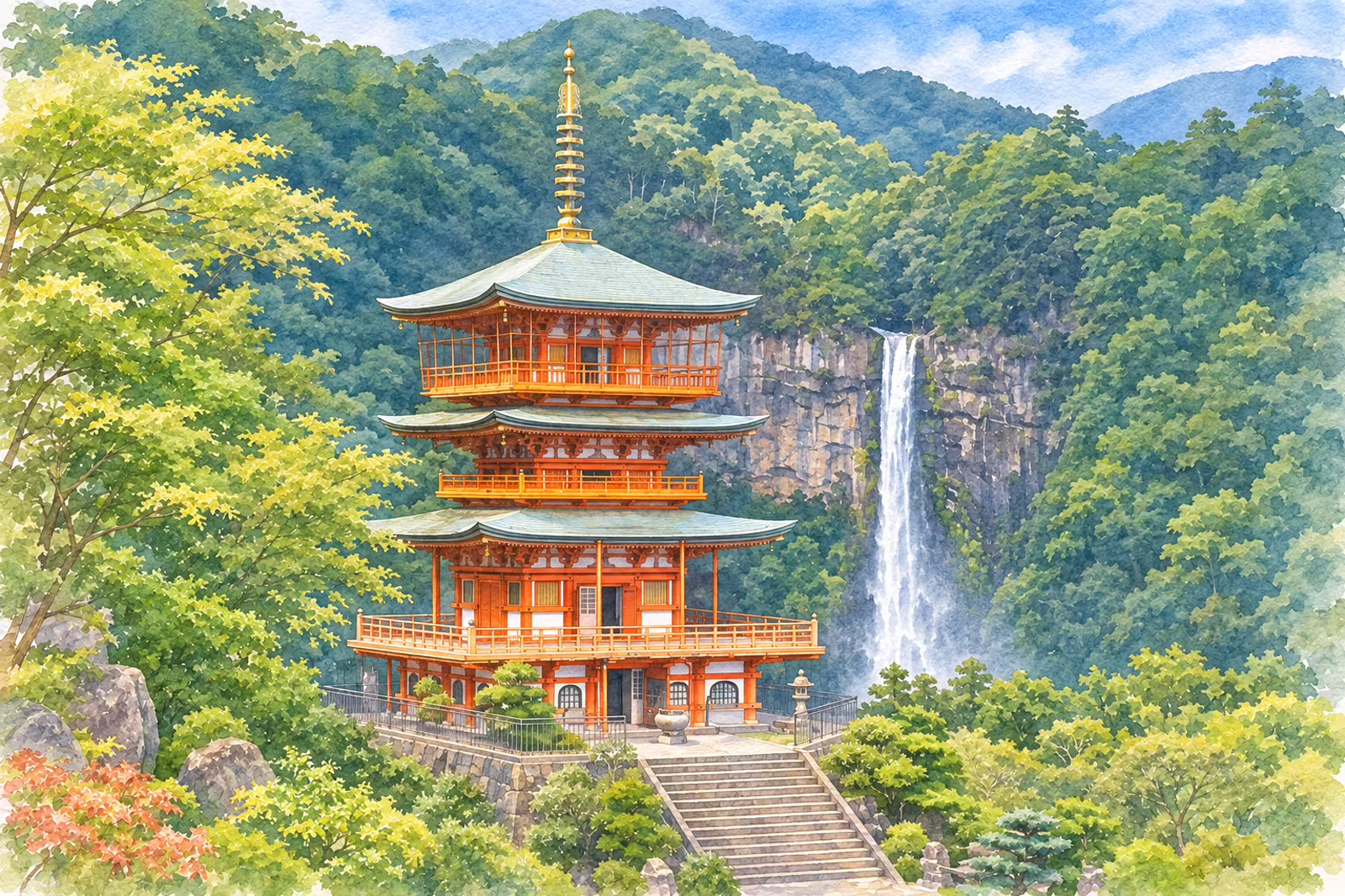
At Nachi, climb the Daimonzaka, a cedar-lined stone stairway, to Nachi Taisha and Seiganto-ji. The temple’s main hall was rebuilt in 1590 on Hideyoshi’s orders. The three-story pagoda beside it, rebuilt in 1972, frames the white column of the falls in the view on almost every poster of Kumano. On July 14 each year the Nachi Fire Festival carries twelve huge torches up and down the path before the waterfall to purify the shrine’s portable shrines on their return.