
At a glance
What Kūkai brought back from Chang’an, why Shingon works through fire, chant and images, and what visitors find on Mount Kōya and at Tō-ji.
- Shingon was founded by Kūkai, who sailed to Tang China in 804, received the teachings from Huiguo at Qinglong Temple in Chang’an and returned in 806.
- Its central claim is sokushin jōbutsu: a person can become a buddha in this life, in this body.
- Its central buddha is Dainichi; the two mandalas of the Womb and Diamond realms picture this universe.
- Kūkai was granted Mount Kōya in 816 and Tō-ji in Kyoto in 823; the pairing of a mountain and a city temple continues today.
- As of 2026, Mount Kōya has more than 100 temples, about 50 of which offer temple lodging.
Shingon is the form of Esoteric Buddhism that a young monk named Kūkai brought back from Tang China in 806. It teaches that enlightenment can be reached in this body and this lifetime, through ritual gestures, sacred syllables and visualized images, and it fills its temples with mandalas, wrathful guardian deities and roaring fire ceremonies. Kūkai, known after his death as Kōbō Daishi, became the most beloved holy man in Japanese history; many believe he has never died but sits in eternal meditation on Mount Kōya. This piece explains who he was, what Shingon actually teaches, and how a visitor can experience it, from a night in a temple lodging to a walk through the largest cemetery in Japan.
01A Provincial Student Who Walked Away
Kūkai was born in 774 in Sanuki Province on the island of Shikoku, in what is now the city of Zentsūji in Kagawa Prefecture. His family, the Saeki, were local gentry, and at eighteen he was sent to the government academy in the capital to study the Confucian classics that would qualify him for an official post.
He dropped out. In Sangō shiiki (Indications of the Goals of the Three Teachings), a work he wrote in his early twenties, he describes meeting a monk who taught him a ritual for invoking the bodhisattva Kokūzō: recite a particular mantra a million times and your memory will become limitless. Kūkai took the practice into the mountains and sea cliffs of Shikoku. At Cape Muroto, on the Pacific coast of Tosa, legend says the morning star flew into his mouth as he meditated. A sea cave there, Mikurodo, is pointed out as the place where he practiced, seeing nothing but sky (kū) and sea (kai) — the source, according to tradition, of the name he took.
These are hagiographic stories, but they fit what we know. Kūkai was a mountain ascetic before he was a scholar, and he came to Buddhism through practice rather than through the monastic establishment of Nara. In Nara, though, he found a copy of the Mahāvairocana Sūtra (Dainichi-kyō), a core Esoteric text, and realized that no one in Japan could explain its rituals and mantras. The only place to learn them was China.
02Initiation in Chang’an
In 804 Kūkai sailed as a student monk with an official embassy to the Tang court. The fleet of four ships also carried Saichō, the monk who would found Japan’s Tendai school. Kūkai’s ship was blown far south and landed in Fujian, where local officials were suspicious of the ragged arrivals until Kūkai wrote a petition on the ambassador’s behalf in such elegant Chinese that they were treated as proper envoys. By the end of the year he reached Chang’an, then one of the largest cities in the world, often described as the largest of all.
In 805 he went to Qinglong Temple (Seiryū-ji in Japanese) and met the master Huiguo, a disciple of the great translator Amoghavajra and the leading holder of both major lineages of Esoteric teaching. In Kūkai’s own account, Huiguo greeted him by saying he had long known Kūkai would come and had been waiting. Within a few months Huiguo gave him the initiations (kanjō, consecration by sprinkling water on the head) of both lineages and then the full initiation that made him a master entitled to transmit the teaching. He received the initiation name Henjō Kongō, "Universally Illuminating Vajra." Huiguo had painters produce mandalas and craftsmen cast ritual implements for him. At the end of that year Huiguo died, and Kūkai was chosen to write the inscription for his memorial.
Student monks were expected to stay twenty years. Kūkai left after about two, returning in 806 with a catalog of sutras, commentaries, mandalas and ritual objects that he presented to the court. Coming home early was a breach of the rules, and he had to wait in Kyūshū for some time before being allowed to the capital. The accession of Emperor Saga in 809 changed his fortunes, and Japan now had the most complete Esoteric transmission anywhere outside China.
03What Shingon Teaches
Shingon means "true word," the Japanese rendering of the Sanskrit mantra. Shingon calls itself Esoteric (mikkyō, "secret teaching") in contrast to the Exoteric (kengyō) schools. Exoteric Buddhism is the teaching the historical Buddha spoke openly, which can be studied in texts and explained in words. Esoteric Buddhism holds that the cosmos itself is the body of a cosmic Buddha, Dainichi Nyorai (Mahāvairocana, the "Great Sun"), who is always preaching — but in a language of sound, form and gesture that has to be learned from a teacher who received it in an unbroken line.
The central claim, and the one that made Kūkai’s teaching so attractive, is sokushin jōbutsu: becoming a Buddha in this very body. Many Buddhist schools taught that enlightenment would take countless lifetimes. Kūkai argued it could happen here and now, through the "three mysteries" (sanmitsu) of body, speech and mind. The practitioner forms hand gestures called mudras (ingei), recites mantras, and visualizes a deity in the mind’s eye. When body, speech and mind are aligned with those of the Buddha, the gap between the two disappears. This is why a Shingon ritual looks the way it does: a priest seated before an altar crowded with bells, vajras and incense burners, fingers shifting from one mudra to the next, chanting syllables that sound nothing like ordinary Japanese.
Because the teaching lives in images as much as words, Kūkai put great weight on art. He wrote that the Esoteric teachings are too profound for writing, and so are revealed through painting. The essential images are the two mandalas, together called the Ryōkai Mandara, which hang facing each other on either side of the main altar in a Shingon hall. The Womb Realm mandala (Taizōkai) places Dainichi at the center of an eight-petaled lotus, with ring after ring of buddhas, bodhisattvas and guardian figures around it, expressing compassion spreading through all things. The Diamond Realm mandala (Kongōkai) is a grid of nine squares showing how wisdom unfolds and how the practitioner moves toward union with the Buddha. Neither is complete without the other.
| Womb Realm (Taizōkai) | Diamond Realm (Kongōkai) | |
|---|---|---|
| Layout | Dainichi at the center of a lotus, ring after ring around it | A grid of nine squares |
| Expresses | Compassion spreading through all things | Wisdom unfolding toward union with the Buddha |
The two mandalas hang on either side of the main altar; neither is complete without the other.
Visitors are often startled by the fierce figures in Shingon temples, especially Fudō Myōō, the "Immovable Wisdom King": blue-black, scowling, a sword in one hand and a rope in the other, wreathed in flames. Fudō is not a demon. He is Dainichi in a wrathful form, angry at ignorance, binding and cutting away whatever keeps people from enlightenment. He became one of the most popular figures in Japanese religion, and many people who know nothing of Shingon doctrine pray to "Fudō-san."
Fudō’s element is fire, and the most dramatic Shingon ritual is the fire ceremony, goma (from the Sanskrit homa). A priest builds a fire on the altar and feeds it with wooden sticks on which worshippers have written their wishes, chanting while drums pound and flames leap toward the ceiling. The fire represents the Buddha’s wisdom, burning up the worshippers’ afflictions. People commission goma prayers for health, safe travel, exam success, or business prosperity, and the ceremony is one of the main ways ordinary Japanese encounter Shingon.
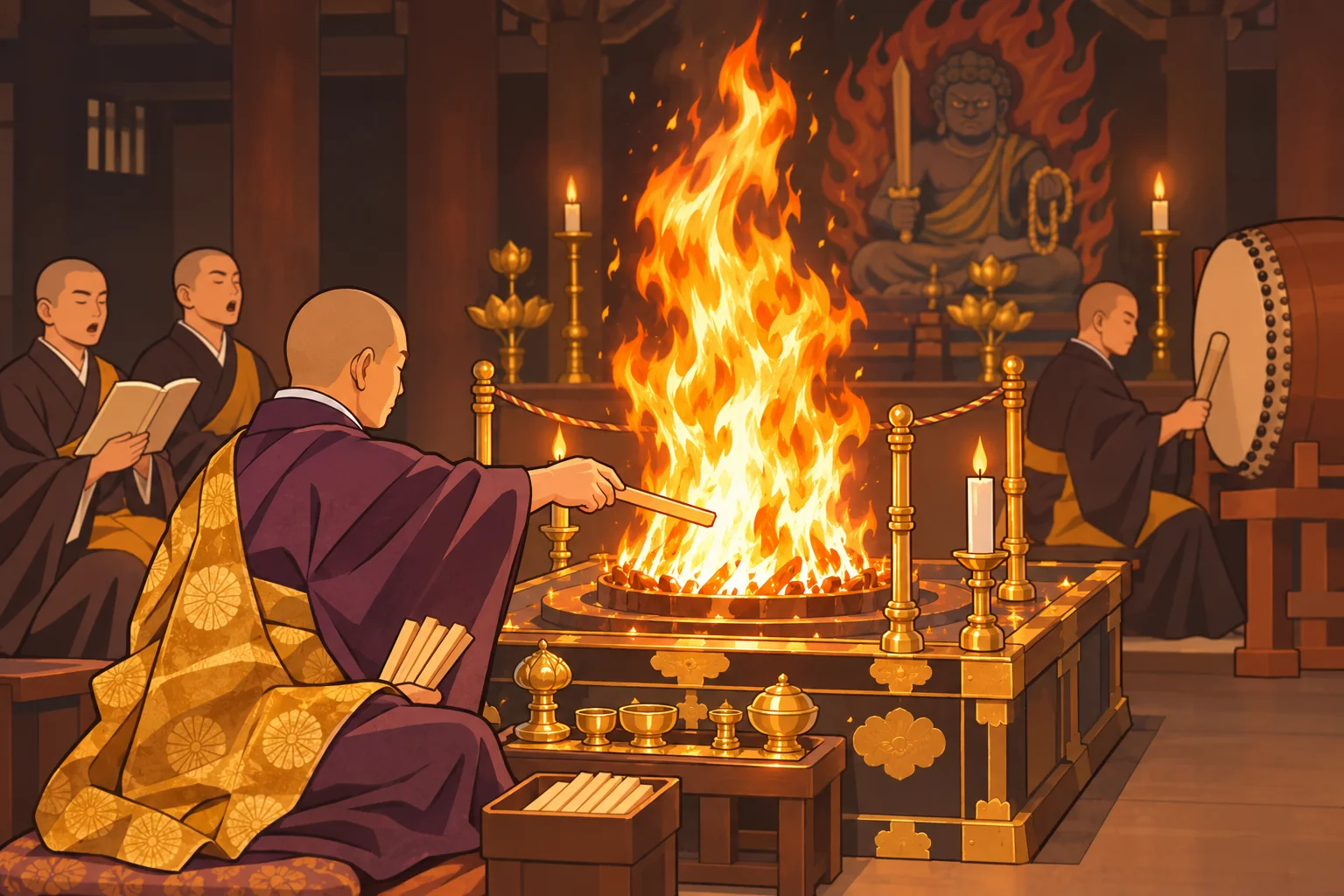
A Shingon goma rite: a priest feeds wooden sticks into the altar fire as flames leap higher than a person (illustration).
04Two Centers: Tō-ji and Mount Kōya
Kūkai built his school around two bases that still define it. In 816 Emperor Saga granted his request for Mount Kōya, a high basin more than 800 meters up in the mountains of Kii Province, south of present-day Ōsaka, as a place for meditation. Kūkai described it as a plateau ringed by eight peaks like the petals of a lotus. In 823 the emperor gave him Tō-ji, the official "East Temple" beside the southern gate of the capital, Heian-kyō (Kyoto). Tō-ji, registered today under the name Kyōō Gokoku-ji, the "Temple for the Protection of the Nation by the King of Teachings," became Shingon’s urban headquarters. The pattern — a mountain retreat for practice and a city temple serving the court — has lasted twelve centuries.
Kūkai’s range was enormous. He is counted, with Emperor Saga and the courtier Tachibana no Hayanari, as one of the "Three Brushes" (Sanpitsu), the great calligraphers of the age; the Japanese saying Kōbō ni mo fude no ayamari, "even Kōbō slips with the brush," is the local equivalent of "even Homer nods." He directed the repair of Mannō-ike, a large irrigation reservoir in his home province that farmers still use. He founded a school in Kyoto, the Shugei Shuchi-in, open to commoners as well as aristocrats, an unusual idea at the time. Popular tradition even credits him with the iroha poem that uses every syllable of the Japanese kana once, though scholars no longer accept this.
Kūkai died on Mount Kōya in 835, at about sixty (sixty-two by the traditional count). Shingon does not say he died; it says he entered nyūjō, eternal meditation, and remains in his mausoleum in the Okunoin, still praying for the world and awaiting the coming of the future Buddha Miroku. In 921 the court granted him the posthumous title Kōbō Daishi, "Great Teacher Who Spread the Dharma." To this day monks carry meals to the mausoleum twice a day, a ritual called shōjingu. Japan has many great teachers called Daishi, but say "Daishi" alone and people will usually assume you mean Kōbō Daishi. There is said to be a popular saying for this: "The title Daishi was taken by Kōbō."
05After Kūkai
In the Heian period, Shingon and Tendai were the two great schools of aristocratic Buddhism. Saichō’s Tendai also embraced Esoteric practice, and the two strands became known as Taimitsu (Tendai Esotericism) and Tōmitsu (the Esotericism of Tō-ji, meaning Shingon). Courtiers commissioned rituals to bring rain, cure illness, ensure a safe childbirth or subdue rebels, and much of Heian art, from painted mandalas to sculpted Fudō figures, was made for these ceremonies.
In the twelfth century the reformer Kakuban clashed with the establishment on Mount Kōya. His followers eventually based themselves at Negoro-ji in Kii, forming the Shingi ("new doctrine") branch of Shingon. Negoro grew into a fortified temple complex with its own army and musket corps before Toyotomi Hideyoshi destroyed it in 1585. Its heirs split into the Chizan and Buzan branches, headquartered at Chishaku-in in Kyoto and Hase-dera in Nara. Some of the busiest temples in Japan belong to the Chizan branch, including Naritasan Shinshō-ji near Narita Airport and Kawasaki Daishi, each drawing millions of visitors over the New Year.
Shingon’s influence ran deep in popular religion. Its rituals were absorbed by Shugendō, the tradition of mountain ascetics. Wandering fundraisers called Kōya hijiri spread the idea that having one’s bones or a memorial placed on Mount Kōya would bring salvation, which is why so many people from so many eras are commemorated there. The Meiji government’s separation of Buddhism and Shinto in the 1860s and 1870s cut many of Shingon’s ties with shrines, but not its hold on popular devotion. Today Shingon is divided into dozens of branches; the largest include Kōyasan Shingon-shū, headquartered at Kongōbu-ji on Mount Kōya, and Tō-ji Shingon-shū.
The clearest sign of Kūkai’s place in Japanese hearts is the Shikoku Pilgrimage, a circuit of 88 temples around the island of his birth, some 1,200 to 1,400 kilometers on foot. Pilgrims wear hats inscribed Dōgyō Ninin, "two traveling together," because Kōbō Daishi is believed to walk beside every one of them.
06Visiting Mount Kōya and Tō-ji
Mount Kōya is about two hours from Ōsaka. The Nankai Kōya Line runs from Nanba Station to Gokurakubashi, where a cable car climbs to the mountaintop town. As of 2026, Kōyasan is a small town of more than a hundred temples, around fifty of which offer shukubō, temple lodging open to anyone. You sleep on tatami and eat shōjin ryōri, the vegetarian cuisine of Buddhist monasteries: sesame tofu (goma-dōfu), freeze-dried Kōya tofu, mountain vegetables, pickles and miso soup, arranged on lacquer trays. Early the next morning guests are invited to the morning service, sitting in the dim hall while monks chant; at some temples it includes a goma ceremony, with the heat of the fire on your face. Many temples also offer sutra copying (shakyō) and ajikan, a Shingon meditation on the Sanskrit letter A, the seed syllable of Dainichi.
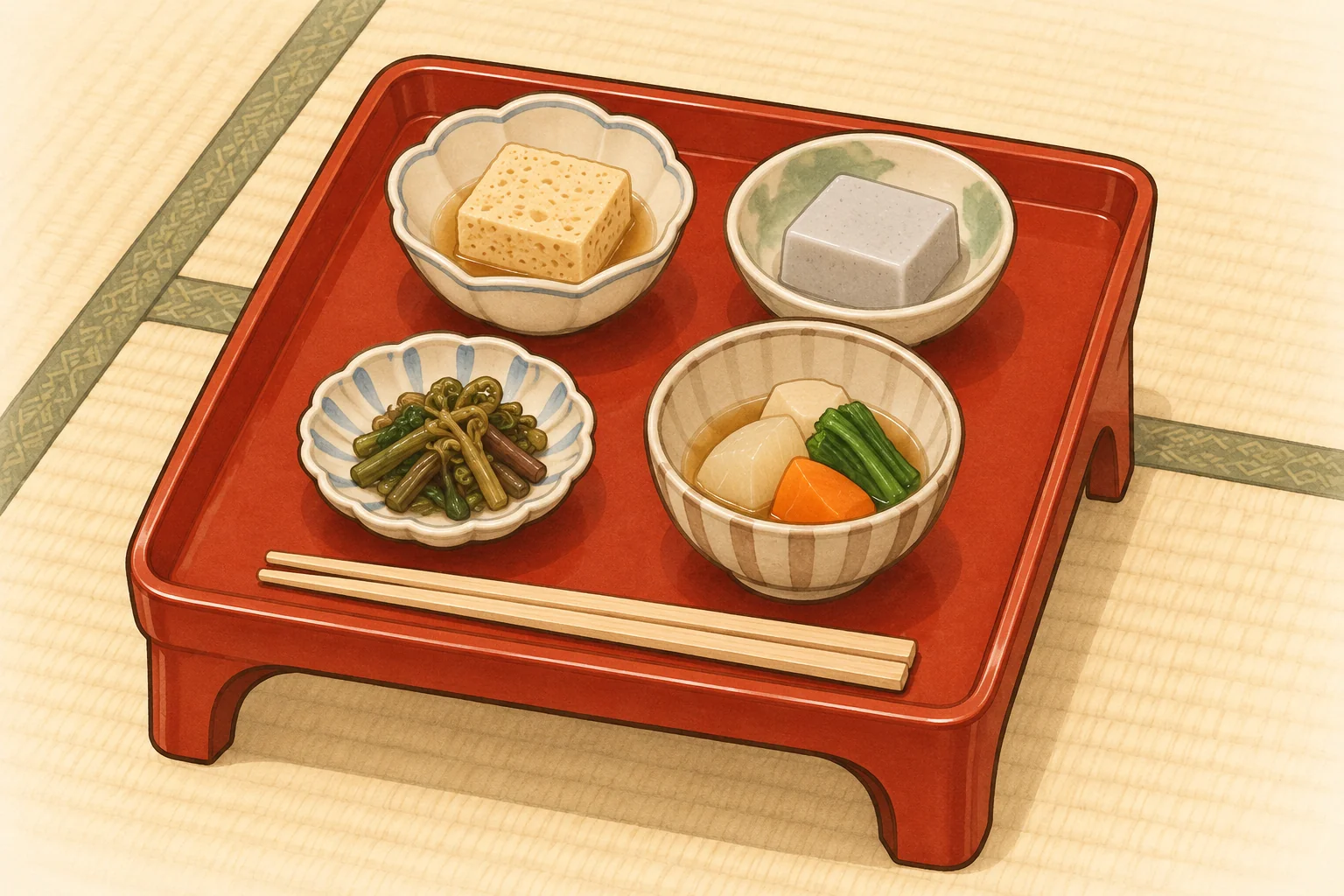
Shōjin ryōri at a Kōyasan temple lodging includes freeze-dried Kōya tofu, sesame tofu and mountain vegetables.
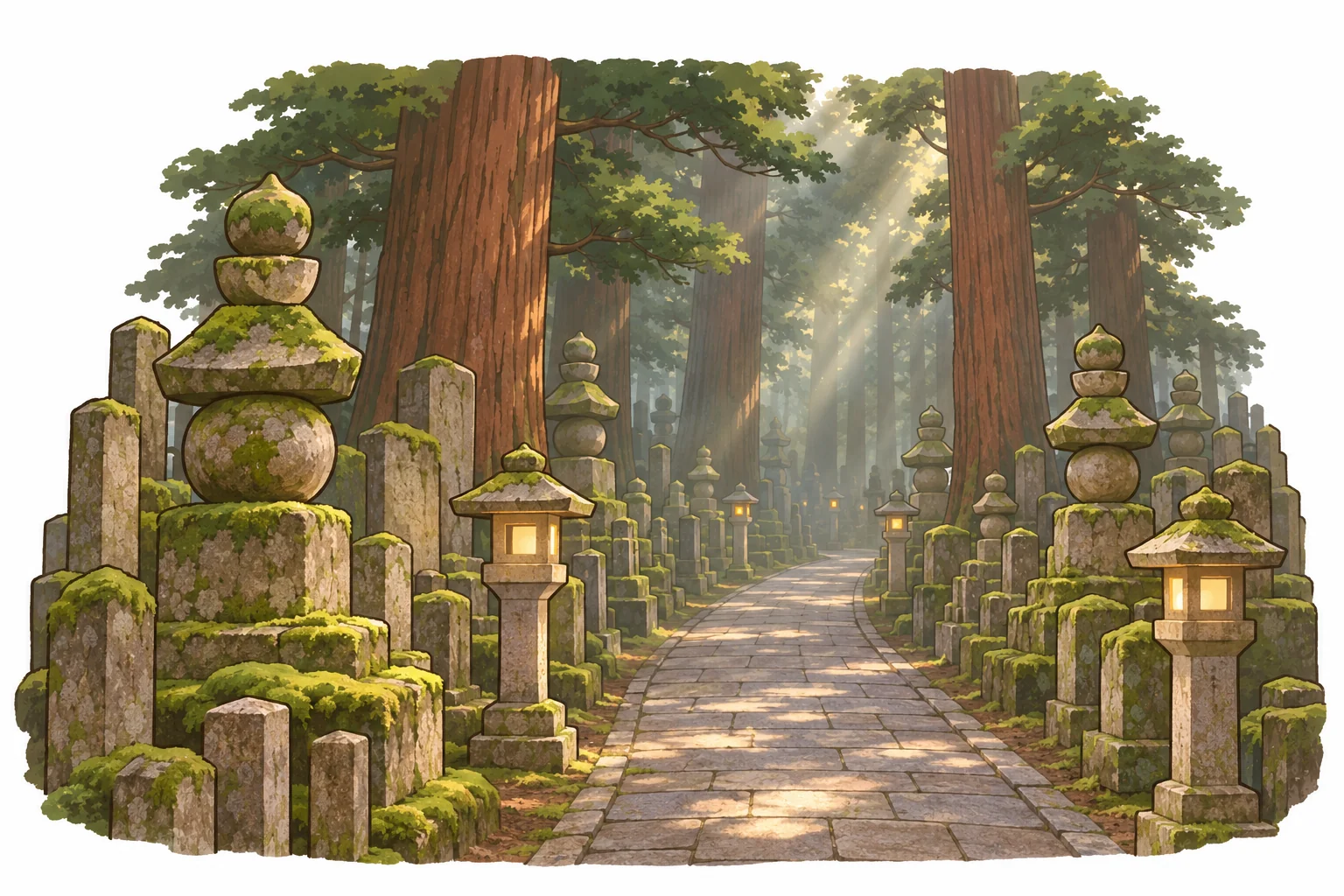
Two places anchor a visit. The Danjō Garan is the sacred precinct Kūkai laid out first. Its vermilion Konpon Daitō, the Great Stupa, contains a seated Dainichi surrounded by pillars painted with bodhisattvas, so that stepping inside means standing within a three-dimensional mandala. The other is the Okunoin. From the Ichi-no-hashi bridge, a path of about two kilometers runs through towering cedars and past more than 200,000 graves and memorials to Kūkai’s mausoleum. Among them are memorials to Oda Nobunaga, the Toyotomi family, Takeda Shingen and Uesugi Kenshin — rivals in life, neighbors here — alongside modern corporate monuments shaped like a coffee cup or a rocket. Beyond the Gobyō-bashi bridge you enter the inner sanctuary: bow, remove your hat, and put away your camera, since photography and eating are not allowed. The Tōrōdō, the Lantern Hall, glows with thousands of lamps, including one said to have burned for a thousand years. Several temples run evening walks through the Okunoin led by monks, and walking among the moss-covered stones by lantern light is often the moment visitors remember most. In 2004 Mount Kōya was inscribed as part of the UNESCO World Heritage site "Sacred Sites and Pilgrimage Routes in the Kii Mountain Range."
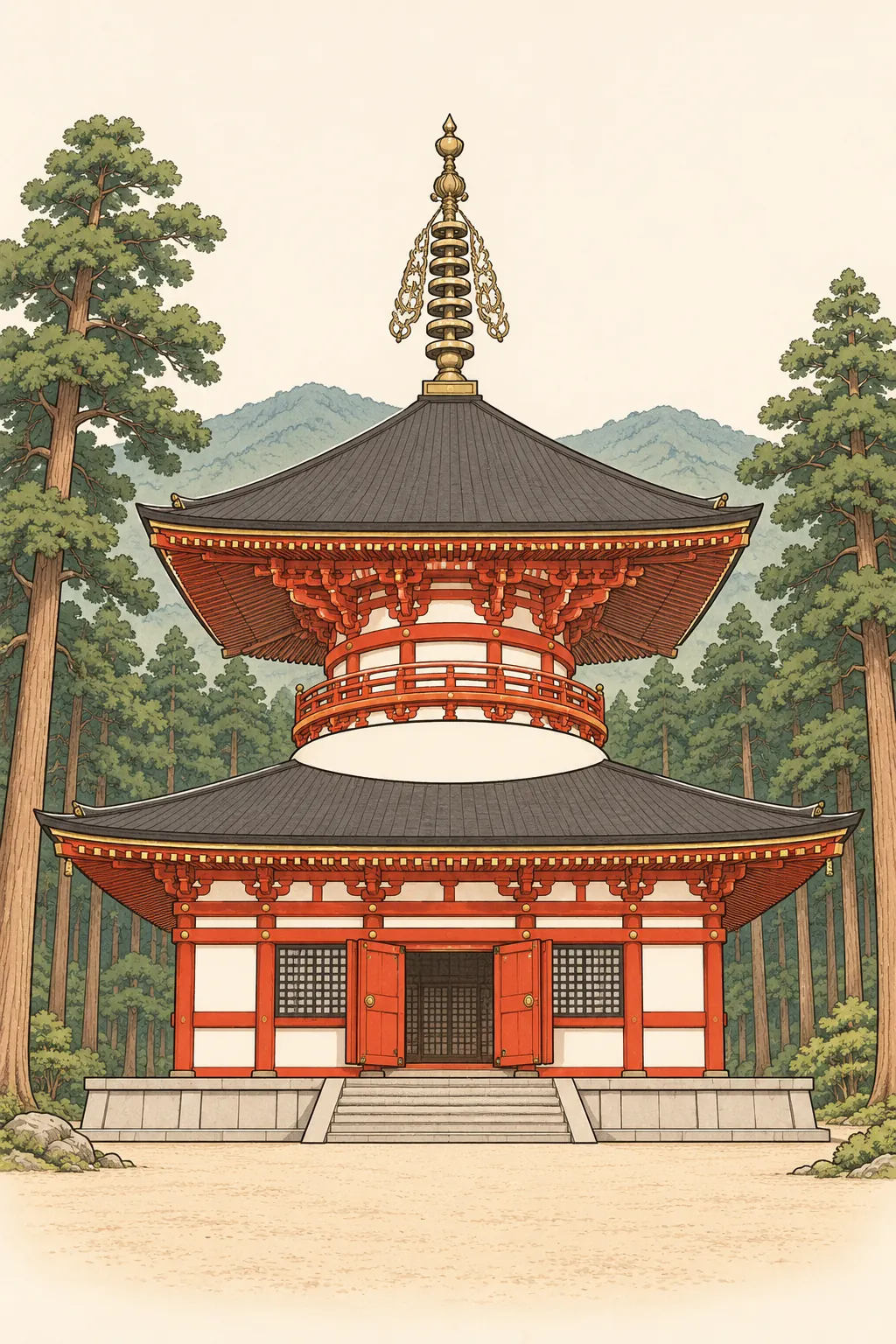
The vermilion Konpon Daitō, the Great Stupa on Mount Kōya, contains a seated Dainichi.
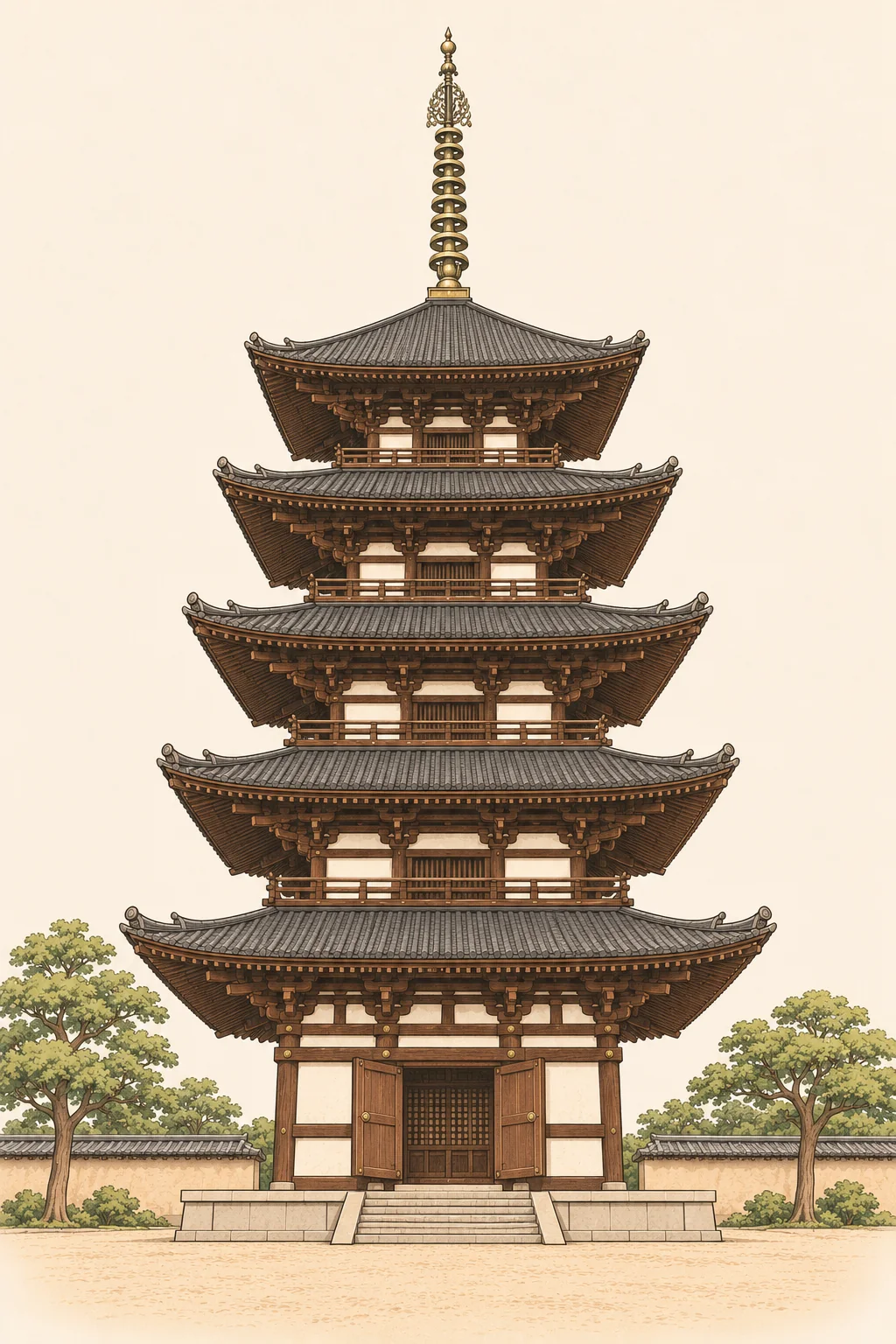
Tō-ji’s five-story pagoda in Kyoto, about 55 meters tall, is the tallest wooden pagoda in Japan.
In Kyoto, Tō-ji is a short walk south of Kyoto Station. Its five-story pagoda, about 55 meters tall, is the tallest wooden pagoda in Japan and is visible from the shinkansen as it pulls into the city. Inside the Lecture Hall (Kōdō), twenty-one statues arranged around Dainichi form the three-dimensional mandala Kūkai designed to teach the doctrine through sight; most of them date from the ninth century and many are National Treasures. On the 21st of every month, the day of Kūkai’s death, the temple grounds fill with the Kōbō-ichi flea market, with antiques, secondhand kimono, pottery and street food. Kyoto residents call it simply "Kōbō-san."
In any Shingon hall, look for the two mandalas facing each other across the altar and for Fudō among the statues. You will often hear worshippers chanting the Kōmyō Shingon, the Mantra of Light, a string of Sanskrit syllables filtered through Chinese characters and Japanese pronunciation, or the simple invocation Namu Daishi Henjō Kongō, calling on Kūkai by his initiation name. Hardly anyone understands the Sanskrit words. In Shingon that is not a problem, since the sound itself is held to carry power.