
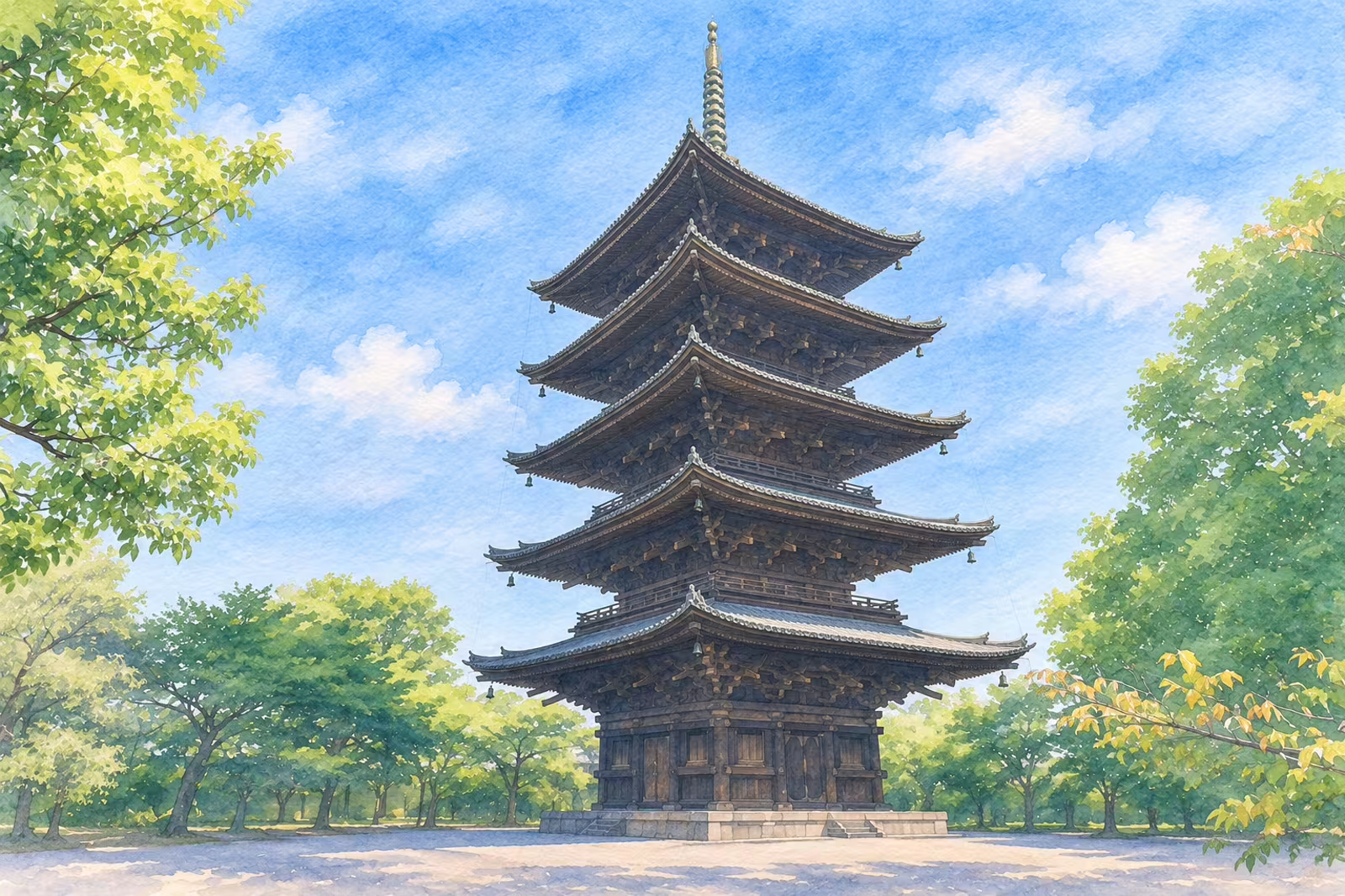
Tō-ji stands in Kujō, Minami Ward, Kyoto, Kyoto Prefecture. Its formal name is Kyōō Gokoku-ji, and it is the head temple of the Tō-ji branch of Shingon Buddhism. Founded as an official temple when Heian-kyō was laid out, it was granted to Kūkai by Emperor Saga in 823 and became the main seat of Shingon esoteric Buddhism in the capital. Its five-story pagoda, about 55 meters tall, is the tallest wooden pagoda in Japan and one of the best-known sights of Kyoto.
01An official temple of Heian-kyō
After the capital moved to Heian-kyō in 794, the court built two official temples, Tō-ji (East Temple) and Sai-ji (West Temple), on either side of Rashōmon, the main gate of the city, to protect the state. Construction of Tō-ji is generally thought to have begun around 796. In 823 Emperor Saga gave the still unfinished temple to Kūkai, who used it as a base for spreading Shingon teaching, oversaw the building of the Lecture Hall, and planned the arrangement of its images. From then on Tō-ji and Mount Kōya were the two centers of Shingon. Sai-ji later fell into ruin and survives only as a site, while Tō-ji has continued to the present.
From the medieval period on, the temple suffered repeated fires and warfare. In 1486 a fire set off during a peasant uprising destroyed the Main Hall, the Lecture Hall and other major buildings. The temple was supported by the court and by successive warrior governments, and devotion to Kōbō Daishi (Kūkai) also made it a place of worship for ordinary people.
02What can be seen today
Most of the surviving buildings were rebuilt in the medieval and early modern periods. The Main Hall was rebuilt around 1603 under Toyotomi Hideyori, and the five-story pagoda was donated by Tokugawa Iemitsu in 1644; both are National Treasures. According to records, the pagoda had burned four times, from lightning and other causes, and the present tower is the fifth. The Lecture Hall was rebuilt in 1491. Inside, 21 statues centered on Dainichi Nyorai form a "three-dimensional mandala," and many of them are 9th-century originals designated National Treasures. The Miei-dō (Founder’s Hall), dedicated to Kūkai, is also a National Treasure.
The temple’s archive, the Tō-ji Hyakugō Documents, is a major source for the study of medieval temples and estates and was added to UNESCO’s Memory of the World Register in 2015. In 1994 Tō-ji was inscribed as part of the World Heritage property "Historic Monuments of Ancient Kyoto." The Kōbō-ichi market, held on the 21st of each month, the day of Kūkai’s death, carries on a long tradition of popular pilgrimage.