
At a glance
Japanese calligraphy from brush and ink to Kūkai, Heian kana, Zen scrolls and avant-garde ink art, with practical advice on looking at it and trying it yourself.
- The Japanese call calligraphy shodō, a word already found in the Fusō ryakki, compiled in the 12th century.
- About 80 percent of Japan’s writing brushes come from Kumano in Hiroshima Prefecture, and by the usual account over 80 percent of its solid ink sticks from Nara.
- Kūkai and two others of the early Heian period are known as the Three Brushes; Ono no Michikaze, Fujiwara no Sukemasa and Fujiwara no Yukinari of the mid-Heian are the Three Traces.
- Hiragana grew out of simplified cursive Chinese characters, and kana calligraphy prizes linked strokes, shifting ink tone and scattered writing with open space.
- Japanese children start using the brush in third-grade writing classes, and the New Year custom of kakizome, the first writing, falls on January 2.
Japanese calligraphy, shodō, "the way of writing," looks at first like something sealed off behind museum glass: black ink, white paper, characters most visitors cannot read. Yet it is everywhere in Japan once you know to look. It is on the noren curtain of a noodle shop, on the ranking sheet of a sumo tournament, on the envelope of cash handed over at a wedding, and in the red-stamped pages a temple priest fills in while you wait. Every January, schoolchildren across the country kneel on the floor with a brush and write their New Year’s characters. This is an introduction to what shodō is, why a single brushstroke carries so much weight, where the art came from, and how a traveler can look at it, and try it, with some understanding.
01A Line You Cannot Take Back
The essential fact of shodō is that there is no correcting it. A brush loaded with ink touches absorbent paper and the ink soaks into the fibers at once. Hesitation shows as a blot, a tremor shows as a wobble, going back over a stroke shows as a thick, dead patch. A finished piece of calligraphy is therefore a record of a few seconds or minutes of movement: how fast the hand traveled, how hard it pressed, when the brush ran dry. The Japanese saying that "the writing is the person" sounds sentimental, but anyone who has held a brush understands it literally. There is nowhere to hide.
That is why the art is called a dō, a "way," like chadō (the way of tea) or kendō (the way of the sword). The Chinese call the same practice shufa, "the method of writing," and Koreans call it seoye, "the art of writing." The Japanese word, already found in a twelfth-century chronicle and long used alongside older names such as jubokudō, puts the stress on practice as a lifelong path. Posture, breathing, and the quiet minutes spent grinding ink are treated as part of the writing itself, not as preparation for it.
Shodō in Japan today has several faces that coexist without much friction. There is shosha, the penmanship lessons every Japanese child takes at school, starting with the brush in the third grade. There are neighborhood calligraphy schools all over the country, said to number in the tens of thousands, where children and adults copy model sheets, send in monthly work, and climb a ladder of grades and dan ranks much as in martial arts. There is calligraphy as fine art, shown at large juried exhibitions alongside painting and sculpture. And there is everyday practical brushwork: signs, ceremonial envelopes, shrine plaques, the names on a funeral register. The same word covers a nine-year-old’s homework and a museum masterpiece.
02The Four Treasures
Calligraphers speak of the "four treasures of the study": brush, ink, inkstone, and paper. Japan inherited all four from China and then developed its own centers of production.
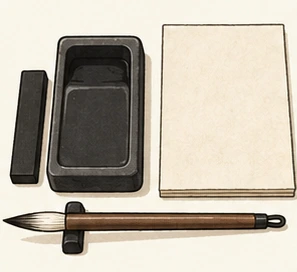
An ink stick, an inkstone, a stack of paper and a brush resting on its stand.
The brush (fude) most likely comes from Kumano, a small town in the hills outside Hiroshima. Kumano had no local supply of animal hair or bamboo. In the late Edo period, villagers spent the farming off-season buying brushes and ink in the Nara area and peddling them; young men later learned the craft itself, in places such as Arima near Kōbe, brought the skill back, and turned the town into the country’s dominant brush producer, making roughly 80 percent of Japan’s brushes. Kumano brushes are now famous abroad less for calligraphy than for makeup, since the same craftsmen make cosmetic brushes prized by makeup artists. Calligraphy brushes vary by hair. Goat hair is soft, holds a lot of ink, and gives round, full lines. Weasel and horse hair are springy and produce crisp, sharp strokes. Beginners usually get a mixed brush that does a bit of both.
The ink (sumi) is a solid stick, made of soot mixed with animal glue, pressed in wooden molds, and dried slowly for months or years. Nara produces the great majority of Japan’s ink sticks, commonly put at more than 80 percent, a tradition that grew out of the needs of the city’s great temples, whose monks copied sutras by the thousand. Kobaien, an ink maker founded in Nara in 1577, still operates near Kōfuku-ji; the shop says it makes ink only in the cold months from autumn to spring, and during that season visitors can try kneading an ink stick by hand. Ink made from burnt plant oil gives a warm black with a hint of brown; ink made from pine soot has a cool, bluish cast, which shows beautifully when diluted. Most students today use bottled liquid ink, but serious work still begins with grinding.
The inkstone (suzuri) is a flat slab with a shallow slope and a well. The best-known Japanese stones come from Ogatsu in Miyagi Prefecture, which made about 90 percent of Japan’s inkstones before 2011. Ogatsu stone, also called genshōseki, is a dense black slate that was also used to re-roof the restored Marunouchi building of Tokyo Station. The 2011 tsunami swept through Ogatsu and nearly destroyed the industry, and the craftsmen who remain have been rebuilding it ever since. Chinese stones from Duan and She are still considered the finest of all.
Paper is the last treasure, and here Japan has its own strong tradition of washi, handmade paper from mulberry, gampi, and mitsumata fibers, with famous centers in Echizen, Mino, and Tosa. For practice, everyone uses hanshi, a standard sheet about 24 by 33 centimeters. Bold kanji work is often done on gasenshi, an absorbent paper descended from Chinese xuan paper that makes ink bleed softly at the edges. Fine kana writing prefers thin, smooth gampi paper that keeps a hairline stroke clean. Heian courtiers went further and wrote poems on dyed, mica-printed, gold-flecked papers so lovely that the sheet itself was a work of art.
Grinding ink is how a session begins. You put a few drops of water on the flat part of the stone and rub the ink stick in slow circles, pushing the darkening liquid into the well. It takes several minutes, and it is supposed to. Many teachers insist that beginners grind their own ink precisely because it slows them down.
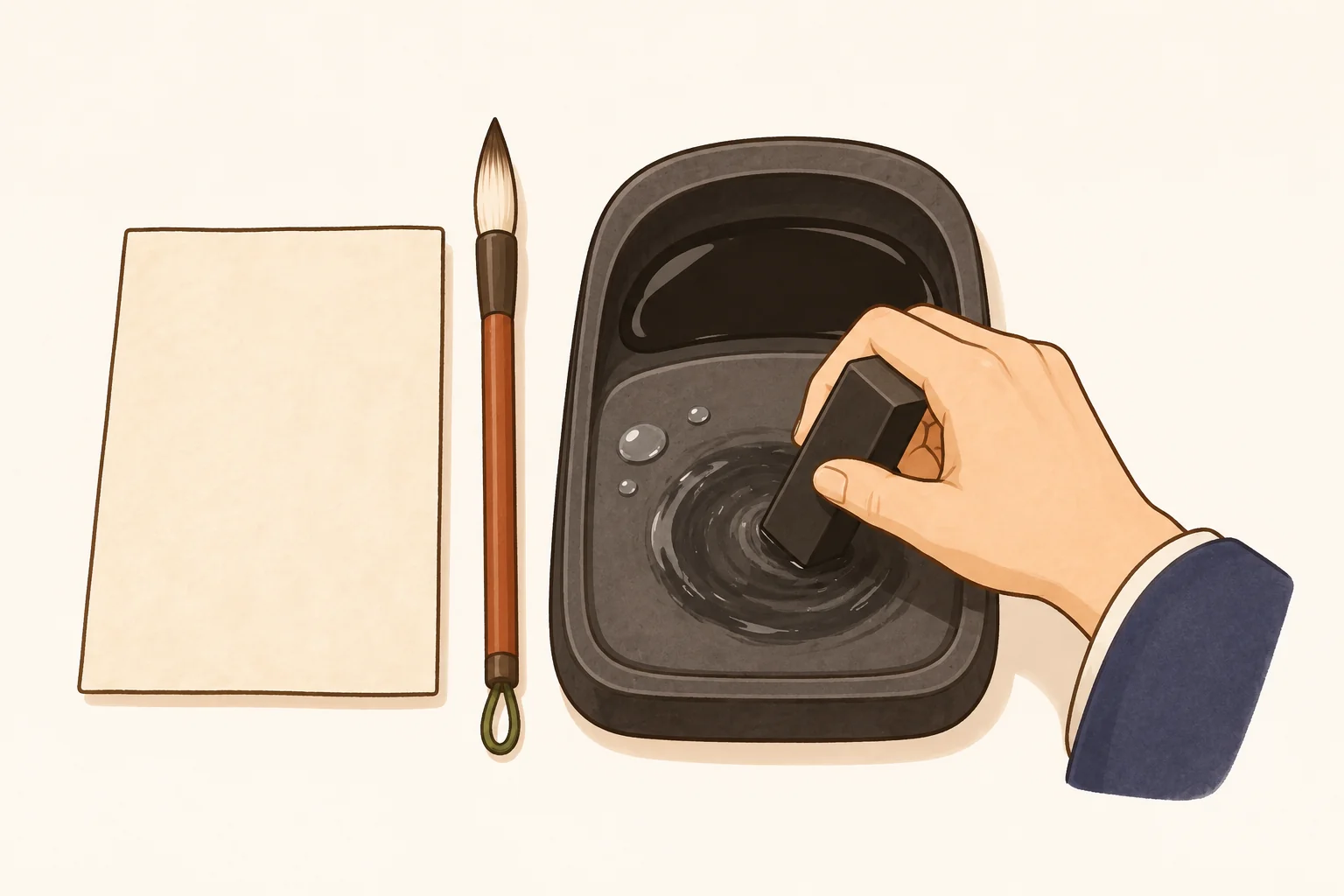
Grinding ink: water on the flat of the stone, the stick rubbed in slow circles, ink pushed into the well.
03Learning from China
Writing reached Japan from the continent. Legend credits a scholar from the Korean kingdom of Baekje named Wani with bringing the Analects and the Thousand Character Classic, the standard Chinese primer. What is certain is that by the seventh century, Buddhism and a Chinese-style bureaucracy had made copying a major occupation. The eighth-century government in Nara ran a sutra-copying office where trained scribes produced Buddhist scriptures in bulk, and the Shōsōin, the imperial treasure house at Tōdai-ji, still holds thousands of documents from this period.
The supreme model was Wang Xizhi, the fourth-century Chinese calligrapher whose elegant running script defined the art for East Asia. Japanese envoys to Tang China brought home careful copies of his work. Empress Kōmyō, the wife of Emperor Shōmu, made a copy of Wang Xizhi’s Essay on Yue Yi that survives in the Shōsōin, and its strokes are strong and assured. Some early tracing copies of Wang Xizhi’s letters, generally thought to be Tang work, survive only in Japan, including the Sōranjō ("Letter on Disorder"), brought over in the Nara period and now in the imperial collection at the Sannomaru Shōzōkan. Japan, in other words, preserved parts of China’s calligraphic heritage that China itself lost.
In the early ninth century, three men came to be called the Sanpitsu, the "Three Brushes": the monk Kūkai, Emperor Saga, and the courtier Tachibana no Hayanari. Kūkai and Hayanari both sailed to China in 804 with an official embassy. Kūkai studied esoteric Buddhism in Chang’an, returned to found the Shingon school, and became, in Japanese memory, the calligrapher above all others. His letter to the monk Saichō, the Fūshinjō, is a National Treasure kept at Tō-ji in Kyoto. Its characters have Wang Xizhi’s poise but also a broad, generous weight that reflects the newer Tang style of Yan Zhenqing. Kūkai’s posthumous title was Kōbō Daishi, and Japanese still say "Even Kōbō slips with the brush" when an expert makes a mistake, and "Kōbō does not choose his brush" to mean that real skill does not depend on tools. Almost nothing reliably by Hayanari survives; his reputation rests largely on tradition.
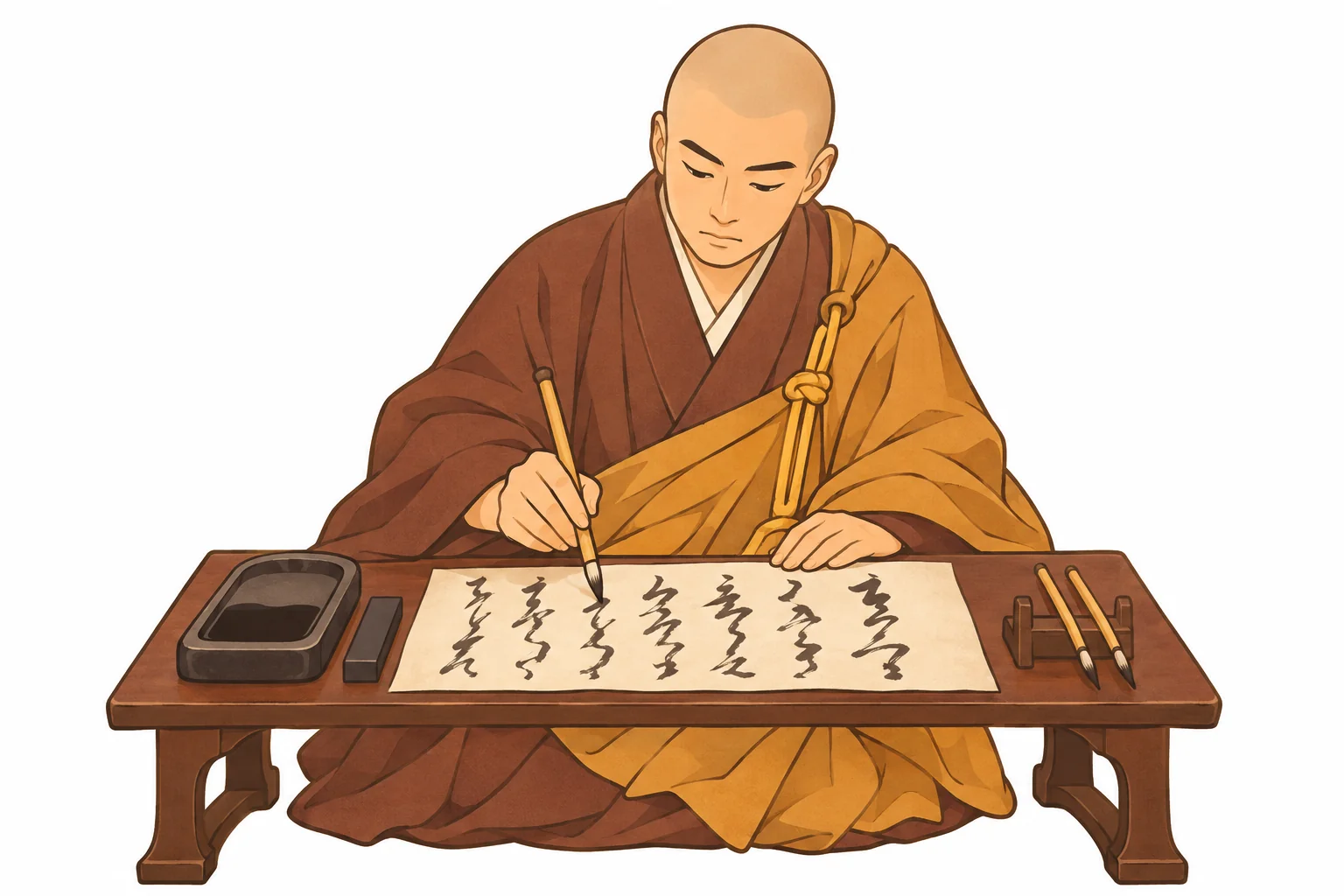
In the early Heian period, Kūkai kneels at a low desk writing a letter in vertical lines (illustration).
The goal in this era was to write like the Chinese, and the best Japanese calligraphy of the ninth century is hard to tell apart from continental work.
04Kana and the Court: A Japanese Beauty Emerges
In 894 the court stopped sending embassies to China, and over the following century aristocratic taste turned inward. In calligraphy, the decisive change was the maturing of kana, Japan’s own phonetic script.
Japanese had first been written by borrowing Chinese characters purely for their sounds, a system called man’yōgana after the eighth-century poetry anthology Man’yōshū. Written quickly in cursive, those characters grew simpler and simpler until they became hiragana: 安 became あ, 以 became い, 宇 became う. Hiragana was associated with women and private writing and was called onnade, "the woman’s hand," but male courtiers used it too, above all for poetry. After the Kokinshū anthology of around 905, composing and exchanging waka poems was the basic currency of court life, and how you wrote a poem, on what paper, in what hand, was as much a test of refinement as the words.
The tenth and early eleventh centuries produced the Sanseki, the "Three Traces": Ono no Michikaze, Fujiwara no Sukemasa, and Fujiwara no Yukinari. Together they shaped wayō, the "Japanese style," which softened and rounded the Chinese model. Michikaze is honored as its founder. A well-loved story, of later origin, says that as a discouraged young man he watched a frog leap again and again at a willow branch until it finally caught hold, and resolved to keep practicing. The scene appears on one of the cards of hanafuda, the Japanese flower-card game. Sukemasa wrote with dash and speed. Yukinari was the most polished of the three; his descendants served the court as calligraphers for generations, founding the Sesonji school.
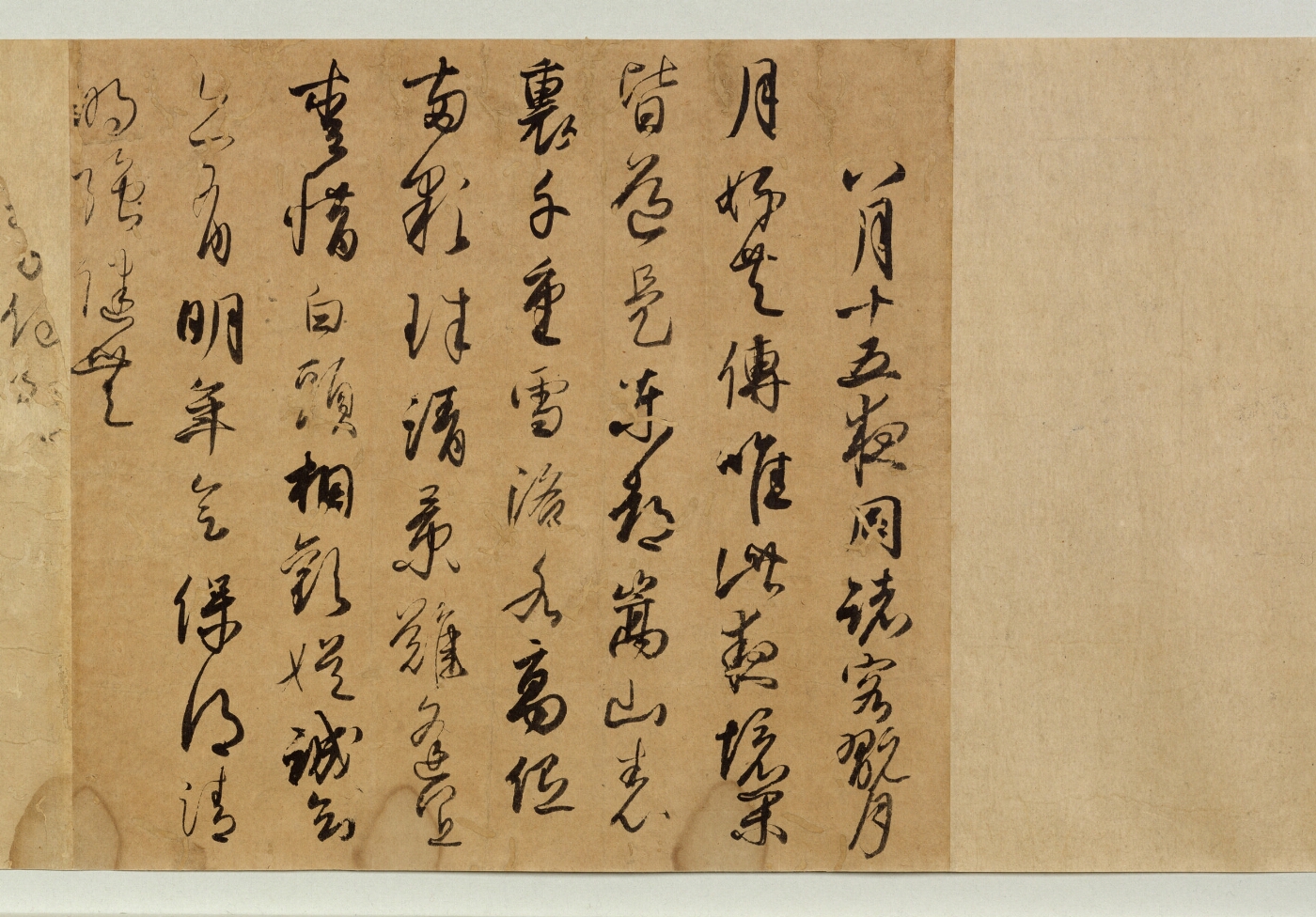
Opening of the Hakushi shikan, written by Fujiwara no Yukinari in 1018. Yukinari, one of the Three Traces, wrote in an upright, elegant hand.Tokyo National Museum, Fujiwara no Yukinari, Poems of Bai Juyi (1018)
To see what kana calligraphy can do, look at the Kōya-gire, fragments of the oldest surviving manuscript of the Kokinshū, written in the eleventh century. Tradition attributed them to the poet Ki no Tsurayuki, but they were in fact written by several unnamed scribes, and the name comes from a section once held on Mount Kōya. The lines are as thin as thread and flow without a break, the end of one character pulling into the beginning of the next. The brush is dipped, written until it nearly runs dry, then dipped again, so that each column breathes from dark to pale. Even more striking is chirashi-gaki, "scattered writing," in which a poem is not set in neat columns but spread across the sheet in staggered groups, with column tops at different heights and the empty paper flowing between them like water. The three famous "poem sheets," the Tsugi Shikishi, Sunshōan Shikishi, and Masu Shikishi, are the classic examples.
You do not need to read Japanese to enjoy this. Look at the line itself: very fine, yet never limp, with a slight spring at each turn. Look at the white space, which is shaped as deliberately as the ink. That sensitivity to emptiness runs straight through later Japanese painting, garden design, and the tea room.
In the following centuries, the Shōren-in school, founded by the imperial prince-abbot Son’en in the fourteenth century, became dominant. Under the Tokugawa shogunate it was renamed the Oie-ryū and served as the standard script for government documents and everyday business. In Edo-period terakoya, the small private schools where commoners’ children learned to read and write, pupils copied Oie-ryū models of letters and practical vocabulary. Japan’s high literacy rate in the Edo period owed a great deal to this brush training.
05Zen Ink and the Tea Room
From the thirteenth century, Chinese Zen monks came to Japan and Japanese monks went to study in Song and Yuan China. They brought a very different kind of writing. The Japanese call the calligraphy of Zen monks bokuseki, "ink traces." Bokuseki ignores polish. Strokes may be heavy, crooked, or streaked with the white gaps of a dry brush, but they hit with directness and force. Letters and certificates by the Chinese master Wuzhun Shifan, and by the émigré monks Lanxi Daolong and Wuxue Zuyuan, who founded great temples in Kamakura, became treasures. Among Japanese monks, the most famous hand belongs to Ikkyū Sōjun, the eccentric fifteenth-century abbot whose huge, rough characters match his reputation for breaking every rule.
Bokuseki holds an unusually high place in Japan because of the tea ceremony. From the late fifteenth century onward, tea masters hung Zen calligraphy in the tokonoma, the alcove of the tea room, as its most important decoration. Later tea writings state that the hanging scroll comes first among all the utensils, because it sets the theme of the gathering. Tradition holds that Murata Jukō, revered as the founder of the tea ceremony, received a piece of writing by the Song monk Yuanwu Keqin from Ikkyū and hung it in his tea room, the beginning of the custom. One account adds that the Yuanwu calligraphy later used by Sen no Rikyū was part of a letter that had been cut in two. At a tea gathering today, a guest’s first act on entering is to kneel before the alcove, bow, and study the scroll. Common phrases include ichigo ichie, "one time, one meeting," and nichinichi kore kōjitsu, "every day is a good day." The reverence Japanese people feel for a written word owes a great deal to the tea room.
Zen monks also drew the ensō, a circle made in one stroke, standing for enlightenment, completeness, and emptiness at once. In the Edo period, the monks Hakuin Ekaku and Sengai Gibon produced great numbers of ensō and humorous ink sketches for anyone who asked. Sengai drew a circle and wrote beside it, roughly, "Eat this, and drink your tea," turning a symbol of the absolute into a rice cake. This rough, quick, slightly comic brushwork came to be linked with the aesthetic of wabi-sabi, and it fed directly into the avant-garde calligraphy of the twentieth century.
06Modern Shodō: Steles, the Avant-Garde, and the Classroom
Meiji Japan shook up calligraphy along with everything else. In 1880, the Chinese scholar Yang Shoujing arrived in Tokyo on the staff of the Qing legation, bringing thousands of rubbings of ancient stone inscriptions, especially from the Northern Wei dynasty. Japanese calligraphers including Kusakabe Meikaku and Iwaya Ichiroku studied with him and discovered a blunt, monumental style quite unlike either the courtly Japanese hand or the Tang models. Stele study swept the Japanese calligraphy world. Kusakabe’s style dominated Meiji calligraphy, and through his many students he became one of the founders of modern Japanese shodō; some call him the father of modern calligraphy.
His successor in influence, Hidai Tenrai, urged students to copy as widely as possible from the classics and find their own brushwork through them. Out of his circle came many of the major calligraphers of the twentieth century, and with them the argument that calligraphy was an art in its own right, deserving a place in public exhibitions. In 1948, the fourth Nitten, Japan’s largest juried art exhibition, added calligraphy as a division alongside Japanese-style painting, Western-style painting, sculpture, and crafts.
In the 1950s, a group of younger artists went further. They argued that the essence of calligraphy was the movement of line and ink, and that legibility could be given up. In 1951 Morita Shiryū launched the journal Bokubi ("The Beauty of Ink") in Kyoto; its first cover reproduced a painting by Franz Kline, then unknown in Japan, and the magazine traded ideas with American and European abstract painters fascinated by gesture and black-and-white composition. In 1952 Morita, Inoue Yūichi, and three others founded the Bokujinkai, the Ink People’s Society. Inoue Yūichi wielded a broom-sized brush on huge sheets, writing a single character such as 貧, "poverty," with what looks like his entire body. Shinoda Tōkō built an international reputation with abstract ink works and kept working until her death in 2021 at the age of 107. This avant-garde current, sometimes called bokushō, "ink image," is often the first kind of shodō Westerners encounter, because it can be read like a painting.
Meanwhile shodō sank deep roots in ordinary education. Japanese elementary schools teach brush writing from third grade as part of Japanese-language class, middle schools continue it, and high schools offer shodō as an elective arts subject. Calligraphy associations publish monthly model books; students submit work each month and move up through grades and ranks, and after many years they can earn a teaching license and open schools of their own. For many Japanese adults, childhood memories include a tatami room lined with low desks, a teacher’s red corrections circling their strokes, and ink stains on their sleeves on the walk home.
The liveliest recent development is the shodō performance. High school calligraphy clubs, in matching outfits, write together on sheets several meters long with mop-sized brushes, choreographed to pop music. Since 2008, the paper-making city of Shikokuchūō in Ehime Prefecture has hosted a national high school competition, nicknamed the "Shodō Performance Kōshien" after the famous baseball tournament, and in 2010 it inspired a feature film, Shodō Girls!! Traditionalists have mixed feelings, but the performances have put brushes back into the hands of a great many teenagers.
07Brushwork in Everyday Life
Shodō does not live only in galleries. Walk through any Japanese town and you will see brush lettering constantly, and much of it in specialized styles.
The best-known calligraphy custom is kakizome, the first writing of the year, done on January 2. People write auspicious words such as "first sunrise," "new spring," or "hope." Schoolchildren bring their kakizome to class after the winter break, and the best are pinned up in school corridors. Large public kakizome events fill gymnasiums with thousands of people writing at once. In mid-January, at the dondo-yaki or sagichō bonfires, people burn their New Year’s decorations and kakizome sheets; the higher the burning paper flies, the saying goes, the more your handwriting will improve.
Cash gifts for weddings and funerals go in special envelopes, and the giver’s name is written on them by brush: in rich black ink for happy occasions, in pale gray ink for funerals, to suggest that grief has left the mourner unable to grind the ink dark, or that tears have diluted it. Many people now use brush pens, but the distinction between dark and pale remains.
Then there are the professional scripts. Sumo ranking sheets, banzuke, are written by the referees in sumō-ji, a thick, crowded style whose packed strokes are said to suggest a full house. Kabuki signs and programs use kanteiryū, with plump, inward-curling strokes, said to wish for audiences flowing in. Signs for rakugo storytelling halls use yose moji, heavy and closely packed. The name stickers that pilgrims paste on shrine and temple gates, senjafuda, use their own bold Edo lettering. All these scripts grew out of Edo-period commerce and entertainment, designed for luck, liveliness, and legibility from a distance. They are the opposite of gallery refinement and every bit as skilled.
The most personal everyday calligraphy a visitor will meet is the goshuin, the temple or shrine seal. Bring a goshuinchō, a folding album sold at most temples, and a priest or shrine attendant stamps it in red and then writes, by brush, the name of the temple, its principal deity, and the date. Each hand is different, some formal, some flowing, and many collectors value the brushwork as much as the stamp.
08Seeing and Trying Shodō
The best single place to see Japanese calligraphy is the Tokyo National Museum in Ueno, where the permanent galleries of the Honkan rotate calligraphy regularly, usually on the second floor: Heian kana, Zen bokuseki, and Edo masters. Nearby, in the Negishi neighborhood, the Taitō City Calligraphy Museum was founded by the painter and calligrapher Nakamura Fusetsu to house his collection of Chinese oracle bones, stele rubbings, and sutras; it stands a few steps from Shiki-an, the former home of the poet Masaoka Shiki, and is usually described as directly across from it. The Kyoto and Nara National Museums, and the treasure hall at Tō-ji, often show works by Kūkai and other early masters in their autumn exhibitions. Because old ink and paper are sensitive to light, the most important pieces go on display for only a few weeks at a time, so check the schedule if there is something specific you want to see.
When you stand before a piece, try looking in three stages. First step back and see it as a picture: the balance of black and white, the dark and pale passages, the rhythm of large and small characters. Then come close and follow the line. Where does the brush enter the paper? Are the corners sharp or rounded? Where does the ink run dry into streaks? Can you tell where the hand sped up? Only then turn to the text, which labels often translate. With kana, watch the empty spaces and the staggered tops of the columns. With Zen bokuseki, feel the unvarnished force. The small red seals in the corners are the artist’s signatures, and seal carving, tenkoku, is an art of its own.
The easiest way to try it yourself is shakyō, sutra copying. Many temples, including Yakushi-ji in Nara and numerous temples in Kyoto, offer sutra-copying halls where you sit in silence and trace the Heart Sutra, about 260 characters, over a model placed beneath thin paper. It usually takes about an hour. You do not need any skill, since you are tracing, and the finished sheet is dedicated at the temple. Most people find that what stays with them is not the characters but the hour of quiet.
Tokyo, Kyoto, and other tourist cities also have calligraphy workshops for visitors, usually an hour or two long. A teacher shows you how to hold the brush, upright, with wrist and elbow off the table, so that you write with the whole arm, and walks you through basic strokes. Then you write a character you like, such as 夢 (dream), 和 (harmony), or 心 (heart), on a sheet of hanshi or a square card, and take it home. The moment the first stroke lands and the ink spreads into the paper, the idea that a line cannot be taken back stops being a phrase.
For supplies, Kyūkyodō in Ginza and its main shop on Teramachi in Kyoto sell everything from brushes and ink sticks to fine letter paper. In Nara, Kobaien, in business since 1577, sells traditional ink sticks. In Kumano, the Fude no Sato Kōbō museum shows how brushes are made, and every year on the autumn equinox the town holds a brush festival at Sakakiyama Shrine, when used brushes are ritually burned beside a brush memorial mound in thanks for their service. A beginner needs very little: one medium mixed-hair brush, a small inkstone, a bottle of liquid ink, and a stack of hanshi.
In a Japanese calligraphy class, the teacher circles and corrects your strokes in red, and you go home and write the same character again. The character 永, "eternity," which contains all the basic strokes, is the one every student comes back to, for years.