
At a glance
How hill farmers in Niigata bred food carp into Kohaku, Sanke and Shōwa, how the Japanese judge koi from above, and where to see them.
- Koi come from the Yamakoshi and Ojiya area of Chūetsu in Niigata, where they began as food carp kept in ponds beside terraced rice fields.
- Around the early nineteenth century, late in the Edo period, farmers began keeping and breeding the carp that showed red.
- The place to start is the "big three": Kohaku, Taishō Sanshoku and Shōwa Sanshoku.
- Koi are judged from above, looking at body shape, quality of color and pattern.
- In 2018 a Kohaku sold for about 200 million yen, still among the most expensive koi on record as of 2026.
The koi in a Japanese garden pond look timeless, as if they had always been there, drifting under maple branches in red and white. In fact the fancy colored carp the Japanese call nishikigoi, "brocade carp," are a fairly recent creation, and a rural one. They were bred by farmers in the mountains of Niigata who kept ordinary carp in their rice-terrace ponds to eat in winter and began, sometime around 1800, to keep the oddly colored ones instead. This is the story of how that hobby became a national symbol and a global trade, how to tell the main varieties apart, what Japanese breeders look for in a fine fish, and where a visitor can see the best of them.
01Carp in the snow country
The heartland of koi is the Chūetsu region of Niigata Prefecture, on the Sea of Japan side of Honshū. More precisely, it is a cluster of hill villages around the old village of Yamakoshi, now part of the city of Nagaoka, and the eastern hills of the neighboring city of Ojiya. This is some of the snowiest inhabited country on earth. Winter snow piles up several meters deep, and for months the villages used to be cut off.
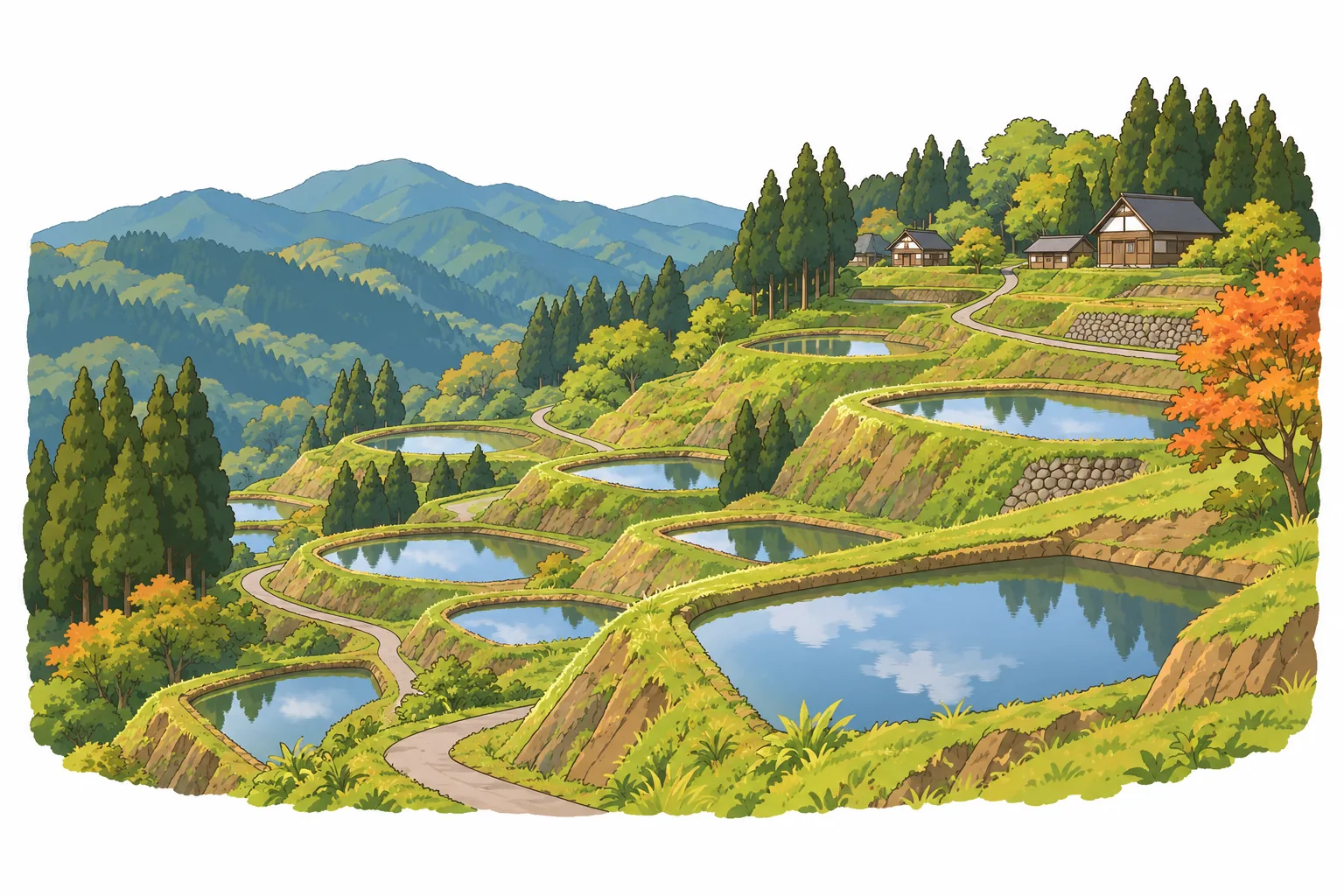
Hillside terraces at Yamakoshi, Niigata, with small carp ponds set among the rice paddies (illustration).
Farmers here carved rice terraces into steep slopes and dug small reservoir ponds beside them to hold irrigation water from mountain springs. They stocked those ponds with carp. The plain dark carp, magoi, was a practical animal: hardy, easy to feed, and a valuable source of protein when nothing else was available. In autumn the fish were moved to ponds near the house, and they were eaten through the long winter and at New Year.
Every so often a carp hatched with patches of red or a paler body. Around the early nineteenth century, in the late Edo period, the farmers of Yamakoshi began to keep these mutants and breed them together. Over generations they fixed colors and patterns that did not exist in the wild. The fish were known locally by names like irogoi (colored carp) and hanagoi (flower carp). The breeding was done pond by pond, family by family, with no science beyond a sharp eye and patience, which is why the history of the early lines is mostly oral tradition.
By the Meiji period (1868–1912) the red-and-white pattern had become fairly stable. In the early twentieth century, scaleless and partly scaled carp were imported from Germany, and Japanese breeders crossed them with local stock. The Japanese still call these scale-reduced fish doitsu, from the Japanese word for Germany.
The colored carp of Niigata reached a national audience in 1914, when they were exhibited at the Taishō Exposition in Tokyo. The name nishikigoi is said to have been coined in the early Taishō years by a Niigata fisheries official who saw the new three-colored fish, though it did not come into general use until the 1930s. Nishiki is brocade, the heavy patterned silk of formal kimono, and the comparison fits: a good koi seen from above looks like a length of woven cloth. From the 1920s on, koi became a status ornament for wealthy households, and in the high-growth decades after World War II, owning a pond full of expensive koi became a recognizable marker of success.
The breeding villages have known disaster. In October 2004 the Chūetsu earthquake struck Niigata, and Yamakoshi was among the worst-hit places. Landslides destroyed roads, houses, and many koi ponds, the entire population was evacuated, and huge numbers of fish died. Breeders carried survivors out, rebuilt their ponds, and slowly restarted. Today the terraced slopes of Yamakoshi are again dotted with small ponds of koi.
02The big three
There are more than a hundred named varieties of koi, and the names can sound like a private code. They are less mysterious once you know that they mostly describe three things: the base color, the color of the markings, and how those markings are laid out. Any beginner should start with the three varieties known in Japan as the gosanke, the "three great houses," a term borrowed from the three senior branches of the Tokugawa family.
The first is Kohaku, simply "red and white." It is a white fish with red markings. The red of a koi is called hi, and in a good Kohaku it is deep, even, and thick-looking, with crisp edges where it meets the white. Kohaku is the original pattern and still the most prestigious. There is a saying among Japanese hobbyists: "it begins with Kohaku and ends with Kohaku." Beginners start with red and white because it is simple; experienced collectors come back to it because, with only two colors, every flaw shows and every excellence is obvious.
The second is Taishō Sanshoku, usually shortened to Sanke, meaning "Taishō-era three colors." It is a Kohaku with small black spots, called sumi, scattered across the white. The black is limited to the body and usually kept off the head. The variety takes its name from the Taishō era (1912–1926), when it appeared.
The third is Shōwa Sanshoku, or Shōwa, which is generally credited to a Niigata breeder named Hoshino, given in English-language koi literature as Hoshino Jūkichi, around 1927, in the early Shōwa era. It also has red, white, and black, and newcomers mix it up with Sanke all the time. The difference is in the black. On a Shōwa the black is the base, laid on in large bold wraps that sweep up from the belly, run across the back, and often onto the head, like a heavy brushstroke of ink. On a Sanke the black is a sprinkling of spots on a white field. A second clue is the pectoral fins: Shōwa usually have black stripes at the base of the fins, while Sanke fins are white or lightly striped.
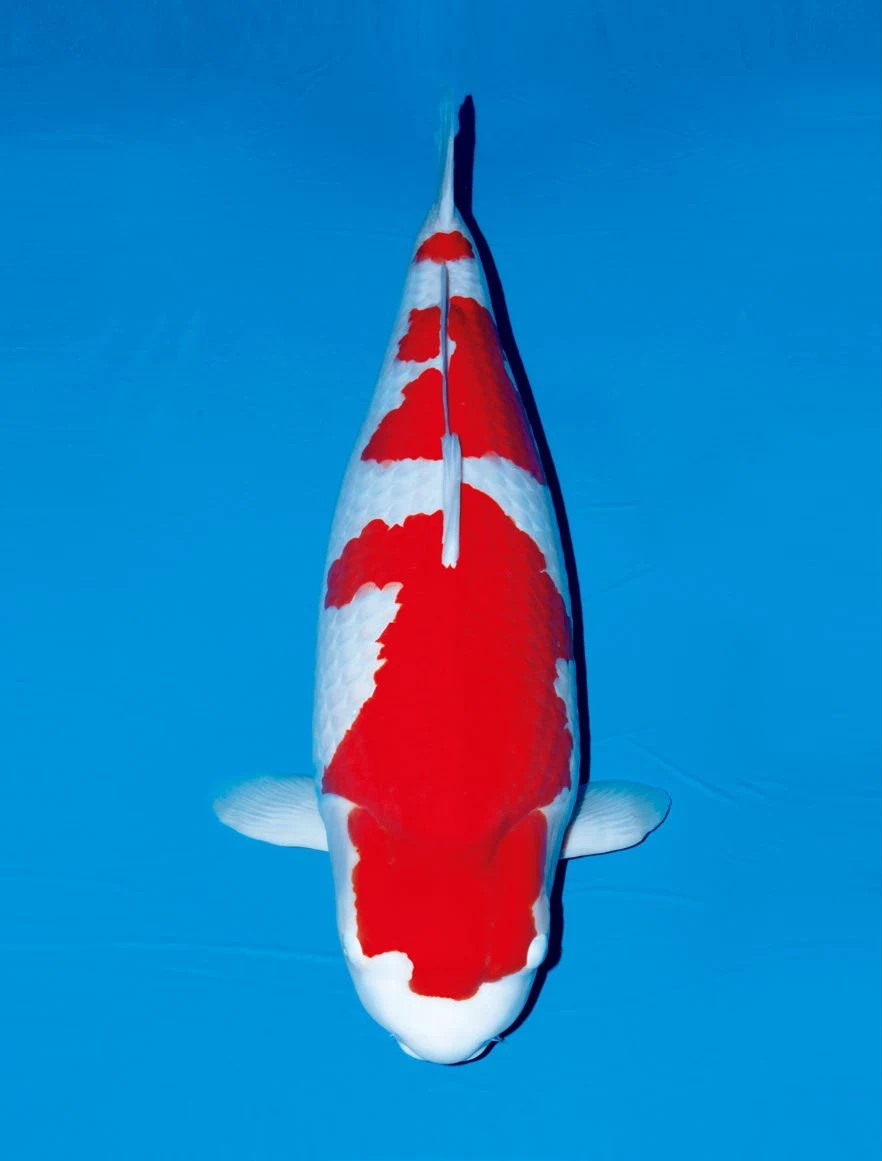
Kohaku: red markings on a white body.
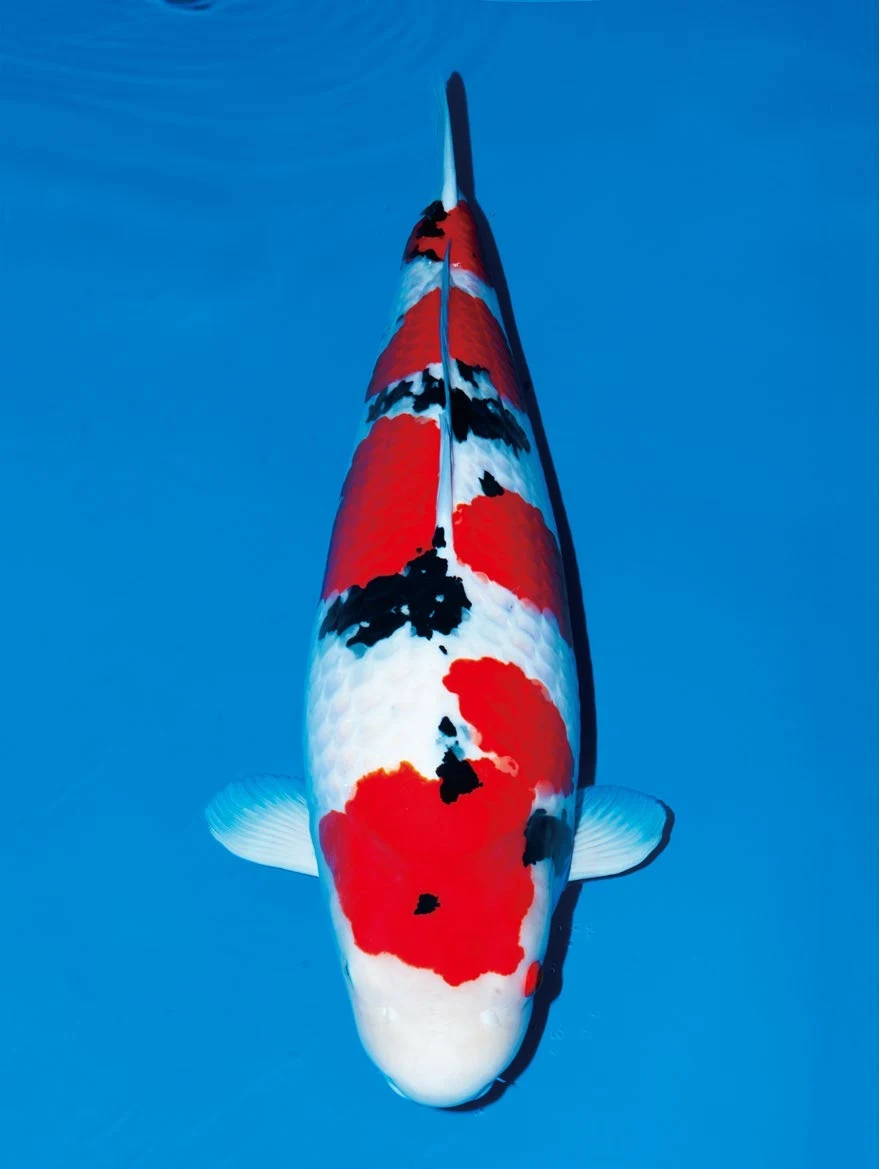
Taishō Sanshoku: a Kohaku with small black spots added.
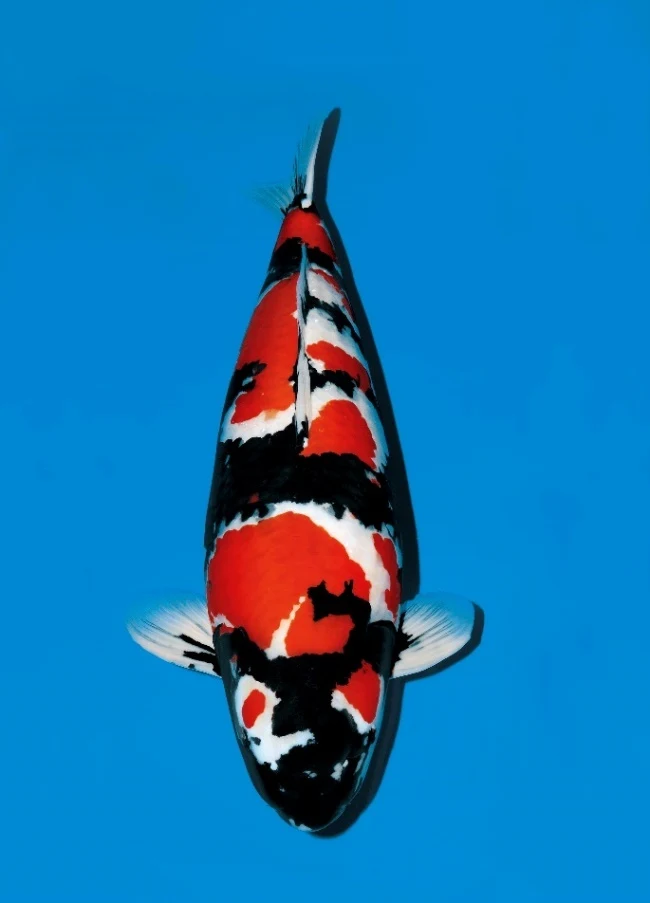
Shōwa Sanshoku: a black base, with black reaching onto the head.
Beyond the big three, a handful of other names come up constantly. Tanchō is a pure white fish with a single round red spot on the head, named after the red-crowned crane, tanchōzuru. To many people it also suggests the Japanese flag, and it is a favorite abroad. Asagi has a blue-gray back with a net pattern of scales and red on the sides and belly; it is one of the oldest varieties. Shūsui is the scaleless cousin of Asagi, bred from crosses with German carp, with a single line of large scales along the spine. Ogon is a solid metallic gold fish, a postwar creation. Kumonryū, "nine-crested dragon," is a black-and-white fish whose pattern can shift with the seasons and the water temperature. Chagoi, a plain brown-tea color, is the one serious collectors keep for personality: it grows big, becomes tame, and is usually the first to swim up and take food from your hand, which encourages the shyer fish to follow.
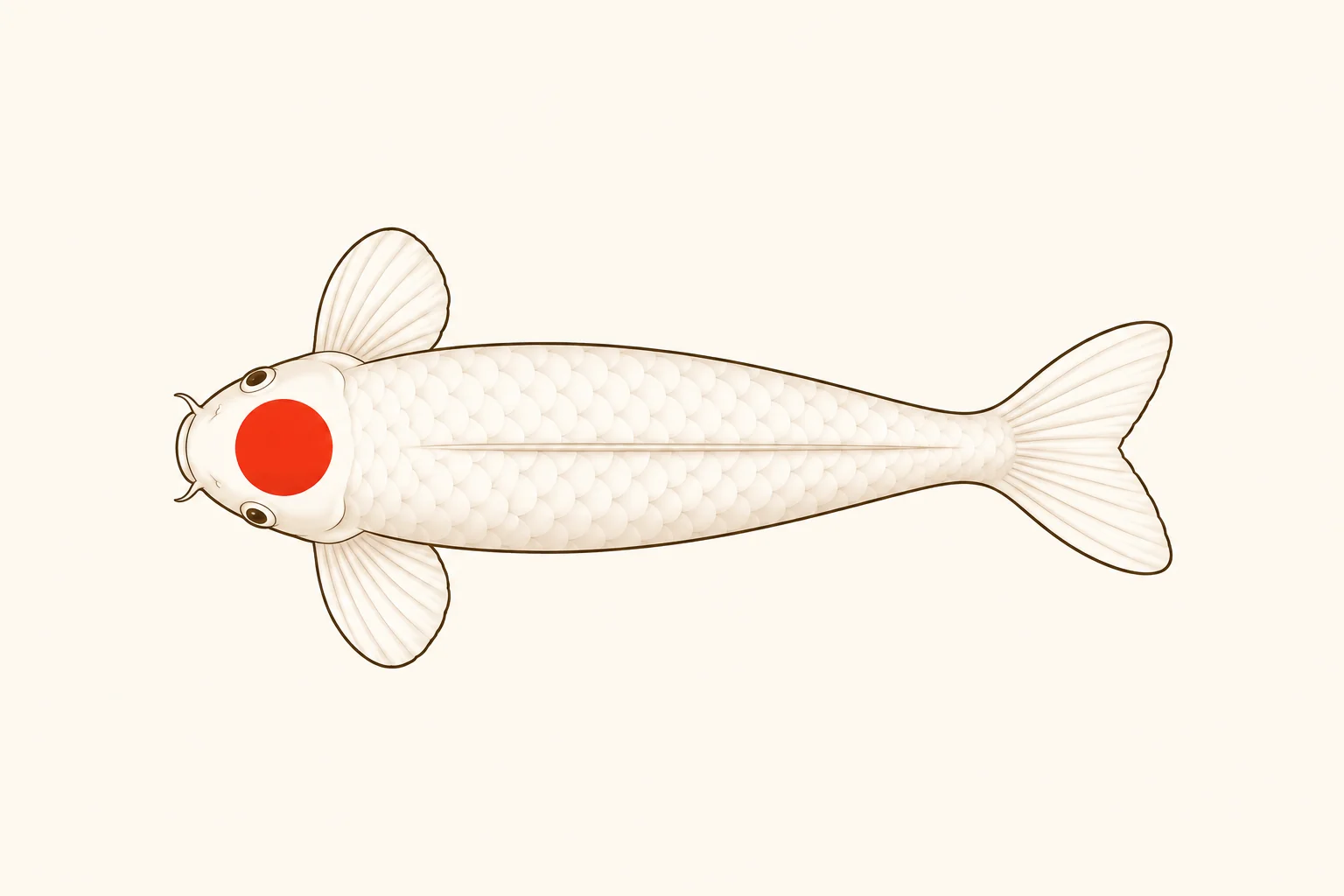
A Tanchō is pure white with a single round red spot on the head.
03Looking down on a koi
Koi were bred to be seen from above. A Japanese pond is shallow and broad, and people stand at its edge or on a bridge and look down. Everything a koi breeder values is judged from that angle, which the Japanese call uwami. Many people now keep koi in glass tanks and admire them from the side, but at a show the judges still look down.
A koi is judged on three main qualities. The first is body. A fine fish is symmetrical, full-bodied without being fat, and from above looks like a smooth torpedo that widens gently behind the head and tapers to a strong tail. Koi can grow to 70 or 80 centimeters and more, and a fish whose body does not develop will distort even the best pattern. The second is color quality. The white should be clean like fresh snow, without yellow tinge. The red should be deep and opaque, and the black should be glossy and solid, like lacquer. The third is pattern, which is about balance and empty space. The red on the head should not cover the eyes, the markings should break in pleasing places along the back, and there should be a clean band of white just before the tail.
Above these, Japanese breeders talk about hin, a word that means something like dignity or class. A fish can score well on every point and still lack presence. This is close to the way calligraphy or painting is judged in Japan: skill is the minimum, and what matters at the top is bearing.
Koi are also a living artwork that keeps changing. Color and pattern shift with age, water, and diet. Red on a young fish may fade; black may rise slowly to the surface of the skin over years. Breeders select young fish they think will improve, known as tategoi, and buying one is a bet on what it will look like in three or five years.
The breeder’s year follows the seasons. Koi spawn in spring, and the tiny fry are culled in round after round, often leaving only a small fraction of a percent of the original spawn. In summer the survivors are released into mud ponds in the hills, where the minerals in the soil and the room to swim help them grow fast and color well. Around October the ponds are drained and the fish netted out, an event called ikeage, the busiest and most festive time of the year in the koi villages, when buyers come to see the new crop. Winter is spent indoors in heated or sheltered fish houses.
04Why the carp matters
Koi caught on in Japan partly because the carp was already a lucky fish. An old Chinese legend says that a carp that swims up the Yellow River and leaps the falls at the Dragon Gate turns into a dragon. The story came to Japan early, and "climbing the dragon gate," tōryūmon, became a phrase for a breakthrough in life. The carp’s ability to live in cold or murky water and to swim against the current made it a symbol of perseverance.
The most visible form of this today is koinobori, the carp streamers that fly in late April and early May. Around Children’s Day on May 5, originally the Boys’ Festival, families with sons raise a tall pole and hang a set of cloth carp in black, red, and blue that fill with wind and seem to swim in the sky, a wish for children to grow up strong. Samurai households of the Edo period set out banners bearing their family crests for the boys’ festival; from the mid-Edo period townspeople began raising carp streamers outdoors, and the custom spread from there. Even Hiroshima’s professional baseball team, the Hiroshima Tōyō Carp, takes its name from the carp, both the fish that crowded the Ōta River through the city and Hiroshima Castle’s old nickname, Carp Castle.
Carp have lived in Japanese garden ponds for a very long time, but the fish in temple and daimyo gardens of earlier centuries were mostly plain black magoi or solid orange-red higoi. The multicolored koi that now seem inseparable from the image of a Japanese garden are a modern addition, mostly from the twentieth century.
Koi can live a very long time. The most famous case is a red koi named Hanako, reportedly kept in Gifu Prefecture, which died in 1977. Her age was estimated from growth rings on her scales at 226 years, a figure that is still widely repeated but rests on a method few would trust, so it is best treated as a legend. Well-kept koi commonly live twenty or thirty years, and some pass fifty, outliving their owners. In Japan a prized koi can be something handed down in a family.
05A two-hundred-million-yen fish
Koi are now an international business. Niigata remains the most famous source, with many farms around Ojiya and Nagaoka, but there are celebrated breeders in Hiroshima, Fukuoka, Shizuoka, and elsewhere. A large share of Japan’s production is exported, to buyers in mainland China, Taiwan, Hong Kong, Southeast Asia, Europe, and the United States. The word "koi" has simply become English. In 2017 Niigata Prefecture named the nishikigoi its official prefectural ornamental fish, and industry groups have long promoted it as Japan’s "national fish."
The range in price is enormous. A small koi a few centimeters long can cost a few hundred yen at a pet shop. Prize-winning adults sell for tens of millions of yen. In 2018 a Kohaku bred by the Sakai Fish Farm in Hiroshima Prefecture sold to a buyer from Taiwan for about 200 million yen, roughly 1.8 million US dollars, as of 2026 still one of the highest prices on record for a koi. Owners of top fish often leave them in Japan in the care of the breeder, who raises them and enters them in shows on the owner’s behalf.
The biggest stage is the All Japan Combined Koi Show, held in winter in Tokyo and still running as of 2026. At the 56th show in January 2026 about 2,000 koi from Japan and abroad were sorted by variety and size into rows of blue tanks and judged, with the Grand Champion as the top prize; as of around 2025, more of the entries came from abroad than from Japan. A win is more than prestige: it raises the value of that fish and of its parents and siblings.
The trade carries risk. In the early 2000s koi herpesvirus spread in Japan, killing huge numbers of farmed carp around Lake Kasumigaura in Ibaraki Prefecture, and breeders tightened quarantine. An earthquake or a long power cut can wipe out years of work on a single farm.
06Where to see koi
To see where it all began, go to Ojiya in Niigata and visit Nishikigoi no Sato, a museum devoted to koi. Indoor pools hold fine examples of the main varieties, a garden pond holds big fish, and you can buy food and feed them. From Ojiya the road climbs into the hills to Yamakoshi. In autumn, during the ikeage season, you may see breeders netting fish out of the mud ponds, bagging them in water with oxygen, and sending them off. The landscape of terraces and small ponds is worth the trip on its own.
You do not have to go to Niigata to see koi. In Tsuwano, a small castle town in Shimane Prefecture, large carp swim in the stone-lined canals in front of old samurai houses. In Shimabara, Nagasaki Prefecture, there is a street known for koi swimming in channels of clear spring water. Gujō Hachiman in Gifu Prefecture, a town built around water, has carp in its streetside channels too. Most of the great landscape gardens, such as Kenrokuen in Kanazawa and Kōrakuen in Okayama, have carp in their ponds.
When you feed koi in a garden, use only the food sold on site, not bread or snacks. For photographs, do what the Japanese do: stand a little higher and shoot down, and wait for a fish to turn just below the surface, when the red and white flash against the green water. In winter koi sink to the bottom and barely move, so the best season to see them active is from late spring to autumn.
If you happen to be in Tokyo in winter, the All Japan Combined Koi Show is open to the public. After an afternoon walking past tank after tank of the country’s best fish, you will start to see why one Kohaku stops people in their tracks while another, almost identical on paper, does not.