
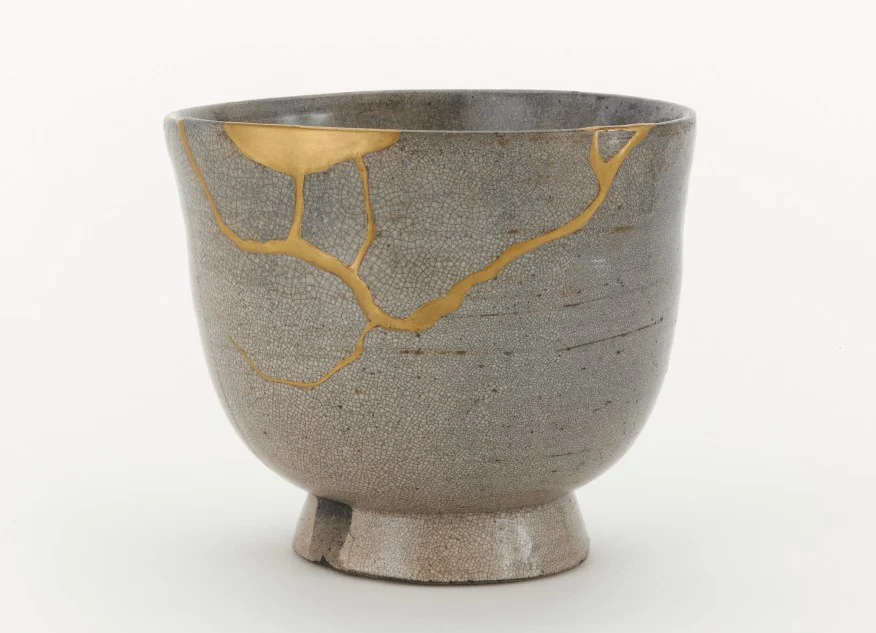
At a glance
How a broken bowl is rejoined with lacquer and dusted with gold, the tea-world bowls that made the craft famous, and where to see or try it.
- Kintsugi rejoins broken pieces with natural lacquer and dusts the seams with gold, so the crack becomes the most visible line on the piece.
- It is generally thought to have taken shape in the fifteenth and sixteenth centuries, from the late Muromachi into the Momoyama period, alongside the rise of tea.
- The pieces are glued with mugi-urushi, filled with sabi-urushi, traced with red bengara lacquer and dusted with gold, each layer cured in a lacquer cabinet and polished.
- A bowl sent for repair usually comes back after anything from a little over a month to half a year.
- A mended piece can be used normally, but it must not go in the microwave and is best washed by hand with a soft cloth.
Most of us, when a favorite bowl breaks, either throw it away or glue it back together and hope no one notices. Kintsugi, "golden joinery," does the opposite. The pieces are rejoined with natural lacquer, and the seams are dusted with gold, so that the break becomes the first thing you see. The craft took shape among Japanese tea masters some four or five hundred years ago, and in the past two decades it has become a byword far beyond Japan, turning up in craft workshops, design magazines and self-help books. This is an introduction to what kintsugi actually is, how a golden seam is built up layer by layer, why it appeals to Japanese taste, and where you can see it or try it yourself in Japan.
01What Kintsugi Is
The word kintsugi (金継ぎ) joins kin, gold, with tsugi, joining or patching. You will also hear kintsukuroi, "golden repair," which means much the same thing. The objects mended are mostly ceramics: rice bowls, plates, sake cups, tea bowls, and the small lidded jars called chaire that hold powdered tea. Lacquerware and even glass can be repaired the same way.
The surprise for many newcomers is that the gold is the least important part. The real work is done by urushi, the sap of the lacquer tree. Lacquer glues the fragments, lacquer mixed with powders fills the gaps, and only at the very end is a thin line of lacquer painted along the seam and dusted with gold. The gold is a skin a fraction of a millimeter thick. What it does is announce the repair rather than hide it.
That choice is the heart of the matter. Most repair traditions, in Europe and in China, aimed either for an invisible mend or for a sturdy, practical one; Chinese and European restorers long used metal staples drilled into the ceramic to clamp a crack shut. Kintsugi treats the break as part of the object’s story. The line of a crack is accidental, no two breaks are alike, and the gold traces it exactly, so each repair is unique. Collectors compare the seams to mountain ridges, rivers or lightning.
02Why Show the Crack?
Japanese tea culture has long prized what it calls keshiki, the "landscape" of a pot: the run of a glaze, a scorch mark from the kiln, a slight warp in the rim. These accidents of making are things to be looked at and talked about over tea, not flaws to be sanded away. A golden seam fits naturally into that way of seeing. It is one more feature of the landscape, added by the bowl’s life after it left the kiln.
Two everyday attitudes sit underneath this. One is mottainai, the sense that it is wasteful, even a little shameful, to throw away something that still has use in it. The other belongs to the aesthetics associated with tea, often summed up in the West as wabi-sabi: a taste for the plain, the irregular and the worn, for things that show the passage of time. Kintsugi is not the same thing as wabi-sabi, and Japanese writers rarely define one by the other, but it makes the idea that damage can be beautiful unusually easy to grasp, which is why it appears in so many books about Japanese aesthetics.
03How a Golden Seam Is Made
Raw urushi comes out of the tree as a milky, grayish sap. It does not dry the way paint does, by evaporation. Instead, an enzyme in the sap uses moisture from the air to link the molecules together, and the result is a hard film that resists water, acids and alcohol. Paradoxically, lacquer needs humidity to cure. Craftspeople keep their work in a muro, a wooden cabinet kept warm and damp, typically somewhere above 20°C and at 60 to 80 percent humidity. A bowl left out in dry air may stay tacky for days.
Repairing a bowl broken into several pieces goes roughly like this. First the fragments are glued with mugi-urushi, a paste of wheat flour and water kneaded until it turns stretchy, then mixed with raw lacquer. The paste is spread on the broken edges, the pieces are pressed together and taped in place, and the bowl goes into the muro for a week or two, sometimes longer. Once the joint is hard, the squeezed-out excess is scraped away.
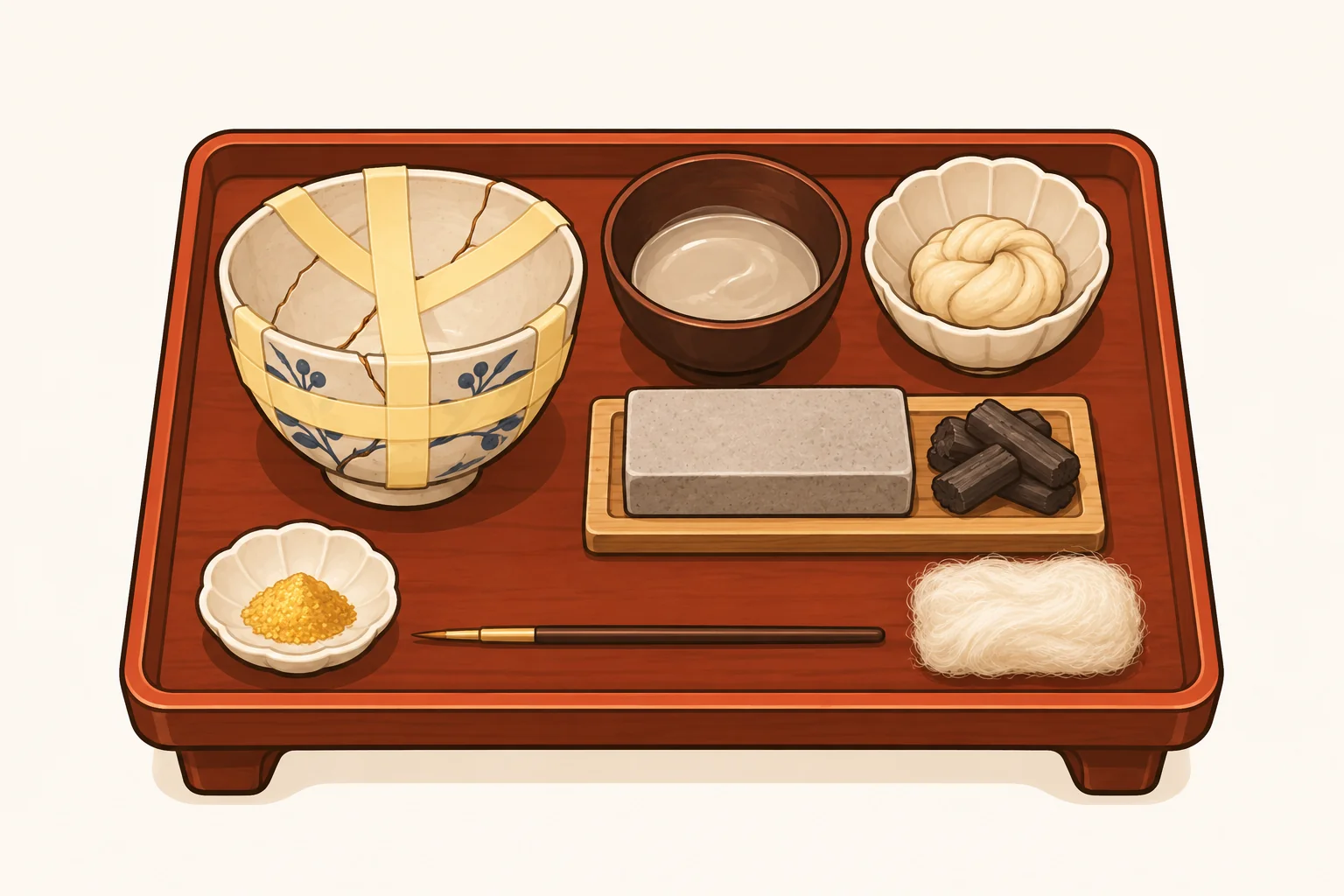
Kintsugi materials and tools, with a broken bowl glued with mugi-urushi and taped while it dries.
Next come the fillers. Small chips and the shallow valley along a seam are filled with sabi-urushi, lacquer mixed with tonoko, a fine clay powder, which dries to something like a very smooth putty. Larger losses are first built up with kokuso, lacquer thickened with wood flour or plant fiber. Each layer must cure and then be ground flat with whetstone or charcoal before the next goes on. This is slow and invisible work, and it determines everything: if the ground is uneven, the gold line will be lumpy, and if the joint is weak, the bowl will crack again.
- 1Glue with mugi-urushiwheat-flour paste and raw lacquer; into the muro
- 2Fill with sabi-urushilacquer and tonoko; larger losses built up with kokuso
- 3Cure and grind flatwhetstone or charcoal, every layer
- 4Paint bengara-urushilacquer with red iron oxide
- 5Dust on goldwhile the line is half dry
- 6Seal and burnisha thin coat of lacquer, then polishing
Each layer must cure and be ground flat before the next; the slow, invisible groundwork before the gold decides everything.
Only when the surface is level does the decorative stage begin. With a very fine brush the craftsperson paints a thin line of bengara-urushi, lacquer colored with red iron oxide, along the seam. The red underlayer warms the gold that goes over it. When the line is half dry and still slightly tacky, gold powder is brushed or dusted onto it with a tuft of silk floss, and it clings only where the lacquer is. After a full cure, the gold may be sealed with a thin coat of lacquer and then burnished, traditionally with tools such as a sea bream’s tooth, until it shines.
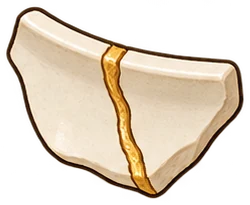
Kintsugi: gold powder brushed onto a half-dry lacquer line.
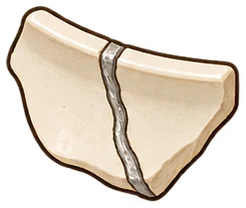
Silver mending: the silver oxidizes with time into a muted gray.
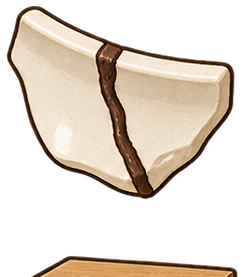
No metal at all, finished in lacquer alone.
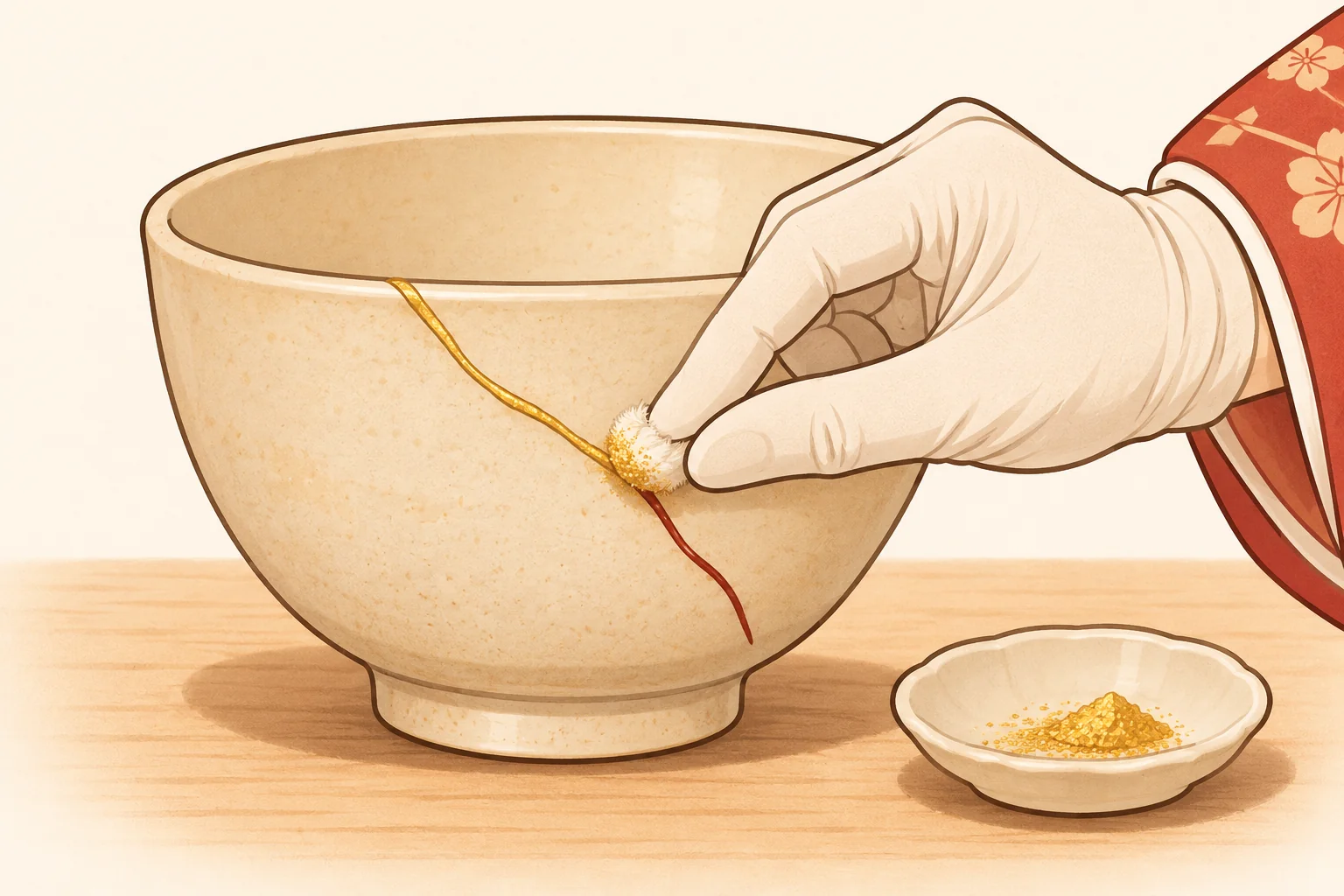
Gold powder is dusted with silk floss onto a line of red bengara-urushi while the lacquer is still tacky.
There are different golds for different budgets. Keshifun, made by grinding gold leaf, is extremely fine and bright from the start, but wears relatively quickly. Marufun, made of tiny round particles, is thicker and more durable and needs polishing to bring up its luster. Silver powder gives gintsugi, which tarnishes over time to a soft gray that some people prefer. Many repairs skip metal altogether and finish in red or black lacquer.
From drop-off to collection, a professional repair can take anywhere from a month to half a year. Most of that time is spent waiting for lacquer to cure.
04Where It Came From
Lacquer has a very long history in Japan. Objects coated with urushi found at the Kakinoshima site in Hokkaidō have been dated to around 9,000 years ago, and people of the Jōmon period already used lacquer to decorate their wares. They mended broken pots too, by drilling holes on either side of a crack and lashing it shut or by gluing it with natural asphalt. Mending with lacquer has a long history of its own. What kintsugi added was the gold, and the idea that the repair should be admired.
That idea is generally traced to the late Muromachi and Momoyama periods, the fifteenth and sixteenth centuries, when the tea ceremony was rising among warriors and wealthy merchants. Tea bowls and tea caddies became objects of enormous value. A famous caddy could be worth as much as a castle, and warlords handed them out as rewards. A celebrated bowl that broke could not simply be discarded, and a fine repair, carefully recorded in the bowl’s pedigree, could add to its fame.
The story most often told about the origins of kintsugi involves a Chinese celadon bowl now in the Tokyo National Museum. Made at the Longquan kilns in the Southern Song dynasty, it has a crack across its base held together with iron staples. The staples were traditionally likened to a large locust perched on a horse; hence its name, Bakōhan, roughly "horse-locust clamp." According to an account written in the eighteenth century by the Confucian scholar Itō Tōgai, the bowl was said to have belonged to Taira no Shigemori in the twelfth century and later to the shogun Ashikaga Yoshimasa. Yoshimasa noticed the crack and sent it to China to be replaced. No better bowl could be found, so it came back stapled, and the stapled bowl became more treasured than before.
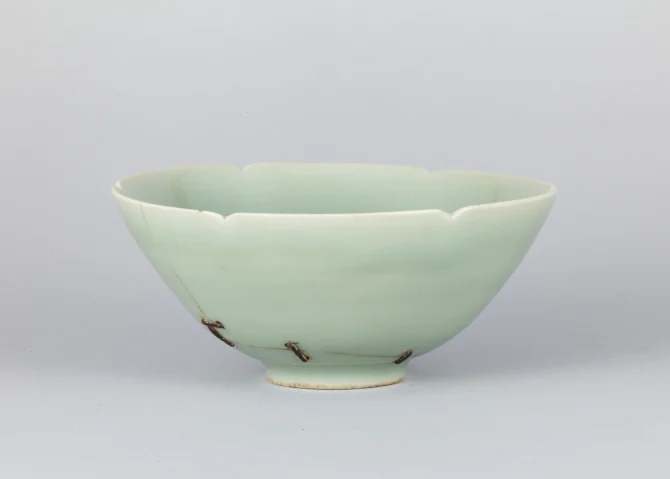
The Southern Song Longquan celadon bowl Bakōhan; its cracks are held by iron staples, not kintsugi.Tokyo National Museum, celadon tea bowl with foliate rim named Bakōhan (Longquan ware, Southern Song, 13th century)
Many retellings add that Japanese craftsmen, finding the staples ugly, went on to invent a more elegant method with lacquer and gold. That ending is a later embellishment with no documentary basis, and the Bakōhan itself was mended in the Chinese manner, not with kintsugi. But the story captures something real about the period: in Japan, a repaired bowl could become more precious because of its repair and the history attached to it.
From the Edo period onward the technique spread beyond the circles of tea masters into the general lacquer trade, and from treasured tea wares to ordinary household dishes. Lacquer workshops across the country took in repairs as a sideline. Kintsugi never died out, but for centuries it was simply one of the things a lacquerer did, not a famous art in its own right.
05Bowls with Stories
The most famous broken bowl in Japanese tea lore is an Ido tea bowl named Tsutsui-zutsu. Ido bowls were made in Korea, probably as everyday wares, and Japanese tea masters ranked them among the finest of all tea bowls. This one belonged to Tsutsui Junkei, a warlord of Yamato province, who presented it to Toyotomi Hideyoshi. According to the story, a page dropped it one day and it broke into five pieces. Hideyoshi was furious. The warrior-poet Hosokawa Yūsai, who was present, improvised a playful verse modeled on a poem from The Tales of Ise, punning on the bowl’s name and the number five, and taking the blame on himself. Hideyoshi’s anger turned to laughter. Whether or not it happened that way, the bowl was mended with lacquer and its joins can still be clearly seen.
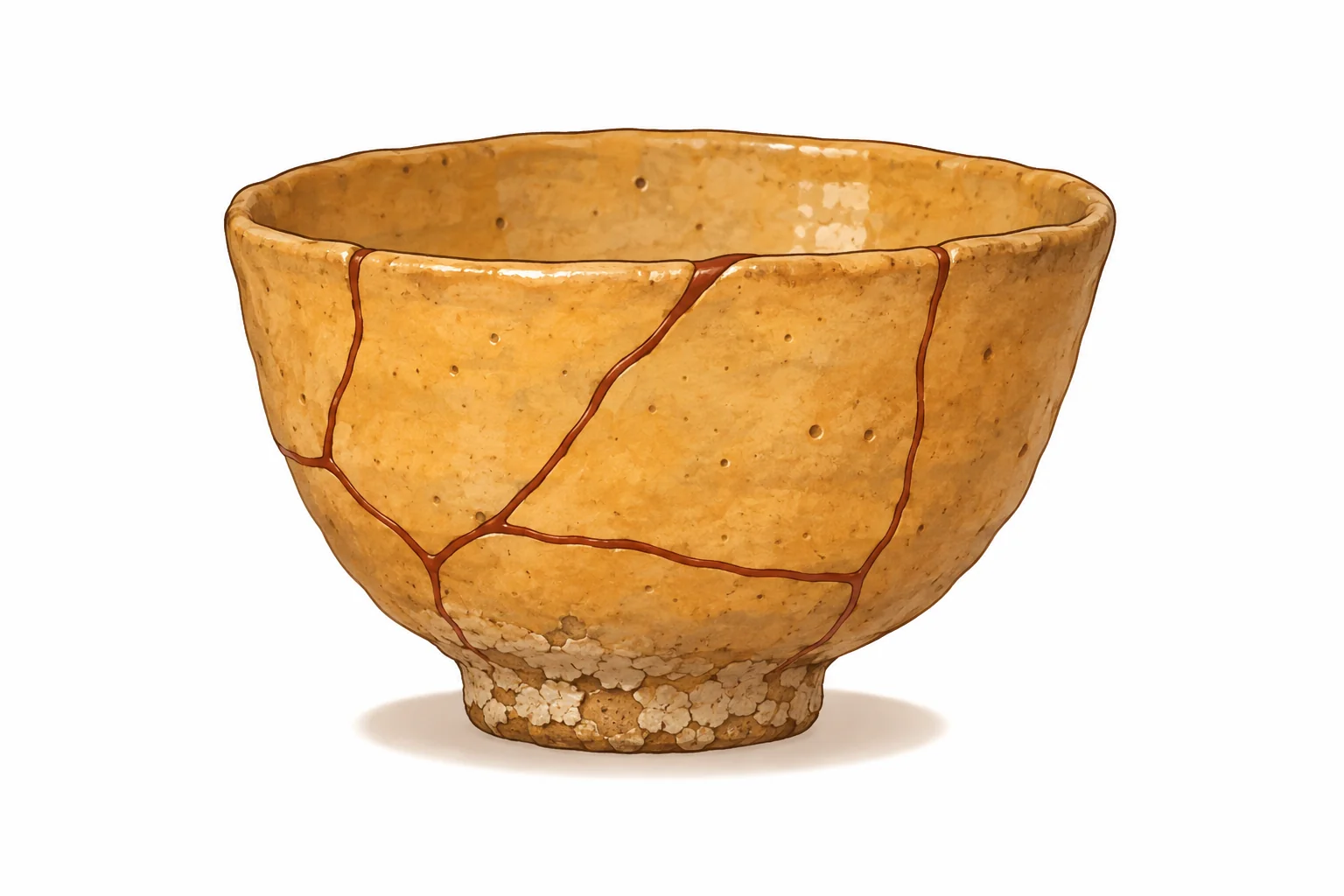
An Ido tea bowl broken into five pieces and rejoined with lacquer, its seams clearly visible (illustration).
Another well-known example is a red Raku tea bowl by Hon’ami Kōetsu, the great artist of early seventeenth-century Kyoto, who excelled at calligraphy, pottery and lacquer design. The bowl cracked during firing, with thick fissures running from the inward-turning rim down through the body to the foot, and all of them were filled with lacquer and gold powder. A splash of white glaze spills down from one side of the lip. Kōetsu is said to have named the bowl himself, likening the white glaze to snow on a mountain ridge and the golden cracks to streams of meltwater: Seppō, "Snowy Peak." Here the gold is not a rescue after an accident but part of the work’s identity, bound up with its shape and its name.
Then there is yobitsugi, "calling-in joinery." When a piece is missing and the original fragment is lost, the repairer takes a shard of similar shape from a different pot and sets it into the gap. The two parts may have entirely different glazes or patterns, and the result has the charm of a collage. Seeing a yobitsugi piece makes it clear that kintsugi involves aesthetic decisions, not just mending: what to fill, how to fill it, and what the finished repair should look like.
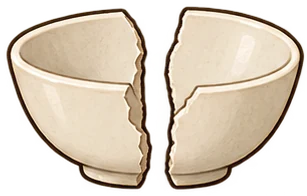
All the pieces survive: they are glued back into the original shape with lacquer.
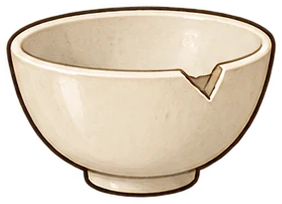
A small chip in the rim: filled level with lacquer paste.
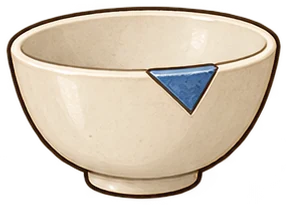
Yobitsugi: a shard cut from another vessel fills the gap.
06Kintsugi Today
Kintsugi’s international fame is fairly recent. From the 2000s onward museums mounted exhibitions on Japanese repair, design magazines ran features, and photographs of gold-veined bowls spread across social media. The word also became a metaphor: the idea that our own breaks and scars need not be hidden, that a life mended can be stronger or more beautiful for its repairs. That reading has inspired books, talks and even tattoos. It is a fair extension of the idea, but it comes mostly from outside Japan. Japanese craftspeople tend to talk about the temperament of lacquer, the grain of the powder and the feel of the polishing stone.
Within Japan, too, kintsugi has had a revival. During the pandemic, many people stuck at home started repairing their own chipped dishes, and classes and how-to books multiplied. Studios in Tokyo, Kyoto and elsewhere now run courses, some of them in English for visitors.
You will also see many "easy kintsugi" kits, which use epoxy glue, synthetic lacquer and brass or imitation gold powder. They take a few hours rather than months, and they do not cause skin rashes, but they are a different thing. Most epoxies and synthetic coatings are not considered safe for food or hot liquids, and imitation gold darkens over time. If you want to keep eating from the bowl, a traditional repair with real urushi and real gold is the safer choice.
Real urushi has its own drawbacks. The sap contains urushiol, the same family of compound that makes poison ivy itch, and many people react with a red, itchy rash that can last a week or more. Gloves are essential, especially for beginners. Most of the lacquer used in Japan is imported from China. According to Forestry Agency statistics, domestic lacquer made up only about 6 percent of national consumption as of 2024, much of it tapped around Jōbōji in Iwate Prefecture, and it is expensive, reserved largely for restoring buildings designated as National Treasures or Important Cultural Properties and for high-end lacquerware.
A kintsugi-repaired piece can be used every day, with some care. Keep it out of the microwave, since the metal will spark. Avoid the dishwasher and harsh detergents, wash by hand with a soft cloth, and do not leave it soaking in hot water. The gold will slowly wear with use, which is a sign the bowl is being lived with; when it wears thin, it can be regilded.
07Seeing and Trying Kintsugi in Japan
The best place to see fine kintsugi is a museum with a strong collection of tea wares. The Tokyo National Museum often has repaired tea bowls in its permanent galleries, and the Bakōhan is in its collection, though it is displayed only occasionally. In Tokyo, the Gotoh Museum and the Nezu Museum are known for their tea utensils; in Kyoto, the Raku Museum and the Kitamura Museum are good bets. Lean in close. Notice whether the gold lies flush with the glaze or stands slightly proud of it, whether the two sides of a crack meet without a step, and whether a filled chip follows the curve of the bowl. These details separate a master’s work from an amateur’s.
Antique shops and craft stores in lacquer towns such as Kyoto, Kanazawa and Wajima often have old bowls and plates with gold repairs, at prices from a few thousand yen upward. Buying one and using it at home is perhaps the most natural way to get to know kintsugi.
If you want to try it yourself, many cities offer one-day workshops of two or three hours. Usually the teacher has already glued and prepared the pieces, and participants do only the final stage of painting the lacquer line and dusting on the gold. Longer courses let you bring your own broken dish and take it through every stage over several months. Because lacquer has to cure slowly in the muro, workshop pieces are often finished and mailed weeks later.
Finally, you can simply hand a broken bowl to a lacquer studio or a kintsugi specialist. Prices depend on the length of the cracks and the size of any missing pieces; as of 2026 a single simple crack might cost around 10,000 yen, while a bowl in several pieces with chips can run to tens of thousands, and a wait of two or three months is normal. For an ordinary bowl, that is far more than buying a new one. Yet the bowls people bring in are usually exactly those ordinary ones: a grandmother’s rice bowl, a pair of teacups received as a wedding gift, the mug used every morning.