
At a glance
Folded paper in Japan, from ceremonial wrappings and Edo-period linked cranes to Sadako’s thousand cranes, Yoshizawa Akira’s art and the Miura fold used in space.
- Origami uses folding alone, with no cutting, gluing or drawing, usually on one square sheet; the most common size is 15 cm.
- Ceremonial gift-wrapping folds, called orikata, were handed down from the Muromachi period by warrior-etiquette houses such as the Ogasawara and Ise.
- Hiden senbazuru orikata, published in Kyoto in 1797, is generally regarded as the oldest surviving book of recreational origami, with 49 linked-crane models.
- Yoshizawa Akira (1911–2005) invented wet-folding, and his valley-fold and mountain-fold symbols became the diagram language used worldwide.
- The Miura fold, designed by Miura Kōryō, was used in 1995 to deploy the solar array of a Japanese experimental space platform.
Ask almost anyone in Japan to fold a paper crane and they will do it without thinking, in about two minutes, from a square of colored paper bought at the nearest convenience store. Origami, from oru (to fold) and kami (paper), is the rare Japanese word that needs no translation in English. Behind the childhood pastime lies a longer story: ceremonial wrappings in samurai households, an eighteenth-century book of linked cranes, a kindergarten curriculum imported from Germany, a girl in Hiroshima, a factory worker who turned folding into an art, and a space engineer who folded a solar array for orbit. This is an introduction to what origami is, why it took root so deeply in Japan, and where a visitor can pick up a sheet and try it.
01One Square, No Scissors
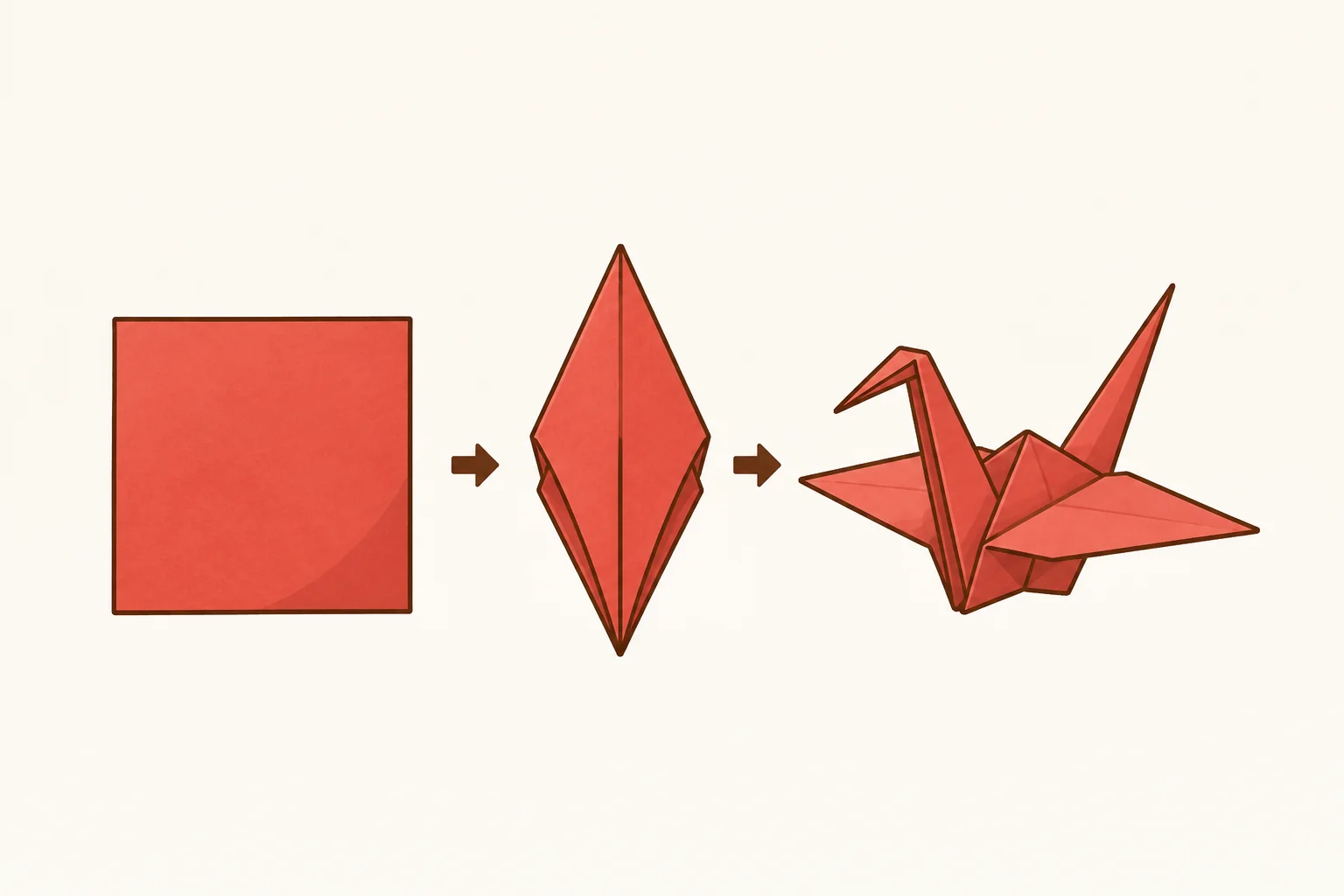
The basic rule is short. Take one sheet of paper, usually square, and shape it by folding alone: no cutting, no glue, no drawing. Everything a finished model becomes has to be found inside the paper. The four corners of a crane’s square end up as its head, tail, and two wings, and nothing is thrown away.
- 1
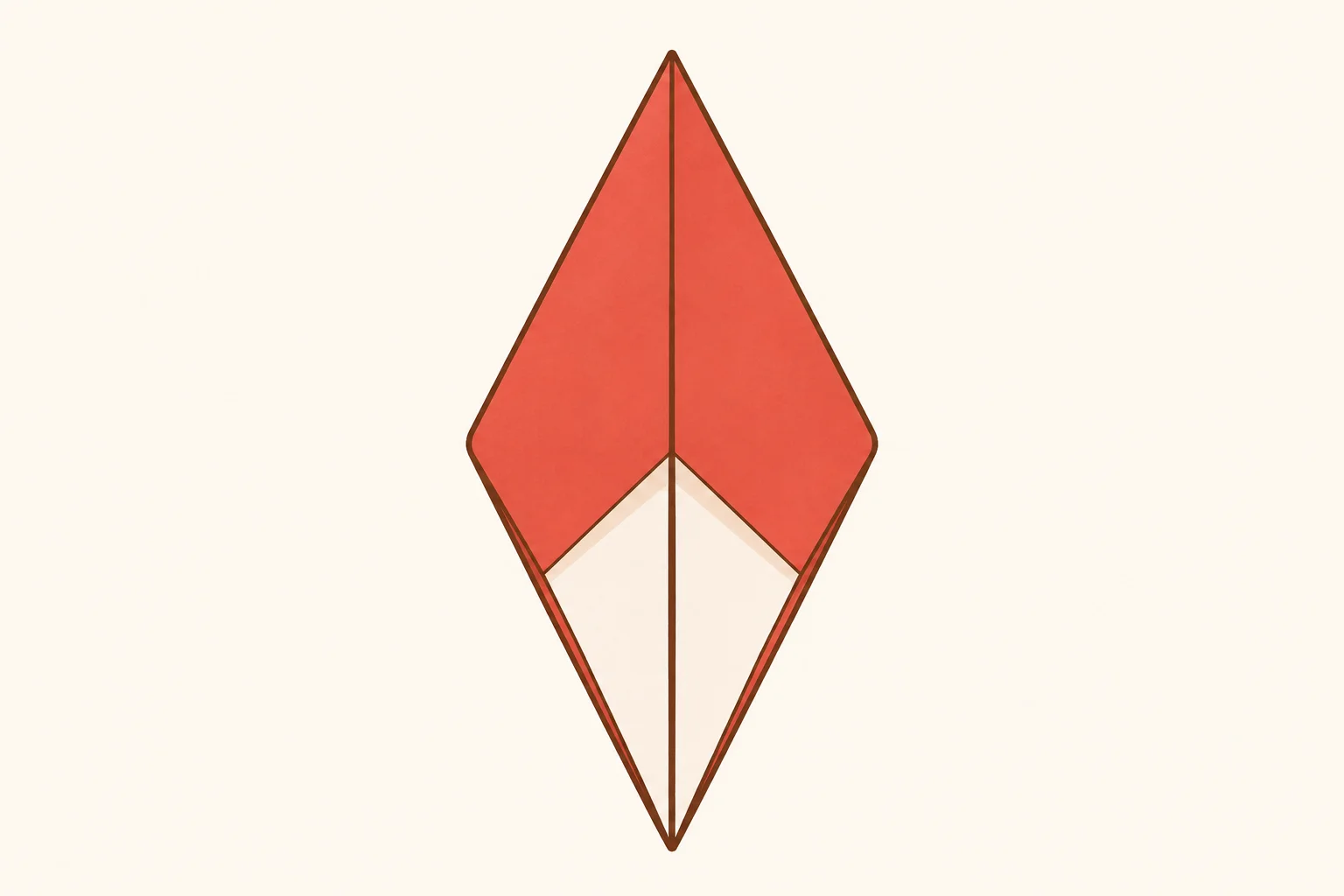 The square is first folded into a diamond shape known as the crane base.
- 2
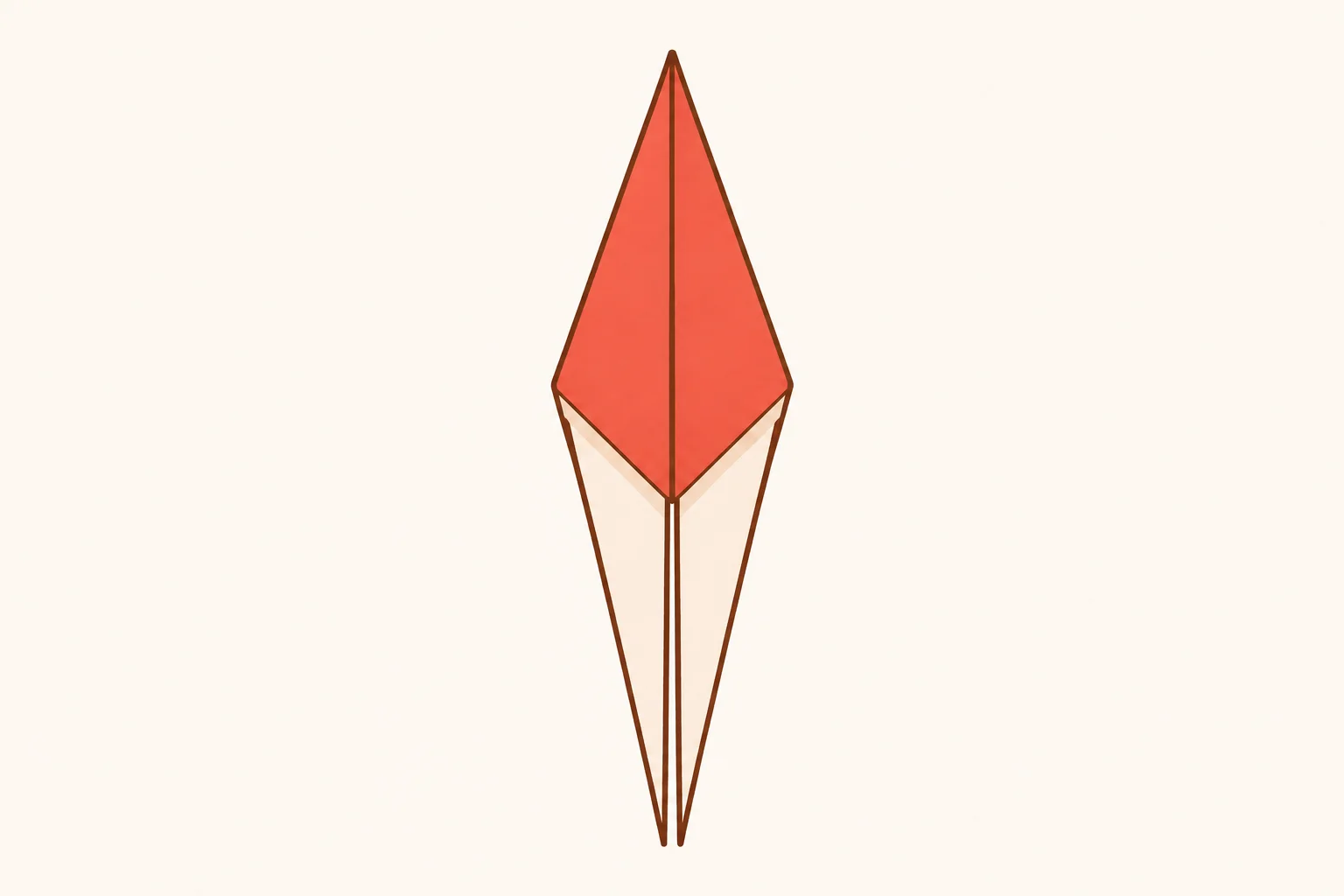 The two sides are then folded in toward the middle to narrow it.
- 3
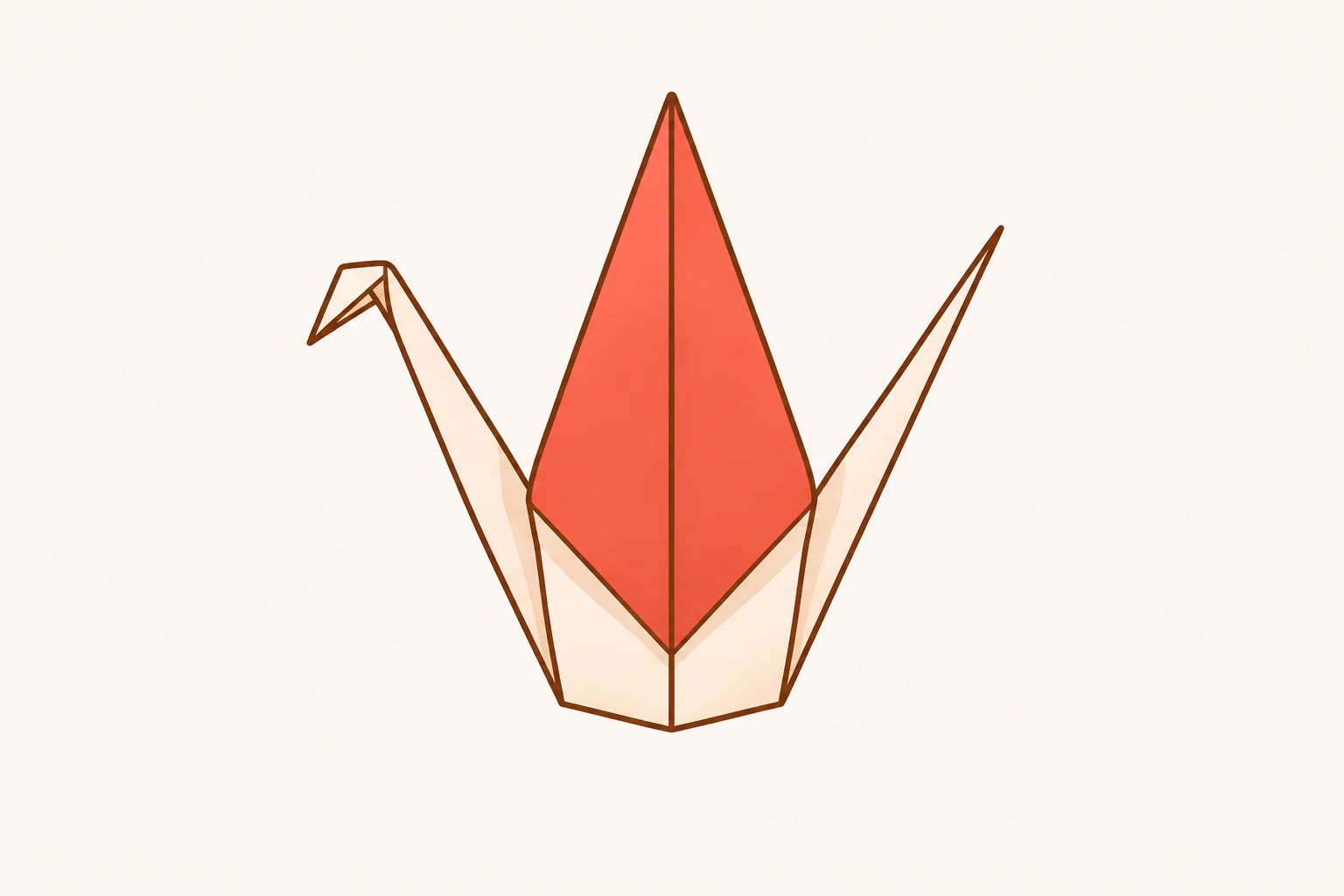 The neck and tail are pulled up and the head pressed down; only the wings are left to spread.
Most Japanese children learn a small repertoire of traditional models, known as dentō origami, which have no known author and pass from grandparent to parent to child. There is the kabuto, a samurai helmet, often folded from a sheet of newspaper and worn by small boys on Children’s Day, May 5. There is the paper balloon that inflates when you blow into a hole at one end, the jumping frog, the sailboat, the shuriken throwing star made from two interlocking pieces, and the yakko-san, a little figure of a samurai’s footman with his arms stuck out stiffly in a kimono. And there is the crane, the orizuru, which every child eventually masters and which most adults can still fold from memory.
What makes the activity satisfying is the discipline of the constraint. A crease has to be placed exactly, corner to corner and edge to edge, and pressed flat with a fingernail. An error of a millimeter in the first fold shows up as a crooked neck at the end. Japanese teachers and parents often describe folding as a way to teach patience and care, and many people remember it as the first time they understood what it meant to do something properly.
02Paper for the Gods, Paper for Etiquette
Origami could flourish in Japan partly because Japan made good paper. Washi, traditional Japanese paper, is made from the long inner-bark fibers of the paper mulberry (kōzo), mitsumata, and gampi. It is thin, strong, and tolerates repeated folding without cracking. For centuries it was valuable, used for Buddhist sutras, government documents, and offerings at shrines.
Paper still marks sacred space in Japan. The white zigzag streamers that hang from the twisted straw ropes at Shinto shrines, called shide, are cut and folded according to set patterns, and they signal purity and the presence of the divine. It is commonly suggested that this link between paper and ritual gave folding a serious, respectful character from early on.
By the Muromachi period (1336–1573), the warrior class had developed elaborate codes of etiquette, and among them was orikata, the ceremonial folding of paper wrappers for gifts. Families that served as arbiters of samurai etiquette, notably the Ogasawara and Ise houses, transmitted rules for exactly how to wrap medicine, a fan, chopsticks, tea, or money. A well-informed recipient could tell from the fold what was inside and whether the giver knew the proper forms.
Traces of orikata are everywhere in modern Japan once you know to look. The small elongated hexagon in the top right corner of a gift envelope for weddings or New Year is a noshi. It originally held a strip of dried, stretched abalone, a symbol of long life and good fortune; later the abalone became a slip of yellow paper, and today the noshi is often simply printed on. At a traditional Shinto wedding, the sake vessels may be decorated with a folded male and female butterfly, ochō and mechō. The idea that the wrapping is itself part of the gift, and must be done with correct form, carries over into the cloth wrapping of furoshiki as well.
03Edo: Paper Gets Cheap and Folding Becomes Play
During the Edo period (1603–1868), paper production expanded and prices fell. Ordinary townspeople could now afford paper for things that were not strictly necessary, and recreational folding, known as asobi-ori, spread alongside the ceremonial kind. Cranes appear on woodblock prints and kimono patterns of the era, a sign that the folded crane was a familiar image.
In 1797 a book called Hiden senbazuru orikata (Secret Techniques for Folding a Thousand Cranes) was published in Kyoto. It is generally considered the oldest surviving book devoted to recreational origami. It shows 49 designs for connected cranes: a single sheet is slit partway, leaving small bridges of paper, and folded into two, four, or dozens of cranes joined at the beak, the tail, or the wingtip. Some look like a mother and chick, some like a flock in flight, and each comes with a name and a comic kyōka verse. The designs were the work of Gidō, the chief priest of Chōen-ji, a temple in Kuwana in Ise Province, who used the pen name Rokōan. In 1976 Kuwana, in Mie Prefecture, designated the book’s 49 designs an intangible cultural property under the name Kuwana no senbazuru, and practitioners recognized by the city still teach them.
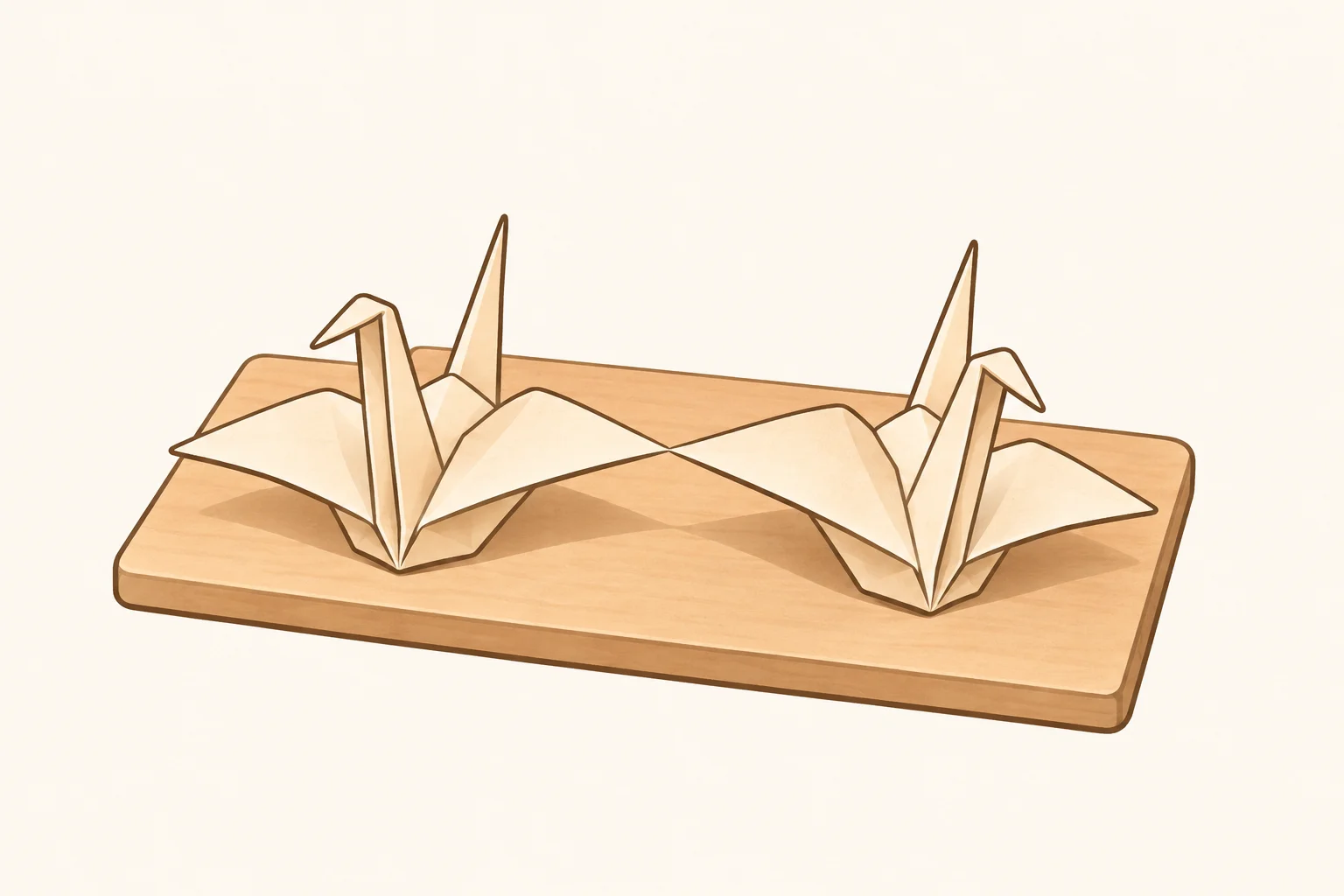
Linked cranes: a single sheet is slit partway and folded into two cranes joined at the wingtip.
The phrase senbazuru, a thousand cranes, also took hold. The crane is a bird of longevity in Japanese tradition, as in the saying that the crane lives a thousand years and the tortoise ten thousand. Stringing a thousand folded cranes together and offering them at a temple or shrine, or giving them to someone who is ill, became a way of making a wish. The custom is still very much alive.
04Kindergartens, Fifteen-Centimeter Squares, and Sadako’s Cranes
In the Meiji period (1868–1912), Japan adopted the kindergarten system devised by the German educator Friedrich Fröbel. Fröbel’s teaching materials included paper-folding exercises meant to train a child’s hands and sense of geometry. European folding traditions met Japanese ones in the classroom, and origami became a fixture of early education. Kindergartens used squares of colored Western paper about 15 to 18 centimeters across, and the packs later sold for folding, colored on one side and white on the other, settled on 15 centimeters as the most common size. The craft went by several names after the Meiji period, among them tatamigami, orimono, and origami saiku, before origami became the general word.
Since then, practically every Japanese person has folded paper in kindergarten and elementary school. A pack of origami paper is one of the most ordinary things in a Japanese stationery shop or 100-yen store, along with chiyogami, paper printed with bright traditional patterns, which makes even a simple model look festive.
The thousand cranes acquired a new meaning through a girl named Sasaki Sadako. She was two years old and living about 1.6 kilometers (one mile) from the hypocenter when the atomic bomb fell on Hiroshima on August 6, 1945. She seemed unharmed. Ten years later she was diagnosed with leukemia. In the hospital she began folding cranes, using medicine wrappers and whatever paper she could find, in the hope that a thousand would grant her wish to recover. She died in October 1955 at the age of 12. Accounts differ on how many cranes she finished; the usual version is that she passed a thousand and kept going. Her classmates started a campaign that drew donations from schoolchildren across Japan, and in 1958 the Children’s Peace Monument was unveiled in Hiroshima’s Peace Memorial Park, topped by a figure of a girl holding a golden crane above her head. Strings of cranes have arrived there from around the world ever since, and the paper crane has become an international symbol of peace.
05Yoshizawa Akira and the Birth of Modern Origami
Traditional origami consists of a few dozen fixed models. The person most responsible for turning it into a creative art was Yoshizawa Akira (1911–2005). As a young man he worked in a Tokyo factory, where he used folding to teach geometry to apprentices. He later left to fold full-time and endured years of poverty while doing it. Over his life he is said to have created tens of thousands of models, and what set them apart was character: his animals have posture, weight, and expression rather than the flat geometry of the traditional repertoire.
Two of his contributions changed the field. The first was wet-folding, in which thicker paper is slightly dampened so it can be molded into soft curves that hold their shape once dry, giving a gorilla’s shoulders or a dog’s muzzle a sculptural roundness. The second was a system of diagrams: a dashed line for a valley fold, a dash-and-dot line for a mountain fold, and a set of arrows to show movement. With it, anyone could learn a model from a page without a teacher and without reading Japanese. Codified and popularized in the West by Samuel Randlett and Robert Harbin, the Yoshizawa–Randlett system is now the universal language of origami instructions.
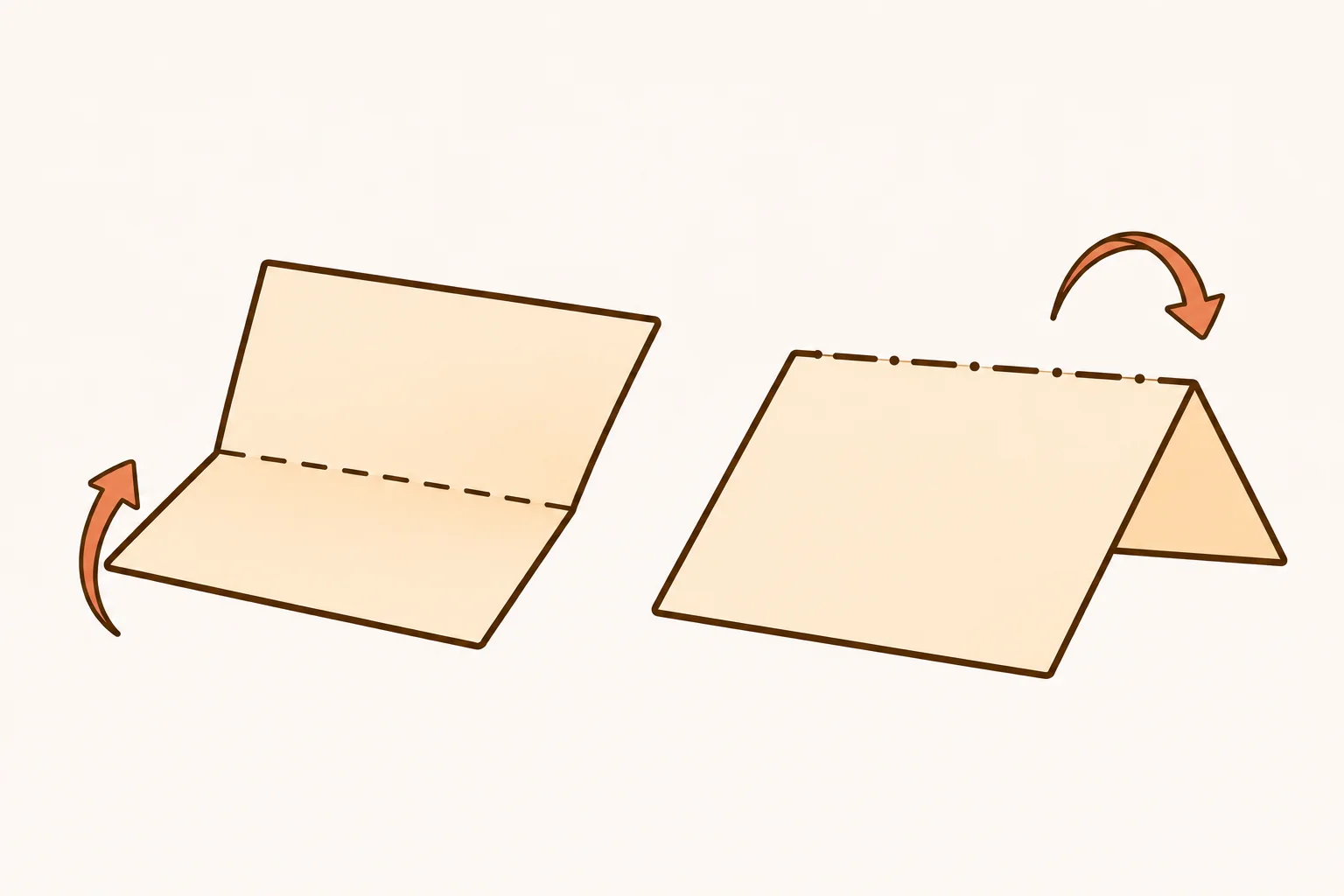
The two lines of an origami diagram: a dashed line for a valley fold, a dash-and-dot line for a mountain fold.
In 1955 an exhibition of Yoshizawa’s work at the Stedelijk Museum in Amsterdam introduced Japanese creative origami to a European audience, and the word origami began its spread through other languages. Origami societies formed in Britain, the United States, and elsewhere; in Japan, the Nippon Origami Association promotes the craft and marks November 11 as Origami Day.
After Yoshizawa, a generation of Japanese designers pushed complexity further. Maekawa Jun’s Devil, with horns, fingers, and a tail all from one uncut square, showed in the 1980s that a model could be designed systematically rather than discovered by trial and error. Kamiya Satoshi’s Ryūjin, a dragon covered in individual scales, is said to take dozens of hours to fold. Modern designers can produce an insect with six legs, antennae, and wings from a single sheet, planned in advance on a crease pattern.
06Folding Meets Mathematics and Engineering
Behind the handicraft is geometry, and Japanese researchers have been prominent in working it out. Around 1989 the mathematician Humiaki Huzita set out a list of the basic operations a single fold can perform, now known as the Huzita–Hatori axioms after Hatori Kōshirō added one more; the French mathematician Jacques Justin had independently listed the same operations in 1989, so some writers call them the Huzita–Justin axioms. A consequence is that folding can do things a ruler and compass cannot, such as trisecting an arbitrary angle. Kawasaki Toshikazu described the angle conditions that creases meeting at a point must satisfy for the paper to lie flat, and his twisted Kawasaki rose is a favorite among folders.
The best-known engineering application is the Miura fold, devised by Miura Kōryō, a space-structures engineer at Japan’s Institute of Space and Astronautical Science and professor emeritus of the University of Tokyo. It is a pattern of slanted parallelograms that lets a large sheet collapse into a compact stack and open fully with a single pull on two opposite corners. In 1995 a Japanese satellite, the Space Flyer Unit, used it in an experiment to deploy and retract a solar array in orbit. On Earth, the same fold turns up in maps that open and close in one motion. Engineers have borrowed origami ideas for folding car airbags, collapsible medical stents, and deployable structures.
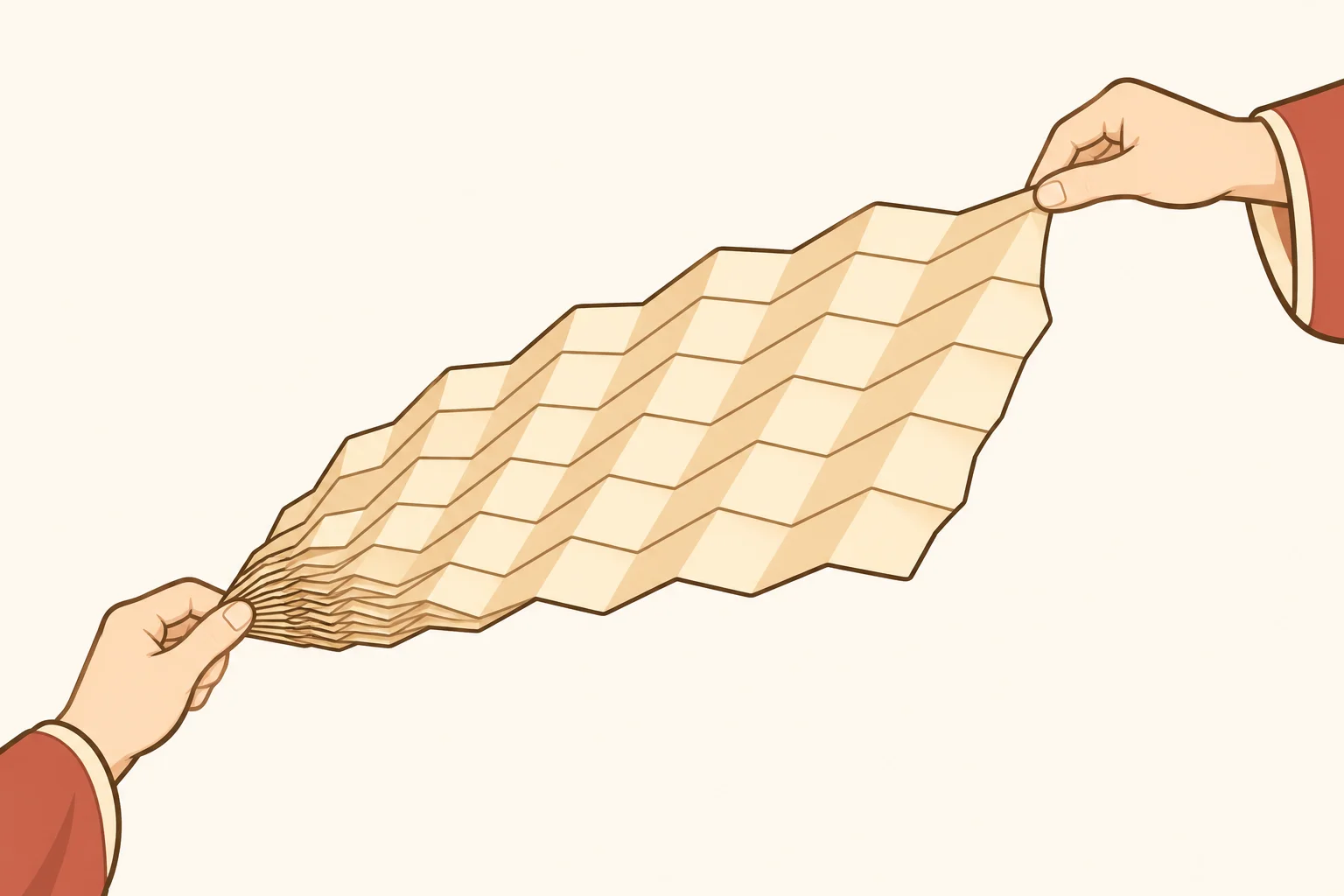
The Miura fold: a sheet creased into slanted parallelograms opens fully with a single pull on two opposite corners.
07Folding in Japan Today, and Where to Try It
In Tokyo, the place to go is Origami Kaikan, in the Yushima district of Bunkyō Ward, a short walk from Ochanomizu Station. It grew out of Yushima no Kobayashi, a paper-dyeing and chiyogami business founded in 1858, and it still dyes washi by hand on the premises. The ground floor and mezzanine hold exhibitions of folded dolls, flowers, and large display pieces; the third-floor shop stocks every kind of folding paper, from plain packs to hand-dyed patterned sheets; and in the fourth-floor workshop you can sometimes watch the dyers at work, brushing color onto long sheets. The director, Kobayashi Kazuo, has taught origami to visitors from all over the world, and the building hosts regular classes. It pairs naturally with a visit to Yushima Seidō and Kanda Myōjin nearby.
In Hiroshima, roofed display booths around the Children’s Peace Monument hold thousands of strings of cranes sent from schools and groups around the world, a riot of color around the statue. Several places near the park let visitors fold a crane themselves and leave it to join the others.
You do not need to go anywhere special, though. In casual restaurants you will see diners fold the paper sleeve of their disposable chopsticks into a little chopstick rest. Some ryokan, traditional inns, leave a folded crane on the pillow or the tea tray. Every 100-yen store has a shelf of origami paper and simple instruction books, and diagrams in the Yoshizawa–Randlett notation can be followed without reading a word of Japanese. A pack of 15-centimeter squares is a good companion for a long Shinkansen ride. The first crane will probably come out lopsided; by the third you will feel the quiet focus that Japanese people describe.
A single folded crane is a casual gesture. A string of a thousand, given to someone in the hospital, is a serious one, and it is usually folded by the givers themselves, often divided among a whole class or office and strung together at the end.