
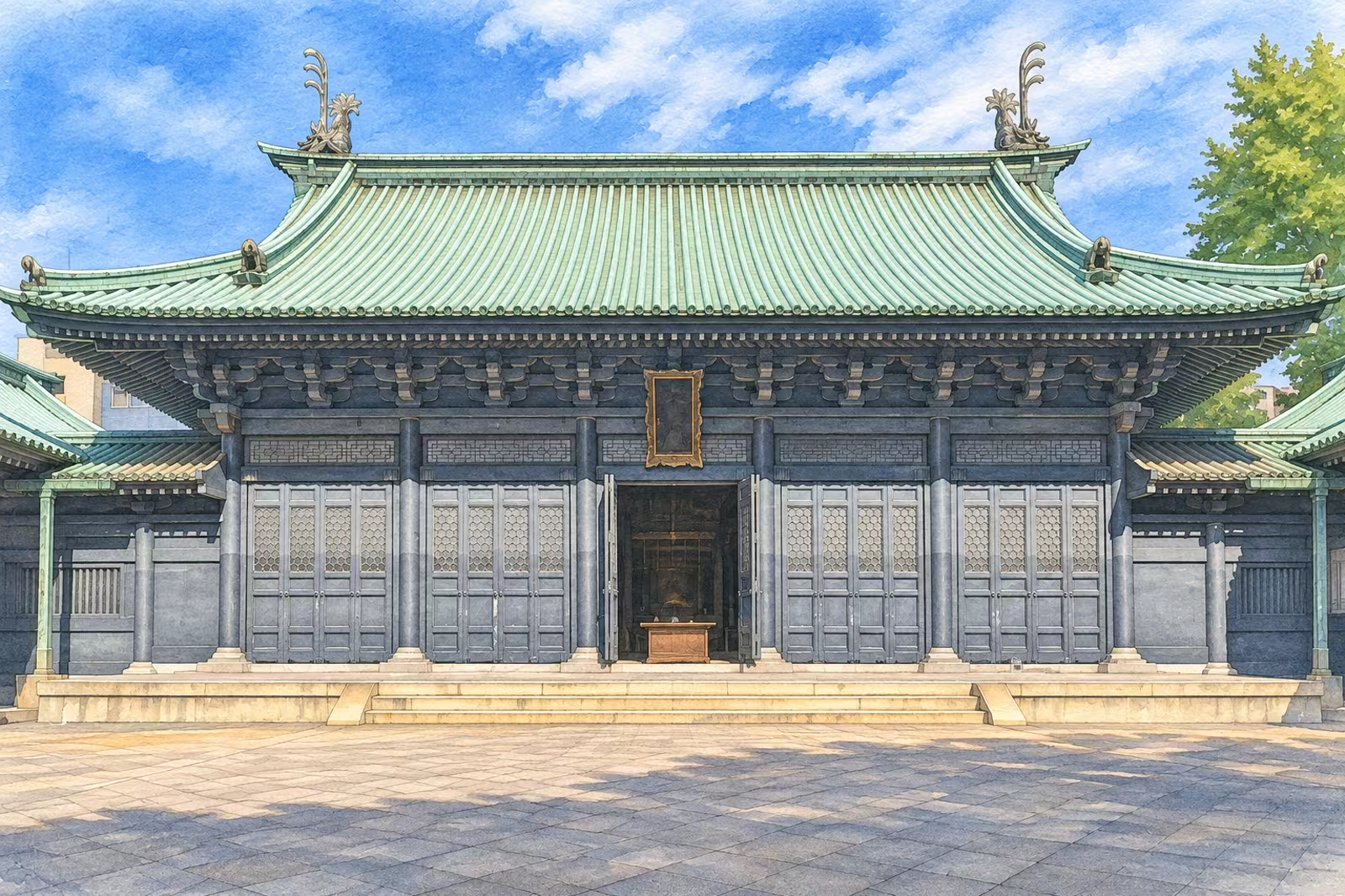
Yushima Seidō, in the Yushima district of Bunkyō Ward, Tokyo, was the shogunate’s Confucian temple in the Edo period, and beside it stood the Shōheizaka Gakumonjo, the highest academy under direct shogunal control. The site was a center of Edo Confucian learning and official education, and after the Meiji Restoration it was linked to the beginnings of modern teacher training and of Japan’s national museum. The precinct is a nationally designated Historic Site.
01From the Hayashi School to the Shogunate’s Academy
In 1632 the Confucian scholar Hayashi Razan built a hall to honor Confucius at his residence at Shinobugaoka in Ueno, reportedly with support from Tokugawa Yoshinao, lord of Owari. In 1690 the fifth shogun, Tokugawa Tsunayoshi, a devoted patron of Confucian learning, moved the temple to Yushima. The main hall was named the Taiseiden, and the nearby slope was called Shōheizaka after Changping, the birthplace of Confucius. The Hayashi family continued to lead the rites and lectures there for generations. During the Kansei Reforms the shogunate promoted Zhu Xi Neo-Confucianism as orthodox learning, and in 1797 it turned the Hayashi school into the Shōheizaka Gakumonjo, also called the Shōheikō, an academy under its direct control that taught and examined shogunal retainers and students sent from the domains.
02After the Meiji Restoration
After the Restoration the academy was closed and the land was put to new uses. The Ministry of Education was briefly housed here in 1871, and an exhibition held at the Seidō in 1872 is generally regarded as the starting point of the Tokyo National Museum. The Normal School founded that same year, and later the women’s normal school, also used the grounds; they are among the origins of today’s University of Tsukuba and Ochanomizu University.
03What Can Be Seen Today
The Edo-period buildings burned repeatedly, and the Great Kantō Earthquake of 1923 destroyed most of the remaining halls. The present Taiseiden was designed by the architect Itō Chūta and rebuilt in reinforced concrete in 1935 following the old design; its black exterior preserves the layout of the Edo Confucian temple. The Nyūtokumon gate, built in 1704, is recorded as having survived the earthquake and is the oldest wooden structure in the precinct. The grounds also hold a large bronze statue of Confucius, donated from Taiwan in the 1970s. The Seidō is now managed by the Shibunkai foundation.