
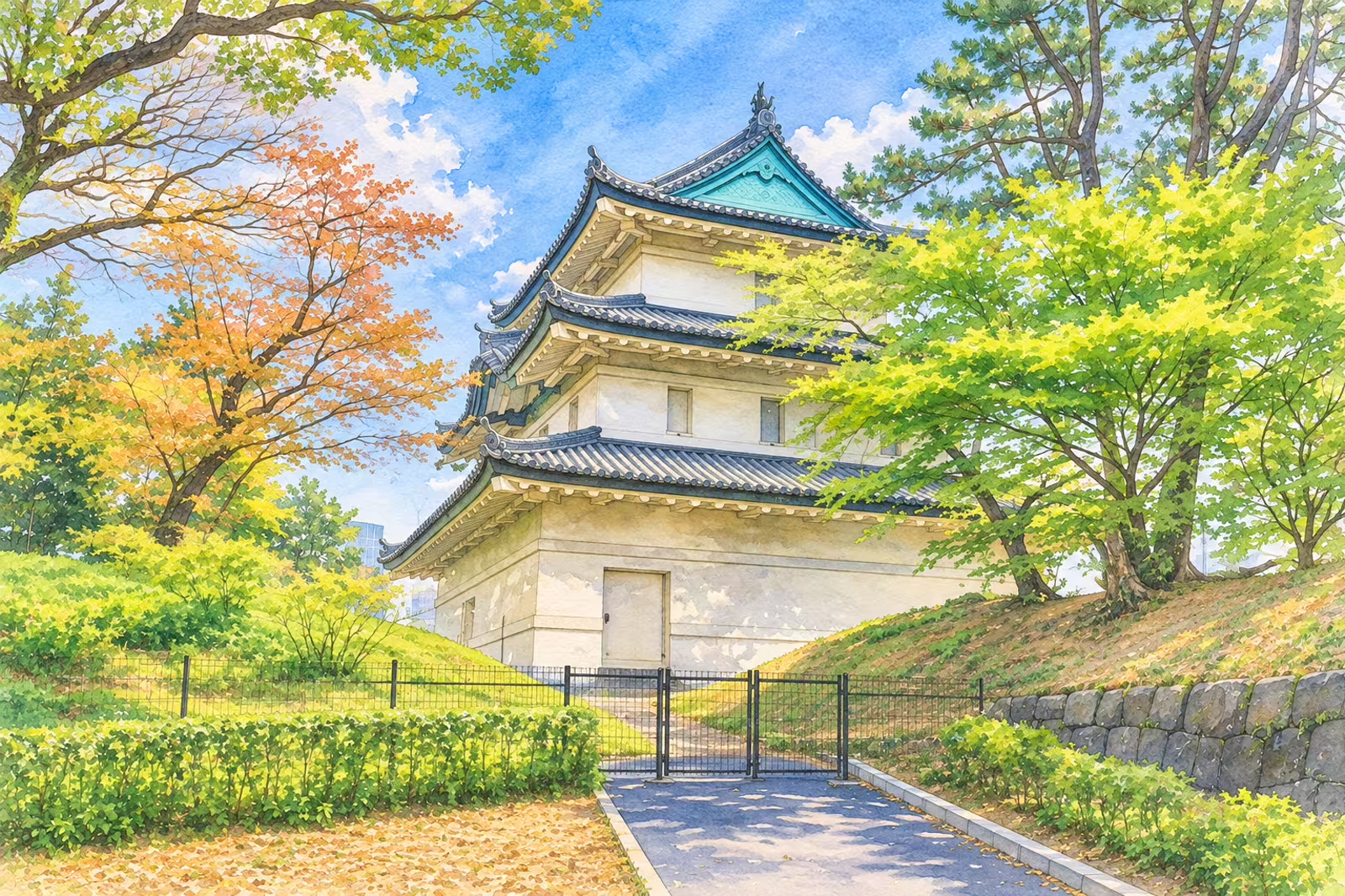
Edo Castle, in Chiyoda Ward, Tokyo, was the seat of the Tokugawa shoguns for more than 260 years. After the Meiji Restoration it became the residence of the emperor, and today’s Imperial Palace stands on the castle’s former Nishinomaru enclosure. The Imperial Palace East Gardens occupy parts of the old Honmaru, Ninomaru and Sannomaru enclosures and are open to the public, with stone walls, moats, gates, turrets and the massive base of the vanished keep.
01From Ōta Dōkan to Tokugawa Ieyasu
In 1457 Ōta Dōkan, a retainer of the Ōgigayatsu Uesugi, built a fortress at Edo in Musashi Province, the origin of Edo Castle. After Toyotomi Hideyoshi destroyed the Hōjō of Odawara in 1590, Tokugawa Ieyasu was moved to the Kantō and made Edo his base. Once he founded the shogunate in 1603, the castle was greatly enlarged over three generations, under Ieyasu, Hidetada and Iemitsu, by construction work imposed on daimyo across the country. By the 1630s it was largely complete, an enormous complex ringed by moats laid out in a spiral. The keep was built three times, and the Kan’ei-era keep is said to have been the tallest ever raised in Japan.
02The lost keep and the change of regime
The Great Fire of Meireki in 1657 destroyed the keep and the Honmaru palace. A new keep base was built the following year, but the keep itself was never rebuilt; according to the usual account, Hoshina Masayuki argued that the money should go to rebuilding the city instead. The Honmaru palace burned several more times and, after its destruction late in the Edo period, was not rebuilt. The castle and its surroundings saw many famous events: the sword attack in the Matsu no Rōka corridor in 1701 that set off the Akō incident, and the assassination of the great elder Ii Naosuke outside the Sakurada Gate in 1860. In 1868, after negotiations between Katsu Kaishū and Saigō Takamori, the castle was handed over peacefully to the new government. Emperor Meiji arrived from Kyoto later that year, and the castle became the imperial residence, known in time as the Imperial Palace.
03The East Gardens today
The East Gardens opened in 1968. The Fujimi turret, the Fujimi tamon storehouse and several guardhouses, including the Hyakunin-bansho, survive from the Edo period, while the gatehouse of the Ōte Gate, burned in the Second World War, was rebuilt after the war. The stone keep base, about 11 meters high, stands empty. The site of the Honmaru is now a lawn, with a Japanese garden nearby and a museum of objects from the imperial collections. The Edo Castle site is designated a Special Historic Site. As of 2026, proposals to rebuild the keep surface from time to time, but there is no official plan.
Edo Castle (Imperial Palace East Gardens)
01A Platform Without a Tower
At the northern end of the great lawn in the Imperial Palace East Gardens stands a massive stone platform of pale, precisely cut granite. A ramp leads to the top, and from there you can look back over the whole of the former inner citadel. This is the tenshudai, the base built to carry the castle’s keep (tenshu, the tall central tower that crowns most Japanese castles). It has carried nothing since 1657.
Edo Castle was the seat of the Tokugawa shoguns for more than two and a half centuries and the largest castle in Japan. Three keeps rose here in succession; the last, the tallest ever built in Japan, burned in the Great Fire of Meireki. The shogunate rebuilt this platform the following year and then decided not to put a tower on it. What you are standing on is the physical record of that decision, and of a city that chose to spend its money elsewhere.
02Ōta Dōkan’s Castle
The name Edo appears in the late Heian period, attached to a warrior family, the Edo clan, who are thought to have had a residence on the bluff where the castle later stood.
The castle proper is usually dated to 1457, when Ōta Dōkan, chief retainer of the Ōgigayatsu branch of the Uesugi family, built a fortress here. The Kantō region was then torn by a long war between the Uesugi and the Koga kubō (a branch of the Ashikaga family claiming authority over eastern Japan), and Edo, near the mouths of several rivers flowing into Edo Bay, was a strategic point. Dōkan was a capable commander and a respected poet; contemporary monks wrote verses about a tower in his castle with views of the bay and Mount Fuji. Many stories about him, however, belong to later legend.
In 1486 Dōkan was murdered at the residence of his own lord, Uesugi Sadamasa, who is generally thought to have come to fear his influence. In 1524 the castle fell to Hōjō Ujitsuna of Odawara, and for the next sixty-odd years it was a secondary fortress in the Hōjō domain.
03Ieyasu Arrives
In 1590 Toyotomi Hideyoshi destroyed the Hōjō and transferred their lands in the Kantō to Tokugawa Ieyasu, taking away Ieyasu’s home provinces in exchange. Ieyasu chose Edo as his base. Tradition fixed his formal entry on the first day of the eighth month, and throughout the Edo period lords came to the castle in white robes on that date (hassaku) to mark the anniversary.
Later writers liked to describe Edo in 1590 as a poor fishing village. That is an exaggeration; it was already a modest port and market town. But the castle itself was simple, with earthen ramparts rather than stone walls, and its southeastern side faced an inlet of the sea, the Hibiya Inlet. Ieyasu’s first works were practical: a canal, the Dōsanbori, to bring boats to the castle; a channel, the Onagigawa, to bring salt from Gyōtoku; and the leveling of the Kanda hills to fill in the Hibiya Inlet and create new land for the town.
04A Castle Built by the Whole Country
After the Battle of Sekigahara in 1600, Ieyasu was appointed shogun in 1603 and established his government in Edo. The castle now had to suit the ruler of Japan rather than a regional lord. The shogunate ordered daimyo across the country to supply labor, materials, and money, a system called tenka-bushin, "construction by the realm."
From 1606 the stone walls and palaces of the main citadel (Honmaru) and the second and third enclosures (Ninomaru and Sannomaru) took shape. Much of the stone came from quarries on the Izu Peninsula and was shipped to Edo in fleets of stone-carrying boats. Work continued under the second shogun, Hidetada, and the third, Iemitsu; by 1636 the outer moats and gates were largely complete. The result was a vast spiral of moats with the inner citadel at its center and the city wound around it.
The Honmaru held the main palace, which was both the shogun’s residence and the seat of government. The Nishinomaru to the west housed a retired shogun or the heir; the Kitanomaru lay to the north, the Ninomaru and Sannomaru to the east. The East Gardens today cover the Honmaru, Ninomaru, and part of the Sannomaru.
05Three Keeps in Thirty Years
Edo Castle had three keeps, named for the eras in which they were built.
Ieyasu completed the first, the Keichō keep, around 1607, slightly south of the present platform. Little is known of its exact form, though it is generally described as a large white tower roofed with lead tiles.
Hidetada pulled it down and built the Genna keep on the site of the present platform, finished around 1623. Iemitsu then pulled that down and built the Kan’ei keep, completed in 1638. Neither demolition was caused by damage. Each new shogun was announcing himself in the most visible way available.
The Kan’ei keep had five roofs on the outside and five floors above a basement within. Its walls were faced with blackened copper plates, its roofs were covered in copper tiles, and golden shachihoko (dolphin-like roof ornaments) crowned the ridge. Including the platform, it stood about 58 meters high, the tallest keep in Japanese history. It was visible from all over the city and appears on screen paintings of early Edo. By then a keep had little military purpose; it existed to be seen.
06The Great Fire of Meireki
On the eighteenth day of the first month of Meireki 3 (March 2, 1657), a fire broke out in the Hongō district. A popular story says it began when the temple of Honmyō-ji burned a long-sleeved kimono believed to be cursed, so the disaster is also called the "Long-Sleeves Fire" (Furisode Kaji). That origin is a later tale; the real cause is unknown.
There had been no rain for a long time, and a strong northwest wind was blowing. The first day’s fire swept south and east through Yushima, Kanda, and Nihonbashi to the Sumida River. On the second day new fires broke out in Koishikawa and Kōjimachi and spread into the castle. On the nineteenth, flames reached the Honmaru. The keep caught fire, reportedly through a window that had been left open, and burned along with the Honmaru and Ninomaru palaces. Only the Nishinomaru survived, and the young shogun Ietsuna took refuge there.
Over two days the fire destroyed most of the city. The death toll is traditionally given as around 100,000, though estimates vary widely. The shogunate founded the temple of Ekō-in on the east bank of the Sumida to bury the unclaimed dead.
07Hoshina Masayuki’s Decision
Rebuilding began at once. The Maeda family of Kaga, the wealthiest daimyo house, was assigned the keep’s platform and completed it in 1658. It is the platform you see now, built of granite, the blocks cut square and fitted tightly in the mature style of the mid-seventeenth century. It was lower than its predecessor and stands about 11 meters high today.
The tower itself was postponed. The man who argued for postponing it was Hoshina Masayuki, lord of Aizu, a half-brother of Iemitsu and guardian to the boy shogun Ietsuna. According to the record of his views, he said that a keep served no real military purpose in his day and was merely a place to look out from, and that the government’s money was better spent on relief for the people and the reconstruction of the city. The council agreed.
The city was rebuilt on new lines. Streets were widened, firebreaks called hirokōji were opened, temples and daimyo residences were moved outward, and the Ryōgoku Bridge was built across the Sumida, allowing Edo to grow eastward.
The idea of a new keep did not die at once. Under the sixth shogun, Ienobu, the scholar-official Arai Hakuseki pushed for reconstruction and plans were drawn, but the project lapsed after Ienobu’s death in 1712. Edo Castle never had a keep again. The three-story Fujimi-yagura, a corner tower on the southeast of the Honmaru, served in practice as its substitute.
08The Palace and the Ōoku
The Honmaru Palace was a sprawling complex of single-story wooden buildings in three parts. The Omote (Outer Palace) in the south was where ceremonies were held and officials worked; the great audience halls where daimyo were received by the shogun were here. The Nakaoku (Middle Interior) was where the shogun lived and worked day to day. The Ōoku (Great Interior) to the north housed the shogun’s wife, concubines, and hundreds of women attendants; apart from the shogun, men were in principle barred.
The organization of the Ōoku is credited to Kasuga no Tsubone, the wet nurse of Iemitsu. Over time its women influenced succession and appointments, and in the last years of the shogunate figures such as Tenshōin (Atsuhime) and Princess Kazu played parts in national politics.
The palace burned and was rebuilt many times. After fires in 1844 and 1859, it burned again in 1863 and was not rebuilt; the shogun moved to the Nishinomaru. The great lawn of the East Gardens is the site of the Honmaru Palace.
09The Pine Corridor
The most famous spot in the palace was a corridor called the Matsu no Ōrōka, the Great Pine Corridor, named for the pines painted on its sliding doors. On the fourteenth day of the third month of Genroku 14 (April 21, 1701), while the shogunate was receiving envoys from the imperial court, Asano Naganori, lord of Akō and one of the officials in charge of the reception, drew his sword here and wounded Kira Yoshinaka, the senior master of ceremonies. Drawing a blade in the palace was a grave crime. The fifth shogun, Tsunayoshi, ordered Asano to commit seppuku that same day and confiscated his domain; Kira was not punished. Why Asano attacked has never been established, and the familiar stories of insult and bribery come largely from later drama.
In the twelfth month of the following year, forty-seven of Asano’s former retainers led by Ōishi Yoshio broke into Kira’s mansion and killed him. The vendetta became the subject of countless plays and films under the title Chūshingura. A stone marker in the trees on the eastern side of the lawn shows where the corridor ran.
10Surrender and a New Name
In early 1868, after the Battle of Toba-Fushimi, the armies of the new imperial government advanced on Edo. Katsu Kaishū, representing the shogunate, and Saigō Takamori, for the imperial forces, negotiated the handover of the castle without a fight. On the eleventh day of the fourth month (May 3, 1868) the castle was surrendered, and the last shogun, Tokugawa Yoshinobu, withdrew to Mito. The "bloodless surrender of Edo Castle" spared a city of about a million people.
Edo was renamed Tokyo that year, and the Meiji Emperor entered the castle in the autumn. It was called Tokyo Castle, then the Imperial Castle. When the Nishinomaru palace burned in 1873, a new palace was eventually built on the site and completed in 1888. That Meiji Palace was destroyed in an air raid in May 1945; the present palace was finished in 1968. The old Honmaru and Ninomaru remained closed under the Imperial Household until they were landscaped and opened to the public as the East Gardens in 1968. The castle site was designated a Special Historic Site in 1960.
11What Survives
What remains of the castle in the East Gardens is mostly stonework, moats, gates, a corner tower, and guardhouses.
The keep platform dates from 1658; some of its stones still show discoloration from fire. From 1882 a weather observation station was set up on top of it for a time. The Fujimi-yagura dates from 1659, rebuilt after the Meireki fire, and is one of the few original towers of the castle. The Fujimi-tamon, a long single-story storehouse-tower built along the top of the Honmaru wall, also survives.
The Ōte-mon was the main gate. Its outer gate (the kōrai-mon) was rebuilt in 1659 after the Meireki fire and survives; the large inner gatehouse burned in 1945 and was reconstructed in 1967. The Hirakawa-mon on the north was the gate used by the women of the Ōoku and also the "unclean gate" through which condemned men and the dead left the castle; Asano Naganori is said to have been taken out this way. The gate has been restored in its original form. The Kitahanebashi-mon leads toward the Kitanomaru.
The guardhouses are original Edo-period structures. The long Hyakunin-bansho, the "Hundred-Man Guardhouse," was manned in rotation by four corps of guards, including the Kōga and Iga units. The smaller Dōshin-bansho and Ōbansho also survive.
In the Ninomaru, the garden was restored in 1968 on the basis of old plans of the Edo-period garden. Near the Ōte-mon, the Museum of the Imperial Collections, Sannomaru Shōzōkan, displays works of art given to the nation by the imperial family.
12A Walk Through the Gardens
Enter by the Ōte-mon and pass the Dōshin-bansho and the Hyakunin-bansho. Ahead are the enormous, smoothly dressed stones of the Naka-no-mon walls, some of the finest masonry in the castle. Past the Ōbansho, the slope leads up into the Honmaru and onto the lawn.
Walk north along the eastern edge of the lawn to find the Matsu no Ōrōka marker among the trees. At the far end rises the keep platform. Climb it and look back across the site of the palace. Nearby, a scale model of the Kan’ei keep lets you picture what once stood above you.
From the platform, go east down the Shiomizaka, the "Tide-Viewing Slope," named because the sea in the Hibiya Inlet was once visible from it, into the Ninomaru with its pond and iris beds. Leave by the Hirakawa-mon or return to the Ōte-mon.