At a glance
How rice, kōji, and water become sake, what ginjō and polishing ratios on the label mean, and how to order it chilled or warm.
- Sake is brewed from rice, water and kōji; water makes up more than 80 per cent.
- Kōji saccharification and yeast fermentation run at once in one tank (multiple parallel fermentation), so the mash can reach nearly 20 per cent alcohol.
- Ginjō uses rice polished to 60 per cent or less and slow ginjō brewing, daiginjō 50 per cent or less; without added brewer’s alcohol the name takes "junmai".
- One bottle can be drunk from about 5°C chilled to 55°C-plus hot kan; in the traditional usage, hiya means room temperature.
- In December 2024 Japan’s kōji-based traditional knowledge and skills of sake-making were added to UNESCO’s intangible heritage list.
In Japan the word sake on its own simply means alcohol; the drink English speakers call sake is known there as nihonshu, "Japanese liquor," or seishu, "clear liquor." It is brewed from nothing more than rice, water, a mold called kōji, and yeast, yet a single glass can smell of green apple, banana, steamed rice, or cream, and the same bottle tastes like two different drinks when served chilled and when warmed. Labels covered with words like junmai daiginjō, seimai buai 50%, kimoto, and genshu look forbidding at first, but each word answers a simple question about how the sake was made. This introduction explains those words, follows sake from Shinto offerings to the taverns of Edo and its revival as a craft drink, and ends at the counter of a Japanese bar, where the question is how warm you want it.
01How Rice Becomes Sake
Grapes contain sugar, and yeast can turn that sugar into alcohol on its own. Rice contains starch, which yeast cannot eat. Every rice-brewing culture in East Asia solved this problem with mold. In Japan the mold is Aspergillus oryzae, known as kōji-kin. Brewers steam polished rice, cool it, dust it with kōji spores, and keep it for about two days in a warm, humid room. The grains become coated in fine white threads and smell faintly of chestnuts. That moldy rice, called kōji, is full of enzymes that break starch down into glucose. The same mold, grown on soybeans or barley, underlies miso, soy sauce, and mirin, which is why the Brewing Society of Japan declared kōji mold the country’s "national fungus" in 2006.
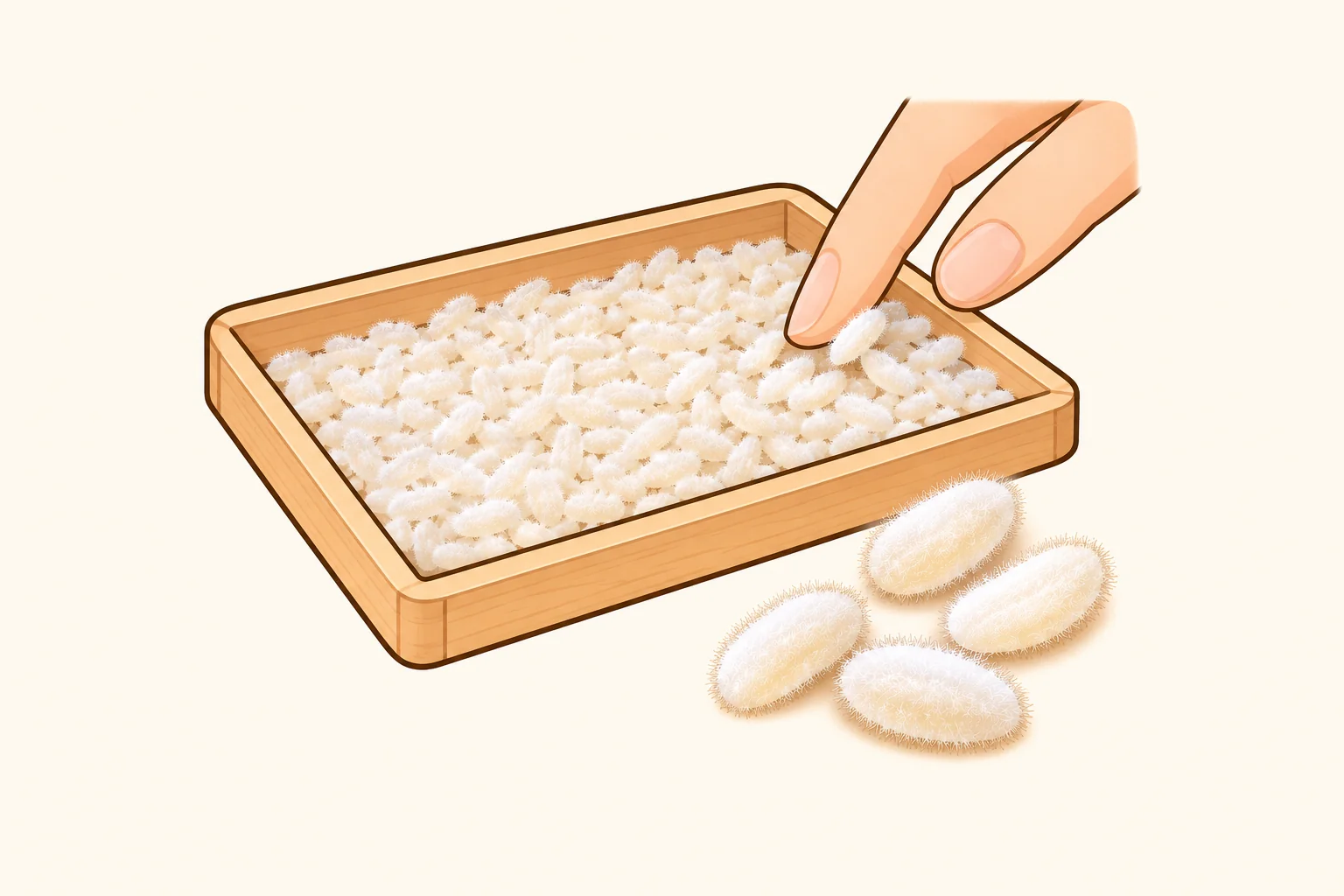
Kōji: steamed rice whose grains have become coated in fine white threads of mold.
What sets sake apart from beer is timing. A beer brewer converts grain starch to sugar first, by mashing, and only then adds yeast. In a sake tank both processes happen at once: the kōji keeps releasing sugar while the yeast keeps turning it into alcohol. Brewing scientists call this multiple parallel fermentation. Because sugar never piles up all at once, the yeast is never overwhelmed, and the fermenting mash, called moromi, can reach close to 20 percent alcohol, unusually high for any drink that is not distilled. Most sake is diluted with water to around 15 percent before bottling.
The sequence runs like this. Rice is polished, washed, soaked, and steamed. Part of it becomes kōji. Kōji, steamed rice, water, and yeast are combined in a small vessel to make the shubo, or yeast starter, also called moto: a dense culture of healthy yeast. The starter then goes into a large tank, and kōji, steamed rice, and water are added in three stages over four days. Adding the ingredients in steps lets the yeast population keep pace with the growing volume, so wild bacteria never get a foothold. After three to five weeks the moromi is pressed, separating clear sake from the white lees, called sake kasu. Kasu is sold in Japanese supermarkets for pickling fish and vegetables and for a winter soup, kasujiru.
- 1Polish, wash, soak, steam
- 2Make kōjifrom part of the steamed rice
- 3Yeast starter (shubo, moto)kōji + rice + water + yeast
- 4Three-stage additionkōji, rice and water, in three stages over four days
- 5Moromi fermentsthree to five weeks
- 6Pressingsake and lees (kasu)
- 7Hi-ire and storageheated to about 60–65°C, stored through summer, heated again at bottling
Kōji turns starch into sugar while yeast turns sugar into alcohol, in the same tank. Adding ingredients in three stages lets the yeast keep pace.
Freshly pressed sake is usually pasteurized by heating it to around 60–65°C, a step called hi-ire, stored through the summer, and pasteurized again at bottling. Sake that is never heated is namazake, "raw sake": lively, sometimes faintly fizzy, and in need of refrigeration. Sake pasteurized only once before storage (namazume) or only once at bottling (nama-chozōshu) sits between the two. Hiyaoroshi, released in autumn, is sake pasteurized only before its summer storage; it has mellowed over the hot months and is a seasonal treat in September and October. Undiluted sake, at around 17 to 20 percent alcohol, is genshu.
Water makes up about 80 percent of the finished drink and is used at every stage, from washing the rice to the final dilution, so breweries were sited by their wells. Iron is the enemy: even small amounts darken sake and spoil its flavor. Potassium, magnesium, and phosphorus feed the yeast. Hard water ferments vigorously and gives a firm, dry sake; soft water ferments slowly and gives a gentler, finer one. That difference shaped the rivalry between Japan’s great brewing districts.
02Reading a Label: Polishing Ratios and Premium Grades
The words that matter most on a sake label are junmai, honjōzō, ginjō, and daiginjō. They are categories of tokutei meishōshu, "special designation sake," defined by Japan’s National Tax Agency. Two questions sort a sake into a category: how much of the rice was polished away, and whether distilled alcohol was added.
The outer layers of a rice grain hold most of its protein, fat, and minerals, which produce rough flavors in fermentation. The core is mostly starch, and good sake rice has an opaque white patch at its centre, called shinpaku or "white heart," where the starch is loosely packed. So sake rice is milled before brewing, and the percentage of the grain that remains is the seimai buai, or polishing ratio. Table rice is about 90 percent. Sake rice for ordinary brewing is usually around 70 percent; premium sake goes to 60 percent, 50 percent, or lower. A label reading 50 percent means half of every grain was ground off.
Under current rules, ginjō sake uses rice polished to 60 percent or less and is brewed by the ginjō method: highly polished rice fermented slowly at low temperatures. Under that stress the yeast produces esters with a fruity aroma Japanese drinkers call ginjō-ka, reminiscent of apple, pear, melon, or banana. Daiginjō uses rice polished to 50 percent or less. Sake made only from rice, kōji, and water, with no added alcohol, carries the word junmai, "pure rice," giving junmai ginjō and junmai daiginjō. Plain junmai has had no minimum polishing requirement since 2004. Honjōzō uses rice polished to 70 percent or less with a small amount of distilled alcohol added. "Tokubetsu," special, junmai and honjōzō are polished to 60 percent or less or made with some other special method. There are eight categories in all, and all of them require graded rice and at least 15 percent of the rice to be used as kōji.
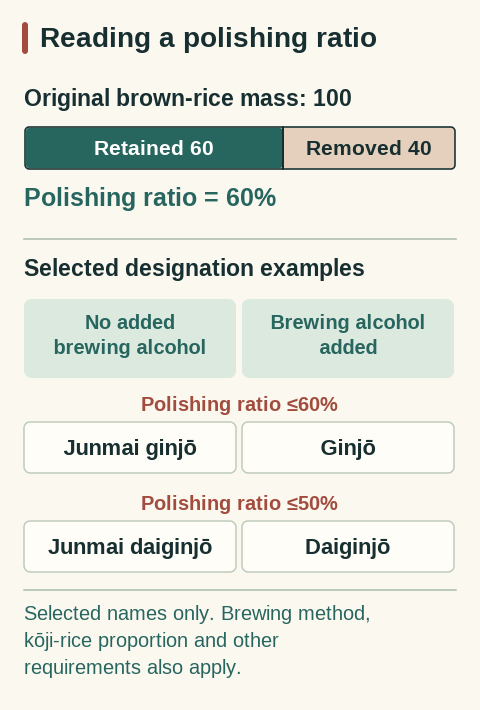
Keeping 60 per cent of the grain is a 60 per cent polishing ratio; ginjō needs 60 or less, daiginjō 50 or less, and sake without added alcohol is called junmai.
Added alcohol sounds like adulteration, but in premium sake it is a technique. A small dose of high-proof neutral alcohol added just before pressing pulls aromatic compounds out of the lees and into the liquid, giving a lighter body and a more pronounced fragrance. Many of the daiginjō entered in national competitions contain it. The rules cap the alcohol at 10 percent of the weight of the polished rice. Brewers were first allowed to add distilled alcohol on a large scale during the wartime rice shortages. What gave it a bad name was sanbai jōjōshu, "triple-volume sake," developed in the even worse shortages after the war: a brewer could stretch a batch to three times its volume with alcohol, glucose, and acidifiers. It persisted for decades after the war and did lasting damage to sake’s reputation.
Sake that does not meet any special designation is futsūshu, ordinary sake. It makes up the majority of production, is inexpensive, and tastes good warm. It is what fills the cups at many family dinners, funerals, and weddings, and it should not be dismissed as simply inferior.
More polishing does not always mean better sake, only a different style. Daiginjō is aromatic and delicate, best sipped chilled; junmai and honjōzō taste more of rice and stand up to food and to warming. Dassai "Migaki Niwari Sanbu," from the Yamaguchi brewery that renamed itself Dassai Inc. in June 2025 (it was formerly Asahi Shuzō), milled down to 23 percent, is a famous extreme. Other brewers deliberately polish very little to keep the flavor of the grain.
Two numbers also appear on many labels. Nihonshu-do, the sake meter value, is measured with a hydrometer: the less sugar, the higher the number, so positive values lean dry (karakuchi) and negative values lean sweet (amakuchi). Acidity, san-do, makes a sake taste richer and drier when high and lighter when low. Both are rough guides; aroma, temperature, and food all change how sweet a sake seems.
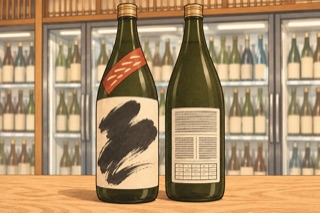
03Winter in the Brewery: Tōji and Their Crews
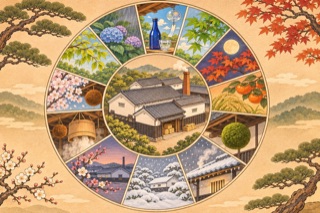
Traditionally, sake was brewed only in winter. Cold air kept bacteria down and made fermentation temperatures easier to control, and by the Edo period (1603–1868) brewing had concentrated into a season called kanzukuri, "cold brewing," from late autumn to early spring. Winter was also the idle season on the farm. After the harvest, farmers from snowy regions such as Niigata, Iwate, and the Tanba hills left home for half a year to live in breweries in Nada, Fushimi, and other centers, returning in spring to plant rice. The master brewer who led them was the tōji; his crew were the kurabito, "brewery people."
Tōji formed regional guilds that passed down techniques and trained successors. The best known, often called the three great guilds, are the Nanbu tōji of Iwate, the Echigo tōji of Niigata, and the Tanba tōji of Hyōgo; others include the Noto, Tajima, and Hiroshima groups. The owner, or kuramoto, ran the business, but the tōji decided how the sake would taste. Which guild a brewery hired often shaped its style.
A brewery day began before dawn. Rice had to be steamed early in the morning and spread on cloths to cool, and the kurabito turned it by hand, feeling its texture. The kōji room was kept between the mid-20s and about 30°C, and steamy, and whoever tended it got up several times a night to mix and spread the rice as the mold grew. Moromi temperatures were checked and recorded daily and nudged up or down. Before modern equipment, brewers lowered casks of hot water, dakidaru, into the yeast starter to warm it and cooled the outside of the tanks with cold water to cool them. Making a traditional kimoto starter meant pounding steamed rice, kōji, and water into a paste with wooden poles in unheated rooms on winter nights, a task called yama-oroshi, done to the rhythm of work songs.
The kimoto method relies on lactic acid bacteria from the environment. They multiply first and acidify the starter, which kills off other microbes and leaves only acid-tolerant yeast to thrive. In 1909 Kagi Kin’ichirō, an engineer at the national brewing institute, and colleagues showed that the pounding could be skipped if water and kōji were mixed first and given time to dissolve the rice. This became yamahai, short for yama-oroshi haishi, "pounding abolished." At about the same time the institute developed sokujō-moto, the "quick" starter, in which commercially produced lactic acid is added directly; it takes about two weeks instead of a month, and the great majority of sake today is made this way. Kimoto and yamahai sakes tend toward higher acidity, a gamey or yogurt-like depth, and a richness that shines when warmed, and a number of breweries now make them a signature.
Yeast was the other variable. Breweries once depended on whatever yeasts lived in their buildings, with unpredictable results. From the early twentieth century the national brewing institute led the isolation of yeast strains from outstanding moromi, and the Brewing Society of Japan distributed them nationwide as "association yeasts," kyōkai kōbo. Yeast No. 6, from the Aramasa brewery in Akita, and No. 7, from Miyasaka Brewing, maker of Masumi, in Suwa, Nagano, are still widely used. Later strains such as No. 9 produced the bright aromas of modern ginjō, and prefectures have since bred their own yeasts and rice varieties, sharpening regional character.
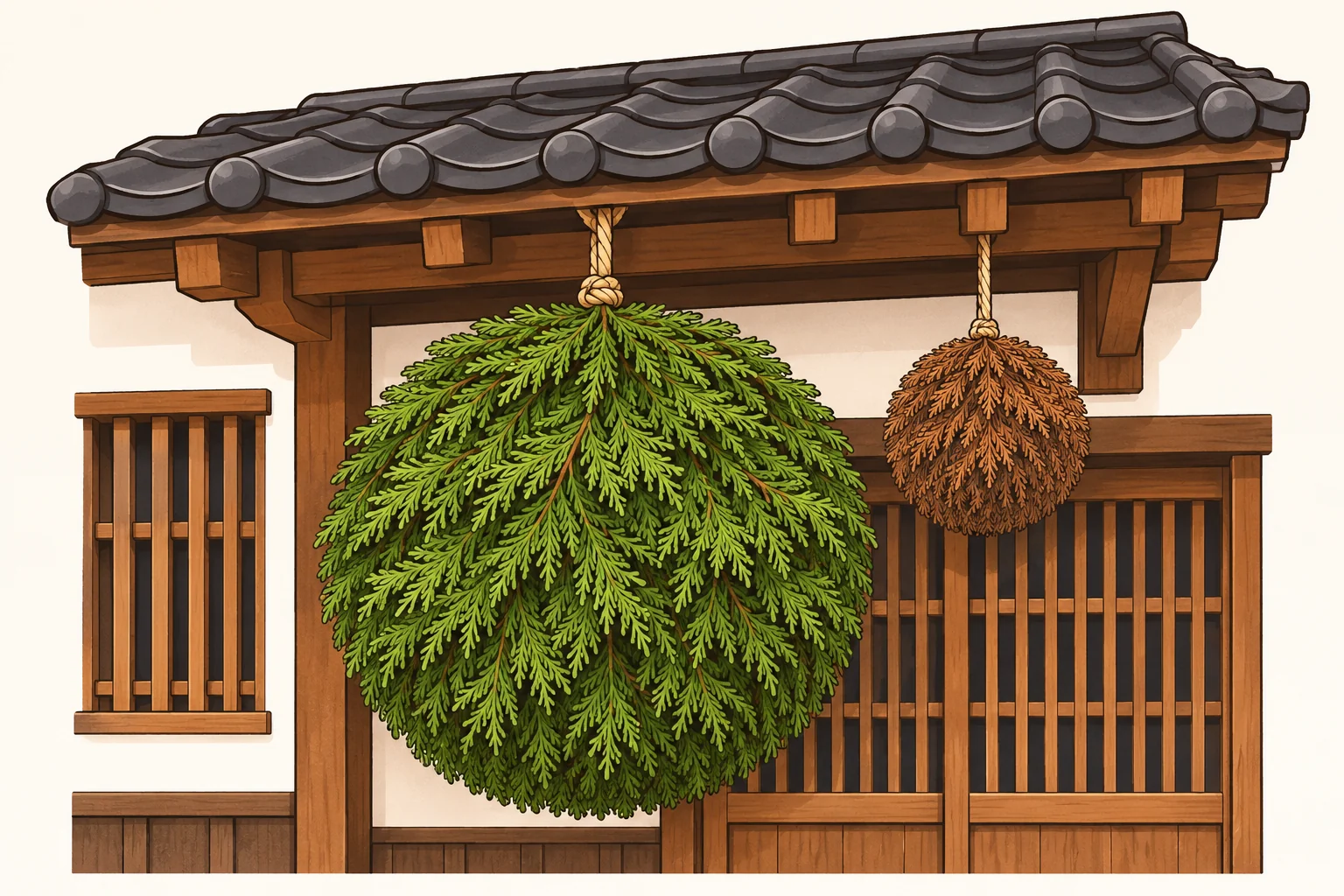
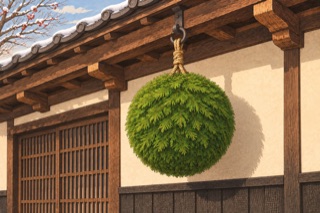
When the new sake is pressed, many breweries hang a fresh sugidama under the eaves: a large ball of cedar sprigs, also called sakabayashi. It starts bright green and turns brown over the following months, so passers-by could read the progress of the year’s sake from its color. The custom is generally linked to Ōmiwa Shrine in Nara Prefecture, whose deity is associated with brewing and whose sacred mountain is covered in cedar.
Seasonal tōji are now rare. Rural Japan has aged, few people want to leave home for six months, and many breweries have trained their own year-round employees as brewers (shain-tōji) or have the owner serve as brewer, a figure called the kuramoto-tōji. Large companies with temperature-controlled tanks and automated kōji machines brew year-round. The old skills have official recognition, though: in December 2024, UNESCO added Japan’s "traditional knowledge and skills of sake-making with kōji mold," which covers sake, shochu, awamori, and mirin, to its list of the Intangible Cultural Heritage of Humanity.
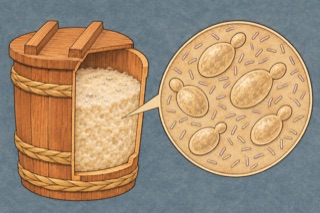 Deep diveThe Yeast Starter and the YeastsBefore a sake brewery commits a ton of rice to a fermentation, it brews something much smaller: a dense, sour culture of yeast called the shubo ("mother of sake") or moto…8 chapters
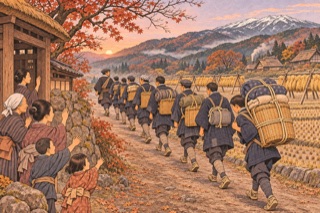 Deep diveTōji Guilds and the Brewery CrewFor most of the last three centuries, the people who actually made Japanese sake did not own the breweries and did not live near them.8 chapters
04From the Gods to Edo: A Short History
Brewing in Japan followed the arrival of wet-rice farming. A surviving fragment of the Ōsumi fudoki, an eighth-century provincial gazetteer from southern Kyūshū, describes villagers chewing rice and spitting it into a vessel to ferment: kuchikami-zake, "mouth-chewed sake," using the enzymes in saliva. Brewing with mold is generally thought to have come from the continent. Under the court bureaucracy of the Nara period, an office called the Sake-no-tsukasa brewed sake for imperial rituals and banquets.
Sake and Shinto have been bound together from the start. Sake offered to the gods is omiki. At shrine festivals it is presented on the altar and then shared among the participants in a rite called naorai, partaking of the same offering as the deity. At a Shinto wedding the couple drinks from three stacked lacquer cups, three sips each, in the san-san-kudo ceremony. At openings, election victories, and New Year events, the lid of a sake cask is smashed with wooden mallets in kagami-biraki. Rows of donated sake barrels, wrapped in straw and painted with brewery names, line the approaches to major shrines such as Meiji Jingū in Tokyo.
In the medieval period, Buddhist temples became the centers of brewing technique. They had land, rice, and literate monks to write methods down, and their sōbōshu, "monastery sake," was famous. Shōryaku-ji, a temple in the hills outside Nara, is associated with bodai-moto, an early form of yeast starter, and calls itself the birthplace of seishu. By the fifteenth and sixteenth centuries, brewers around Nara were making morohaku, sake in which both the kōji rice and the main rice were polished white, the mark of a luxury product. Records from this time already describe adding ingredients in stages and heating sake to keep it from spoiling, roughly three centuries before Louis Pasteur published his work on gentle heating, a fact sake enthusiasts like to mention.
The Edo period gave sake its modern form. Edo, the shogun’s capital and by the eighteenth century one of the largest cities in the world, had few good brewing districts nearby, so it drank sake shipped from the Kamigata region around Kyoto and Ōsaka. This was kudari-zake, "sake sent down" from the old capital region. A popular etymology holds that sake not good enough to ship was kudaranai, "not sent down," which is the source of the modern word for "worthless" or "nonsense." The story is widely repeated but is best treated as folk etymology. The first districts to become famous were Itami and Ikeda, north of Ōsaka. Itami preserves a legend that Yamanaka Shinroku, ancestor of the merchant house of Kōnoike, discovered clear sake around 1600 when a disgruntled employee threw ashes into a vat of cloudy sake. It is a later story; clear sake existed well before then, and one account holds that the use of ash to adjust sake had other origins.
By the late Edo period, the coastal district of Nada had overtaken Itami. Nada stretches along the shore of Ōsaka Bay from eastern Kōbe to Nishinomiya. Streams running off the Rokkō mountains drove water wheels that could polish rice whiter than foot-powered mortars. The sea was at the door, so casks could be loaded straight onto taru kaisen, fast cargo ships dedicated to the Edo sake trade. In winter, cold winds called Rokkō oroshi blew down from the mountains, ideal for cold brewing. In 1840, Yamamura Tazaemon of the Sakura Masamune house, who ran breweries in both Uozaki and Nishinomiya, noticed that his Nishinomiya sake was always better. When he hauled Nishinomiya well water to Uozaki and brewed with it, the Uozaki sake improved too. That water became known as miyamizu, short for "Nishinomiya water," and its hardness and high levels of potassium and phosphorus produced vigorous fermentation and a dry, robust sake nicknamed otoko-zake, "masculine sake." The five villages of Nada, the Nada Gogō, became and remain Japan’s largest brewing district, home to names such as Kiku-Masamune, Hakutsuru, Sakura Masamune, Kenbishi, and Ōzeki.
After the Meiji Restoration, sake became a pillar of state finance. In 1899 the liquor tax overtook the land tax as the government’s largest source of national tax revenue, and it held first place in most years until income tax passed it in 1918. Home brewing was banned outright the same year. In 1904 the Ministry of Finance founded a national brewing research institute to put production on a scientific footing. A national sake competition began in 1907, followed in 1911 by the National New Sake Competition, which still runs today.
At the first competition in 1907, the top prize went to Ryūsei, from Fujii Shuzō in Hiroshima. Hiroshima’s water is soft, and brewers who followed Nada’s methods there struggled with weak fermentation. Miura Senzaburō, a brewer in Mitsu on the Seto Inland Sea, spent years experimenting and in an 1898 book set out what became known as the soft-water brewing method: grow the kōji more thoroughly and ferment longer at lower temperatures. His approach became a foundation of ginjō brewing, and the Saijō district of Higashi-Hiroshima grew into a major brewing town, a rise generally linked to the spread of his method.
The twentieth century was a long decline with a revival inside it. Wartime controls on rice forced mergers and brought large-scale alcohol addition, and the postwar shortages produced triple-volume sake. Shipments peaked in 1973; after that beer, whisky, shochu, and wine took turns eating into the market. As of 2024, domestic shipments were a little over a fifth of the peak, and the number of breweries keeps falling: more than a third have disappeared since 1989 alone, and by one account more than half over the past half century.
Inside that decline something new appeared. A jizake boom in the 1970s turned local brands such as Koshi no Kanbai from Niigata into national objects of desire. From the 1980s, ginjō sake, once brewed mainly to win medals, reached shop shelves. In 1994, Takagi Shuzō in Yamagata released Jūyondai, whose fruity, rounded style became a sensation and inspired a generation of owners’ sons and daughters to return home and brew themselves. Since the 2000s Dassai has led a push abroad, and breweries such as Aramasa in Akita have become cult names. Sake exports have grown several times over in less than two decades, and as of 2025 had risen two years in a row, and in restaurants from New York to Hong Kong sake lists are now organized like wine lists, by region, rice, and producer.
05Regions and Rice
Nearly every prefecture in Japan has breweries; as of the mid-2020s somewhere over a thousand are active, and many towns have their own jizake, local sake. A handful of names will orient a visitor.
Nada in Hyōgo is the largest producer. Fushimi in southern Kyoto is the second. Its old name, Fushimizu, means "hidden water," and its groundwater is softer than Nada’s miyamizu, giving a smooth, gentle sake traditionally called onna-zake, "feminine sake," in contrast to Nada’s. Gekkeikan, founded in Fushimi in 1637, is based there, along with Kizakura and Takara Shuzō’s Shōchikubai. Fushimi also has the Teradaya inn where Sakamoto Ryōma was attacked in 1866, and its canal lined with brewery storehouses makes a pleasant afternoon walk.
Niigata, on the Sea of Japan coast, is known for tanrei karakuchi, "light and dry": clean, crisp sake that sits well with food and, since the jizake boom, has been many Japanese drinkers’ idea of good sake. Niigata has one of the largest numbers of breweries of any prefecture, producing brands such as Kubota, Hakkaisan, and Koshi no Kanbai. Heavy winter snow keeps the air cold and clean for slow fermentation, and the prefecture developed the sake rice Gohyakumangoku.
As of 2026, Saijō in Hiroshima has seven breweries within walking distance of the station, and it holds a sake festival every October. In the northeast, Yamagata, Akita, Miyagi, and Fukushima have done remarkably well in competitions; Fukushima topped the gold medal count at the National New Sake Competition nine years running. Ishikawa’s Noto peninsula, Kōchi’s dry sakes, and Saga and Fukuoka in Kyūshū all have devoted followers.
| Region | Where | Known for |
|---|---|---|
| Nada | Hyōgo | The largest producer |
| Fushimi | Southern Kyoto | Second largest; softer water, onna-zake |
| Niigata | Sea of Japan coast | Tanrei karakuchi, light and dry |
| Saijō | Hiroshima | Seven breweries near the station, October festival (as of 2026) |
| The northeast | Yamagata, Akita, Miyagi, Fukushima | Strong in recent competitions |
You need not know every region; a handful of names will orient a visitor.
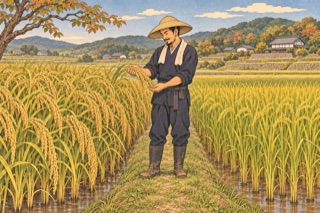
Sake rice is not table rice. A good sake rice has large grains with a big, opaque white heart, low protein, and a structure that absorbs water well and does not crack when milled hard. The most famous is Yamada Nishiki, grown mainly in Hyōgo and nicknamed "the king of sake rice"; much daiginjō is made from it. Gohyakumangoku from Niigata gives a crisp, clean style. Omachi, selected from ears a farmer from Omachi in Okayama brought home around 1859, is one of the oldest sake rice varieties still grown and is commonly said to be among the ancestors of Yamada Nishiki; it makes rich, complex sake with a following who call themselves "Omachists." Miyama Nishiki, bred in Nagano in 1978, tolerates cold and is common in the northeast. Prefectures now compete to breed their own rice and yeast, and sake made entirely from local rice, local water, and local yeast has become a selling point.
06Cold, Room Temperature, Warm
Few drinks are served across as wide a temperature range as sake, from about 5°C to over 55°C, and Japanese has a vocabulary for each step.
Chilled sake is reishu. Around 5°C is yuki-bie, "snow-chilled"; 10°C is hana-bie, "flower-chilled"; 15°C is suzu-bie, "cool-chilled." Beware the older word hiya, which sounds as if it means cold. Before refrigerators, sake was either warmed or served as it was, and hiya meant room temperature. At an old-fashioned bar, ordering hiya may bring you sake straight from the shelf.
Warmed sake is kan, or more politely okan. Around 30°C is hinata-kan, "sunlit warm"; 35°C is hitohada-kan, "skin warm"; 40°C is nurukan, "lukewarm"; 45°C is jōkan; 50°C is atsukan, "hot"; and 55°C and above is tobikiri-kan, "extra hot." The traditional method is to fill a tokkuri, a narrow-necked ceramic flask, and stand it in hot water. Experienced hands judge the heat by touch or by watching the sake swell slightly in the neck; one rule of thumb says that when it does, it is close to atsukan. Some bars have a dedicated kanban, the person who does nothing but warm sake.
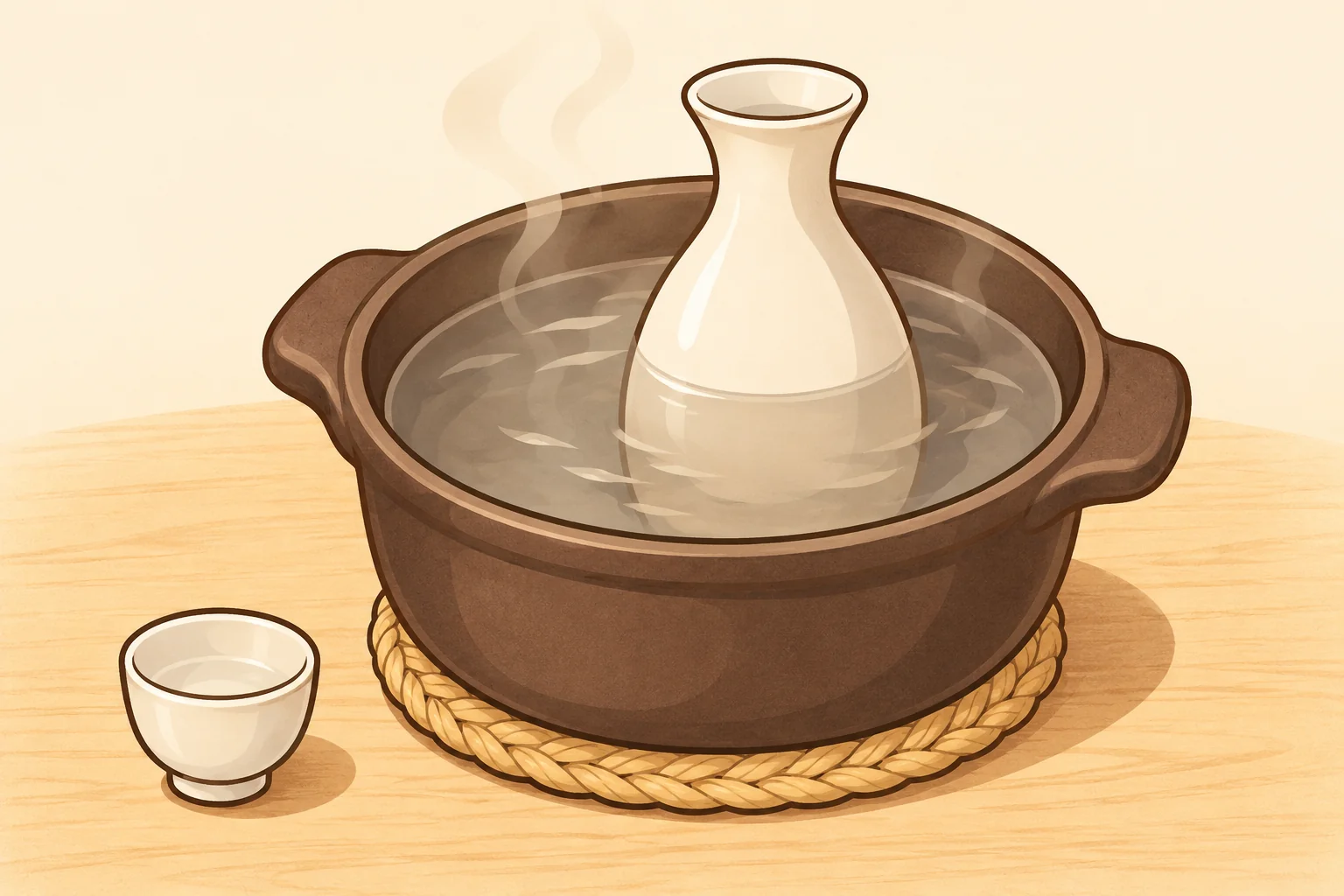
The traditional way to warm sake: fill a tokkuri, a narrow-necked ceramic flask, and stand it in hot water.
Different sakes suit different temperatures. Aromatic ginjō and daiginjō lose their fragrance and can turn cloying when heated, so they are served chilled or cool. Fuller junmai, and especially kimoto and yamahai sakes, open up when warmed: the savory notes and acidity broaden and the texture softens, and many enthusiasts think they are better hot than cold. Ordinary sake or honjōzō as atsukan, with oden or grilled fish on a cold night, is the way most Japanese people first learned to drink sake. Some labels now print a recommended serving temperature.
Sake works so well with Japanese food because it carries umami of its own, from amino acids, which stacks with the umami in fish, shellfish, soy sauce, and miso. It is lower in acid than wine, so it does not clash with raw fish, and it softens fishy notes rather than amplifying them. Warm sake is particularly good with fatty dishes, rinsing richness from the palate.
07Cups, Flasks, and Etiquette
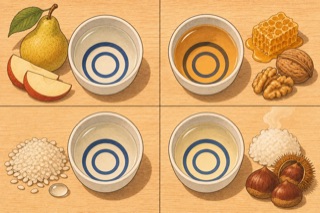
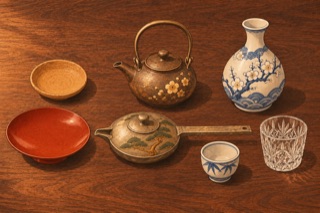
The basic set is a tokkuri and ochoko, a small cup emptied in a sip or two. A larger cup meant for slower drinking is a guinomi. A katakuchi is a lipped bowl used to pour chilled sake. The square wooden masu was originally a measure for rice and sake; the common size holds exactly one gō. In bars today a glass is often set in a masu and filled until sake overflows into the box, a gesture of generosity called mokkiri; drink from the glass first, then tip the rest from the box into it. Tasters and brewers use the janome choko, a white porcelain cup with two blue concentric rings painted on the bottom, which makes it easy to judge a sake’s color and clarity.
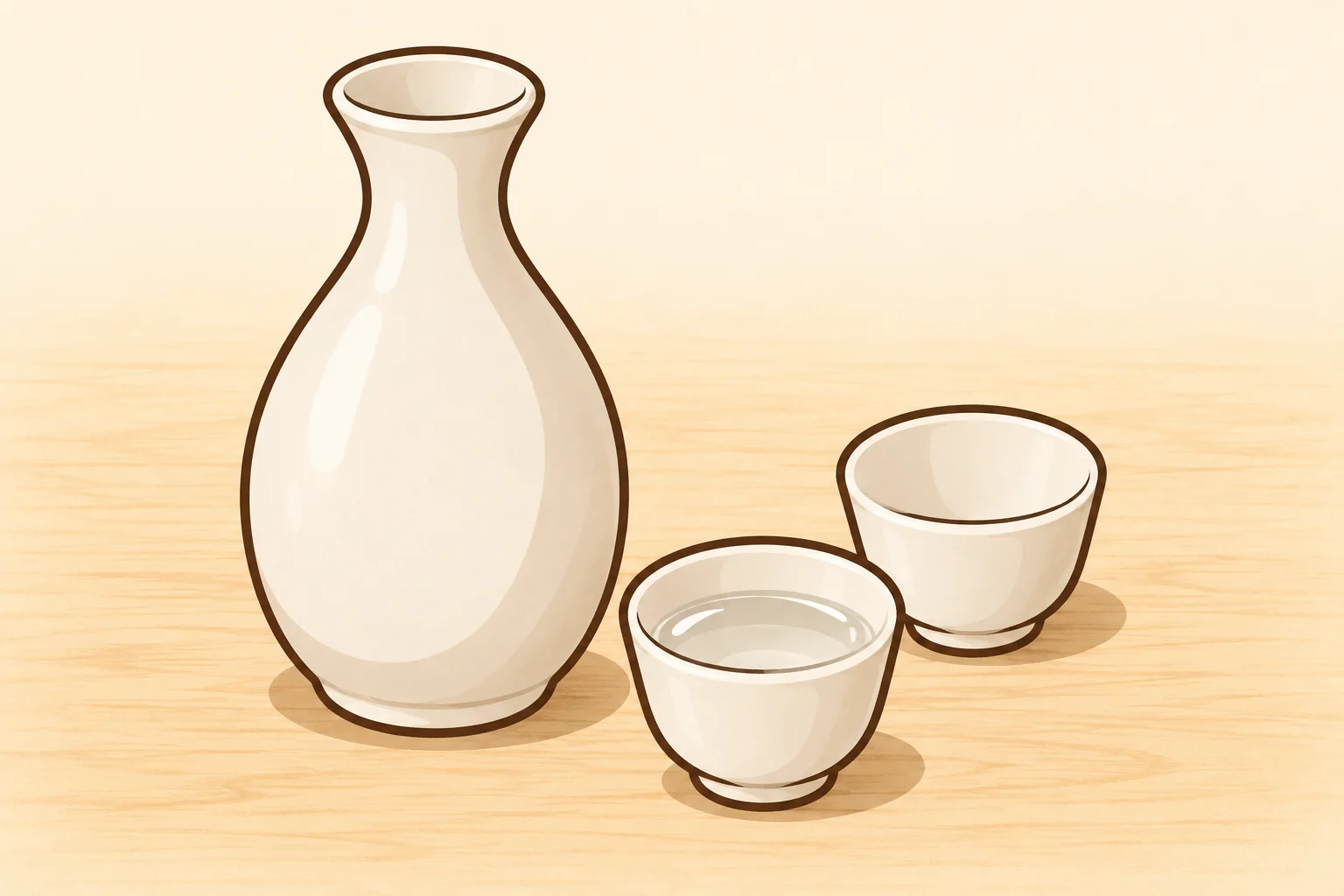
Tokkuri and ochoko: the flask holds the sake, and the small cup is emptied in a sip or two.
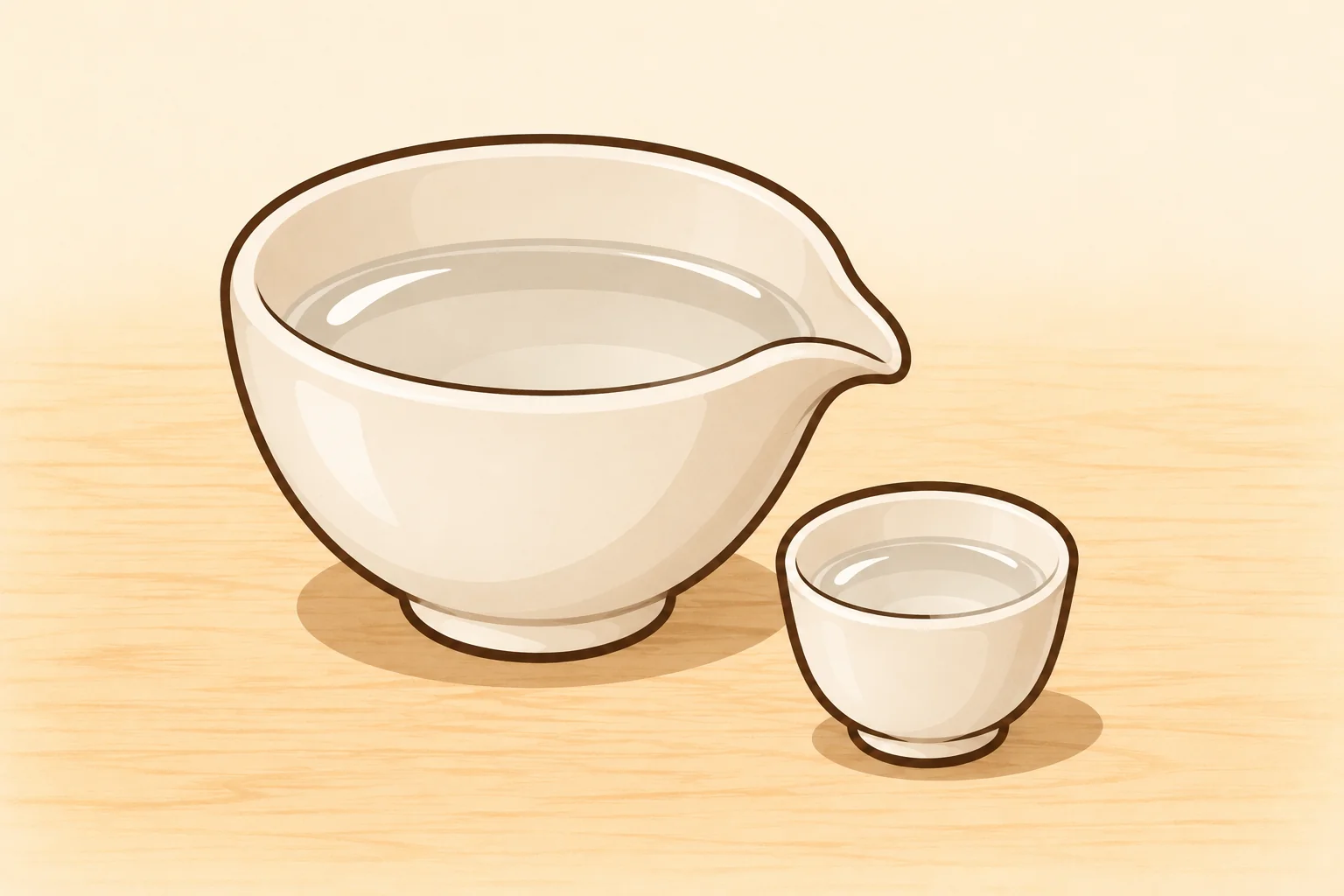
Katakuchi: a lipped bowl used to pour chilled sake.
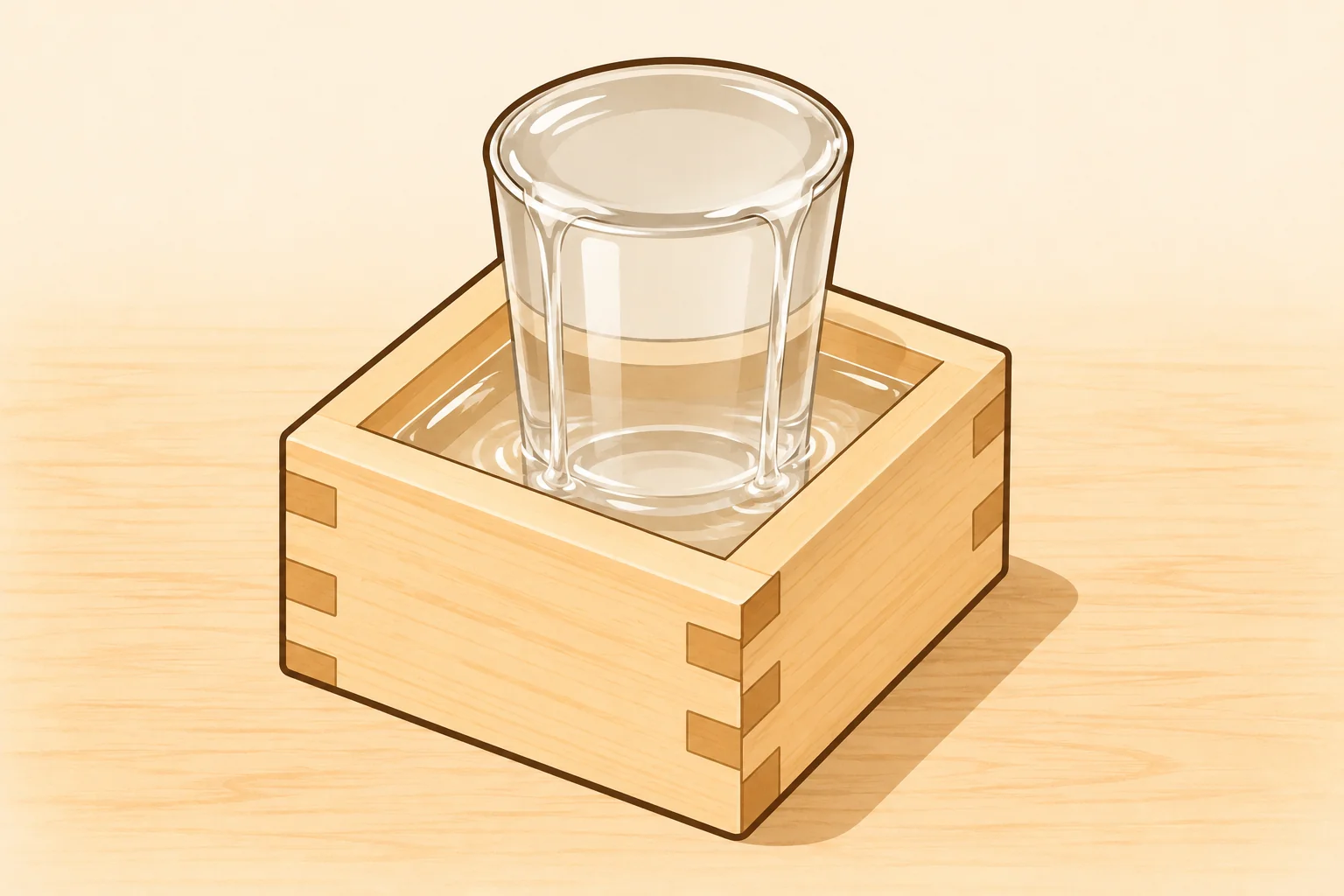
Mokkiri: a glass set in a square wooden masu and filled until the sake overflows into the box.
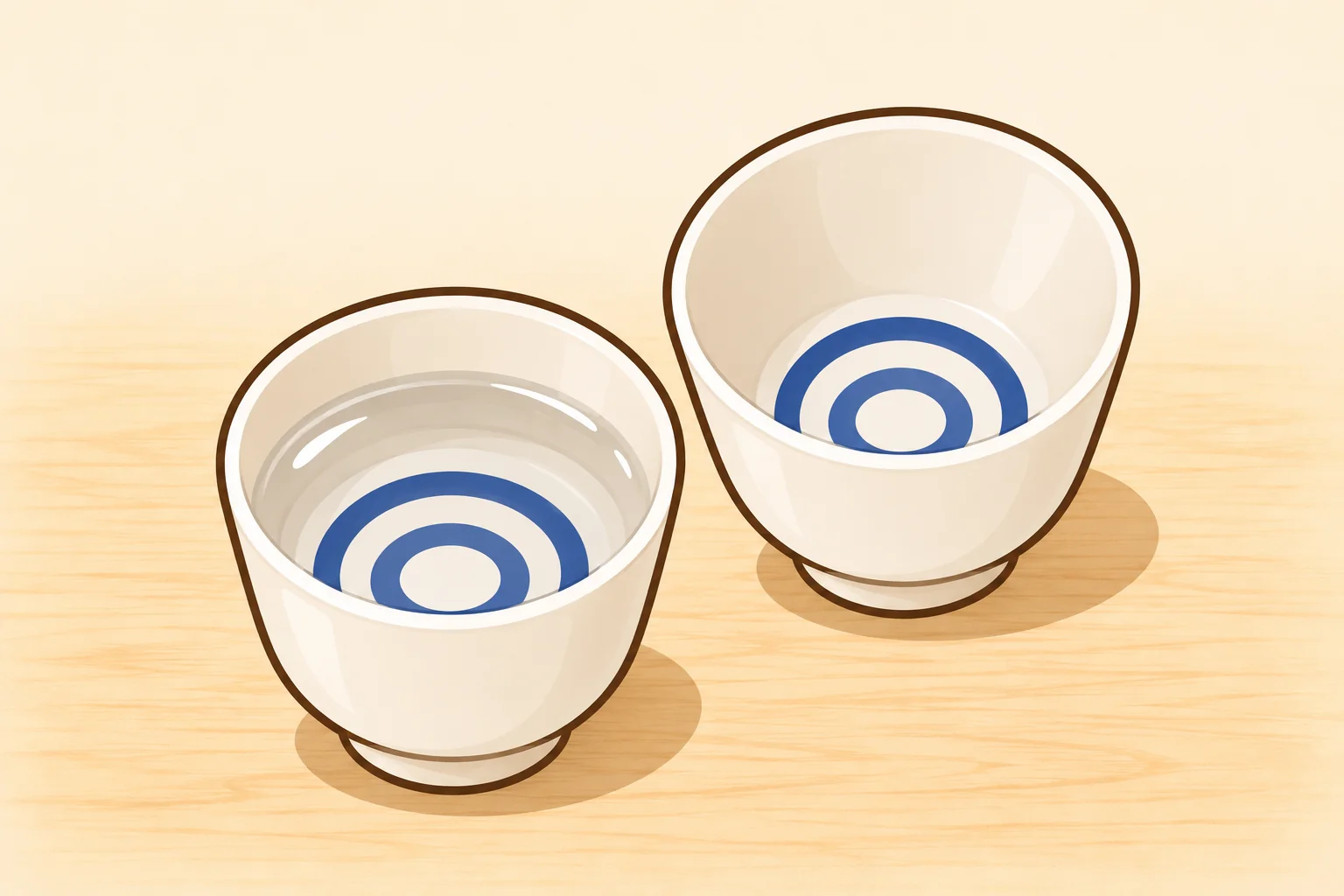
Janome choko: two blue rings on the white porcelain bottom make it easy to judge a sake’s color and clarity.
Sake measures come from the old Japanese system. One gō is 180 milliliters, the standard serving in a bar. Ten gō make one shō, 1.8 liters, which is why the big bottle is called an isshōbin. The common 720-milliliter bottle is four gō, a yongōbin.
When drinking with others in Japan, you do not usually pour for yourself. Companions pour for each other, a practice called oshaku. When someone’s cup is low, pick up the flask and top it up; when someone pours for you, lift your cup with both hands. To signal that you have had enough, leave some sake in your cup. At the start of a gathering, wait until every glass is filled before everyone says "kanpai." Younger people and casual settings have relaxed these customs, but they still matter at business dinners.
Sake is meant to be drunk slowly, alongside food. A glass of water on the side, called yawaragi-mizu, "softening water," keeps the palate fresh and slows the effects; the Japan Sake and Shochu Makers Association has spent years promoting it.
08Drinking Sake in Japan
The easiest place to start is an izakaya, a Japanese pub. Sake lists are usually arranged by prefecture or brand, priced per gō, as of 2026 running from a few hundred yen for ordinary sake to a thousand or two for daiginjō. If you do not know what to choose, tell the staff what you like: karakuchi (dry) or amakuchi (sweet), aromatic or clean. Or simply ask what they recommend. Often someone will bring the isshōbin to the table so you can see the label before pouring. In winter, look for shinshu (new sake), namazake, and cloudy nigori; in autumn, hiyaoroshi. Menus mark these as seasonal.
Specialist sake bars and standing bars often offer nomikurabe, tasting flights of three or four small pours side by side. In some liquor shops there is a corner where you can drink standing at the counter, called kakuuchi, cheap and especially common in Kitakyūshū, full of regulars stopping on their way home from work.
To go deeper, visit a brewery. In Nada, the Kiku-Masamune Sake Brewery Museum and the Hakutsuru Sake Brewery Museum display old tools and explain the process; in Fushimi, the Gekkeikan Okura Sake Museum does the same. Most have tastings and sell sake available only locally. During the winter brewing season many small breweries refuse visitors, because outsiders can carry in unwanted microbes, natto bacteria above all; some brewery workers give up natto entirely while brewing. In spring, when the season’s sake is finished, many hold kurabiraki, open-house days, where you can taste sake straight from the press.
If you are taking sake home, avoid namazake and anything labeled for refrigeration on a long trip. Most sake, unlike wine, is not made for aging; drink it within a year, keep it in the refrigerator after opening, and finish it soon. There are exceptions: koshu, or long-aged sake, turns amber and tastes nutty, closer to Shaoxing wine or sherry.
Sake is not Japan’s only drink. Shochu from Kyūshū and awamori from Okinawa are distilled spirits; umeshu is a liqueur of plums steeped in shochu or other alcohol; Japanese whisky has an international reputation of its own. They share the izakaya menu with sake but are made and drunk differently and deserve their own introductions.