
Walk past an old sake brewery in Japan and you will probably see a large ball of cedar hanging over its door. Walk into Meiji Jingū in Tokyo and you will pass a wall of straw-wrapped casks, each painted with a brand name. Attend a shrine blessing and you may be handed a tiny unglazed cup with a mouthful of sake in it. These are not random overlaps between drinking and religion. In Shinto, sake is one of the basic offerings to the gods, brewers have their own patron shrines, and the objects that carry sake into and out of the sacred space have recognisable shapes and colours. This piece explains what you are looking at.
01The Cedar Ball over the Brewery Door
A sugidama ("cedar ball"), also called sakabayashi ("sake grove"), is a sphere made of Japanese cedar (sugi) sprigs, hung from the eaves or lintel of a sake brewery or old liquor shop. Small ones are the size of a basketball; big ones reach about a metre across and hang from a thick rope or iron hook. From a distance it looks like a giant, neatly trimmed green pompom.
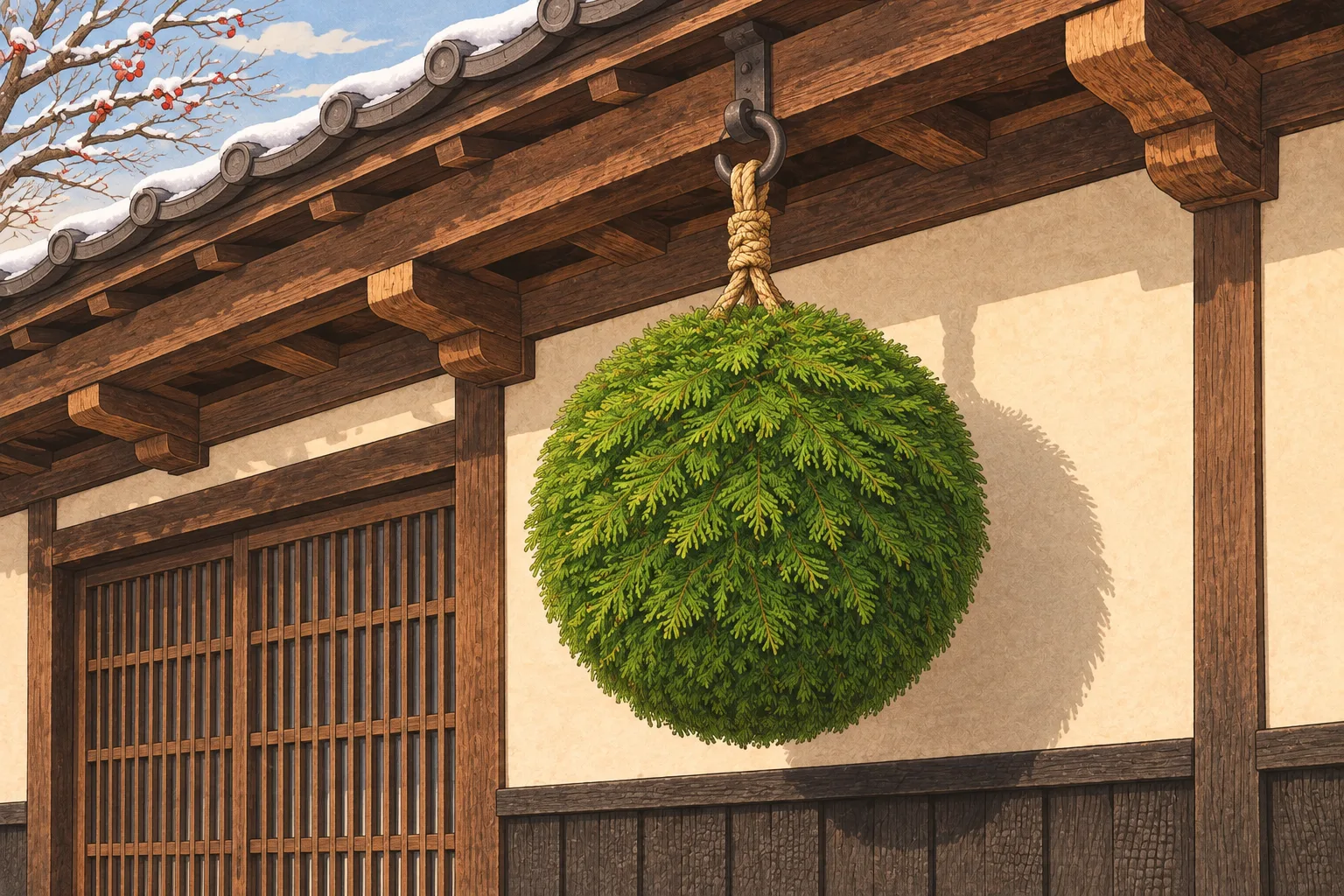
A freshly hung, bright green sugidama on a thick rope under the eaves of a sake brewery in early winter.
Up close you can see how it is made. Typically, a frame of bamboo or wire is formed into a ball, sometimes around a core of straw or wire mesh. Hundreds of cedar sprigs, cut to the same length, are pushed into the frame one bunch at a time until the frame disappears. Then someone walks round it with large shears and clips it into a smooth sphere. It is slow work, and a large ball uses a surprising quantity of foliage. Some breweries still make their own; others order from specialist makers.
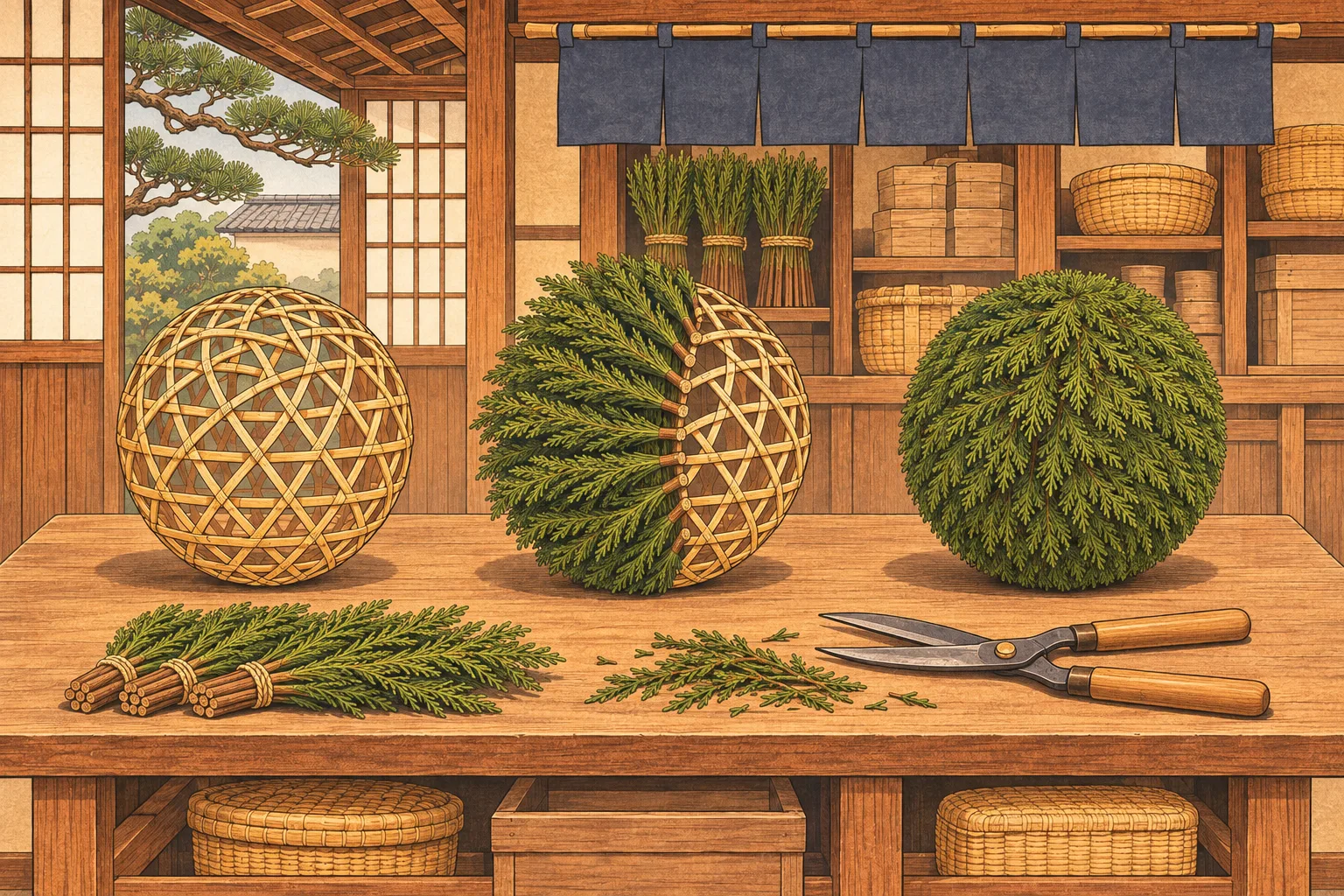
Making a sugidama, from left: the woven bamboo frame; the frame half filled with cedar sprigs; the finished ball clipped smooth. Bundles of sprigs and the large shears lie on the bench.
The famous thing about a sugidama is that it changes colour. Hung fresh, it is bright green. Over the following months it fades to yellow-green, then straw, and by the next summer or autumn it is brown. Breweries traditionally put up a new ball when the first sake of the season is pressed, so the colour worked as a rough public calendar: green meant new sake had just come out; brown meant the sake had rested through a summer and mellowed. (The brewing year itself is a separate subject.)
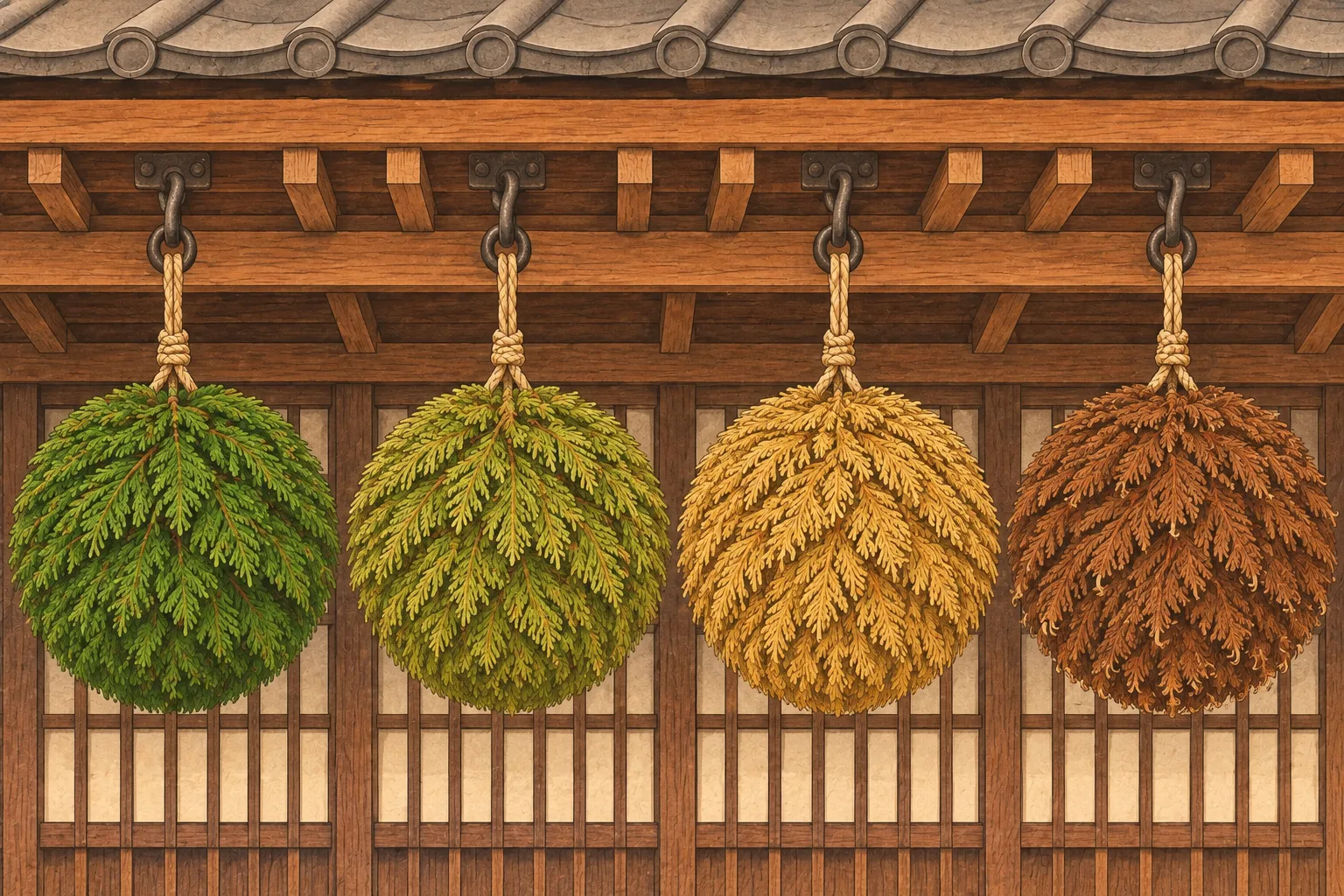
How a sugidama changes colour, from left: fresh green, yellow-green, straw yellow, and the brown of the following summer and autumn.
The custom traces back to Ōmiwa Jinja, a shrine in Sakurai, Nara Prefecture, whose deity is honoured as a god of sake brewing, and whose sacred mountain, Mount Miwa, is covered in cedar. Every 14 November the shrine holds a festival for safe brewing, and brewers from around the country come to receive a small sugidama and a protective charm to take home. Giant sugidama hang from the eaves of the shrine’s worship hall and prayer hall, renewed each year around the festival, in recent years on the day before. Each is about 1.5 metres across and weighs around 200 kilograms, and they are the most famous cedar balls in Japan.
Why cedar? One explanation is religious: the cedars of Mount Miwa are sacred, so a cedar ball carries a token of the god back to the brewery. Another is practical: cedar has a clean scent and was believed to resist rot and insects, and breweries already used cedar for vats and casks. Older names include sakabōki ("sake broom"): cedar sprigs a foot or two long, tied into a broom shape or a ball and propped by the door or hung from the eaves, a sight still common in the late Edo period. By the Edo period at the latest, cedar bundles and balls were established sake-shop signs.
So a sugidama does two jobs. It is a trade sign, as plain as a barber’s pole, announcing that sake is made or sold here. It is also a link to Mount Miwa. In brewing districts such as Fushimi in Kyoto, Nada in Kobe, Saijō in Hiroshima and many towns in Niigata, nearly every brewery has one. Some izakaya and liquor shops hang them purely as signs, and small decorative versions are now sold for homes and restaurants.
02Mount Miwa: Where the Sake God Lives
Ōmiwa Jinja is often described as one of the oldest shrines in Japan. As the main Shinto article explains, it has no main sanctuary: the mountain itself is the god’s body, and worshippers pray towards it through the worship hall and a rare triple torii. The question here is why the god of this mountain is tied to sake.
The shrine’s deity is Ōmononushi. The best-known link between this god and sake comes from the Nihon Shoki, the court chronicle completed in 720. During the reign of the semi-legendary Emperor Sujin, the chronicle says, a plague swept the land and the emperor worshipped Ōmononushi as instructed in a divine message. In Sujin’s eighth year a man of Takahashi village named Ikuhi was appointed brewer to the Great Deity. That winter, at the rite, Ikuhi presented sacred sake to the emperor with a short poem saying, in effect, that this sacred sake was not his own but was brewed by Ōmononushi, who built the land of Yamato, and wishing it long ages. A feast followed in the shrine; afterwards the officials sang of the gates of the hall of "sweet-sake Miwa" and the emperor answered in kind. Ikuhi came to be honoured as an ancestor of brewers, and a small shrine to him, Ikuhi Jinja, stands within the Ōmiwa grounds. A local legend says he brewed the sake in a single night, and the shrine is still nicknamed "Hitoyozake-san", the overnight-sake shrine.
In classical poetry, the phrase umasake ("delicious sake") is a fixed epithet (makurakotoba) for Miwa: whenever a poet named Miwa, "delicious-sake" could stand in front of it. The link is one of sound: sacred sake was anciently called miwa, the same sound as the place name. The usage shows that by the time of the Man’yōshū, Japan’s eighth-century poetry anthology, Miwa and good sake were already linked in people’s minds; one Man’yōshū poem opens with "sweet sake" and goes on to the sacred cedar tended by the priests of Miwa.
Cedar is everywhere at Ōmiwa. The approach is lined with tall, straight trunks and the ground is soft with fallen needles. In the grounds stands an old tree called Mi no Kamisugi, the "Sacred Cedar of the Snake"; according to legend it is home to a white snake in which Ōmononushi appears, and because snakes are said to like eggs and sake, visitors often leave both in front of it.
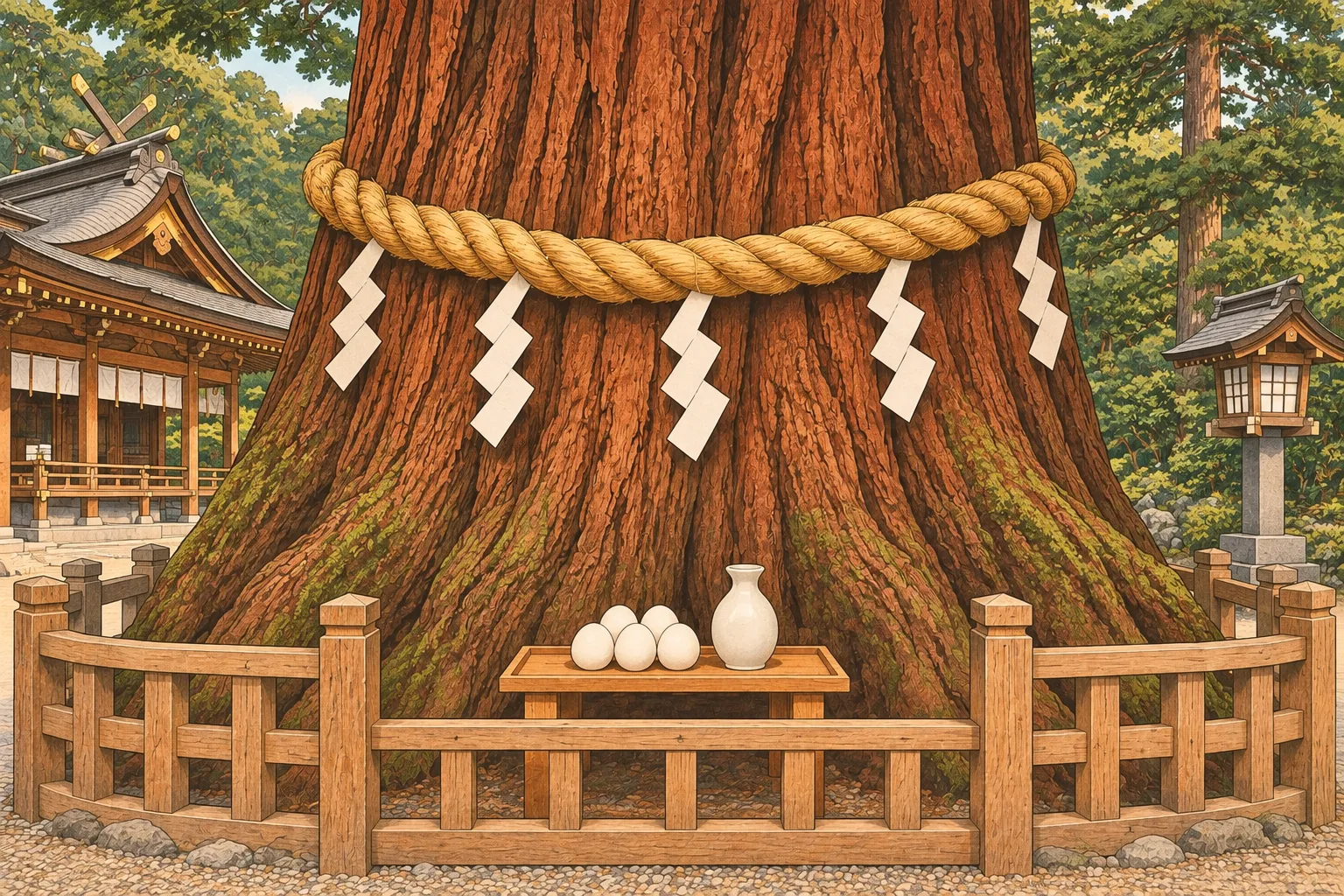
Mi no Kamisugi, the old cedar at Ōmiwa Jinja, girdled with a sacred rope. Eggs and a flask of sake have been left on the offering stand in front.
The brewing festival, formally the Jōzō Anzen Kigansai ("prayer festival for safe brewing"), is held on 14 November, just as the new rice is in and breweries are starting the season’s first batches. Priests present food offerings, shrine maidens perform a kagura dance called Umasake Miwa no Mai, and master brewers from across Japan attend. The giant sugidama has been replaced the day before. Over the following weeks, the small cedar balls taken home that day appear over brewery doors across the country, so the ball outside a brewery in Kyushu or Niigata really is, in a sense, a piece of Mount Miwa.
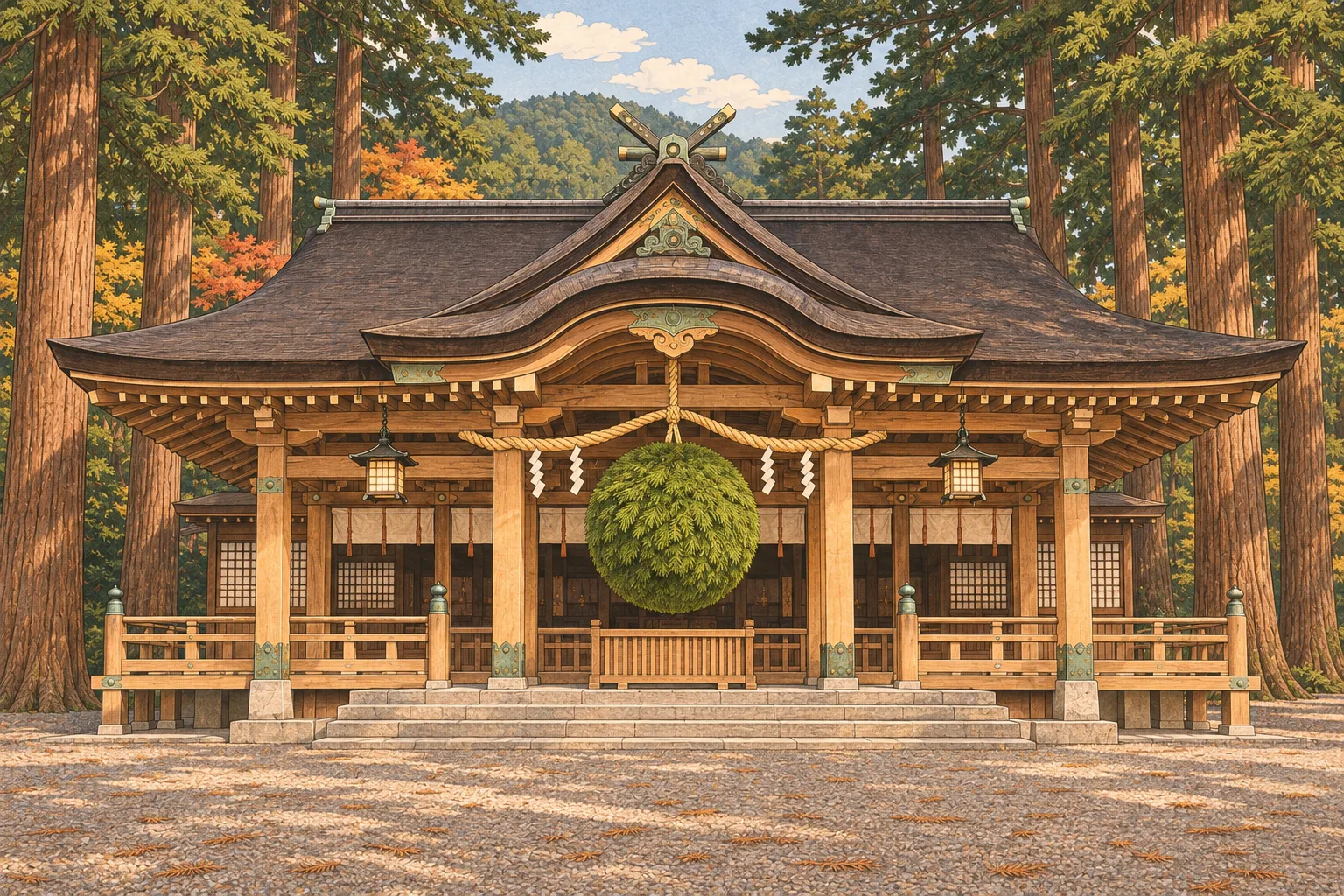
The worship hall of Ōmiwa Jinja among tall cedars, with the giant sugidama, renewed for the November brewing festival, hanging from its eaves.
03Matsuo, Umenomiya and Other Brewers’ Shrines
Ōmiwa is not the only shrine brewers turn to. Two shrines in Kyoto are just as closely tied to sake; together with Ōmiwa they have long been counted as the three great shrines of sake brewing.
Matsuo Taisha sits at the foot of Mount Matsuo in western Kyoto, not far from Arashiyama. It is said to have been founded in 701 by the Hata, an immigrant clan of the ancient period who developed the western Kyoto basin, and its main deity is Ōyamakui. There is no firm date for when Matsuo became a sake shrine. The usual explanation is that the Hata, who knew how to brew, worshipped it as their clan shrine; from the Edo period on, brewers across Japan revered it. A spring in the grounds, the Kame no I ("Turtle Well"), is said to keep sake from spoiling if a little of its water is added to the brewing water, and brewers still come to draw water from it.
The sight most visitors remember at Matsuo is the stack of donated sake casks in front of the portable-shrine storehouse, piled in tiers and printed with the names and logos of breweries from all over Japan. Two festivals frame the brewing season: in November, on the first day of the hare, the Kami-u-sai, when brewers pray for a safe season, and in April, on the middle day of the rooster, the Chū-yū-sai, giving thanks once brewing is done. Many breweries keep a small altar in the brewhouse, and the paper talisman on it is often from Matsuo. The shrine also has a small sake museum explaining its ties to sake and the brewing process with videos, panels and old brewing tools, with a sugidama at its door.
Umenomiya Taisha, in Kyoto’s Ukyō Ward, enshrines Sakatoke no Kami and Sakatokeko no Kami, among others. They are usually identified with the mountain god Ōyamatsumi and his daughter Konohanasakuya-hime. In one variant account in the Nihon Shoki, Konohanasakuya-hime (there called Kamuatakashitsu-hime) chose a field by divination, named it Sanada, and brewed "heavenly sweet sake" (ama no tamuzake) from its rice, one of the stories cited as an origin of rice sake. Umenomiya was originally the clan shrine of the ancient Tachibana family and is also known for prayers for children and safe childbirth; a stone inside the fence of the main sanctuary, the matage-ishi, is said to help those hoping for a child if they step over it.
Beyond these, many regions have local brewers’ shrines. In Izumo, Shimane Prefecture, Saka Jinja, whose name is said to come from "sake", is where, according to the eighth-century Izumo Fudoki, the gods once gathered to brew and feasted for 180 days. Under special permission it still brews a small amount of unfiltered doburoku each year for its Doburoku Festival on 13 October, attended by brewers from across Shimane. Branch shrines of Matsuo are also found in many regions.
None of these is exclusive. A single brewery may have a Matsuo talisman on its altar, a Miwa cedar ball over its door, and send a cask every autumn to the local shrine. Brewing depends on yeast, mould, temperature and weather, and one spoiled tank can mean a lost season. Asking several gods at once makes sense.
04Komodaru: The Walls of Casks at Big Shrines
At Meiji Jingū, Matsuo Taisha and many other large shrines, you will find long, neat stacks of sake casks beside the approach or near the kagura stage. These are komodaru ("straw-mat casks"), also called komokaburi: wooden casks wrapped in a woven straw mat (komo), bound with straw rope, and printed on the front with a brand name, brewery name and a design. The colours are bold: red, black, gold and blue on a pale straw ground, with big brush-style lettering.
The standard size is the yontodaru, a four-to (about 72-litre) cask, made of cedar staves; cedar from Yoshino in Nara has long been prized for its straight grain and fragrance. The straw mat was originally protection in transit. In the Edo period, sake from Nada and Itami was packed in these casks and shipped by special cask-carrying vessels (taru-kaisen) from Osaka and Nishinomiya to Edo; a ship of 1,000 koku carried some 1,600 to 2,000 casks. Decorating the mat turned packaging into branding. Sake kept for a while in cedar picks up a gentle woody aroma, and taruzake ("cask sake") is still sold for people who like that taste.
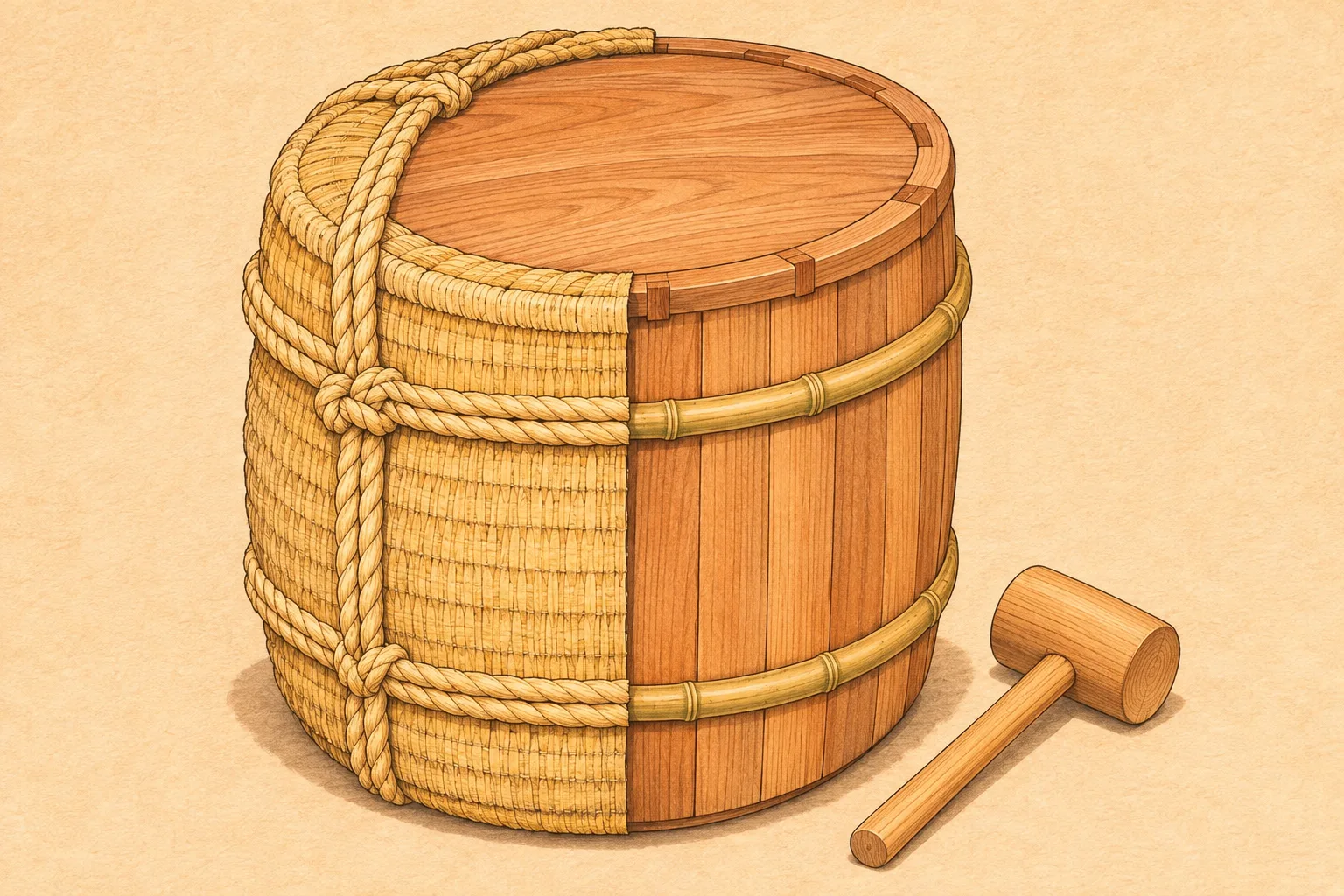
How a komodaru is built: the left half wrapped in straw matting and rope, the right half stripped to show cedar staves and bamboo hoops. The round lid on top is the kagami; a wooden mallet lies beside it.
The row at Meiji Jingū is the most famous. On the gravel path towards the main hall, the casks are stacked several tiers high in a long line. They are offered every year by the member breweries of the Meiji Jingū Zenkoku Shuzō Keishinkai, a nationwide brewers’ association, in honour of Emperor Meiji and Empress Shōken. Directly opposite stands a row of wine barrels from Burgundy. The shrine’s sign explains that Emperor Meiji was fond of Western food and wine; in 2006 several well-known Burgundy wineries donated wine in his memory, and Burgundy wine has been offered every year since. The sign presents the facing rows as a symbol of the Meiji era’s blend of foreign culture and Japanese tradition, and the two rows together are now one of the most photographed spots in Tokyo.
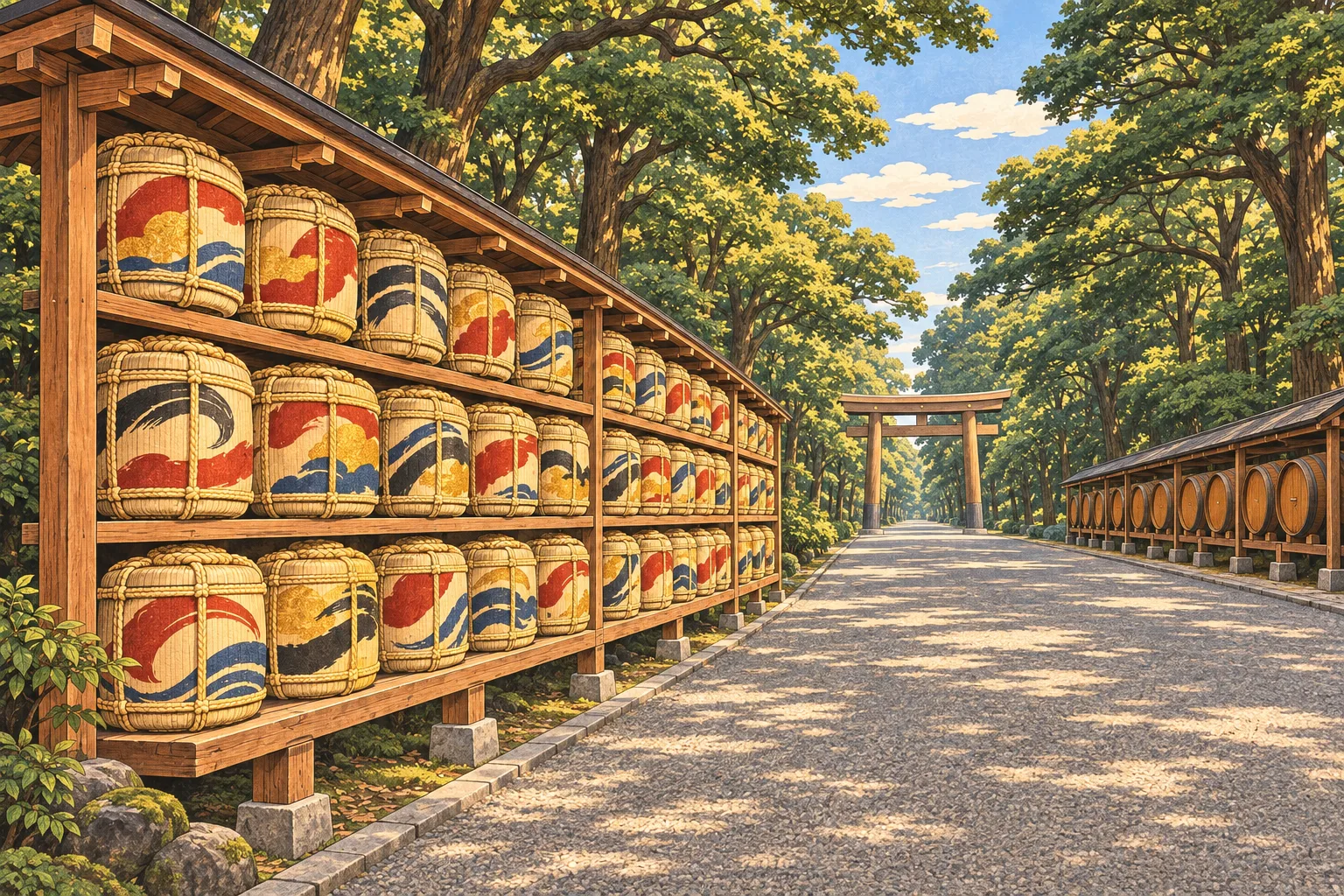
The approach at Meiji Jingū: komodaru stacked three tiers high on one side and, across the gravel path, a row of Burgundy wine barrels.
Are the casks full? Mostly not. At Meiji Jingū the sign states that these straw-wrapped display casks (kazaridaru) are empty and are offered together with bottled sake. Donated casks elsewhere are often empty too, which keeps them light and lets them stand outdoors for months; real sake usually arrives in large 1.8-litre isshōbin bottles, for use in rituals and the gathering afterwards.
Why give them? Partly as an offering and a prayer for safe brewing and good business; partly because supplying sake for the local festival is an old obligation of a brewery to its community; and partly for the visibility of having your name on the approach to a famous shrine. At a small neighbourhood shrine during its autumn festival you may see just two or three casks from local breweries in front of the stage. The idea is the same.
05Omiki: Sake for the Gods
There is a Japanese saying, "o-miki agaranu kami wa nashi": there is no god who does not drink sacred sake. It is used jokingly to excuse a drink, but it reflects a real feature of Shinto ritual: sake is one of the core offerings.
Food offered to the gods is called shinsen. The most basic set is rice, sake, salt and water; fuller sets add fish, seaweed, vegetables, fruit and sweets. Each item sits on a sanbō, a small stand of plain white wood, arranged before the altar in a set order. Sake is presented in a pair of heishi, slender white ceramic flasks with narrow mouths and broad shoulders, often lidded, and at New Year often topped with a decoration of bamboo or cypress called mikinokuchi. Offered sake is called omiki, "sacred sake".
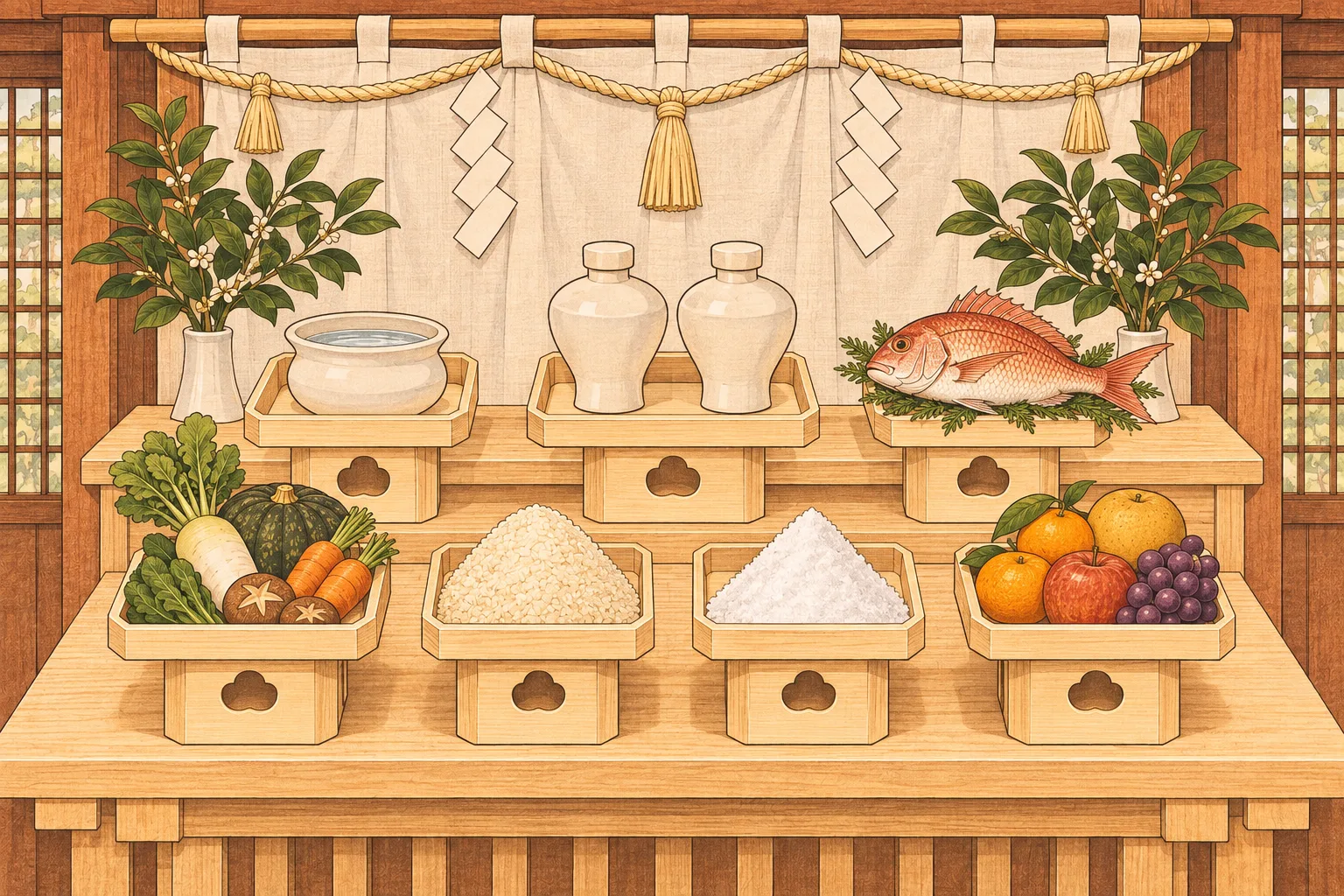
Shinsen set out on plain wooden sanbō. Back row, from left: water, a pair of lidded white heishi, a sea bream. Front row: vegetables, rice, salt and fruit.
At the most solemn rites of the imperial court and some major shrines, two special sakes appear: shiroki ("white sake") and kuroki ("black sake"). They are used mainly at the Niinamesai, the annual harvest rite in November, and at the Daijōsai, the harvest rite that follows an emperor’s accession. According to the Engishiki, a code of procedures compiled in the early tenth century, the same brew was divided in two: one half was left as it was, and plant ash was added to the other half to darken it. The Engishiki calls the plant kusagi; which plant that was is uncertain, and some explain it as the root of a mountain shrub, utsugi. The two are offered side by side. Methods have varied over the centuries.
At ordinary shrines, omiki is ordinary sake. Bottles donated by worshippers or breweries are wrapped in white paper marked "hōnō" (offering) with the donor’s name, and you often see rows of them before the altar or by the shrine office. After the rite, the sake is taken down and shared.
At New Year and festivals, many shrines give visitors a sip of omiki from a small cup, or sell or hand out small bottles to take home. These usually contain local sake, labelled with the shrine’s name. Families may place the bottle on the home altar or share it over the holidays.
Why sake? Shinto ritual treats the gods as honoured guests, and you serve a guest the best you have. Rice was Japan’s most important crop, and sake is rice in its most valued form, made from a season’s harvest. Sake is also believed to purify: it is sprinkled on the ground at groundbreaking ceremonies, on new boats, and on the corners of a new building for the same reason.
06Naorai, San-san-kudo and Kagami-biraki
The last part of a festival often happens away from the altar, in the shrine office or a community hall. This is the naorai. Offerings are taken down from the altar and shared by those who took part, with the offered sake at the centre. The idea is that eating and drinking what the gods have received lets people share in their blessing. The word is usually explained as a contraction of naori-ai, a "return" from the state of ritual purity to everyday life, though some scholars stress that it is part of the rite itself rather than just its end.
The version a visitor is most likely to meet comes after a formal prayer ceremony at a shrine. At the end, a shrine maiden brings out a sanbō holding small, flat, unglazed cups called kawarake, pours a little omiki from a long-handled pourer, and each person lifts the cup with both hands and drinks. It is a token naorai, a single sip. If you are driving or do not drink, touching the cup to your lips is fine. At a village festival, by contrast, the naorai can be a proper party in the community hall.
San-san-kudo, "three, three, nine times", is the central rite of a Shinto wedding, formally the "rite of the pledge cups". Three flat vermilion lacquer cups of different sizes sit stacked on a stand. A shrine maiden pours with a long-handled server, and the couple drink in turn from each cup, each cup taken in three sips, nine sips in all. Details vary from shrine to shrine. Three is an auspicious, odd number that cannot be split evenly, which is read as a wish that the couple will not be parted.
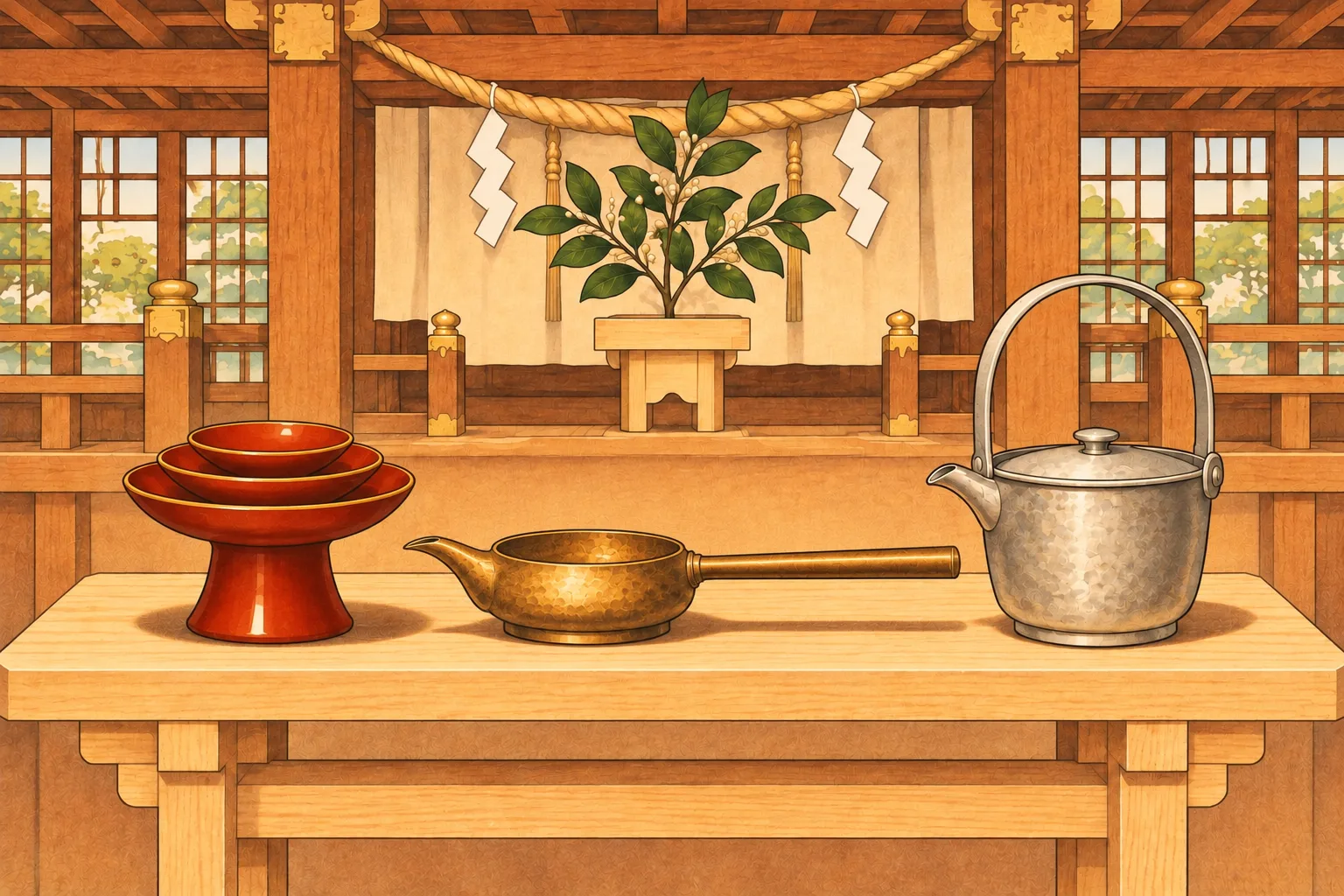
The vessels of san-san-kudo, from left: three vermilion lacquer cups nested on a stand, a long-handled chōshi, and a hisage with its arched handle.
The rite is much older than shrine weddings. It comes from sankon, a formal way of serving sake at banquets in three rounds, each with its own dish, using large, medium and small cups for nine cups in all. It appears at feasts as early as the Heian period; by the late Muromachi period terms such as shikisankon and san-san-kudo were in use, and warrior etiquette schools such as the Ogasawara school are generally credited with fixing its form before it spread to commoners. Edo-period weddings were held at home, and san-san-kudo was already essential. Shrine weddings themselves only became common in the twentieth century (the main Shinto article tells that story), and when the ceremony was designed, san-san-kudo was carried over intact, with a shrine maiden pouring and sake that had been offered at the altar. On weekends at Meiji Jingū you may see a wedding procession crossing the grounds; it is best watched from a respectful distance.
Kagami-biraki, "opening the mirror", is the breaking open of a sake cask’s lid. The round cedar lid is called the kagami ("mirror"), usually explained by its resemblance to an ancient round bronze mirror, an object in which the gods were believed to dwell. Several people raise wooden mallets, shout "yoisho!" and strike together; the lid gives way and the sake is ladled out in wooden measuring boxes (masu). It is also called kagami-wari, "mirror breaking", or kagami-nuki, but "breaking" is an unlucky word at celebrations, so "opening", with its sense of opening up good fortune, is preferred. The same word is used in January, usually on the 11th (in parts of western Japan the 15th or 20th), when the round rice cakes offered at New Year are broken and eaten.
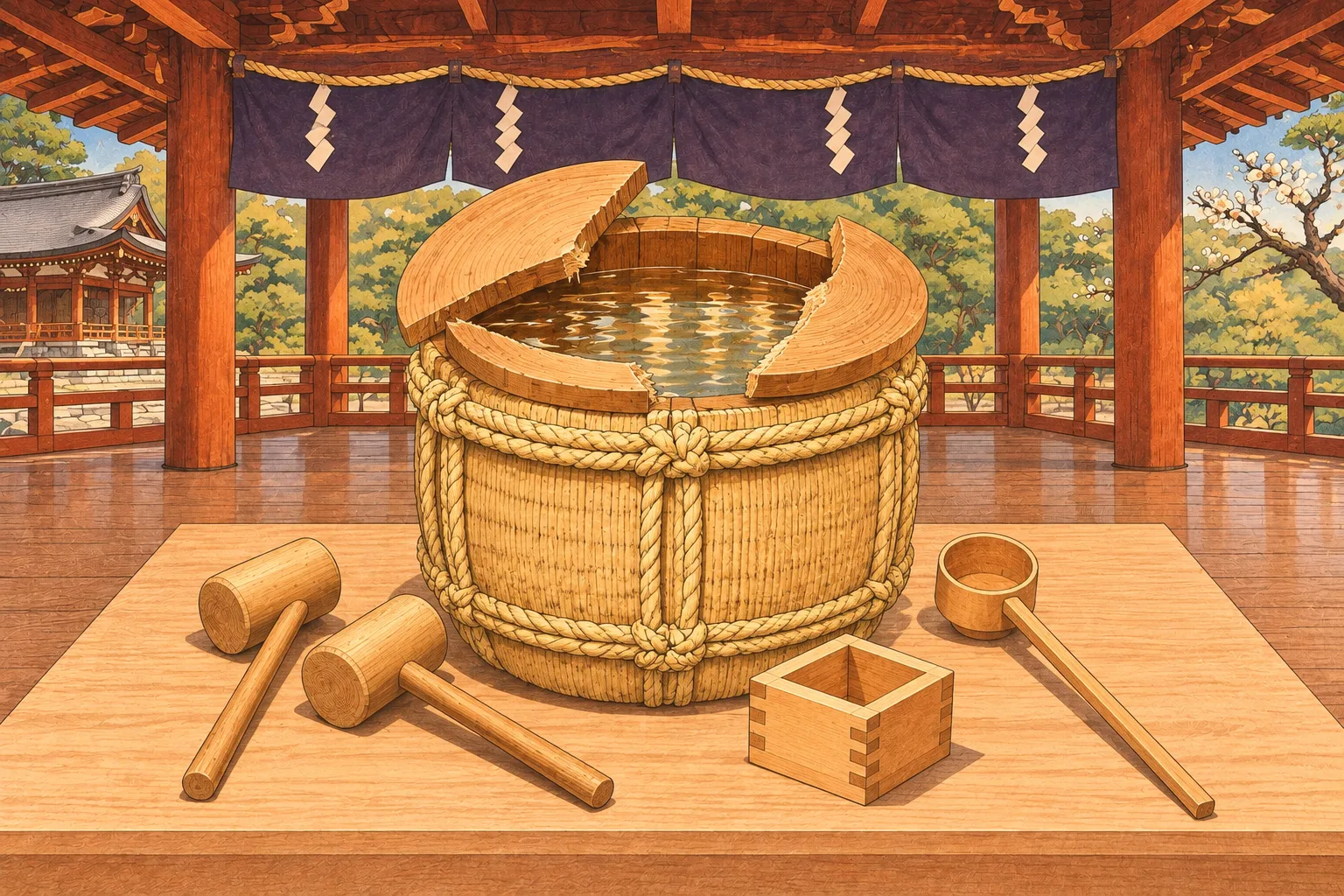
A komodaru after kagami-biraki: the round lid, the kagami, has been split open over the sake. Two wooden mallets, a masu and a long-handled ladle lie beside the cask.
The origin of cask-opening is uncertain. One explanation traces it to warriors sharing sake from a cask before battle to raise spirits; another to the old custom of sharing sacred sake after a rite. Today it is a fixture of company openings, weddings, New Year events, sports victories and election nights. Most kagami-biraki today happen outside shrines, but they are common at shrine events too. The casks used are usually smaller ones, and their lids are often loosened in advance: breaking a tightly hooped cedar lid with one blow is harder than it looks.
07Toso: The First Drink of the Year
Toso is a spiced medicinal sake drunk on New Year’s morning. A sachet of herbs called tososan, typically including Japanese pepper, balloon-flower root, cinnamon, atractylodes and saposhnikovia root, is steeped overnight in sake or mirin, and on 1 January the family drinks a little from a special set of vessels. It tastes slightly bitter and warm, like a herbalist’s shop. At the end of the year, pharmacies and supermarkets sell sachets of tososan.
The custom came from China and is said to have been used at the Heian court from around the time of Emperor Saga in the early ninth century, as part of the New Year’s Day medicine rite, to ward off evil for the year and lengthen life; it later spread to samurai households and commoners. The name has many explanations, one of them reading it as "slaying the demon called So"; all are later interpretations.
A toso set is New Year lacquerware: a vermilion pourer with a handle, three stacked vermilion cups on a cup stand, all placed on a square tray, often decorated with gold pine, bamboo, plum, crane and tortoise motifs. Traditionally the youngest drinks first and the oldest last, usually explained as passing youthful vigour up the generations, though some families start with the head of the household.
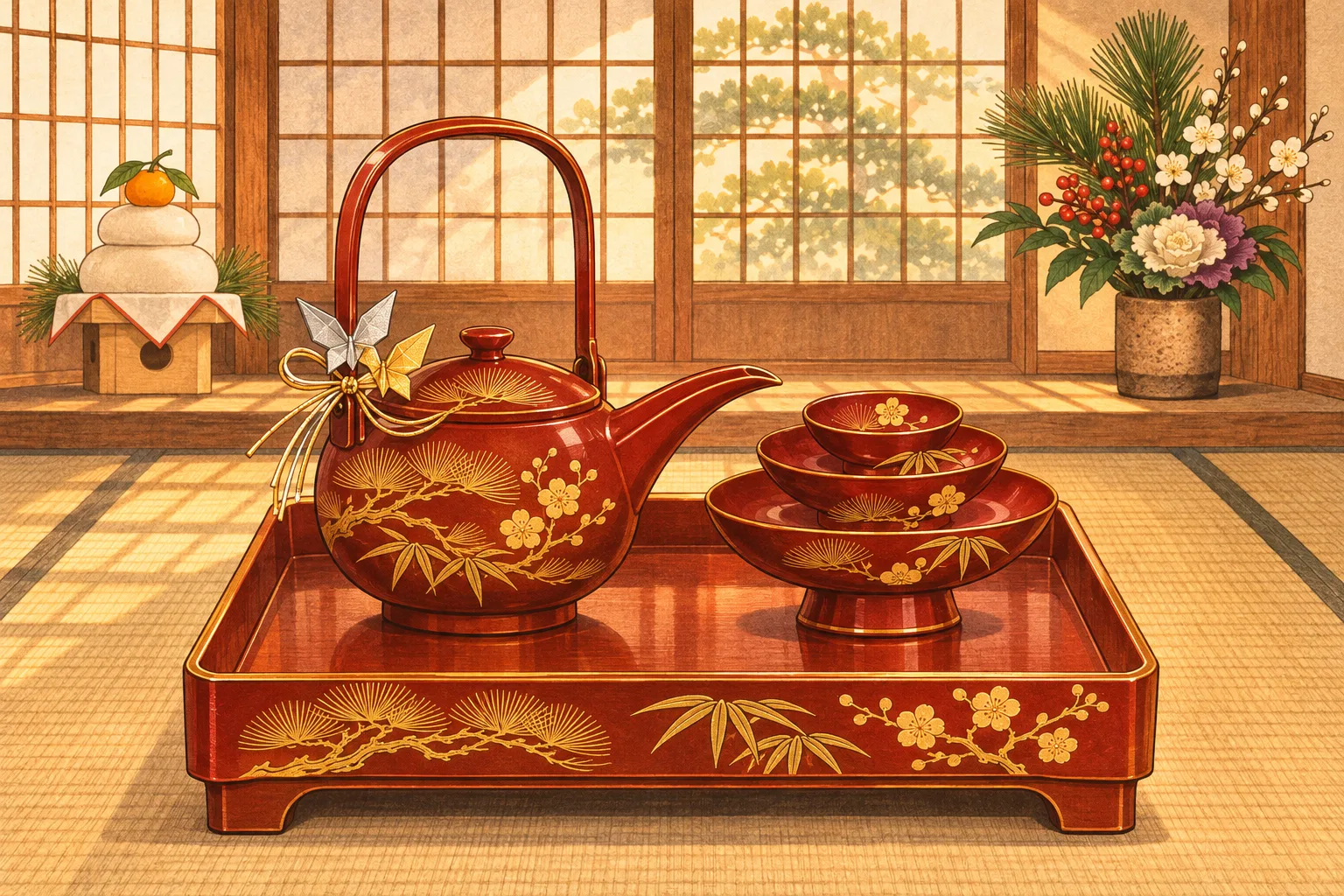
A New Year toso set: a vermilion pourer with an arched handle, tied with folded paper butterflies, and three stacked cups on a stand, all on a tray and painted with gold pine, bamboo and plum. New Year rice cakes sit behind.
Toso is a household custom, not a shrine rite, but it uses the same visual vocabulary as shrine sake: vermilion lacquer, three stacked cups, a pourer and a fixed order of drinking. Many people seeing a toso set for the first time mistake it for wedding equipment. Fewer families now make true toso, and many simply drink ordinary sake from the set and still call it toso. Ryokan and traditional restaurants sometimes set one out with the New Year meal.
08Side by Side: Sake Objects You Will See at Shrines
Several of these objects appear together and have similar names. Here is how to tell them apart. (Sake vessels in general are covered elsewhere.)
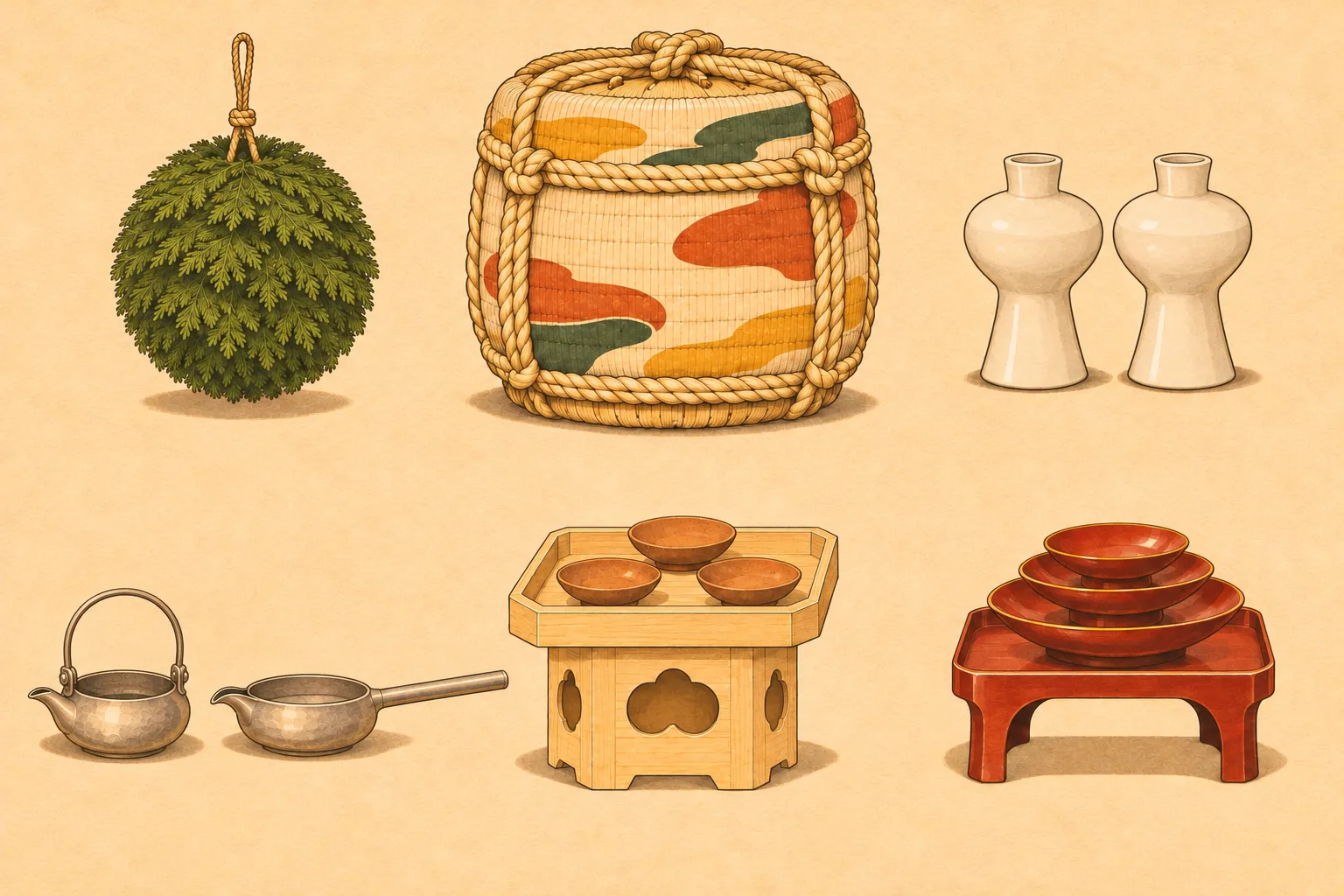
Sake objects seen at shrines. Top row, from left: sugidama, komodaru, a pair of heishi. Bottom row: a hisage and a long-handled chōshi (nagae no chōshi), three kawarake on a sanbō, and three nested vermilion cups on a stand.
The sugidama is a ball of cedar foliage hung high up, green or brown, with no writing on it. The most famous ones at a shrine are the two giants at Ōmiwa Jinja, and Matsuo Taisha hangs one at its sake museum; most others hang outside breweries and shops.
The komodaru is a straw-wrapped cask, about an armful in size, with bold printed lettering, stacked in rows. Look for the straw texture and the brand names. Some shrines also display plain cedar casks with bamboo hoops and no mat; their role is the same.
The heishi is a pair of white unglazed or ceramic flasks with a narrow mouth, broad shoulders and a tapering base, often lidded, set on a sanbō before the altar, at New Year often with a decoration of bamboo or cypress (mikinokuchi) in the mouth. It holds sake for the gods and is not used to pour for people. The small white flasks on a home altar are the same kind of object.
The hisage and the nagae no chōshi are for pouring. The nagae no chōshi is a flattish round vessel, usually metal but sometimes lacquer, with a long straight handle sticking out of its side; a shrine maiden holds it with both hands in weddings and formal rites. The hisage, usually of tin, silver or cupronickel, looks more like a small pot with an arched handle over the top and a spout. They often work as a pair, the hisage topping up the chōshi when it runs low (a practice called kuwae-chōshi as early as the Muromachi period), though the hisage can also pour directly. The difference is the handle: a long side handle for the chōshi, an overhead bail for the hisage.
The kawarake on a sanbō are for the naorai. The sanbō is a square tray of plain white wood with low rims, on a base pierced on three sides. On it sit shallow, unglazed cups of pale clay, slightly rough to the touch. Sometimes visitors may take the cup home. The same unglazed ware has another use at a few hillside sites, such as Jingo-ji temple in Takao, Kyoto, where people write a wish on a small clay dish and throw it into the valley (kawarake-nage).
The vermilion cups are flat lacquered cups, three nested by size on a stand, used for san-san-kudo and for toso. Context tells you which: in a shrine sanctuary, poured by a shrine maiden from a long-handled chōshi, it is a wedding; on a family’s New Year table with a gilded pourer and tray, it is toso.
Laid side by side, a pattern emerges. Vessels for the gods are white: plain wood, white ceramic, unglazed clay, all signalling purity. Vessels for people at celebrations are vermilion, the colour of good fortune and protection. And the cedar ball and the cask belong to the brewers: one their sign, the other their gift, carrying their trade and their names into the shrine.
More deep dives on this topic
 Reading the Fine Print on a Sake LabelPick up a sake bottle in a Japanese liquor shop and the front label will usually give you a brush-written brand name and not much else.
 Sake RicePick up a bottle of premium sake in Japan and the largest characters on the label after the brewery’s name are often the name of a rice: Yamada Nishiki, Omachi, Gohyakumangoku.
 The Yeast Starter and the YeastsBefore a sake brewery commits a ton of rice to a fermentation, it brews something much smaller: a dense, sour culture of yeast called the shubo ("mother of sake") or moto…
 From Polished Grain to Pressed SakeA sake brewery in winter is a working kitchen on an industrial scale.
 Tōji Guilds and the Brewery CrewFor most of the last three centuries, the people who actually made Japanese sake did not own the breweries and did not live near them.
 A Year of SakeWalk into the same Japanese liquor shop once a month for a year and the fridge will tell you the season before the weather does.
 Sake Vessels and Warming ToolsOrder sake in Japan and the drink often arrives in an object you have no name for: a slim-necked ceramic bottle, a cup the size of a thimble, a square wooden box filled to the…
 Sake and the GodsWalk past an old sake brewery in Japan and you will probably see a large ball of cedar hanging over its door.
 Aroma, Taste and the Four Types of SakeMost sake menus in Japan assume you already know the code.
- Back to the main article: Sake →