
Before a sake brewery commits a ton of rice to a fermentation, it brews something much smaller: a dense, sour culture of yeast called the shubo ("mother of sake") or moto ("foundation"). It uses only about seven percent of the batch’s rice, yet it decides whether the fermentation starts cleanly, and it leaves fingerprints on the finished sake. When a label says kimoto or yamahai, it is describing how this starter was made. The yeast inside has a pedigree too: numbered strains handed out by a national brewing society since 1906, prefectural strains bred for local pride, and the wild "house yeasts" that live in the beams of old breweries. This guide walks through the five ways of making a starter and the yeasts that go into them.
01Why Sake Needs a Starter at All
Brewers have an old ranking of priorities: ichi kōji, ni moto, san tsukuri, "first the kōji, second the starter, third the brewing." Kōji, rice grown over with a mould, turns starch into sugar. Yeast turns sugar into alcohol. The starter is where the yeast is raised before it is sent to work.
The problem is that a mash of steamed rice, kōji and water is warm, sweet and nutritious, and every microbe in the building wants it. Wild yeasts and spoilage bacteria that get there first can sour a batch into something undrinkable. In the Edo period a spoiled tank, called fuzō, could ruin a brewery’s season.
The defence is acid. Sake yeast tolerates acidity far better than most of its competitors, so if the starter becomes acidic before the yeast multiplies, the yeast has a walled garden to grow in. The acid that does this is lactic acid, and the whole story of starter methods is the story of where that lactic acid comes from: grown slowly by naturally occurring bacteria, or poured in from a bottle.
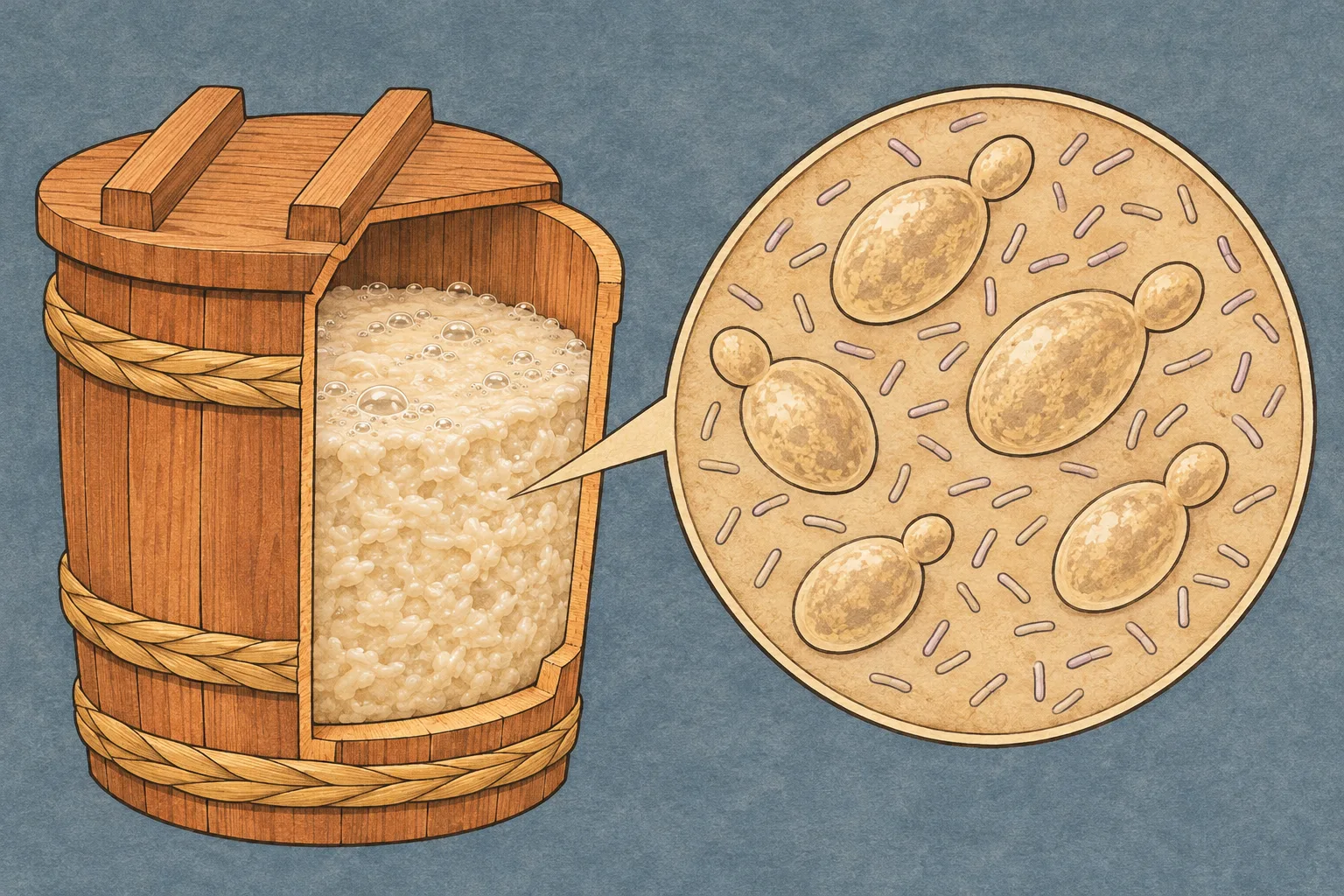
A starter tub cut open: thick rice mash with fine bubbles on top. In the magnified circle, the budding ovals are yeast and the tiny rods are lactic acid bacteria.
A finished starter holds something like one to two hundred million yeast cells per gram. It smells like a cross between rice porridge and yoghurt. It is then moved into a larger tank and built up in three additions of rice, kōji and water into the main mash, the moromi. Those later stages belong to a different story; what matters here is that a strong starter gives the main mash a strong start.
02Bodaimoto: Sour Water from a Mountain Temple
The oldest method still practised is bodaimoto, also called mizumoto, "water starter." It is tied to Shōryakuji, a temple on Bodaisen, a wooded hill southeast of Nara city. In the Muromachi period (roughly the fourteenth to sixteenth centuries) the great temples of Nara were famous for their sōbōshu, monastery-brewed sake, and Shōryakuji’s brew, known as Bodaisen, is often cited as an early example of morohaku, sake made with polished rice for both the kōji and the main mash. A stone erected at the temple in 2000 calls it the birthplace of Japanese clear sake. That is the temple’s claim and a popular one; historians do not agree on a single birthplace, but bodaimoto is widely accepted as the oldest starter type that can still be made today.
The heart of the method is soyashi-mizu, sour soaking water. Raw rice is soaked in water together with a small cloth bag of cooked rice. Over a few days at mild room temperature, lactic acid bacteria living on the rice feed on what leaches out, and the water turns sour and slightly fizzy, smelling of yoghurt, rice bran and even a little cheese.
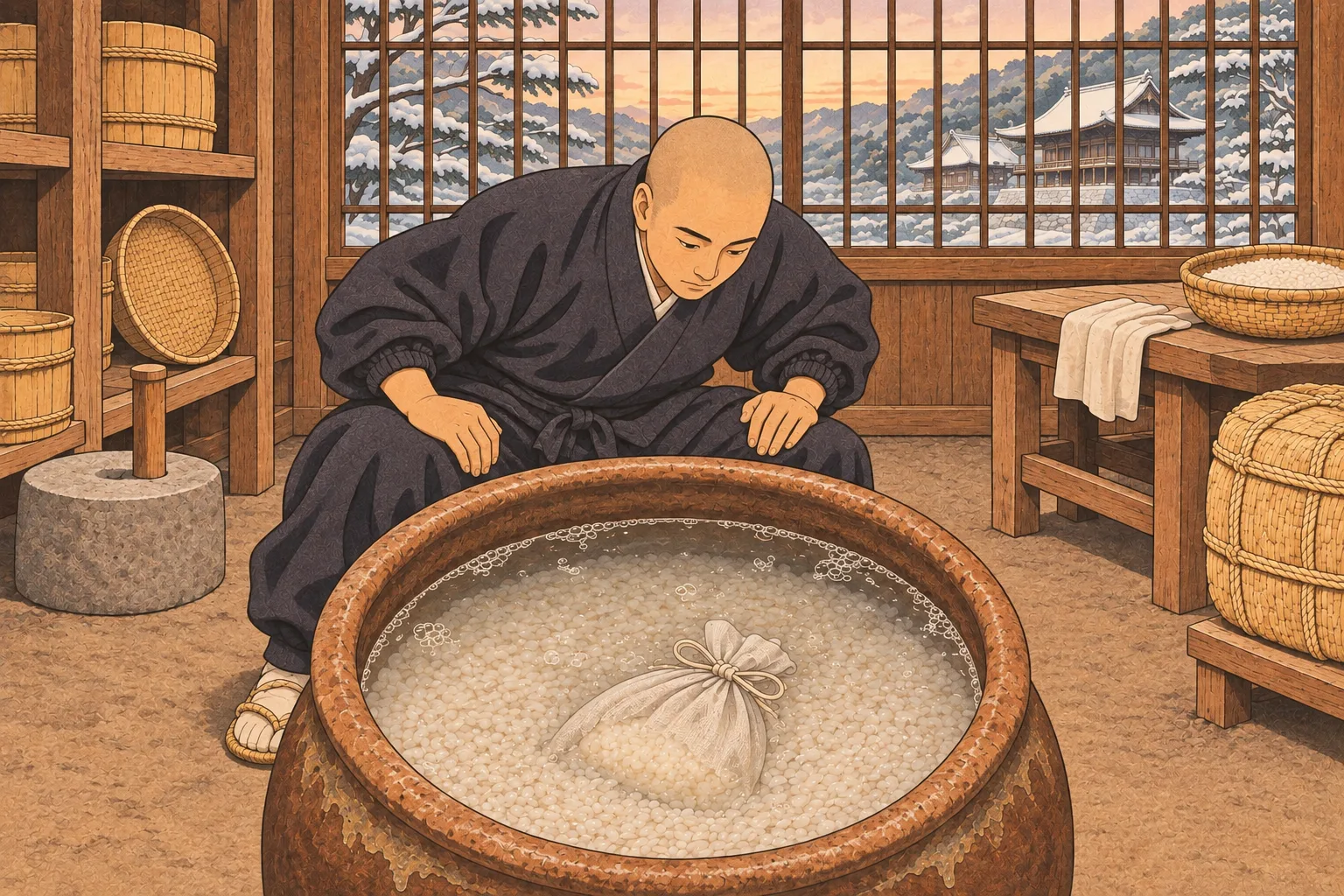
The first step of bodaimoto: raw rice soaking in a jar with a small cloth bag of cooked rice, fine bubbles already rising. A winter scene at Shōryakuji (artist’s impression)
The brewer then lifts out the soaked rice, steams it, and returns it to the sour water along with kōji. With the acid already in place, yeast can grow safely. In the past the yeast arrived on its own from the air and the equipment; today most breweries add a cultured strain. From soaking to a usable starter takes roughly one to two weeks. Because it does not depend on deep cold, bodaimoto belongs to a time before Japanese brewing settled into the winter-only kanzukuri system.
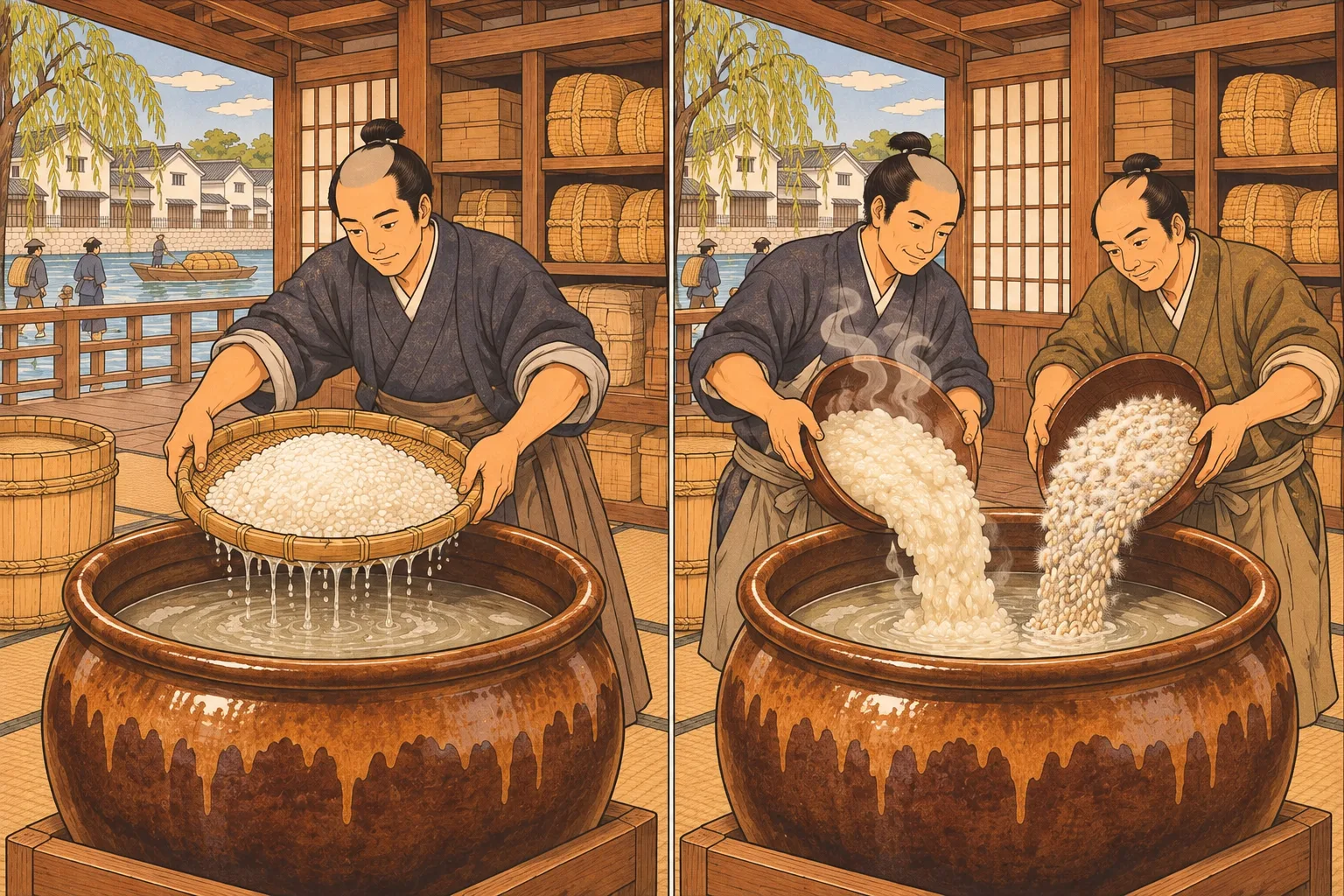
Bodaimoto in two steps. Left: the soaked raw rice is lifted out of the sour water. Right: the steamed rice and the kōji go back into the same jar (artist’s impression)
As the cold-weather kimoto method of the Itami and Nada brewing districts took over in the Edo period, bodaimoto was lost. In 1996 some fifteen Nara breweries, the prefectural technology centre and the temple formed a study group to revive it, collecting microbes on the temple grounds, isolating lactic acid bacteria and yeast, and following the recipe in a Muromachi-period brewing text, the Goshu no Nikki. In 1998 Shōryakuji obtained a licence to make sake starter, and since January 1999 the member breweries have gathered at the temple each January to make a batch of bodaimoto that is divided among them, each finishing it into its own sake. The temple’s Bodaimoto Sake Festival in early January has become a small winter fixture in Nara.
One detail sets bodaimoto apart from everything that came later: its key acid is made while the rice is still raw. In kimoto and yamahai the bacteria work on steamed rice and kōji; in bodaimoto they finish most of their job in the soaking water before the rice is ever cooked. The soaked grains come out slightly softened and sour-smelling. The Goshu no Nikki’s entry on Bodaisen already describes this sequence: a little cooked rice in a basket buried in the soaking rice, the clear water drawn off after a few days and used to brew, long before anyone knew what a lactic acid bacterium was.
Bodaimoto sakes tend to be noticeably tart, often with some sweetness and a round, almost lactic body. Several Nara breweries release them, and outside Nara the Tsujimoto brewery in Katsuyama, Maniwa, Okayama Prefecture, maker of Gozenshu, has built its identity around the method and aims to use it for all its sake.
03Kimoto: Poles, Shallow Tubs and Winter Nights
If bodaimoto belongs to the temples, kimoto belongs to the big commercial breweries of the Edo period. It was perfected in winter brewing at Itami, Ikeda and Nada, and it runs on three things: cold, labour and time.
The work begins with hangiri, cedar tubs far wider than they are deep. The name means "cut in half," as if a full barrel had been sawn through at the waist. Steamed rice, kōji and water are divided among a row of these tubs, whose shallowness exposes the mixture to the cold air. Traditionally this was night work, keeping the mash around 6 to 7°C.
Once the rice has absorbed the water, the brewery workers take up long wooden poles called kai and begin yama-oroshi, "bringing down the mountain," also called moto-suri, "grinding the starter." Several people work each tub, pressing, grinding and pushing the rice into a paste. The grinding is repeated in several rounds a few hours apart, often through the night until dawn. To keep time and stay awake, breweries had their own work songs, moto-suri uta, with one voice leading and the rest answering, the knock of the poles on the tub bottoms setting the beat. When breweries demonstrate kimoto today, this is the scene they show: steam in a cold wooden hall, a row of tubs, figures in white bent over their poles.
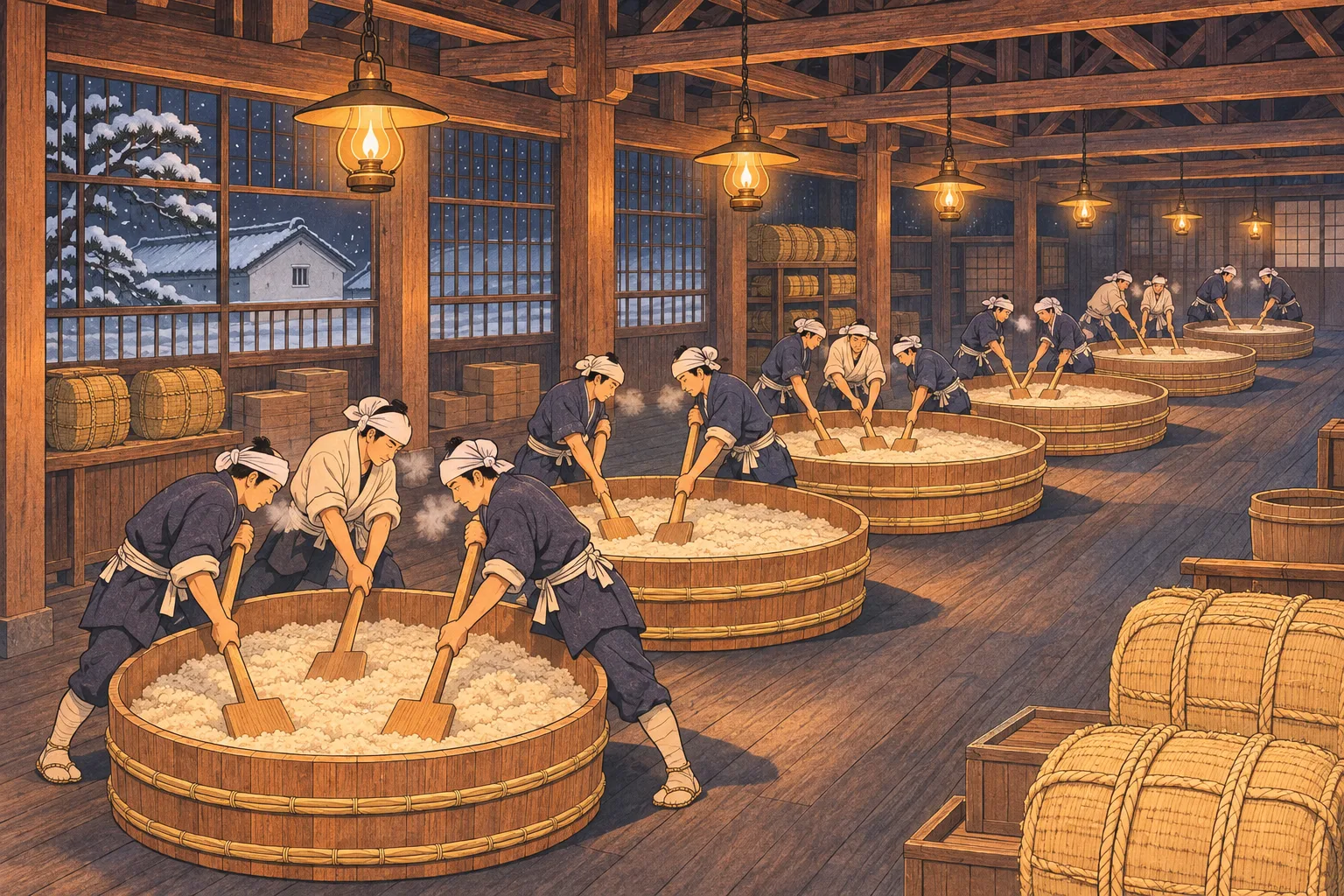
Yama-oroshi on a winter night: teams of workers at a row of shallow hangiri tubs grind the rice to a paste with long kai poles (artist’s impression)
The paste is then gathered into a larger vessel and left in the cold for several days. This is where kimoto becomes clever. The first microbes to thrive are bacteria that convert the nitrate in the water into nitrite, which is toxic to wild yeast; they clear the ground. At almost the same time cold-tolerant lactic cocci start making acid, and as the temperature rises, rod-shaped lactobacilli that make more acid take over and the acidity climbs. Eventually the yeast takes hold and the alcohol it makes kills off the lactic bacteria.
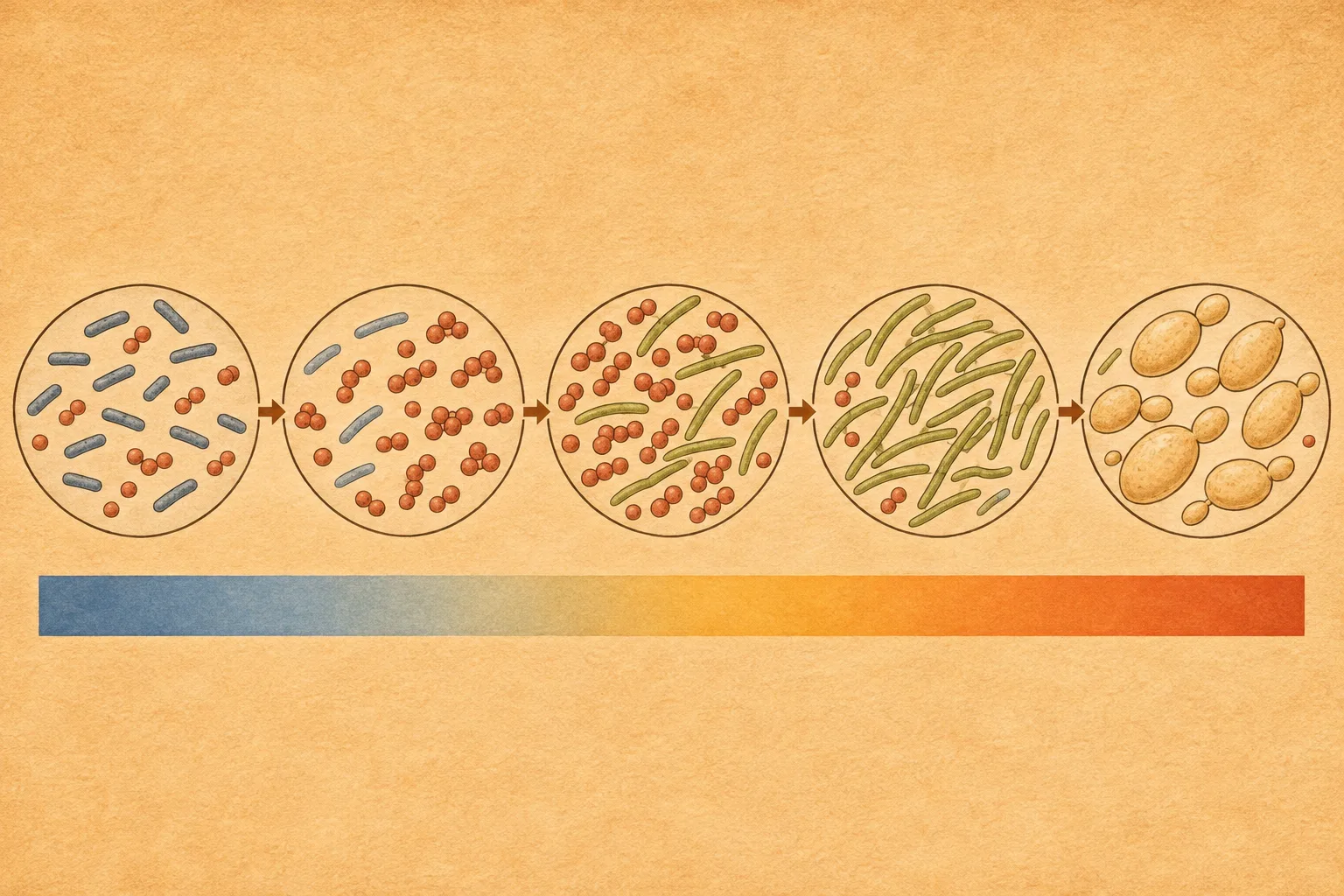
The microbial relay in kimoto, left to right: nitrate-reducing rods and lactic cocci come first, long lactobacilli take over, and budding yeast ends the sequence. The band below shows the temperature rising from cold to warm.
A traditional kimoto calendar might run like this. Day one: the mash goes into the tubs in the evening, and the grinding continues in rounds through the night. Day two: the paste is combined. Days three to six or so: a cold rest. The following ten days or so: the dakidaru goes in each day, temperatures are taken, the brewer smells and tastes. Around the third week the yeast rises. The last days are for splitting, cooling and resting. A head brewer would be running several starters at staggered dates, so the grinding songs could be heard in the brewery every few nights all winter.
Next comes warming. A small wooden keg filled with hot water, the dakidaru, is lowered into the starter to raise its temperature little by little each day. Push too fast and spoilers get a chance; too slow and the yeast never wakes. Most breweries add cultured yeast at around this point, though in the Edo period the yeast simply drifted in from the brewery. When the yeast takes off, the surface fizzes with fine bubbles and the whole mass swells. The starter is then split into smaller tubs to cool and left to settle for several days before use. From start to finish, kimoto takes about four weeks.
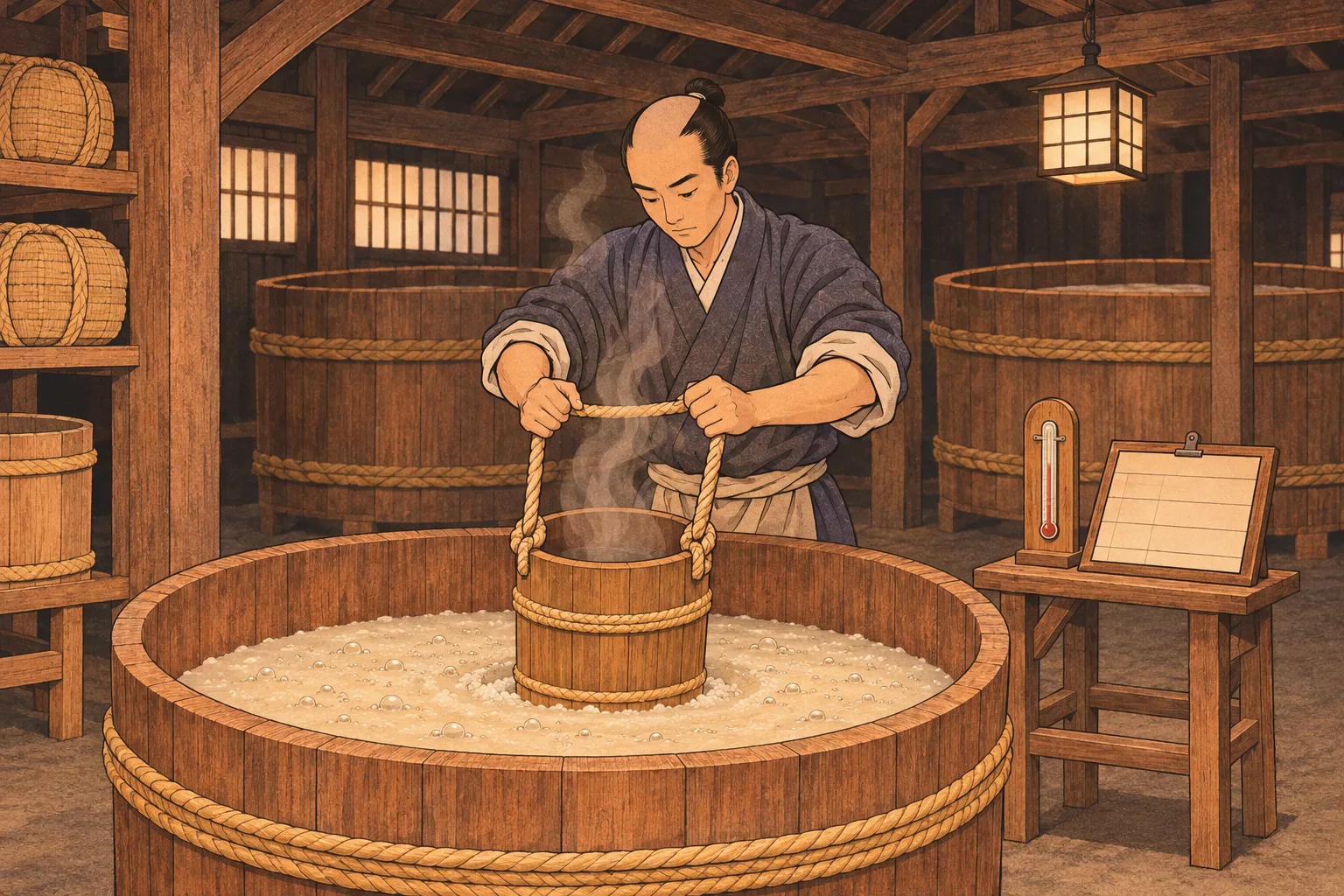
Warming: a keg of hot water, the dakidaru, is lowered by its rope into the starter, whose surface has begun to bubble; a thermometer and record board stand by (artist’s impression)
Why grind? The traditional explanation was that crushing the rice lets the kōji’s enzymes release sugars and nutrients faster, feeding the bacteria and yeast. As the next section shows, scientists found in 1909 that the grinding could be skipped. Breweries that still do it argue that it produces a more even, more stable starter, and many also simply refuse to let the skill die.
Kimoto sakes are often described as firm, with clear acidity and a clean finish; they open up when warmed and age well. Style depends just as much on rice, polishing, yeast and the brewer’s choices, and there are light, bright kimoto sakes too, so the word on the label is a hint rather than a guarantee.
Three breweries show the range. Daishichi in Nihonmatsu, Fukushima Prefecture, says it has brewed only by kimoto since its founding. Kiku-Masamune in Kobe’s Nada district, committed to dry sake, uses kimoto even for everyday bottlings sold nationwide. Aramasa in Akita city switched its entire production to junmai kimoto in the 2014 brewing year and began moving to cedar vats in 2013.
04Yamahai: The Step That Science Removed
Yamahai is short for yamaoroshi haishi moto, "starter with yama-oroshi abolished."
In the early twentieth century the Ministry of Finance’s National Research Institute of Brewing in Tokyo began studying sake scientifically. In 1909 a team including the engineer Kagi Kin’ichirō showed that if the kōji is soaked in water first, making mizu-kōji, so its enzymes dissolve into the liquid before the steamed rice goes in, the rice breaks down on its own nearly as well as if it had been ground by hand.
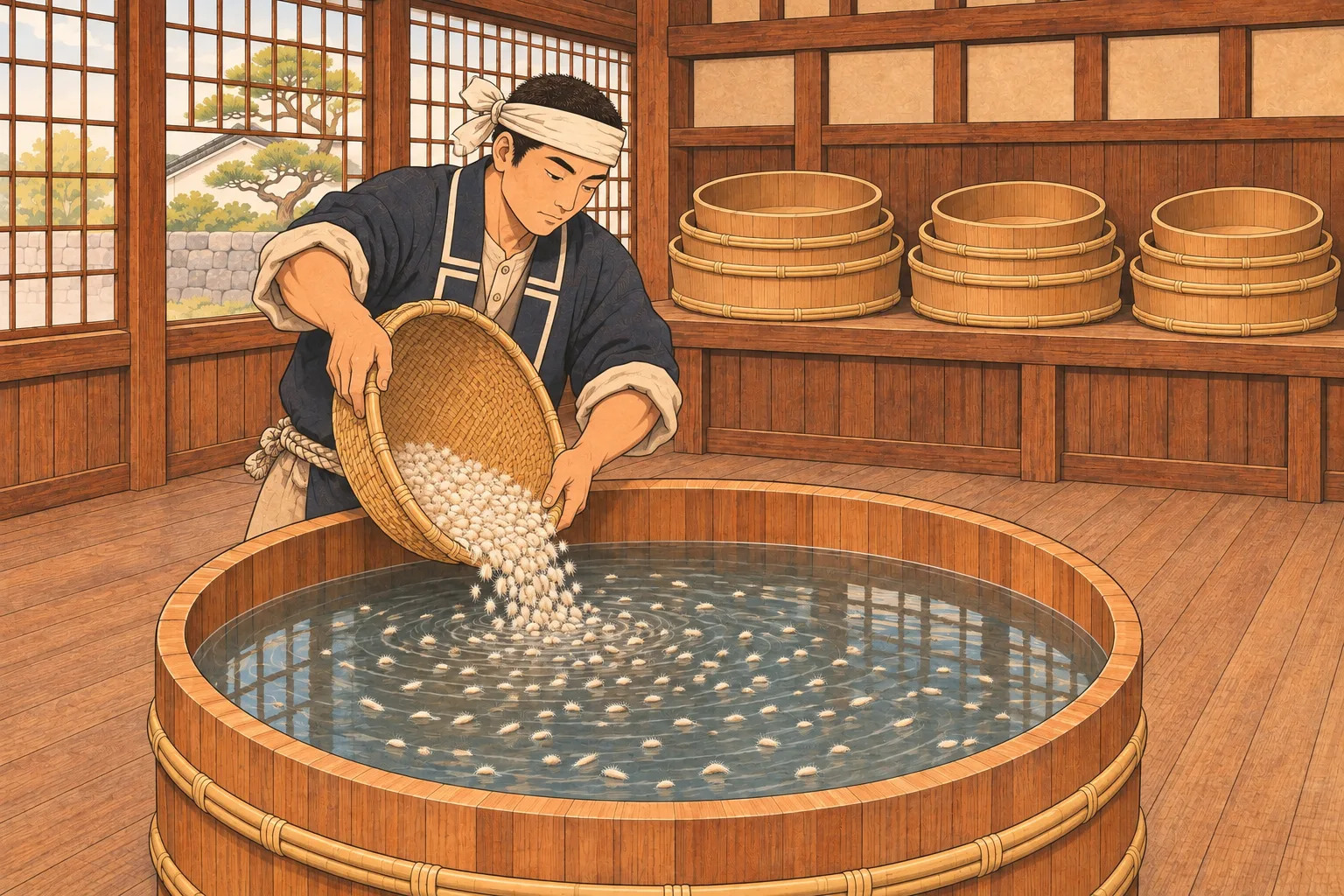
Yamahai begins with mizu-kōji: kōji is tipped into a tub of water so that its enzymes dissolve first. The hangiri tubs, no longer needed, are stacked by the wall.
Everything else follows the kimoto pattern: a cold rest, the relay of nitrate-reducing and lactic acid bacteria, gradual warming, yeast, fizzing, cooling. The timescale is the same, around three to four weeks. Without the night-long grinding, yamahai gradually spread, and many kimoto breweries switched. Kimoto and yamahai together are called the kimoto-kei, the kimoto family.
Yamahai saved more than effort. Grinding needed teams of skilled workers on night shifts, many times a season; with the kōji-water method a brewery could run its starter room with fewer hands and more flexible timing, which mattered to small country breweries short of labour and competing with the big houses. Some brewers also argue that unground rice dissolves more slowly, giving the bacteria and yeast a gentler relay and the starter a more distinct personality.
In popular imagination yamahai is the wilder sibling: higher acidity, deep umami, notes of nuts, mushrooms or dairy, often a golden tint. Much of that reputation comes from Ishikawa Prefecture. Kikuhime in Hakusan revived the yamahai starter in 1983 and has made it its signature, and Shata Shuzō, maker of Tengumai, on the same Kaga plain, is known for yamahai too; its yamahai junmai, golden-yellow and full, is often cited as the classic example. It is the reason many drinkers assume yamahai is always heavier than kimoto, though the difference has more to do with each brewery’s taste than with whether the rice was ground.
05Sokujō and Kōon Tōka: The Twentieth-Century Shortcuts
Kimoto and yamahai both wait for bacteria to make the acid. In 1910 another researcher at the same institute, Eda Kamajirō, proposed the obvious shortcut: if lactic acid is what you need, add it at the start. The result was sokujōmoto, "quick-brewed starter." The first version was ready in five to seven days, yet it spread slowly: in Nada it did not account for more than half of starters until after the Second World War.
The method is simple. Water, a measured dose of food-grade lactic acid, kōji and steamed rice go into the starter tank together with cultured yeast. The mash is acidic from the first minute, so there is no bacterial relay and no need to wait in the cold. Today a sokujō starter is ready in roughly two weeks, half the time of kimoto.
Sokujō is reliable and scales well, and today it accounts for the great majority of sake made in Japan, including most ginjō and daiginjō paired with aromatic yeast strains. The sakes are typically clean and light, letting rice and yeast aromas lead. Labels rarely mention it, so a sake that says nothing about its starter is almost always sokujō.
Kōon tōka moto, "high-temperature saccharification starter," cuts the corner further. Kōji, steamed rice and water are held at about 50 to 60°C for several hours. That is the range where the kōji’s sugar-making enzymes work fastest, and it also kills most stray microbes. Once the rice has turned to a sweet liquid, it is cooled quickly through chilling coils to around 20°C, and lactic acid and yeast go in. The whole process usually takes about a week. It is used mostly where efficiency matters; accounts differ on exactly when and by whom it was introduced.
These faster methods also freed the starter from winter. With cooling jackets and air conditioning, large breweries can now brew all year, a system called shiki jōzō, "four-season brewing." In a modern plant the starter is a few stainless-steel tanks wrapped in cooling coils and studded with temperature probes, a world away from a cold room full of cedar tubs.
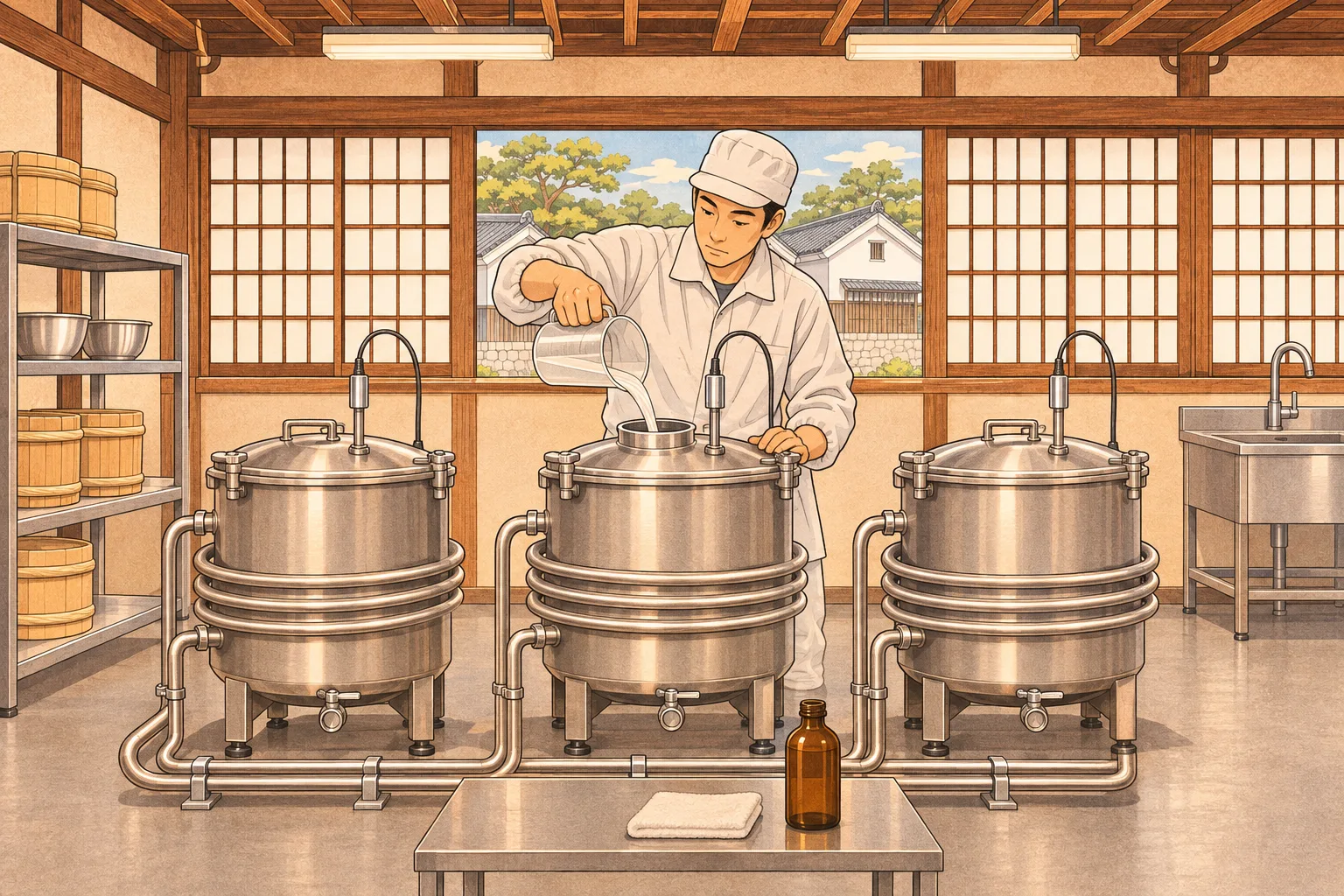
A starter room today: small stainless-steel tanks wrapped in cooling coils and fitted with temperature probes. A worker pours a measured dose of lactic acid into the tank; the brown bottle stands on the table.
There are hybrids as well. Kidoizumi in Chiba Prefecture has since 1956 used a "high-temperature yamahai" starter, made hot but still relying on natural lactic acid bacteria, producing distinctly tart sakes that refuse to fit anyone’s categories.
06Five Starters Side by Side
Method. Bodaimoto first makes a sour water from raw rice, then raises yeast in it. Kimoto grinds steamed rice and kōji in shallow tubs and lets microbes take turns in the cold. Yamahai replaces the grinding with a kōji-water soak and otherwise follows kimoto. Sokujō adds lactic acid and yeast directly. Kōon tōka saccharifies at 50 to 60°C, cools, then adds acid and yeast.
Time. Kimoto and yamahai are the slowest at about three to four weeks. Sokujō takes about two. Bodaimoto takes one to two counting from the soak. Kōon tōka is the fastest at about a week.
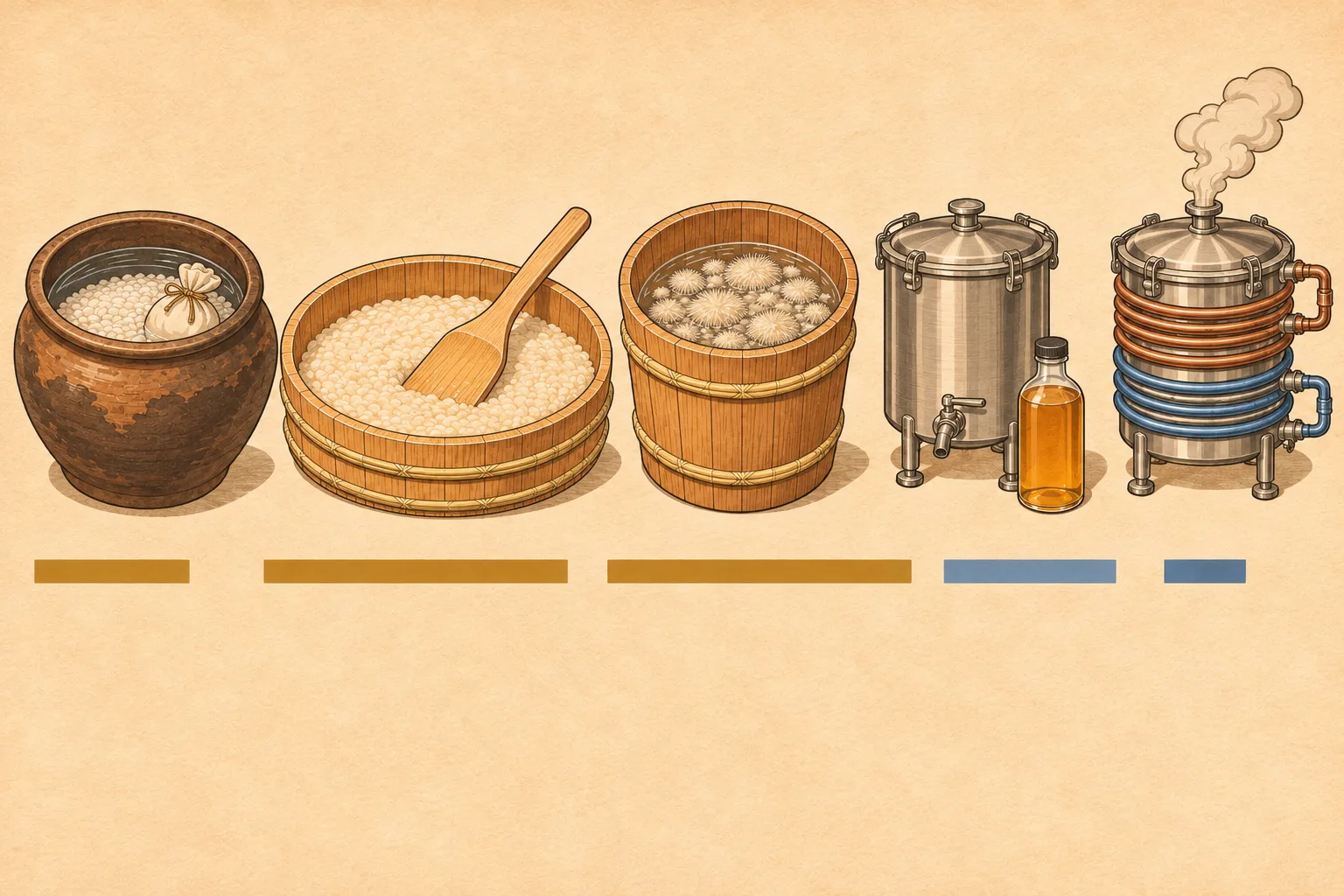
The five starters, left to right: bodaimoto (a jar of soaking raw rice with its bag of cooked rice), kimoto (a hangiri tub and pole), yamahai (a tub of kōji in water), sokujō (a steel tank and a bottle of lactic acid), kōon tōka (a tank wrapped in heating and cooling coils). The bars compare the days each takes; gold means lactic acid from natural bacteria, blue means added acid.
Source of lactic acid. Bodaimoto, kimoto and yamahai rely on naturally occurring bacteria: in bodaimoto they work in the soaking water first, in kimoto and yamahai they work in the rice-and-kōji paste alongside the nitrate reducers. Sokujō and kōon tōka add the acid, and kōon tōka adds a heat step that sterilises as well.
Typical style. Bodaimoto: tart, often sweet, lactic. Kimoto: firm, clear acidity, good warm and with age. Yamahai: richer, more umami, sometimes wild. Sokujō: clean and light, the base of most ginjō. Kōon tōka: clean, mostly for everyday sake. These are tendencies, not rules.
On the label. The first three are usually named: look for 菩提酛 or 水酛, 生酛 (kimoto), 山廃 (yamahai). The last two almost never are.
07The Kyōkai Yeasts: A Numbered Family
Until the twentieth century, every brewery used whatever yeast lived in it, and quality was partly luck. From 1906 the national brewing institute and the Brewing Society of Japan began isolating yeast from the mash of breweries known for excellent sake, and the Society cultured the best strains and distributed them nationwide. These are the kyōkai kōbo, "society yeasts," numbered roughly in the order they appeared.
No. 1 came from Sakura-Masamune in Nada, No. 2 from Gekkeikan in Fushimi, Kyoto, and Nos. 3 to 5 largely from Hiroshima breweries. All five had been withdrawn by 1939, partly because they lost their good qualities over generations of subculturing. Genetic studies later showed that Nos. 1 to 5 belong to a different lineage from the society yeasts used today.
No. 6 is the oldest strain still in use. It was isolated in 1930 from a yamahai starter at Aramasa in Akita and released in 1935. It ferments strongly and steadily even at low temperatures, with soft, restrained aromas and a light, clean style. Aramasa has used No. 6 exclusively since the 2009 brewing year, treating it as a family heirloom.
No. 7 was isolated in 1946 at Miyasaka Brewing, maker of Masumi, in Suwa, Nagano Prefecture, and released the same year. Vigorous, aromatic and forgiving, it became one of the most widely used yeasts in the country, and for decades much of Japan’s sake was, in effect, No. 7 sake.
No. 9 comes from Kumamoto, where in 1953 Nojiro Kin’ichi of the Kumamoto Prefectural Sake Research Institute isolated it from the mash of the institute’s own sake, Kōro. It went to Kumamoto breweries as Kumamoto or Kōro yeast from 1964 and nationwide as No. 9 from 1968. It gives bright ginjō aromas, excels in long, cold fermentations, and has long been one of the most common yeasts in competition ginjō.
No. 10, known as Meiri Ogawa yeast, is said to have been isolated in 1952 by Ogawa Chikara and colleagues from the mash of Tōhoku breweries; it was long kept by Meiri Shurui in Ibaraki and distributed by the Society from 1977. It makes little acid and high ginjō aroma. No. 11 is a mutant of No. 7 that ferments cleanly even in a long mash and leaves few amino acids. No. 12 was isolated in 1965 from a ginjō mash at Urakasumi in Miyagi, and No. 13 is a hybrid. No. 14, known as Kanazawa yeast, comes from the Hokuriku region, where it is widely used; it is low in acid and suited to a moderately long, cool mash.
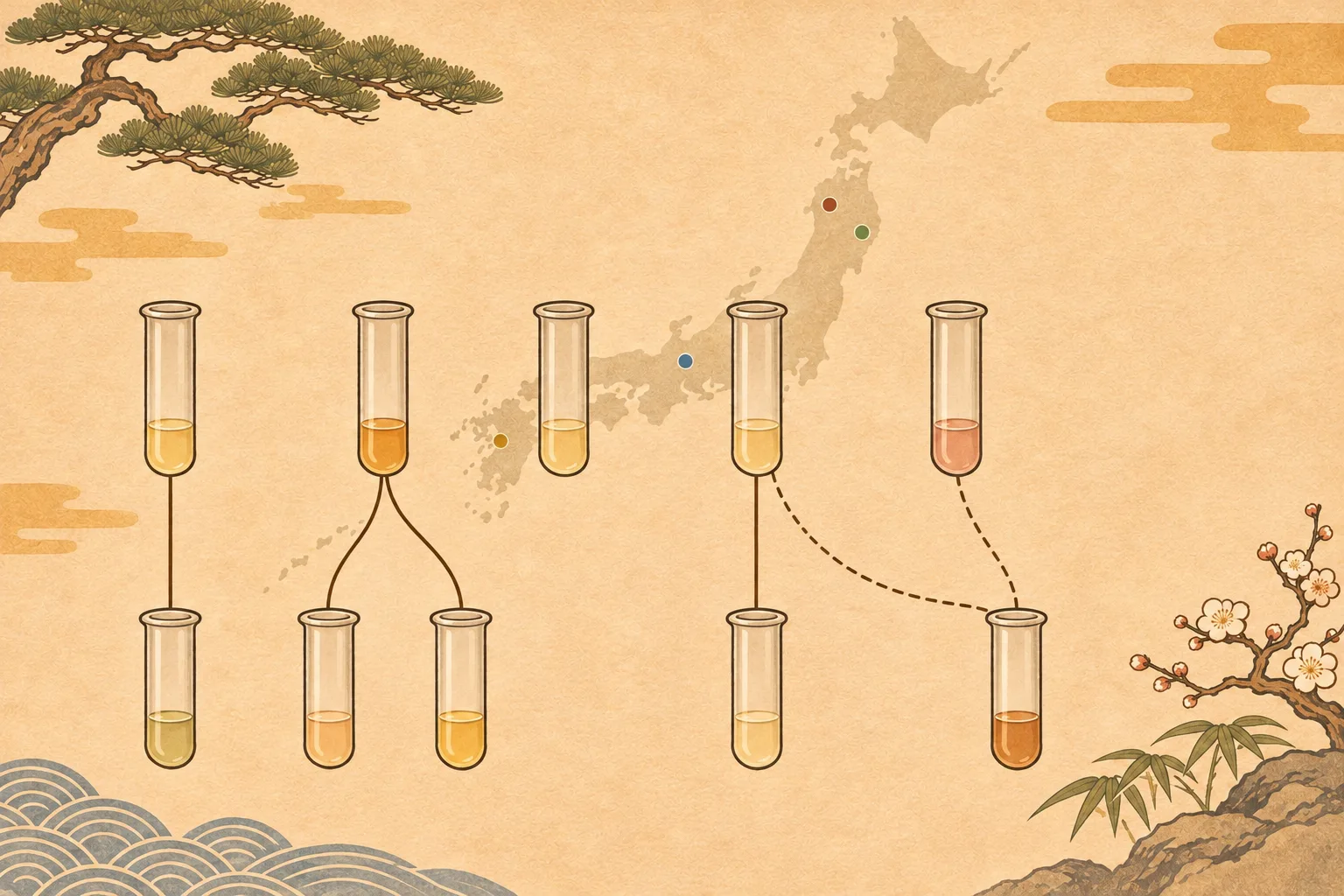
How the Kyōkai yeasts relate: the main parent strains in the top row, the strains derived from them below. Solid lines mark mutants, dashed lines hybrids; the dots on the map show where several of the strains were first isolated.
No. 1801, put into use in 2006, is a hybrid, generally said to come from the aromatic strain No. 1601 and a No. 9-line strain. It makes little acid and high levels of both main ginjō aroma compounds, and is best known for intense apple and pear notes; it is a common choice for competition daiginjō.
Society yeasts used to be sent out as cultures; today they come in small pouches of liquid culture and as dried yeast. A brewery orders its strains each season and builds them up in its own starters. The same numbered yeast behaves differently in different breweries, with different rice and water, which is part of what a brewer’s skill means.
Two aroma compounds explain most ginjō talk. Isoamyl acetate smells of banana and melon; ethyl caproate smells of apple and pear. Nos. 9 and 14 generally lean toward the first; No. 1801 is known for the second. Later, screening yeast for resistance to a compound called cerulenin produced strains that pump out ethyl caproate, and fashion in ginjō drifted from banana toward apple.
08Foamless, Prefectural and House Yeasts
Strains whose numbers end in "01," such as 601, 701, 901, 1001, 1401 and 1801, are awanashi kōbo, foamless yeasts. Ordinary yeast throws up a thick, rising foam at the height of fermentation, sometimes over the rim of the tank. Breweries once kept a watchman up through the night to knock it down, later replaced by mechanical foam breakers, and tanks could only be filled to between half and two-thirds of their capacity.
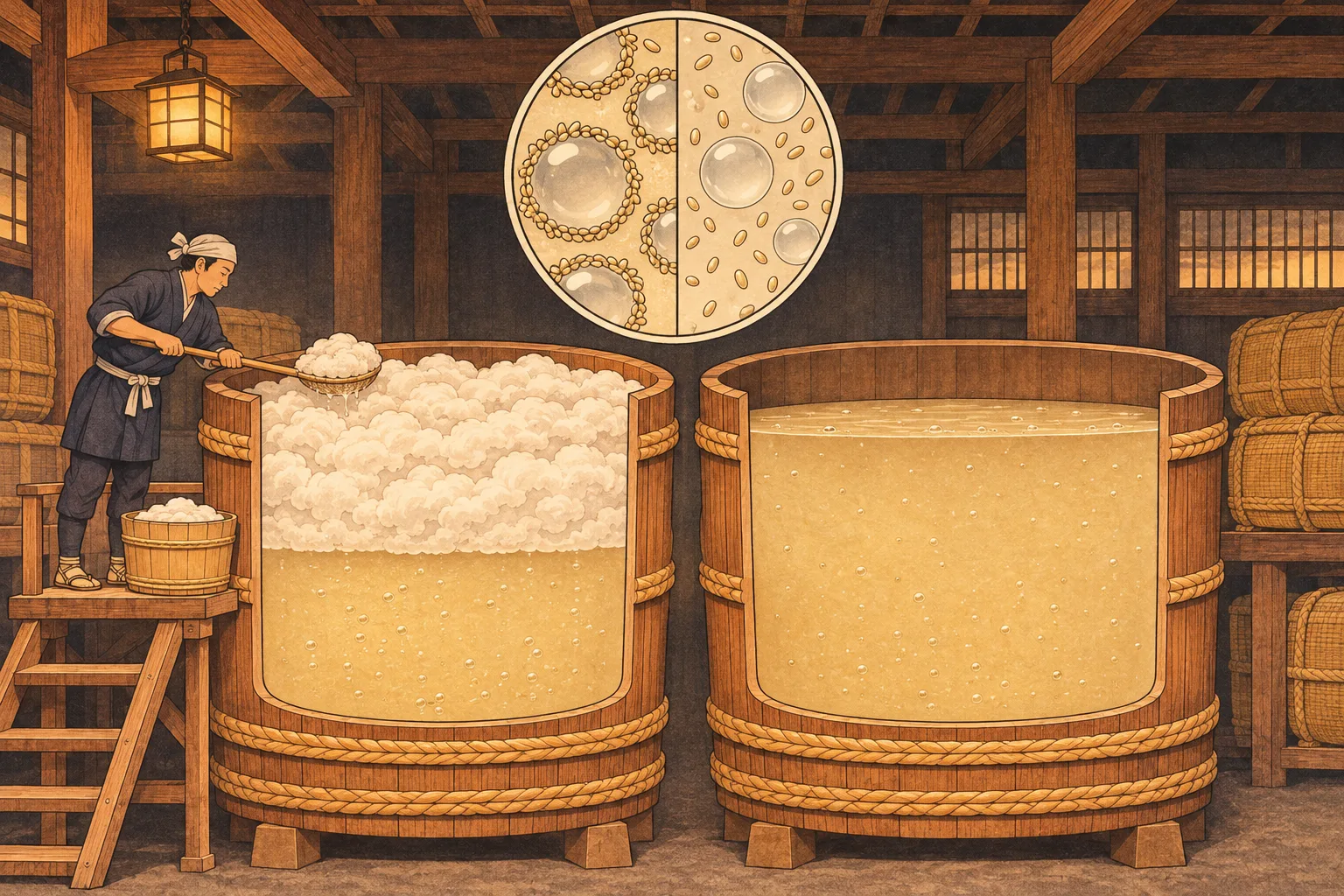
Left: ordinary yeast in a tank filled little more than halfway, the foam up to the rim and a man knocking it down. Right: foamless yeast in a fuller tank with a calm surface. In the circle, yeast lines up around the bubbles on the left and ignores them on the right.
Around the 1960s a brewery in Shimane Prefecture found a tank of mash that threw no foam yet still made alcohol. A team at the national institute that included Akiyama Yūichi traced the cause to the cell wall: foaming yeast has a water-repellent surface and lines up around bubbles, holding them up as a thick head, while foamless yeast has a water-loving surface and ignores them. By bubbling air through a culture, they floated off the foaming majority and kept the rare foamless mutants, and in this way produced foamless versions of the main society yeasts. From the 1970s foamless strains spread, letting the same tanks hold 20 to 30 percent more and freeing brewers from the night watch. Because the shape of the foam had long been how brewers read a fermentation, and a mash without foam was feared as a sign of spoilage, some were uneasy at first.
Prefectural yeasts are a separate branch. From the 1970s and 1980s, prefectural research centres began breeding local strains to give their sake a regional identity. The best-known success is Shizuoka, where between the late 1970s and early 1980s Kawamura Denbei and colleagues at the prefectural industrial research station developed Shizuoka yeast, including HD-1; combined with soft water and long cold fermentation, it produced light sakes with melon and banana notes that did very well at the national new-sake competition and earned Shizuoka the nickname "ginjō kingdom." Akita has its Akita Ryūka yeast, Fukushima its Utsukushima Yume yeast, Nagano the Nagano yeasts of its prefectural technology centre, and Yamagata, Kōchi and Miyagi their own lines. From 1998 Professor Nakata Kubo of Tokyo University of Agriculture developed "flower yeasts" collected from blossoms such as pinks, climbing roses, begonias and periwinkles, which some breweries use for distinctive bottlings.
Finally there are kuratsuki kōbo, house yeasts that live naturally in a brewery’s air, beams, vats and tools. Every Edo-period kimoto depended on them, and they are part of what brewers call kura-guse, the quirk that makes one house’s sake unlike another’s. Most breweries switched to isolated strains for consistency, but a few deliberately add no yeast, make everything by kimoto and let their resident yeast settle into the starter, Terada Honke in Chiba Prefecture being a well-known example. Others have re-isolated yeast from their own buildings and culture it like a society strain. The society yeasts began the same way: No. 6 was Aramasa’s house yeast and No. 7 was Masumi’s.
House yeast is not automatically better. It may ferment weakly, throw off-flavours, or vanish one season, so breweries that rely on it have to watch their starters more closely and decide earlier whether to rescue them. Its admirers value what cannot be copied: a brewery’s sake still tastes like that brewery ten years later, because it is made by the same community of microbes living in the same rafters.
Step into the starter room of an old brewery and you may see a stack of wide, shallow hangiri against the wall, a small starter tank wrapped in insulating cloth, a dakidaru hanging from a hook, and handwritten charts of temperature and acidity. If a board nearby reads "701" or "1801," that is the name of the yeast invited in for the season.
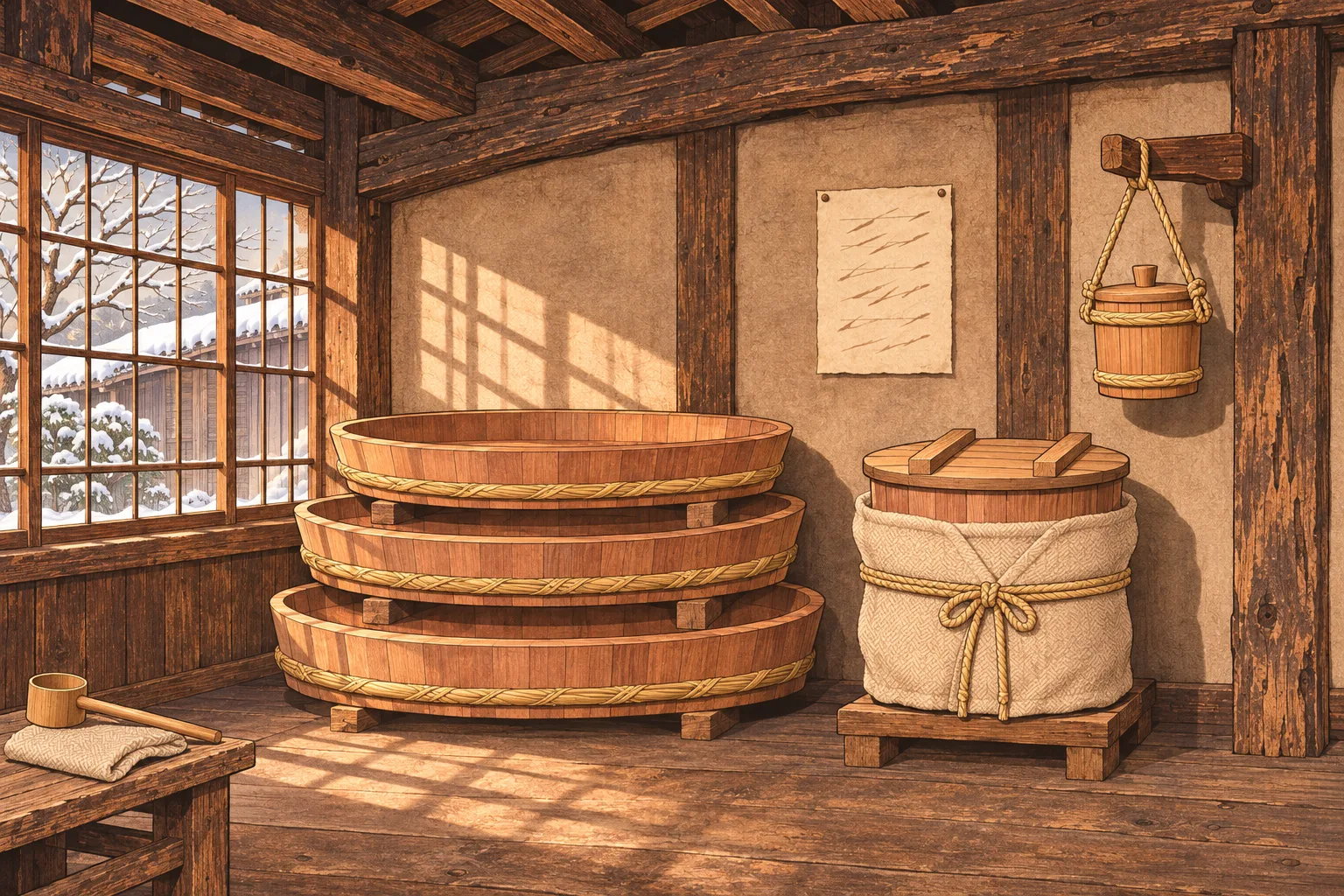
A corner of an old starter room: hangiri tubs stacked against the wall, a small starter tank wrapped in insulating cloth, a dakidaru on its hook and a handwritten chart on the wall.
More deep dives on this topic
 Reading the Fine Print on a Sake LabelPick up a sake bottle in a Japanese liquor shop and the front label will usually give you a brush-written brand name and not much else.
 Sake RicePick up a bottle of premium sake in Japan and the largest characters on the label after the brewery’s name are often the name of a rice: Yamada Nishiki, Omachi, Gohyakumangoku.
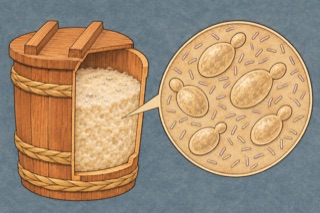 The Yeast Starter and the YeastsBefore a sake brewery commits a ton of rice to a fermentation, it brews something much smaller: a dense, sour culture of yeast called the shubo ("mother of sake") or moto…
 From Polished Grain to Pressed SakeA sake brewery in winter is a working kitchen on an industrial scale.
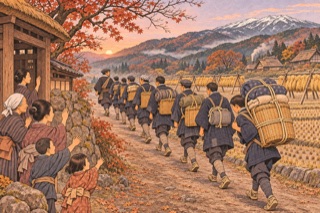 Tōji Guilds and the Brewery CrewFor most of the last three centuries, the people who actually made Japanese sake did not own the breweries and did not live near them.
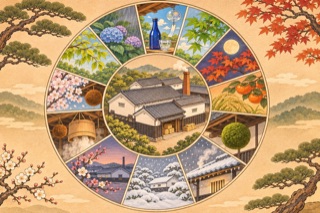 A Year of SakeWalk into the same Japanese liquor shop once a month for a year and the fridge will tell you the season before the weather does.
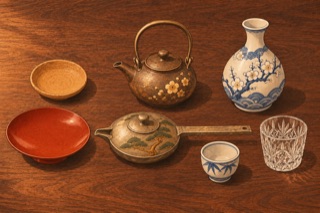 Sake Vessels and Warming ToolsOrder sake in Japan and the drink often arrives in an object you have no name for: a slim-necked ceramic bottle, a cup the size of a thimble, a square wooden box filled to the…
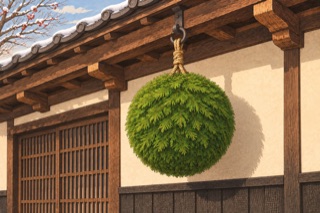 Sake and the GodsWalk past an old sake brewery in Japan and you will probably see a large ball of cedar hanging over its door.
 Aroma, Taste and the Four Types of SakeMost sake menus in Japan assume you already know the code.
- Back to the main article: Sake →