
Most sake menus in Japan assume you already know the code. Next to each name sit a few compressed words: hanayaka, tanrei karakuchi, umakuchi, hōjun. Some bars go further and plot every bottle on a little grid with "fragrant" at the top and "rich" on the right. None of this is random. The Japanese sake trade commonly uses a simple map that sorts every sake into one of four types by two qualities: how much it smells, and how much it tastes.
This guide walks through that map, explains where the smells in sake actually come from, translates the menu vocabulary, and follows a professional taster through the five steps of judging a glass. By the end you should be able to look at a label, guess what is in the bottle, and tell the person behind the counter what you want.
01A Map with Two Axes
Sake is made from only rice, water, kōji (rice grown with a mould, Aspergillus oryzae, that turns starch into sugar) and yeast, yet the range of flavour is wide. A single brewery can release a dozen different sakes in one season. Grade names such as daiginjō or junmai tell you how the sake was made: how far the rice was polished, whether distilled alcohol was added. They do not reliably tell you how it tastes.
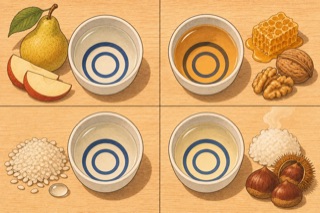
The Sake Service Institute (SSI), an organisation founded in 1991 to train restaurant and retail staff, proposed a tasting-based alternative. Draw a cross. The horizontal axis runs from light to rich in taste; the vertical axis runs from low to high in aroma. The four quadrants become four types. Kunshu, fragrant sake, has high aroma and a light taste. Sōshu, light and smooth sake, is low in both. Junshu, rich sake, has modest aroma but a full taste. Jukushu, aged sake, is high in deep aroma and rich in taste, usually from long ageing.
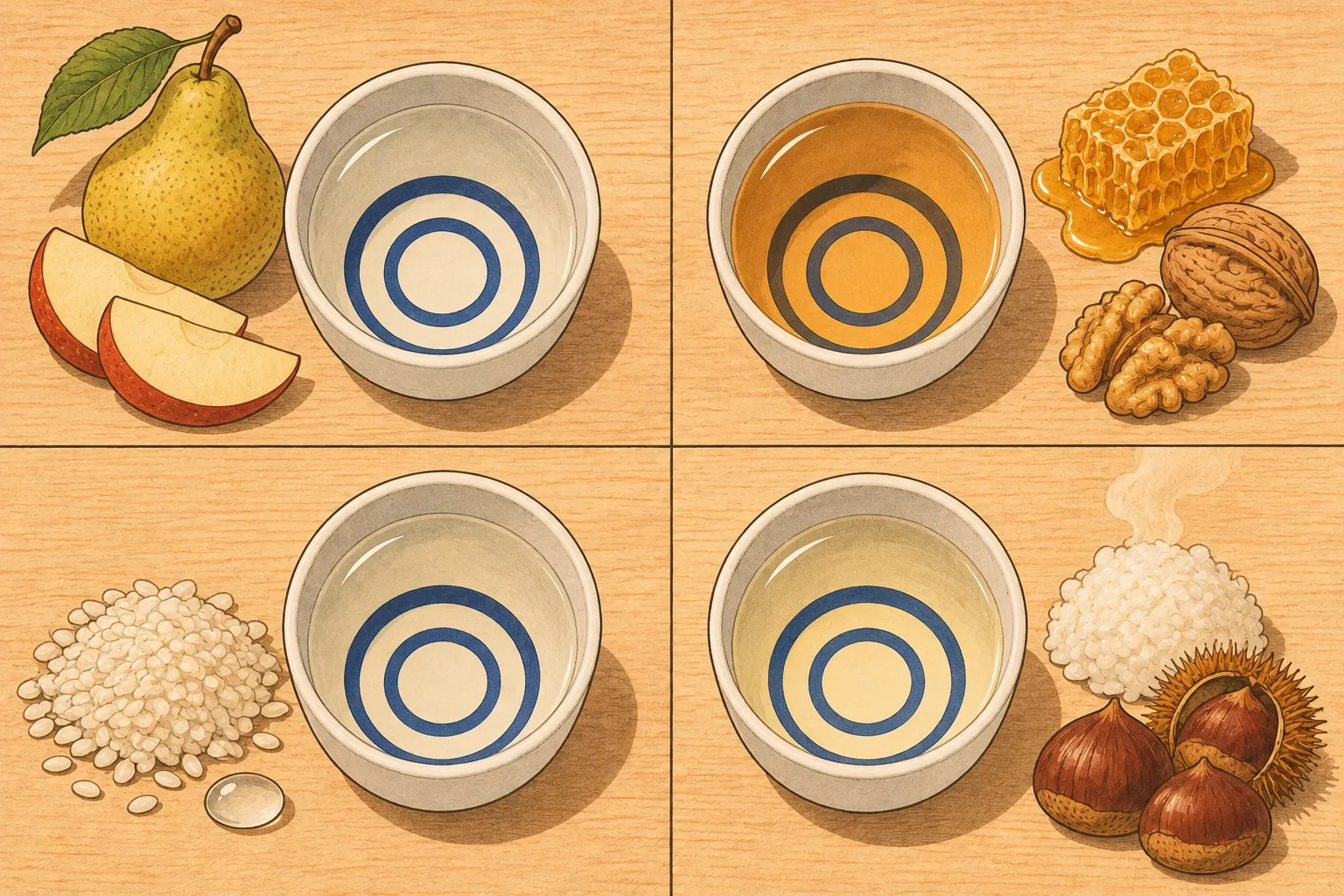
The four types, one cup each. Top left, kunshu with apple and pear; top right, jukushu with honeycomb and walnuts; bottom left, sōshu with white rice and a drop of water; bottom right, junshu with steamed rice and chestnuts. The two cups on the right are deeper in colour.
The point was practical. A server who knows which quadrant a bottle sits in can suggest a serving temperature, a glass and a dish in a sentence. The types roughly track the grades, but not perfectly: there are quiet, restrained daiginjō and loud, fruity junmai.
The main sake article covers the two numbers printed on many labels, the nihonshu-do (sake meter value) and acidity. They help, but they cannot capture aroma, which is why the four-type map has become the common language in bars and shops. Treat the types as compass directions rather than boxes. Plenty of sake sits on a border, and some guides list sparkling sake separately.
02Where the Smells Come From
The aromas in a glass of sake come from five broad sources.
The first source is yeast, and it gives the ginjō aroma. The fruit that leaps out of a good ginjō is mostly two compounds. Isoamyl acetate smells of ripe banana, and more generally of ripe fruit. Ethyl caproate (ethyl hexanoate) smells of green and red apple and pear. Yeast produces both, and produces more of them when fermentation runs cold and slow on highly polished rice. That is why ginjō-style brewing involves rice milled to 60 percent of its weight or less and a slow, low-temperature fermentation.
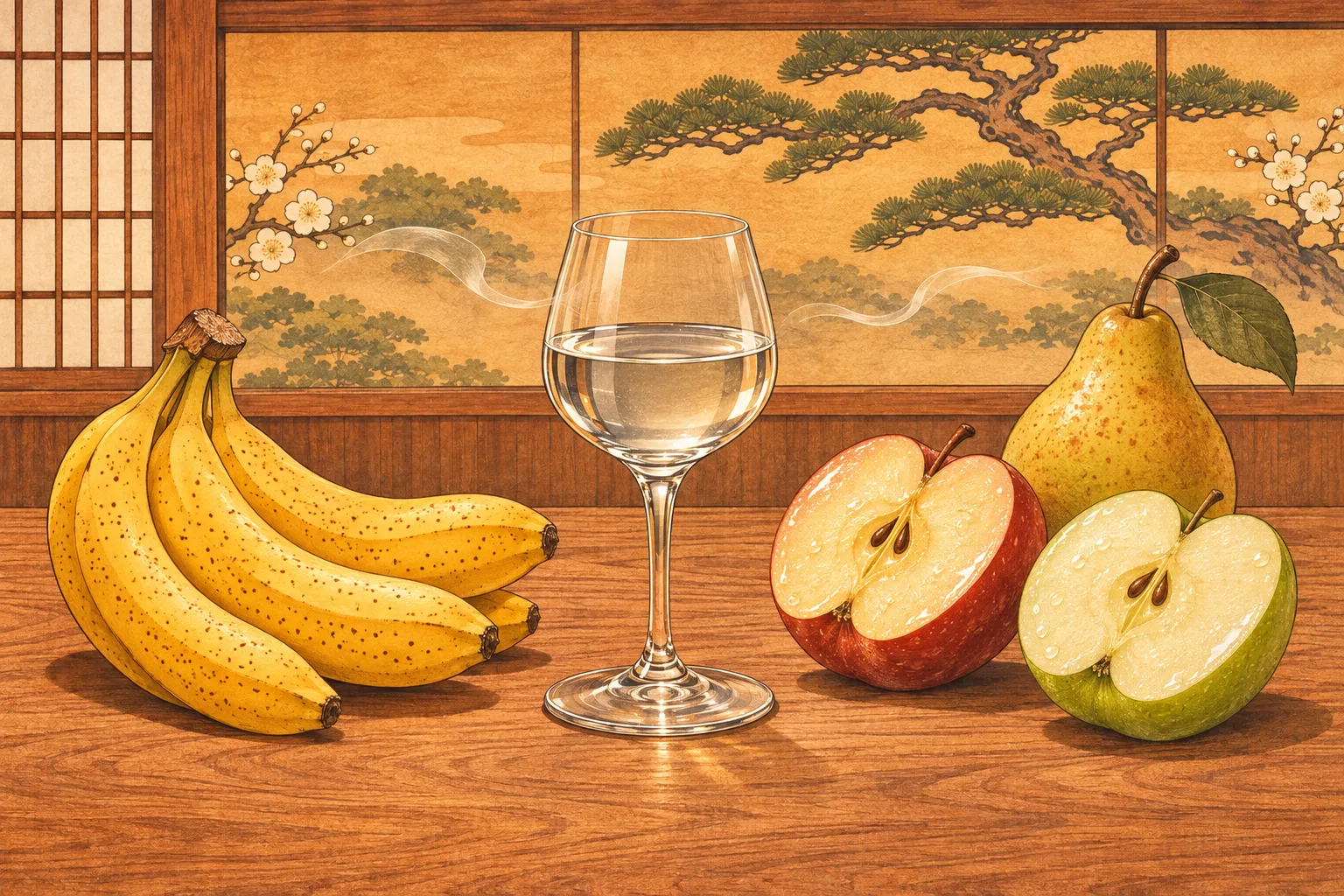
The two sides of ginjō aroma: ripe bananas on the left for isoamyl acetate; red apple, green apple and pear on the right for ethyl caproate; a nearly colourless sake in the glass between them.
From the 1980s onward, yeast selection made these aromas something brewers could aim for. The Brewing Society of Japan distributes numbered "association yeasts," and from around 1990 strains bred to produce lots of ethyl caproate spread widely, giving the crisp-apple nose that many newcomers now associate with sake. Prefectures developed their own local strains too. When a back label names its yeast, it is telling you which way the aroma leans.
The balance between the two esters gives a ginjō its personality. Sake heavy in isoamyl acetate smells soft and round, like ripe banana; competition ginjō of the Shōwa era leaned this way. Sake heavy in ethyl caproate smells brighter and sweeter, like a freshly cut apple, and has dominated competitions since the 1990s. More is not always better. Too much ethyl caproate and the aroma swamps the palate, tiring after a few sips and clumsy with food. Many brewers now hold the aroma back so that it stays quiet when cold and unfolds as the glass warms.
The second source is rice and kōji. Steamed rice has its own gentle smell: cooked rice, rice cakes, rice flour. Kōji adds notes often described as chestnut, toasted grain or light mushroom. These aromas are quiet. You find them by bringing the glass close, or by tasting, and they open up when the sake is slightly warm. Less-polished, rice-forward sake shows them most.
Newly pressed and unpasteurised sake adds a green note of its own: cut grass, green apple, a mint-like coolness, sometimes a faint prickle of leftover carbon dioxide on the tongue. A sign reading shiboritate, "freshly pressed," in a winter or spring shop window promises exactly this. Barrel sake, taruzake, carries a different note again: the clean, resinous smell of Japanese cedar from the cask, familiar from the barrels broken open at ceremonies. Cedar from the Yoshino area of Nara is the classic wood, and because the scent can overwhelm the sake, taruzake is not usually left long in the cask.
The third is lactic. Kimoto and its later simplification yamahai are traditional ways of starting the yeast culture in which naturally occurring lactic-acid bacteria acidify the mash before the yeast takes over. (A separate deep-dive on the yeast starter explains the method.) The result is often an aroma of yoghurt, cream or fresh cheese, sometimes a sourdough tang, and a firmer, more layered acidity.
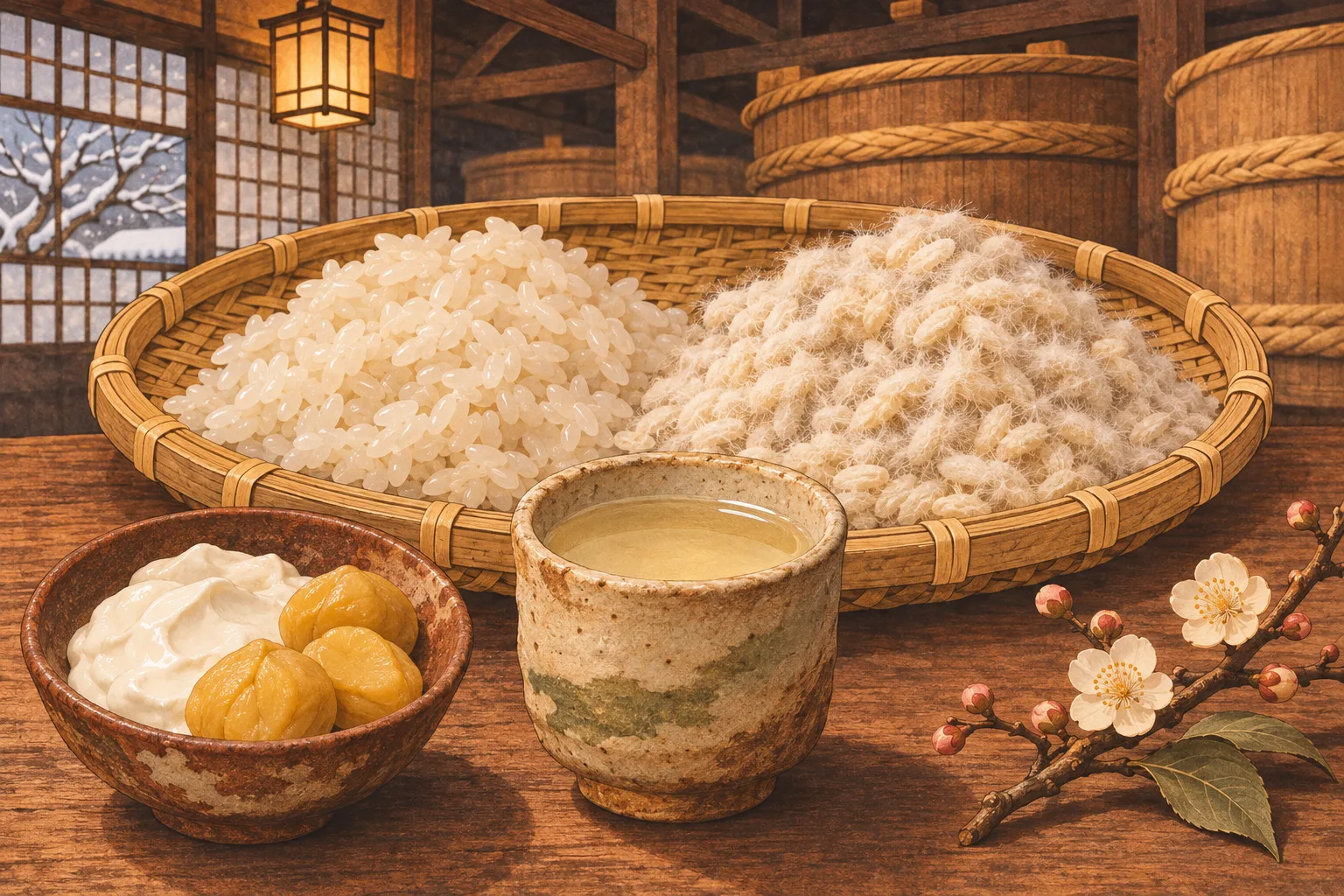
Two quieter sources of aroma: steamed rice on the left of the basket and kōji, white with mould, on the right; in front, a bowl of yoghurt and peeled chestnuts beside a cup of sake with a pale rice-yellow tint.
The fourth is ageing. Leave sake for years and its sugars and amino acids slowly react. The colour moves from water-clear through straw and gold to amber and tea-brown, and the nose shifts to honey, caramel, walnuts, dried fruit, soy sauce and spice. This is the signature of jukushu.
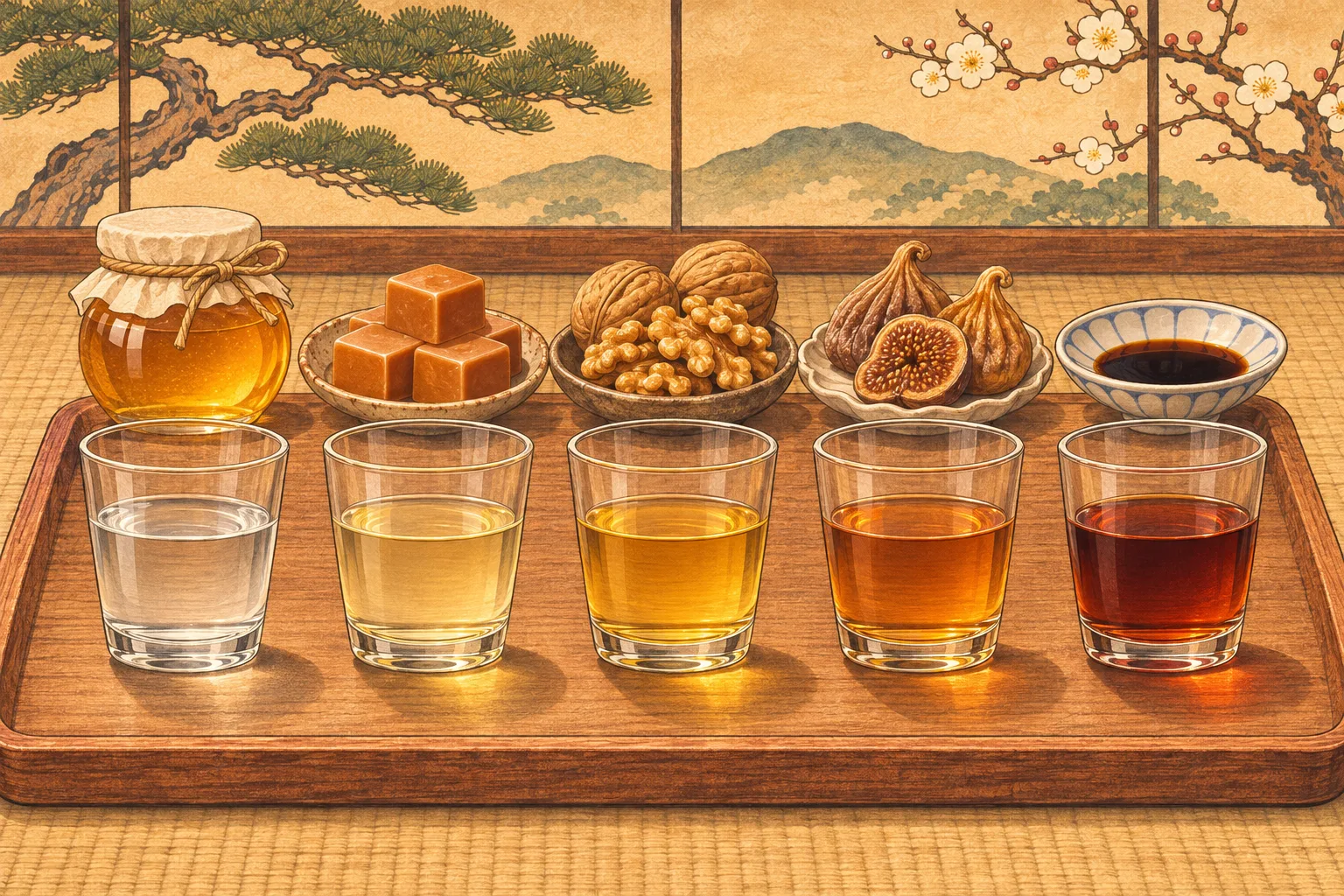
The colours of ageing, left to right: clear, straw, gold, amber, tea-brown. Behind the glasses are honey, caramel, walnuts, dried figs and soy sauce, the usual comparisons for aged aroma.
The fifth is faults. The best-known fault is hineka, the stale smell that ordinary sake develops after a year or more on the shelf, usually described as caramel, scorched, soy sauce, nuts and pickled radish. The colour darkens too. Heat speeds it up. One key compound is dimethyl trisulfide, a sulphur compound that smells of pickled radish. Hineka shares some compounds with the aroma of deliberately aged sake; the difference is that aged sake is meant to taste that way and stays in balance, while hineka is a fresh sake gone off in distribution. Nikkō-shū, "sunlight smell," appears when sake sits under sunlight or even indoor lighting: the sake picks up colour and an off-odour. Brown and very dark green glass block the damaging light; clear, blue and lighter green glass do not, which is why some sake is sold boxed and some shops wrap big 1.8-litre bottles in newspaper. Unpasteurised nama sake that has gone off develops nama-hineka, a dull, stale mustiness.
Walk into a good sake shop and you will see the defence against these faults in the layout: nama and nama-chozō sake, and often ginjō, in refrigerated cases, everyday sake on ambient shelves away from the windows.
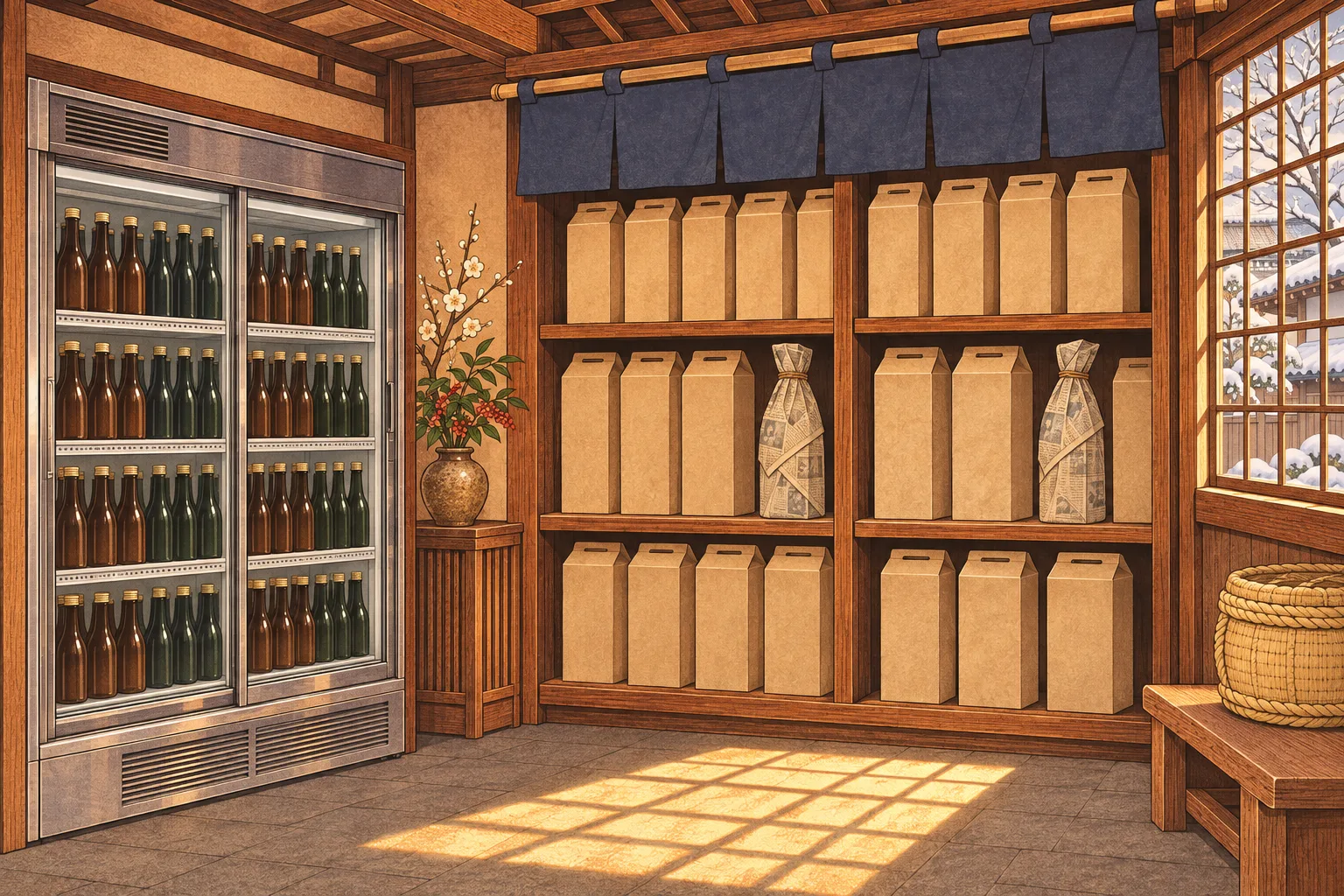
How a sake shop keeps light away: brown and dark-green bottles in the refrigerated case, boxed bottles on the shelves, two wrapped in newspaper, and the sunlight from the window falling short of them all.
03The Four Types, One by One
Kunshu, fragrant sake, announces itself. Pour it and the aroma reaches you before you lift the glass: apple, pear, melon, banana, sometimes white flowers, lychee or muscat grape. The palate is light and gently sweet, the acidity fine, the finish clean, and the fruit rises again at the back of the throat. In colour it is almost clear, with the faintest green or straw tint.
The typical examples are daiginjō, ginjō, junmai daiginjō and junmai ginjō. Serve them chilled, but not straight from the coldest corner of the fridge, which mutes the aroma; let the glass warm a few degrees. Heat drives the fruit off and makes the alcohol obvious, so kunshu is rarely warmed. Many bars pour it into a white-wine glass, whose curved bowl collects the aroma. Pair it with delicate food: white-fleshed sashimi, vegetable starters, dishes with yuzu or other citrus.
Kunshu is the youngest of the four as a mainstream style. Ginjō sake was long a brewer’s showpiece, made in tiny quantities for competitions. Only in the 1980s did it reach shop shelves in volume, setting off a "ginjō boom" that shaped how much of the world now pictures sake.
Sōshu, light and smooth sake, has low aroma and a light body. There is no obvious fruit, only a faint rice smell and something like cool water. It glides over the tongue, with little sweetness, and the finish snaps shut: Japanese drinkers praise this as kire, a clean cut. It is close to colourless.
Typical examples are crisp honjōzō and everyday futsūshu, plus some nama and nama-chozō sake. The tanrei karakuchi ("light and dry") style associated with Niigata, which swept Japan in the 1970s and 1980s, is the classic sōshu. Serve it well chilled, around 5 to 10°C, the coldest of the four, especially in summer; the futsūshu and honjōzō in this group also make good hot sake. Because it never fights the food, it goes with almost anything: salt-grilled fish, edamame, chilled tofu, tempura. The first sake of the evening in an izakaya is often of this type.
Junshu, rich sake, has moderate to low aroma and a full taste. The nose is cooked rice, kōji and grain, perhaps a lactic note or a hint of nuts. In the mouth it is round and savoury, the sweetness and umami of rice spreading across the tongue, held up by solid acidity, with a long finish. The colour may be clear or a pale rice-yellow, especially in muroka sake that has not been charcoal-filtered.
Typical examples are junmai, tokubetsu junmai, and sake made by the kimoto or yamahai method. Junshu has the widest temperature range: firm and tight when cold, most complete at room temperature, and for many drinkers at its best warmed, when the umami and acidity relax and broaden. The main article’s sixth chapter covers the named warming temperatures; here it is enough to say that a menu note reading o-kan ni osusume ("recommended warm") almost always points to a junshu. Pair it with heartier food: teriyaki, simmered dishes, oden, sauce-glazed yakitori, oily fish.
Junshu is, in a sense, the old normal. Before the ginjō boom most everyday sake was rice-forward and drunk warm. Its recent revival owes a lot to brewers returning to kimoto, yamahai and full-flavoured junmai.
Jukushu, aged sake, combines deep aroma, rich taste and visible age. The colour runs from gold to amber, and very old examples approach strong tea or sherry. The nose is honey, caramel, walnut, dried fig, soy sauce, vanilla, sometimes spice or smoke. The palate is thick, with sweet, sour, bitter and savoury notes woven together and a long, lingering finish.
The category is long-aged sake, jukusei koshu or chōki jukuseishu. The brewers’ Long-Term Aged Sake Society defines it as sake kept at least three full years after pressing (excluding sake with added sugar), and many are kept five or ten years or more. Aged sake was enjoyed in the Edo period, but in the Meiji era social change and the tax system made it all but vanish. It came back gradually after post-war tax reforms, and brewers founded the society in 1985 to promote it. Serve it at room temperature or barely warm, in a small glass, the way you would a sherry or a Shaoxing wine. It stands up to strong flavours: braised pork, cheese, foie gras, dark chocolate, dried fruit.
Aged sake itself splits by polishing and storage temperature. Less-polished sake aged for years at cellar temperature turns dark, with strong soy, caramel and spice; Japanese enthusiasts sometimes call this style nōjuku, "rich-aged." Highly polished, ginjō-style sake aged slowly in the cold stays pale gold and develops finer notes of honey, dried apricot and white chocolate, called tanjuku, "light-aged." In between sits chūjuku. The first drinks like sherry, the second more like an old white wine, so it is worth asking which you are being offered.
One caution: koshu is sometimes used simply for sake from the previous brewing year, which is not the same thing at all. A true jukushu usually states its years of ageing or uses the word jukusei (aged).
04Side by Side
Put the four in a row and colour and aroma separate them fastest.
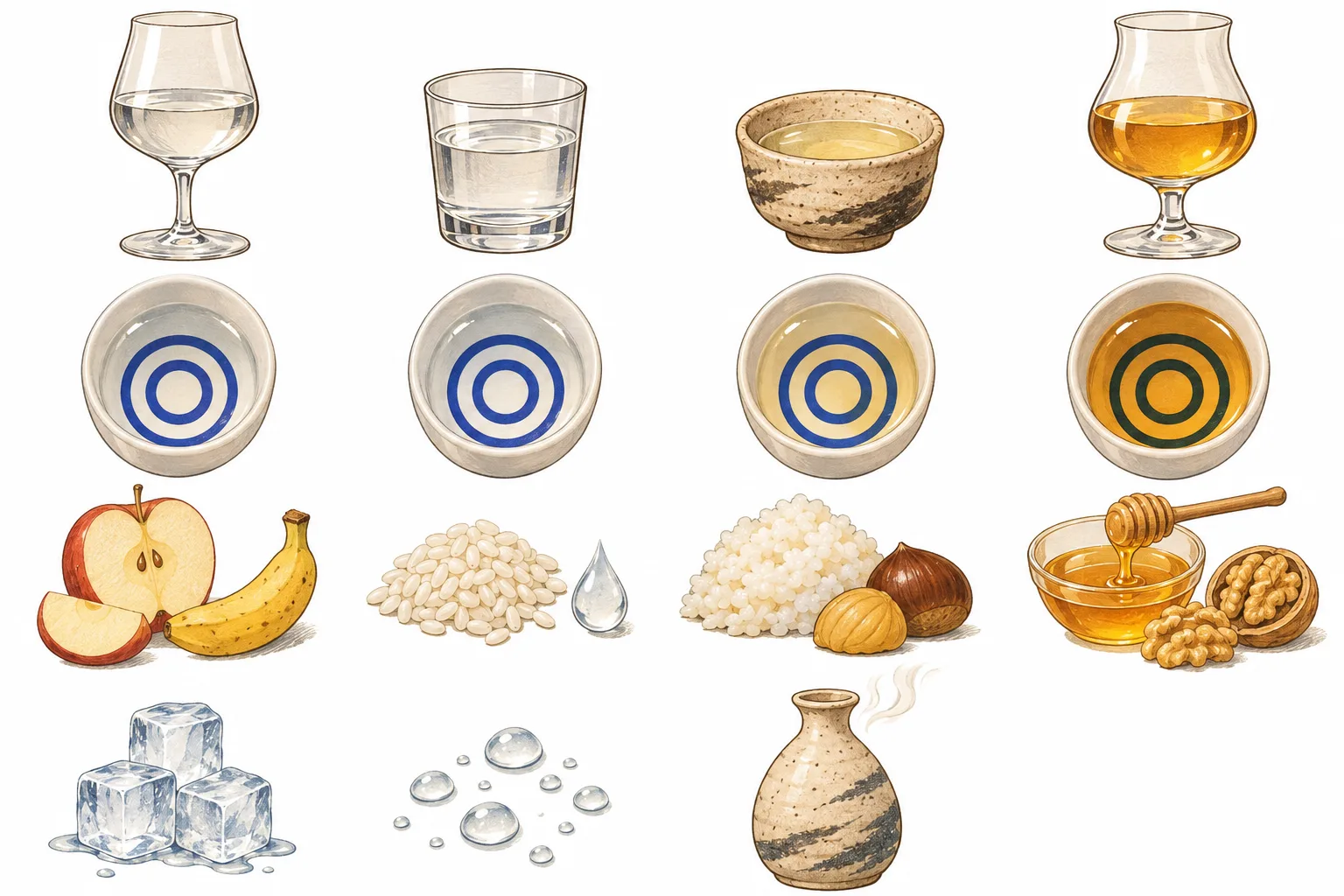
The four types side by side, left to right: kunshu, sōshu, junshu, jukushu. Each column shows, from the top, the usual glass, the colour in a janome cup, the typical aromas (apple and banana; white rice and water; steamed rice and chestnut; honey and walnut) and the serving temperature (ice, cool droplets, a warm flask; the blank under jukushu stands for room temperature).
In the blue-ringed tasting cup, kunshu and sōshu are nearly clear and the blue edge looks razor-sharp. Junshu may carry a faint rice-yellow tint, but the rings stay clear. Jukushu is plainly gold to amber; it warms the white porcelain and turns the blue rings greenish and dark.
On the nose, kunshu gives fruit and flowers, apple, pear, melon and banana, before the glass reaches your face. Sōshu gives almost nothing beyond a cool rice note. Junshu needs a closer sniff and offers cooked rice, rice cake, chestnut and sometimes yoghurt. Jukushu is deep and heavy: honey, caramel, nuts, soy sauce.
In the mouth, kunshu is light and gently sweet, with the aroma blooming again as you swallow. Sōshu is light and smooth and stops cleanly. Junshu is full and savoury with a long finish. Jukushu is thick and complex, ending bittersweet.
For serving, kunshu wants chilling and is rarely warmed; sōshu is happiest well chilled, though its futsūshu and honjōzō can also be served hot; junshu works cold, at room temperature or warm, and shines warm; jukushu is best at room temperature or barely warm.
The typical sakes follow: daiginjō and ginjō for kunshu; honjōzō, futsūshu and nama for sōshu; junmai, kimoto and yamahai for junshu; long-aged koshu for jukushu. So do the glasses: a wine glass to gather the aroma of kunshu, a small glass or thin cup for crisp sōshu, a thicker ceramic cup that stays comfortable when junshu is warm, and a small tulip glass to show off the colour of jukushu.
The pair most often confused is kunshu and sōshu: both are light and both look like water. Hold the glass a fist’s width below your nose. If fruit reaches you, it is kunshu; if you get little or nothing but a cool rice note, it is sōshu. The other confusable pair is junshu and jukushu, both rich. Look first: junshu is clear or pale; jukushu is unmistakably gold or amber. Then smell: rice and grain for junshu, caramel and nuts for jukushu.
05Reading the Menu
Japanese sake descriptions lean on a few paired terms.
Amakuchi and karakuchi mean sweet and dry. Kara usually means spicy-hot in Japanese food, but on a sake list it means dry: low sweetness, quick finish. The sake meter value is the starting point, but higher acidity makes a sake seem drier, and so does chilling, so a server’s "karakuchi" usually reflects their own palate as much as the number.
Tanrei and nōjun mean light and rich. Tanrei is clean and slim, flowing over the tongue; nōjun is full and weighty. Combine the pairs and you get four common labels, tanrei karakuchi, tanrei amakuchi, nōjun karakuchi and nōjun amakuchi, and some shops arrange their shelves on exactly that grid.
Hanayaka means showy or floral in aroma, and is almost a synonym for kunshu; it often appears alongside furūtī (fruity). Hōjun means rich in both aroma and flavour, used for sake between junshu and jukushu. Umakuchi, a word that has spread in recent years, describes sake with plenty of rice sweetness and umami, a "meaty" mid-palate; it is the natural word for many junshu.
A handful of everyday words fill out the picture. Sukkiri means refreshing and crisp. Kire is a clean finish. Koku is depth and body. Maroyaka is mellow, smooth-edged. Fukuyoka is plump and soft. Gatsun means punchy and bold. Words like kimoto-kei, yamahai-kei or nyūsan-kan (lactic feel) signal yoghurty aromas and lively acidity. Jukusei, kohaku (amber) or koshu signal aged sake.
The back label adds more. A low seimai buai (polishing ratio) points toward the ginjō end. A named aromatic yeast predicts fruit. Genshu means undiluted, so higher alcohol and more weight. Nama, nama-zume and nama-chozō indicate different pasteurisation choices; fully unpasteurised nama tastes fresh and sometimes faintly prickly. Muroka means not charcoal-filtered, so expect more colour and flavour.
When you order, a few phrases go a long way. For something fragrant: Hanayaka de furūtī na no o ("Something floral and fruity"). For something crisp to go with food: Sukkiri shita karakuchi o ("A clean, dry one"). For a sake to drink warm: O-kan ni au umakuchi no mono o ("A savoury one that suits warming"). For aged sake: Jukuseishu wa arimasu ka? ("Do you have any aged sake?"). Naming the type, kunshu or junshu, works with knowledgeable staff. Telling them what you are eating and asking for a match is perfectly normal in Japan.
06How a Professional Tastes
Formal tasting is called kikizake. It follows five steps.
First, look. Fill the cup about three-quarters and view it against white. Tasters check clarity: a good new sake is bright with no haze or floating particles. Then they check hue, from colourless through pale green and straw to gold and amber, which tracks the sake’s age and handling. The standard tasting cup, the janome or "snake’s eye" cup, is white porcelain with two concentric blue rings on the bottom; in clear sake the edge of the blue is crisp, while colour or haze makes it look soft and greenish. (A separate deep-dive on sake vessels covers the cup itself.)
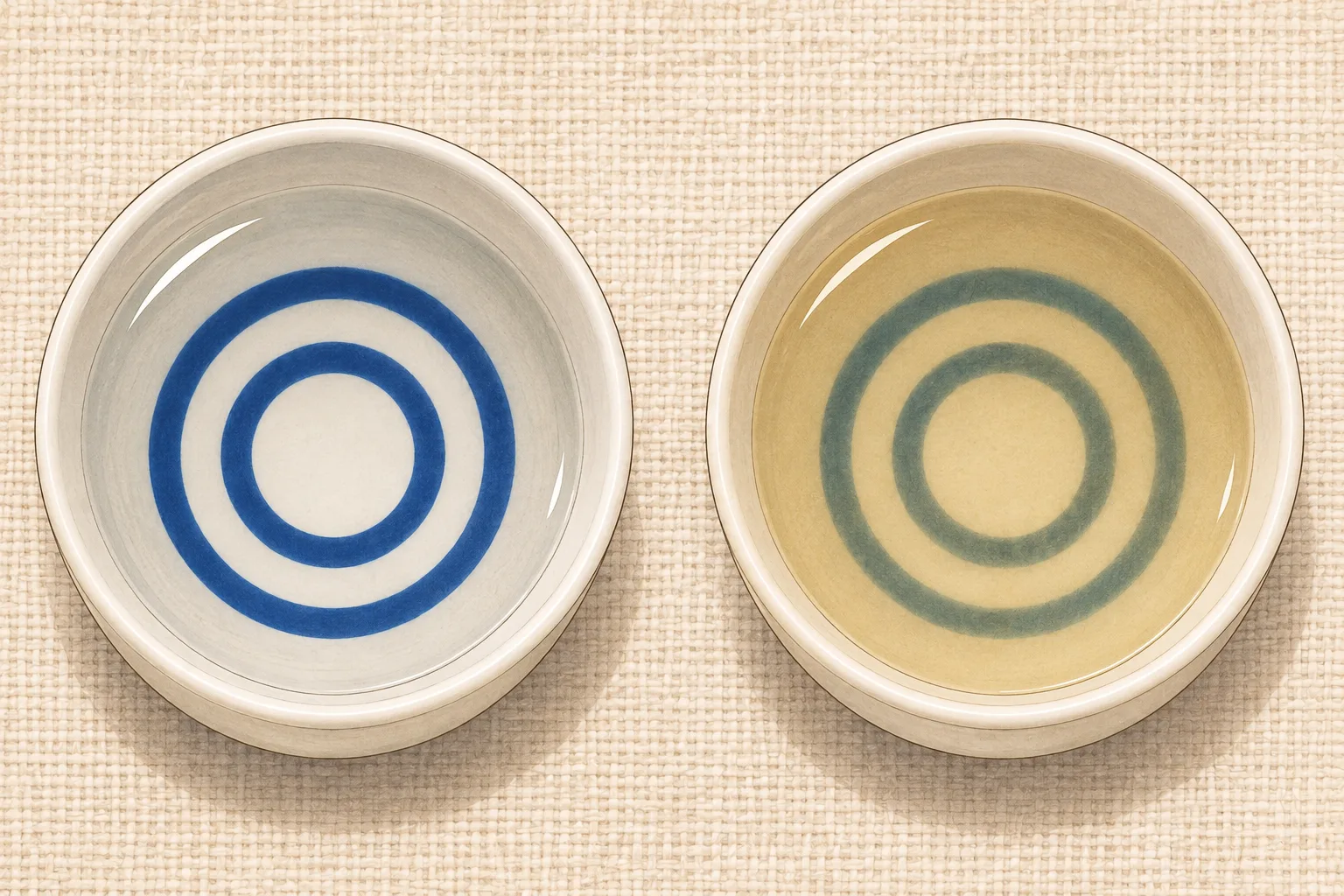
Reading colour in the janome cup: on the left the sake is clear and the blue rings are sharp; on the right it is yellowish and slightly hazy, and the rings blur and turn greenish.
Second, smell the uwadachika. Bring the cup under your nose, give it a gentle swirl and breathe in. Uwadachika is the "rising aroma," the scent that lifts off the surface; note its character and strength. Whether the ginjō aroma is bright, and whether there are faults such as hineka or sunlight smell, often shows here. Don’t plunge your nose in and sniff hard; the alcohol will sting and blur everything.
Third, find the fukumika. Take a small sip, three to five millilitres and the same amount each time, spread it across the tongue, then part your lips slightly and draw in a little air so the sake churns, and breathe out through the nose. It makes a quiet slurping sound, which is exactly how professionals do it. Two to five seconds in the mouth is enough. Fukumika, "aroma in the mouth," often reveals what the nose missed: rice and kōji, lactic notes, aged character. At the same time the taster reads the balance of sweet, sour, bitter and savoury, and the weight of the body.
Fourth, follow the finish. After swallowing or spitting, notice how long flavour and aroma remain and how they fade. A short, clean finish is the kire of sōshu; a long, sweet-edged one belongs to junshu and jukushu. Lingering bitterness or off-notes get written down.
Professionals have their own vocabulary, and some of it leaks onto menus. Positive words include tanrei (light and clean), nameraka (smooth), kire ga yoi (a clean finish), umami aru (savoury) and nōjun (rich); on the nose, new-sake aroma, ginjō aroma, aged aroma and cask aroma are all good things. Negative words include usui (thin), zatsumi (unpleasant bitterness, astringency or roughness), shibumi (astringency) and nigami (bitterness), and on the nose the faults described above. If a server calls a bottle kirei, "clean" or "pretty," they mean no off-notes and clear lines, common praise for a young sake.
Fifth, spit. Judges may taste dozens or hundreds of sakes in a session. Swallowing would dull the palate within the hour, so a spittoon stands by every table and spitting is the rule, not a rudeness.
In an izakaya you don’t need the full routine, but the first two steps are useful. A glance at the colour and a sniff before the first sip will usually tell you which of the four types is in front of you.
07Competitions, Tasting Rooms and Kikisake-shi
Japan’s best-known tasting event is the Annual Japan Sake Awards, the Zenkoku Shinshu Kanpyōkai (National New Sake Competition). It began in 1911 at the Ministry of Finance’s brewing research institute in Tokyo and is now run by the National Research Institute of Brewing together with the Japan Sake and Shochu Makers Association, with judging at the institute in Higashihiroshima, Hiroshima Prefecture. Each spring breweries submit new sake; panels judge it; the best receive a gold award. The "gold award" posters you see in sake shops refer to this.
The judging is a large operation: in 2019, the 107th competition, preliminary and final rounds ran over five days with 69 judges drawn from the research institute, the National Tax Agency, academia and the industry. Entries are grouped by the concentration of aroma compounds and tasted in order of rising glucose content, and judged on whether aroma and flavour are harmonious and distinctive. Professional tasting generally uses the kikichoko, white porcelain with a blue snake’s-eye pattern, holding about 180 millilitres, far larger than an everyday cup, filled seven or eight tenths so colour and aroma are easy to read; the sake is best at 15 to 20°C, since colder hides the aroma. Tasters work cup by cup, looking, smelling, sipping and spitting, scoring aroma, taste and appearance together and noting strengths and faults.
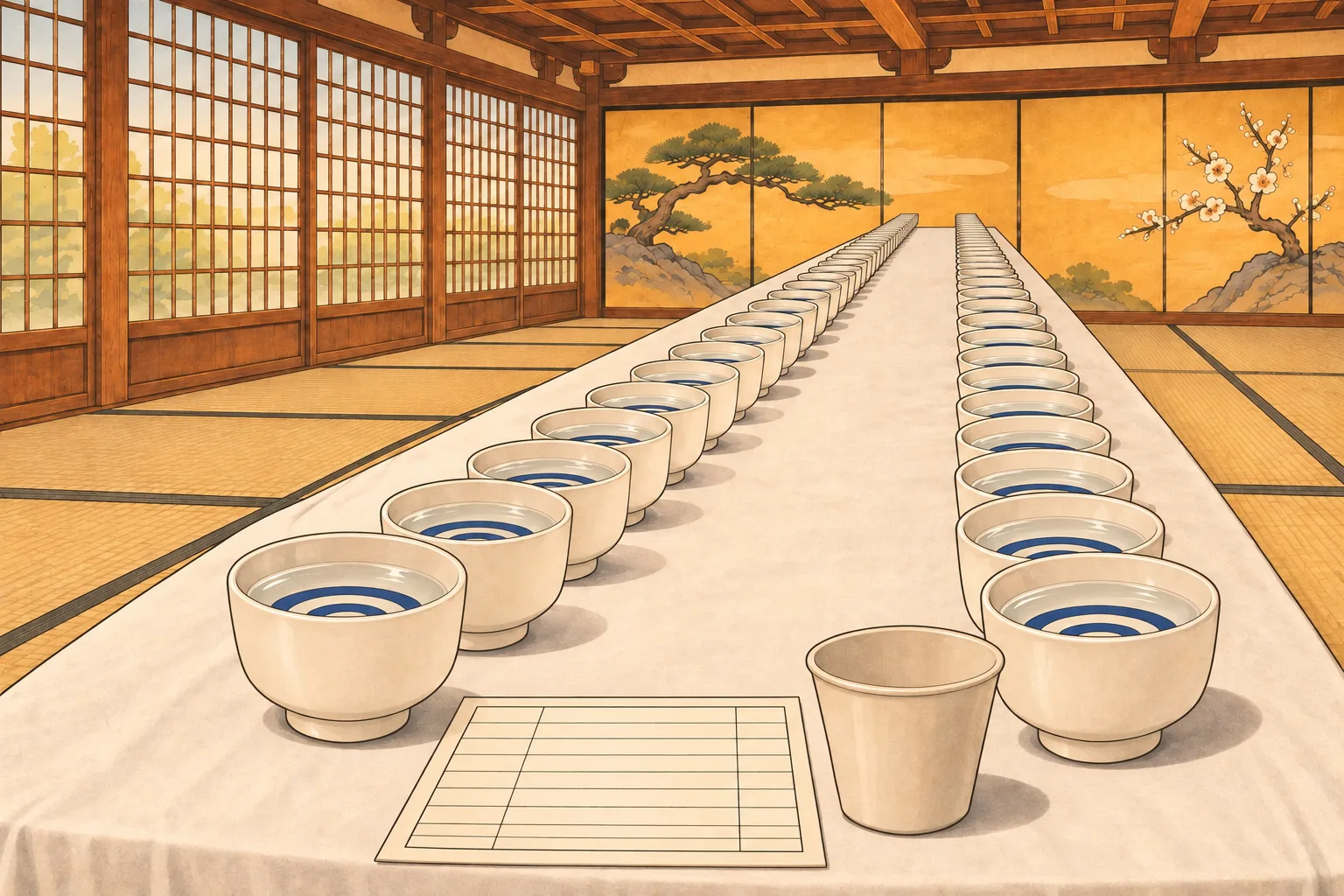
A judging table: two long rows of large janome cups on white cloth, with a score sheet and a spittoon at the near end (artist’s impression)
For decades the competition favoured bright ginjō aroma, and breweries made small batches of highly polished, very fragrant "competition sake" to win. That drove advances in ginjō technique and aromatic yeasts, and also drew criticism that sake aroma was becoming uniform. Some breweries now skip the competition and enter wine-style international judgings or food-pairing contests instead, and the definition of a good sake has broadened.
Breweries also taste constantly in-house. The tōji (master brewer) and crew taste fermenting mash, freshly pressed sake and sake in storage to decide when to press, when to pasteurise, and which tanks to blend. This kind of tasting hunts for faults and change, with snake’s-eye cups or small glasses, in cold brewery rooms, sip and spit, all season.
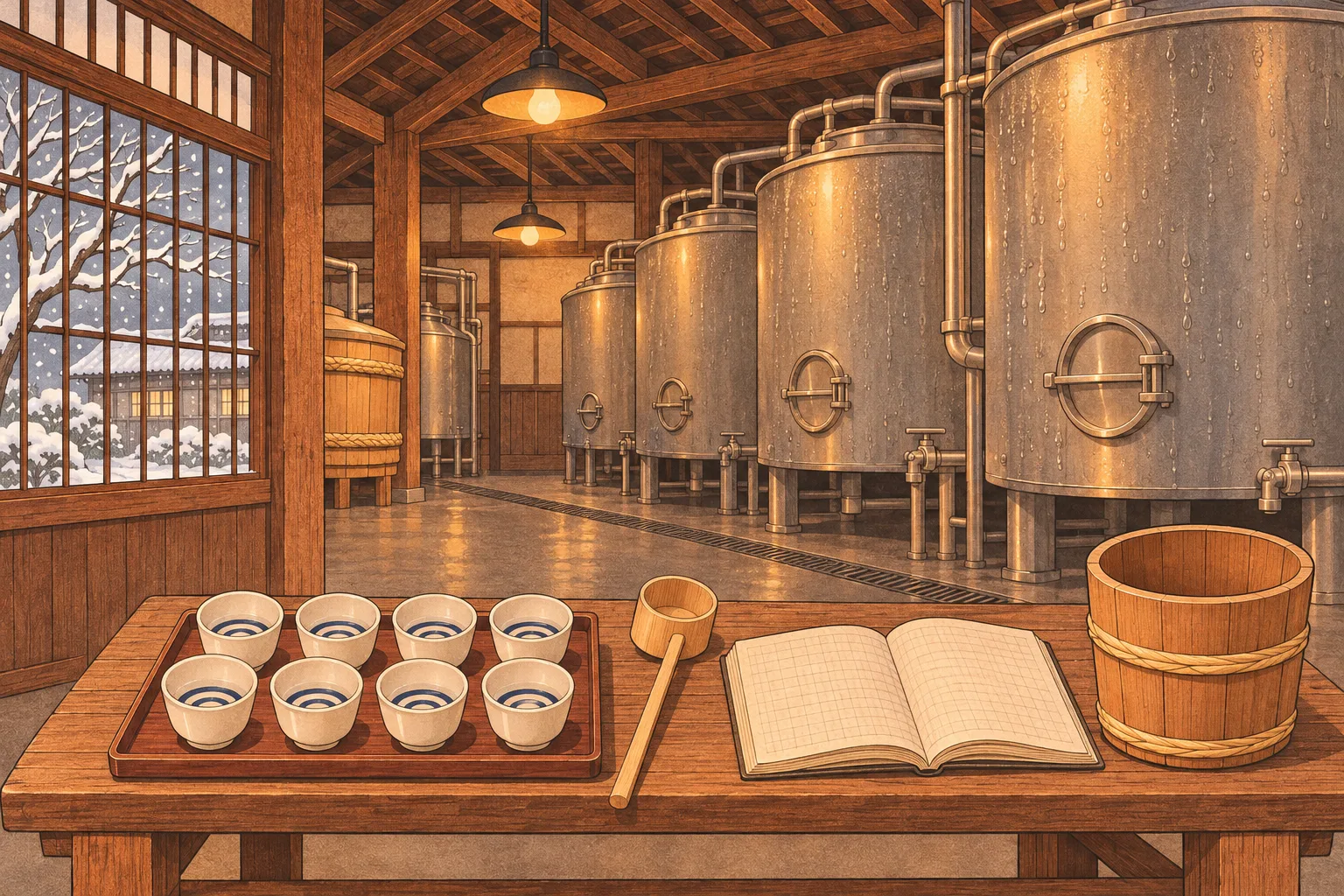
A tasting table inside a brewery: a tray of janome cups, a long-handled ladle, a notebook and a wooden spit bucket in front of the fermentation tanks.
Kikisake-shi is a private qualification awarded by the SSI since 1991, often translated as "sake sommelier"; more than 50,000 people now hold it. It is aimed at people who sell and serve sake: restaurant staff, shop clerks, ryokan employees, plus many enthusiasts. The syllabus is not brewing but service: understanding sake from the customer’s and the seller’s side, and how to choose, serve and explain it. The four-type map comes from the same organisation and is a standard tool in this kind of training. If the server is a kikisake-shi, describe what you want in the terms from section 5 and you will be understood. The SSI also awards a senior master-taster qualification, and an International Kikisake-shi that can be taken in English or Chinese.
To practise, look for a bar offering a nomikurabe (tasting flight), usually three small glasses of different sakes served side by side. Work through look, smell, sip and finish, glass by glass, and compare what you find with the words on the menu. After a few flights, hanayaka, sukkiri and umakuchi stop being jargon and start matching what is on your tongue.
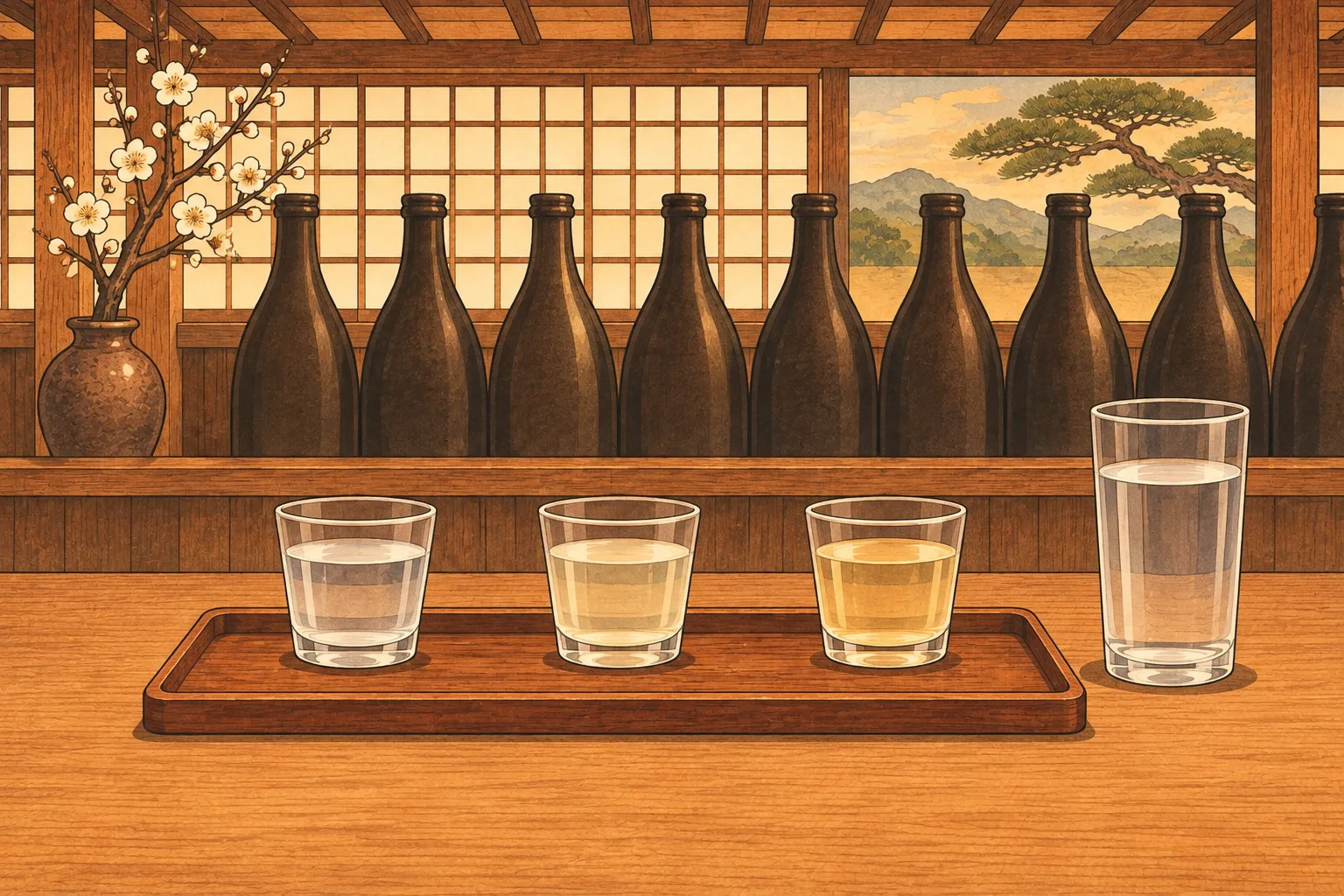
A tasting flight: three small glasses side by side, from clear through the palest yellow to light gold, with a glass of water alongside. Compare them one by one: look, smell, taste, finish.
More deep dives on this topic
 Reading the Fine Print on a Sake LabelPick up a sake bottle in a Japanese liquor shop and the front label will usually give you a brush-written brand name and not much else.
 Sake RicePick up a bottle of premium sake in Japan and the largest characters on the label after the brewery’s name are often the name of a rice: Yamada Nishiki, Omachi, Gohyakumangoku.
 The Yeast Starter and the YeastsBefore a sake brewery commits a ton of rice to a fermentation, it brews something much smaller: a dense, sour culture of yeast called the shubo ("mother of sake") or moto…
 From Polished Grain to Pressed SakeA sake brewery in winter is a working kitchen on an industrial scale.
 Tōji Guilds and the Brewery CrewFor most of the last three centuries, the people who actually made Japanese sake did not own the breweries and did not live near them.
 A Year of SakeWalk into the same Japanese liquor shop once a month for a year and the fridge will tell you the season before the weather does.
 Sake Vessels and Warming ToolsOrder sake in Japan and the drink often arrives in an object you have no name for: a slim-necked ceramic bottle, a cup the size of a thimble, a square wooden box filled to the…
 Sake and the GodsWalk past an old sake brewery in Japan and you will probably see a large ball of cedar hanging over its door.
 Aroma, Taste and the Four Types of SakeMost sake menus in Japan assume you already know the code.
- Back to the main article: Sake →