
A sake brewery in winter is a working kitchen on an industrial scale. Before dawn, steam rises from a wooden vat the size of a hot tub; in a cedar-lined room kept at blood heat, someone in a T-shirt is rubbing rice between their palms; in the tank hall, a brewer leans over a three-metre vat and stares at the foam. Each of these scenes belongs to a precise moment in a process that takes a grain of rice two to three months to become sake. This piece walks through that process in the order a brewery runs it, with the emphasis on the steps where most of the skill lives: polishing, washing, steaming, making kōji, the three-stage build of the mash, and reading the mash as it ferments. If you visit a brewery, it should help you recognise each machine and vessel and know where it sits in the line.
01Taking the Grain Apart: Polishing and Resting
Sake rice arrives at the brewery as brown rice. Its outer layers carry fats, proteins and minerals that feed yeast too generously and leave the finished sake coarse, yellowish and heavy. So the first job is to grind them away.
The machine that does this is the vertical rice mill (tategata seimaiki). It is a tall cabinet, often two or three storeys high, painted white or pale grey. Inside, an abrasive roller spins on a vertical shaft. Rice drops onto the roller, has a thin layer scraped from its surface, and is lifted back to the top by a bucket elevator to go round again, hundreds of times. The mill room hums, and fine white dust settles on every ledge.
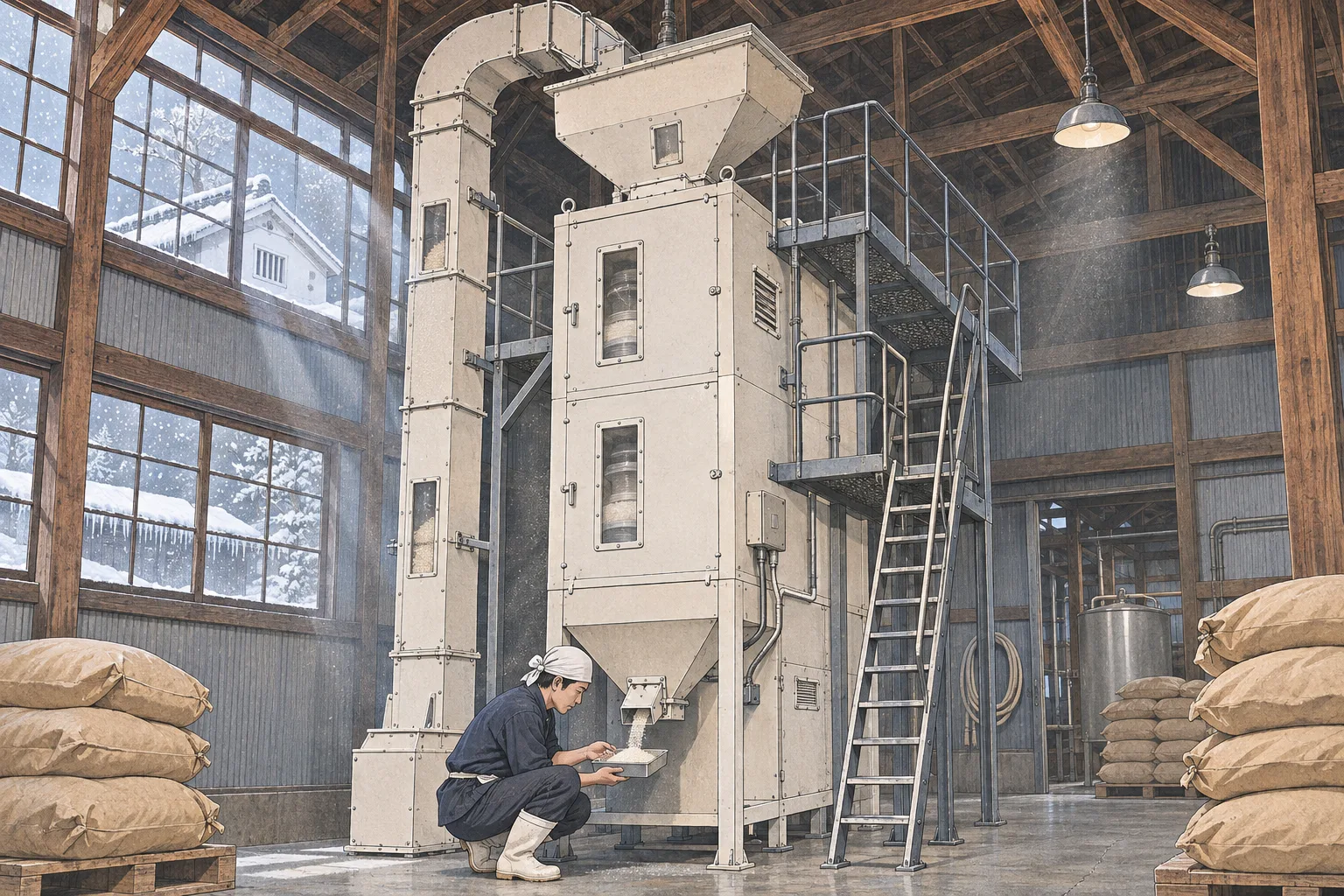
A vertical rice mill stands two to three storeys high. A brewer crouches at the outlet at its base to catch a sample of the rice.
The polishing ratio on the label, the seimai buai, is the percentage of the grain left after milling: 60 percent or less for ginjō, 50 or less for daiginjō. At the mill, that number translates into hours. Some brewers go to 35 percent, and a few famous labels go into the low twenties, leaving a small white bead of starch. Depth costs time, though the figures vary widely with the machine, the batch size and the rice: milling to 70 percent takes perhaps ten hours, to 50 percent around two days, and to the extreme ratios close to a week. The roller cannot be rushed, because friction heats the rice, and hot, dry rice cracks. Broken grains absorb water unevenly later on.
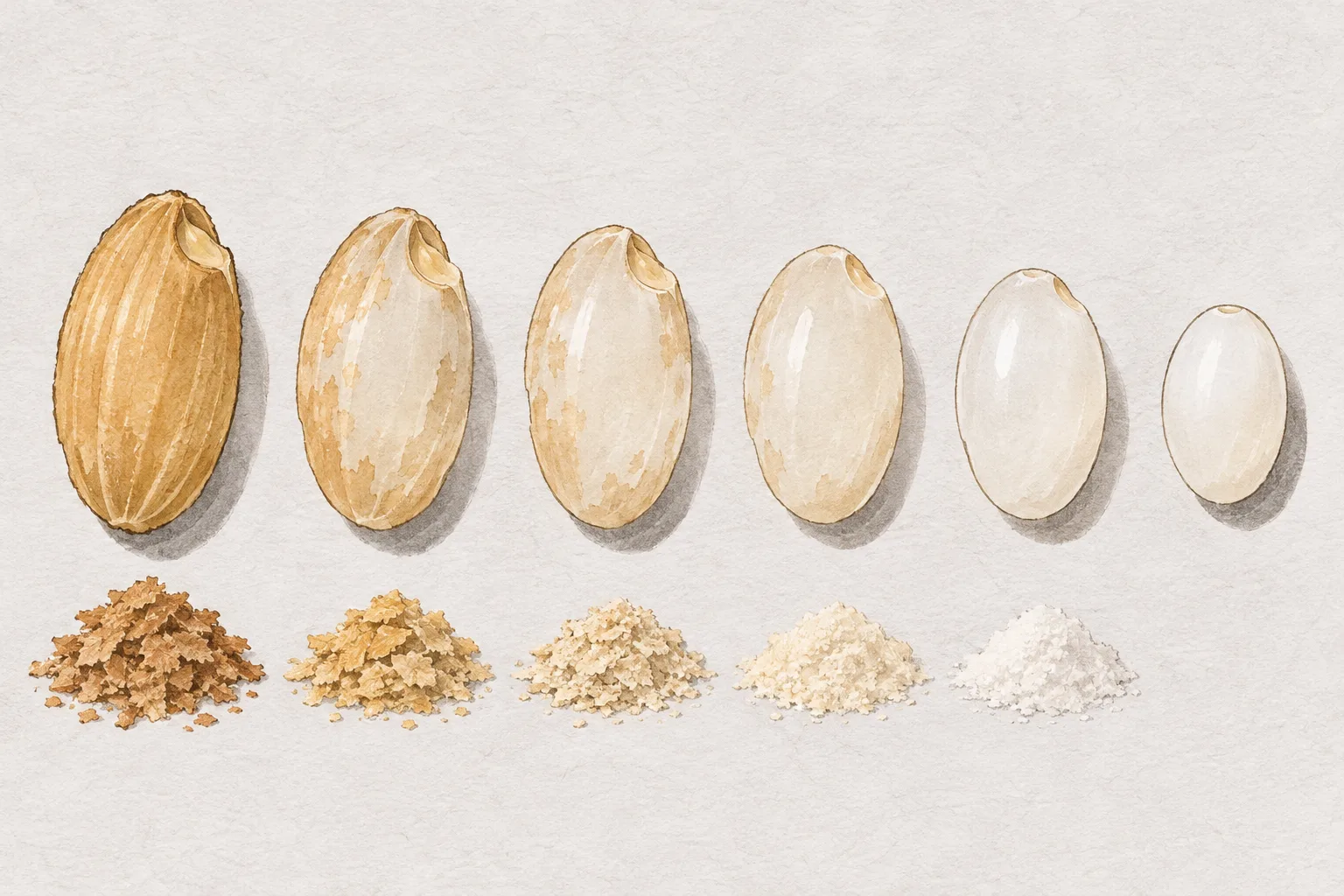
Top row, from left: a grain of brown rice, then the same grain milled further and further, shrinking to a small white bead. Bottom row: the bran taken off at each depth, from brown outer bran to fine white powder.
The miller checks progress by weight and by eye. Samples are drawn at intervals and a thousand grains are weighed against the thousand-grain weight of the original brown rice. The grains should keep a smooth oval shape, like a scaled-down version of the original, rather than being shaved only at the ends. A newer approach, flat milling (henpei seimai), follows the grain’s flattened shape so that the outer layer comes off more evenly.
The bran comes off in layers, from coarse brown outer bran through a paler middle layer to fine white powder (shironuka) from deep inside the grain. The outer bran mostly goes to animal feed and fertiliser. White bran can be used in rice crackers, confectionery and rice-flour products, and has been tried in the fermented rice-bran beds used for pickles, though not all of it finds a use.
Freshly milled rice cannot go straight into water. Milling has warmed it and driven off some of its moisture, so it is brittle and thirsty; dropped into cold water, its outside would swell faster than its centre and it would split. The rice is bagged and left in a cool place, typically for two weeks to a month and often a month or more for ginjō, while it slowly takes back moisture from the air and settles to room temperature. This rest is called karashi, literally "drying out" or "seasoning". When it is complete, the rice is cool and supple to the touch and back to its target moisture content.
Many small breweries do not mill their own rice; they send it to a specialist mill or an agricultural co-operative. So you will not see a mill at every brewery. Some old houses keep a wooden pestle mill at the entrance, the kind once driven by foot treadles or waterwheels. It could barely take rice below about 80 percent, which goes some way to explaining why the sake of the Edo period tasted so different from modern ginjō.
02Washing by the Second
Rested rice goes to the washing area. Washing removes the bran powder clinging to each grain, and soaking loads the rice with exactly as much water as the steaming will need.
Rice for everyday sake is washed by machine, tumbled through channels and pipes in running water. Rice for premium sake is often handled in batches of about 10 kilograms, in cloth bags or baskets, plunged into tubs and agitated by hand. Winter well water is close to freezing, and the washing area is loud with running water and slick with milky runoff.
Then comes soaking. Lightly milled rice can soak overnight and simply stop absorbing when it is full. Highly polished rice is different: with most of its outer layers gone, it absorbs water fast, and if it takes on too much it steams into a soft, sticky mass that ruins both kōji-making and fermentation. The answer is gentei kyūsui, "limited water absorption". The soak is cut short so the rice cannot take on too much. The brewer sets a target weight gain and soaks against a stopwatch; for very highly polished rice the soak is measured in minutes, sometimes timed to the second. When the time is called, several people lift the bags out at once.
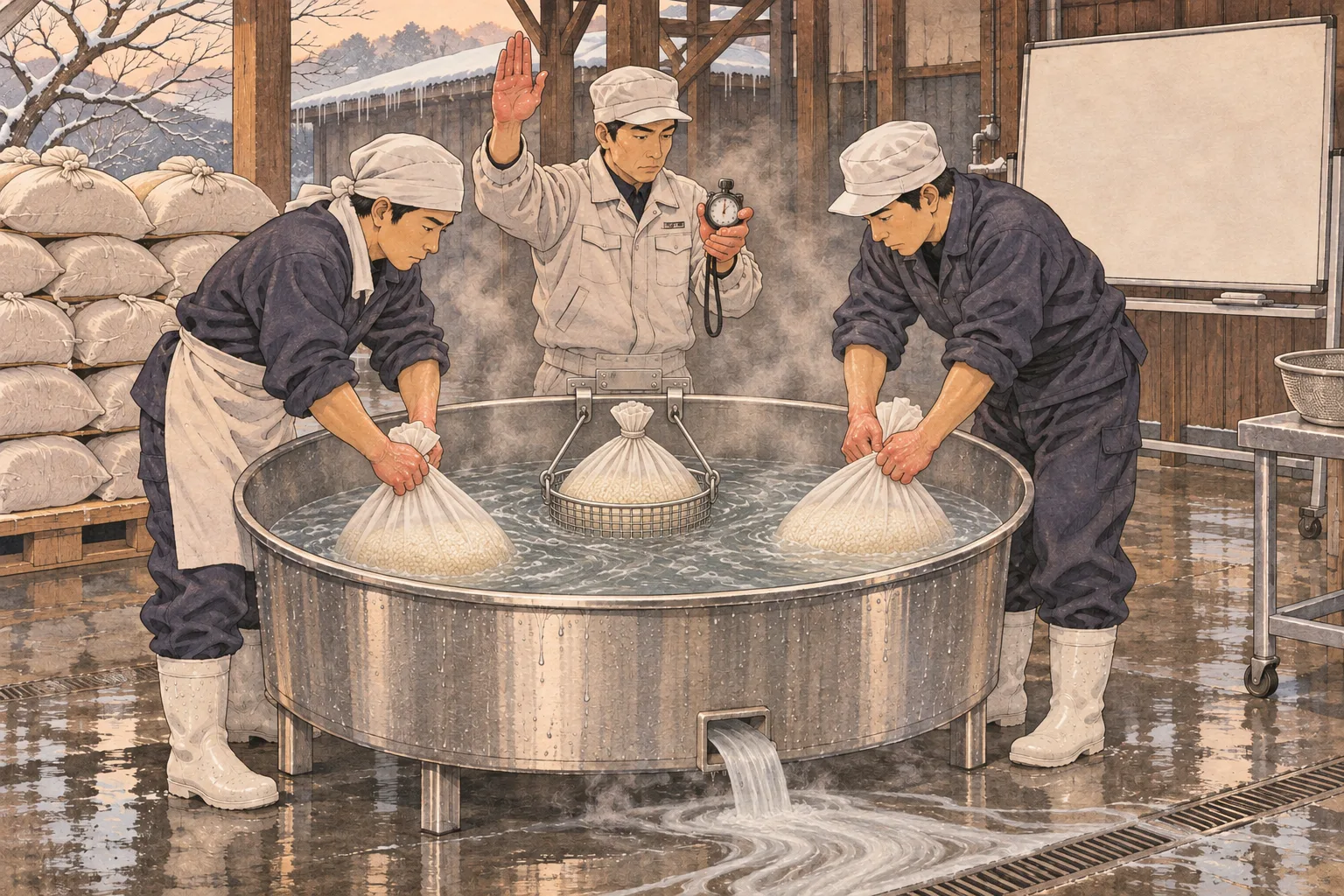
Limited water absorption (gentei kyūsui): one brewer watches the stopwatch with a hand raised while two others stand ready to lift their bags of rice out of the tub at the same moment.
The soak time is recalculated every day. Variety, growing region, the year’s harvest, milling ratio, water temperature and rice temperature all change how fast the grain drinks. A small test portion is soaked, weighed before and after, and the result sets the day’s timing. Soaked rice drains on racks for a few hours or overnight and is weighed again to confirm it landed on target.
On a visit, look for the tubs, the stacks of cloth bags, and sometimes a whiteboard on the wall with the day’s numbers.
03The Koshiki: Steaming Rice Hard Outside, Soft Inside
Sake rice is steamed, never boiled. The traditional steamer is the koshiki, a large bottomless tub, historically of wood, set over an iron cauldron of boiling water, with a slatted or bamboo base that lets steam rise through the rice. Many breweries now use aluminium or stainless-steel koshiki, but the shape is the same, and a large one holds more than a tonne. Big factories use continuous steamers, with rice riding on a mesh belt over jets of steam.
Steaming usually happens first thing in the morning. A cloth is laid in the base, the drained rice is scattered in layer by layer, and once steam breaks evenly through the top surface the timing starts: roughly 40 minutes to an hour. In a brewing town on a cold morning, a plume from the koshiki is often the first sign that the season has begun.
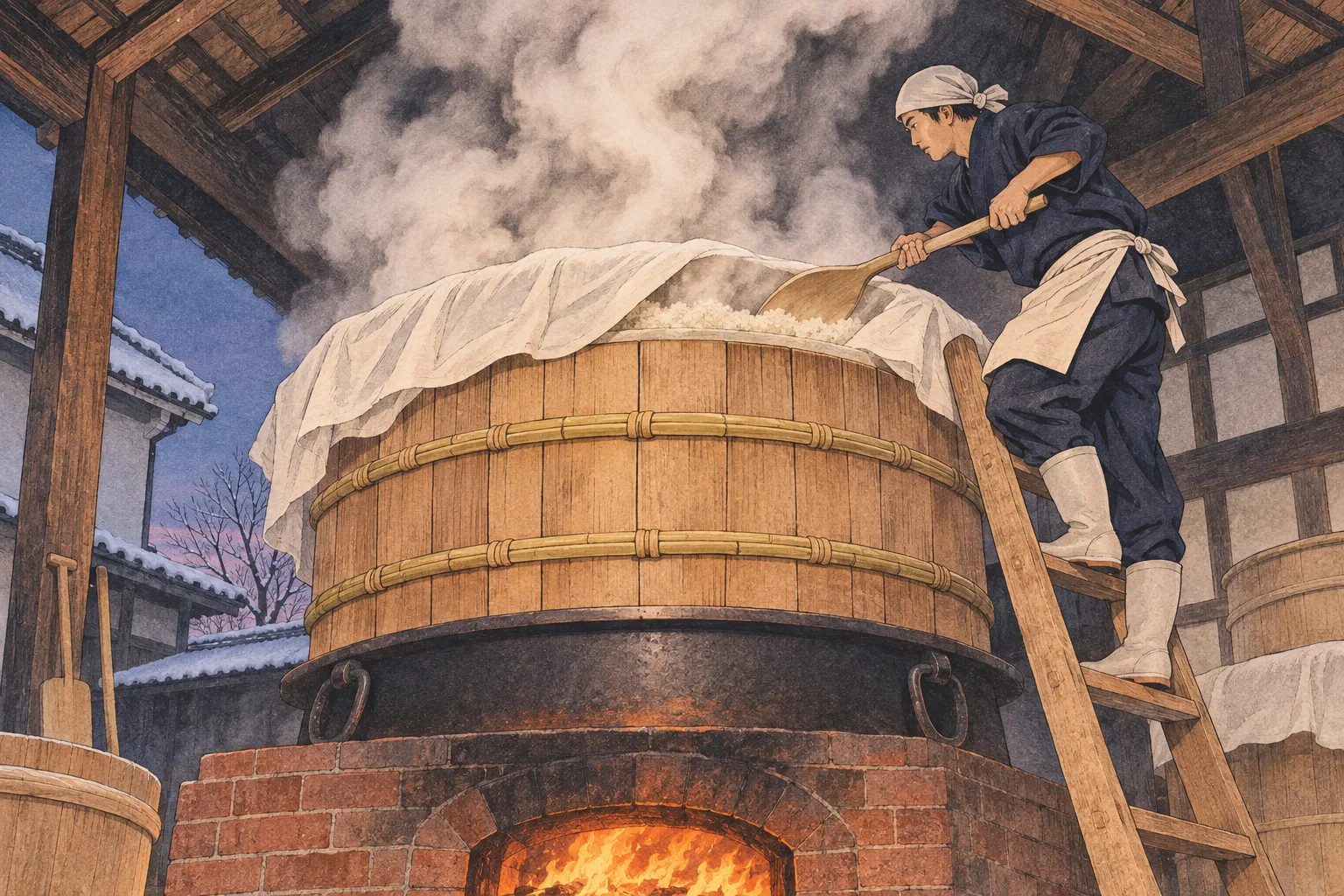
The koshiki at dawn: a wooden steaming tub sits on an iron cauldron over the fire, steam rises through the rice, and a brewer on a ladder spreads the rice with a wooden spade.
The goal is gaikō nainan, "hard outside, soft inside". The surface of each grain should be dry and springy, not sticky; the centre should be fully cooked with no chalky core. A wet surface lets kōji mould spread only across the outside; an undercooked centre leaves starch the enzymes cannot reach. The classic test is hinerimochi, "twisted rice cake": a brewer takes a handful of hot rice and kneads and presses it against a cloth or the palm into a thin sheet. Good steamed rice gives a smooth, slightly translucent sheet in which individual grains are still visible. Experienced hands can judge it from a pinch between the fingers or a chew.
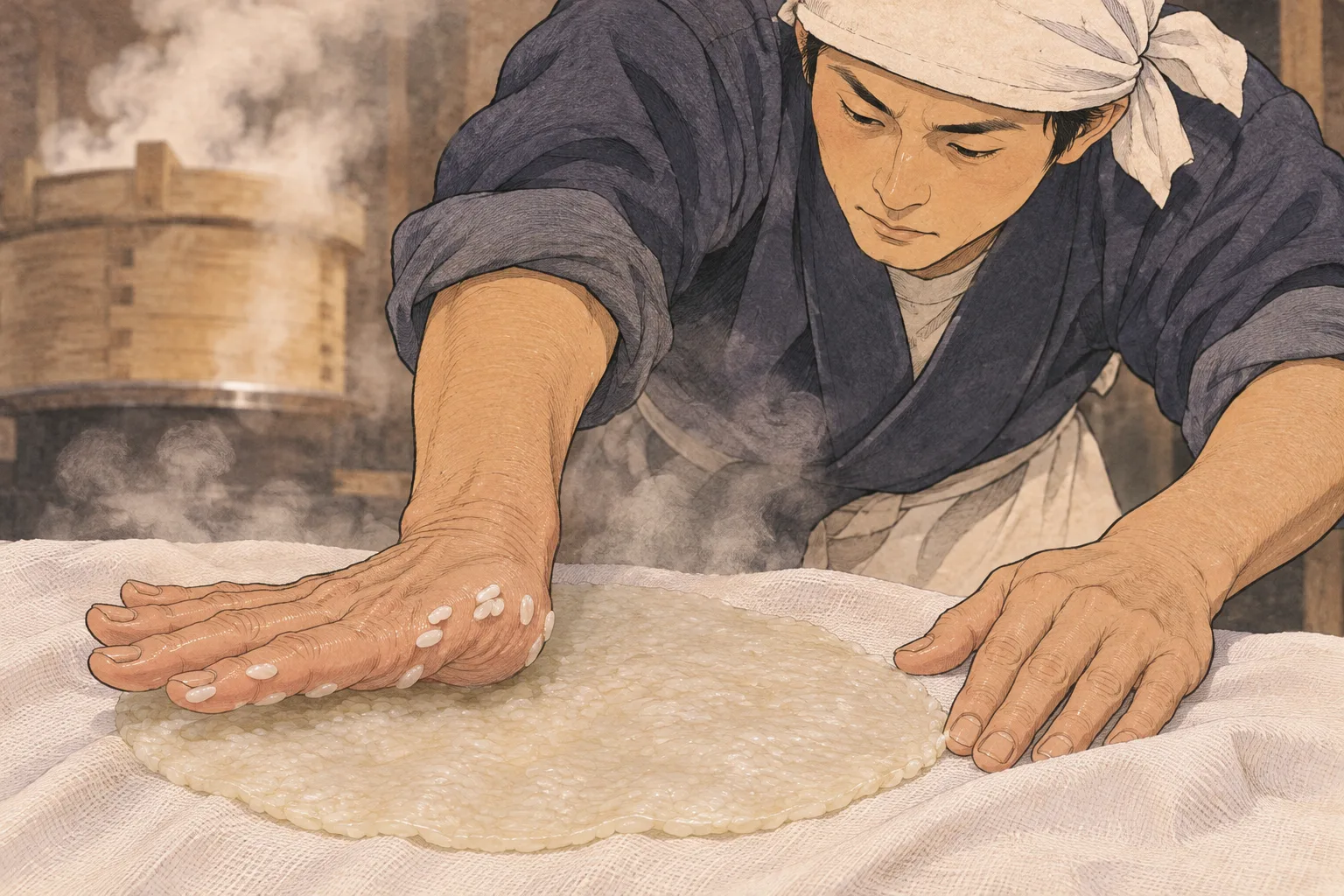
Hinerimochi: a handful of hot steamed rice is pressed into a thin sheet on a cloth. Good rice gives a smooth, slightly translucent sheet in which the grains still show.
Steamed rice comes out at around 100°C and has to be cooled quickly, to different targets: around 35–40°C for rice going to the kōji room, and the teens or lower for rice going into the yeast starter or mash, depending on the day’s plan. The old way was to dig the rice out with wooden spades, spread it on cloths over wooden frames or straw mats, and let winter air cool it while brewers broke up the clumps by hand. Today most breweries use a cooling conveyor, a perforated belt with fans below, feeding directly into pipes to the kōji room or tanks.
The koshiki is the object almost every brewery visit shows you, often an old wooden one set out by the entrance, sometimes with a straw rope (shimenawa) tied round it. When the season’s last rice has been steamed, some breweries hold koshiki-daoshi, "toppling the steamer": the vat is lifted off its cauldron, tipped over, scrubbed and stored, and the crew celebrates, although a few tanks are usually still fermenting.
04Two Days in the Kōji Room
Yeast cannot eat starch. It needs sugar, and in sake the enzymes that turn starch into sugar come from kōji, steamed rice on which a mould, Aspergillus oryzae, has been grown. Making kōji is widely considered the most demanding job in the brewery.
It happens in the kōji-muro, a small insulated room lined with cedar boards. Cedar absorbs and releases moisture, helping to keep the air humid without dripping. The room is held at around 25–30°C, and brewers working inside often wear only a T-shirt. Shoes are changed and hands washed at the door. The great enemy is stray bacteria, above all the nattō bacterium; many breweries forbid their staff from eating nattō during the season.
The whole process takes about two days, usually 48 to 55 hours from bringing the rice in, and is divided into fixed tasks, including at night. The timings below are approximate and vary by a few hours between breweries and types of kōji.
Hikikomi (bringing in). Steamed rice cooled to about 35°C is carried in and tipped onto the toko, a large wooden table. It is spread out and left briefly so that temperature and moisture even out.
Tokomomi (rubbing on the table). Two to four hours after the rice comes in, the brewer shakes tane-kōji, dried yellowish-green mould spores bought from one of a handful of specialist spore houses, over the rice from a fine sieve or a perforated canister, like seasoning. The dose is tiny, around 100 grams per hundred kilograms of rice. Then the rice is rubbed and turned by hand so that every grain is dusted, heaped into a mound and wrapped in cloth to hold the heat while the spores germinate. The later timings are counted from this step.
Kirikaeshi (turning over). Somewhere between 10 and 20 hours later, the mould has begun to grow, the mound is warming and clumping, and tiny white specks show on the grains. The cloth comes off, the clumps are broken up and the rice remixed and re-wrapped, so that growth is even through the heap and the centre does not overheat.
Mori (dividing). Around 20 hours after tokomomi, with the rice at about 32–34°C, the mould is generating its own heat and a single heap would cook itself. The rice is portioned into shallow wooden trays. The smallest, kōji-buta, are shallow cedar trays about 30–35 by 45–55 centimetres and 5–6 centimetres deep, each holding about 1.5 kilograms; they are used for the finest sake, stacked on shelves so each can be moved independently. Larger boxes hold anything from over ten to several tens of kilograms. Some breweries work on the table throughout, and many larger ones use automated kōji machines.
Nakashigoto (middle work). Seven or eight hours after dividing, close to 30 hours from tokomomi, the rice has climbed to 34–36°C. The rice in each tray is mixed and broken up, heaped back into a mound in the middle of the tray and pressed into a hollow to let heat escape. Trays are swapped between top and bottom of the stack throughout, since the top runs warmer.
Shimaishigoto (final work). Six or seven hours later, around 35 hours from tokomomi, comes the last turning. The rice is now at 37–40°C. It is spread across the whole tray and three furrows are drawn through it with the fingers, enlarging the surface so moisture escapes and the temperature does not spike. The rice keeps warming to just over 40°C and slowly dries.
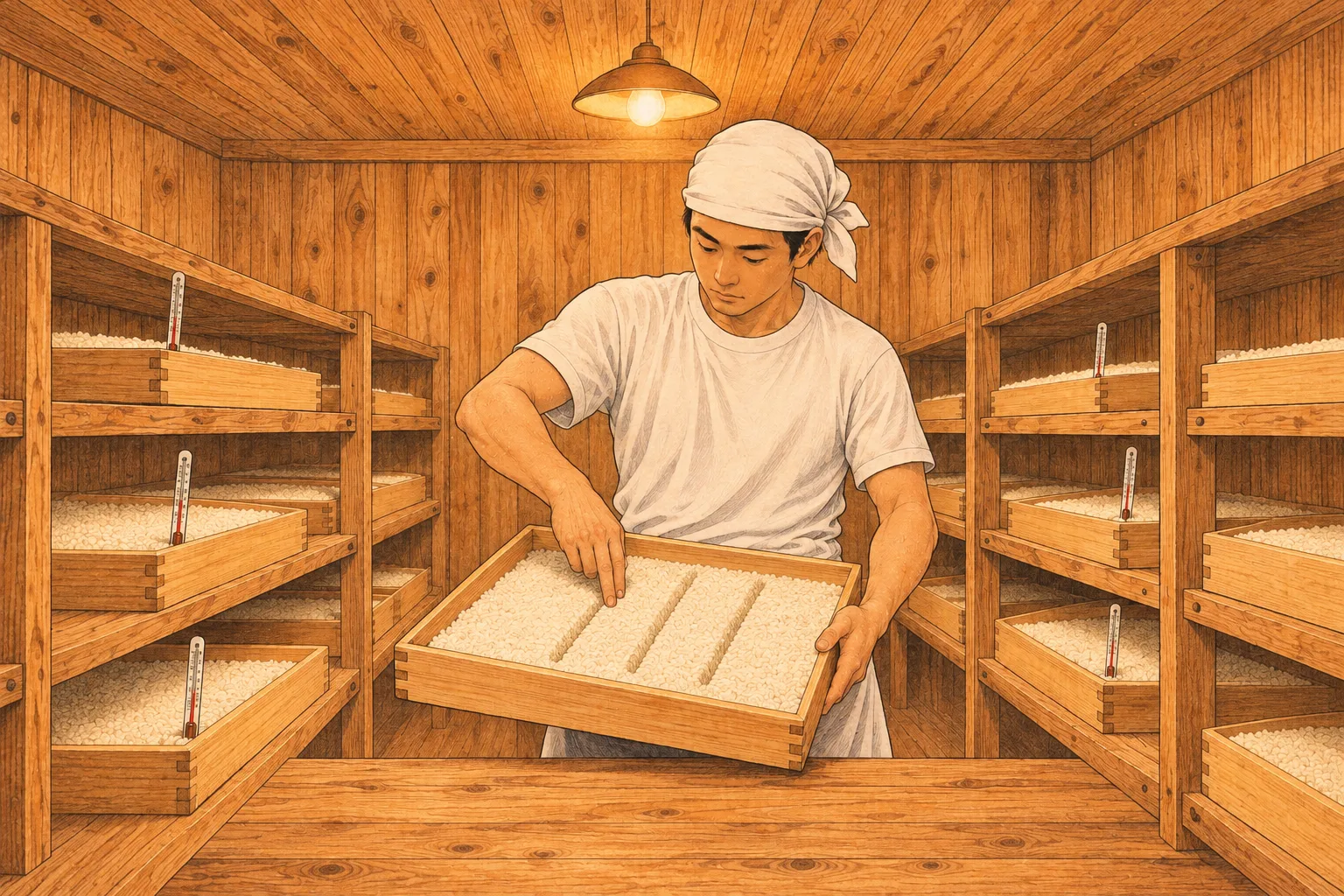
Shimaishigoto in the kōji room: the rice is spread across the whole kōji-buta tray and three furrows are drawn through it with the fingers. The walls are cedar boards, and a thermometer stands in each tray on the shelves.
Dekōji (taking out). Eight to a dozen or so hours after the final work, at around 40–42°C, the finished kōji is moved out to a cooler, drier room to shed heat and moisture and stop growing. Good kōji is dry, loose and free-flowing. Each grain wears white threads of mould, and broken open, it shows white reaching into the core. It smells of roasted chestnuts.
Through all this the brewers rely on thermometers pushed into every heap and tray, checked several times a night. But they also press the rice with a palm to feel heat and moisture, hold a grain up to the light, smell it for sweetness or sourness, and chew a few grains.
Finished kōji falls into two broad types. In tsuki-haze, "piercing" kōji, the mould shows only as scattered white spots on the surface, but its threads have driven deep into the centre. Its enzyme balance suits slow, cool fermentation and clean, fragrant sake, and it is the type favoured for ginjō. In sō-haze, "all-over" kōji, the mould covers the entire surface like frost and also grows deep. It has strong enzyme power and converts starch fast, giving fuller, sweeter, more savoury sake. Kōji whose mould stays only on the surface, nuri-haze or "painted" kōji, is considered poor. Brewers steer between the types through how dry the steamed rice is, how many spores they use, how thickly they spread the rice and the temperature at each stage.
Visitors are rarely allowed inside the kōji room, but many breweries have a small window in its cedar door through which you can see the table and towers of trays. Old kōji-buta, their wood darkened and polished by decades of hands, often turn up in display rooms.
05Building the Mash in Three Stages
The yeast starter, shubo or moto, is a small batch in which a large, healthy population of yeast is raised before the main brew; it is a subject of its own, and here it is enough to know it is the seed of the mash.
The mash, moromi, is made from starter, kōji, steamed rice and water. Added all at once, those ingredients would dilute the starter’s yeast and acidity so much that stray bacteria could take hold before the yeast caught up. So sake uses sandan jikomi, a three-stage addition spread over four days, each addition larger than the last, in proportions commonly given as about 1:2:3, so the first is around a sixth of the total and the last around half.
Day 1, hatsuzoe (first addition). The starter goes into the mash tank with the first portion of kōji, steamed rice and water, and the brewers stir it in. The temperature is held fairly warm, typically around 12°C, to keep the yeast active.
Day 2, odori (the dance). Nothing is added. The mash rests for a day while the yeast multiplies; the name pictures it dancing in the tank. By evening fine bubbles show on the surface. Brewers watch this day closely, because the state of the mash after odori tells them whether it is safe to commit the big additions.
Day 3, nakazoe (middle addition). About twice the first portion goes in, and the temperature drops to around 8–10°C.
Day 4, tomezoe (final addition). The largest portion fills the tank, and the temperature drops again, to around 6–8°C. The fermentation clock starts from this day.
The temperature falls with each addition because more food means more vigorous, heat-producing yeast; lowering the temperature step by step keeps fermentation steady. Additions are tipped into the tank by bucket or conveyor and stirred with a kai, a long wooden paddle with a flat head. In a deep tank the brewer stands on a wooden walkway at the rim and drives the paddle down to the bottom stroke by stroke, until the fresh rice and kōji floating on top like wet snow have no dry lumps left.
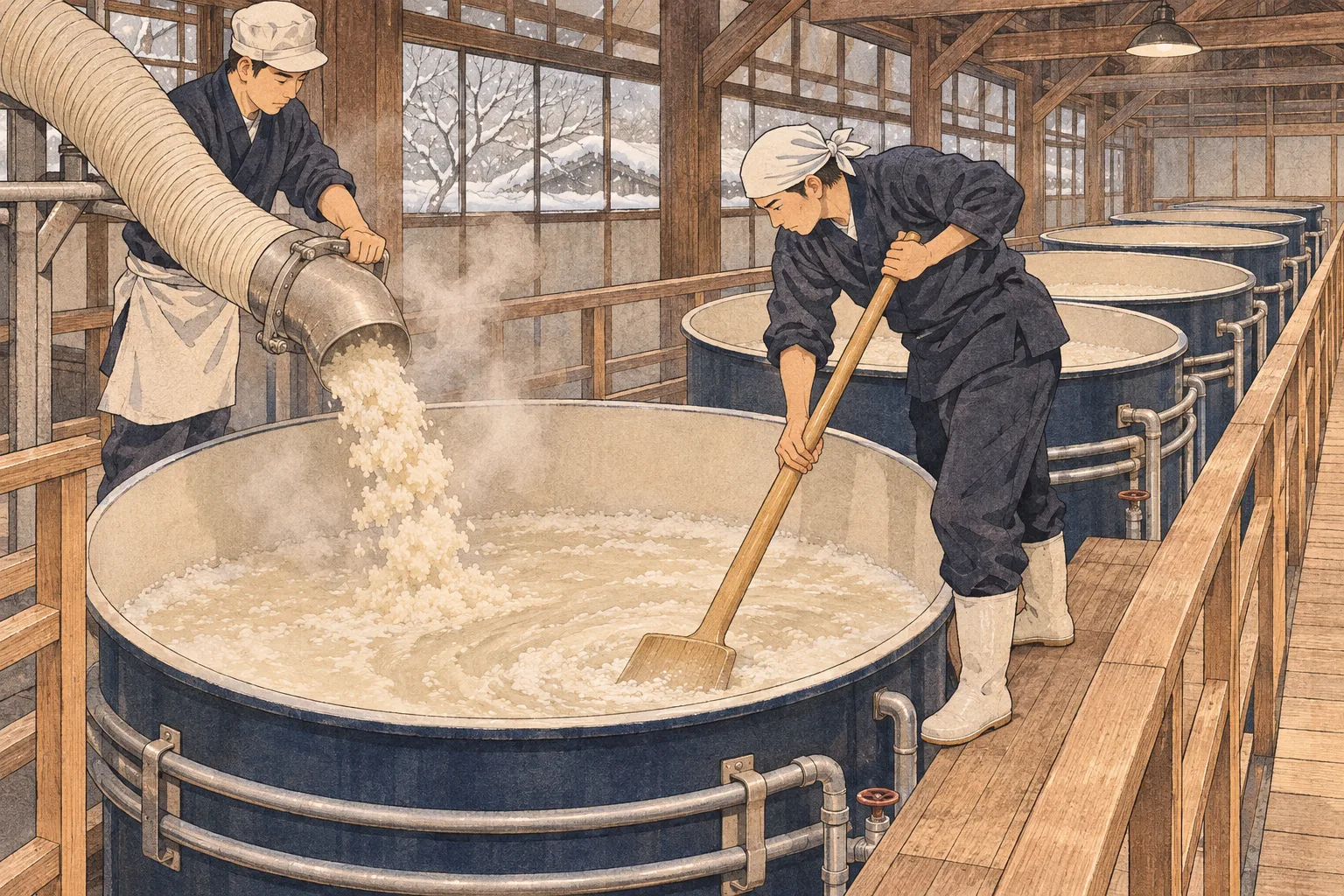
Building the mash: one brewer tips steamed rice into the tank from a conveyor hose while another, standing on the wooden walkway at the rim, stirs with a long kai paddle.
What the brewers check over these four days is concrete. Temperature is measured before and after every addition, and kept on plan by adjusting the temperature of the added water and steamed rice, which is why rice for the mash is cooled to a different point from rice for kōji. On the odori day they look for a film of fine bubbles and smell for a clean, faintly sour, bready yeast note; if the bubbles are slow or the smell is dull, the next addition can be delayed or the tank warmed slightly. Breweries with a lab may also count yeast cells under a microscope or check acidity before committing.
The tank hall is the most open space on a brewery tour: rows of white enamel or stainless-steel tanks with open tops, a walkway of wood or steel around the rims, and paddles taller than a person leaning against the wall. A clipboard or small blackboard on the walkway often records each tank’s addition dates and temperatures.
06Reading the Foam
After tomezoe, the mash ferments for three to five weeks. Everyday sake runs warmer, usually kept at or below about 15°C, and may be ready in twenty-odd days to three weeks. Ginjō and daiginjō ferment at around 10°C or below and take a month or longer, sometimes about forty days. Throughout, enzymes from the kōji break starch into sugar while the yeast turns sugar into alcohol, both in the same tank at the same time.
Management rests on three things. Temperature: before modern equipment, tanks were cooled from the outside with cold water, and warmed by lowering in a dakidaru, a handled cylindrical tub of cedar (later aluminium or stainless steel) filled with hot water, used above all in the yeast starter and sometimes filled with cold water to cool instead; today’s stainless-steel tanks often have cooling jackets or coils of chilled-water hose. Stirring: the kai goes in morning and evening to even out temperature, lift settled rice and release carbon dioxide. And daily analysis: a sample is drawn and filtered, and its specific gravity, alcohol and acidity are measured and plotted. After rising for the first few days, gravity falls as sugar is consumed, alcohol rises, and brewers compare this year’s curves against their best tanks from past years, cooling a tank that runs fast and warming one that lags.
Before instruments, though, the brewer’s main gauge was the surface. Carbon dioxide from fermentation builds a cap of foam whose look changes from day to day. A practised brewer could glance into a tank and know how far along it was and whether it was running hot or slow. The traditional sequence has seven stages.
Suji-awa, streak foam, appears two or three days after tomezoe: thin white lines across the surface, a sign the yeast is getting to work. Mizu-awa, water foam, follows a day or two later: a layer of white, light bubbles spreading across the surface. Iwa-awa, rock foam, is thicker and stickier, heaving up in lumps like boulders; fermentation is accelerating. Taka-awa, high foam, arrives somewhere between a week and ten days in, at the peak: dense, sticky foam that will not collapse and keeps rising past the rim. Left alone, it would overflow and carry mash with it, so brewers once took turns on night watch, knocking the foam down with boards or paddles; later a collar (awagasa) was fitted to raise the rim, or a rotating foam-breaker beat it back. Ochi-awa, falling foam, comes next, as the cap sinks and collapses with a crackle when stirred. Tama-awa, ball foam, leaves a scatter of round, soap-bubble-like bubbles that swell and pop. Finally comes ji, "ground": the bubbles are gone and the surface of the mash lies flat, like thin porridge. The end is near, and the analysis numbers will decide the day of pressing.
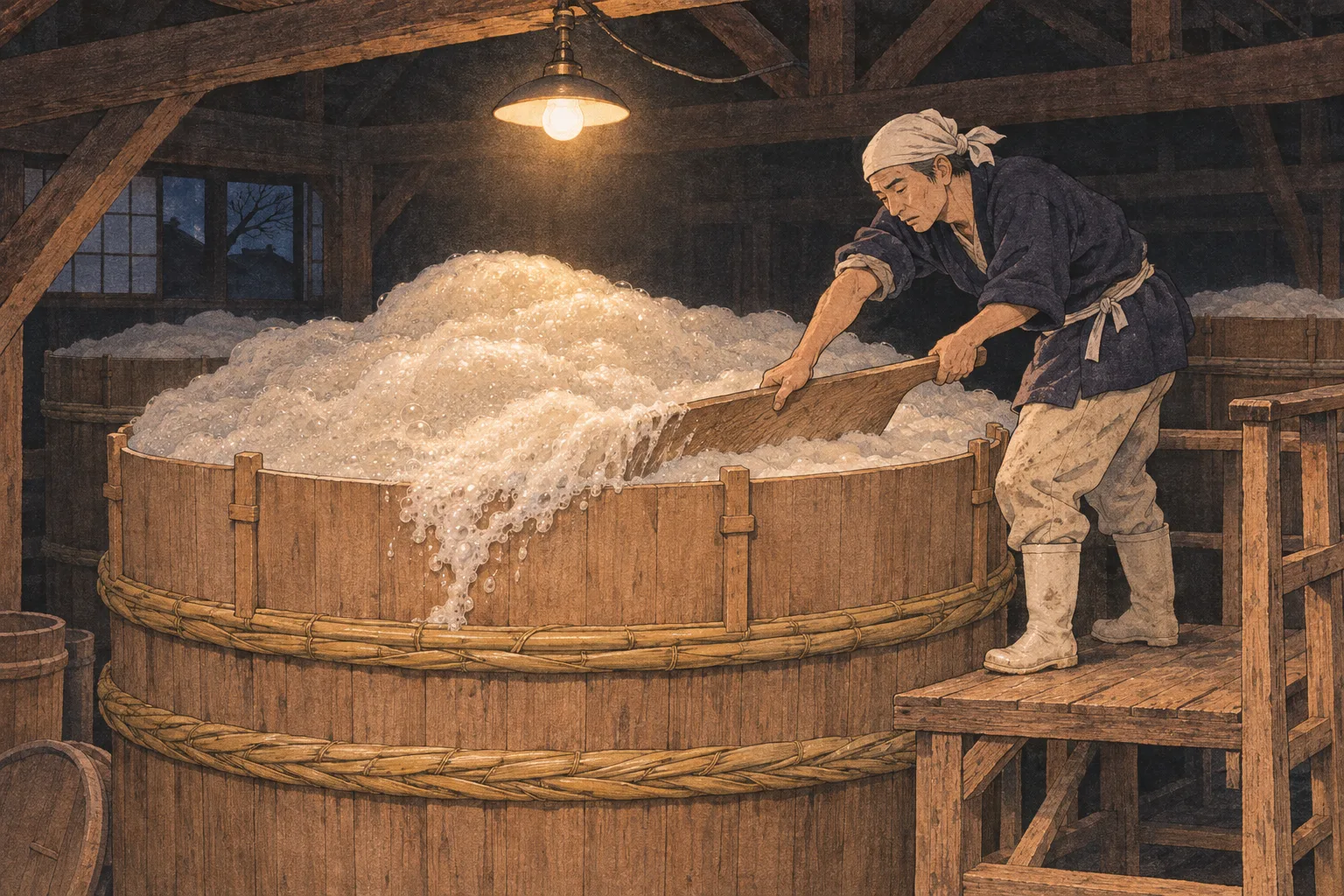
Night watch at the high-foam stage: a brewer on the platform beside a wooden vat pushes the rising foam back with a board. The boards fixed round the rim are the awagasa collar. (artist’s impression)
From the 1970s the national brewing research institute, the Brewing Society of Japan and prefectural laboratories developed "foamless" yeast strains that never throw high foam, letting breweries fill tanks fuller and ending the night watch. Most sake today is made with them, so you may not see all seven stages. But in a brewery using traditional yeast, standing on the tank walkway on a winter day, you can still watch the mash heave and bubble, hear a soft crackle, and smell fruit in the air.
07Side by Side: The Seven Foams and the Kōji Grain
Laid out together, the seven stages read as a single curve of rising and falling activity.
Timing (counted from tomezoe; only the first stages are pinned down consistently, the rest are rough, and ginjō stretches each stage): streak foam around days 2–3; water foam a day or two later; rock foam around day 5; high foam between about day 7 and day 10; falling foam in the second week; ball foam around two weeks in; then flat ground.
Amount and shape: streak foam is only lines; water foam is a thin even sheet; rock foam is thick and lumpy; high foam is a mountain growing upward; falling foam is that mountain collapsing; ball foam is a few scattered round bubbles; ground is flat.
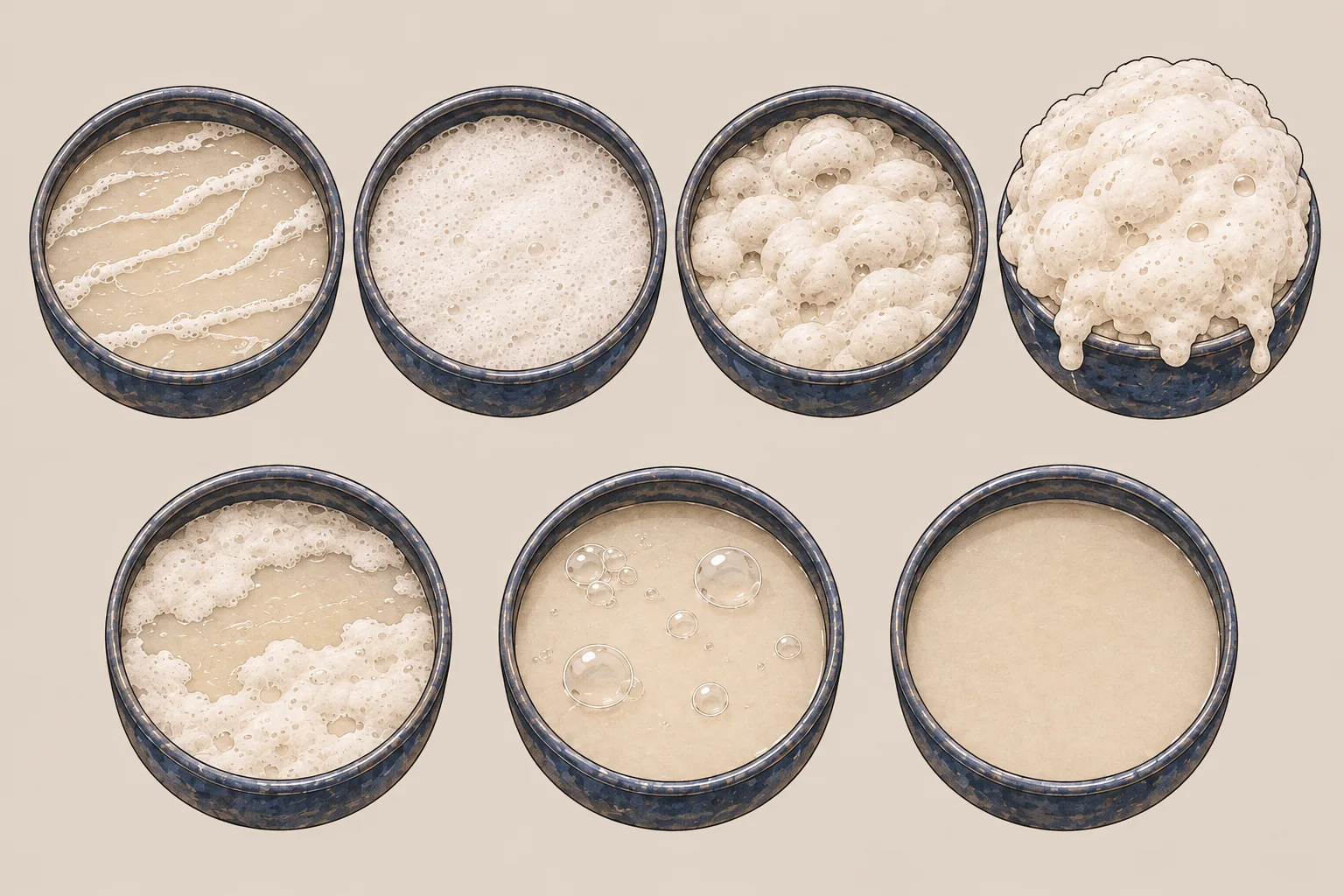
The surface of the mash seen from the top of the tank. Top row, from left: suji-awa, mizu-awa, iwa-awa, taka-awa. Bottom row, from left: ochi-awa, tama-awa, ji.
Texture: light in streak foam and white and light in water foam; thicker and stickier from rock foam on, stickiest and most stubborn in high foam; collapsing at a stir in falling foam; separate soap-bubble spheres in ball foam; none in ground, where the bare mash shows.
What the brewer does: in the streak and water stages, watch that the yeast gets going, warming slightly if the tank is sluggish; in the rock stage, keep the temperature from climbing too fast; in the high stage, prevent overflow and cool on schedule; in the falling and ball stages, read the numbers to judge sweetness and dryness; at ground, prepare to press.
A second comparison follows a grain of kōji through its two days. Brought in, it is a glossy, half-translucent grain, moist and springy. At the turning it shows the faintest white specks. Around dividing, the whole grain turns white and opaque as the specks join into patches. At the middle work, white threads clearly coat the surface and begin to drive inward. Taken out, tsuki-haze shows sparse spots outside and a white core; sō-haze is frosted all over; poor surface-only nuri-haze is white outside and still clear within.
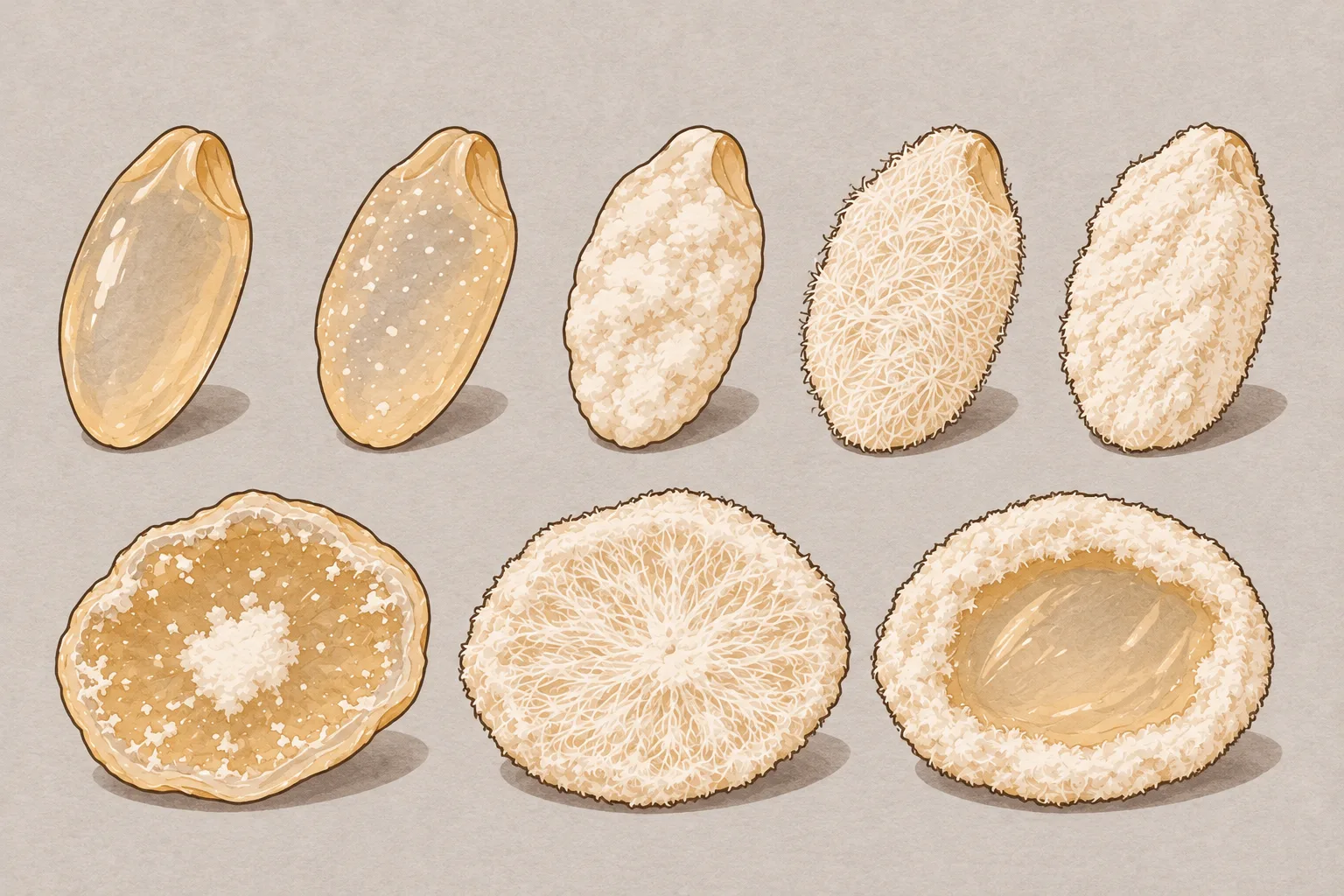
Top row, from left: a grain of kōji rice at hikikomi, kirikaeshi, mori, nakashigoto and dekōji, the white mould spreading step by step. Bottom row, from left, cut open: tsuki-haze (sparse spots outside, white core), sō-haze (white throughout) and nuri-haze (white on the surface only).
08After the Mash: Pressing, Filtering, Pasteurising, Ageing, Blending
When fermentation ends, liquid sake is separated from the solids, the lees, in the pressing (jōsō). Most breweries use an automatic press like a giant accordion, in which mash is pumped between rows of filter cloths and squeezed by inflating bladders, leaving white sheets of sake lees (sake-kasu) to be peeled off. Older methods, with cloth bags stacked in a wooden box (fune) or hung to drip, and the names for the different fractions that run off, are covered on a separate page, as are the roles of the master brewer (tōji) and crew.
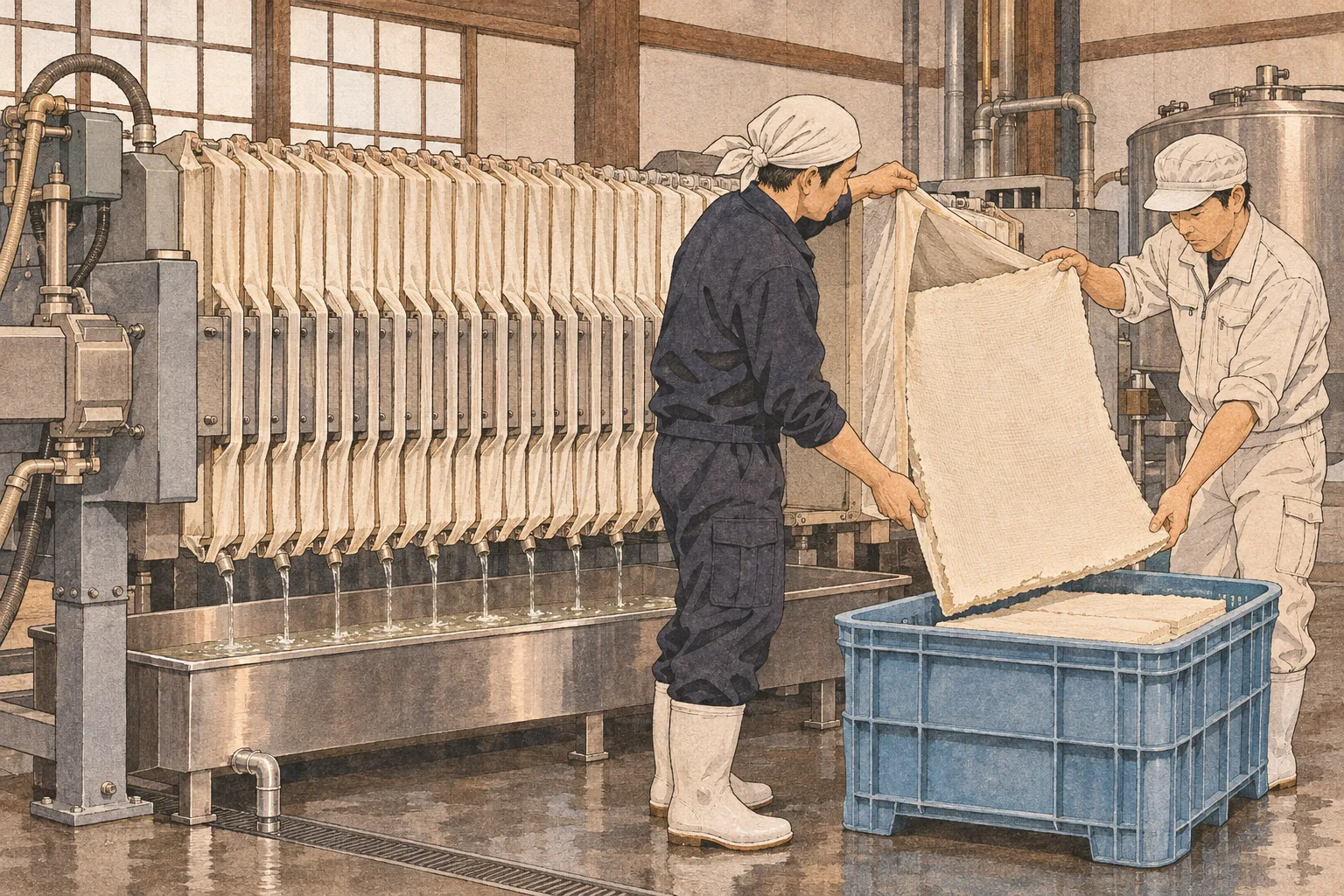
An automatic press: filter plates stand in a long row like an accordion and sake runs into the trough below. Two brewers peel a whole white sheet of sake lees from the cloth.
Freshly pressed sake is cloudy. It is left to settle for some days and the clear liquid is drawn off the sediment (oribiki). Many breweries then add a little powdered activated charcoal to strip colour and rough flavours before filtering; others skip the charcoal or filtration entirely and label the sake muroka, unfiltered, keeping a faint yellow-green tint and more body.
Next comes hi-ire, pasteurisation. The sake is heated to around 60–65°C and cooled, which stops leftover enzymes and kills the lactic bacteria (hiochi-kin) that can turn sake sour and hazy. Traditionally it runs through a coil of pipe sitting in hot water; some breweries heat sake already in the bottle to keep more aroma. Most sake is pasteurised twice, before storage and before bottling, and the familiar nama (unpasteurised) categories are defined by which of those heatings is skipped. The temperature has to be held precisely: too low and the bacteria survive, too long and the aroma fades and a cooked note creeps in, so the sake is chilled again quickly.
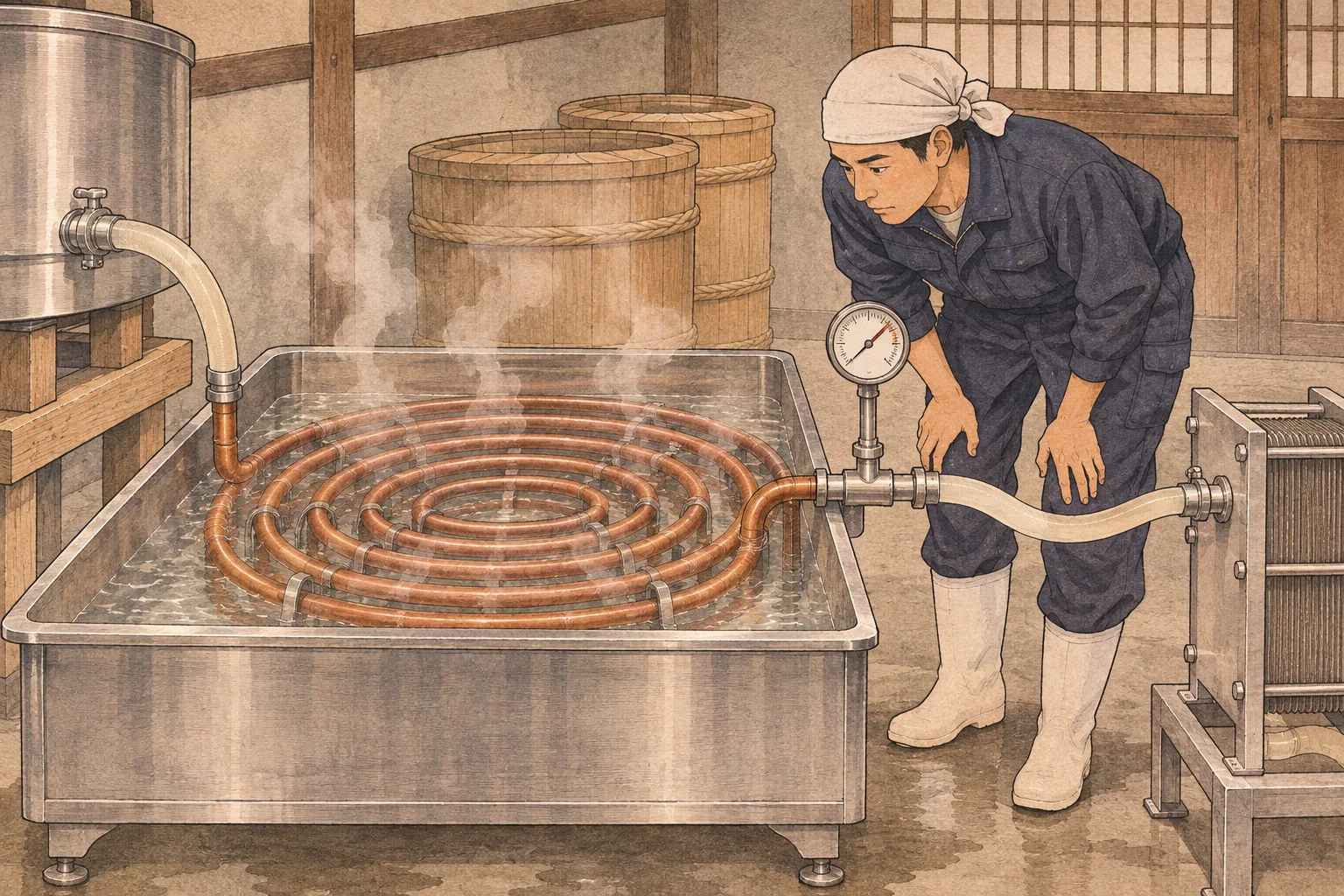
Hi-ire through a coil: the sake runs through a copper-coloured coil lying in a bath of hot water and on to a cooler, while a brewer bends to read the gauge at the outlet.
Pasteurised sake then rests in tanks in a cool store, from spring through summer into autumn, as its sharp edges round off. Brewers taste each tank through the summer to decide which is ready to ship and which needs longer; autumn’s hiyaoroshi is sake that has come through this rest. Some brewers age sake for years into amber, caramel-scented koshu.
Two last steps come before shipping. Blending: no two tanks taste quite the same, so the master brewer tastes them all and combines them to keep a label consistent year to year. Dilution (warimizu): pressed sake usually comes out at around 17–20 percent alcohol, and brewing water is added to bring it to about 15–16 percent. Sake shipped undiluted is labelled genshu. After a final filtering and pasteurising, the sake is bottled.
In the storage hall you will see ranks of tanks marked in white paint with their numbers and volumes. In the tasting room, rows of numbered white cups with blue bullseye rings at the bottom are where the master brewer compares tanks before blending.
More deep dives on this topic
 Reading the Fine Print on a Sake LabelPick up a sake bottle in a Japanese liquor shop and the front label will usually give you a brush-written brand name and not much else.
 Sake RicePick up a bottle of premium sake in Japan and the largest characters on the label after the brewery’s name are often the name of a rice: Yamada Nishiki, Omachi, Gohyakumangoku.
 The Yeast Starter and the YeastsBefore a sake brewery commits a ton of rice to a fermentation, it brews something much smaller: a dense, sour culture of yeast called the shubo ("mother of sake") or moto…
 From Polished Grain to Pressed SakeA sake brewery in winter is a working kitchen on an industrial scale.
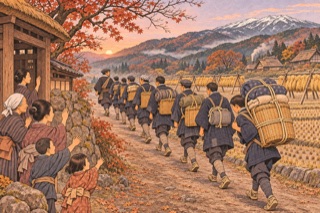 Tōji Guilds and the Brewery CrewFor most of the last three centuries, the people who actually made Japanese sake did not own the breweries and did not live near them.
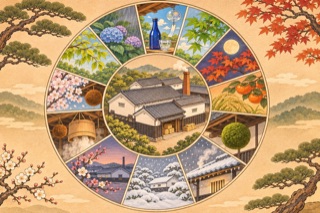 A Year of SakeWalk into the same Japanese liquor shop once a month for a year and the fridge will tell you the season before the weather does.
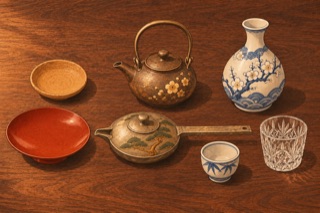 Sake Vessels and Warming ToolsOrder sake in Japan and the drink often arrives in an object you have no name for: a slim-necked ceramic bottle, a cup the size of a thimble, a square wooden box filled to the…
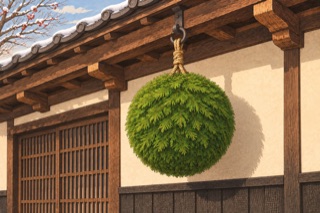 Sake and the GodsWalk past an old sake brewery in Japan and you will probably see a large ball of cedar hanging over its door.
 Aroma, Taste and the Four Types of SakeMost sake menus in Japan assume you already know the code.
- Back to the main article: Sake →