
Walk into the same Japanese liquor shop once a month for a year and the fridge will tell you the season before the weather does. In November the posters say shinshu, new sake. On the morning of risshun, the first day of spring (usually 4 February), a batch of bottles arrives that was pressed only hours earlier. In spring the shelves fill with faintly cloudy bottles printed with cherry blossoms; in July the glass turns blue and the labels show goldfish and fireworks; in September everything goes maple-red for hiyaoroshi. Most of these bottles come from the same winter’s brewing. What separates them is when the sake was pressed, whether it was heated, and how long it sat in the tank. This page walks through the sake year month by month, explains how each seasonal style is made, what it tastes like and how to spot it, and fits in the brewery’s own calendar: the first steaming, the day the rice steamer is tipped over, the last pressing, the open days, and the national new-sake competition.
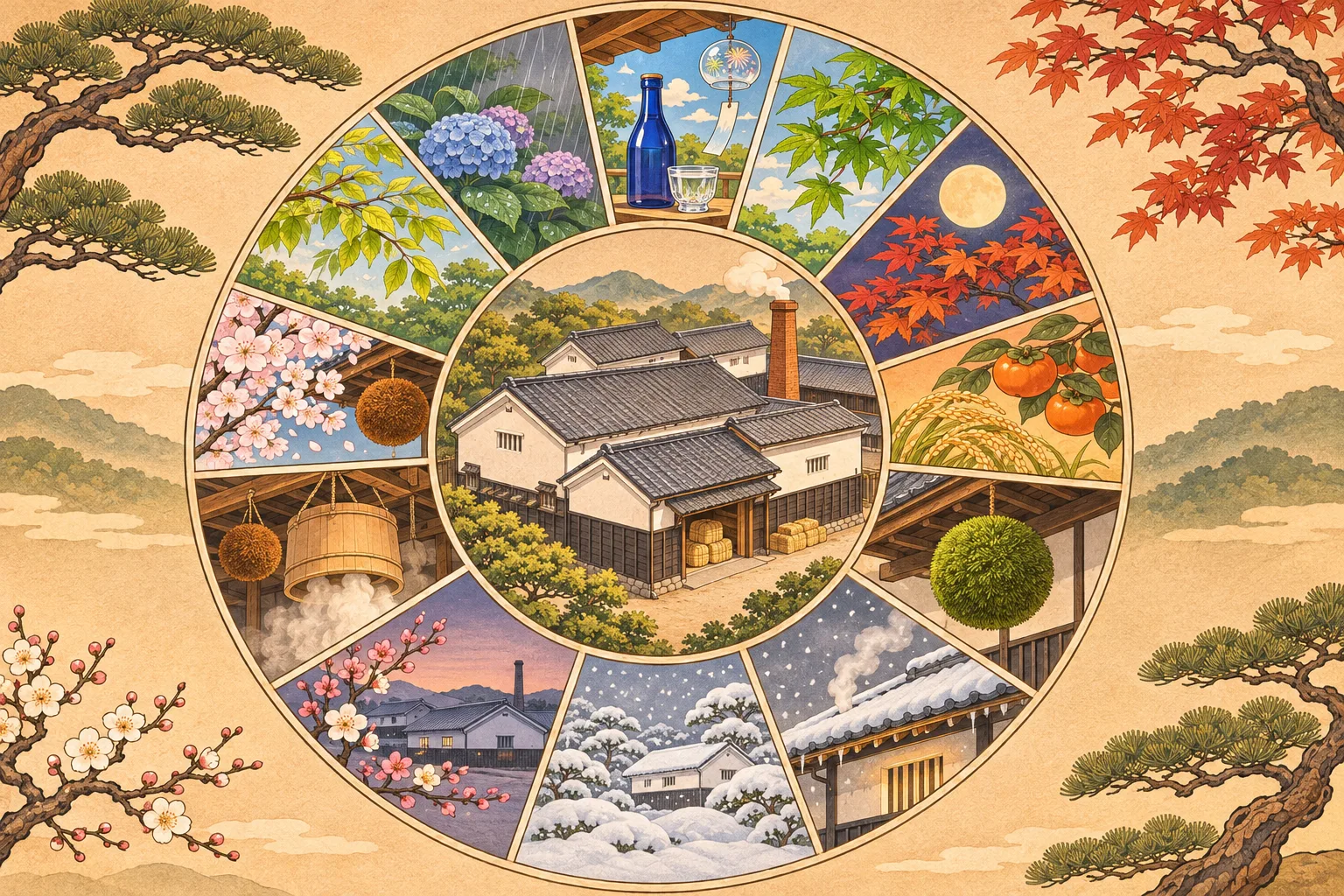
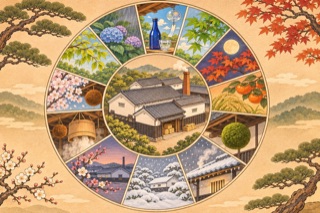
The brewery year as a ring of twelve months, read clockwise from July at the top: a blue summer bottle and wind chime, September’s maples and full moon, the green sugidama of November, snow, February plum blossom, the steamer laid on its side, cherry blossom, and June rain.
01The Year Starts on 1 July
The sake industry keeps its own calendar. The shuzō nendo, or brewing year, runs from 1 July to 30 June. You will sometimes see it on back labels or shop tags as "BY", for Brewery Year, with the Japanese era year in front: "R6BY" means sake brewed in the brewing year that began in Reiwa 6. The line falls at the quietest moment of the year. The previous season’s sake has all been pressed, the seasonal workers have gone home, and the only thing happening in the brewery is sake slowly changing in storage tanks. It was not always there: the Meiji-era sake tax law set the brewing year from 1 October to 30 September, and the start moved to 1 July only at some point between 1965 and 1974. The old date is not forgotten. In 1978 the Japan Sake and Shochu Makers Association named 1 October "Sake Day", citing among its reasons that it had long been the brewers’ New Year.
The shape of the year comes from kanzukuri, cold-season brewing. Over the Edo period, brewers concentrated production in the winter months, when low temperatures kept bacteria in check and let fermentation run slowly and cleanly, and when farmers had free time to work as brewery hands. The resulting rhythm still holds at most small breweries: new rice arrives in autumn, brewing peaks in midwinter, the season ends in early spring, sake rests through summer, and the matured stock goes out in autumn. Each seasonal style is a snapshot taken at one point on that line.
Not every brewery follows it. In 1961 Gekkeikan in Fushimi completed Japan’s first brewery built for temperature-controlled, year-round brewing (shiki jōzō, "four-season brewing"), and large producers have brewed through the year ever since. But most of Japan’s breweries are small family firms that still brew only in winter, and shops and izakaya have turned the resulting calendar into a seasonal release schedule that customers look forward to.
One practical warning: the date printed on a bottle (seizō nengetsu) is the bottling date, not the brewing date; since 2023 it has been optional, though many bottles still carry it. A sake brewed last winter and bottled this September for autumn release will carry this September’s date.
02Midsummer: Natsuzake and the Empty Brewery
In July a sake brewery looks almost abandoned. The great rice steamer has been scrubbed and stored, the press is dry, the fermentation tanks are empty. The few staff who remain spend the summer watching the storage tanks, tasting samples every few weeks to decide which tank will go out as autumn’s hiyaoroshi and which will be held longer. Summer is also when roofs get fixed and equipment serviced.
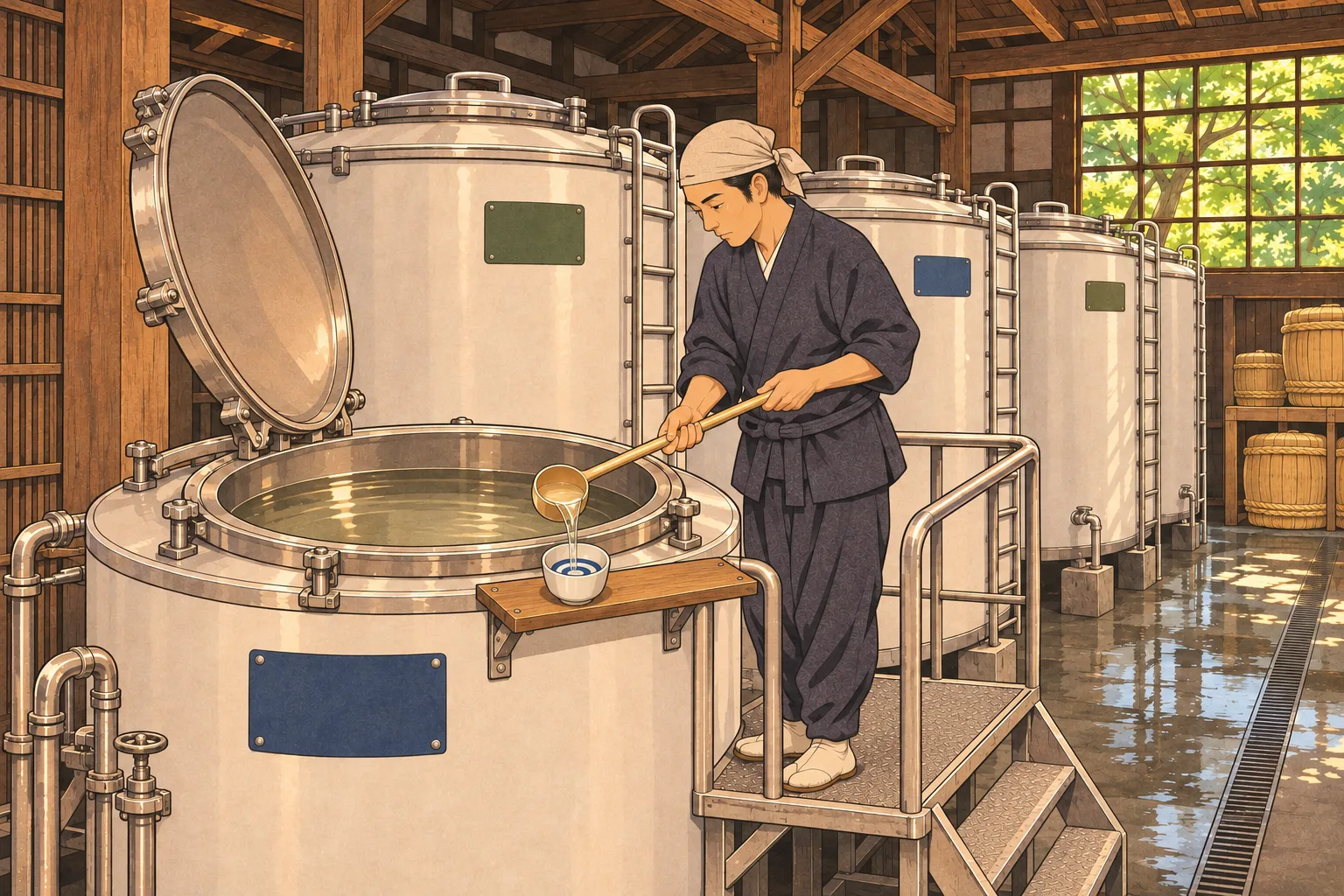
Midsummer in the storage hall: a brewery worker ladles a sample from a storage tank into a small white cup to check its colour.
Meanwhile, from late June, shop fridges fill with natsuzake, summer sake. This is a young category, about twenty years old: it is generally traced to a Tokyo specialist sake shop that planned a "summer sake" range around 2005, with more breweries joining each year. It has no legal definition. It is easy to recognise: bottles of cobalt, sky blue or clear glass; labels with goldfish, fireworks, morning glories, wind chimes, waves; names with natsu (summer), ryō (cool), or simply "Summer" in katakana. Some are labelled natsu-gin, summer ginjō.
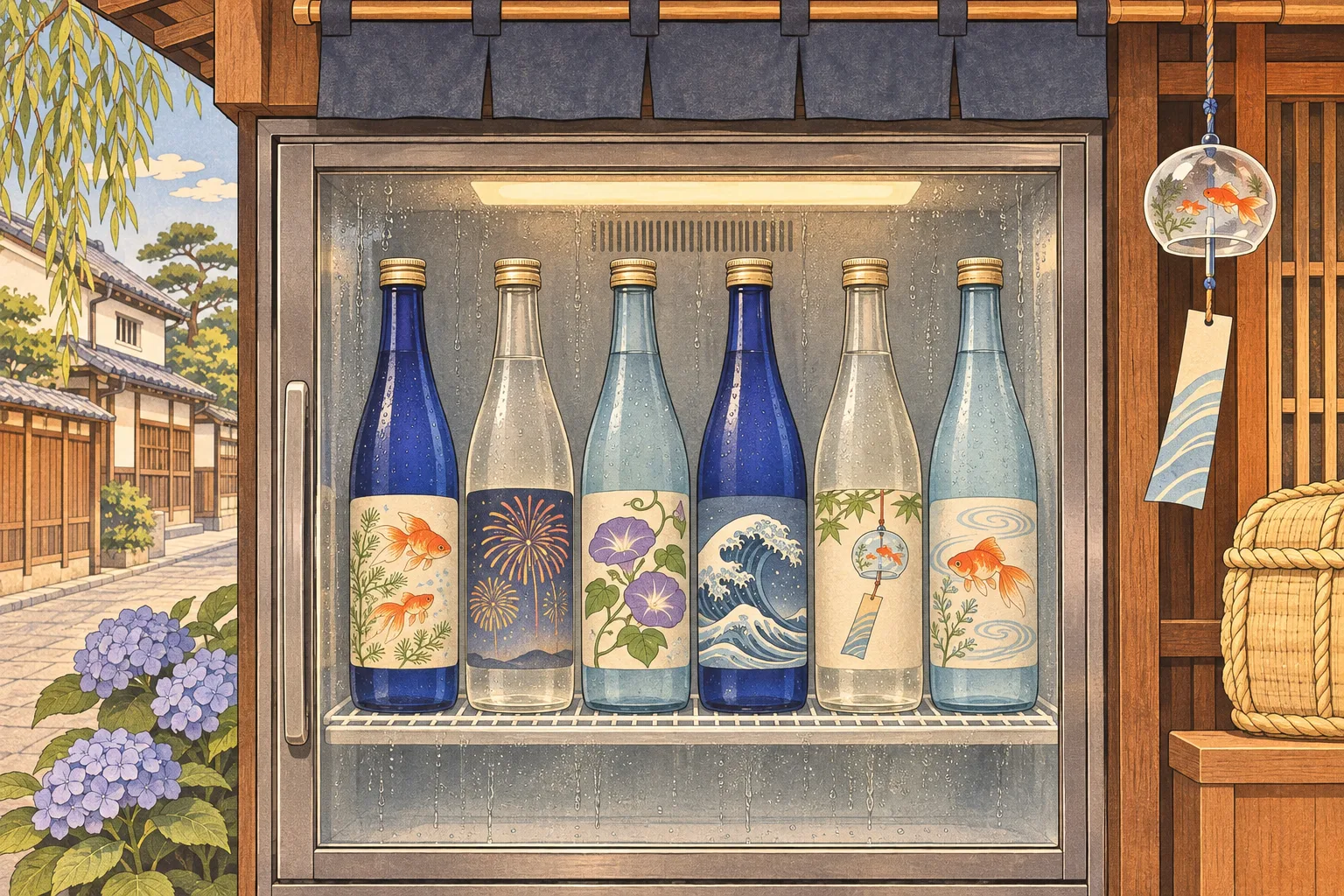
Natsuzake in a shop fridge: cobalt, pale blue and clear bottles, with labels showing (from left) goldfish, fireworks, morning glories, waves, a wind chime and goldfish again. A glass wind chime hangs beside it.
Brewers take several routes to a summer style. The most common is lower alcohol, with many at around 13 to 14 percent instead of the usual 15 to 16, achieved either by adding water or by managing fermentation so the undiluted sake is naturally lighter. Others push acidity, using white kōji or high-acid yeasts so the sake drinks like a crisp white wine. Some are designed to be served on the rocks and say so on the label. Most natsuzake is pasteurised, often as nama-chozō, heated only at bottling, so it survives summer distribution and the constant opening of shop fridges; some is sold unpasteurised.
Expect something light, dry and short, with citrus or green-apple notes rather than the banana-and-melon fragrance of a classic ginjō. In izakaya, summer sake appears on the chalkboard under a "summer" heading, served well chilled with cold tofu, edamame, salt-grilled sweetfish and vinegared dishes.
Summer sake exists because summer used to be dead season for sake; people drank beer and shōchū. Unlike hiyaoroshi or new sake, natsuzake does not correspond to any point in the brewing calendar. It is a product designed for the season, and styles vary widely. Check the back label: one brewery’s summer sake may be unpasteurised, another’s a diluted honjōzō.
03September to November: Hiyaoroshi and Aki-agari
Early September brings the first big release of the sake year. There is no nationwide release date for hiyaoroshi; most of it starts to appear in early September. Some regions agree on a shared date instead: in Nagano Prefecture hiyaoroshi is released each year on 9 September, the old Chrysanthemum Festival, and breweries elsewhere also choose that day. Shops post signs announcing its arrival. Labels shift to maple red, persimmon orange and rice-stalk gold, decorated with autumn leaves, a full moon, pampas grass or a Pacific saury.
As the main sake article explains, sake is normally pasteurised (hi-ire) by heating to around 60 to 65°C, traditionally twice: once before storage and once at bottling. Hiyaoroshi is pasteurised only the first time. It is brewed in winter, pressed, heated once in spring, stored through the summer, and then bottled in autumn without the second heating. Hiya means "cold" and oroshi means "to release to the trade": the sake goes out cold, as it is. In label terminology this is namazume, pasteurised before storage but not at bottling. (The full set of nama terms is covered in the sake-label deep-dive.)
The practice dates to the Edo period. Sake brewed in winter was moved into large casks in spring and kept in the brewery over summer. By autumn, the outside air had cooled to roughly the temperature of the sake in the casks, so it could be decanted into shipping barrels without risk of spoilage and sold without reheating. That autumn release was prized. Today’s hiyaoroshi is usually stored in refrigerated or temperature-controlled rooms and released on a commercial timetable rather than by the thermometer, but the outline is unchanged: brewed in winter, heated once, rested over summer, shipped in autumn without a second heating.
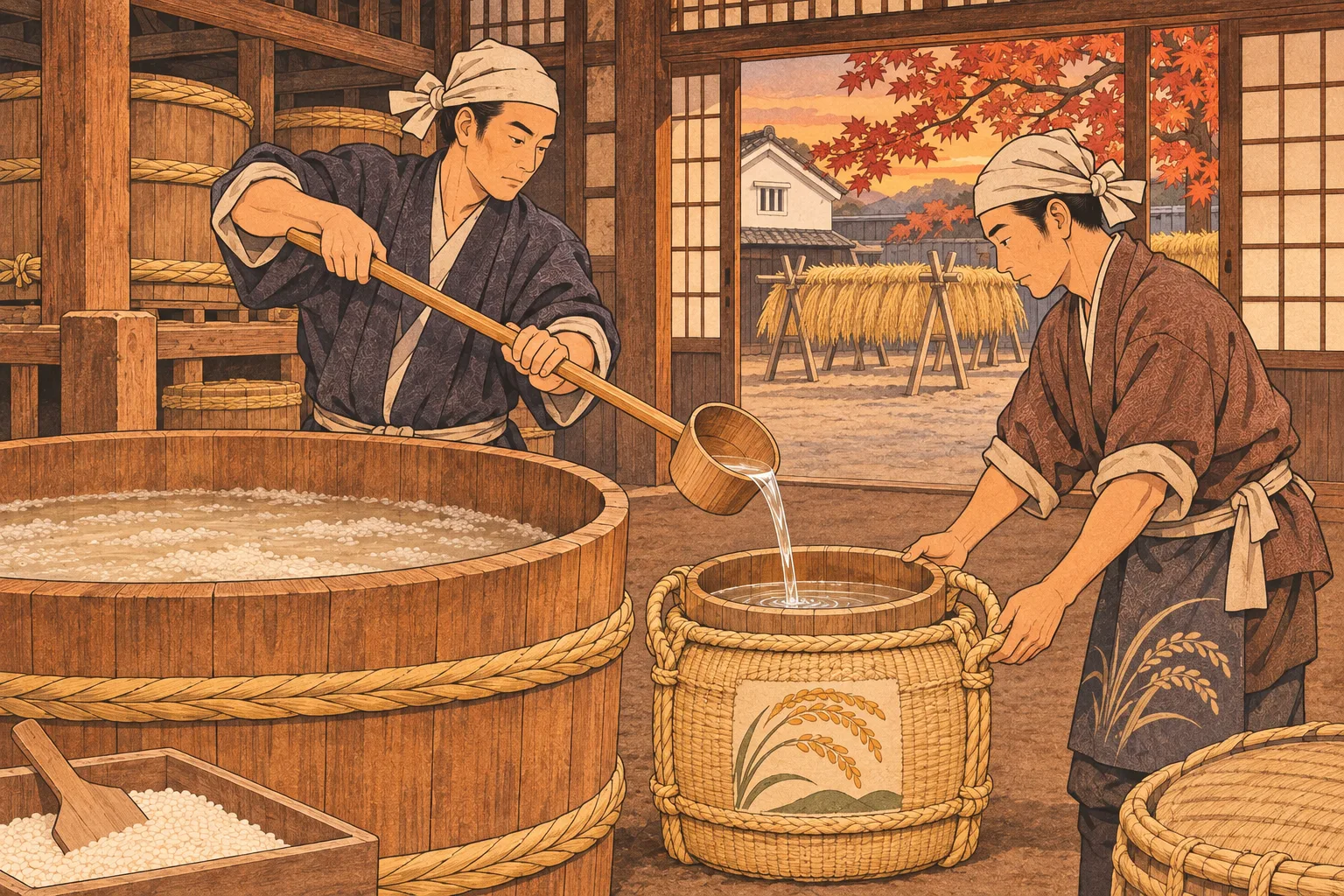
Autumn in an Edo-period brewery: workers ladle sake from a large cask into a straw-wrapped shipping barrel, to be sold without reheating. Maples and drying rice stand outside (artist’s impression)
The best way to taste what a summer does to sake is to compare hiyaoroshi with the same brewery’s new sake from the previous winter. New sake is loud: sharp aromas, a prickly edge, sometimes a touch of bitterness. After five or six months the components settle and bind. The texture rounds out and thickens, the fruity top notes give way to cooked rice, nuts and grain, and savoury depth (umami) comes forward. Brewers call this maruku naru, "becoming round", or aji ga noru, "the flavour filling in". Because it has been heated only once, hiyaoroshi keeps a little more liveliness than fully pasteurised sake. It suits autumn food: grilled saury, matsutake mushrooms, mushroom hotpot, simmered taro. It can be served chilled or gently warmed, and autumn is when many izakaya start recommending nurukan, lukewarm sake.
Alongside hiyaoroshi you will see aki-agari, literally "risen by autumn". It began as a verdict rather than a method: a sake that improved over the summer was said to have "come up" in autumn. The opposite, a sake that went flat and lost its aroma over summer, is sometimes called aki-ochi, "fallen by autumn". Originally hiyaoroshi and aki-agari described the same sake from two angles, one the shipping method, the other the flavour change.
In today’s shops they often appear as different products. Hiyaoroshi generally keeps the single-pasteurisation rule. Aki-agari emphasises summer-matured flavour, and whether it is heated again at bottling varies by brewery. Plenty of brewers and shops simply treat the two names as synonyms. Some breweries call their September release hiyaoroshi and a deeper, later October or November release aki-agari. Look for namazume on the back label, or ask. Each brewery makes one batch a year, and when it sells out it is gone, which is why shops make an event of it.
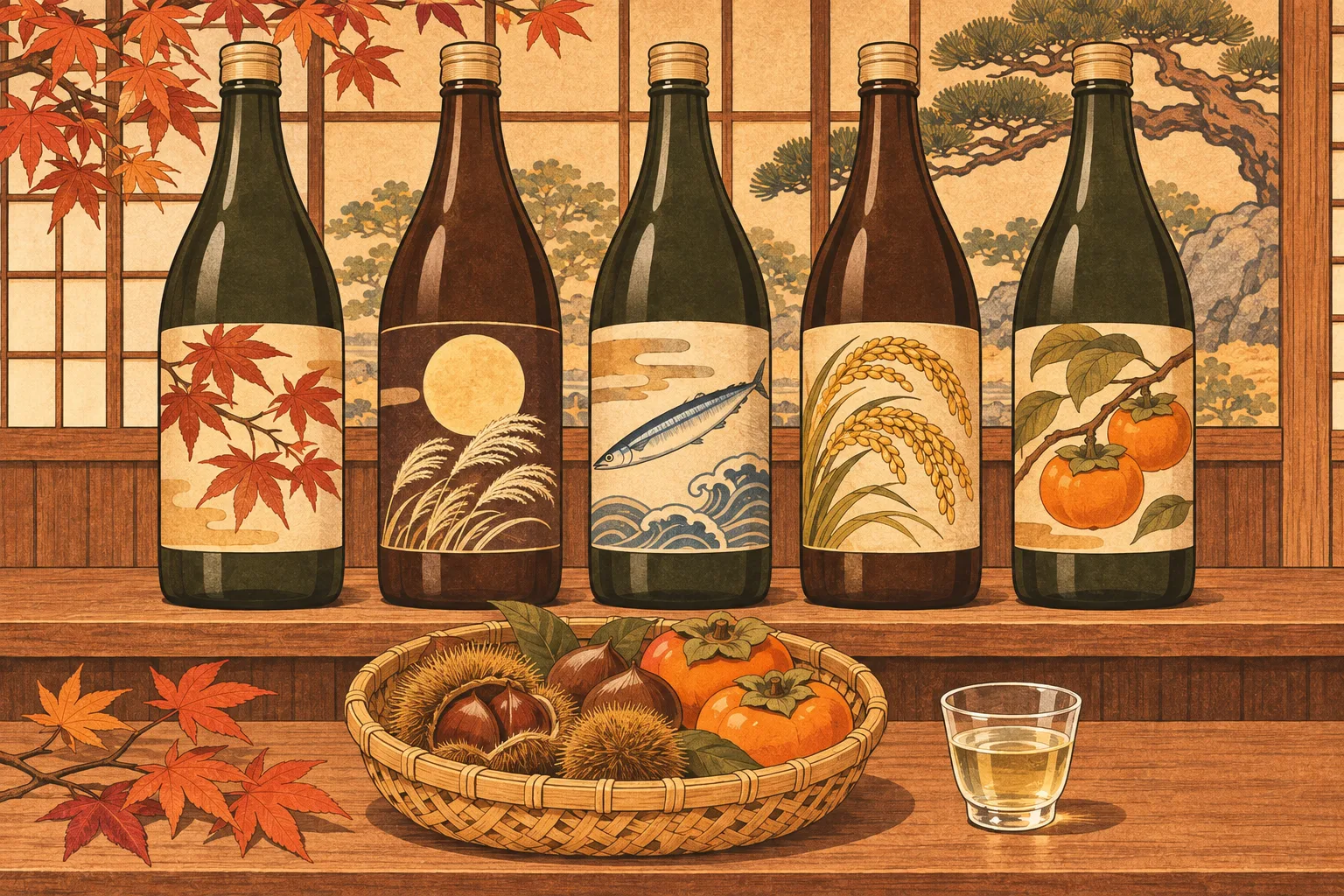
Hiyaoroshi and aki-agari on an autumn shelf. The five labels show, from left, maple leaves, a full moon over pampas grass, a saury, ears of rice and persimmons; a basket of chestnuts and persimmons sits in front.
04October to December: The First Steaming and the First Pressing
While hiyaoroshi is selling, the new season begins inside the brewery. Rice is harvested in September and October. It must be polished, then rested (karashi) so its moisture stabilises, before it can be washed, soaked and steamed. Most breweries therefore begin brewing (jōzō-hajime or tsukuri-hajime) in October or November. Rice for ginjō and daiginjō, polished much further, usually comes later.
In the past this moment was sharply defined. After harvest, the tōji (master brewer) arrived from his home village with a team of workers who lived in the brewery dormitory until spring. Today most brewery staff are local, year-round employees, but many breweries still mark the first day with a short Shinto rite, offering new rice and salt at the brewery shrine and asking for a safe season free of spoiled batches. Shrines associated with sake hold brewing-safety ceremonies in November that breweries send representatives to: Ōmiwa Shrine in Nara on 14 November, after replacing the giant cedar ball at its worship hall the day before, and Matsuo Taisha in Kyoto on the first Day of the Hare of the month, the jōu-sai.
A basic batch takes about a month from steaming to pressing, so the first new sake can be pressed in late October or November. The first tank of the season is hatsu-shibori, "first pressing". Shinshu, new sake, is the broader term for this season’s sake that has not yet been through a summer, and it is on sale roughly from November into spring. Shops put up posters for shinshu and shiboritate, "freshly pressed". When the first tank is pressed, many breweries hang a fresh green ball of cedar sprigs, the sugidama, under the eaves; it browns as the sake matures.
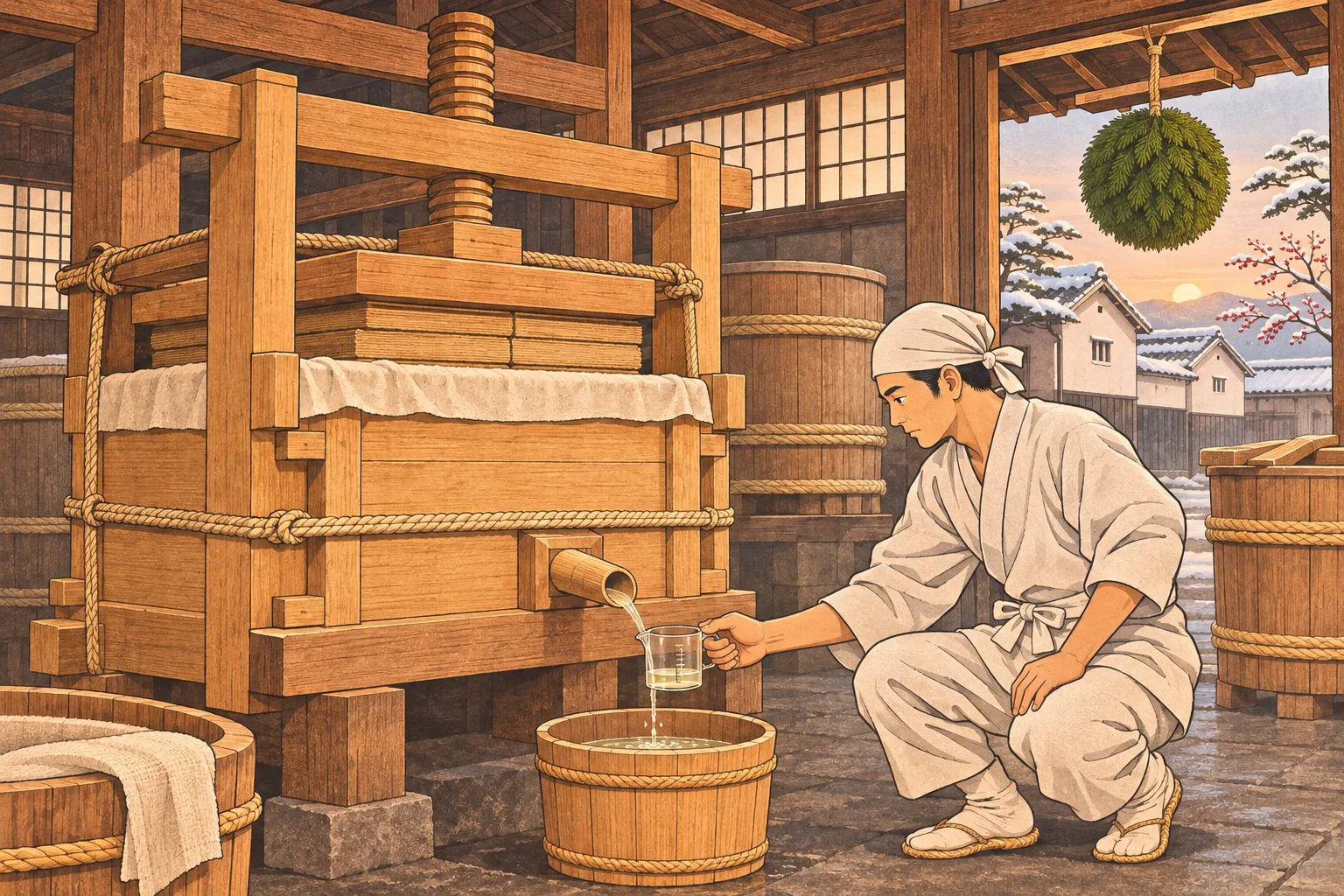
Hatsu-shibori: new sake runs from the spout of a wooden press into a small tub while a brewery worker catches a sample in a measuring cup. Outside, top right, a fresh green sugidama hangs under the eaves.
New sake usually comes as nama genshu: unpasteurised (nama) and undiluted (genshu), bottled exactly as it came off the press. Because it is unpasteurised it must be kept cold, so look for it on the coldest shelf. Bottles are clear or pale green, and the sake may have the faintest yellow-green tint. Labels carry large brushstroke characters for shinshu or hatsu-shibori, and sometimes a neck tag with the pressing date.
New sake is the opposite of hiyaoroshi. Carbon dioxide from fermentation is still dissolved in it, giving a fine prickle on the tongue that Japanese drinkers call gasu-kan ("gassiness") or pichi-pichi. The aroma is direct, acidity and sweetness are sharply outlined, and there is often a bitter edge in the finish. Fans love it as a taste only winter can give; others find it unfinished. It is served cold with winter seafood: sashimi, oysters, cod milt, monkfish liver.
December is the busiest month in the brewery. Batch after batch goes into the tanks; staff rise before dawn to steam rice and check the kōji room late at night. Many breweries close to visitors during these weeks.
05Midwinter: Warm Sake and Aged Sake
In winter, alongside new sake, izakaya lean into kanzake, warmed sake. The main sake article explains the named temperature steps; here it is enough to say that from December, copper and tin warming vessels appear behind counters, menus add an okan (warm sake) section, and oden and hirezake (hot sake infused with a toasted pufferfish fin) come into season. Junmai, honjōzō, and sake made by the traditional kimoto and yamahai methods, with their higher acidity and umami, open up when warmed. Some breweries release winter bottles designed for warming, with sake flasks and snow on the label. New sake is rarely warmed; the warm sake on a winter menu has usually been aged through at least one summer.
That leads to a style often associated with winter: jukuseishu, aged sake, also called koshu. Sake has long been valued for freshness, and most is drunk within a year. But the Edo period already spoke of "three-year" and "nine-year" sake, which sold for far more than new sake. After the Meiji government began taxing sake on the volume brewed, holding stock became costly, and aged sake is generally thought to have faded for that reason; a handful of breweries revived it in the second half of the twentieth century. The Long-Term Aged Sake Research Association, a group of breweries, sets the benchmark at three years or more in the brewery after pressing, with no added sugars, but there is no legal definition, and some breweries call anything that has passed one summer koshu.
Aged sake is easiest to recognise by colour. New sake is nearly colourless. After three to five years it turns pale gold or straw; after ten or more it can reach amber or black-tea brown, and in a clear bottle it looks more like whisky or Shaoxing wine than sake. The aroma shifts to caramel, honey, nuts, dried fruit, soy sauce and spice, and the texture thickens. There are two schools: room-temperature ageing, which produces deep colour and sherry-like richness, and cold ageing, used mainly for ginjō and daiginjō, which changes the sake slowly and keeps more of its original fragrance with only a faint yellow tint.
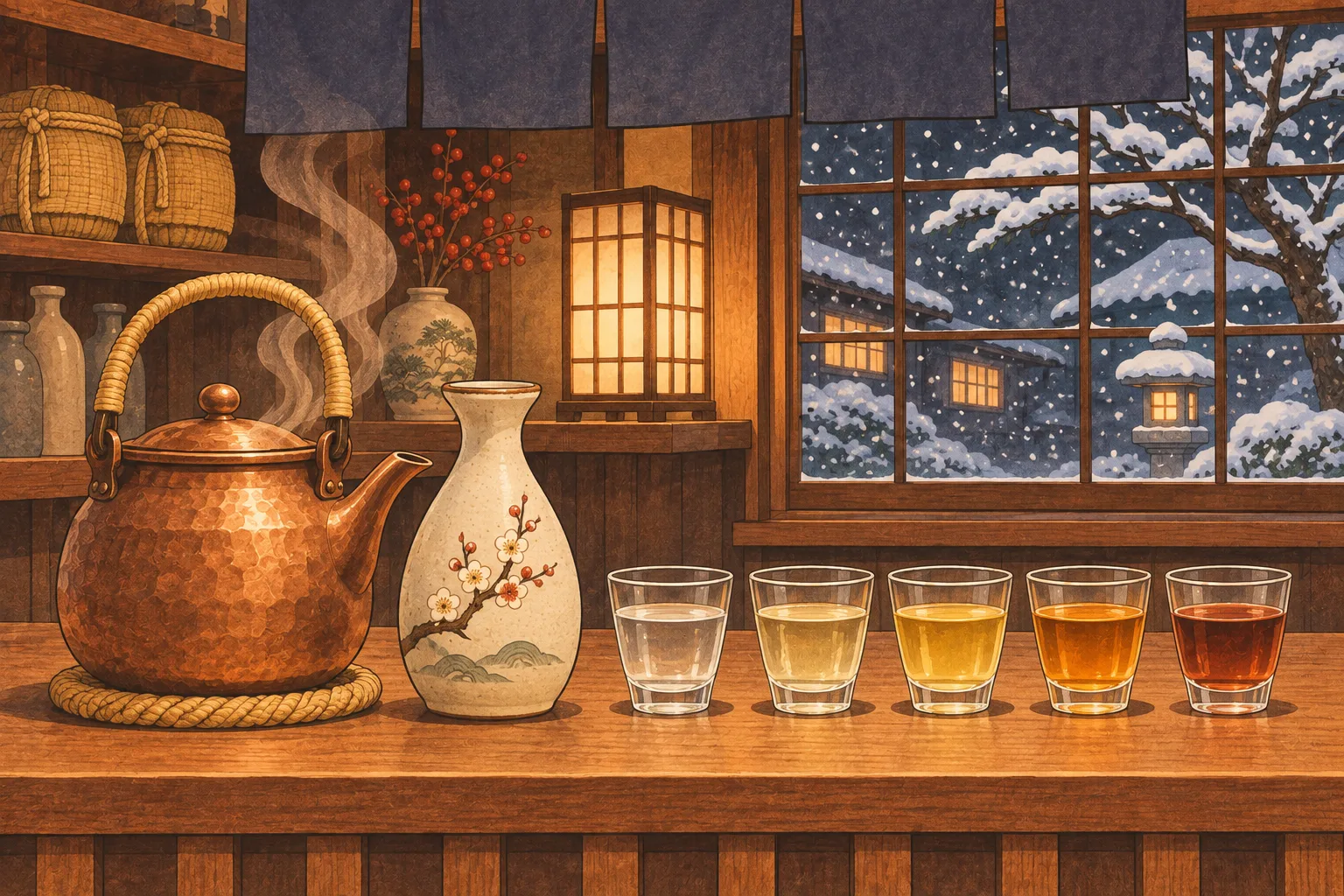
A winter izakaya counter: a steaming copper warming kettle and a tokkuri on the left; on the right, five glasses running from nearly colourless through pale gold and straw to amber and black-tea brown, the colours of aged sake.
You will meet aged sake more often in specialist bars and high-end restaurants than in neighbourhood izakaya, poured into small glasses or white porcelain cups that show off the colour. Its link to winter is loose: it is pushed in cold months because it pairs with rich, slow-cooked food, braises and even cheese.
06The First Morning of Spring: Risshun Asashibori
Risshun, the first day of spring and the first of the twenty-four seasonal divisions of the old calendar, usually falls on 4 February (in 2025 it fell on 3 February), and was traditionally treated as the start of the year. Since the late 1990s it has also been the day of risshun asashibori, "sake pressed on the morning of the first day of spring".
The timetable is tight. Each participating brewery plans a tank, usually junmai ginjō, so that fermentation finishes exactly on the night before risshun. Pressing begins on the night of Setsubun, the day before risshun, and the staff work through the night until the sake is all pressed around dawn. It is neither pasteurised nor diluted. Around dawn the new sake is purified by a local shrine, with prayers for a good year; at some breweries the priest comes to the brewery, at others the sake is taken to the shrine. Then the owners and staff of the liquor shops that ordered it arrive and work alongside the brewers, bottling, sticking on labels, attaching neck tags printed with that day’s date and packing cases, before the sake is driven back to their shops. By late morning or afternoon on the day itself, it is on shop counters.
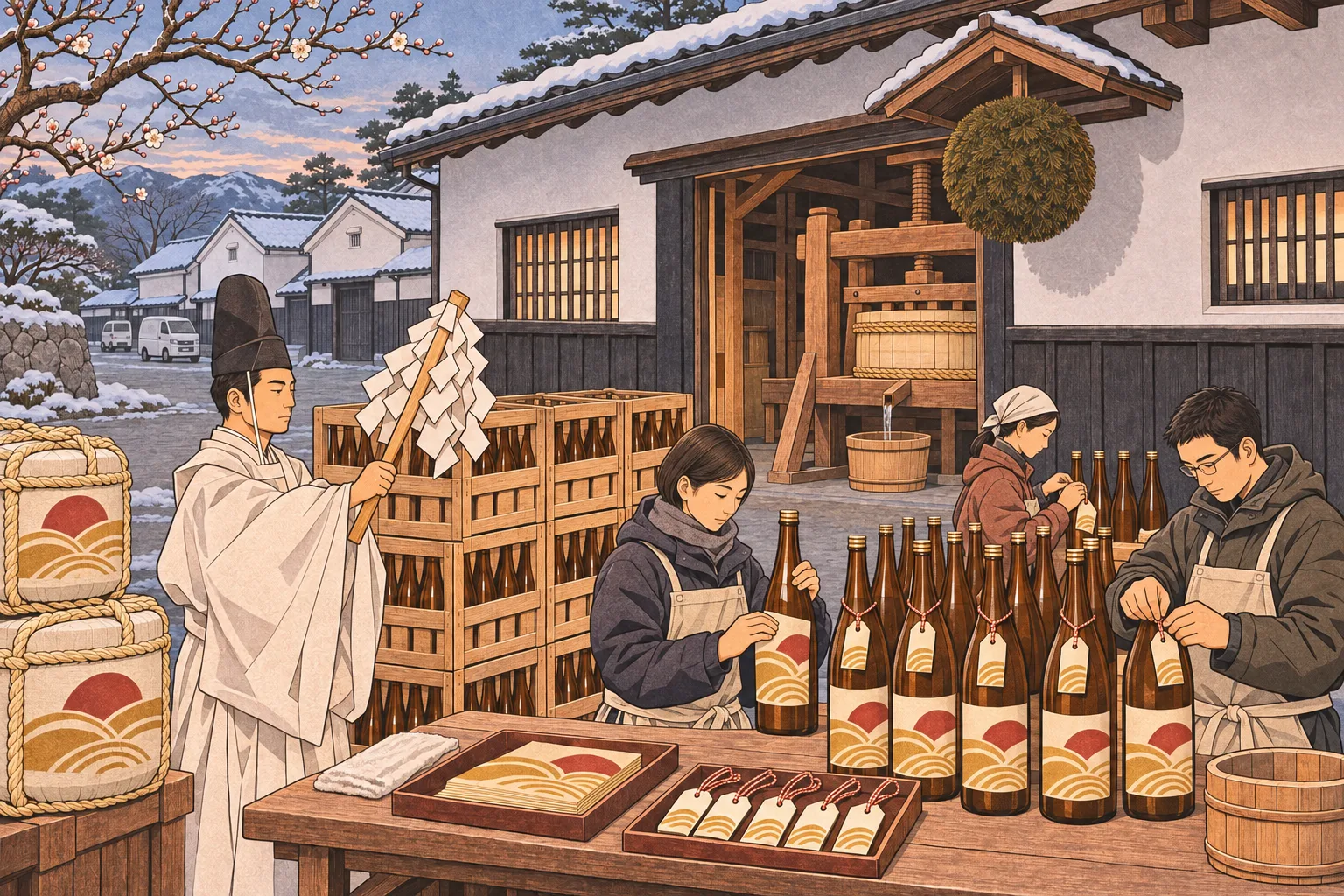
Dawn on risshun in a brewery yard: a Shinto priest purifies the crated new sake while shop staff and brewers stick on labels and tie neck tags. The press is still running in the doorway behind.
The event is organised by Nihon Meimonshukai, a nationwide network of breweries and liquor retailers. It began in February 1998 at a single brewery, Kaika, with 4,000 bottles; by 2011 there were 38 breweries, and in recent years around forty take part, each paired with member shops in its area. Label designs differ, but all show risshun asashibori and the date prominently, often in gold and red with plum blossoms or treasure ships for luck.
It tastes like the newest of new sake: pressed a few hours earlier, still fizzy, bright and sharp, with a hint of raw rice. Because it is unpasteurised it has to be kept cold and is best drunk within days; many people open it that same evening. In Japan it has become a seasonal good-luck item, bought as a gift or to mark the turn of the season along with Setsubun’s rolled sushi. For breweries, the day connects the people who sell sake directly with the press itself: shop owners watch the sake run off and label it with their own hands, and pass that story on to customers.
07February to June: Koshiki-daoshi, Kaizō, Spring Releases, Open Days and the Competition
Around risshun, breweries brew their daiginjō, timing it for the coldest weeks because top-grade sake needs the lowest temperatures and the longest, slowest fermentation. Daiginjō is usually among the last batches of the season.
Sometime between late February and April, depending on the brewery, comes koshiki-daoshi, "tipping over the steamer". The koshiki is the large rice steamer, traditionally a big wooden tub set over a cauldron, which has sent steam up through the brewery roof before dawn every day of the season. After the final steaming, the workers tip it on its side, wash it out and set it to dry. It is the end of the heaviest physical labour, and no more pre-dawn starts. Many breweries hold a small party that evening. Many breweries now use continuous steaming machines rather than a wooden koshiki, but still call the day of the last steaming koshiki-daoshi.
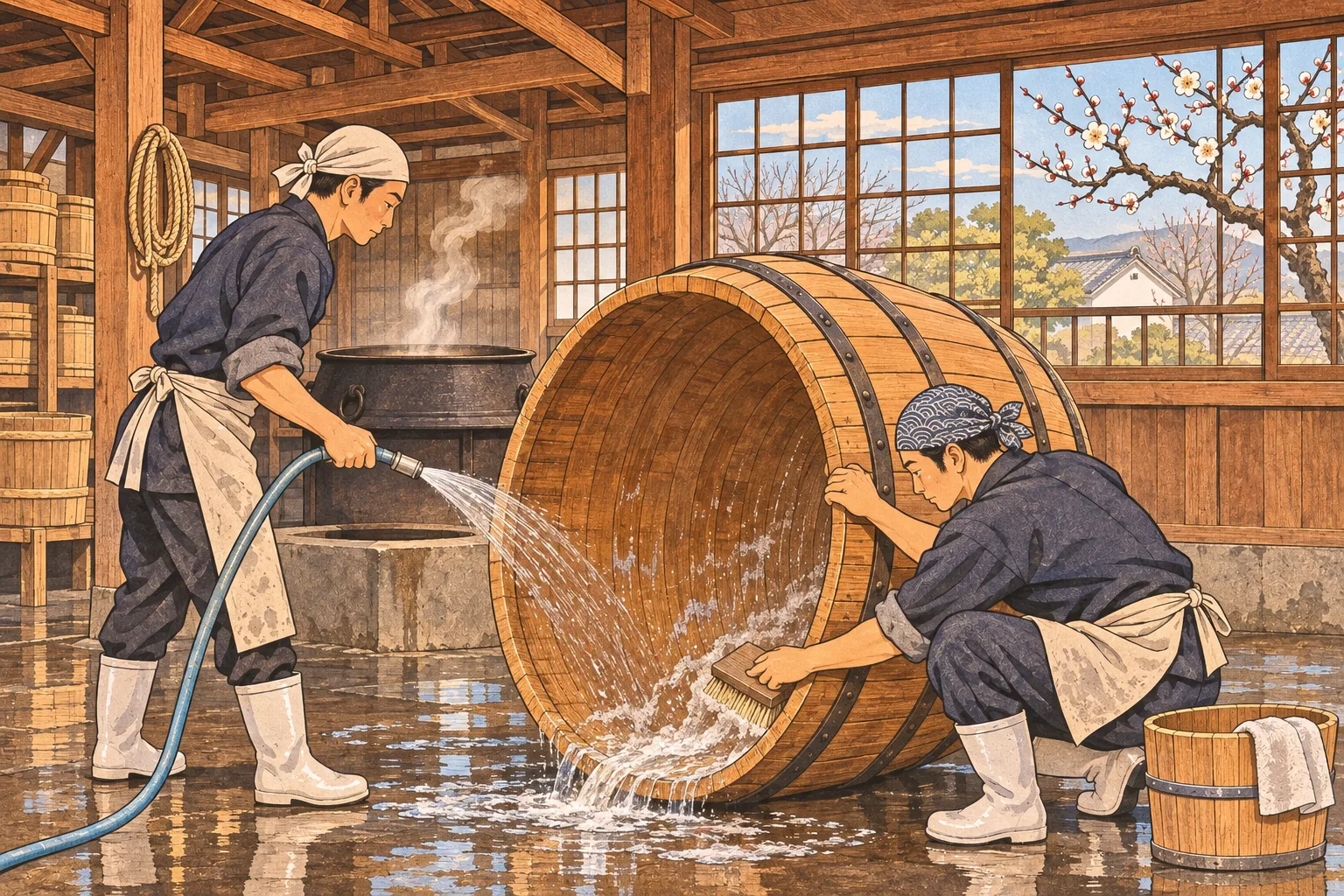
Koshiki-daoshi: after the season’s final steaming, two brewery workers lay the big wooden koshiki on its side and scrub it out with a hose and brush. The cauldron behind still gives off a little steam, and plum blossom shows at the window.
A few batches are still fermenting at this point, and they take another few weeks to a month to finish. The day the last tank is pressed is kaizō, "all brewed", and the kaizō iwai celebration marks the true end of the season. In the old system this was when the seasonal workers went home to plant rice, leaving the tōji and a few hands to finish the pasteurising. Today it is still the day the whole brewery celebrates.
Spring shelves bring a change of colour. The most visible is usu-nigori, "lightly cloudy": sake pressed so that a little fine rice and yeast sediment (ori) stays in. It is a translucent milky white, with a white layer settling at the bottom of the bottle. Similar terms are origarami and sasa-nigori. All are much lighter than true nigori (cloudy) sake. Try the clear top first, then gently swirl the bottle and taste again; the sediment adds sweetness, creaminess and body. Some are kassei, "active", still fermenting and fizzy in the bottle, and must be opened slowly; labels and caps carry warnings.
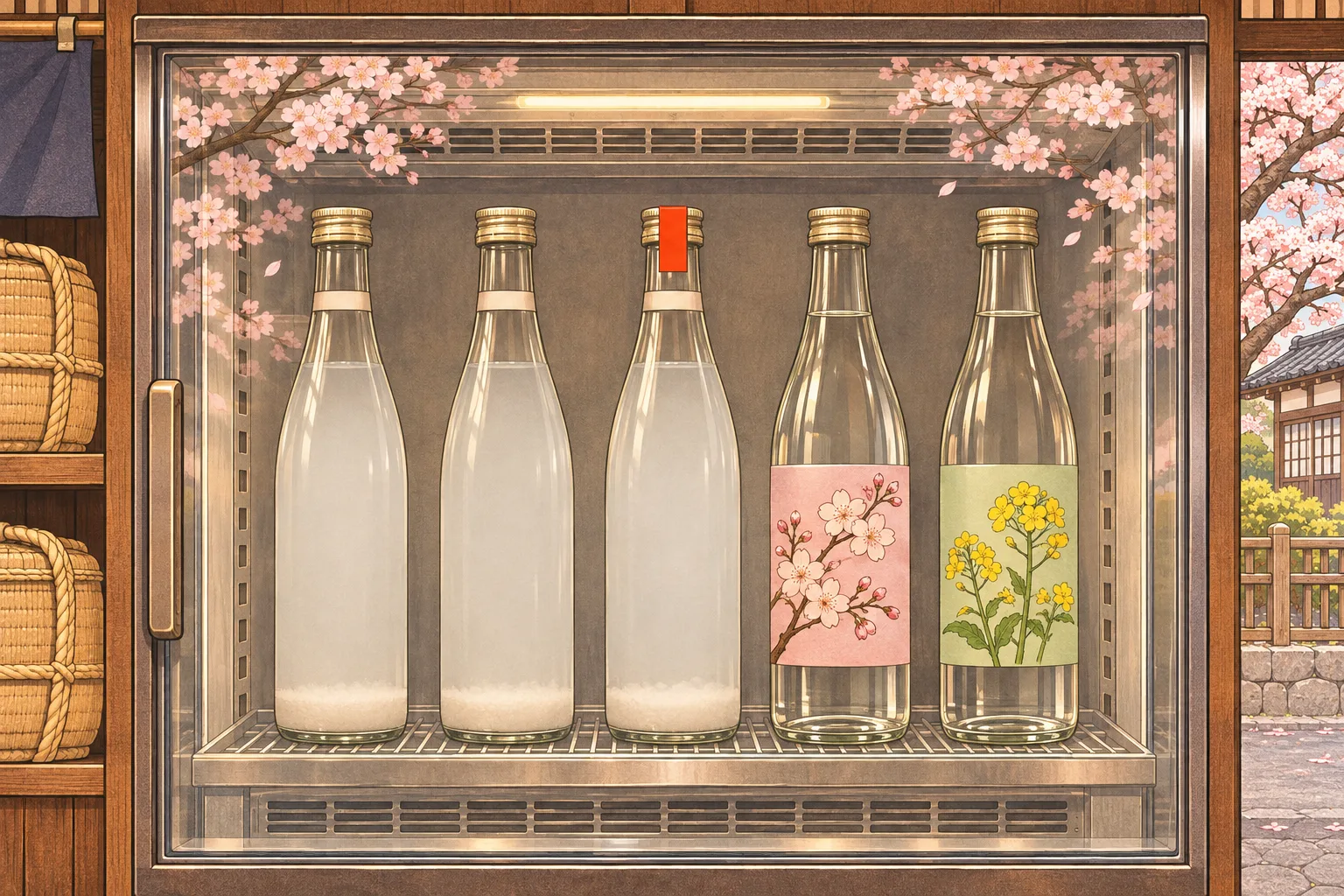
A spring fridge: three bottles of usu-nigori on the left, translucent milky white with a layer of white sediment at the bottom; on the right, two clear spring releases with cherry-blossom and rapeseed-flower labels.
Other spring releases are simply the winter’s sake dressed for the season: unpasteurised or namazume bottles with pink and pale green labels showing cherry blossoms, rapeseed flowers or spring haze, named with characters for spring, cherry or flower. Many come in small bottles meant for cherry-blossom picnics.
February to May is also a common time for kurabiraki, brewery open days, when a brewery invites neighbours and customers in to taste the new sake. Many are now fixed annual events: breweries that are normally closed to the public open their gates, set up tasting tables in the courtyard with freshly pressed nama genshu and brewery-only bottlings, and serve amazake and soup made with sake lees. Some add food stalls, taiko drumming and tours of the brewing equipment. Some sake towns also run multi-brewery festivals, not always in spring: Saijō in Hiroshima holds its sake festival in October. For visitors, these are the easiest time of year to see the inside of a working brewery.
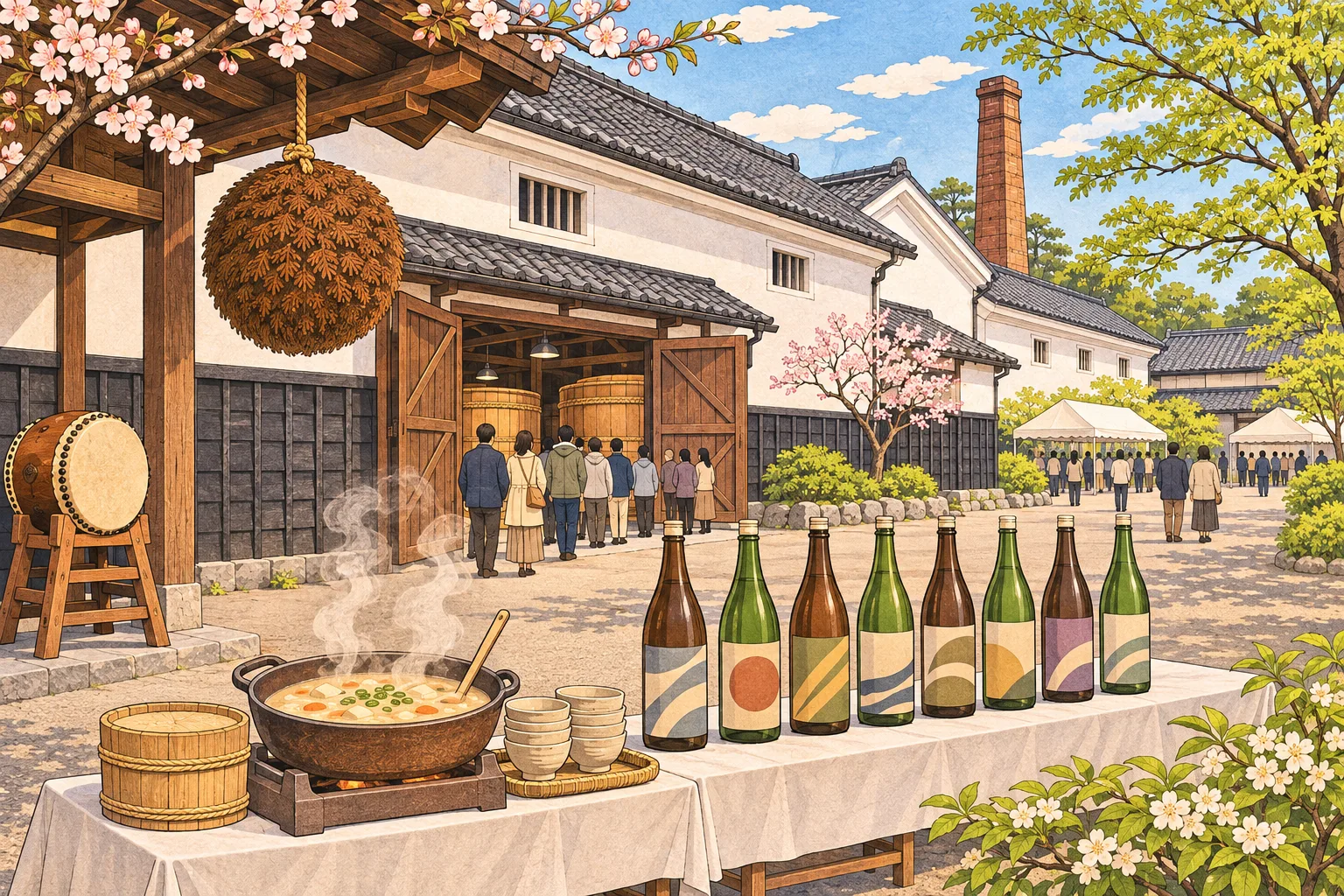
Kurabiraki: the brewery gates stand open and visitors queue to go in. A long table in the courtyard holds a row of bottles and a steaming pot of sake-lees soup; a browned sugidama hangs under the eaves beside a taiko drum.
The other spring landmark is the Zenkoku Shinshu Kanpyōkai, the national new-sake competition. It is now run jointly by the National Research Institute of Brewing, based in Higashihiroshima, and the Japan Sake and Shochu Makers Association, and entries are sent to the institute for judging. First held in 1911, it is the only sake competition held on a national scale; the 2026 round drew 793 entries. Entries are the current season’s undiluted ginjō sake, mostly daiginjō, sent in at the end of March. Judges taste in a preliminary round in late April and a final round in mid-May, and the award winners and gold medallists are announced in late May. Gold-medal breweries print the result on labels, posters and shop tags. For brewers it is a report card on the year. Public tastings afterwards let people sample a cross-section of the whole country’s new sake.
Because the competition follows the brewing year, each round corresponds to one BY. Results come out at the end of May, summer sake appears in late June, and on 1 July the next brewing year begins.
08Side by Side: Telling the Seasonal Styles Apart
Four questions sort out the seasonal releases: when does it ship, how many times was it heated, what does it taste like, and what colour is it?
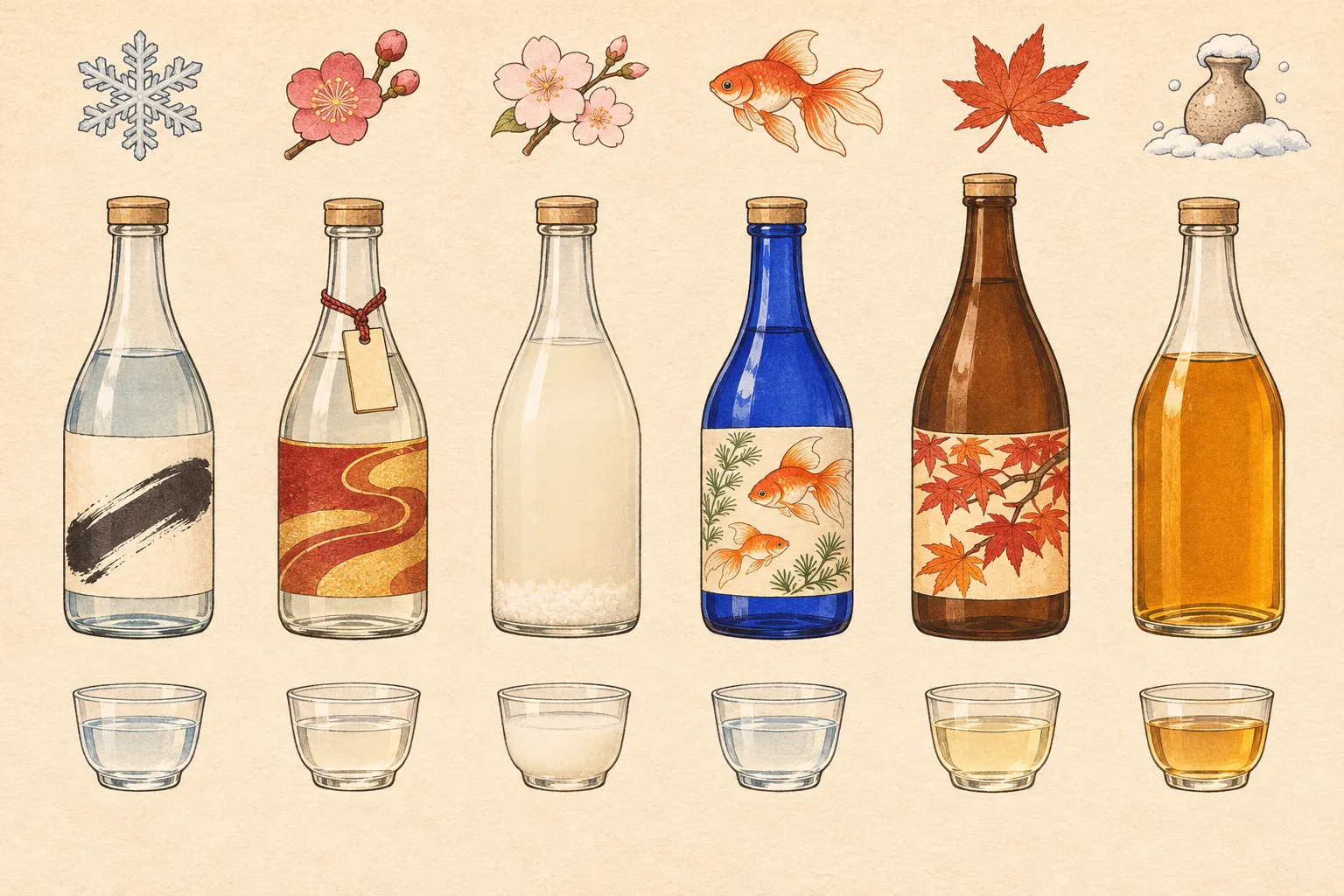
Seasonal styles side by side, from left: new sake (nearly colourless), risshun asashibori (gold-and-red label with neck tag), usu-nigori (milky, with sediment), natsuzake (blue bottle, goldfish label), hiyaoroshi (maple label, pale yellow) and aged sake (amber). The cup below each bottle shows its colour.
New sake and hatsu-shibori ship from late October through to February or March. Mostly unpasteurised nama or nama genshu. The loudest sake of the year: direct aroma, fine fizz, sharp sweetness and acidity, sometimes bitter. Almost colourless, perhaps with a faint green-yellow tint. White labels, black brush characters, on the coldest shelf.
Risshun asashibori appears only on and just after risshun. A festival edition of new sake: unpasteurised and undiluted, on the shelf within hours of pressing, fizzier and brighter than ordinary new sake. Clear or barely hazy. Always dated; often gold and red.
Usu-nigori and spring sake ship from February to April, unpasteurised or namazume. Usu-nigori is translucent milky white with sediment, creamier and sweeter, sometimes fizzy. Spring sake is usually clear, light and fragrant, in pink and green labels.
Natsuzake ships from June to August, mostly fully pasteurised or nama-chozō, with some nama. Lower alcohol, light, dry, crisp acidity, often served over ice. Clear liquid in blue or clear bottles with goldfish and fireworks.
Hiyaoroshi and aki-agari ship from September to November. Hiyaoroshi is heated once before storage and not at bottling; whether aki-agari is heated again varies. Both have rested over summer: round, full, savoury, calm aroma. Clear with a light yellow tinge, noticeably warmer in colour than new sake. Labels in maple red and persimmon orange.
Winter warm sake and aged sake sit on a different axis: how you drink it and how long it has been kept, rather than when it was cut from the year. Warm sake is usually fully pasteurised junmai or honjōzō. Aged sake, by the industry benchmark, has three years or more behind it, ranging from pale gold to amber, with caramel, nut and soy notes.
In a shop, three checks will usually do. Colour: nearly colourless is new sake, milky is usu-nigori, pale yellow is hiyaoroshi, gold to amber is aged sake. Location: nama and namazume sake live in the fridge; fully pasteurised sake can sit on a shelf. Back label: look for nama, namazume or nama-chozō, the BY, and a pressing date. The front label nearly always follows the season: maple leaves for autumn, cherry blossoms for spring, goldfish for summer, snow and plum for winter.
The cycle works because one winter’s sake is cut off at different moments. Bottled straight off the press, it is new sake. Left with some sediment, it is usu-nigori. Heated once and rested over summer, it is hiyaoroshi. Left for years, it becomes aged sake. Only summer sake was designed mainly for its season.
More deep dives on this topic
 Reading the Fine Print on a Sake LabelPick up a sake bottle in a Japanese liquor shop and the front label will usually give you a brush-written brand name and not much else.
 Sake RicePick up a bottle of premium sake in Japan and the largest characters on the label after the brewery’s name are often the name of a rice: Yamada Nishiki, Omachi, Gohyakumangoku.
 The Yeast Starter and the YeastsBefore a sake brewery commits a ton of rice to a fermentation, it brews something much smaller: a dense, sour culture of yeast called the shubo ("mother of sake") or moto…
 From Polished Grain to Pressed SakeA sake brewery in winter is a working kitchen on an industrial scale.
 Tōji Guilds and the Brewery CrewFor most of the last three centuries, the people who actually made Japanese sake did not own the breweries and did not live near them.
 A Year of SakeWalk into the same Japanese liquor shop once a month for a year and the fridge will tell you the season before the weather does.
 Sake Vessels and Warming ToolsOrder sake in Japan and the drink often arrives in an object you have no name for: a slim-necked ceramic bottle, a cup the size of a thimble, a square wooden box filled to the…
 Sake and the GodsWalk past an old sake brewery in Japan and you will probably see a large ball of cedar hanging over its door.
 Aroma, Taste and the Four Types of SakeMost sake menus in Japan assume you already know the code.
- Back to the main article: Sake →