
For most of the last three centuries, the people who actually made Japanese sake did not own the breweries and did not live near them. They were farmers and fishermen from snowbound villages in Iwate, Niigata, the mountains of Hyōgo and the Noto Peninsula. Each autumn, once the rice was in, they packed their bedding and followed a master brewer, the tōji, to someone else’s brewery, where they lived and worked through the winter before walking home in spring to plant.
Every man in that crew had a title and a job. One steamed rice, one ran the press, one cooked for everyone. Crews from different home regions formed schools with their own methods, accents and work songs. The system has mostly faded, but its names survive on sake labels, in brewery museums and on the faded group photographs hanging in brewery offices. This is the story of who those people were.
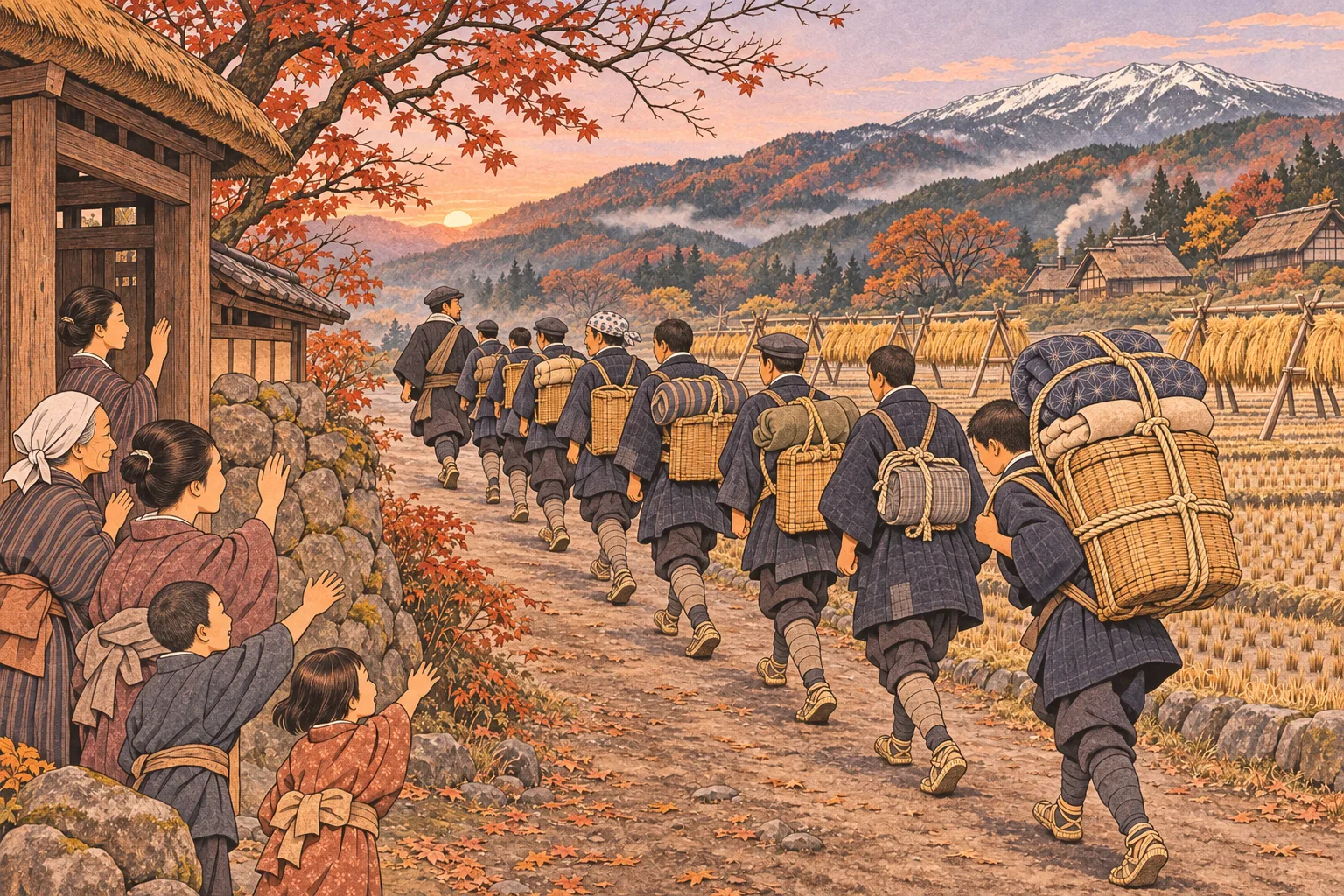
An autumn morning after the harvest: a tōji leads his crew out of the village with bedding and wicker baskets on their backs, bound for a winter in someone else’s brewery, while the women and children wave them off (artist’s impression)
01Why Sake Became Winter Work
Sake was once brewed in several seasons, but by the late 17th century it had been pushed firmly into winter. Cold weather keeps stray bacteria down and lets fermentation run slowly and evenly, which produces cleaner sake. The shogunate, keen to control how much rice went into drink, is generally said to have banned brewing outside the cold season in 1673. From then on, large-scale brewing ran from roughly October or November to March.
That created a labour problem. Brewery owners, known as kuramoto, were usually merchants or landlords. They needed a crew of strong, skilled men, anywhere from a handful to twenty-odd, for half the year and none for the other half. Meanwhile, in the snow country of northern and central Japan, farmers had nothing to do once their fields froze, and their families needed cash. Seasonal migrant work, dekasegi, filled the gap, and brewing was among the better-paid and more respected kinds.
The arrangement had an unusual shape. The kuramoto did not hire workers one by one. He contracted a single man, the tōji, agreeing on pay, dates and how much rice was to be brewed. The tōji then recruited his own crew, the kurabito, from his village and the villages around it. The crew answered to the tōji, not the owner. The owner supplied money, rice and water and sold the product; the tōji was responsible for what came out of the tanks. If the sake spoiled, it was his failure; if it won prizes, it was his reputation.
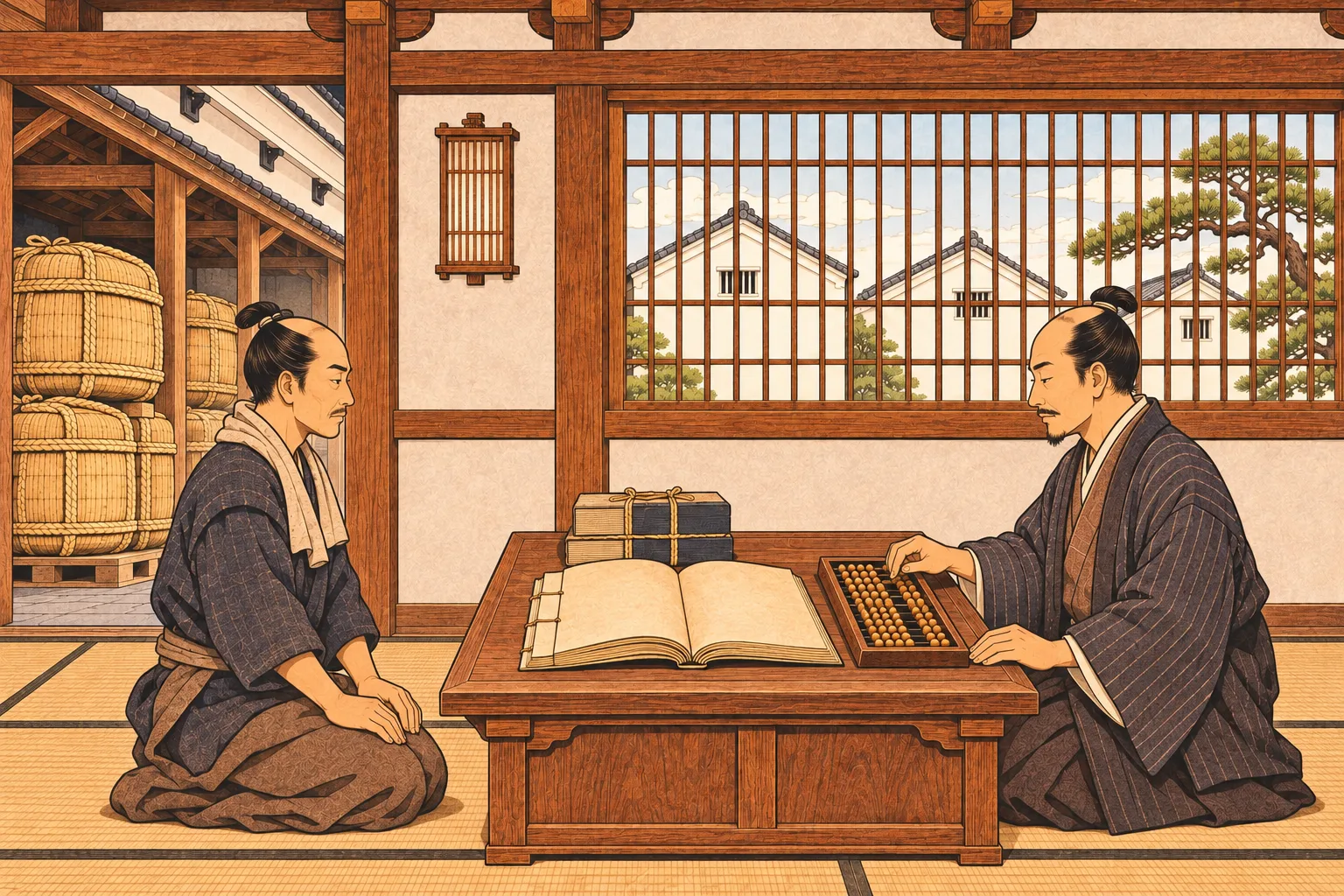
The contract: the kuramoto sits at his desk with an abacus and ledger, the tōji kneels opposite. Pay, dates and the amount of rice were settled with this one man (artist’s impression)
Money followed the same line. The tōji was paid on contract, and a common arrangement was for the owner to hand the season’s wages to him as a lump sum, which he divided according to rank. Some men are said to have taken an advance from the tōji before leaving in autumn, so their families had cash for the winter. The tōji also vouched for his men’s behaviour. If someone stole sake, picked fights or ran home mid-season, the shame fell on the tōji, and it could cost him the next year’s contract. So masters recruited carefully, starting with relatives and neighbours’ sons whose families they knew.
The word tōji itself has several popular explanations, none proven. The most favoured links it to the ancient word toji, the woman who ran a household and, in early times, often brewed its sake. Another connects the first character to Du Kang, a legendary inventor of alcohol in China, and some think the old sound was simply written with Du Kang’s character.
Because crews came from fixed places and young men learned from older men in the same villages, methods stayed local and were handed down for generations. That is how schools, or ryūha, formed. When a brewery says its sake is made by a "Nanbu tōji," it means the brewer belongs to the tradition from the old Nanbu domain in Iwate.
02The Big Three, and the Argument Over Who Belongs
Japanese sources commonly speak of the "three great tōji schools." Most lists name Nanbu, Echigo and Tanba. Some count Tajima among the three, and others add Noto to make a "big four." It makes sense to meet Nanbu, Echigo, Tanba and Tajima together.
The Nanbu tōji come from central Iwate Prefecture, centred on Ishidoriya, now part of Hanamaki city, with villages along the Kitakami River also supplying men. Nanbu is still the largest school, with members once counted in the thousands, and its brewers worked mainly across Tōhoku and as far away as Shikoku. Their sake is often described as soft and rounded. Ishidoriya keeps 1,788 Nanbu brewing tools, from pressing, kōji and steaming gear to the men’s work clothes, designated in 1982 as an Important Tangible Folk Cultural Property. Urakasumi in Shiogama, Miyagi, is a famous Nanbu brewery: in the decade or two after the war the Nanbu master Hirano Sagorō made its name, and his nephew succeeded him as tōji and worked at the brewery for more than half a century, recognised as one of Japan’s Contemporary Master Craftsmen before his death in 2016.
The Echigo tōji come from Niigata and split into smaller local groups: Kubiki in the west, Kariwa around Kashiwazaki, and Nozumi, a fishing village on the coast near Teradomari, where men who could not fish in winter seas went out to brew instead. Echigo brewers once ranged across the Kantō region; today they work mostly within Niigata, as well as in Kantō and Shinshū (Nagano). Niigata sake is known for its tanrei karakuchi style, light and dry, and the Echigo crews helped define it. In 1984 the prefecture’s brewers’ association set up the Niigata Sake School, a three-year course of one or two class days a month for young year-round brewery employees recommended by their employers, as a deliberate answer to the shortage of successors.
The Tanba tōji come from the Sasayama basin in central-eastern Hyōgo, now Tanba-Sasayama city. Their winter road led downhill to Nada, the coastal brewing district of Kobe and Nishinomiya, and to the older brewing towns of Itami and Ikeda. Nada’s hard miyamizu water drives a vigorous fermentation, and the result was the strong, dry sake nicknamed otoko-zake, "men’s sake." The school is usually said to be about 300 years old; from the mid-Edo period its main destination shifted from Ikeda and Itami to Nada. Local tradition says that when the Sasayama domain once forbade its people to leave for work, a villager named Seibei of Ichihara risked his life to petition the lord directly, and winter brewing work was allowed again. It came to be called hyakunichi-kasegi, "hundred-day work," for the length of a brewing season. The Tanba guild had 5,500 members in 1905 and 113 in 2018. In its heyday a large Nada brewery might host several Tanba crews at once. Sasayama keeps a Tanba tōji museum with tools, documents and displays of the brewing process.
The Tajima tōji come from the Tajima region of northern Hyōgo on the Sea of Japan side, where winter snow lies deep, and went south to brewing towns elsewhere. Fushimi’s softer water gives a gentler sake, nicknamed onna-zake, "women’s sake," the counterpart to Nada’s, and the Tajima brewers are generally thought to have had close ties with Fushimi. Tanba in the south of Hyōgo and Tajima in the north both supplied brewers to the great districts.
03Noto, Hiroshima and the Smaller Schools
The Noto tōji come from the Noto Peninsula in Ishikawa Prefecture, mostly from Suzu and the town of Noto. Their sake is often described as rich and full, with plenty of sweetness, acidity and savoury depth, a style that suits warming. Suzu’s brewers formed a guild in 1906, renamed the Noto Tōji Guild in 1921, and its own sake competition has run for more than a century. The school peaked in the early Shōwa years: in 1927 the guild counted 402 tōji and 1,644 crewmen, working in Ishikawa and in Hokkaidō, Toyama, Shiga, Mie, Shizuoka and Tokyo, and as far afield as Sakhalin, Korea and Singapore. The most famous is Noguchi Naohiko, born in 1932 in Uchiura (now Noto town), who became tōji at Kikuhime in Ishikawa at 28 and held the post from 1961 to 1997, known for reviving yamahai, a slower traditional way of building the yeast starter. He is often called one of the "four heavenly kings" of the Noto school, and admirers call him a god of brewing. The Noto Peninsula earthquake of New Year’s Day 2024 hit this area hard, including its breweries and the communities that supplied brewers.
The Hiroshima tōji are centred on Akitsu, formerly called Mitsu, in Higashi-Hiroshima, the home town of Miura Senzaburō, who worked out the soft-water brewing method. In a sense this school grew out of a technique: Miura taught his slow, cool fermentation to the brewers around Mitsu, and they carried it into Saijō and other breweries in the prefecture. Unlike the snow-country schools, Mitsu is a port on the Inland Sea, and its men did not travel far; many worked in Saijō, Takehara and Kure. The Hiroshima guild, founded in 1954, has about 100 members today, including some from outside the prefecture. Hiroshima sake is generally described as soft, with a gentle sweetness and a delicate aroma.
Several smaller schools mostly stayed close to home. The Izumo tōji of eastern Shimane brew largely within Shimane; their guild’s annual competition reached its 75th edition in 2026, with eleven breweries in the ginjō class, ten in Shimane and one in neighbouring Tottori. The Echizen-Nuka tōji take their name from Nuka, a coastal village of Minami-Echizen in Fukui now known for its narcissus fields; the name means "rice bran," but here it is simply a place name. The school was always small and few of its brewers remain. The Sannai tōji come from Sannai, a mountain district of Yokote in Akita, and brew across Akita; their guild, founded in 1922, still had 145 members at its centenary in 2022.
Many other regions have or had their own groups: Tsugaru in Aomori, Suwa in Nagano, Shida in Shizuoka, Bitchū in Okayama, Chikugo in Fukuoka, Aizu in Fukushima, Ōtsu in Yamaguchi. Some have disappeared, and some dissolved and were later revived. A 1979 survey counted 24 tōji groups in 17 prefectures. Almost every brewing district had a cluster of villages nearby that supplied its labour.
04Side by Side: Telling the Schools Apart
The easiest way to keep the schools straight is to ask three questions: where did they come from, where did they go in winter, and what kind of sake were they known for?
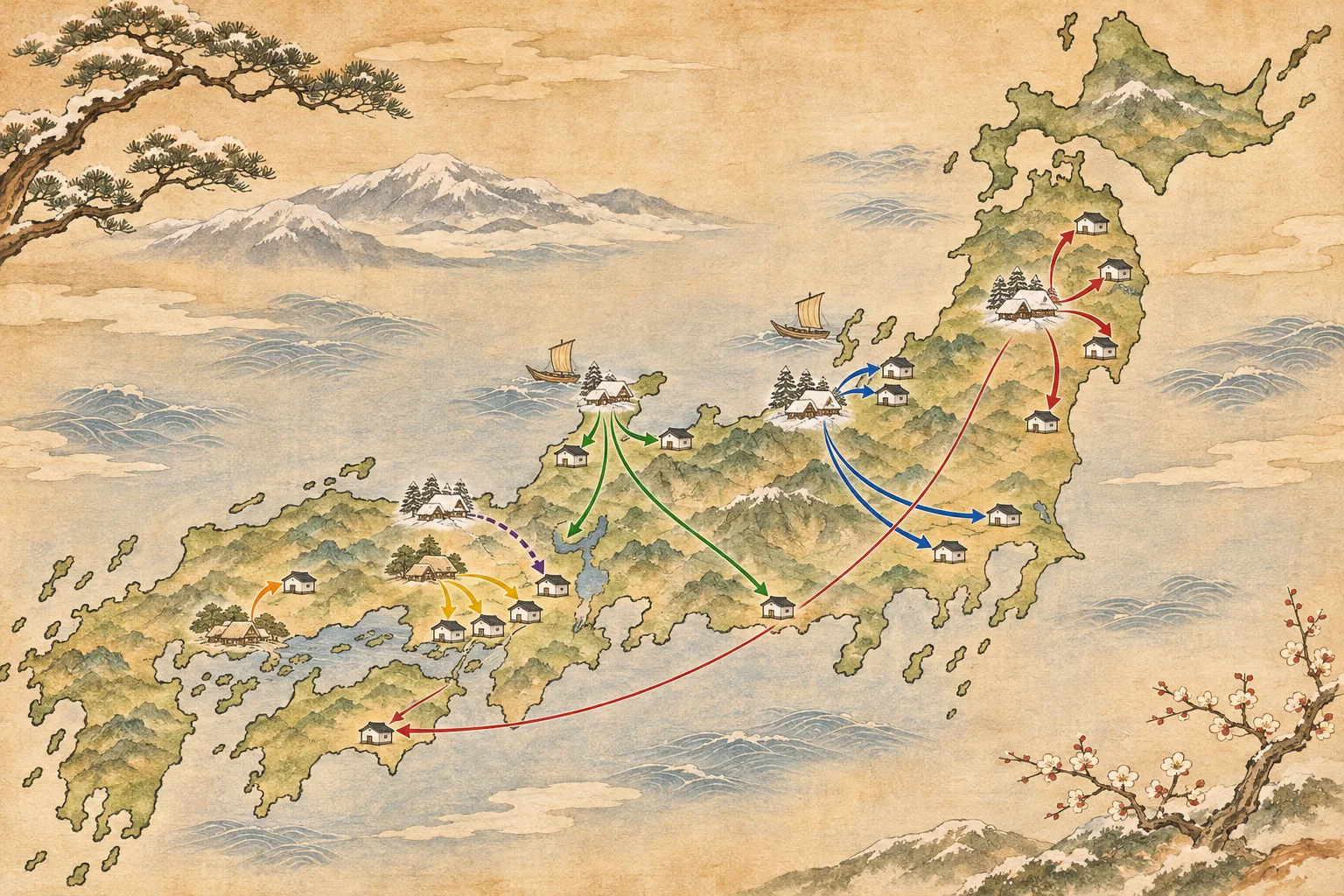
Where each school went in winter. Red: Nanbu, from Iwate across Tōhoku, with one long arrow to Shikoku. Blue: Echigo, within Niigata and to Kantō. Green: Noto, to Ishikawa, Toyama, Shiga and Shizuoka. Dashed purple: Tajima to Fushimi. Yellow: Tanba to Nada, Itami and Ikeda. Orange: Hiroshima, from Akitsu to breweries nearby. Snowy huts are home villages; white-walled houses are breweries.
Nanbu: home in central Iwate around Ishidoriya; worked mainly across Tōhoku and as far as Shikoku; sake described as soft and rounded; example, the Hirano family of tōji at Urakasumi.
Echigo: home in Niigata’s Kubiki, Kariwa and Nozumi; worked mostly in Niigata, plus Kantō and Nagano; light, dry tanrei karakuchi; continued today partly through the Niigata Sake School.
Tanba: home in the Sasayama basin, Hyōgo; worked in Nada, Itami and Ikeda; strong, dry "men’s sake"; about 300 years old, its winter work known as "hundred-day work."
Tajima: home in northern Hyōgo; generally linked with Fushimi and its gentle "women’s sake"; sometimes counted among the big three.
Noto: home in Suzu and Noto town; worked in Ishikawa, Toyama, Shiga, Shizuoka and beyond; sake described as rich and full; example, Noguchi Naohiko.
Hiroshima: home in Akitsu; worked in Saijō and around Hiroshima; soft-water, low-temperature fermentation; rooted in Miura Senzaburō’s method.
Izumo, Echizen-Nuka and Sannai: small schools from Shimane, Fukui and Akita, the first and last working mostly within their own prefectures.
A pattern shows through. The home villages were places where winter shut down farming or fishing. The destinations were places with good water, wealthy merchants and big-city markets nearby.
One caution about "style." Water, rice, climate and the brewery owner’s wishes also shape a sake, and the same Nanbu tōji will make different sake at different breweries. The schools differ mainly in working habits, in how they read and steer fermentation, and in the rules of thumb they pass down. "Nanbu is soft, Tanba is strong" is a tendency, not a law.
05The Crew: Who Did What
A traditional crew was ranked like a ship’s company. Your title decided what you did, where you sat at meals, where you slept and what you were paid. Names varied a little by school, but these are the common ones.
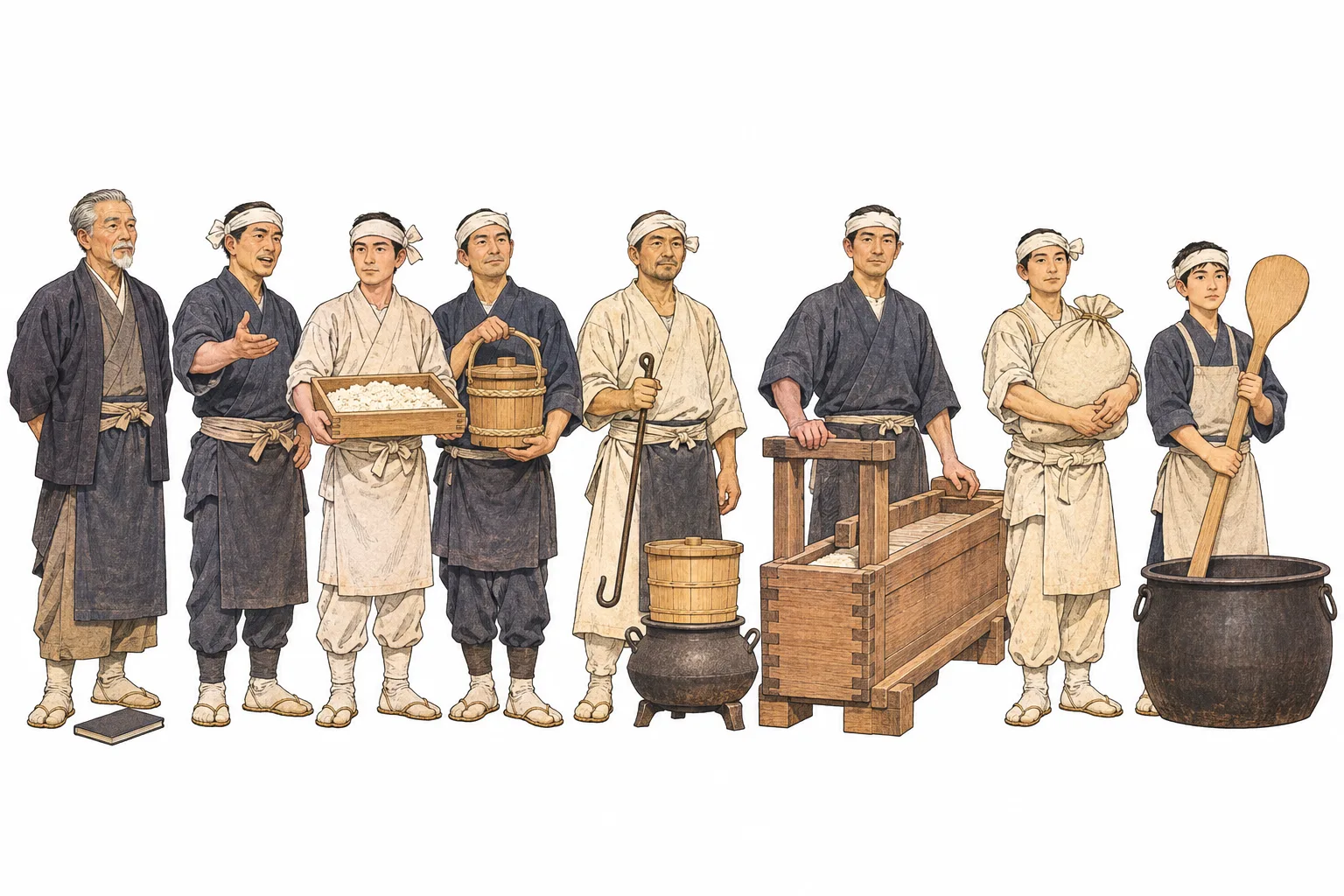
The posts in a traditional crew, left to right: tōji, kashira, kōjiya (holding a tray of kōji), motoya (with a hot-water keg), kamaya (beside the cauldron and steamer), sendō (at the fune press), oimawashi (carrying a sack of rice) and mamataki (with a rice paddle and cooking pot).
The tōji ran everything. He decided how long each batch of rice soaked, how it was steamed, what the kōji should look like and how the temperature of each fermenting tank should move. He did not necessarily do the heavy work, but he made rounds of the kōji room, the starter room and the big tanks several times a day and night, smelling, tasting from a fingertip, watching the shape of the foam. He had his own room and the top seat at meals.
The kashira, or head, was his deputy and foreman. He assigned the day’s work and kept the crew moving, and he stood in when the tōji was absent. Most tōji spent years as kashira before an owner would hire them for the top job.
The kōjiya, also called kōjishi or in some places daishi, was in charge of kōji, the steamed rice on which mould is grown to turn starch into sugar. It was the most demanding post: the kōji room is warm and humid, and the kōjiya had to get up through the night to turn and spread the rice. With the kashira and the motoya, he was one of the three officers, which shows how much weight the job carried.
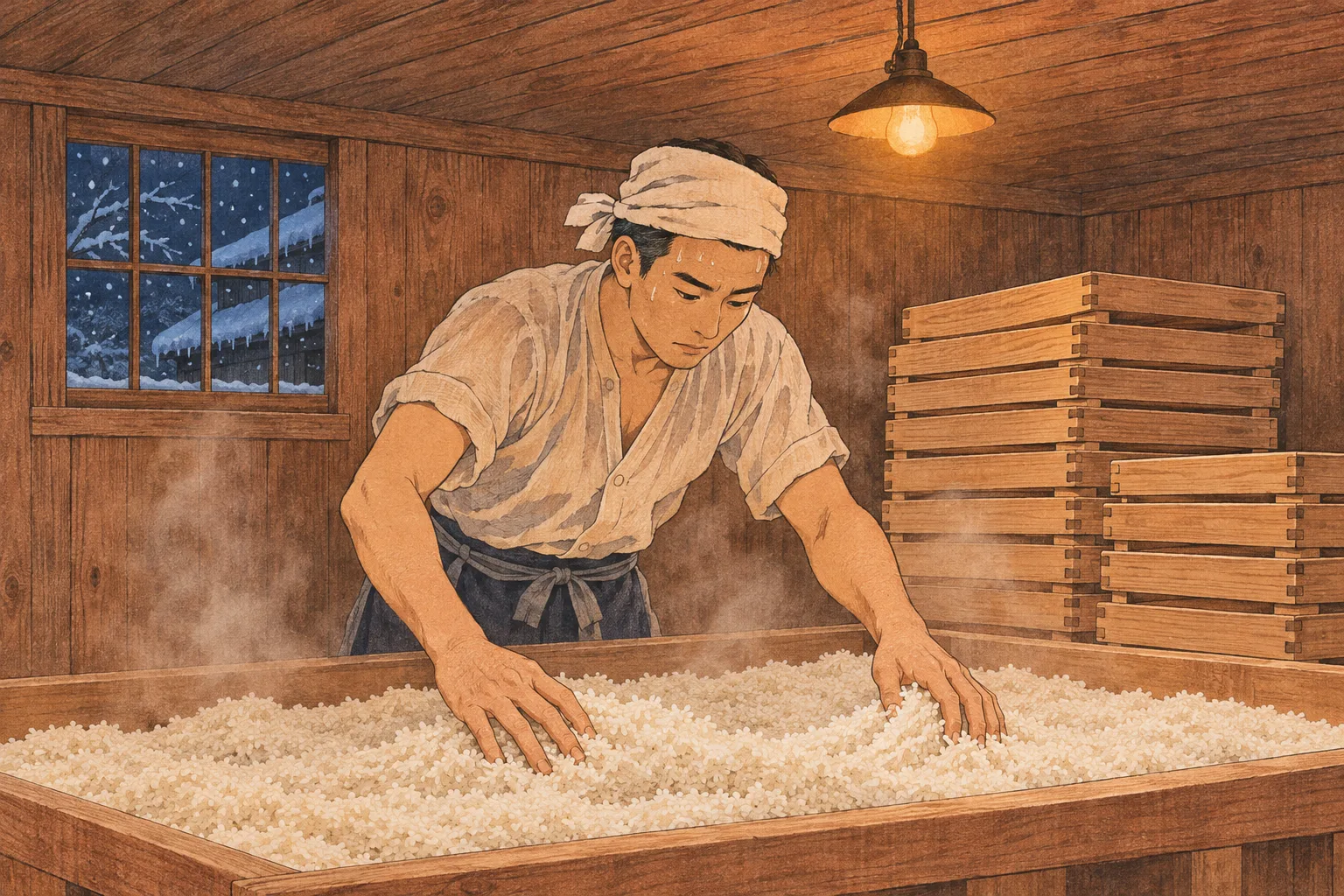
The kōji room late at night: in the warm, humid air the kōjiya spreads and turns the rice by hand, with stacks of shallow wooden trays behind him (artist’s impression)
The motoya looked after the moto, the yeast starter, a small batch in which a large, healthy yeast population is built before the main brew. He nursed a row of small tubs through the cold nights, warming them with tubs of hot water or cooling them as needed. In the old kimoto method, crews pounded the starter with wooden poles in a step called yamaoroshi, and this was one of the jobs with its own songs.
The kamaya ran the steaming: the great iron cauldron, the wooden steamer (koshiki) set on top of it, and the fire beneath. He rose first, at three or four in the morning, to light the furnace. On a winter morning the column of steam from a brewery could be seen from far away.
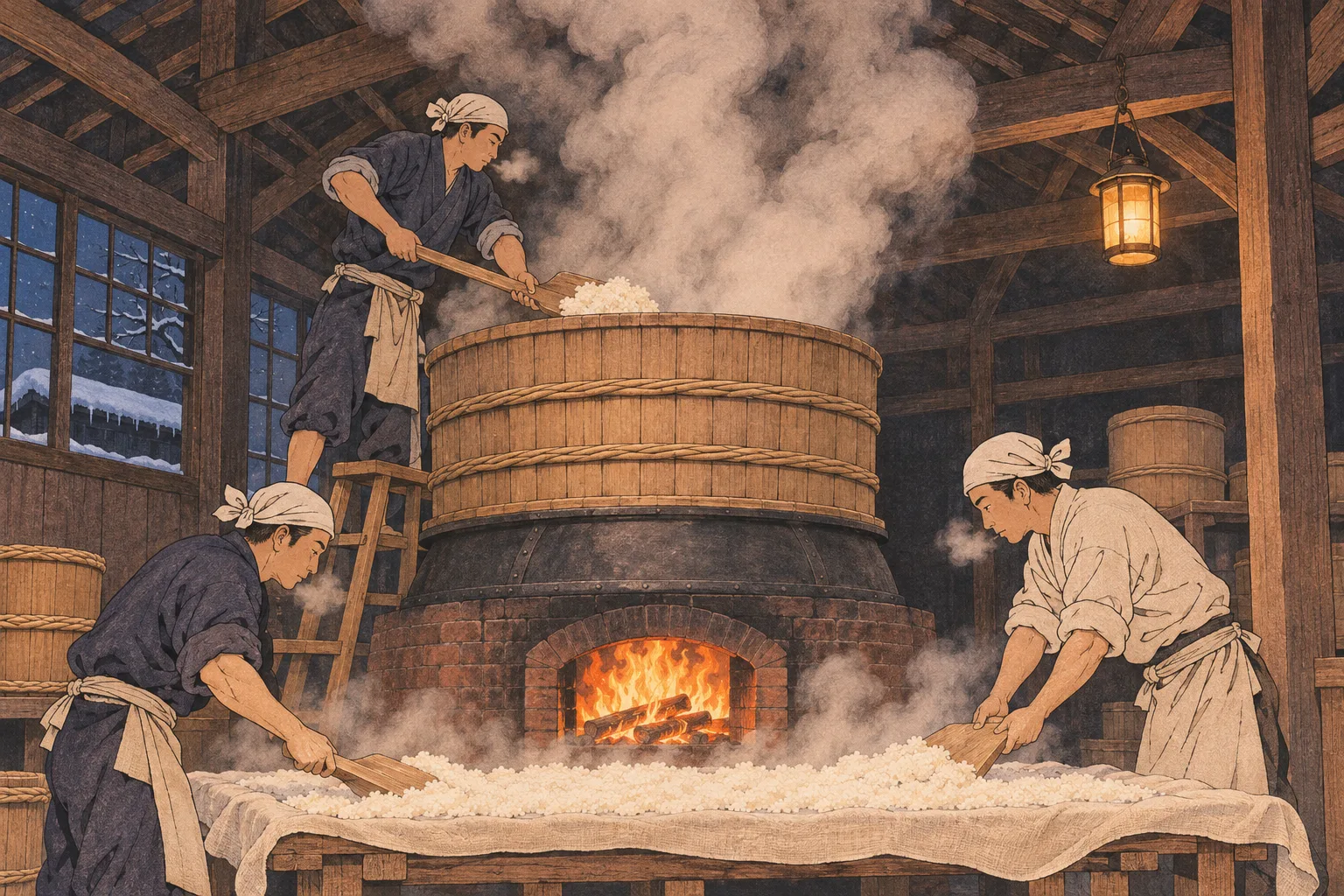
Before dawn at the cauldron: the fire is burning, steam from the wooden koshiki rises to the rafters, and the men shovel out the steamed rice and spread it on cloth (artist’s impression)
The sendō ran the press. The traditional press was a long wooden box called a fune, "boat." Fermented mash was poured into cloth bags, the bags stacked inside, and boards and weights laid on top so that sake trickled out of a spout at one end. The man in charge of the boat was naturally the sendō, "boatman." A pressing could take a day or two, and he stayed with it.
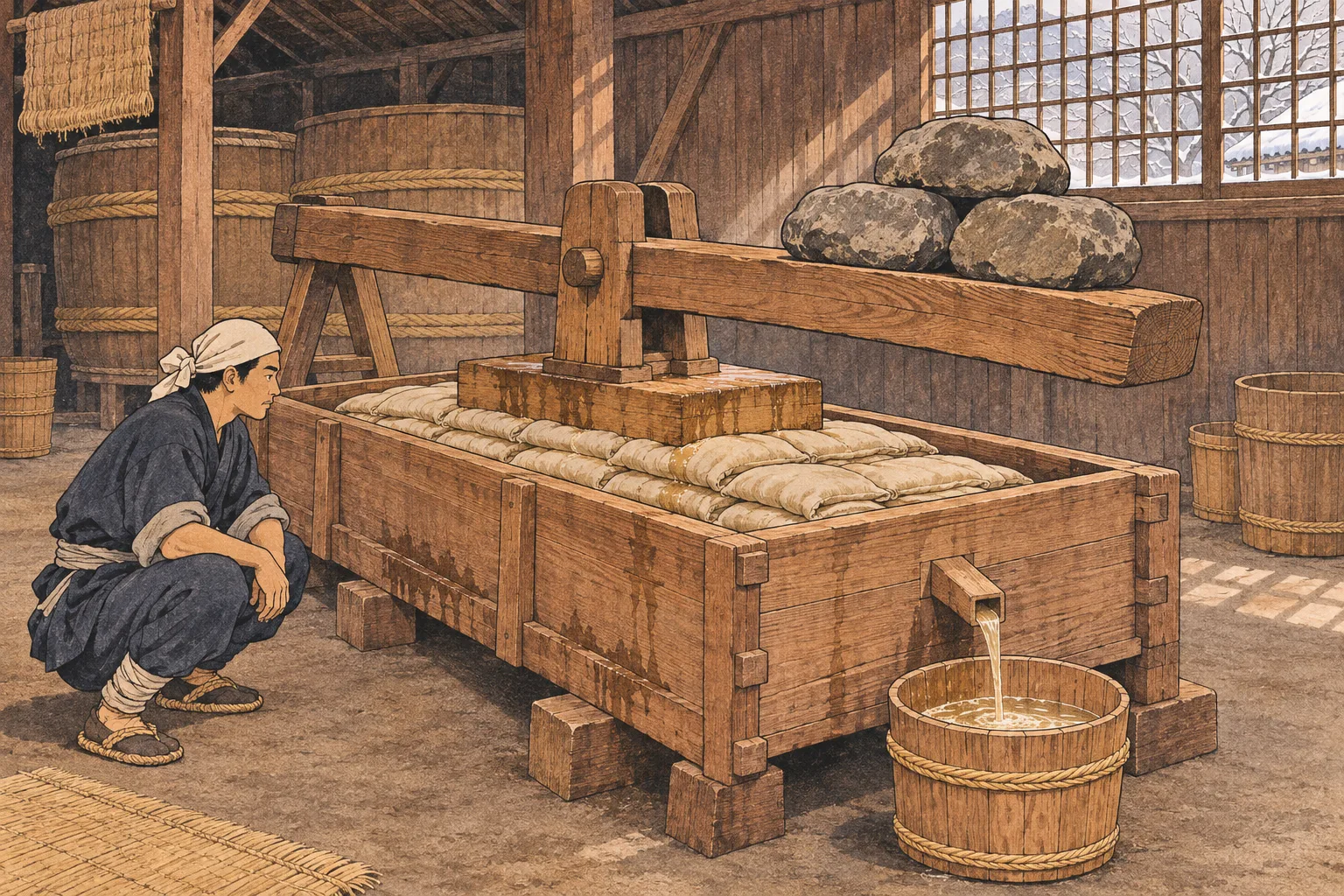
The sendō watches the fune: cloth bags of mash are stacked inside, pressed down by boards, a lever beam and stones, and sake runs from the spout into a tub (artist’s impression)
The oimawashi was a junior hand, in some breweries the kamaya’s assistant; the name sounds like "the one who gets chased around." He washed tubs, carried rice, swept floors and ran errands, going wherever he was needed. A young man’s first winter away usually began here or in the kitchen, watching the older men and working up by seniority through kamaya and sendō toward motoya, kōjiya and kashira.
The mamataki (also read meshitaki or kashiki) cooked. A dozen or twenty men doing hard physical work in the cold ate a great deal, several times a day, so the cook was up before dawn. The job usually went to a newcomer; old brewers in Noto remember that the rice was cooked by boys fresh out of middle school.
The three key posts of kashira, kōjiya and motoya were called the san’yaku, the "three officers." Other titles covered tool-keeping, and there were broader grades by seniority. One record of the Edo period describes a standard crew of thirteen, from the tōji and kashira down through the tool-keeper, the kamaya and three grades of ordinary hands to the cook. Rising from the bottom to tōji took many winters.
Rank showed everywhere. At meals the tōji sat at the head, the kashira and the other officers below him, and the oimawashi nearest the door, last to pick up his chopsticks and first to clear away. Sleeping places followed the same order. Many tōji are said to have kept a private notebook of daily temperatures, soaking times and how each tank behaved, the distilled record of decades. It was rarely shown to outsiders, and some masters passed it on only to the successor they had chosen. Much of a school’s knowledge lived in such notebooks and in spoken advice rather than in printed books.
06A Day, and a Season, Inside the Brewery
Crews set out in late October or November; the actual brewing ran for about a hundred days, from around November to February. Before railways they walked, sometimes for days over mountain passes; later they went by train and boat, carrying bedding and clothes for half a year. On arrival they cleaned the brewery, scrubbed the tubs and repaired tools, then held a ceremony before the brewery’s shrine shelf, praying for safety and a good season. Many breweries honour the sake deities of Matsuo Taisha in Kyoto or Ōmiwa Shrine in Nara, where the Ikuhi Shrine within the grounds is still revered by tōji, and their charms hang in the brewery.
The day began in darkness. The kamaya lit the fire at three or four; the others were up by four or five to wash and soak rice. Around dawn the rice came off the steamer, some carried to the kōji room, some cooled and added to starters or tanks. Mornings were for adding ingredients and stirring the tanks with long wooden paddles called kai. After lunch came washing, carrying and preparing the next day’s rice. At night the tōji and kōjiya took turns checking the kōji and the tanks, and a lantern moved through the dark brewery. There was no heating; floors were wet; hands washing rice in icy water cracked and bled.
The crew lived in the brewery, usually in a shared room upstairs or in an attached dormitory. There were almost no days off, and New Year was usually spent at work, with letters and parcels from home. For many families, the winter’s wages were the biggest cash income of the year, paying for school fees, new roofs and debts.
Back home, winter belonged to the women, the old and the children. Mountain villages in Iwate and Niigata could be buried under several metres of snow, and clearing roofs, tending animals, weaving and making straw sandals fell to those who stayed. In places like Ishidoriya and Nozumi, a winter village with almost no grown men in it is something older residents still remember. From the brewery came letters, and sometimes a parcel of sake lees from the owner, a welcome treat in a lean season.
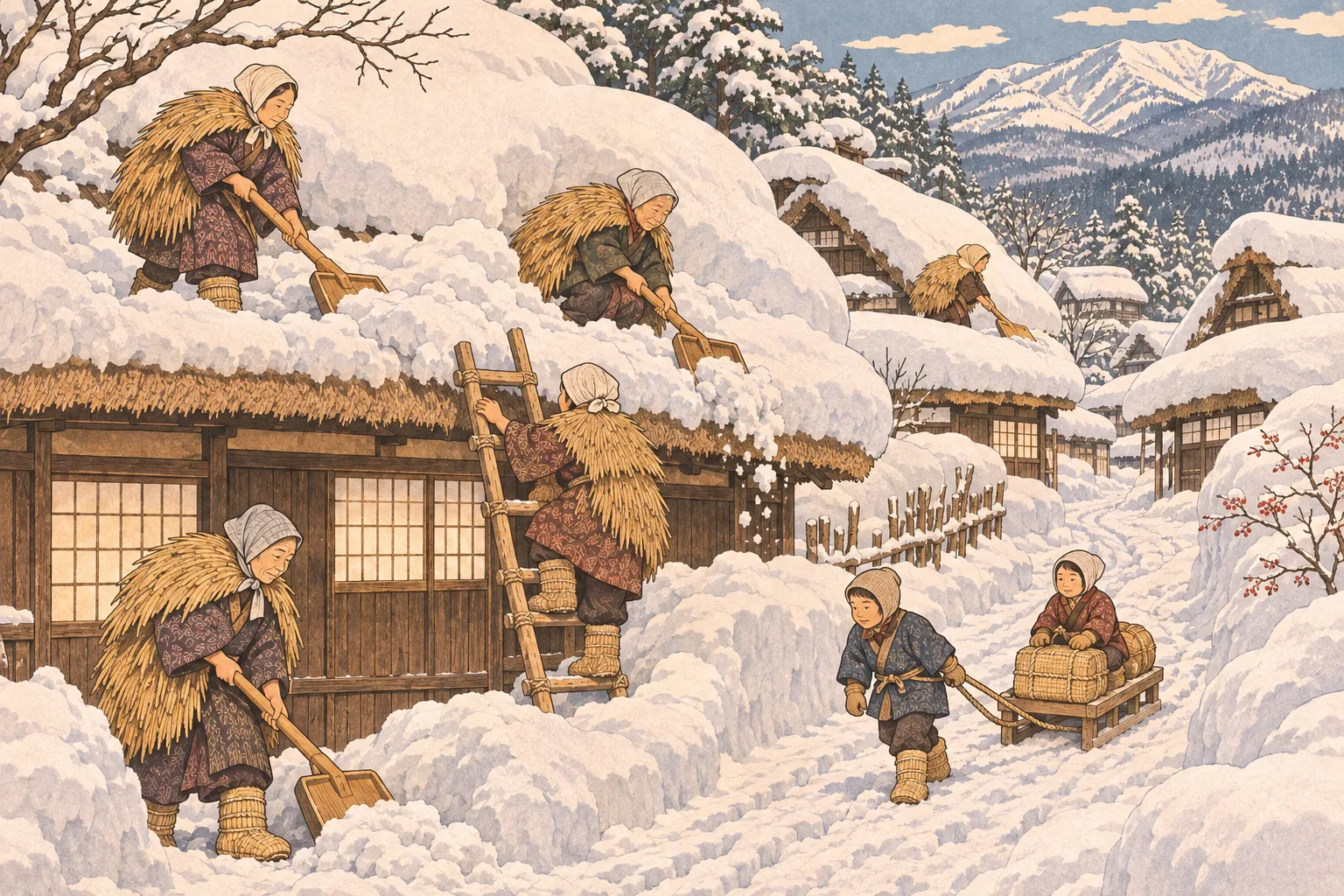
The village in winter after the men have left: women in straw capes shovel snow from the roofs and doorways, and children pull a sled along the lane (artist’s impression)
Two milestones marked the season. Koshiki-daoshi, "toppling the steamer," came when the last rice was steamed, the mashing was finished and the steamer was laid on its side to be cleaned, and it was usually celebrated with a meal. Kaizō generally means the point when every tank had been pressed and the whole season’s sake was done. There was usually a celebration, the crew collected their pay, and they went home in March or April, in time for spring planting.
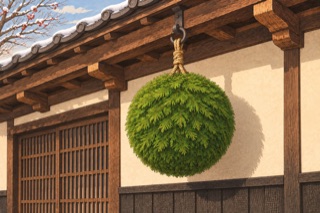
Snow often still lay on the road home. Some tōji had already agreed terms with an owner for the next winter; others waited for the guild to place them in autumn. A man might go out for several decades of winters, and old men in those villages can still reel off the breweries they served and the masters they followed. The fresh green sugidama cedar ball hung at a brewery’s eaves when the new sake is pressed went up at about the time these crews were packing their bags.
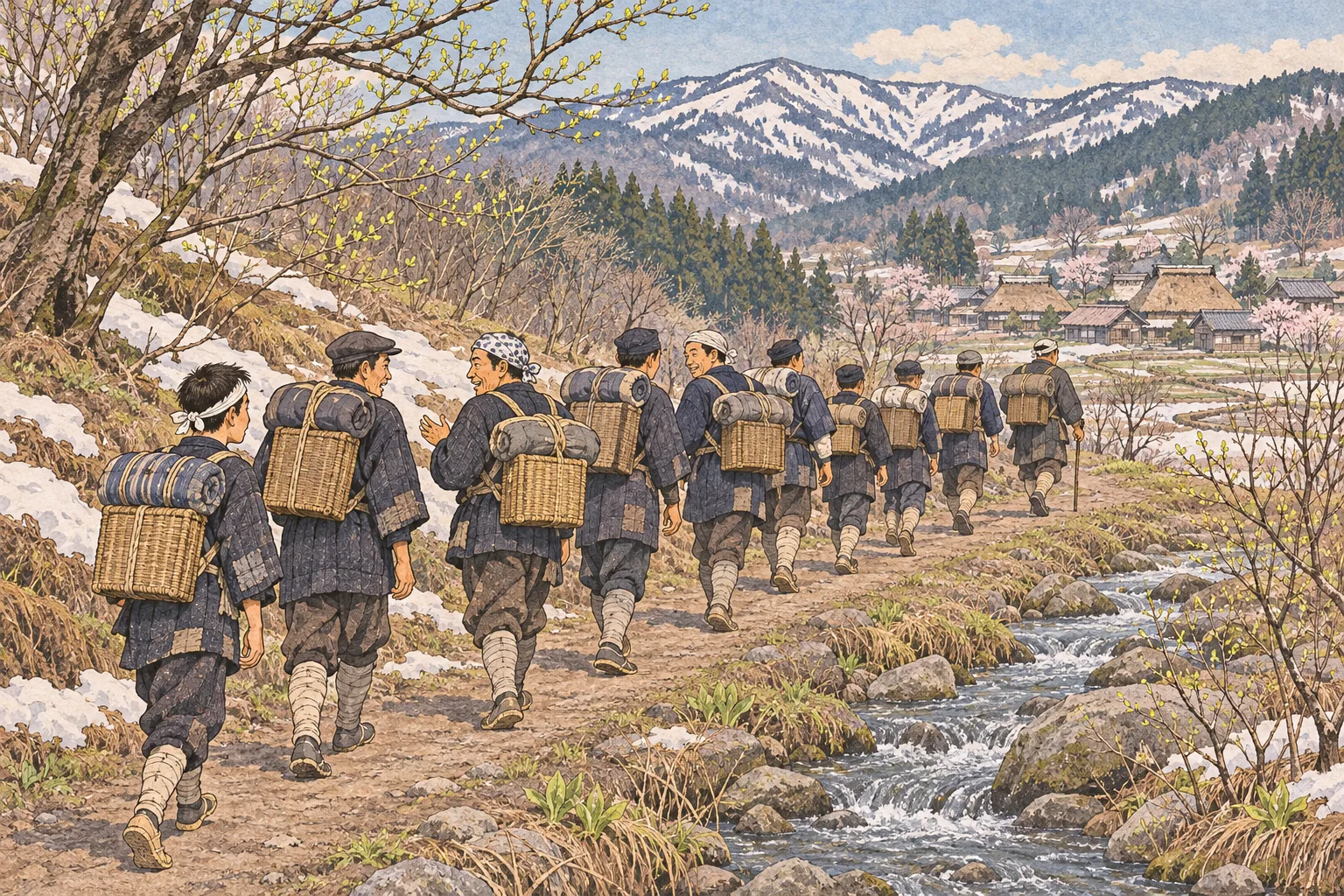
Early spring, the season’s work done: the crew walks home with their packs along a road where snow still lies, the roofs of the village already in sight (artist’s impression)
07Brewing Songs
Brewers sang as they worked, and their sakazukuri-uta were working tools, not performances.
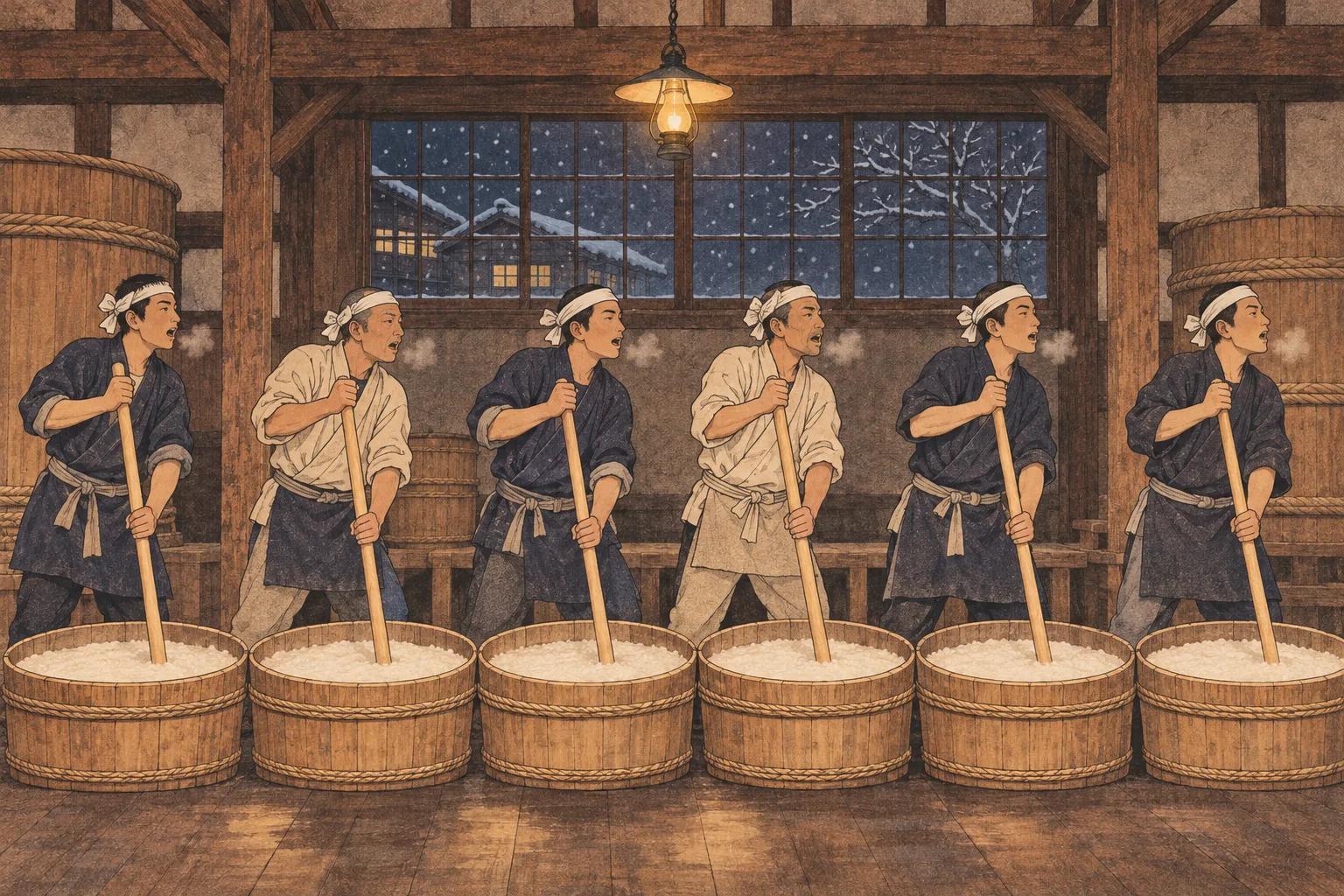
On a cold night six kurabito, one to a tub, press their poles down together as they sing; the sakazukuri-uta keeps them in step (artist’s impression)
They kept time. Breweries are said to have had no clocks on the floor, so the length of a task was measured in songs: wash the rice for so many verses, pound the starter for so many songs, then switch. Because everyone sang at roughly the same pace, the song was a clock the whole crew could hear.
They kept people in step. Pounding, stirring and carrying were often done in groups, and pulling to a shared rhythm saved effort and prevented injury.
They kept people awake and accounted for. The pre-dawn and late-night shifts were the hardest, and singing pushed back sleep. A tōji elsewhere in the building could hear whether a team was working.
Songs were tied to tasks. The Tanba repertoire, for example, has a song for scrubbing the tools, songs for yamaoroshi and for working the starter, and songs for stirring the fermenting mash, sung slowly while the mash is still stiff and faster once it softens. The lyrics mixed fixed verses with improvisation: homesickness, jokes, longing for wives and sweethearts, grumbles about the owner. The songs of the Tanba and Nanbu schools are among the best preserved. The Tanba guild formed a preservation society that records the songs and performs them; in Iwate, "Nanbu sake-brewing customs" were selected by the national government in 1980 as intangible folk culture to be documented.
Machines replaced most handwork, and only a few breweries still pound their starters. In Nada the songs could still be heard until around 1965; after that they were no longer needed on the brewery floor. Visitors may hear them at brewery events, at the tōji museums, or at local festivals.
08Guilds, Exams and the End of the Seasonal Crew
The schools organised themselves early into tōji guilds, or kumiai. A guild matched brewers with breweries, helped negotiate contracts, ran pre-season training courses and studied new techniques. Regional guilds joined a national federation. The Nanbu association holds a summer course every year, its 113th in 2024, with tōji, research and special classes, the last ending in an exam. There is also a national skills test for sake brewing in first and second grades, with written and practical parts; those who pass are certified as shuzō ginōshi.
The system began to decline in the 1960s. As Japan’s economy boomed, young men from the countryside took year-round jobs in factories and offices. Farm machinery made winters less idle. Large brewers built air-conditioned plants that could brew all year, shiki-jōzō, and needed permanent staff rather than seasonal crews. And from the mid-1970s, sake consumption fell steadily, closing many small breweries. According to the national federation of tōji guilds, its tōji, officers and ordinary crewmen numbered 28,075 in 1965 and 2,024 in 2023, a fall of about 92 percent; a 1979 count found about 14,800 seasonal brewery workers, 2,444 of them tōji. Many of those who remain are elderly.
Breweries adapted in several ways. Some hired year-round employees who brew in winter and bottle, sell and deliver the rest of the year; the brewery’s own staff then produce its next tōji, sometimes called a shain tōji. Others turned to the kuramoto tōji, an owner or owner’s heir who brews personally. From the 1990s many young heirs studied brewing at Tokyo University of Agriculture or the National Research Institute of Brewing in Hiroshima and came home to take charge of the tanks themselves. The young heir of Takagi Shuzō in Yamagata, maker of Jūyondai, is the example most often cited. Owner-brewers tend to work in small batches with a clear personal style, and they drove much of the craft-sake boom of the past three decades. Elsewhere, a veteran tōji may now be brought in to train a handful of local employees rather than to lead a full crew from his village, and the old schools have opened up: the Nanbu summer course, for instance, admits non-members who pay a supporting fee, and they may sit its special-class exam.
The biggest change concerns women. For a long time, many breweries kept women out of the brewing areas; old brewers in Noto recall that before the war women could not take part in brewing. One common explanation was that the brewery’s deity was female and would be jealous; another linked it to older ideas of female impurity; others point to the reality of an all-male crew living together for months. Practice varied: some breweries barred even the owner’s own family, others only kept women away from certain tasks.
The taboo eased after the war, and especially from the 1990s more women worked as brewery staff and then as tōji. Many were daughters or wives of owners who took on the brewing when they inherited the business; others joined breweries after university and worked their way up. Women tōji are no longer unusual.
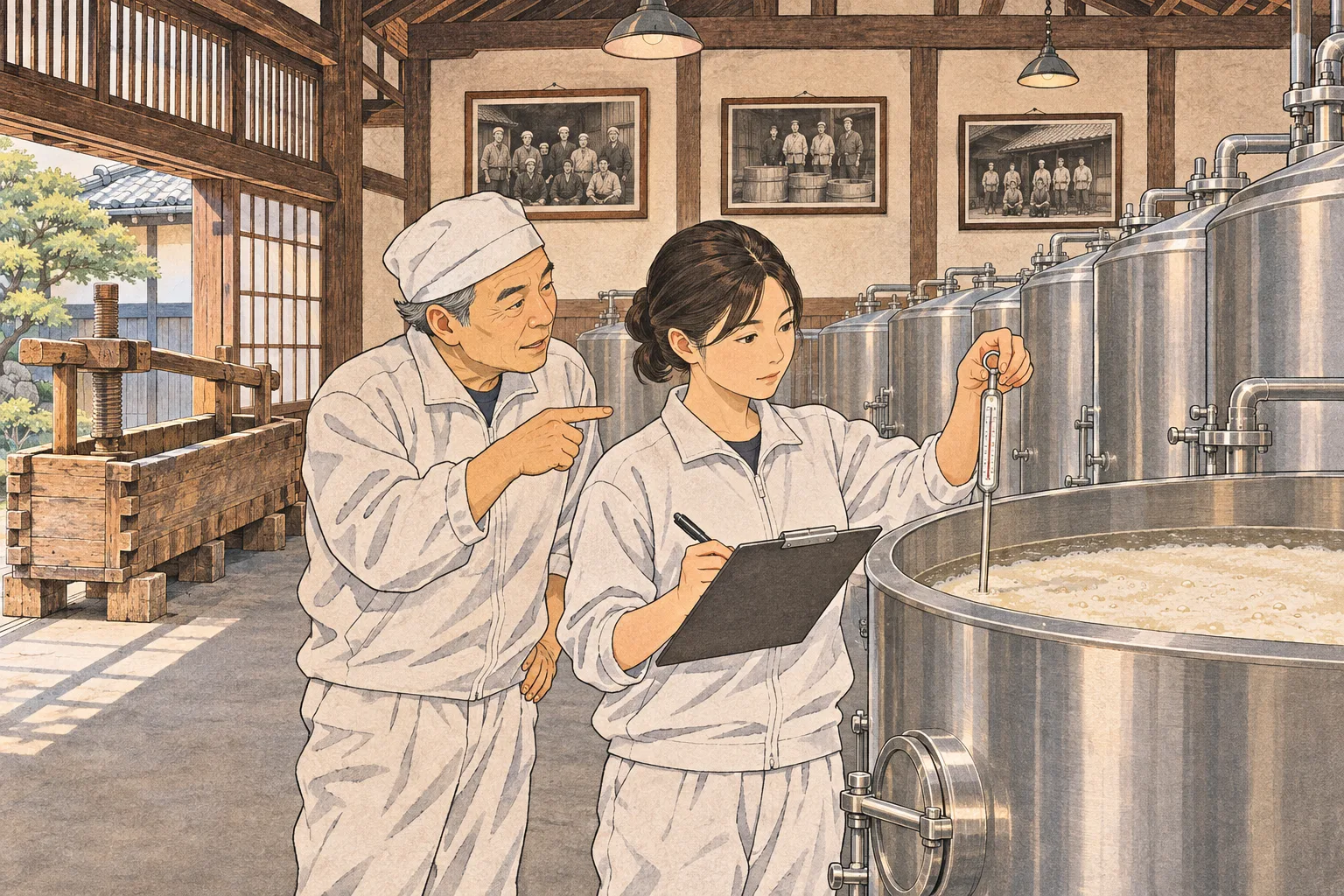
A brewery today: beside the stainless-steel tanks a young woman takes the temperature of the mash and writes it down, with an older tōji advising. Old photographs of past crews hang on the wall, and a wooden press stands by the door.
A brewery visit today usually shows stainless steel tanks, climate-controlled rooms and a few staff in white. But labels still say "Nanbu tōji" or "Noto tōji," the office walls still show photographs of past masters, and old wooden presses and steamers stand by the door. When UNESCO listed Japan’s traditional kōji-based brewing in December 2024, it was these hand-to-hand skills that it recognised.
More deep dives on this topic
 Reading the Fine Print on a Sake LabelPick up a sake bottle in a Japanese liquor shop and the front label will usually give you a brush-written brand name and not much else.
 Sake RicePick up a bottle of premium sake in Japan and the largest characters on the label after the brewery’s name are often the name of a rice: Yamada Nishiki, Omachi, Gohyakumangoku.
 The Yeast Starter and the YeastsBefore a sake brewery commits a ton of rice to a fermentation, it brews something much smaller: a dense, sour culture of yeast called the shubo ("mother of sake") or moto…
 From Polished Grain to Pressed SakeA sake brewery in winter is a working kitchen on an industrial scale.
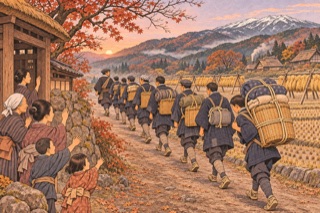 Tōji Guilds and the Brewery CrewFor most of the last three centuries, the people who actually made Japanese sake did not own the breweries and did not live near them.
 A Year of SakeWalk into the same Japanese liquor shop once a month for a year and the fridge will tell you the season before the weather does.
 Sake Vessels and Warming ToolsOrder sake in Japan and the drink often arrives in an object you have no name for: a slim-necked ceramic bottle, a cup the size of a thimble, a square wooden box filled to the…
 Sake and the GodsWalk past an old sake brewery in Japan and you will probably see a large ball of cedar hanging over its door.
 Aroma, Taste and the Four Types of SakeMost sake menus in Japan assume you already know the code.
- Back to the main article: Sake →