
Order sake in Japan and the drink often arrives in an object you have no name for: a slim-necked ceramic bottle, a cup the size of a thimble, a square wooden box filled to the brim, or a dented metal jug pulled out of a tank of hot water. Each of these has a history. Some come from court ritual a thousand years old, some from the measuring tools of Edo-period sake shops, and some were invented simply because people wanted their sake hot and wanted it fast. This guide takes them one by one: what they look like, where they came from, why they have the shape they do, and where a visitor will still find them.
01Three Layers of History on One Table
The oldest Japanese drinking vessel is the kawarake, a shallow, unglazed earthenware dish the colour of dried clay. In ritual use it is generally thought to have served once and then been set aside, sometimes smashed on the spot. Shinto places great weight on purity, and a fresh dish that no one had drunk from was the proper thing to offer a deity. You can still see these plain buff-coloured saucers at shrine festivals and at Shinto weddings.
From the Heian period (794–1185), court banquets added lacquer to the earthenware. At an aristocratic banquet, sake was not served by the bottle. An attendant held a long-handled pourer called a chōshi and filled the shallow red lacquer cups of the guests; when it ran low, it was topped up from a second vessel, the hisage. Cups were often passed along the row, so that several people drank from the same one in turn. The whole set was built around a ceremonial idea of drinking: the order of pouring, receiving and passing mattered as much as the sake.
The samurai inherited this etiquette and formalised it further. By the Muromachi period (1336–1573) the most formal banquets followed shiki-sankon, "three formal rounds", in which sake was offered and drunk with each of three successive courses. Ordinary people drank from whatever was at hand. What really shaped today’s sake table came later, in the cities of the Edo period (1603–1868). Sake shops and taverns multiplied, sake was sold by measure, and drinking it warm became an everyday habit. By the later Edo period, the small warming tokkuri flask that holds one or two gō (a gō is about 180 ml) had come into use, paired with the little choko cup that was already around.
So a modern Japanese table layers several eras. Weddings still use the chōshi, the hisage and red lacquer cups; New Year’s spiced toso is still drunk from lacquer; taverns run on tokkuri and choko; and specialist sake bars bring out glass and tin.
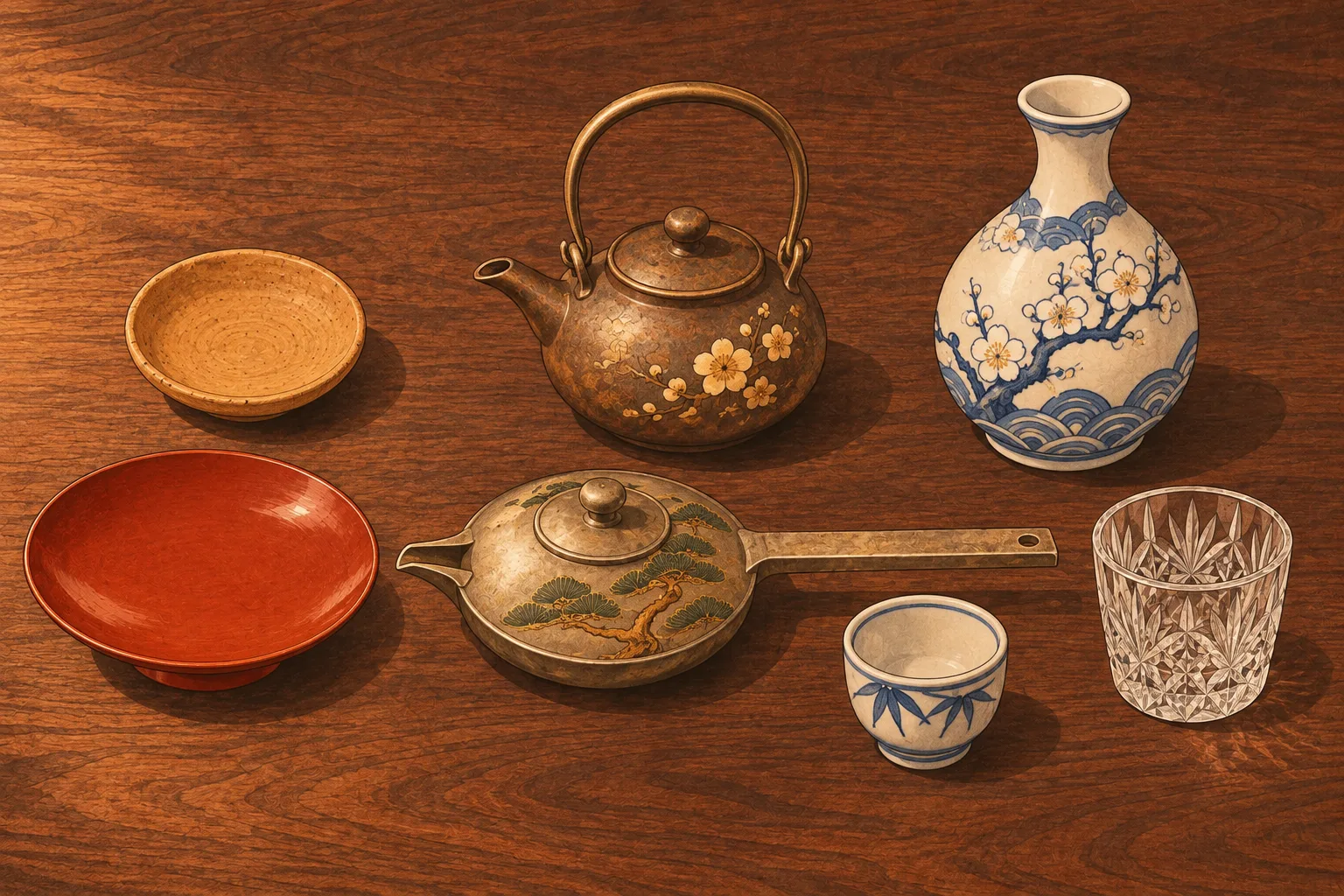
Several eras on one table. Left: an unglazed kawarake above a red lacquer flat cup. Centre: a hisage with its arched bail above a long-handled chōshi. Right: a porcelain tokkuri, a choko and a cut-glass cup.
02Pouring Vessels: Chōshi, Hisage and Tokkuri
The original chōshi is a ceremonial pourer. Picture a flattish round or squarish pot with a narrow spout on one side and a long straight handle on the other. The person pouring holds the end of the handle and fills the cup from a respectful distance. Most chōshi were metal, silver or tin, though wooden lacquered and ceramic ones exist. A chōshi with spouts on both sides is a morokuchi; one with a single spout is a katakuchi, and old etiquette treated the single-spouted kind as the formal one. The chōshi itself was not set over a fire. The long handle let an attendant serve a high-ranking guest without leaning into his space, and the gesture reads well across a large hall.
The hisage looks like a small spouted pot with an arched bail handle on top, made to be carried, usually in tin or white copper, sometimes imitated in red-lacquered wood. In early times it could hold sake or hot water and be warmed directly, and it was used alongside the chōshi for pouring. In formal sets it acts as the chōshi’s reserve: when the chōshi runs low, sake is added from the hisage, a step the Muromachi period called kuwae-chōshi, "adding to the chōshi". At weddings the chōshi and the hisage are tied with butterflies folded from gold and silver or red and white paper, one male and one female, called ochō-mechō, standing for the couple.
The place a visitor is most likely to see this pair is a shrine wedding. The couple drink three sips from each of three nested red cups, poured by a shrine maiden with a long-handled chōshi, in the ritual called san-san-kudo, covered in our separate page on sake and the gods.
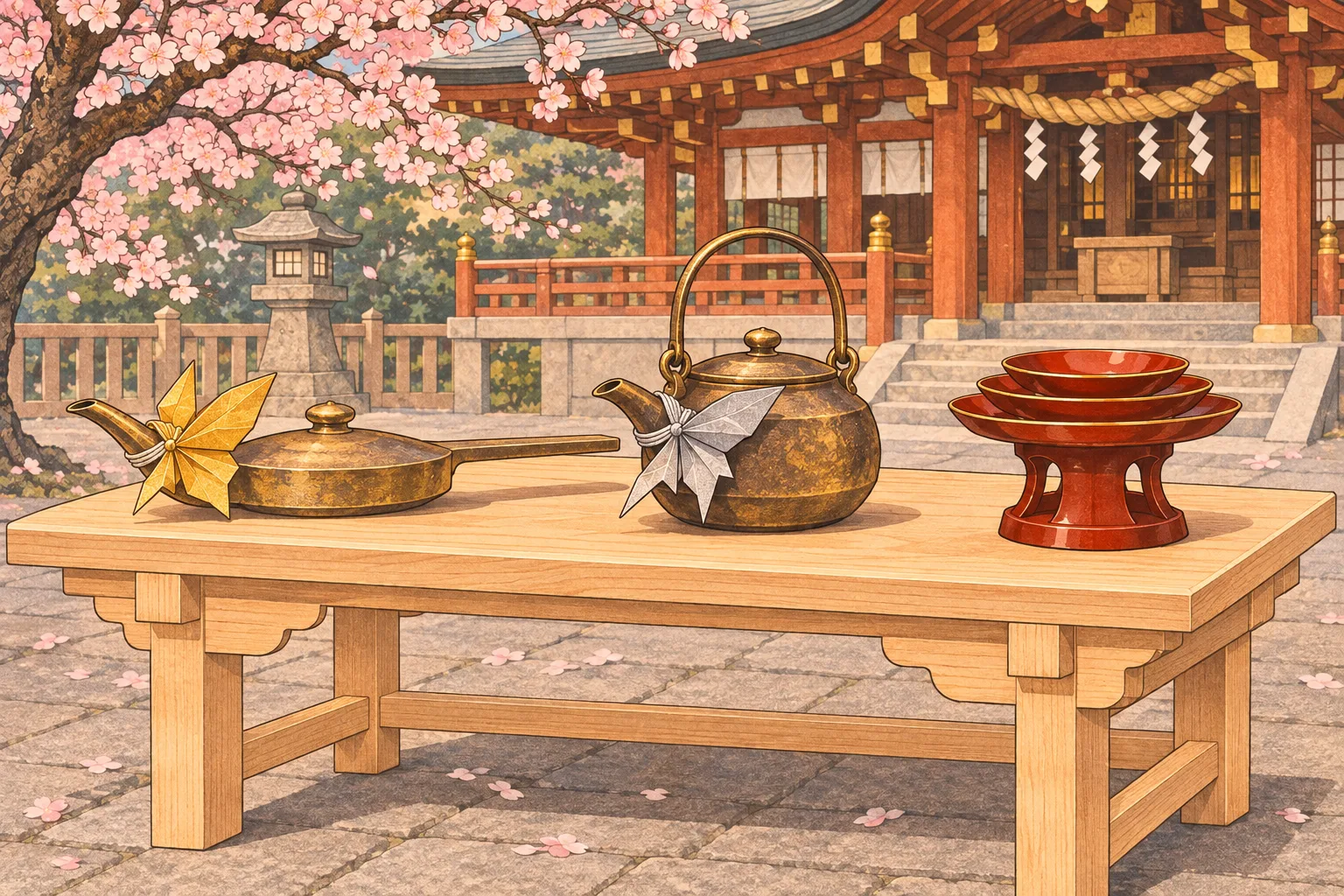
A shrine wedding set on a plain wooden table, from left: a long-handled chōshi tied with a gold paper butterfly, a hisage with a silver one, and three nested red lacquer cups on a stand.
Here is the puzzle. Ask for o-chōshi ippon in a tavern and you get not a long-handled pourer but a slim ceramic bottle. The shift happened in the late Edo period. Morisada mankō, a record of late-Edo customs, notes that in Edo the chōshi was now kept for formal occasions and the warming tokkuri was used otherwise. As the tokkuri spread, people began calling it chōshi too, since that word had long stood for sake vessels in general. A kabuki script of 1860 already uses chōshi to mean a tokkuri of sake.
The tokkuri itself is a narrow-necked, round-bellied bottle. The most popular story about its name is that it imitates the gurgling sound sake makes as it leaves a narrow neck, toku-toku. Another links the name to Bizen tokkuri being cheap and sturdy; other spellings with different characters also appear. None is certain.
Early tokkuri were not table bottles at all. The word appears in the Muromachi period for stoneware bottles that held sake, soy sauce or vinegar, and a guide to regional products of 1638 already lists Bizen tokkuri as a specialty. In the Edo period a customer buying a little sake at a time borrowed a jar from the shop holding five gō to one shō (a shō is about 1.8 litres), usually marked with the shop’s name. You drank it, brought the jar back and had it refilled. These kayoi-dokkuri, nicknamed "poor man’s tokkuri", turn up in folk museums and antique shops: rough brown jars many times the size of a table flask, with a shop name across the shoulder.
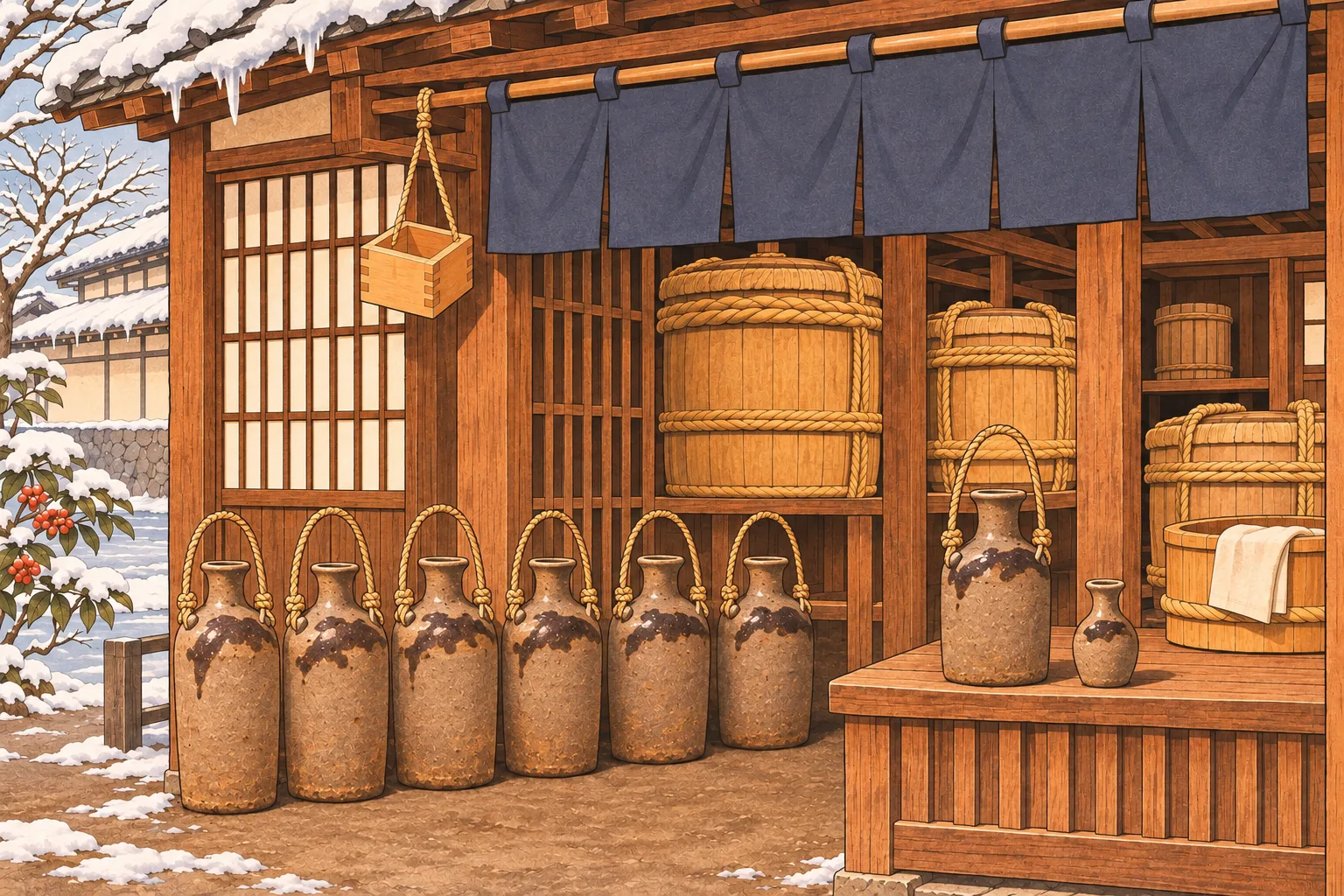
Kayoi-dokkuri outside an Edo-period sake shop: rough stoneware lending jars with rope handles. The small flask on the platform shows how much larger they are than a table tokkuri (artist’s impression)
The small warming flask, the kan-dokkuri, came into tavern use late, around the 1820s and early 1830s; the word itself appears in a popular novel of 1832–33. It usually holds one gō (about 180 ml) or two, and after the early 20th century the two-gō size faded and one gō became the norm. The narrow neck slows heat loss and lets you grip the bottle in one hand and pour a thin, controlled stream into a tiny cup. The round belly gives plenty of surface to sit in hot water. Tokkuri come in many shapes: the tsurukubi or "crane neck" with a long, slender throat; the low-shouldered, wide-based funa-dokkuri or "boat flask", said to have been made so it would not tip over on a rocking boat (the Edo-Tokyo Museum holds one from the mid Edo period); bottles with a dimple pressed into the side for your fingers. A tokkuri may also come to the table standing in a low wooden holder called a hakama, after the pleated trousers it resembles.
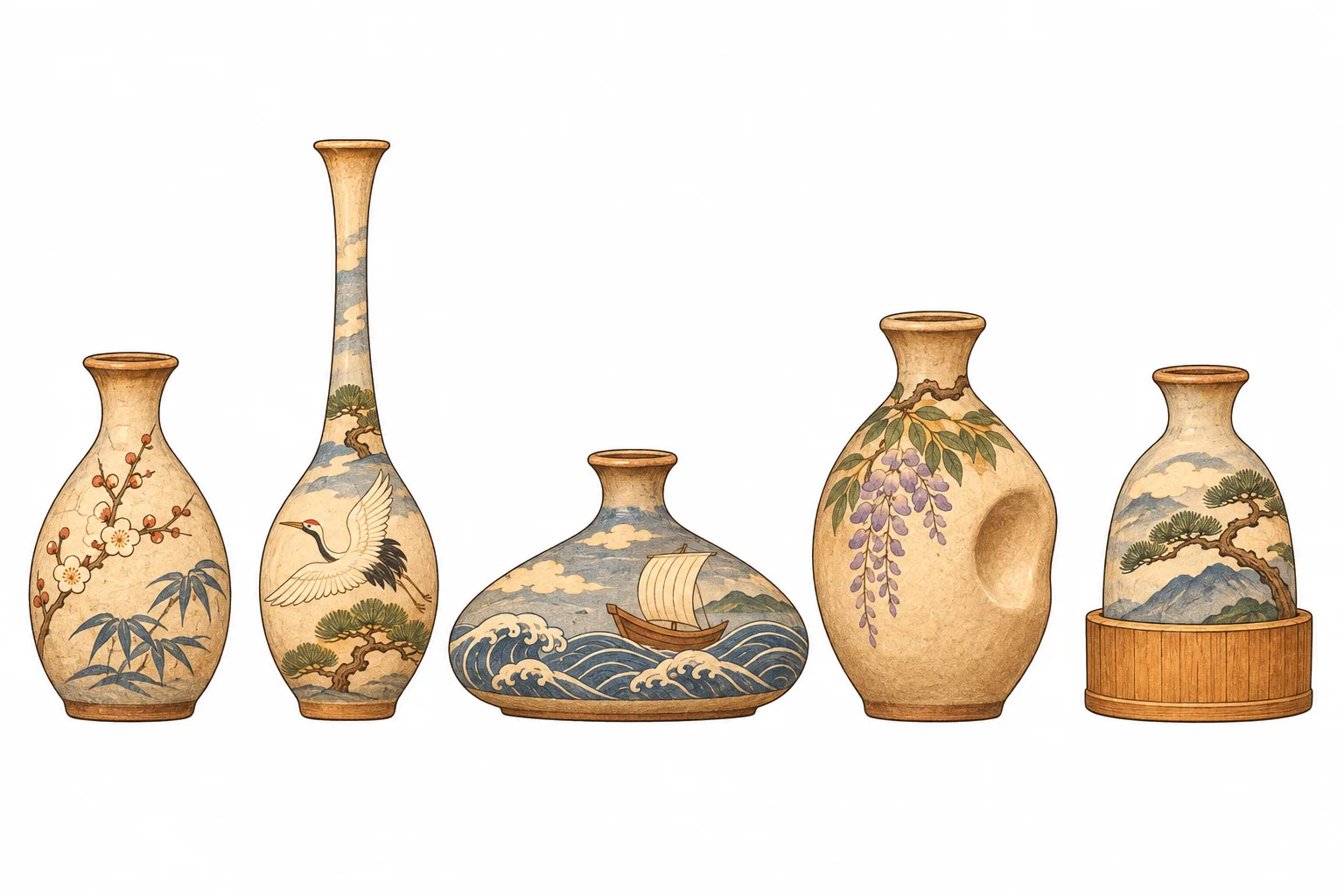
Tokkuri shapes, from left: a standard flask, a long-necked tsurukubi, a low, wide-based funa-dokkuri, one with a finger dimple pressed into its side, and one standing in a wooden hakama.
03Drinking Vessels: Flat Cups, Choko and Guinomi
The hira-sakazuki, or flat cup, is the oldest drinking shape. It is usually 8 to 12 cm across and barely 1 to 2 cm deep, a gently raised disc on a low foot ring. Lacquer versions are mostly vermilion and are called shu-sakazuki; the inside may carry gold pictures of pine, bamboo and plum, cranes and turtles, or a family crest.
Why so shallow? It came out of ritual, where a sip was symbolic. A shallow cup is easy to pass without spilling, and lacquer is most stable and economical as a thin, open form. Ritual sake was usually served unheated, and a wide surface lets the aroma lift, a point modern sake enthusiasts still make.
You will see flat cups at ceremonies and festivals. New Year’s toso is often drunk from a nested set of three lacquer cups, served from a matching pourer. The old rule was for the household to face east and drink youngest first; families now vary. Sacred sake handed out after shrine festivals is often poured into an earthenware or white porcelain saucer. And sumo champions are often photographed at their victory celebrations with an outsized red cup.
Two companions go with the flat cup. The sakazuki-dai is a tall lacquer stand that raises the cup off the table as a mark of formality. The haisen is a bowl of water for rinsing your cup before handing it to someone else in a round of exchanged toasts. Haisen are ceramic, wide and deep on a foot ring, and came into fashion in the late Edo period, when iron pourers and lacquer cups at parties were giving way to blue-and-white porcelain flasks and cups; a list of fashionable things from 1849 includes them. Porcelain haisen are common at flea markets, and many buyers have no idea what they are and use them as flower bowls.
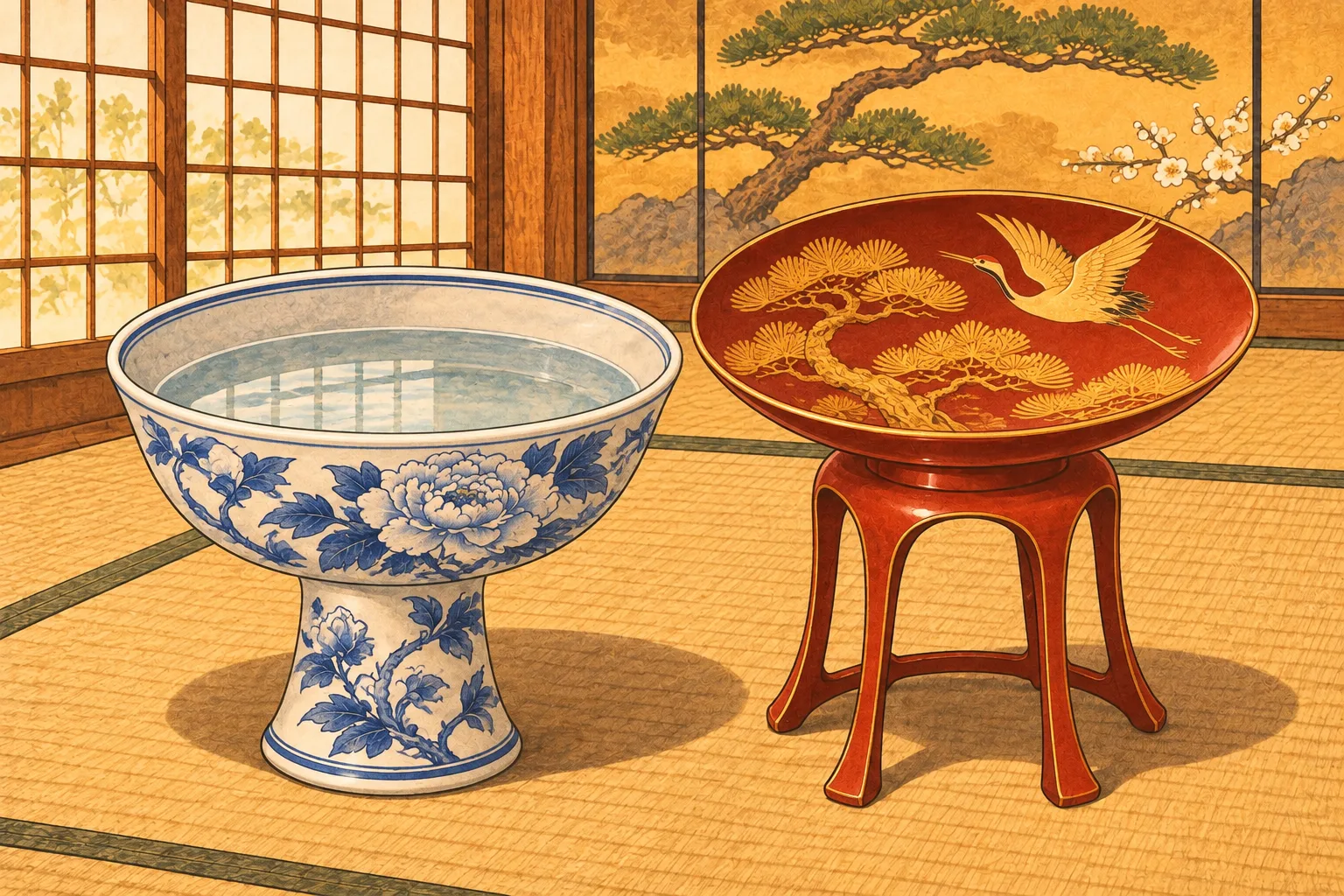
Left, a blue-and-white porcelain haisen, wide and deep on a tall foot, filled with water. Right, a red lacquer sakazuki-dai holding a flat cup painted with a gold pine and crane.
The choko (or o-choko) is the small cup most visitors know, holding perhaps 30 to 50 ml, two sips at most. It is a short straight-sided or slightly flared cup, much deeper than a flat cup. The older form of the word is choku, of uncertain origin; one theory derives it from a Chinese (Wu or Fujianese) or Korean reading of the character for a small cup or bell; the characters used to write it, which literally mean "boar’s mouth", are phonetic and have nothing to do with pigs.
The choko was not only a sake cup either. From the early Edo period, banquet menus list large, medium and small choku, small deep dishes for dressed vegetables, vinegared dishes and salted fish guts. People were drinking from them by 1666, when a haiku mentions sake in a choku. They held warm sake better than a flat cup and fitted neatly with a one-gō flask. The same Morisada mankō says that in Edo lacquer cups were for formal occasions and choko for everyday drinking. Once the warming tokkuri spread in the late Edo period, tokkuri and choko became a pair.
One special choko deserves a mention: the janome or "snake’s eye" cup, white porcelain with two blue concentric rings on the bottom, used at breweries to judge a sake’s colour and clarity.
The guinomi is bigger than a choko and smaller than a teacup, roughly 60 to 150 ml, deep, with a wide mouth and thick walls, like a miniature tea bowl. The name is usually explained as gui to nomu, to knock it back, and the word was in print by the 1770s. Guinomi are the cups collectors fuss over: potters and tea people judge them like small tea bowls, for glaze, kiln effects, weight and foot. Most ceramic artists’ exhibitions include a set of guinomi.
The three sizes map onto three purposes: the flat cup for ceremony, the choko for everyday warm sake poured cup by cup, the guinomi for personal pleasure in the object itself. Many Japanese drinkers buy cups singly rather than in sets, and a good sake bar may bring a tray of mismatched cups and let you choose.
04Katakuchi and Masu: Dividing and Measuring
A katakuchi is a lipped bowl: a bowl with a simple pinched or cut spout on one side. It is old: earthenware katakuchi have been excavated from Nara-period sites. It served as a workshop and kitchen tool for decanting soy sauce, vinegar or sake from large casks; wood gradually replaced pottery, and most surviving pieces are red-lacquered wood from the last few centuries. With the rise of chilled sake, the katakuchi has moved onto the table. Cold sake does not need a narrow neck to hold heat, and a wide mouth shows off colour and aroma. Many sake bars serve cold sake in a glass or white porcelain katakuchi with small cups; red-over-black Negoro lacquer katakuchi are prized by collectors.
The masu is a square wooden box that began as a measure for rice and sake. A one-gō masu holds about 180 ml; there are also half-gō, five-gō and one-shō sizes. In 1669 the shogunate made the "new Kyoto measure" the single official standard for the whole country; before that Edo and Kyoto measures differed. The new one-shō box was 4 sun 9 bu square inside and 2 sun 7 bu deep, about 1.8 litres, and a gō is a tenth of that. Masu are usually made from Japanese cypress (hinoki), the four sides joined at the corners with glued, interlocking teeth called arare-gumi, and the base glued on. A new one smells of fresh wood.
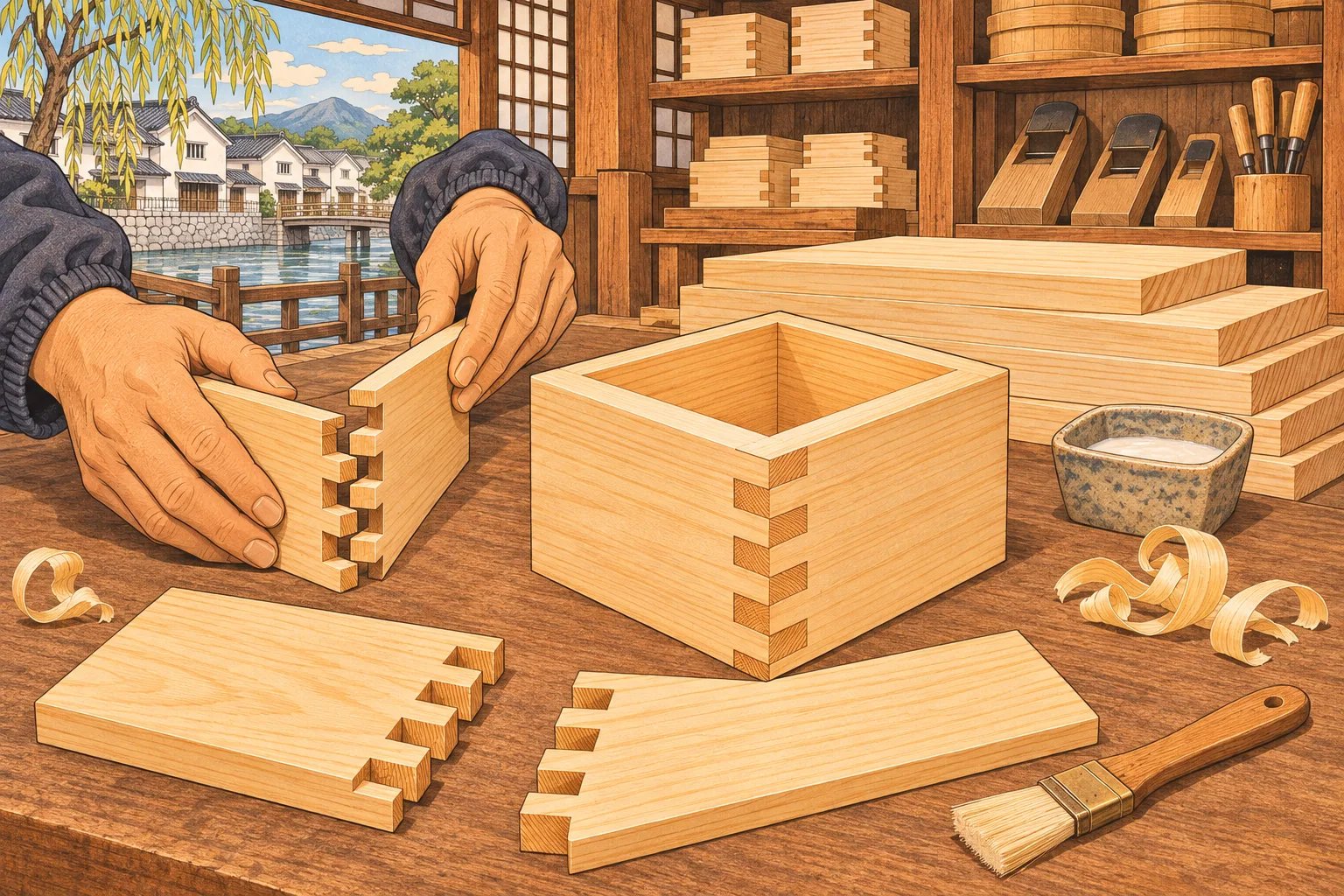
Making a masu: the ends of the hinoki side boards are cut into interlocking arare-gumi teeth and pressed together. An assembled box stands in the centre, with glue and a brush to the right.
People drank straight from it because sake shops measured with it: at the counter, it was easier to drink from the measure than to transfer it. You sip from a corner, and some put a pinch of salt on the rim. Fans like the faint woody taste; others say it masks the sake. Today you see masu holding a glass for an overflowing pour, at celebratory barrel-openings, and full of roasted beans at the Setsubun festival in February. Ōgaki in Gifu Prefecture is the main production centre, making about 80 percent of Japan’s wooden masu; local makers trace the trade to a single masu craftsman who settled there in the Meiji era, and one workshop there lets visitors assemble a one-gō masu themselves.
05Warming Tools: Chirori, Kandōko and Their Successors
Warm sake has a whole vocabulary of temperatures, laid out in chapter 6 of our main sake article. Here the question is what does the heating. The simplest method is to stand a tokkuri in hot water, which is what most homes and taverns do. But before the warming tokkuri spread, Edo drinkers used other tools. One was the kannabe, a warming pot set straight over the fire, from which the sake was transferred to a handled chōshi. The other, still in use, is the chirori.
A chirori is a metal jug: a cylinder narrowing slightly towards the base, with a spout on one side and a handle on the other, holding about one gō. It can be silver, copper, brass or tin; tin is the most common. You pour the sake in, sink the whole jug into hot water, and within a minute or two it is warm. Then you pour straight into cups or decant into a tokkuri. The origin of the name is unknown. A similar vessel exists in China, so some think it came from there; others link it to chirori to, "in a flash". One of its written forms uses characters for a hearth, as if the jug were warmed in the ashes of a sunken fireplace. In Kyoto and Osaka it was called tanpo.
The design is pure function. Metal conducts heat far faster than ceramic, so a tavern keeper could warm sake while a customer waited. A straight cylinder offers the most surface to the water and slots neatly into the holes of a heating box. Pictures of Edo taverns show the staff pouring straight from a chirori into small cups, and in a work by Jippensha Ikku published in 1830 a customer drinks with a chirori at his side. The chirori is sometimes described as a simplified form of the warming tokkuri, but in the taverns the chirori seems to have come first. Some old-fashioned taverns, oden shops and sake bars still heat with them, and a few set the chirori on your table so you can pour for yourself.
The kandōko (kan means warmed sake, dōko a copper heating box) is the dedicated machine, a heat source and a copper water tank built as one. Water in the copper vessel is brought to the right heat, and the chirori or tokkuri is stood in it under a lid. Many tavern models have holes in the top, so the jugs sit with their lower halves in the hot water.
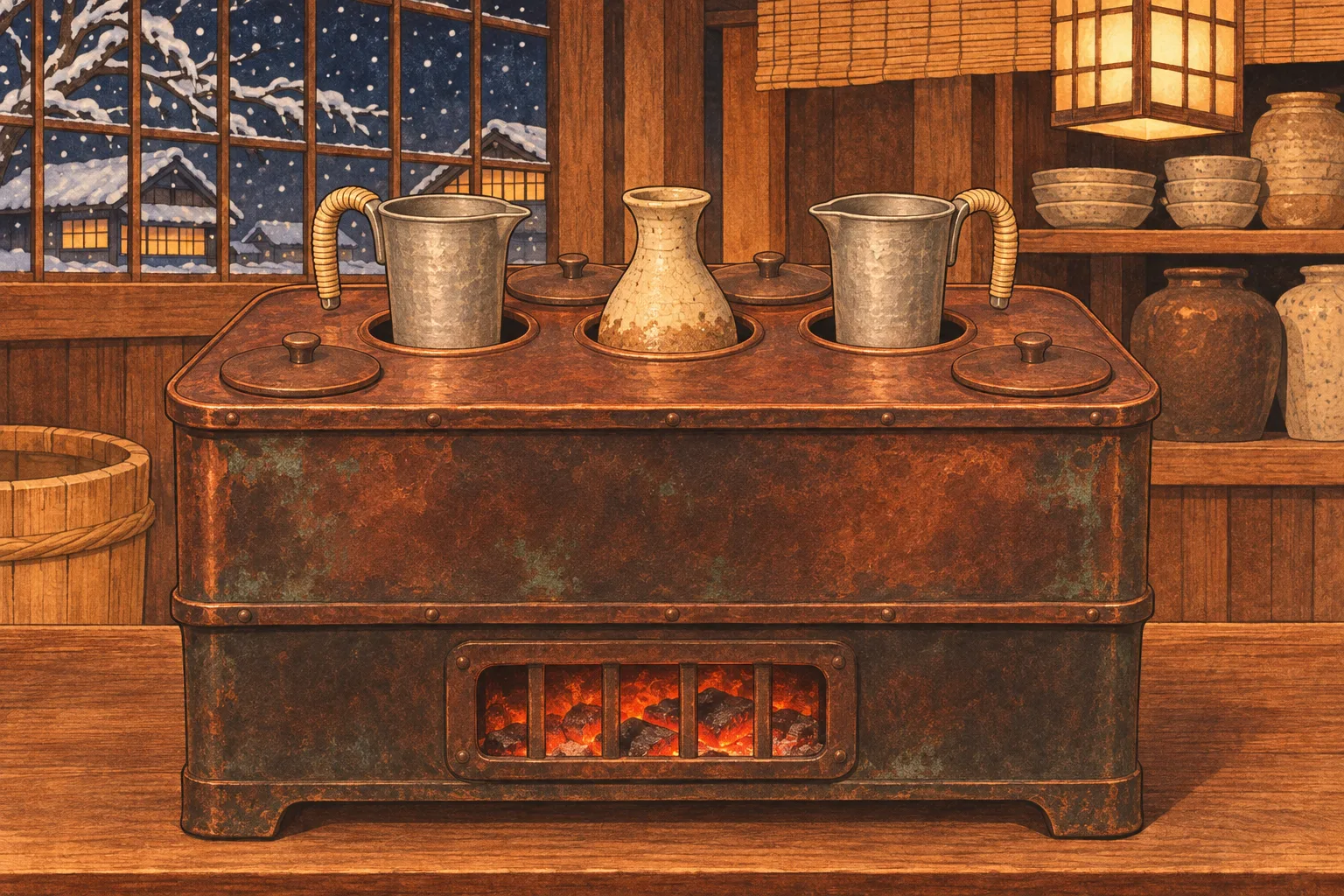
An old copper kandōko in a tavern: charcoal glows below, two handled chirori and a tokkuri stand in the holes on top, and the other holes are covered with lids.
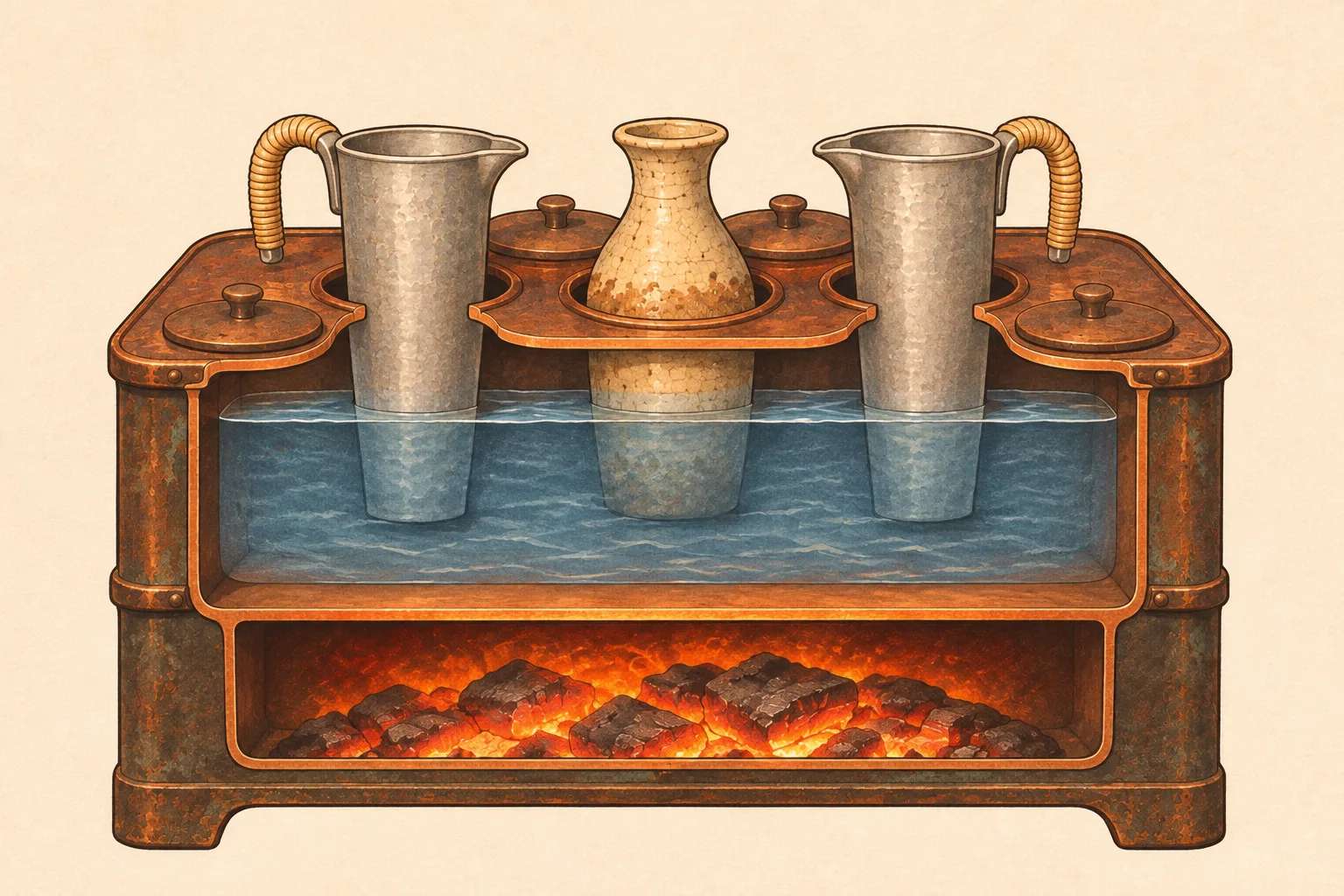
Cutaway of a kandōko: charcoal in the lower chamber, hot water above, and the chirori and tokkuri lowered through the holes so that their lower halves sit in the water.
A popular novel of the 1830s already has a character lifting the lid of a kandōko to rewarm sake. One kandōko could heat several flasks at once, effectively the whole drinks station of a small tavern. Copper conducts heat well and darkens with years of use. Charcoal has since given way to gas or electricity, and some are made of stainless steel. Few shops still use an old copper one. If you find a long-established tavern or oden counter with a copper box behind the bar, lids over holes and metal jugs poking out, you are looking at a kandōko.
Its successors are less romantic. Home sake-kanki are small ceramic or electric warmers shaped like a little kettle, into which you lower a tokkuri. Chain taverns use automatic dispensers that run sake through a heated coil and into a flask at the push of a button, at a preset temperature: fast and consistent, but unable to adjust to each sake the way a person can. Many bars use a stainless-steel electric water bath with holes in the lid, a modern kandōko in all but material. Microwaves exist too, though careful bars avoid them because they heat unevenly.
Why so much equipment? In the Edo period sake was warmed in most seasons, not just winter. Warming is generally thought to soften rough flavours, and many tavern customers were labourers who wanted a hot cup after work. Heating was an everyday necessity, so the tools had to be quick, plentiful and simple.
06Materials and Where They Come From
The same sake tastes different in different vessels. Part of this is physics: wall thickness and conductivity decide how fast the sake warms or cools, and a thin or thick rim changes how it meets the tongue. Part is expectation: weight, colour and texture shape what you think you are about to taste.
Tin holds a special place. It is soft, conducts heat quickly and resists oxidation, and it is traditionally said to make water and sake "rounder", a claim science has not confirmed. Tinware came into everyday use in the Edo period, when Osaka became a centre; Osaka Naniwa pewter was designated a national traditional craft in 1983. Satsuma tinware in Kagoshima goes back to a tin vein found in the hills outside the city in the early Edo period, which became a major source of income for the Satsuma domain; its pieces are often acid-etched to a soft matte finish. More recently a foundry in Takaoka, Toyama, has made pure-tin bowls soft enough to bend by hand. A tin cup filled with cold sake chills quickly and beads with condensation.
Bizen ware from Imbe in Okayama is unglazed stoneware fired long and hot. It grew out of ancient Sue ware and took on its own character around the 12th century, and Bizen kilns were already making tokkuri in the Muromachi period. Pieces run from red-brown to charcoal. Pine ash from the fuel that melts onto the surface leaves speckles called goma ("sesame"); straw, first wrapped round pieces to stop them sticking together, leaves bright red streaks called hidasuki; pieces buried in ash near the kiln wall are smoked grey-blue to dark brown, called sangiri. Bizen tokkuri and guinomi are favourites, and the old claim is that the porous clay lets sake "breathe" and taste better.
Arita ware is porcelain from Arita in Saga Prefecture. Tradition credits the Korean potter Yi Sam-pyeong (known in Japan as Ri Sanpei) with finding porcelain stone at Izumiyama there around 1616. Because it was shipped from nearby Imari, Europeans and Japanese alike called it Imari; "Old Imari" now usually means Edo-period pieces. Expect blue-and-white sometsuke, colourful overglaze enamels, and the milky-white Kakiemon style with red and green birds and flowers. Porcelain is thin, non-absorbent and white, so it shows sake’s colour and cleans easily. That is why most tavern tokkuri and choko are porcelain.
Hagi ware from Hagi and Nagato in Yamaguchi dates from around 1600: the lord Mōri Terumoto brought the Korean potters Yi Shak-kwang and Yi Kyeong, usually described as brothers, to set up kilns, with dates given as 1598 or 1604. Decoration is minimal; glazes are soft loquat or a milky white made with straw ash, over a soft, absorbent body. With years of use, sake and tea seep into the fine crackle and the colour changes, a phenomenon called Hagi no nana-bake, "the seven transformations of Hagi".
Glass means above all Edo kiriko, cut glass said to have begun in 1834 when the Edo glass dealer Kagaya Kyūbei started engraving patterns with emery. Edo-period pieces were mostly clear; British cutting techniques arrived in the Meiji era, and today most pieces are clear glass cased in a coloured layer and cut through. Look for dense geometric cuts such as chrysanthemum and woven-basket patterns, sparkling under light. Edo kiriko was named a national traditional craft in 2002. Satsuma kiriko began in 1846, when the Satsuma lord Shimazu Narioki brought a glassmaker from Edo, and flourished under Nariakira, whose works produced a copper red. The cut edges fade from deep to pale, an effect called bokashi, and the patterns are mostly straight-lined. The works burned in the 1863 bombardment of Kagoshima by the British; with Nariakira’s sudden death a few years before, production stopped until a revival in 1985. Cut-glass cups are summer vessels for chilled sake. Plain glass and stemmed wine glasses are increasingly common; there is even an annual award for sake that tastes best from a wine glass, held for the 16th time in 2026, and aromatic ginjō in particular is often poured this way.
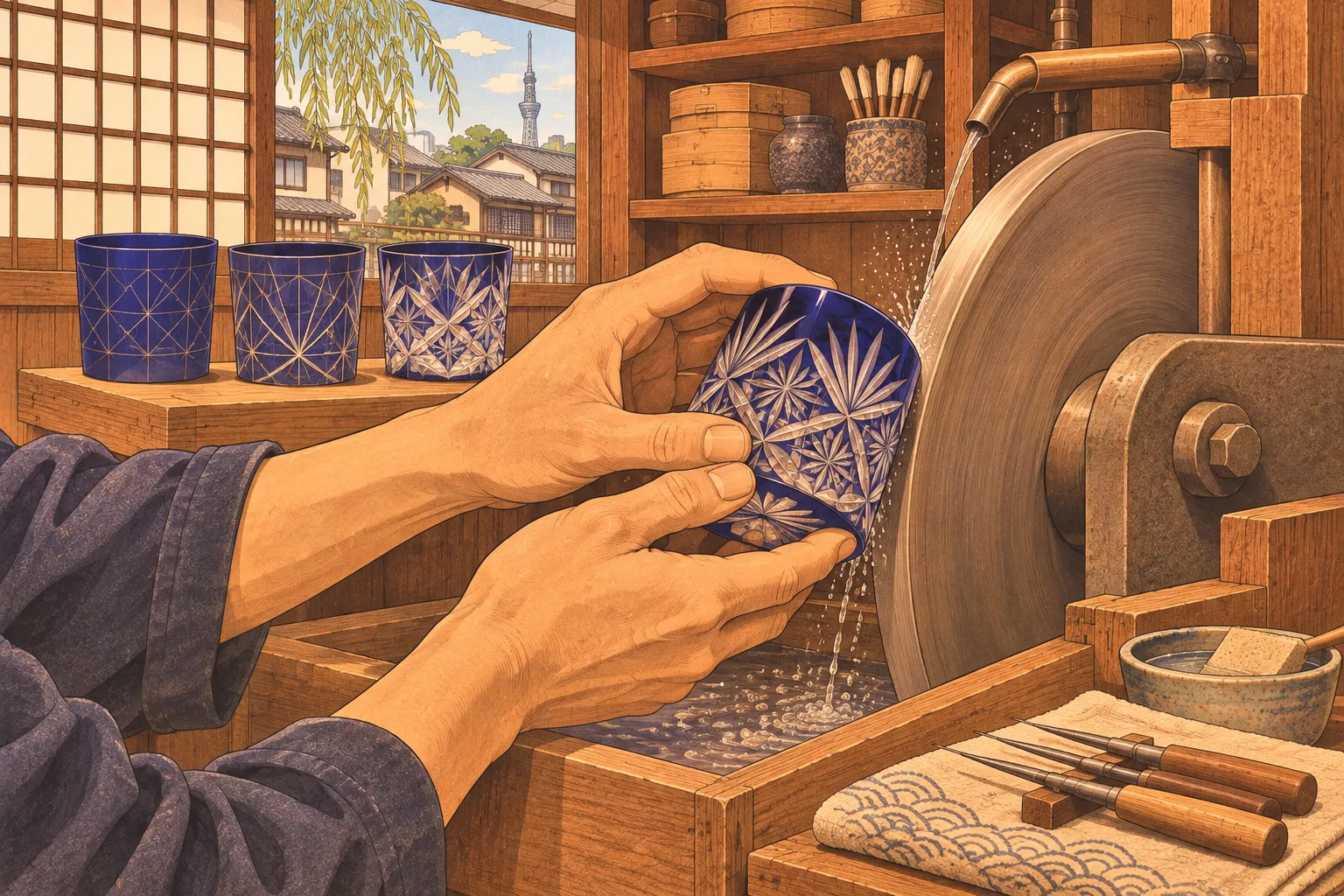
An Edo kiriko workshop: a blue-cased glass cup is pressed against a spinning wheel under running water. On the shelf at left stand cups marked with guide lines and partly cut.
Lacquer covers flat cups, chōshi, hisage and katakuchi. Wajima in Ishikawa is known for durability, thanks to undercoats mixed with a local diatomaceous earth; Aizu in Fukushima and Yamanaka in Ishikawa also make cups. Lacquer is light, warm to the touch and insulating, so cold sake does not chill the fingers and hot sake does not burn the lips. Today it is mostly ceremonial: weddings, New Year, festivals.
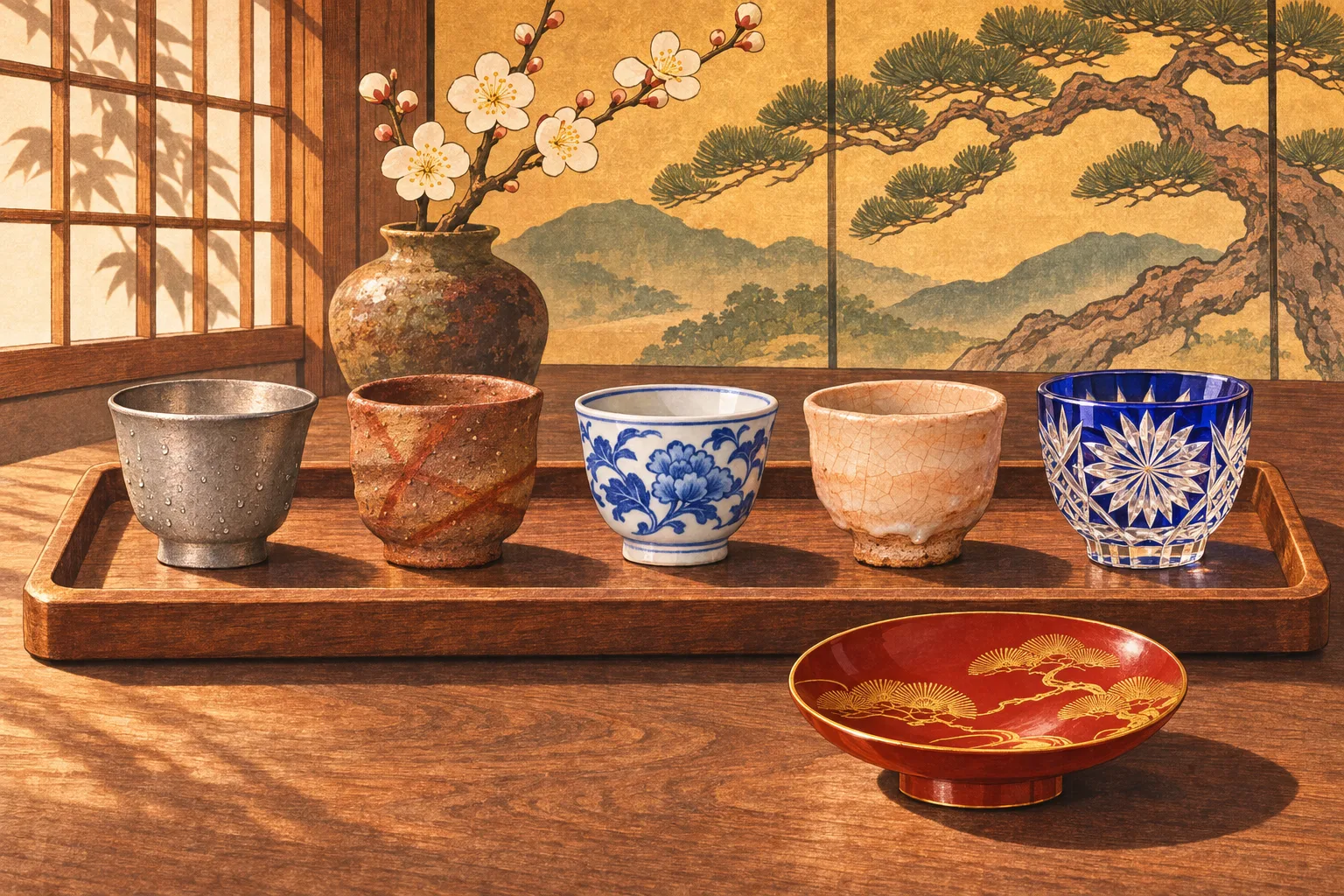
On the tray, from left: a tin cup beaded with condensation, a Bizen guinomi with red hidasuki streaks, a blue-and-white Arita choko, a crackled Hagi guinomi and a blue Edo kiriko cup. In front, a red lacquer flat cup with gold decoration.
07Side by Side
Three groups cause the most confusion.
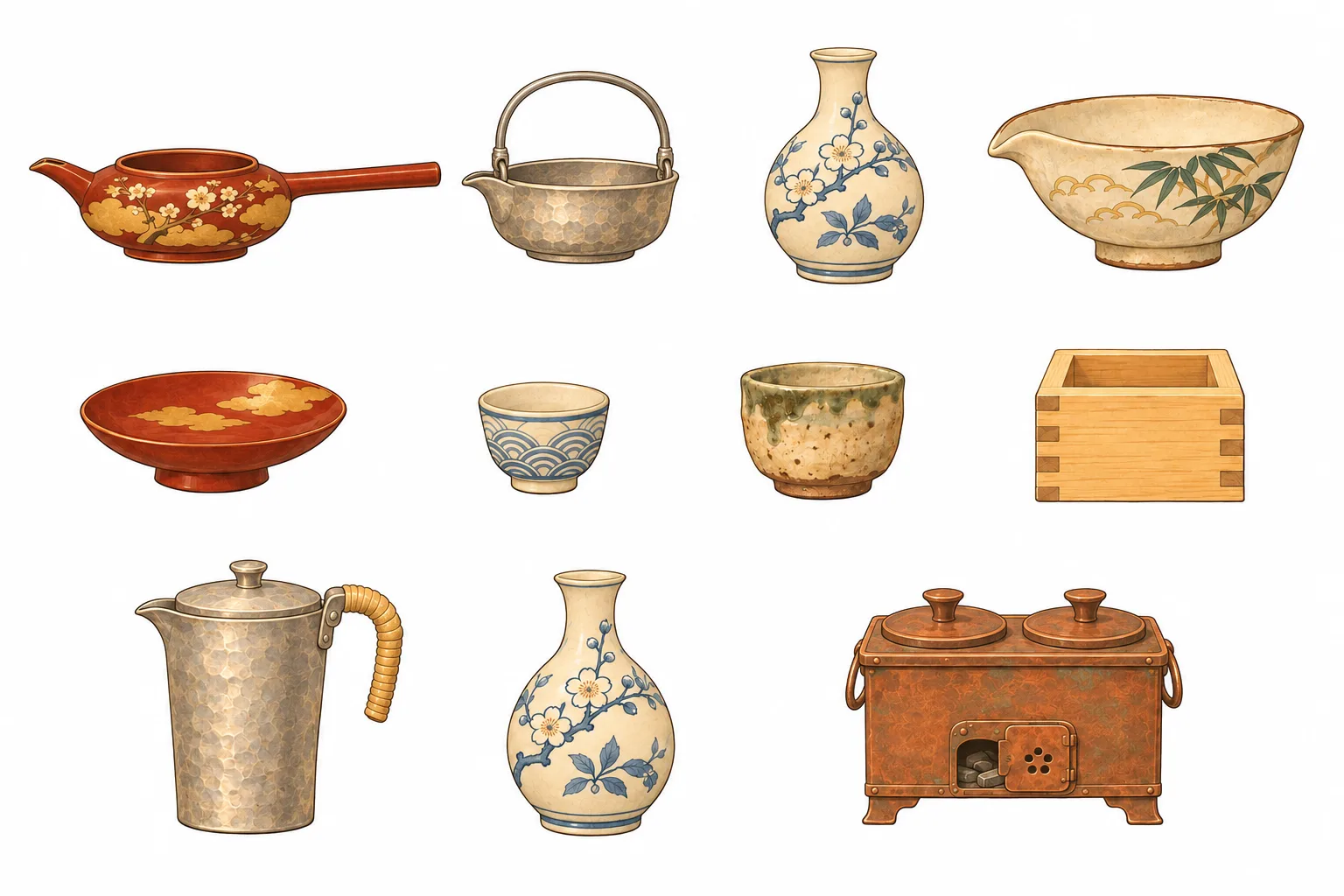
The vessels side by side. Top row, from left: chōshi, hisage, tokkuri, katakuchi. Middle row: flat cup (hira-sakazuki), choko, guinomi, masu. Bottom row: chirori, tokkuri, kandōko.
Pouring vessels: the chōshi has a long handle and a spout and is held by an attendant; the hisage has an arched bail and in ceremony mostly refills the chōshi; the tokkuri is an upright narrow-necked bottle with no handle and usually no projecting spout, one or two gō, for pouring yourself; the katakuchi is an open bowl with a lip, mostly for cold sake. Look at handle and mouth: long handle, chōshi; bail, hisage; slim neck, tokkuri; wide mouth with a notch, katakuchi.
Drinking vessels: the flat cup is shallow and wide, 8 to 12 cm across, usually red lacquer, for ceremony; the choko is small and deep, 30 to 50 ml, usually porcelain, for warm sake from a tokkuri; the guinomi is larger, 60 to 150 ml, thick and wide, usually stoneware, for personal pleasure. In profile: a saucer, a thimble, a little bowl.
Warming: the chirori and the tokkuri both go into hot water. The chirori is metal, cylindrical, with spout and handle, quick to heat, a tool. The tokkuri is ceramic, narrow-necked, slow to heat and slow to cool, and goes to the table. The kandōko is the copper box that holds them both and never reaches the customer.
The masu stands alone: square, wooden, about 180 ml, both a measure and a cup.
A rough rule for materials: lacquer for ritual, porcelain and stoneware for warm sake, glass and tin for cold, wood for measuring.
08Where to Look
In a tavern, porcelain tokkuri and choko are the norm; in winter the flask arrives warm, perhaps in a wooden hakama. Order cold sake and it may come in a glass set in a masu, or in a glass katakuchi. Sake-focused bars often bring a tray of cups to choose from; turn yours over and look at the foot and the potter’s mark. In older taverns and oden shops, look behind the counter for a copper box with holes and metal jugs: a kandōko, or its stainless-steel electric descendant.
At shrines, weddings and festivals bring out the chōshi, hisage and red cups, and offering tables hold earthenware dishes and white porcelain sake bottles. At breweries, the tasting counter will have snake’s-eye cups, and the shop will sell choko and masu stamped with the brewery’s name. In pottery towns like Arita, Imbe and Hagi, tokkuri and guinomi fill the shop shelves, and the annual pottery fairs line them up by the hundred. In Tokyo’s eastern neighbourhoods, some Edo kiriko workshops let you watch through glass as a cutter presses a cup against a spinning wheel, which gives off a thin, high hiss.
And in folk museums you can find the old pieces that have dropped out of use: shop-marked lending jars, old copper kandōko, Old Imari rinsing bowls and Negoro katakuchi, set out side by side.
More deep dives on this topic
 Reading the Fine Print on a Sake LabelPick up a sake bottle in a Japanese liquor shop and the front label will usually give you a brush-written brand name and not much else.
 Sake RicePick up a bottle of premium sake in Japan and the largest characters on the label after the brewery’s name are often the name of a rice: Yamada Nishiki, Omachi, Gohyakumangoku.
 The Yeast Starter and the YeastsBefore a sake brewery commits a ton of rice to a fermentation, it brews something much smaller: a dense, sour culture of yeast called the shubo ("mother of sake") or moto…
 From Polished Grain to Pressed SakeA sake brewery in winter is a working kitchen on an industrial scale.
 Tōji Guilds and the Brewery CrewFor most of the last three centuries, the people who actually made Japanese sake did not own the breweries and did not live near them.
 A Year of SakeWalk into the same Japanese liquor shop once a month for a year and the fridge will tell you the season before the weather does.
 Sake Vessels and Warming ToolsOrder sake in Japan and the drink often arrives in an object you have no name for: a slim-necked ceramic bottle, a cup the size of a thimble, a square wooden box filled to the…
 Sake and the GodsWalk past an old sake brewery in Japan and you will probably see a large ball of cedar hanging over its door.
 Aroma, Taste and the Four Types of SakeMost sake menus in Japan assume you already know the code.
- Back to the main article: Sake →