
Pick up a sake bottle in a Japanese liquor shop and the front label will usually give you a brush-written brand name and not much else. The real information is in the small type: a narrow collar strip that says namazake or muroka, and a back label crowded with figures for rice, polishing, acidity and something called "BY". None of this is decoration. Most of these words record a decision the brewery made after fermentation ended: whether the sake was heated to stabilise it, and when; whether water was added; whether it was filtered through charcoal; how it was pressed out of the mash and which part of the flow was bottled. Learn to read them and you can stand in front of a shop fridge and predict, fairly accurately, how a sake will taste and how it needs to be stored.
The main sake article on this site covers the premium grades (junmai, ginjō, daiginjō and the rest), added alcohol, and the sake meter value. This page picks up where that leaves off.
01Two Different Sets of Words
A Japanese sake bottle usually carries up to three labels. The front label is for recognition at a distance. A small shoulder or neck label (kata-raberu) is where breweries shout the special features, often in red, gold or black: "unpasteurised", "limited", "new sake", "undiluted". The back label (ura-raberu) holds the details.
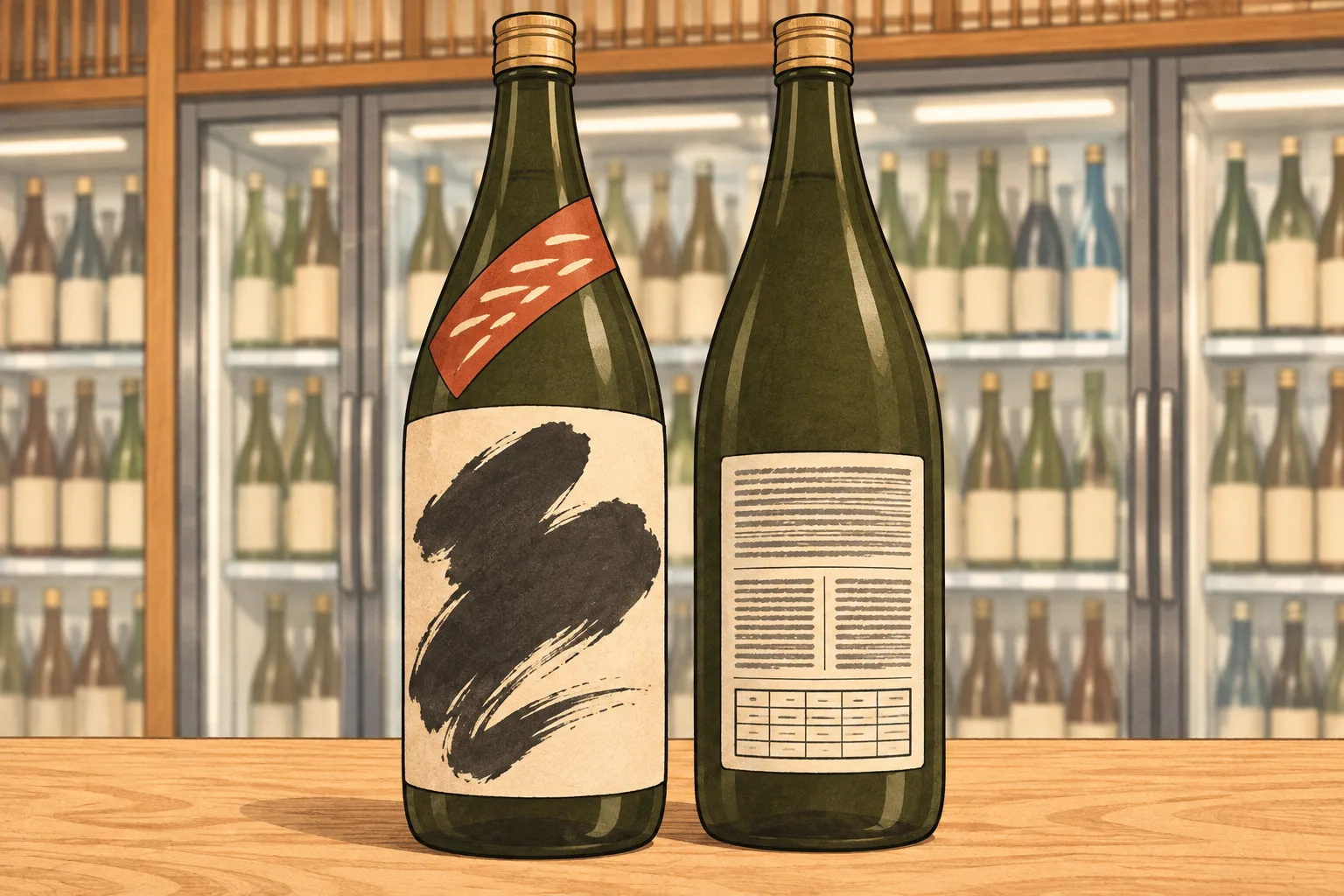
Three labels on a large sake bottle: the left bottle shows the bold front label and a red strip across the shoulder; the right bottle is turned to show the back label, dense with small type and a table at the foot.
Some of what appears there is required by law: the product category (seishu, the legal name for sake), the ingredients, alcohol content, volume, the producer’s name and address, and a warning that drinking under the age of 20 is prohibited by law. If the sake needs refrigeration, that must be said too. The rest is voluntary but regulated, including the production date, which became optional in 2023: since 1990, national labelling standards have attached conditions to words such as nama, genshu and taruzake, so a brewery that uses them has to meet the definition.
The key thing for a reader is that the premium grade and the processing terms run on separate axes. The grade tells you about ingredients and how much the rice was polished. The processing terms on this page tell you what happened afterwards. A junmai daiginjō can be unpasteurised or double-pasteurised; a cheap table sake can be undiluted. Read the two sets of words independently and the label stops being a jumble. Two further families of words appear on labels but are covered on other pages: kimoto and yamahai describe how the yeast starter was made, and seasonal words such as shinshu (new sake), natsuzake (summer sake) and hiyaoroshi tell you when in the year the bottle was released. A useful habit is to sort every word you see into one of these boxes: grade, processing, starter or season.
02Pasteurisation and the Three Kinds of "Nama"
Freshly pressed sake is not inert. It still contains active enzymes, which keep breaking down sugars and proteins and shifting the flavour, and it can harbour a lactic acid bacterium known as hiochi-kin, which tolerates alcohol and can turn a whole tank cloudy and sour. For brewers in pre-modern Japan, a batch going off in the summer heat was a serious financial risk.
The remedy is hi-ire, literally "putting in fire": warming the sake to roughly 60–65°C for a short time and then cooling it. That is hot enough to kill spoilage bacteria and deactivate enzymes but not hot enough to drive off much alcohol or aroma. As the main article notes, the practice appears in medieval records from the Nara area; brewers knew from experience that heat prevented spoilage, without knowing they were killing microbes.
Standard practice is to pasteurise twice. The first heating comes after pressing and settling, before the sake goes into storage tanks to mature over the summer. The second comes at bottling, just before shipping. Double-pasteurised sake is stable enough to sit on an unrefrigerated shelf, which is why most supermarket sake in Japan is stored at room temperature.
The nama family consists of sake that skips one or both of those heatings.
Namazake (often just nama) is never pasteurised at all. Under the labelling standards only sake that has not been heated at any stage may use this name; some breweries emphasise the point with nama-nama or honnama. Fresh nama tends to smell of green apple, white flowers and freshly steamed rice, and sometimes has a faint prickle of residual gas. Its weakness is that it keeps changing. If it is not kept cold, it readily develops an off-odour brewers call namahine-ka, often described as dull and stale; even refrigerated, it begins to show after a few months. That is why nama is always in the glass-fronted fridge, with yō-reizō ("keep refrigerated") printed on the label. Wide distribution of unpasteurised sake only became possible in the late twentieth century with refrigerated transport, home fridges and better microfiltration; before then it was mostly something drunk at the brewery in the new-sake season.
Namazume is pasteurised once, before storage, but not at bottling. Tsume means filling, so the name means "bottled raw". Because the sake was stabilised before it matured, it is far more robust than nama, yet it keeps some of the liveliness lost in a second heating. The autumn seasonal release called hiyaoroshi is the best-known example of this style.
Nama-chozō is the reverse: stored raw in chilled tanks, then pasteurised once at bottling. It spends its whole time at the brewery as a living sake, but reaches you stabilised, so it can usually travel unrefrigerated. It tends to be light and crisp and is often marketed as a summer sake for drinking cold. Making it requires refrigerated storage tanks, which is one reason it spread relatively late.
How the heating is done matters too. Large brewers run sake through a coil or plate heat exchanger, raising and dropping the temperature in seconds. Many small breweries prefer bin-kan hi-ire: the sake is bottled raw and capped, and the bottles are warmed in a hot-water bath and then plunged into cold water. Because the sake is sealed while hot, aroma cannot escape. Labels may say bin hi-ire. Some breweries also use the phrase ikkai hi-ire, "pasteurised once", which can mean either namazume or nama-chozō; the back label usually says which.
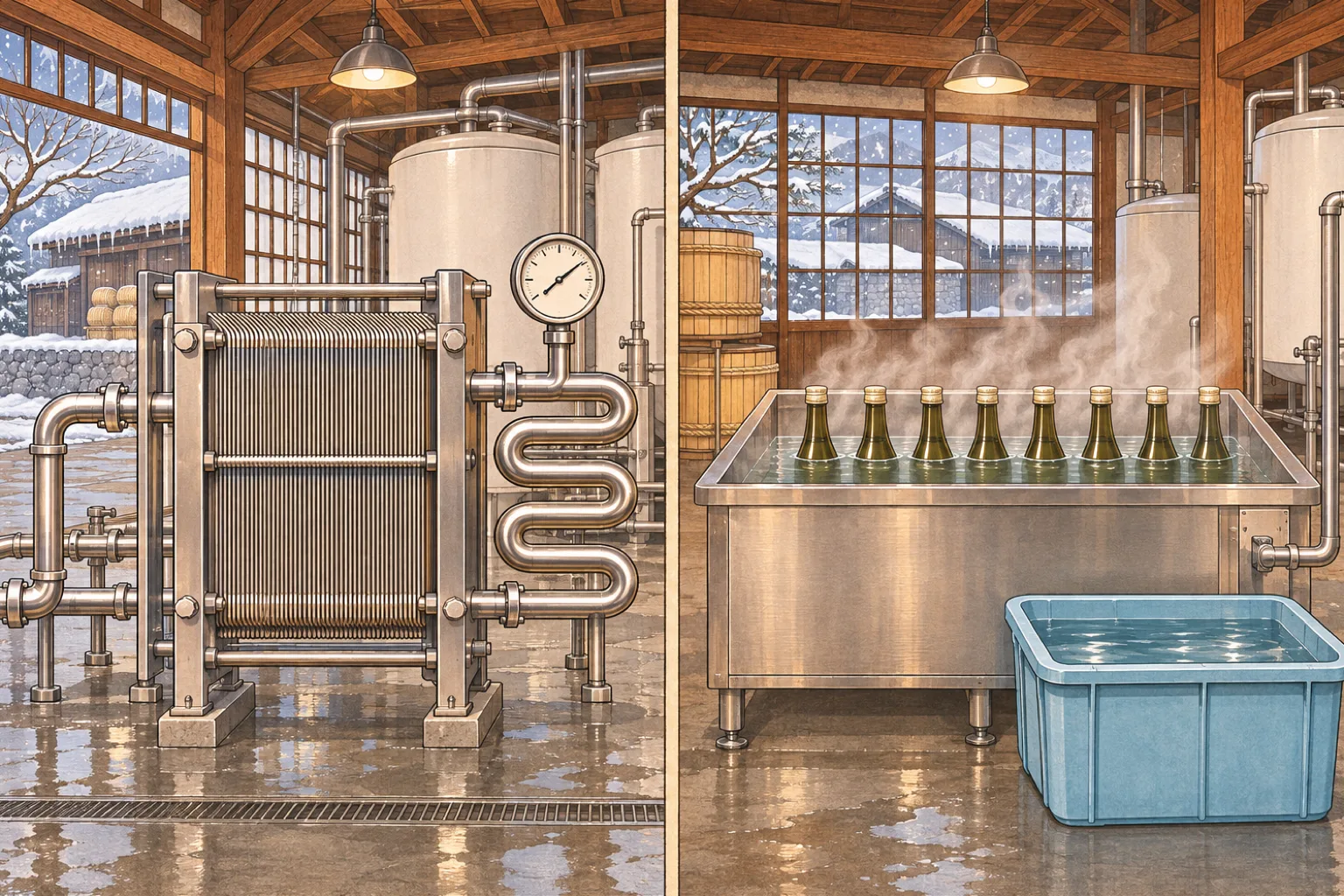
Two ways to pasteurise. Left: a plate heat exchanger and coil, which raise and drop the temperature in seconds. Right: bin-kan hi-ire, with capped bottles standing in a hot-water bath and a tub of cold water ready beside it.
03Genshu and Muroka: No Water, No Charcoal
Genshu means sake bottled without dilution. Sake yeast ferments vigorously, and a finished mash typically reaches 17–20 percent alcohol. Most sake is then cut with water to around 15–16 percent, a step called warimizu, which softens it, makes it easier with food, and helps a brand taste the same from year to year. Genshu skips that step, so it is fuller, sweeter and noticeably warmer on the palate. The standards allow a tiny amount of water for adjustment as long as the alcohol content shifts by less than one percentage point. In Japan it is often served on the rocks, which lets the drinker dilute it gradually in the glass. A recent counter-trend is low-alcohol genshu, brewed so that fermentation itself stops at around 13 percent or lower. It is a trade term rather than a legal category; seeing "genshu" and "13%" on the same label is not a mistake.
Muroka is the most misunderstood word on the label. It does not mean unpressed, and it does not mean cloudy. After pressing, most sake is treated with powdered activated charcoal, which is stirred in and then filtered out. The charcoal strips colour, rough flavours and compounds that would cause the sake to deteriorate, leaving it water-clear and neutral. Charcoal treatment spread in the modern era, and during the twentieth century the market came to expect sake to look as clear as water.
Muroka sake skips charcoal fining. It usually shows a pale straw or greenish tint in a white cup and tastes broader and more textured. From around the late 1980s, as small regional breweries and younger brewers set out to show off the character of their rice and yeast, muroka became a statement, and was combined with the other "skipped steps" into muroka nama genshu: no charcoal, no heat, no water. This is as close as you can get to drinking sake straight from the press, and it is most common in winter and spring, usually in dark green or brown bottles with bold, hand-lettered labels in the fridge section. Note that muroka normally refers only to charcoal; the sake may still have passed through a coarse filter to remove solids.
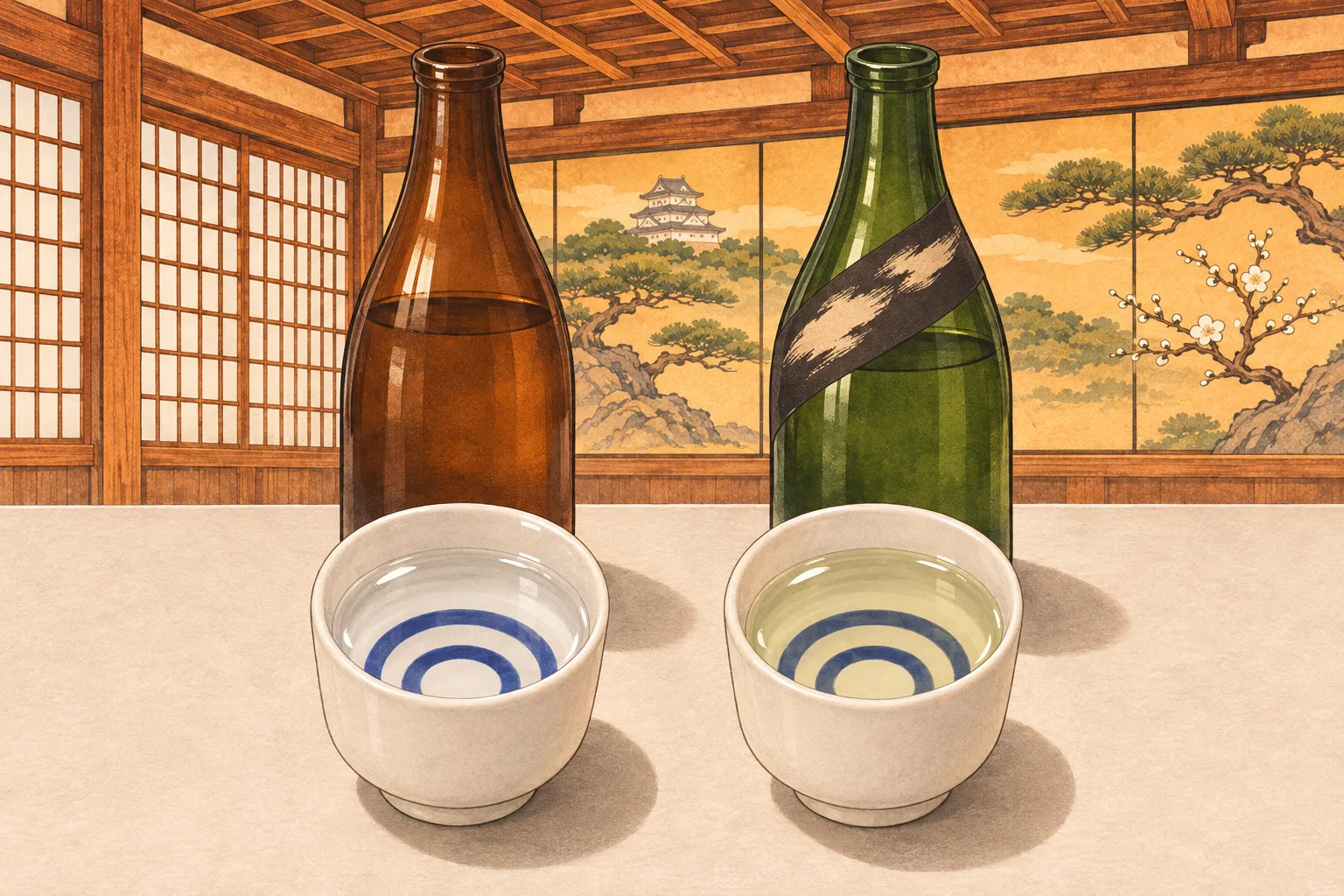
The left cup holds ordinary sake, almost colourless; the right holds muroka sake, with a pale greenish straw tint. The blue rings at the bottom of the white cups make the difference easy to see.
04Cloudy and Sparkling: Nigori, Origarami, Kassei and Happō
The legal definition of seishu requires the mash to be "strained", meaning the liquid has been separated from the rice solids. Fermented rice drunk with its grains intact is doburoku, which falls into a different tax category and is not legally sake. So when a sake bottle says it is cloudy, it means the sake was pressed, but some of the solids were deliberately left in.
Nigori-zake is pressed through a coarse cloth or mesh so that fine rice particles pass into the liquid. It is milky white, separates into a clear top and a white sediment if left standing, and ranges from faintly hazy to as thick as drinking yoghurt. It is usually sweet and ricey. As a commercial product it is fairly modern: it is generally said to have been first marketed in the 1960s by a brewery in Fushimi, Kyoto, and because it is strained through a coarse mesh it still counts legally as sake.
Origarami is lighter. Ori is the fine white sediment of rice starch, yeast and protein that settles at the bottom of the tank after pressing. Normally the clear sake is drawn off the top, a process called ori-biki. Origarami ("tangled with lees") is bottled with a little of that sediment still in suspension, giving a thin, misty haze rather than nigori’s milkiness. Breweries also use names like usu-nigori ("lightly cloudy") and kasumi-zake ("mist sake") for roughly the same thing, without a fixed boundary between them.
Kassei seishu, "active sake", is coarsely strained, cloudy sake in which a faint fermentation is still going on, leaving dissolved gas. Many are in fact pasteurised to stabilise them; in the unpasteurised kind, fermentation continues in the bottle and the trapped carbon dioxide makes the sake fizzy enough to erupt when opened. Bottles often have vented caps and warning labels in large type; opening one is a slow ritual of loosening the cap a fraction, watching the foam climb the neck, waiting for it to settle, and loosening a little more. Many breweries release these as winter limited editions.
Happō seishu, sparkling sake, is made to be fizzy on purpose. It may be carbonated by secondary fermentation in the bottle, in the same way as Champagne, or simply by injecting carbon dioxide. In 2016 a group of breweries founded the Japan Awasake Association, which certifies clear sparkling sake made only from rice, kōji and water and naturally carbonated by secondary fermentation in the bottle, with third-party testing; the aim is a Japanese drink for toasts at international occasions. Lighter, sweeter sparkling sakes in small bottles have also become popular since the 2010s, both with younger drinkers in Japan and abroad.
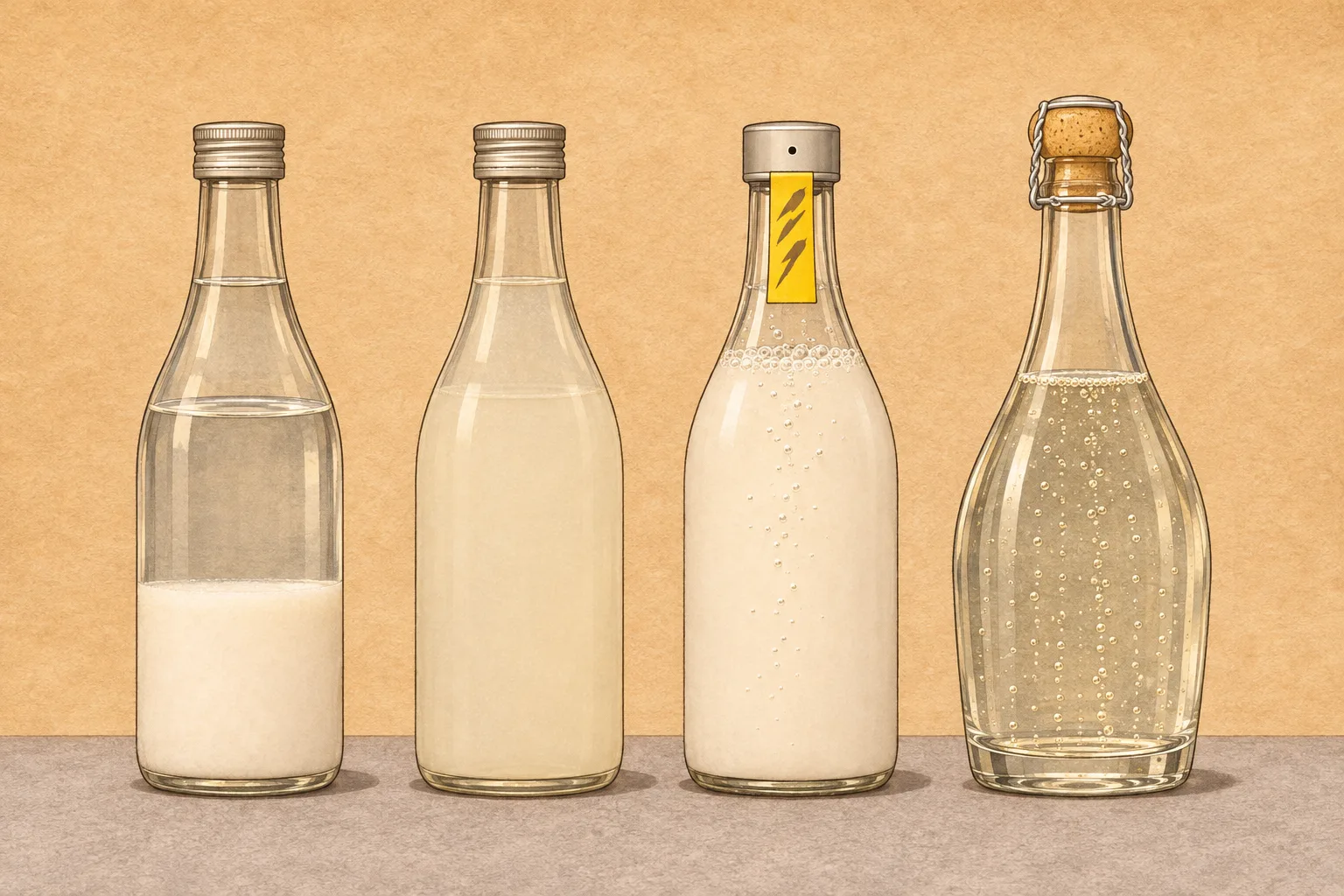
From left: nigori-zake, settled into a clear top and white sediment; origarami, with a light haze throughout; kassei seishu, milky and fizzing under a vented cap; and happō seishu, clear and sparkling in a thick-walled bottle.
05Pressing: How the Sake Leaves the Mash
When fermentation ends, the tank holds a white slurry of liquid, undissolved rice, kōji and yeast. Separating the liquid from the solids is called jōsō, or more casually shibori, "squeezing". Breweries put the method on the label because it affects texture, aroma and cost.
The traditional method is fune-shibori. The fune ("boat") is a long rectangular box, once wooden and now often stainless steel. Brewers ladle mash into cloth bags holding five to nine litres each, fold the mouths shut, and lay them in neat overlapping rows inside the box until it is full, sometimes adding a frame on top to stack more. For the first few hours no pressure is applied and the sake trickles out under the bags’ own weight. Then a lid is lowered and pressure is increased slowly, by screw or hydraulic jack, over a day or more. Finally the bags are lifted out one by one and emptied of flat white sheets of sake lees (sake-kasu). Older presses used a massive wooden lever weighted with stones, and some brewery museums still display the beam. Fune pressing is slow and labour-intensive, but the gentle pressure is thought to give a finer sake.
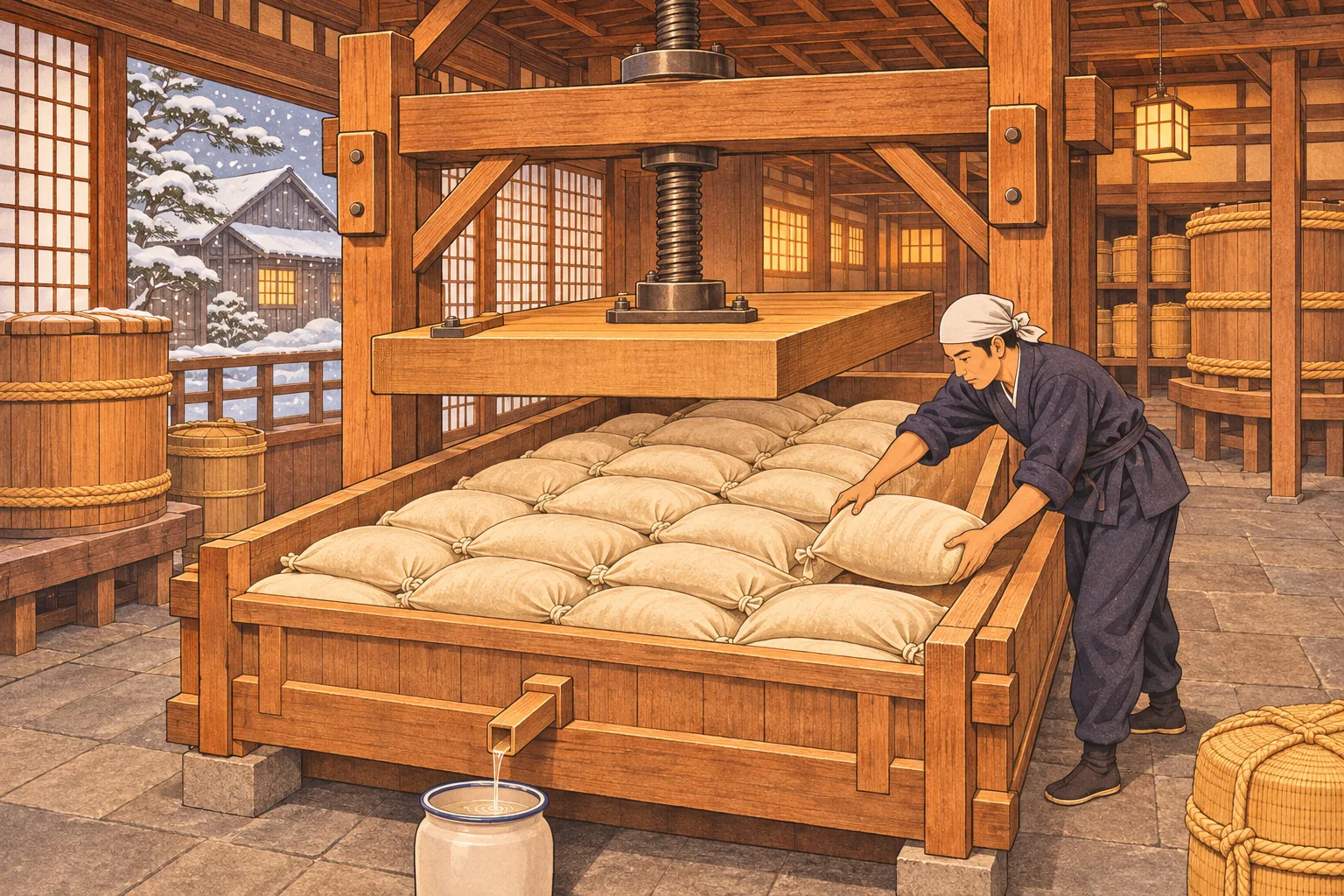
Fune-shibori: bags of mash are laid in overlapping rows inside the long wooden box, with a pressing lid and screw above. Sake runs from the spout into a small jar below.
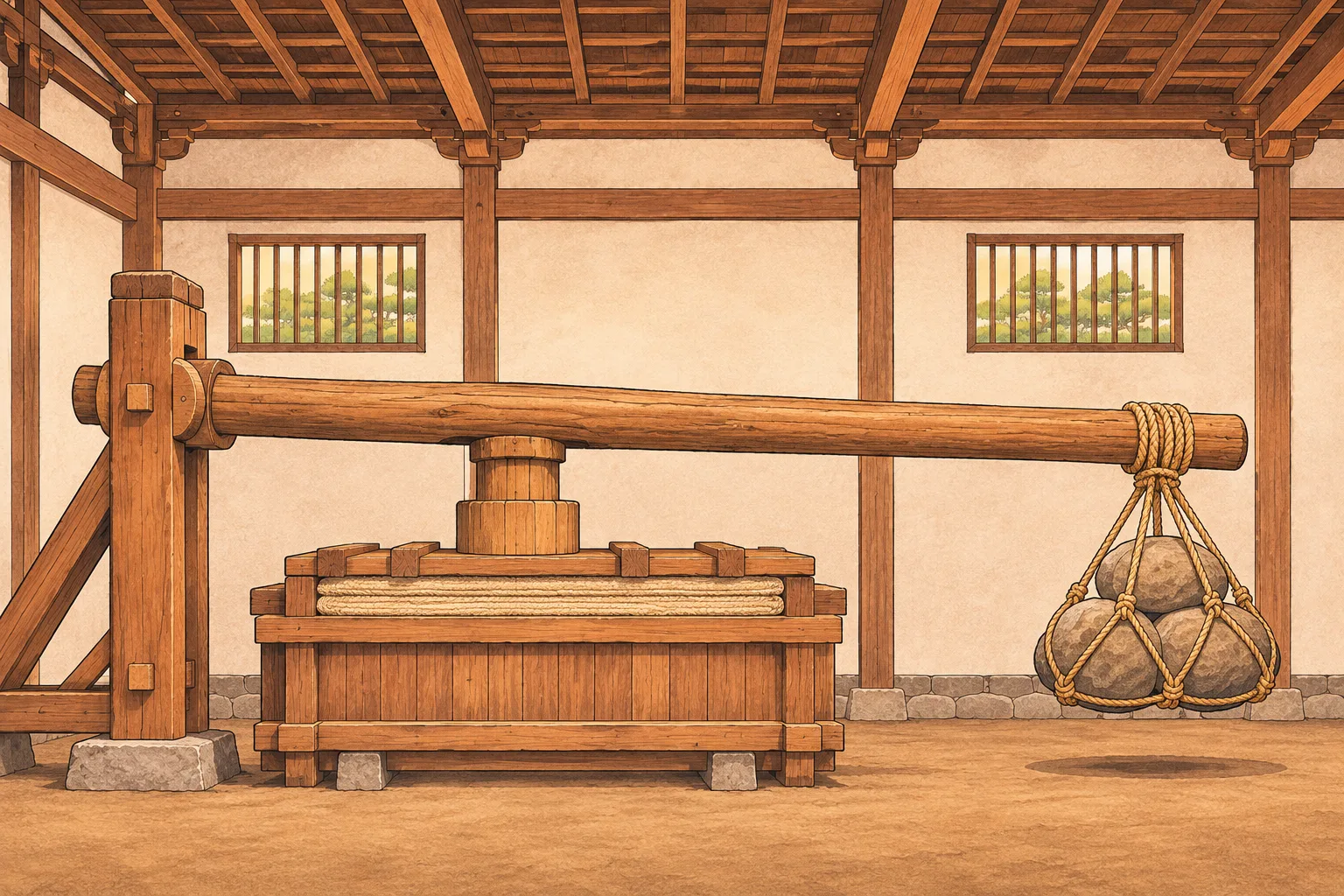
The old lever press: one end of a massive wooden beam is held in a post and the other carries stones slung in a rope net, bearing down on the box beneath.
Most breweries today use a Yabuta, an automatic press named after Yabuta Sangyō, the company set up in Akashi, Hyōgo, in 1963 to build the continuous press that a brewery director named Yabuta had just developed; it then spread across the country. It looks like a long row of upright plates pressed together, rather like a giant accordion. Between each pair of plates is a filter cloth and an inflatable rubber bladder. Mash is pumped into the gaps, the bladders inflate, the sake is squeezed through the cloth, and the lees stay behind. When it is done, the plates are pulled apart and workers peel the sheets of lees off each cloth with paddles. The Yabuta is fast, enclosed and needs only one or two operators, and because the sake has little contact with air, it loses little aroma. Plenty of award-winning daiginjō is pressed this way.
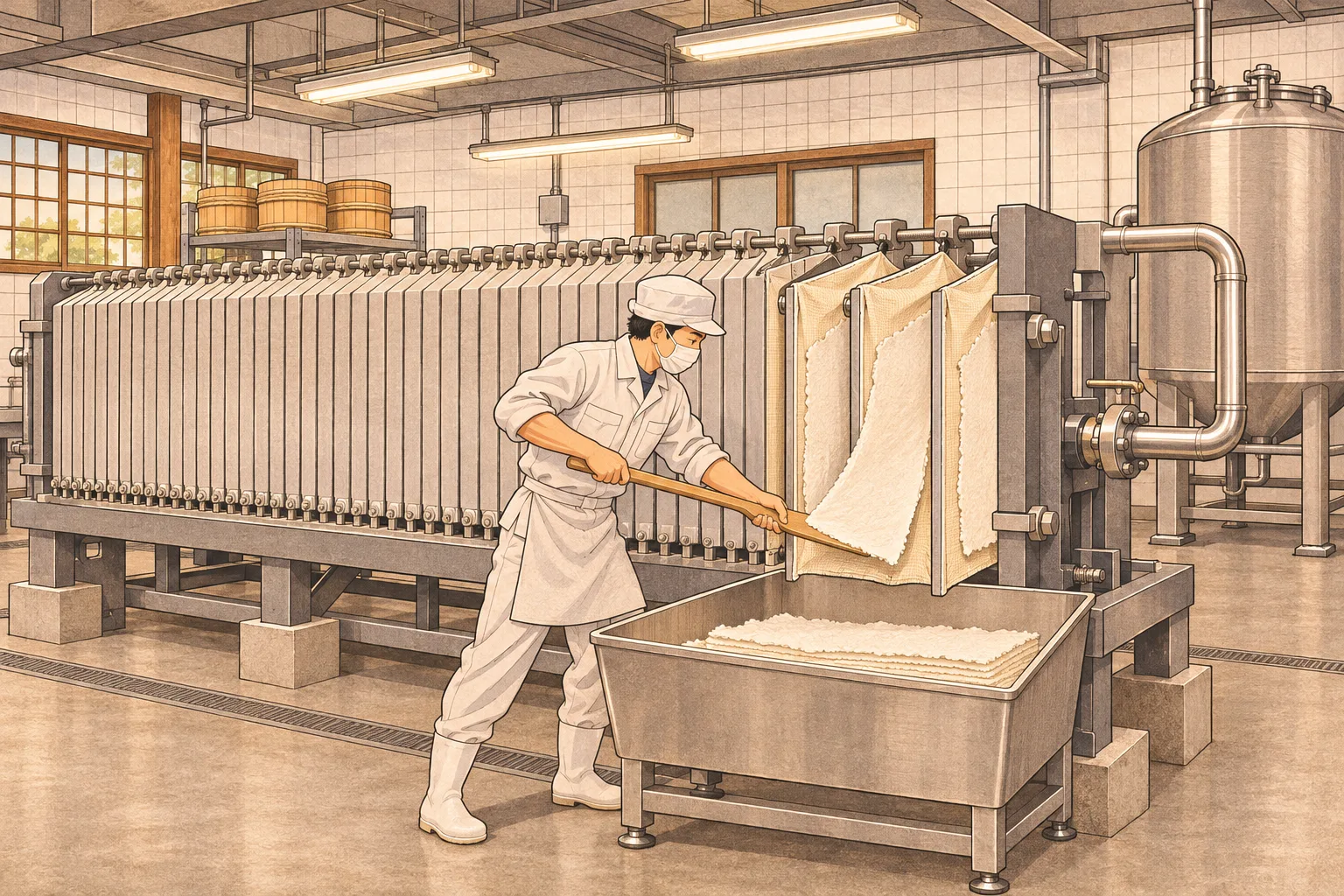
A Yabuta automatic press: dozens of upright plates clamped in a row. After pressing, the plates are pulled apart and a brewer scrapes the sheets of sake lees off the filter cloths with a wooden spatula.
Fukuro-zuri, "bag hanging", is the most extravagant method. The bags of mash are not stacked but hung individually from a pole, with a vessel underneath each one, and the sake is allowed to drip out under gravity alone. Picture a cold brewery room with a row of white bags and the faint sound of dripping. The result is extremely clean, with none of the roughness that pressure can extract, but the yield is tiny and the remaining mash has to be pressed again by other means. Fukuro-zuri is used mainly for competition entries and a brewery’s top bottlings, and labels may also call it shizuku ("drops").
Tobin-gakoi describes what happens next. A tobin is a large, short-necked glass jug holding one to, about 18 litres. The best sake from bag-hanging or from the middle of a pressing is run off into a series of these jugs in order, each one numbered, and stored separately in the cold, "fenced off" (kakoi) from the main batch. Later the head brewer tastes them one by one and chooses the best to send to competition. A bottle labelled tobin-gakoi comes from those hand-picked jugs.
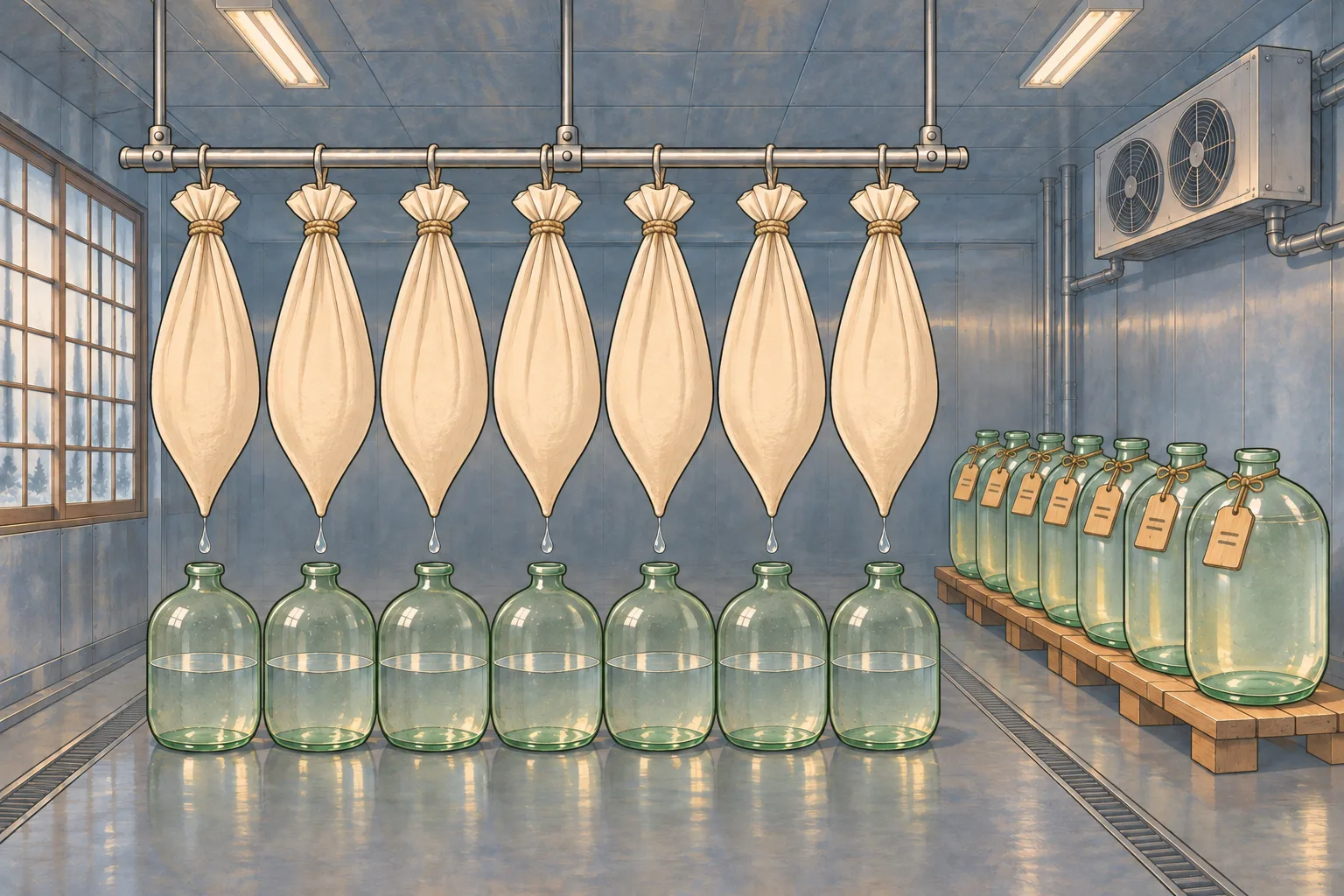
Fukuro-zuri and tobin-gakoi: bags of mash hang from a pole and the sake drips, under gravity alone, into the glass tobin beneath. On the right, filled jugs with numbered tags are kept apart in the cold.
A few breweries now separate sake from lees by centrifuge (enshin bunri), which uses no pressure and no cloth and keeps aroma exceptionally well. The equipment is expensive, so it is used only for premium lines.
06Side by Side: When the Heat Goes In, and Which Part of the Press
The nama terms make sense once you put them on a single timeline: pressing, then the point before storage, then summer storage, then bottling, then you.
Standard sake is heated before storage and again at bottling. It is stable throughout, keeps at room temperature, and tastes rounded and settled, with restrained aroma; it also stands up well to warming.
Namazume is heated before storage only. It matures stably in the tank and keeps some freshness after bottling. Most breweries recommend refrigeration.
Nama-chozō is heated at bottling only. It stays raw and fresh through storage and is stabilised on the way out, giving a light, crisp sake that tolerates normal shelf conditions.
Namazake is never heated. It is the most aromatic and vivid of the four, and the most fragile: refrigerate it and drink it soon after opening.
Think of two checkboxes: "before storage" and "at bottling". Both ticked is standard sake; only the first is namazume; only the second is nama-chozō; neither is nama.
The second comparison is between the three parts of a single pressing. Whether the press is a fune or a Yabuta, sake does not flow out evenly, and brewers divide it into three phases. Some bottle them separately.
Arabashiri, "rough run", is the first sake out, when the mash has just been loaded and is barely under pressure. It carries fine rice particles and sediment, looks slightly cloudy, and may hold tiny bubbles from fermentation. It is bold, fresh and a little rough, and much sought after in the new-sake season, but small in volume and less stable.
Nakadori, "middle take", flows once pressure is steady. It is clear, balanced and clean, and is generally considered the finest part of the pressing; competition sake is often drawn from it. It is also called nakagumi or nakadare.
Seme, "pressing hard", is what comes out at the end when pressure is raised to force the last liquid from the lees. It carries more rice and kōji components and tastes heavier and more bitter, with less aroma and sometimes a deeper colour. It is rarely sold on its own and is usually blended back to add body, though a few breweries release it as a deliberately robust sake.
An easy way to remember it: arabashiri is water rushing out when the sluice first opens, sand and bubbles included; nakadori is the steady clear flow; seme is the last concentrated drops wrung from a towel. Poured side by side into three white cups, the first looks faintly hazy, the second clear, the third slightly golden.
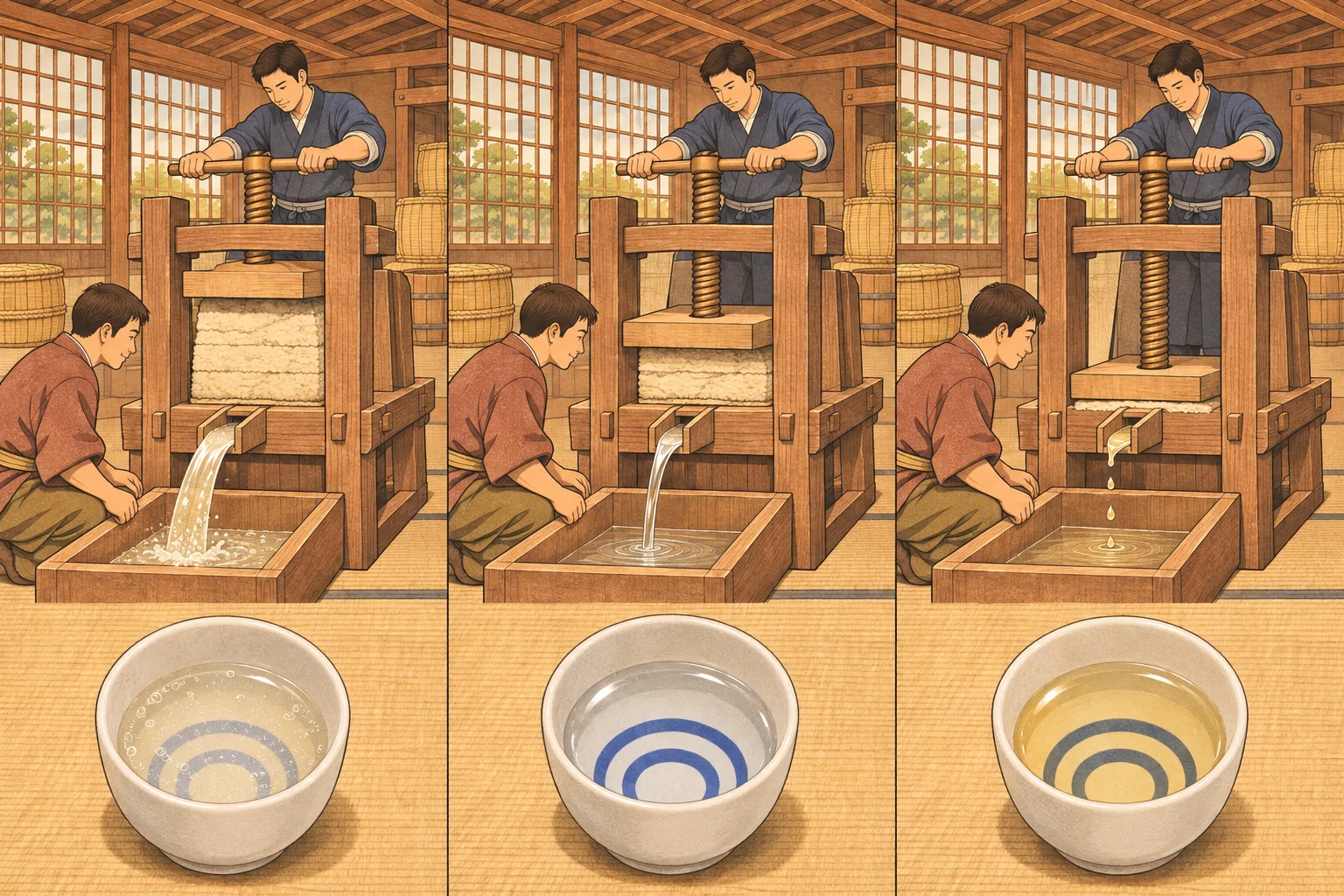
Three phases of one pressing. From left: arabashiri, the first run, faintly hazy with fine bubbles; nakadori, the clear middle flow under steady pressure; seme, the last drops forced out at the end, slightly yellow.
07Kijōshu and Aged Sake
Kijōshu, roughly "noble brew", is made by replacing part of the water in the final addition of the mash with finished sake. Normal sake is built up in three additions of rice, kōji and water. In kijōshu, the alcohol already present slows the yeast so that much of the sugar is never fermented, and the result is sweet, viscous and golden, turning amber with age, with notes of honey, dried fruit and caramel. It was developed in 1973 at the National Tax Agency’s Research Institute of Brewing, and the patent was published in 1975. The usual story is that state banquets were then toasting with French wine or Champagne, and the researchers wanted a luxury sake fit for the occasion. It is often said to revive the shiori method recorded in the tenth-century law code Engishiki for the court’s goshu, in which sake rather than water went into repeated additions; others argue the resemblance is coincidental. In 1976 a group of breweries formed the Kijōshu Association, which holds the name as a trademark, so non-members sell similar sake under other names. It is often compared to Sauternes or port and served with dessert or blue cheese, usually from small bottles.
Aged sake is less tidy. In trade usage, koshu ("old sake") can simply mean sake from a previous brewing year, as opposed to shinshu (new sake). It can also mean sake deliberately aged for years. There is no legal definition of koshu; the rules only say that a number of years in storage may be stated once the sake has been stored for at least one year, with any fraction dropped. A trade group, the Long-Term Aged Sake Research Association, defines long-matured sake as sake aged at the brewery for at least three years, excluding zōjōshu (sake bulked out with added alcohol and sugars). To avoid confusion, many breweries now use jukuseishu (matured sake) or chōki jukuseishu (long-matured sake).
Aged sake moves from pale gold to amber and reddish brown, sometimes almost the colour of soy sauce, and develops aromas of caramel, nuts, dried fruit, spice, soy and mushroom. Sake aged warm changes quickly and darkens; sake aged in the cold changes slowly and stays paler and fresher.
Aged sake was valued in the Edo period: a shopping guide to Edo lists "nine-year" and "seven-year" sake at prices above ordinary sake. From 1880 the Meiji government taxed sake by volume as soon as it was pressed (zōkokuzei), which meant that holding stock for years tied up money already paid in tax, on top of evaporation losses. This is generally cited as one reason aging made no economic sense and largely disappeared. Breweries began experimenting again in the second half of the twentieth century; it is still a niche in Japan, but has found an audience among wine drinkers abroad.
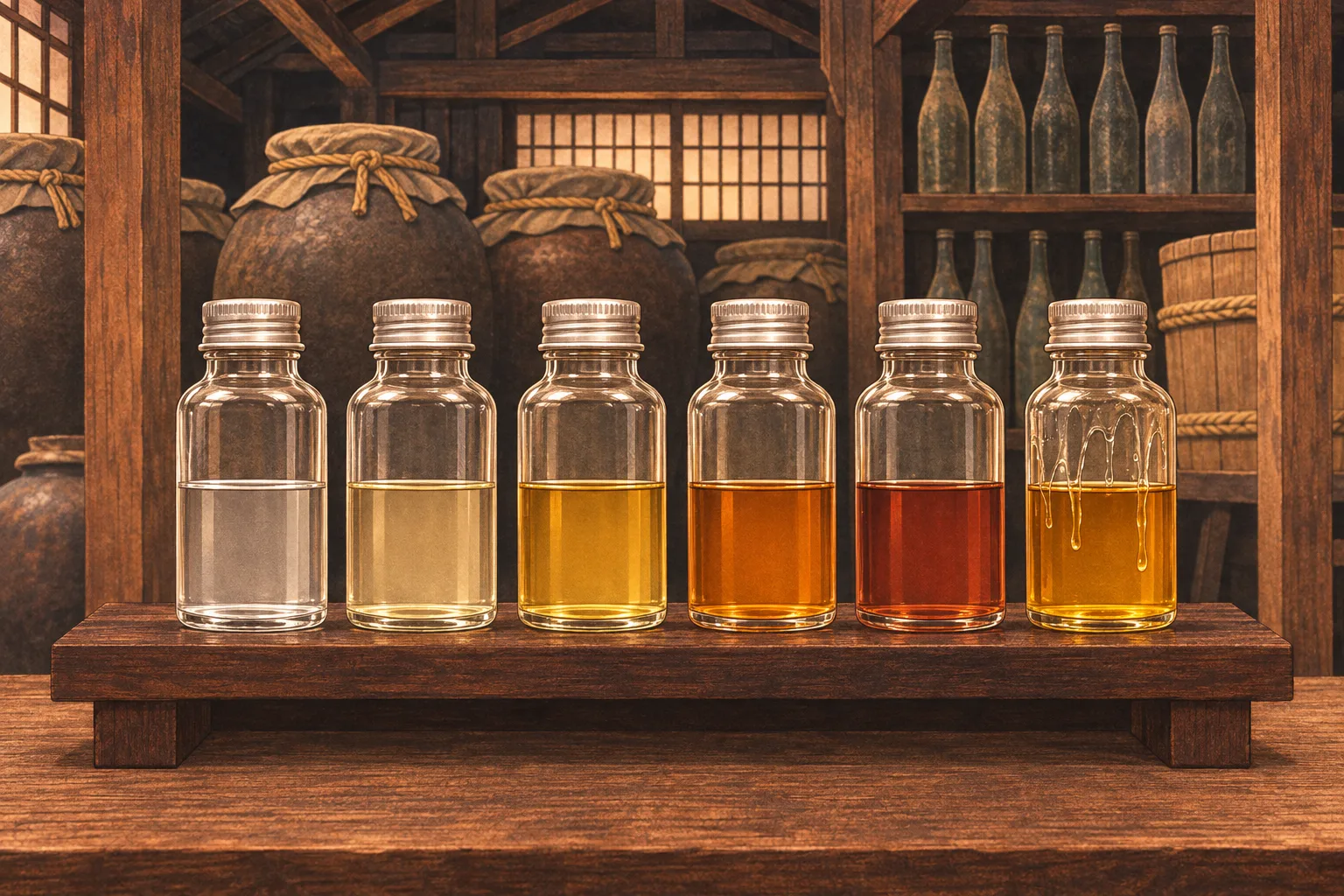
The five bottles from the left run from nearly colourless new sake through pale gold, gold and amber to reddish brown as the years of aging increase. The bottle on the far right is kijōshu, golden and viscous enough to cling to the glass.
08Dates, Origins and the Last Number
The production date (seizō nengetsu) was mandatory until 2023 and is now optional, though many labels still carry it. It is often misread: by rule it records when the sake was filled and sealed for sale, not when it was brewed. A bottle dated October 2026 may have been brewed the previous winter and matured over the summer. The date tells you how long it has been since the sake left the brewery, which matters most for nama and other sake meant to be drunk fresh. Sake has no legally required best-before date.
To know which season a sake was brewed in, look for "BY", the brewing year. A brewing year runs from 1 July to 30 June, so an entire brewing season, from the autumn harvest through winter brewing to spring pressing, falls within one year. "R5BY" means the fifth year of the Reiwa era, July 2023 to June 2024, and in practice sake made in the winter of 2023–24. Breweries that age sake or care about vintage variation print the BY so that drinkers can compare years.
The rice variety is increasingly prominent. Beyond the famous names covered in the main article, such as Yamada Nishiki and Omachi, back labels often list prefectural varieties like Hattan Nishiki, Dewa Sansan or Aiyama, and sometimes name two different rices, one for the kōji and one for the main mash. A variety may be named on the label only if it makes up more than half of the rice used, and the proportion must be stated, as in "Yamada Nishiki 100%". Some labels go further and name a particular district, farmer or field.
Geographical Indications (GI) have become more visible. In 2015, Nihonshu ("Japanese sake") itself was designated a national GI: only sake made from Japanese rice and brewed in Japan may use the name. Regional sake GIs actually came first, starting with Hakusan in Ishikawa in 2005, followed by Yamagata (2016), Nada Gogō (2018), Harima in Hyōgo (2020), Saga, Niigata and others; by October 2025 there were more than twenty, recently including Kyoto and Itami. A GI sake must meet the region’s rules on ingredients, production location and quality and pass inspection, and its label usually says so with the words "GI" or chiriteki hyōji (geographical indication).
The final number is amino acid content (aminosando). The sake meter value and acidity, covered in the main article, indicate dryness and sharpness. Amino acid content measures the compounds that give savouriness (umami) and body, and typical commercial sake falls at around 1.3–1.7. Higher figures mean a richer, more savoury sake that works well warmed and with simmered dishes or grilled fish. Lower figures, common in ginjō, mean a lighter, cleaner sake that shows its aroma best chilled. Read the three numbers together and you have a rough sketch of the sake before you open it.
Put it all together and a back label reading "nama-chozō, nakadori, R5BY, Yamada Nishiki 60%, amino acid 1.2" tells you that the sake stayed raw through storage and was pasteurised at bottling, came from the middle of the pressing, was brewed in the winter of 2023–24 with Yamada Nishiki making up 60 percent of the rice, and is likely to be on the light, clean side.
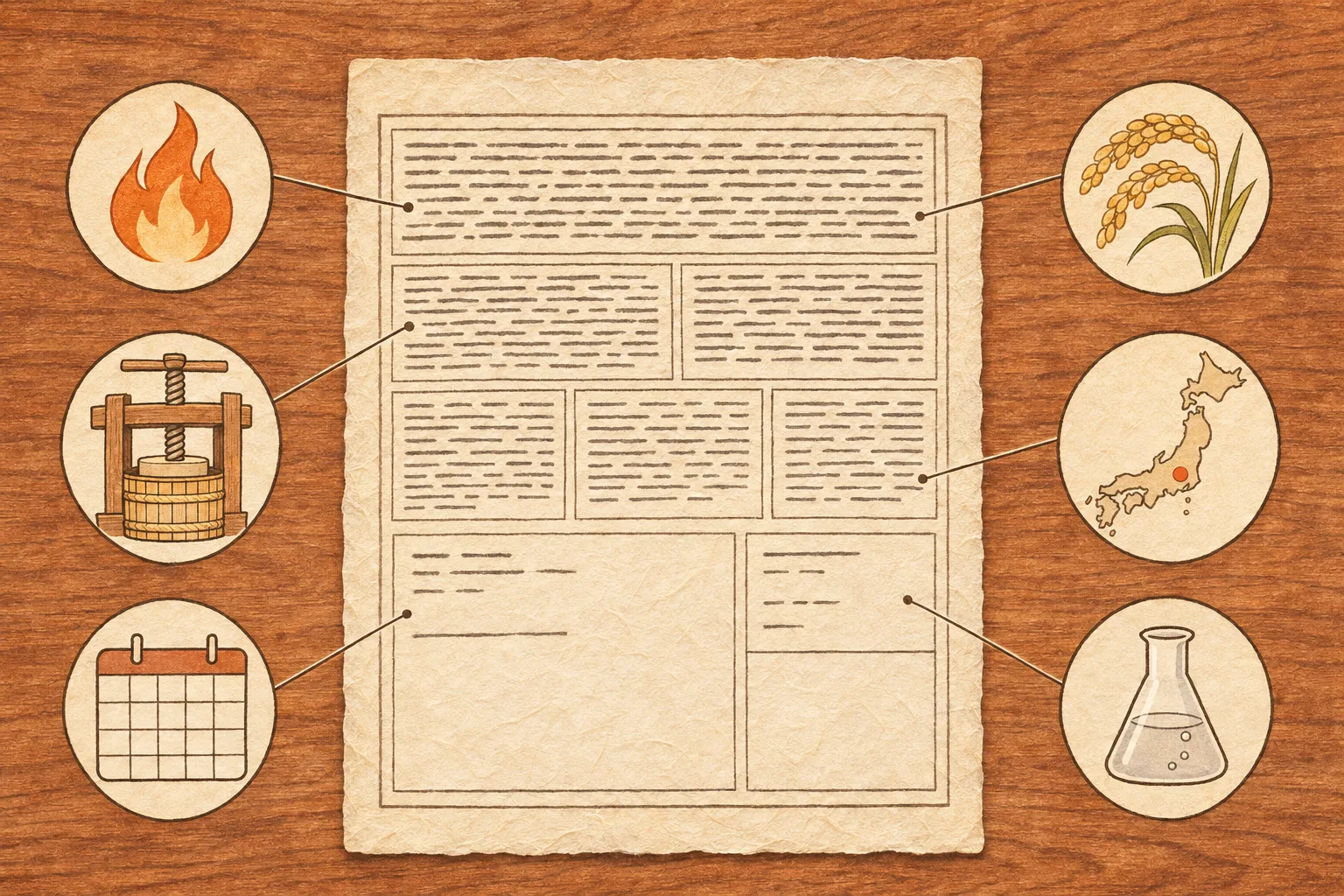
What a back label can tell you. Left, from top: pasteurisation, pressing method and which part of the pressing, brewing year and production date. Right, from top: rice variety, origin, and figures such as amino acid content.
More deep dives on this topic
 Reading the Fine Print on a Sake LabelPick up a sake bottle in a Japanese liquor shop and the front label will usually give you a brush-written brand name and not much else.
 Sake RicePick up a bottle of premium sake in Japan and the largest characters on the label after the brewery’s name are often the name of a rice: Yamada Nishiki, Omachi, Gohyakumangoku.
 The Yeast Starter and the YeastsBefore a sake brewery commits a ton of rice to a fermentation, it brews something much smaller: a dense, sour culture of yeast called the shubo ("mother of sake") or moto…
 From Polished Grain to Pressed SakeA sake brewery in winter is a working kitchen on an industrial scale.
 Tōji Guilds and the Brewery CrewFor most of the last three centuries, the people who actually made Japanese sake did not own the breweries and did not live near them.
 A Year of SakeWalk into the same Japanese liquor shop once a month for a year and the fridge will tell you the season before the weather does.
 Sake Vessels and Warming ToolsOrder sake in Japan and the drink often arrives in an object you have no name for: a slim-necked ceramic bottle, a cup the size of a thimble, a square wooden box filled to the…
 Sake and the GodsWalk past an old sake brewery in Japan and you will probably see a large ball of cedar hanging over its door.
 Aroma, Taste and the Four Types of SakeMost sake menus in Japan assume you already know the code.
- Back to the main article: Sake →