
Pick up a bottle of premium sake in Japan and the largest characters on the label after the brewery’s name are often the name of a rice: Yamada Nishiki, Omachi, Gohyakumangoku. These are shuzō kōtekimai, "rice suited to brewing", a separate family of varieties bred not to be eaten but to be polished, steamed and fermented. Many of them are awkward plants: tall, late, prone to collapsing in the first typhoon of autumn. Their value lies in a chalky white spot at the centre of each grain. This page explains what makes a rice a sake rice, then walks through ten varieties you are likely to meet, where they grow, where they came from and what they do in the glass.
01Why Sake Rice Is Not Dinner Rice
Japan’s everyday table rice, led by Koshihikari, is bred to taste good on its own: glossy, sticky, sweet, slightly fragrant. Sake rice is bred for the opposite job. A brewer wants a large grain that can survive heavy polishing, a low content of protein and fat, quick and even water absorption, and a soft, opaque core called shinpaku, literally "white heart".
Size comes first. A thousand grains of ordinary table rice weigh around 22 to 23 grams; a thousand grains of Yamada Nishiki weigh 27 to 28, and the biggest sake rices are larger still. For ginjō-grade sake, brewers grind away 40 per cent or more of each grain (the main sake article explains the polishing ratio printed on labels). A small grain tends to shatter under that treatment; a large one keeps its shape.
Chemistry comes second. Protein and fat sit mostly in the outer layers of the grain. In sake they turn into heavy, muddy flavours and excess amino acids. Sake rices start with somewhat less protein than table rice, and because the grains are bigger, the core left after polishing is cleaner still.
Then there is the plant. The stalk of Yamada Nishiki, measured to the base of the ear, is a little over a metre long, and Omachi’s is closer to 1.3 metres, some 20 to 30 centimetres or more above common table rice. Tall stalks with heavy heads fall over in wind and rain, and grain lying in wet mud can sprout or rot. Both varieties also ripen late, around mid-October, which means weeks more exposure to autumn storms. Yields per hectare are low. Between the 2010s and 2023, first-grade Hyōgo Yamada Nishiki sold for roughly 1.4 to 2 times the price of ordinary table rice.
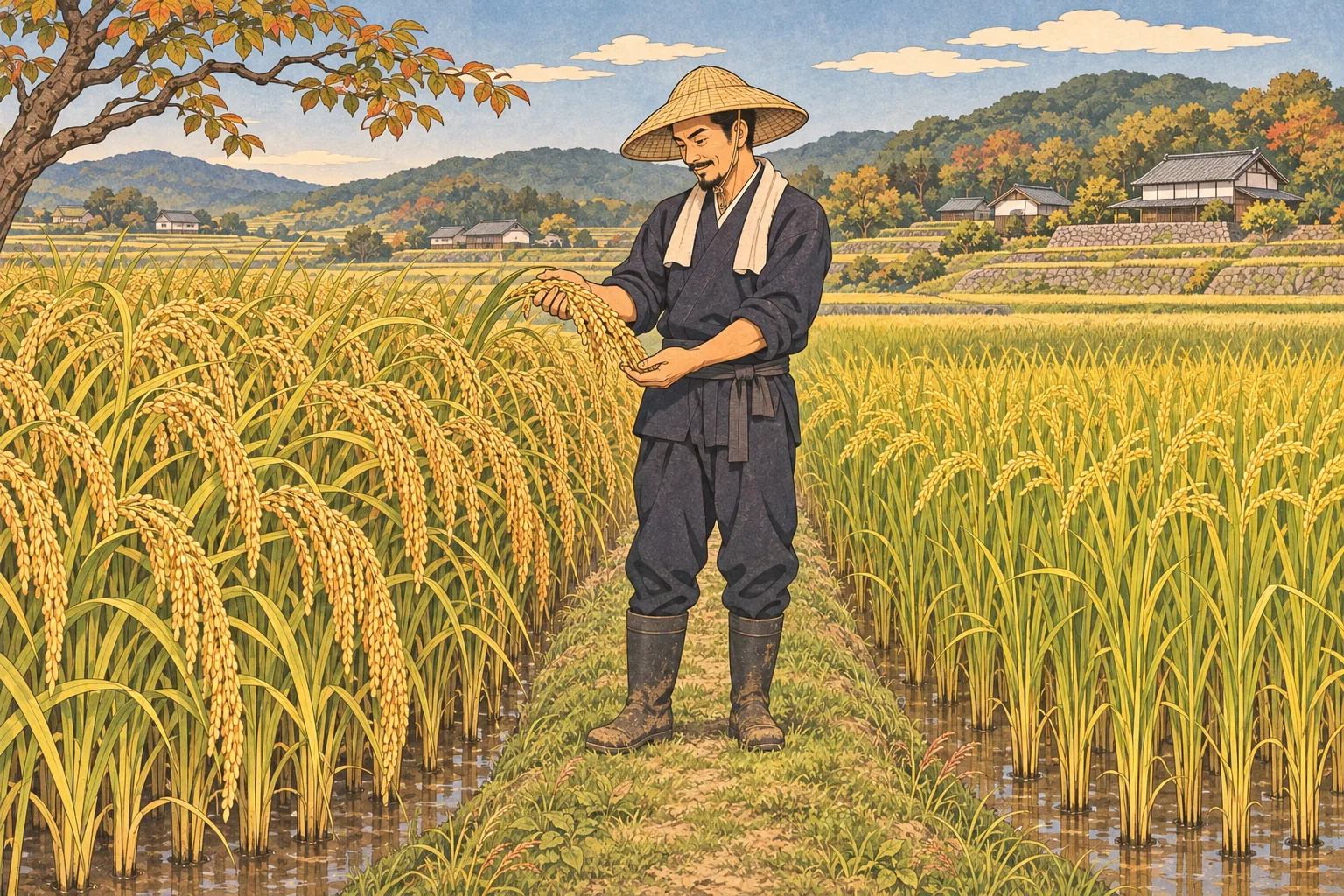
Yamada Nishiki on the left, tall with heavy, drooping ears; table rice on the right, shorter and upright. The farmer on the bund gives the scale.
Not every grain in a brewery is sake rice. The rice used to grow kōji (the mould-covered rice that converts starch into sugar) typically makes up around a fifth of the total, and premium grades must use at least 15 per cent; the rest, kakemai, is added directly to the fermenting mash. Many brewers use a prestige rice for the kōji and a cheaper one for the kakemai. Everyday sake relies heavily on ordinary table-type rice. When the agriculture ministry surveyed brewers in 2023 about the coming year, they planned to buy about 71,000 tonnes of registered sake rice and about 63,000 tonnes of ordinary rice earmarked for processing: the two are not far apart.
"Sake rice" is also an administrative category. Japanese rice passes through a government-regulated inspection system, and each prefecture lists the brewing varieties grown within its borders. The national total is usually put at well over a hundred, and the list changes year to year.
02The White Heart and the Inspection Table
Hold a grain of brown Yamada Nishiki up to the light and you see a translucent grain with an opaque milky patch in the middle. In table rice, chalky grains are a defect, often linked to heat stress during ripening. In sake rice, a well-placed shinpaku is the mark of quality.
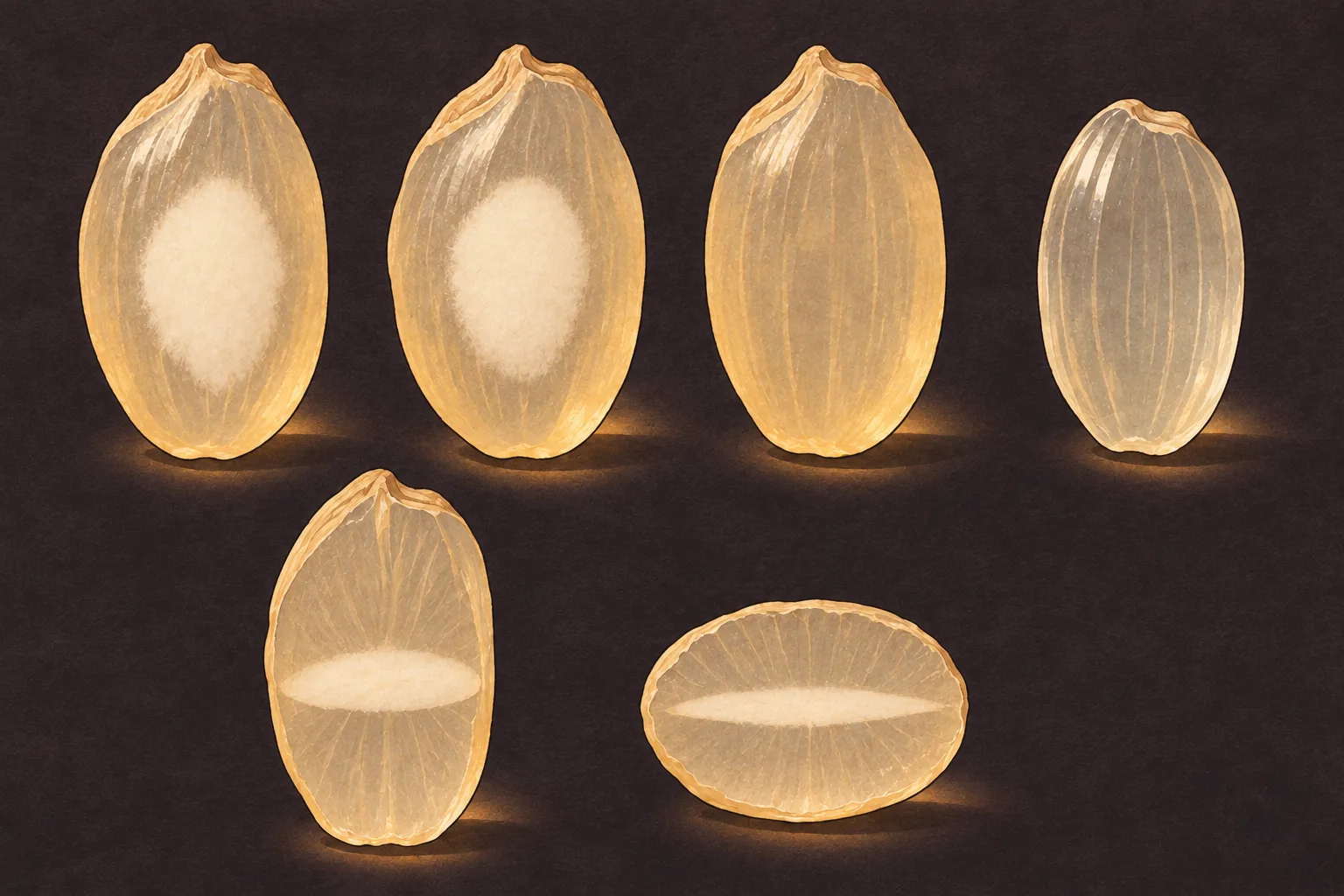
Top row, from left: two grains of brown Yamada Nishiki showing the shinpaku, one with almost none, and a clear grain of Koshihikari on the right. Bottom row: Yamada Nishiki cut lengthwise and crosswise, with the thin flat core lying across the centre.
The core looks white because its starch granules are not tightly packed, with tiny air spaces between them that scatter light. Those gaps matter three times over. After steaming, kōji mould spores are scattered onto the rice, and the mould’s threads grow inward along the loose core; brewers prize kōji whose mould has penetrated deep into the grain, because it converts starch steadily. The core also takes up water quickly and steams to a firm outside and soft inside, which keeps grains separate when they are spread out on cloth in the kōji room. And in the mash, the soft core dissolves readily.
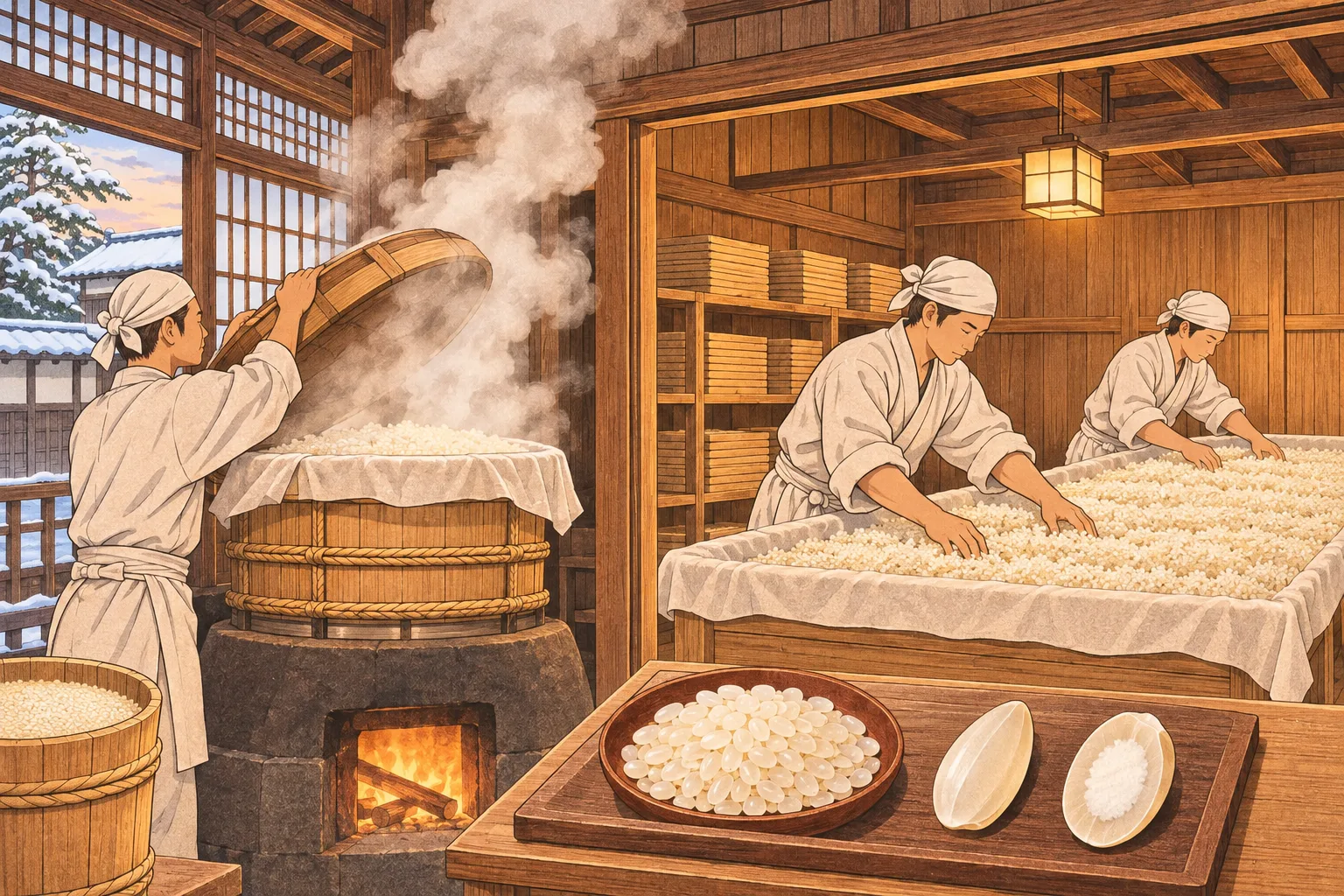
Sake rice in the brewery: freshly steamed rice in the tub on the left, and on the right two brewers spreading steamed rice on cloth in the kōji room. In front lie polished rice and two enlarged grains, one cut open to show its white heart.
Shape matters as much as presence. Seen in cross-section, the shinpaku of Yamada Nishiki is a thin flat disc lying across the centre of the grain. Omachi’s core is large, soft and nearly spherical, and Aiyama’s larger still. Yamada Nishiki actually shows a white heart in only about 65 per cent of grains, and its thin core looks modest; the shape is the point. A very large core weakens the grain, which may crack when polished. A neat, centred, flat core lets the brewer grind away the outer layers and still keep a whole kernel, which is why Yamada Nishiki can be polished to 40 per cent or below for daiginjō.
After harvest, the brown rice is packed into 30-kilogram paper sacks and sampled by registered inspectors, who look at the share of whole grains, the share showing shinpaku, and damage from insects or cracking. Table rice is graded first, second or third class. Brewing rice adds two higher grades above first class, tokutō (special) and tokujō (superior), plus an "out of standard" category below third. Each step down the scale costs the farmer money: in Hyōgo, first-grade Yamada Nishiki sells for over 3,000 yen less per 60 kilograms than tokujō. Tokujō and tokutō Yamada Nishiki is what goes into competition daiginjō.
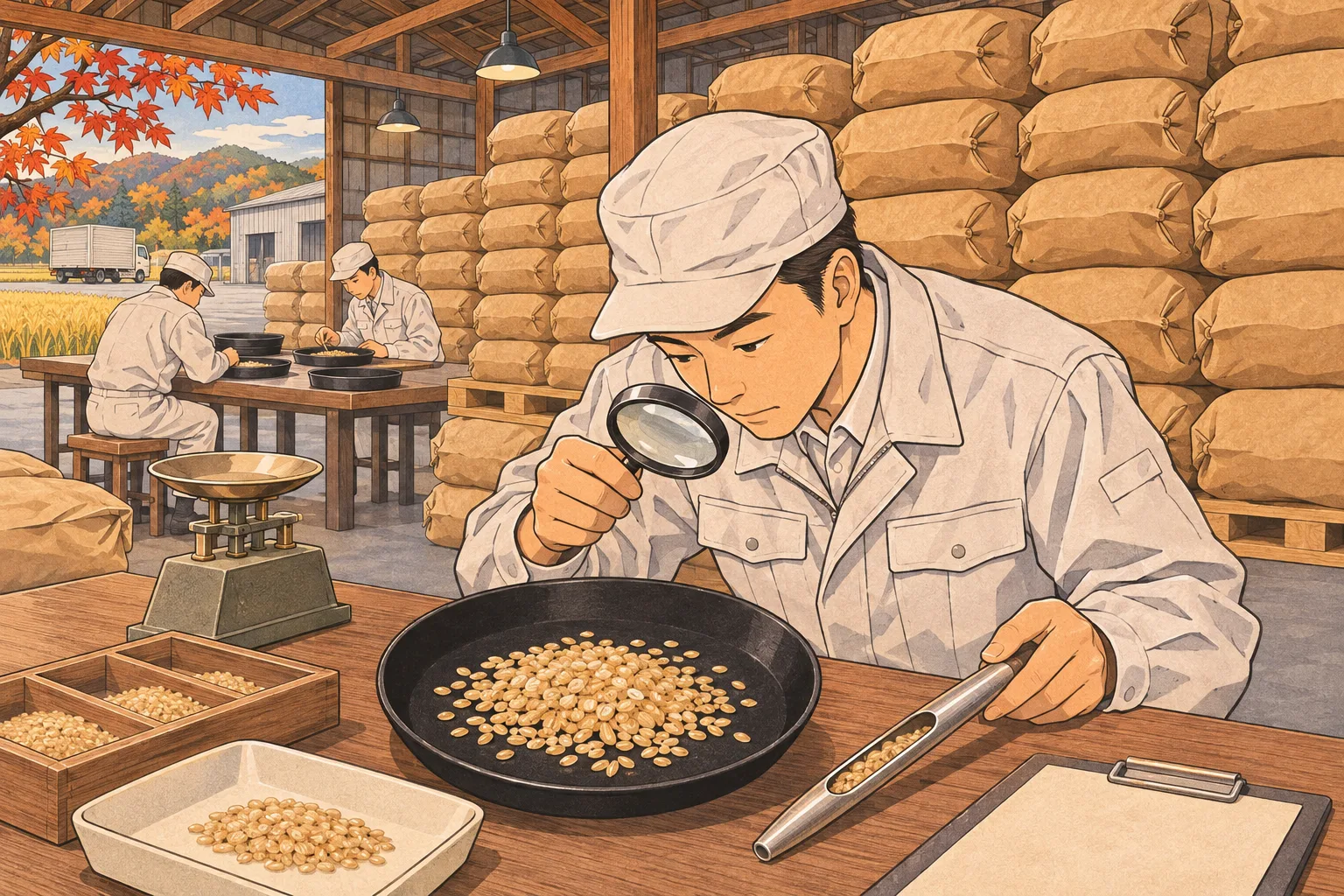
Inspecting brewing rice: an inspector spreads a sample of brown rice on a black tray and studies it through a magnifying glass, with 30-kilogram paper sacks stacked behind him.
Polishing makes the white heart visible to anyone. Brown rice is tan and slightly flat. At 70 per cent the grains are white and still rice-shaped. At 50 per cent they turn into smooth, opaque ovals, and at 35 per cent into small pearls, nearly round. Some breweries display jars of rice at different polishing levels in their shops, and holding one up to a window shows how much of a Yamada Nishiki grain is still intact at the end.
Inspection also shapes what a label can say. Under National Tax Agency rules, rice for premium categories such as ginjō and junmai must be graded third class or better in the official inspection, and a rice variety may be named on the label only if it makes up more than half of the rice used, together with its share, as in "Yamada Nishiki 100%". A line such as "Special A district Yamada Nishiki" adds the place of origin on top of the variety.
03The Ancestors: Omachi and Kamenoo
Many of today’s important sake rices descend from two old lines, one in the west and one in the north. Neither was created by a plant breeder. Both were spotted by farmers who noticed something unusual in a rice field and took it home.
Omachi. The standard story says that around 1859 a farmer named Kishimoto Jinzō from Omachi village in Bizen province (now Omachi, Naka ward, Okayama city) was returning from a pilgrimage to Mount Daisen when he noticed two unusual ears of rice. He took them home and by 1866 had selected a stable line, first called Nihongusa, "two plants". As its reputation as a brewing rice grew, it took the name of its home village. In the Meiji era it was grown widely from the Kantō region westward, and local selections of Omachi appeared in many prefectures.
Omachi is hard to farm. The stalks reach about 1.3 metres and, with the ear, the plant stands around 1.5 metres, shoulder height on many adults; it topples easily, ripens late, into mid to late October, and resists disease poorly. After the Second World War, when Japan needed volume, the variety came close to disappearing. Brewers and farmers in Okayama revived it, and today it is still almost entirely an Okayama rice: in the 2024 crop, 98 per cent of all inspected Omachi came from the prefecture, mostly from Okayama city and Akaiwa city; the Omachi district of Okayama’s Naka ward gave it its name.
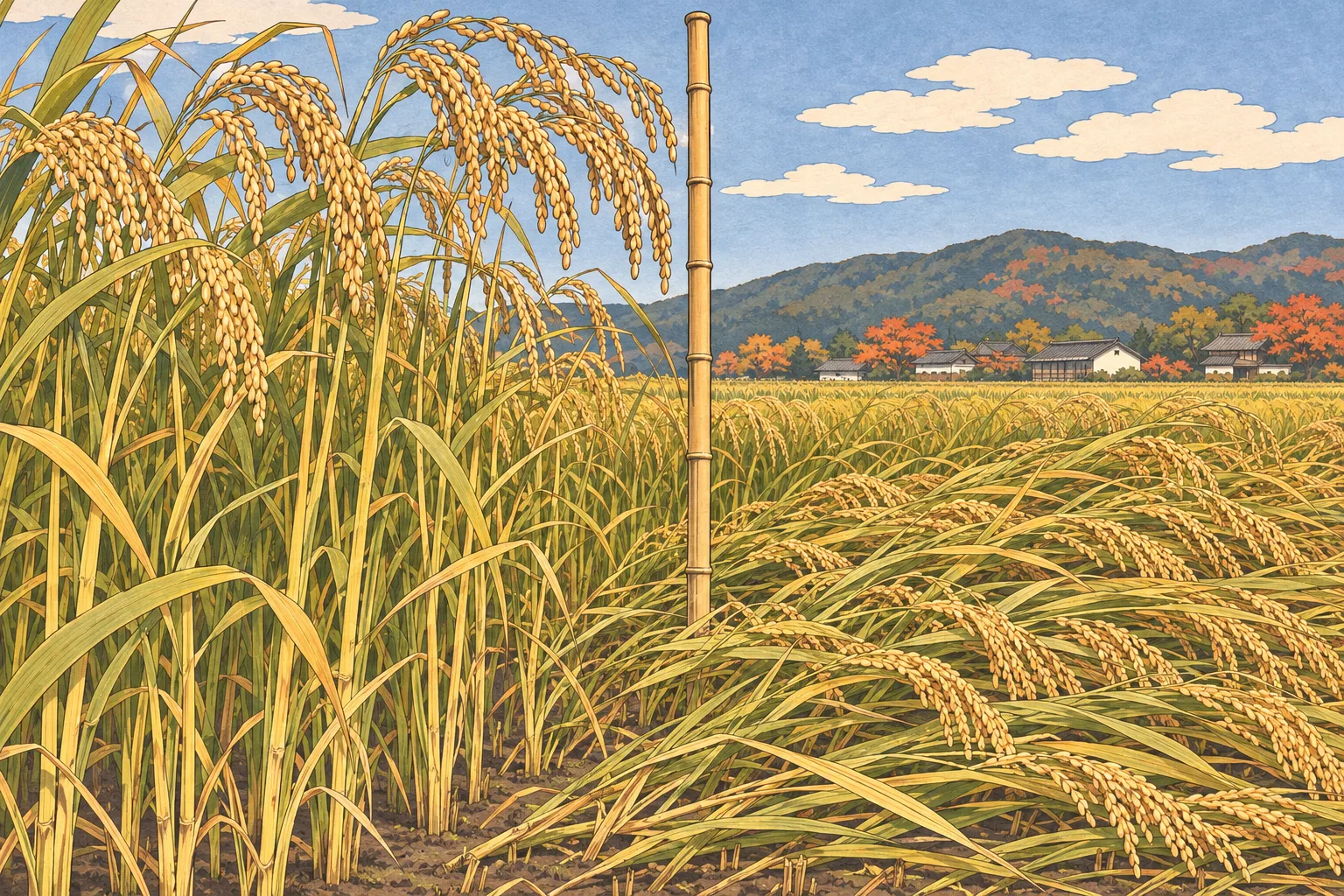
A field of Omachi, with stalks of about 1.3 metres and the whole plant around 1.5. The rice on the left still stands; on the right it has gone down in the wind. The bamboo pole gives the scale.
The grains are large and their shinpaku big and nearly spherical. Omachi sake tends to be broad, rich and savoury, with solid acidity and a slightly earthy depth that rounds out with a year or two of age. Fans in Japan call themselves Omachisuto, "Omachi-ists". Omachi’s bloodline runs further than its acreage: one parent of Yamada Nishiki and one of Gohyakumangoku are generally said to come from Omachi-related lines, Okayama prefecture calls it the ancestor of both, and an often-quoted estimate holds that around two-thirds of registered sake rices carry Omachi ancestry.
Kamenoo. In 1893, after a cold summer in the Shōnai plain of Yamagata, a farmer named Abe Kameji was walking home from a shrine visit when he noticed a few rice plants that had ripened normally in a cold-damaged paddy. He saved three heads, reselected the seed for years, and gave the variety a name drawn from his own: a friend is said to have suggested Kame-no-ō, "Kameji’s king", which he thought boastful and changed to the near-homophone Kamenoo, "turtle’s tail". It became widely grown across northern Japan as both a table and a brewing rice.
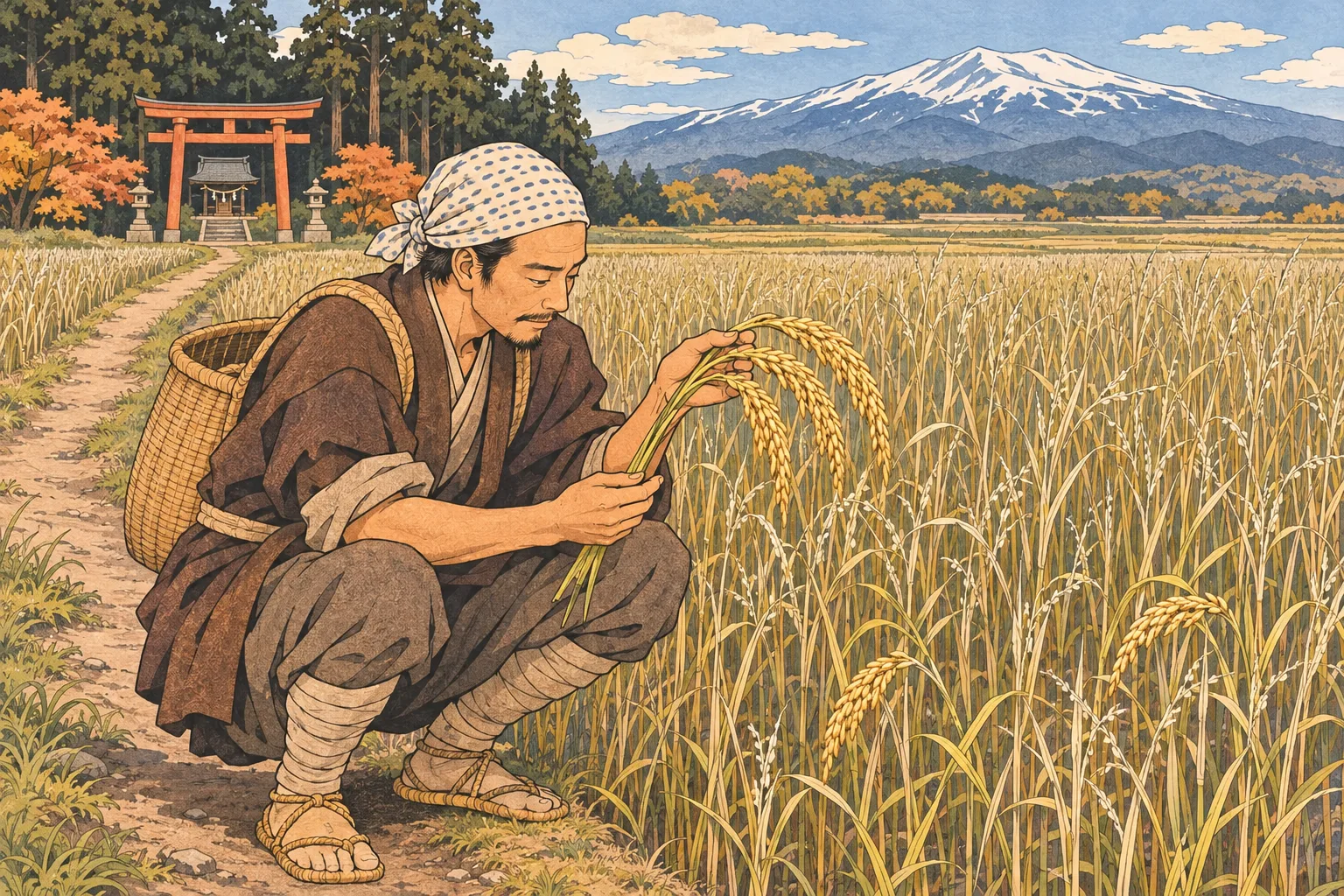
After the cold summer of 1893, the Shōnai farmer Abe Kameji, on his way home from a shrine, picks out three well-filled ears from a cold-damaged paddy. (artist’s impression)
Kamenoo’s bigger legacy is in the dinner bowl: its offspring Rikuu No. 132 became a mainstay of northern breeding, and its descendants are generally said to include Koshihikari and Sasanishiki, the foundations of modern Japanese table rice. The variety itself, tall and weak under heavy fertiliser, fell out of use in the 20th century. Around 1980 a Niigata brewery tracked down seed of the vanished variety, said to be only about 1,500 grains, and spent years multiplying it to brew a Kamenoo sake again. That revival inspired the manga Natsuko no Sake, and the manga in turn sent more breweries looking for Kamenoo.
Kamenoo grains are mid-sized with an indistinct white heart and relatively high protein, so by modern standards it is not an ideal sake rice. Its sake is sharp, high in acidity and layered, sometimes slightly bitter when young and more complex with age. You will usually see it on small-batch bottles from Yamagata and Niigata.
04Yamada Nishiki and the Special A Districts
If you remember one sake rice, make it Yamada Nishiki. It is the most widely grown brewing rice in Japan, around 40 per cent of the national sake-rice crop in the agriculture ministry’s estimate for 2023, and it is generally reckoned to have dominated gold-medal daiginjō at the national new sake competition for decades.
Its origin is well documented. In 1923 the Hyōgo prefectural agricultural experiment station crossed Yamadaho, a local rice grown since the early Meiji era and known for its big grains, as the mother, with Tankan Wataribune, a shorter-stalked selection of the Wataribune line brought in from Shiga, as the father. After years of selection the result was named Yamada Nishiki in 1936 and became a recommended variety in Hyōgo. By the standards of its day it was a relatively short, sturdy, easy and productive plant, and by 1939 it was widely grown. Wartime food controls then stopped brewers buying rice from other prefectures, so many had to use Hyōgo’s Yamada Nishiki, and its merits as kōji rice became widely known. Only next to modern table rice does it look tall, late and fragile.
A thousand grains weigh 27 to 28 grams. The shinpaku is the flat central disc described above, which is why the grain survives polishing to 35 per cent or less. It absorbs water evenly, steams well, takes kōji mould deeply and dissolves in the mash at a steady pace. Brewers call it forgiving. The sake it gives is elegant and rounded, with balanced sweetness, acidity and savouriness, a clean finish and good ageing potential. Critics say it can be too correct; its strength is that it lets the brewer’s technique and the yeast’s aromas show clearly.
Around 60 per cent of Yamada Nishiki shipments come from Hyōgo (57 per cent of the 2022 crop), concentrated in the hills from the north side of Mount Rokkō into Kita-Harima, in today’s Miki, Katō, Nishiwaki and Kasai. Summer days and nights there can differ by more than 10°C, and the clay soils, rich in montmorillonite, hold water and nutrients, suiting a slow-ripening rice. Local growers have a saying, "let it fall without letting it fall": the heads should bow almost to the ground before harvest without the plants actually collapsing.
This is the home of the Special A (Toku-A) districts. From the 1880s and 1890s, brewers of Nada and Nishinomiya contracted directly with villages in this area, an arrangement known as muramai, "village rice": a given village sold to a given brewery, sometimes for generations, and the two sides helped each other through droughts, floods and earthquakes. Over time the villages were ranked by the quality of their rice. A 1938 village-rice price table took the village of Kamikume in Katō as its benchmark and sorted the others into twelve steps. In 1953 a tax-agency notice on rice price differentials split Hyōgo into three zones, the top one called A, and from 1964 the main growing area was subdivided into Special A-a, A-b and A-c, largely following the 1938 table. A-a covers all of Yokawa and Kuchi-Yokawa in Miki city and the former town of Tōjō in Katō city, among others; A-b includes Ōzō and Ōgo in Kōbe’s Kita ward and Hosokawa in Miki. Another usage reserves the name "Special A district" for the best of these. It is a grading kept by growers and the trade, not a national legal category, and the price steps between the grades are small, but for enthusiasts "Special A Yamada Nishiki" is the top of the tree, and labels often name the district or even the village.
The landscape explains a good deal. Kita-Harima is not a flat rice plain but a patchwork of low hills, narrow valleys and terraced paddies, many of them small enough to be worked by one family. In early autumn, when early table rice has already been cut, these fields are still standing gold, the heavy heads bent over, and farmers walk the bunds checking for plants that have fallen. Harvest comes around mid-October. Yokawa has two stone monuments to the old village contracts, contract fields fly brewery flags, and some Nada brewers still buy from the same villages their predecessors did.
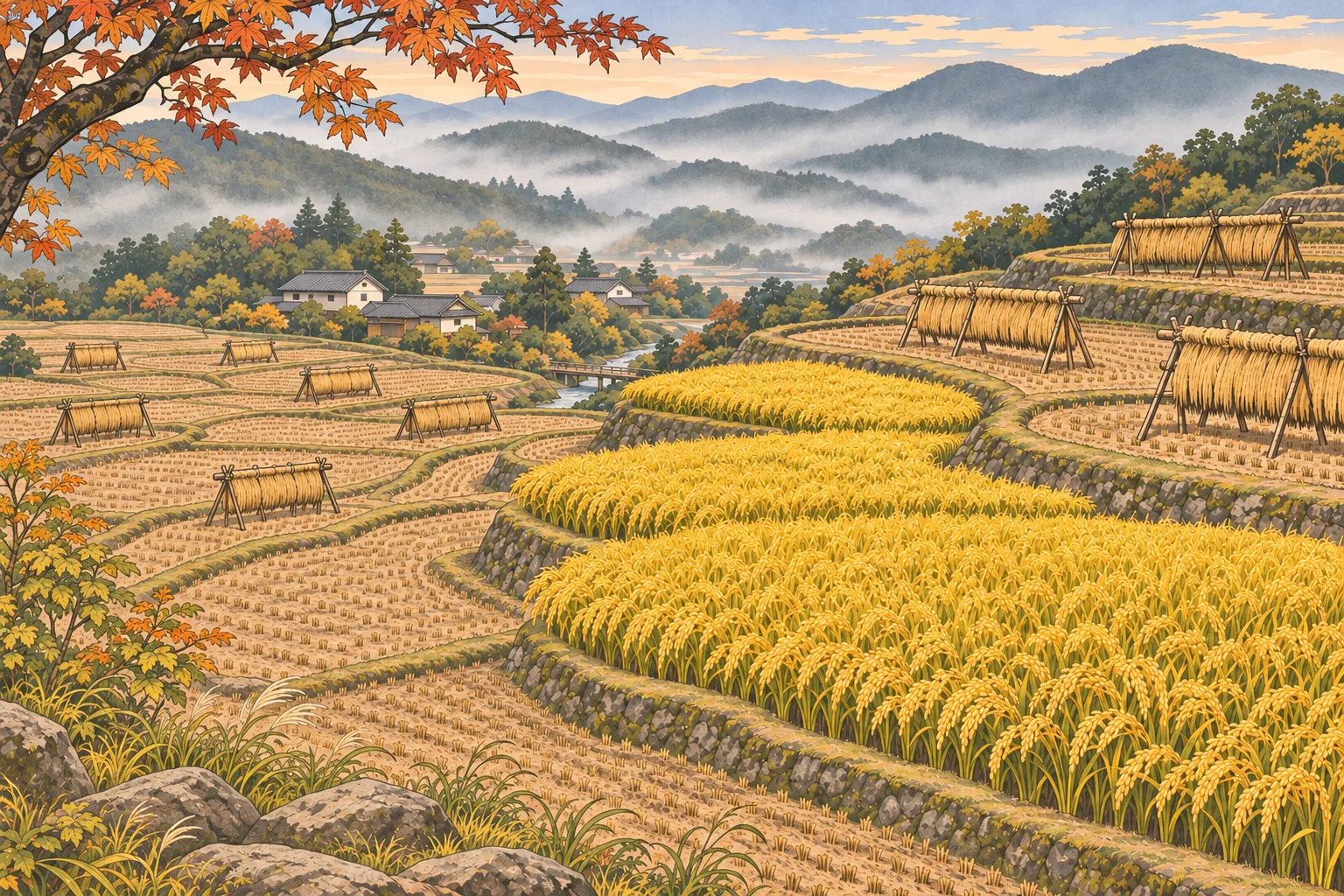
Terraced paddies in the hills of Kita-Harima: the neighbouring fields are already cut, with only stubble and drying racks left, while the late-ripening Yamada Nishiki still stands gold.
Yamada Nishiki is now grown in many prefectures beyond Hyōgo. Origin still matters: warm western regions tend to grow it well, while high or cool areas struggle to ripen it fully.
05Rices for Snow Country and the North
Yamada Nishiki ripens late and dislikes cold. Brewers in Niigata, Tōhoku and Hokkaidō needed rices that could ripen before the snows. Five varieties answer that need.
Gohyakumangoku. Released by the Niigata agricultural experiment station in 1957 from a cross of Kikusui and Shin 200, it is usually said to be named for Niigata’s rice harvest passing five million koku (a traditional volume unit) around the same time. It ripens early, in early September, beating the autumn rains of the Japan Sea coast, and its stalks are under 90 centimetres, about the same as Koshihikari. Grains are medium-large, around 27 grams per thousand, with a large but brittle core that is generally said to crack if polished much below 50 per cent. That makes it a classic ginjō and junmai rice but a hard one for daiginjō. Its sake is light, dry and crisp with a short, clean finish, the backbone of the tanrei karakuchi ("clean and dry") style Niigata made famous from the 1970s. It is generally said to have been Japan’s most-grown sake rice for decades before Yamada Nishiki overtook it; it still ranks second, about a fifth of the national crop in 2023. It is widely used in Niigata, Toyama, Ishikawa and Fukui, and often appears on labels as the kakemai partner to Yamada Nishiki kōji.
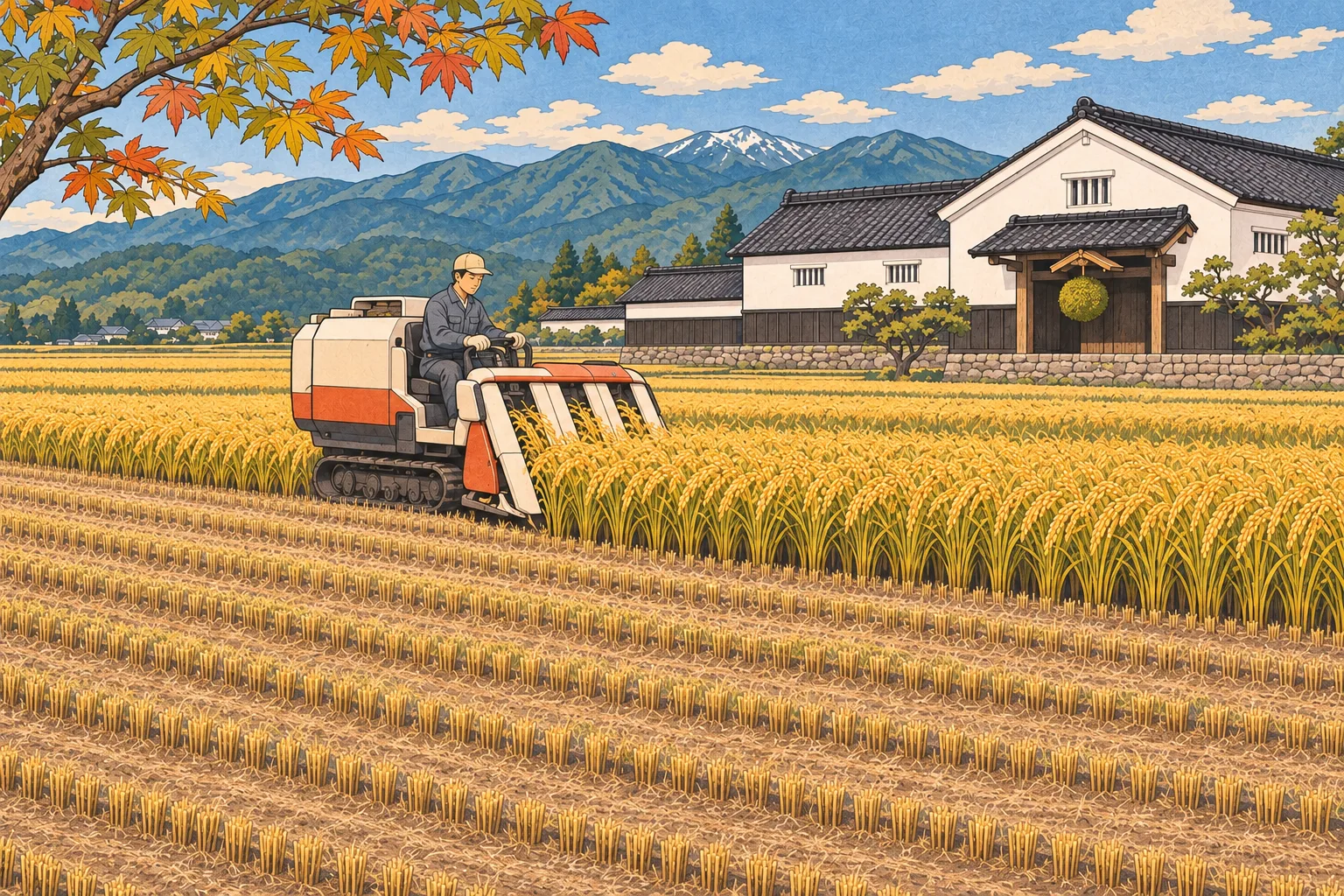
Gohyakumangoku in Niigata is cut in early September, and its stalks stay under 90 centimetres. Beyond the field stands a white-walled brewery with a cedar ball hanging at its entrance.
Miyama Nishiki. Nagano’s rice is a mutation rather than a cross. In 1972 the Nagano agricultural station irradiated seed of an older sake rice, Takane Nishiki, with gamma rays at the national radiation breeding facility and selected a line with large grains and a reliable white heart; it was named Miyama Nishiki in 1978. The name is usually explained as evoking snow on the peaks of the Northern Alps. It is cold-tolerant and grows well in Nagano, Akita, Yamagata and Iwate. Counted with Yamada Nishiki, Omachi and Gohyakumangoku among the "big four" sake rices, it ranks third today, around 5 per cent of the crop. The stalks are not short, close to a metre in Nagano, and lodge easily under heavy fertiliser. Its grains dissolve less readily than Yamada Nishiki’s, so the sake tends to be lean, clean and slightly bitter at the edges, with a crisp finish and restrained aroma.
Koshi Tanrei. Niigata brewers wanted a home-grown rice for competition daiginjō, which Gohyakumangoku could not provide. From around 1989 the prefecture worked on a rice usually described as a cross of Yamada Nishiki and Gohyakumangoku, and in 2004 released it as Koshi Tanrei, a low-protein rice that polishes well. It takes heavy polishing like Yamada Nishiki but ripens in Niigata’s shorter season like Gohyakumangoku. The sake keeps Niigata’s clean profile but adds more body and a longer, gently spreading finish. "Koshi" is the old name for the region; "tanrei" is the style it serves.
Ginpū. Hokkaidō was long thought too cold for proper sake rice, and its breweries bought from Honshū. In 1990 breeders at the Hokkaidō central agricultural experiment station took a cross between Hiroshima’s Hattan Nishiki No. 2 and the Hokkaidō line Jōiku 404 and crossed it again with the local table rice Kirara 397. Ginpū, released in 2000, marked the start of serious sake-rice breeding on the island. Its stalks are only about 60 centimetres, as short as Hokkaidō table rice, it stands up well to wind, and it ripens in late September. Grains are fairly large with a high rate of big, soft shinpaku. The sake is soft and full, lightly sweet with fruity notes. Hokkaidō later added Suisei (2006) and Kitashizuku (2014), and labels from the island usually state "Hokkaidō-grown Ginpū".
Dewa Sansan. From the mid-1980s the Shōnai branch of Yamagata’s agricultural experiment station crossed Miyama Nishiki, as the mother, with a line usually identified as Hana Fubuki, and completed the variety in 1995; Dewa is the old provincial name and sansan means "brilliantly sunny". It improves on Miyama Nishiki’s weakness for lodging, grows easily in cold conditions and suits ginjō brewing. Yamagata tied it to a prefectural brand, DEWA33: as usually described, a junmai ginjō made entirely from Dewa Sansan, polished to 55 per cent or less, using the prefecture’s own yeast and kōji mould and local water, may carry the mark. The sake is gentle, soft and moderately fragrant.
06Western Characters: Hattan Nishiki and Aiyama
Hattan Nishiki. Hiroshima’s rice belongs to the Hattan lineage, which goes back to Hattansō, bred in 1875 by a private breeder. The prefecture released Hattan No. 35, early but tall with a small core, in 1962, and in 1983 created Hattan Nishiki No. 1 from a cross of No. 35 and Akitsuho, followed by No. 2. On a label, "Hattan" may mean any of these, though most current bottles mean Hattan Nishiki. Hattan Nishiki No. 1 is early, short-stalked and high-yielding; the grains are fairly large with a big core. It suits Hiroshima’s soft-water brewing tradition, pioneered in the Meiji period by Miura Senzaburō, in which slow, cool fermentation in soft water yields delicate aromas. Hattan Nishiki sake is clean, dry and gently aromatic with a brisk finish, a good match for the breweries of Saijō. It often shares the cellar with Senbon Nishiki, bred in 1998 to make Yamada Nishiki easier to grow, a small-cored rice suited to high polishing.
Aiyama. Sometimes called the "diamond of sake rice", Aiyama is usually recorded as a 1941 cross made at Hyōgo’s sake-rice station from Aifune No. 117 and Yamao No. 67, the latter itself a Yamada Nishiki × Omachi line. For decades it is said to have been used almost exclusively by the old Hyōgo brewery Kenbishi. Interest is generally said to have exploded from the 1990s when other breweries, notably Yamagata’s Jūyondai, released Aiyama bottlings. Its grains are among the largest of any sake rice, around 30 grams per thousand in early trials, with an enormous core that makes them crack easily and demands slow, careful polishing. It is generally said to lodge easily and yield little; production, mostly in Hyōgo, is a small fraction of Yamada Nishiki’s. The sake is famously lush: sweet, juicy, with ripe melon and white-peach notes and soft acidity. Expect small, seasonal releases.
07Side by Side
Lay ten handfuls of brown rice next to each other. Aiyama, Omachi and Yamada Nishiki are the biggest and plumpest, with Gohyakumangoku close behind. Koshi Tanrei, Ginpū, Hattan Nishiki, Dewa Sansan and Miyama Nishiki are a step smaller; Kamenoo is close to table-rice size. A handful of Koshihikari beside them looks slim and glassy.
Against the light, the cores differ. Yamada Nishiki shows a neat flat line across the middle, and Koshi Tanrei a similar compact centred core. Omachi’s is large and round; Aiyama’s larger still, sometimes clouding most of the grain. Gohyakumangoku’s is big but irregular, often off-centre. Miyama Nishiki, Dewa Sansan, Ginpū and Hattan Nishiki show white hearts in a high share of grains, medium to large and less tidy. Kamenoo’s is faint or absent.
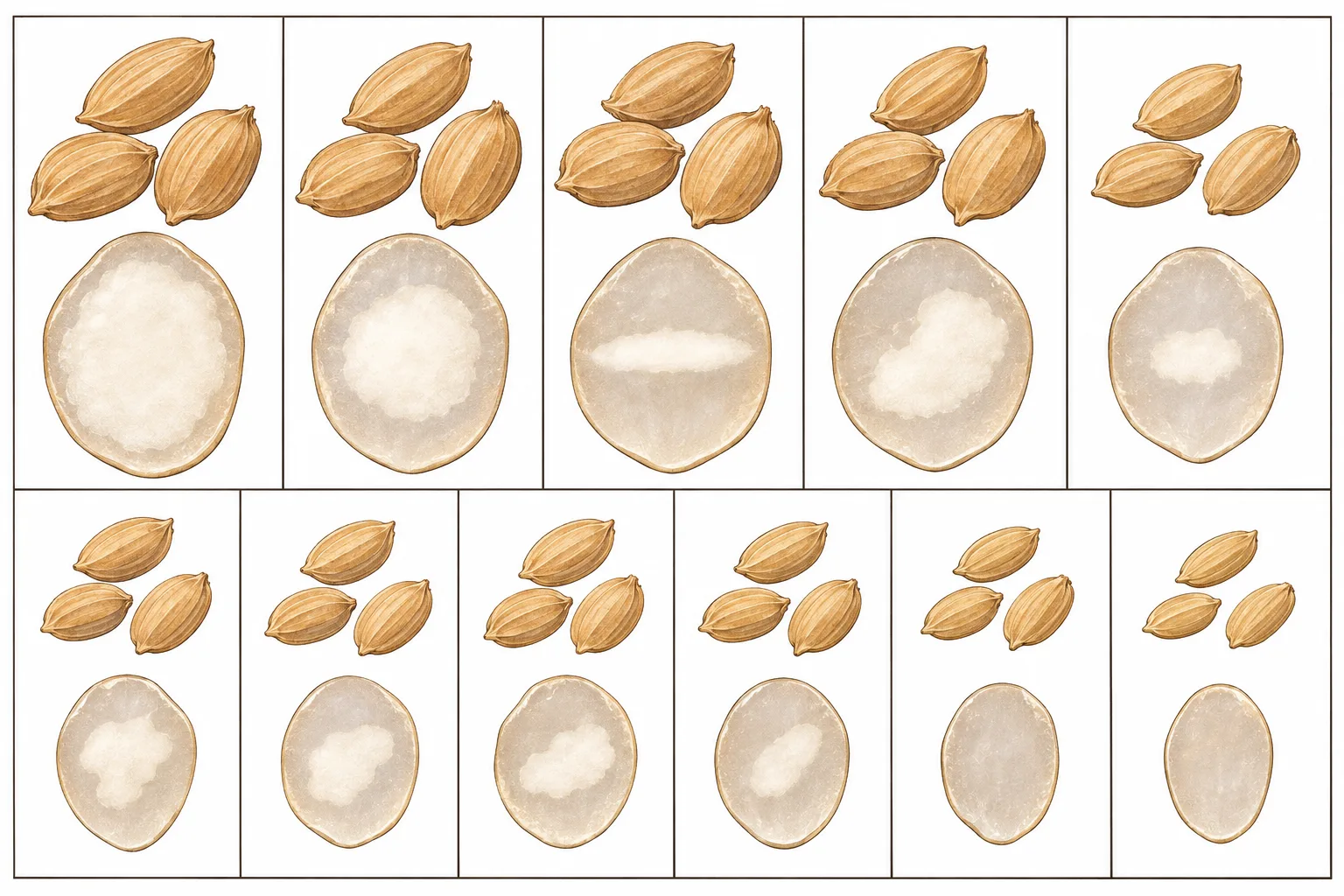
Each box shows three grains of brown rice above one enlarged grain held to the light. Top row, from left: Aiyama, Omachi, Yamada Nishiki, Gohyakumangoku, Koshi Tanrei. Bottom row, from left: Ginpū, Hattan Nishiki, Dewa Sansan, Miyama Nishiki, Kamenoo, and Koshihikari on the far right for comparison.
In the field, Omachi towers over the rest, its stalks about 1.3 metres and the plant around 1.5 with the ear; Yamada Nishiki has stalks a little over a metre and lodges readily; Miyama Nishiki’s are close to a metre and also prone to falling; Gohyakumangoku stays under 90 centimetres and Hattan Nishiki No. 1 is short-stalked; Hokkaidō’s Ginpū is the smallest, about 60 centimetres. Gohyakumangoku is cut in early September and Hattan Nishiki No. 1 is also an early variety; Ginpū ripens in late September in Hokkaidō; Yamada Nishiki and Omachi hold out until mid-October or later.
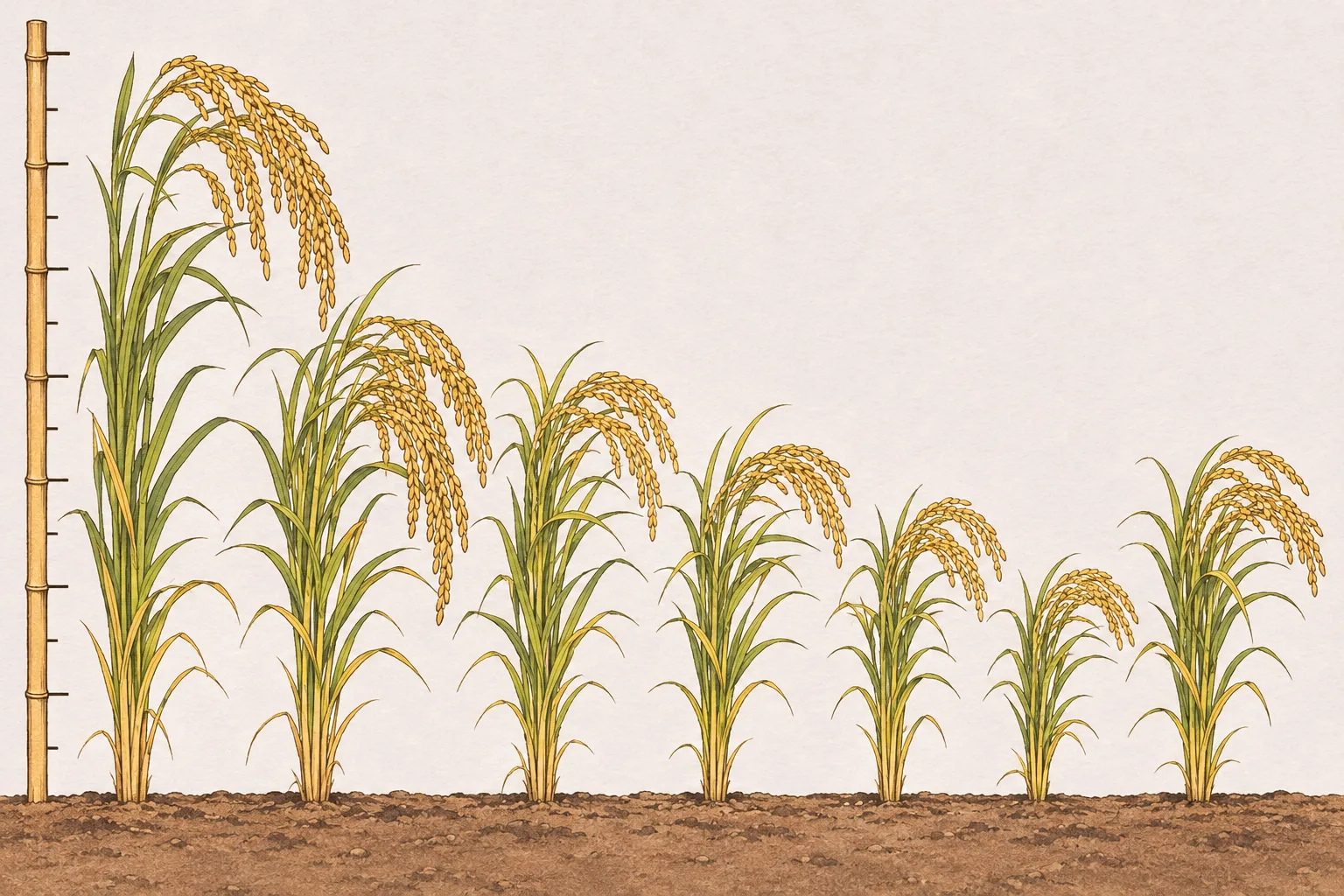
Plant height compared, from left: Omachi, Yamada Nishiki, Miyama Nishiki, Gohyakumangoku, Hattan Nishiki No. 1 and Ginpū, with Koshihikari on the far right for reference. The bamboo pole on the left is the measure.
Geographically: Yamada Nishiki and Aiyama in Hyōgo, Omachi in Okayama, Hattan Nishiki in Hiroshima; Gohyakumangoku and Koshi Tanrei along the Japan Sea coast; Miyama Nishiki, Dewa Sansan and Kamenoo in the cool north and highlands; Ginpū in Hokkaidō.
In the glass, a rough spectrum runs from light and dry (Gohyakumangoku, Miyama Nishiki, Hattan Nishiki) through balanced and rounded (Yamada Nishiki, Koshi Tanrei, Dewa Sansan, Ginpū) to rich and characterful (Omachi’s earthy depth, Aiyama’s juicy sweetness, Kamenoo’s sharp complexity). Treat it as a tendency. Yeast, water, polishing and the brewer’s hand can push any rice a long way from its stereotype.
08Reading Rice on a Label, and the Prefectural Rice Boom
Menus in Japan list many more names than these ten: Akita Sake Komachi, Sankei Nishiki from Nagano, Hyakumangoku no Shiro from Ishikawa, Senbon Nishiki from Hiroshima, Iwai from Kyoto. Most were bred or revived by prefectural research stations from the 1990s on.
The reasons are commercial and local. As national sake consumption fell from the 1970s, small regional breweries shifted toward premium jizake (local sake) and needed a story. Local rice, local water and a prefecture’s own yeast make the clearest one. Yamada Nishiki was expensive and concentrated in Hyōgo, and cold regions could not grow it well, so many prefectures crossed it with locally adapted rice. Kyoto has its own sake rice, Iwai; Yamagata built DEWA33, and in 2016 the whole prefecture was designated as the sake geographical indication "Yamagata".
These new varieties tend to share a recipe. A breeder takes Yamada Nishiki, or one of its descendants, for grain size and polishing strength, and crosses it with a local rice that ripens early and stands up to cold or wind. Ten or fifteen years of selection follow before the prefecture registers the result and releases seed to farmers. Akita’s stated goal for Akita Sake Komachi is typical: the growing habits of Miyama Nishiki with the brewing qualities of Yamada Nishiki. Naming is part of the marketing: many of the names borrow an old provincial name or a local landmark.
For a traveller, the rice name is often a map: Dewa Sansan points to Yamagata, Ginpū to Hokkaidō, Hattan Nishiki to Hiroshima, Koshi Tanrei to Niigata, Omachi to Okayama.
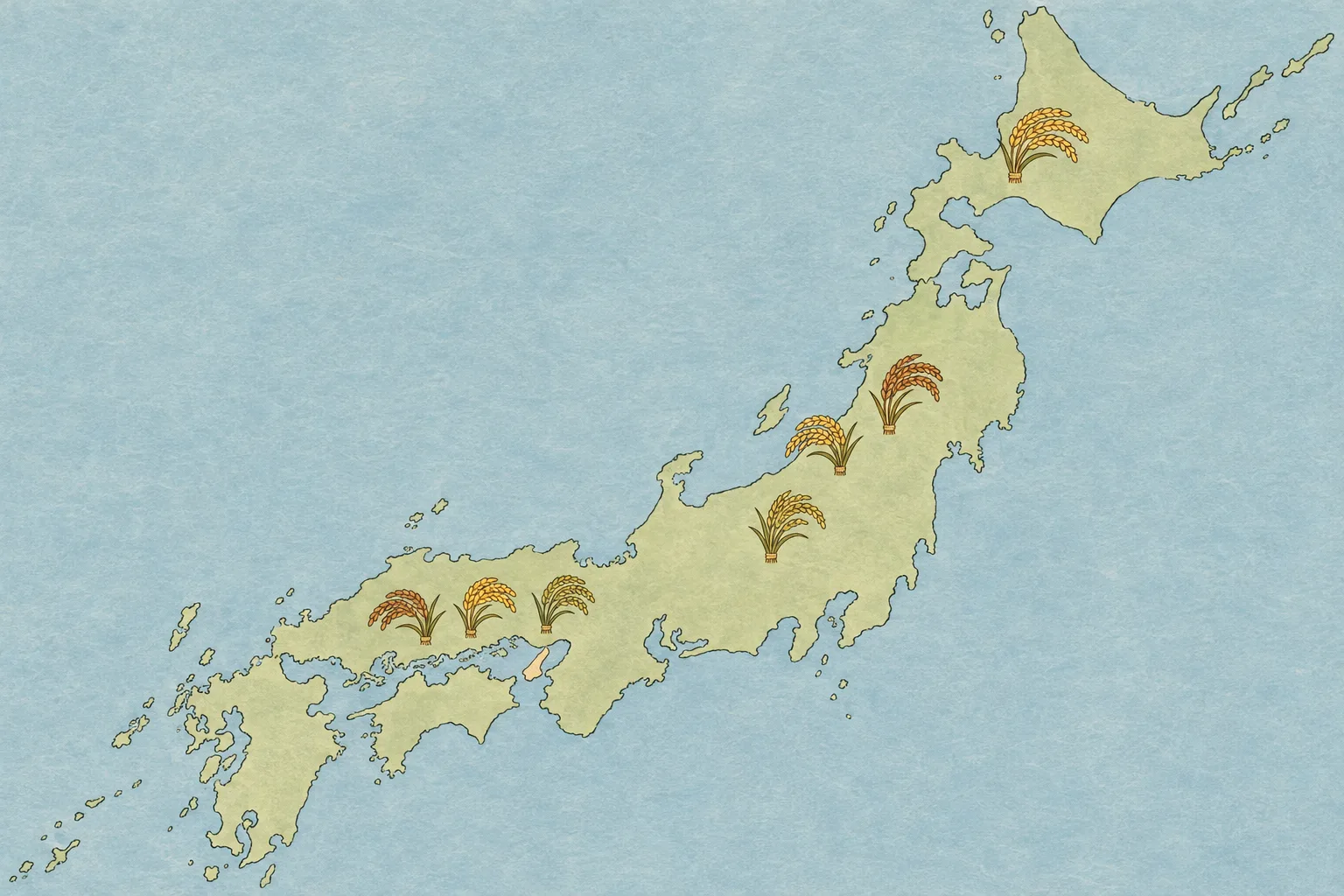
The ears of rice mark where each variety belongs. From the north: Hokkaidō (Ginpū), Yamagata (Dewa Sansan), Niigata (Gohyakumangoku, Koshi Tanrei), Nagano (Miyama Nishiki); then in the west, from left: Hiroshima (Hattan Nishiki), Okayama (Omachi), Hyōgo (Yamada Nishiki, Aiyama).
On labels, look for "原料米" (raw material rice) followed by the variety and often a percentage. Better bottles add origin and grade, such as Special A Yamada Nishiki from Hyōgo or Omachi from Akaiwa. When kōji and mash rice differ, the label may read "麹米 山田錦 / 掛米 五百万石" (kōji rice Yamada Nishiki, kakemai Gohyakumangoku). Some breweries release a set brewed identically but with a different rice in each bottle. If an izakaya offers one, order two or three side by side; it is the fastest way to learn what the names mean.
More deep dives on this topic
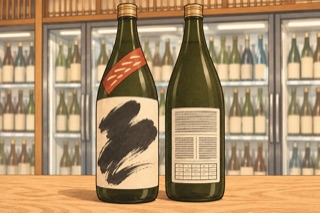 Reading the Fine Print on a Sake LabelPick up a sake bottle in a Japanese liquor shop and the front label will usually give you a brush-written brand name and not much else.
 Sake RicePick up a bottle of premium sake in Japan and the largest characters on the label after the brewery’s name are often the name of a rice: Yamada Nishiki, Omachi, Gohyakumangoku.
 The Yeast Starter and the YeastsBefore a sake brewery commits a ton of rice to a fermentation, it brews something much smaller: a dense, sour culture of yeast called the shubo ("mother of sake") or moto…
 From Polished Grain to Pressed SakeA sake brewery in winter is a working kitchen on an industrial scale.
 Tōji Guilds and the Brewery CrewFor most of the last three centuries, the people who actually made Japanese sake did not own the breweries and did not live near them.
 A Year of SakeWalk into the same Japanese liquor shop once a month for a year and the fridge will tell you the season before the weather does.
 Sake Vessels and Warming ToolsOrder sake in Japan and the drink often arrives in an object you have no name for: a slim-necked ceramic bottle, a cup the size of a thimble, a square wooden box filled to the…
 Sake and the GodsWalk past an old sake brewery in Japan and you will probably see a large ball of cedar hanging over its door.
 Aroma, Taste and the Four Types of SakeMost sake menus in Japan assume you already know the code.
- Back to the main article: Sake →