
At a glance
Why Ōsaka mixes its okonomiyaki and Hiroshima layers it, how takoyaki batter is turned into spheres, and how to order and eat at the griddle.
- Okonomiyaki means "grilled as you like it": the diner decides what goes into the batter.
- Ōsaka style mixes cabbage into the batter before frying; Hiroshima style builds it up in layers and adds yakisoba or udon.
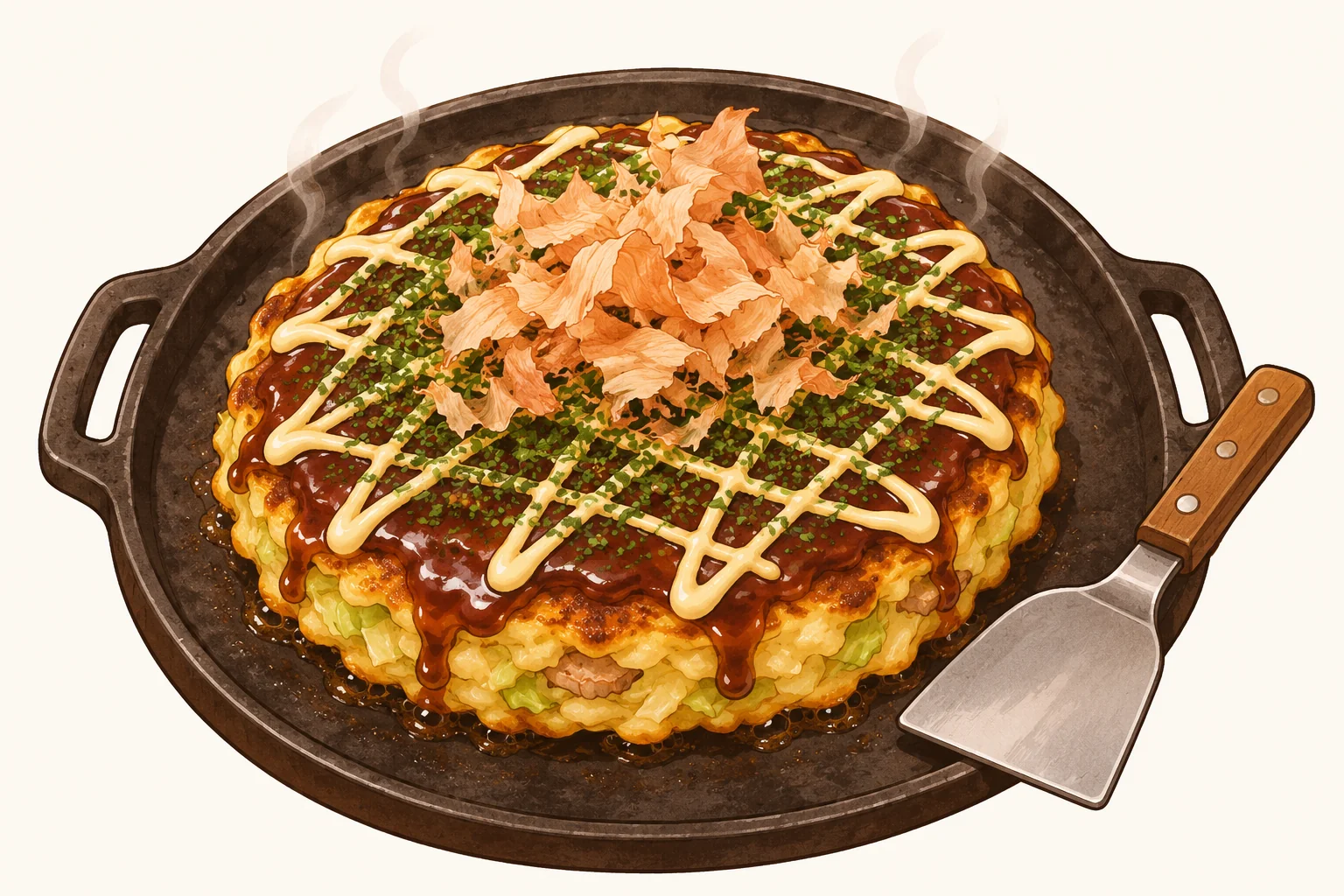
- Once cooked, it is brushed with okonomiyaki sauce, striped with mayonnaise and topped with aonori and bonito flakes.
- Takoyaki grew out of Ōsaka’s 1930s rajio-yaki; by the shop’s own account, octopus went in from 1935.
- As of 2026, an okonomiyaki usually costs around 1,000 yen.
Okonomiyaki is often called a Japanese pancake or a Japanese pizza, and neither description quite works. It is a griddle-cooked cake of shredded cabbage held together by batter, topped with pork, painted with a thick sweet-sour sauce and showered with bonito flakes that curl and wave in the heat. Its small, round cousin takoyaki is batter cooked in a pan of hemispherical molds around a piece of octopus, turned with a skewer until it becomes a ball. Both are cheap, filling, messy and loud, and both belong above all to Ōsaka, a city that likes to call itself the nation’s kitchen. This introduction explains what they are, why Ōsaka and Hiroshima make okonomiyaki so differently, how a takoyaki ball gets its shape, and what to do when you sit down in front of a hot plate.
01"Grill What You Like"
The name is the recipe. Okonomi means "as you like it" or "your preference," and yaki means grilled or cooked on a hot surface. The batter is a base, and what goes into it is up to the person eating: pork belly, squid, shrimp, beef tendon, mochi, cheese, kimchi. The informality is the point.
The standard Ōsaka version starts in a bowl. Finely chopped cabbage goes in with flour, dashi (Japanese soup stock), egg and often a little grated yam, which makes the batter light and airy. Everything is stirred together, poured onto the griddle, and shaped into a round about two or three centimeters thick. Strips of pork belly are laid across the top; the whole thing is flipped so the pork crisps underneath, and it cooks slowly until the outside is browned and the inside is soft and steaming. The cabbage matters more than the flour. A large volume of it releases moisture and sweetens as it cooks, so a good okonomiyaki tastes less like bread than like a hot, loose vegetable cake.
Then comes the finish that makes it recognizable anywhere. A dark brown okonomiyaki sauce, thicker and sweeter than Worcestershire, is brushed over the top. Mayonnaise goes on in thin lines, sometimes cross-hatched. Then a dusting of aonori, powdered green seaweed, and a handful of katsuobushi, shaved dried bonito. The bonito flakes are so thin that the rising heat makes them twist and flutter, and first-time visitors nearly always film it. The result is heavy on flavor, sweet, salty, smoky and rich at once, and it goes very well with cold beer.
In Ōsaka, okonomiyaki belongs to a category locals call konamon, "flour things," along with takoyaki and udon. It is a merchant city’s food: cheap, quick, satisfying. Many Ōsaka households own a griddle or an electric hot plate, and a weekend dinner of okonomiyaki cooked at the living-room table is ordinary family life. In the Kansai region it is also common to eat okonomiyaki with a bowl of rice, sold in restaurants as an okonomiyaki teishoku (set meal). People from elsewhere in Japan find this baffling, flour with rice, but to an Ōsaka diner okonomiyaki is a side dish, much as gyoza are eaten with rice.
02From Tea Sweet to Penny Western Food
Writers on okonomiyaki like to trace it back to funoyaki, a thin crepe of wheat flour and water spread with miso and rolled up, served as a sweet. The tea master Sen no Rikyū is said to have served it at his tea gatherings in the sixteenth century. The story is widely repeated, but several centuries separate funoyaki from anything like modern okonomiyaki, and it is better taken as a refined origin legend than as a direct ancestor.
The more convincing ancestors appear in city streets in the late nineteenth and early twentieth centuries, as snacks for children. In Tokyo there was monjayaki, a runny batter cooked on a griddle; the name is usually explained as coming from mojiyaki, "letter grilling," because children drew characters in batter on the hot iron. By the Taishō era (1912–1926), cheap sweet shops and street stalls in Tokyo and the Kansai sold issen yōshoku, "one-sen Western food": a thin crepe of batter topped with green onion and a few bits of meat or dried shrimp, then splashed with Worcestershire sauce. The sauce was what made it "Western," and one sen was a very small coin. A restaurant in Kyoto’s Gion district, often described as an old shop though accounts of its founding date differ, still serves its own folded version under that name. The word "okonomiyaki" itself is generally thought to have come into use in Tokyo in the early Shōwa period, around the 1930s, later taking firm root in Ōsaka; in Hiroshima, issen yōshoku was not commonly renamed okonomiyaki until around 1950.
The war and the hungry years after it changed the dish. Rice was scarce, and wheat flour, much of it American aid, poured into Japan. Making a meal out of flour and whatever vegetables were at hand became routine. Cabbage was cheap, kept well and grew in quantity, and it became the main ingredient. Okonomiyaki turned from a children’s snack into something that could feed an adult, and specialist shops multiplied in Ōsaka neighborhoods such as Tsuruhashi and Sennichimae.
The sauce developed in the same period. Before the war, cooks used thin, tangy Worcestershire. After it, sauce makers in Ōsaka and Hiroshima began producing thick, fruit-and-vegetable-based sauces designed to cling to a griddle cake instead of running off it. Otafuku, a Hiroshima company, launched a dedicated okonomiyaki sauce in the 1950s, and its bottle with the round-faced, smiling woman on the label is now almost a symbol of the dish. Mayonnaise came later; the Ōsaka chain Botejyu claims to have been the first to put it on okonomiyaki.
03Hiroshima: Building in Layers
In Hiroshima, people do not call their version "Hiroshima-yaki," and it is wise not to use the term in front of them. To them it is simply okonomiyaki; it is the Ōsaka kind that needs a qualifier.
The fundamental difference is that Hiroshima style is layered, not mixed. The cook ladles a little batter onto the griddle and spreads it with the back of the ladle into a thin crepe. On top goes a mound of shredded cabbage, sometimes twice or three times what an Ōsaka okonomiyaki contains, followed by bean sprouts, tenkasu (crunchy bits of fried tempura batter) and slices of pork. A little more batter binds it, and the whole stack is flipped so the cabbage steams under the crepe and pork. Beside it, the cook fries a portion of yakisoba noodles or udon, then lifts the stack onto the noodles and presses it down. An egg is cracked onto the griddle and spread into a circle, the tower is placed on top of the egg, and it is flipped one last time, egg side up, to be brushed with sauce and finished with green onion or seaweed. What arrives is a tall, compact construction of several distinct layers.
- 1
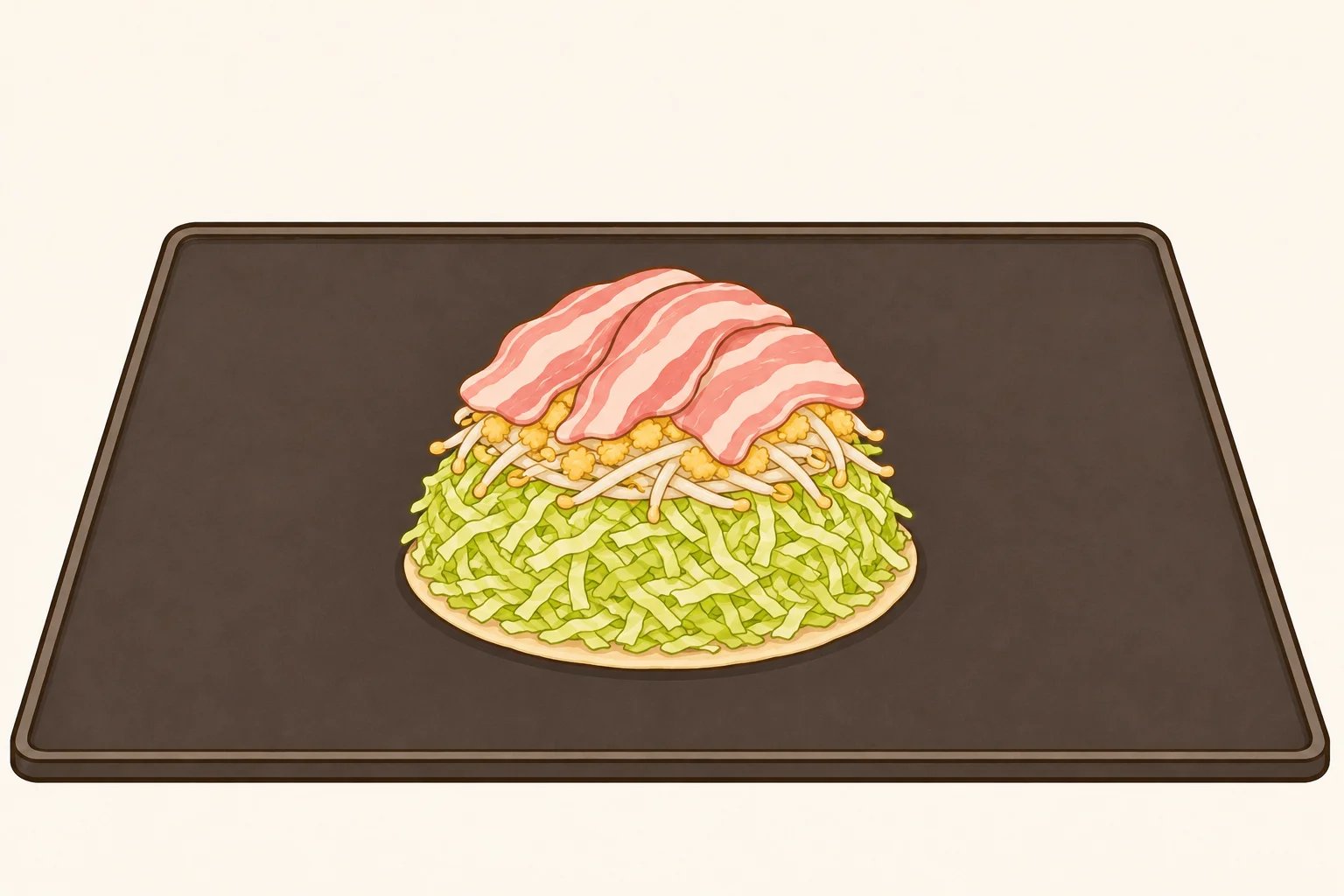 A thin crepe of batter is topped with a mound of shredded cabbage, bean sprouts, tenkasu and slices of pork.
- 2
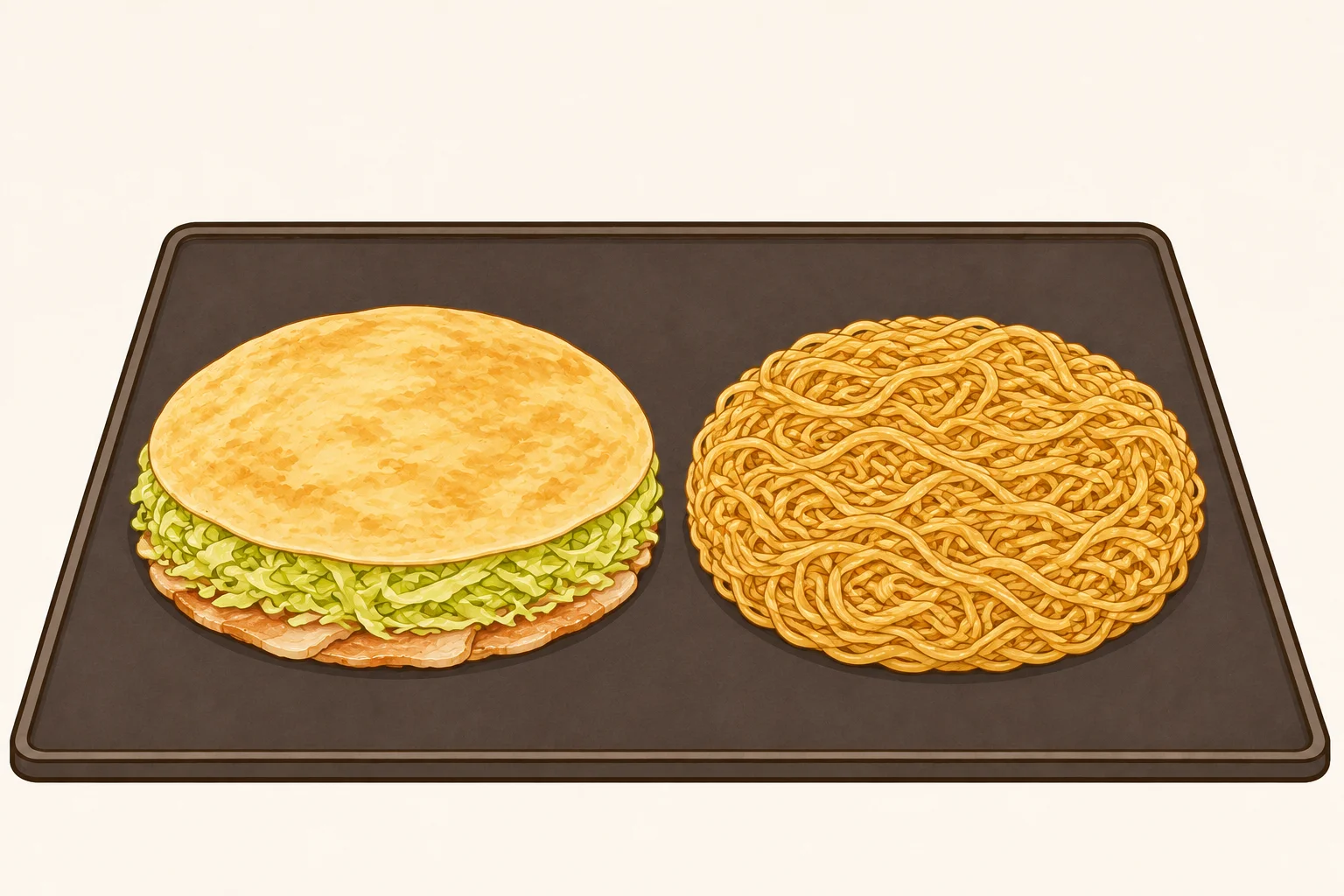 The stack is flipped so the cabbage steams under the crepe, while yakisoba noodles fry beside it.
- 3
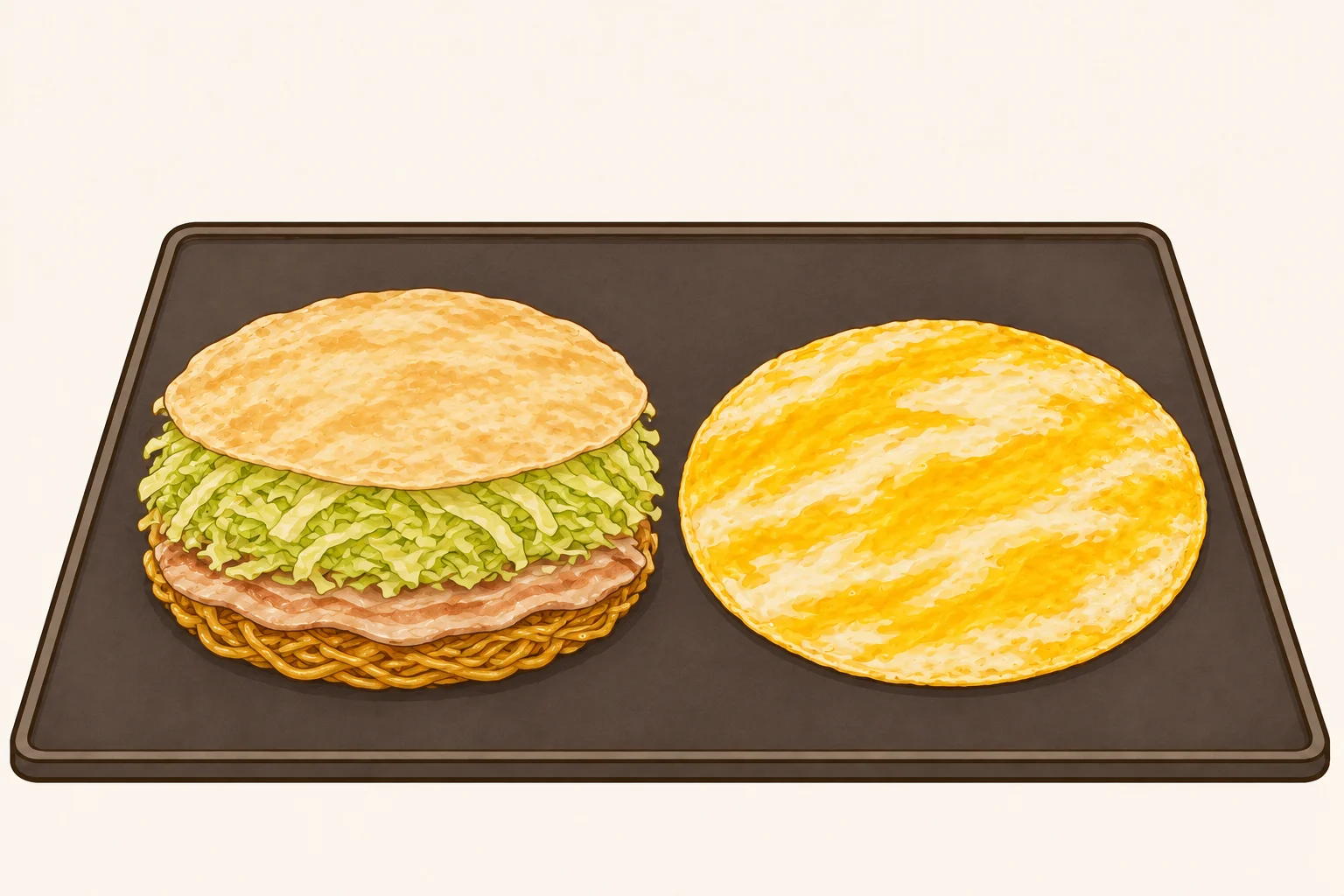 Pressed down onto the noodles, the stack is about to go on top of an egg spread into a circle.
- 4
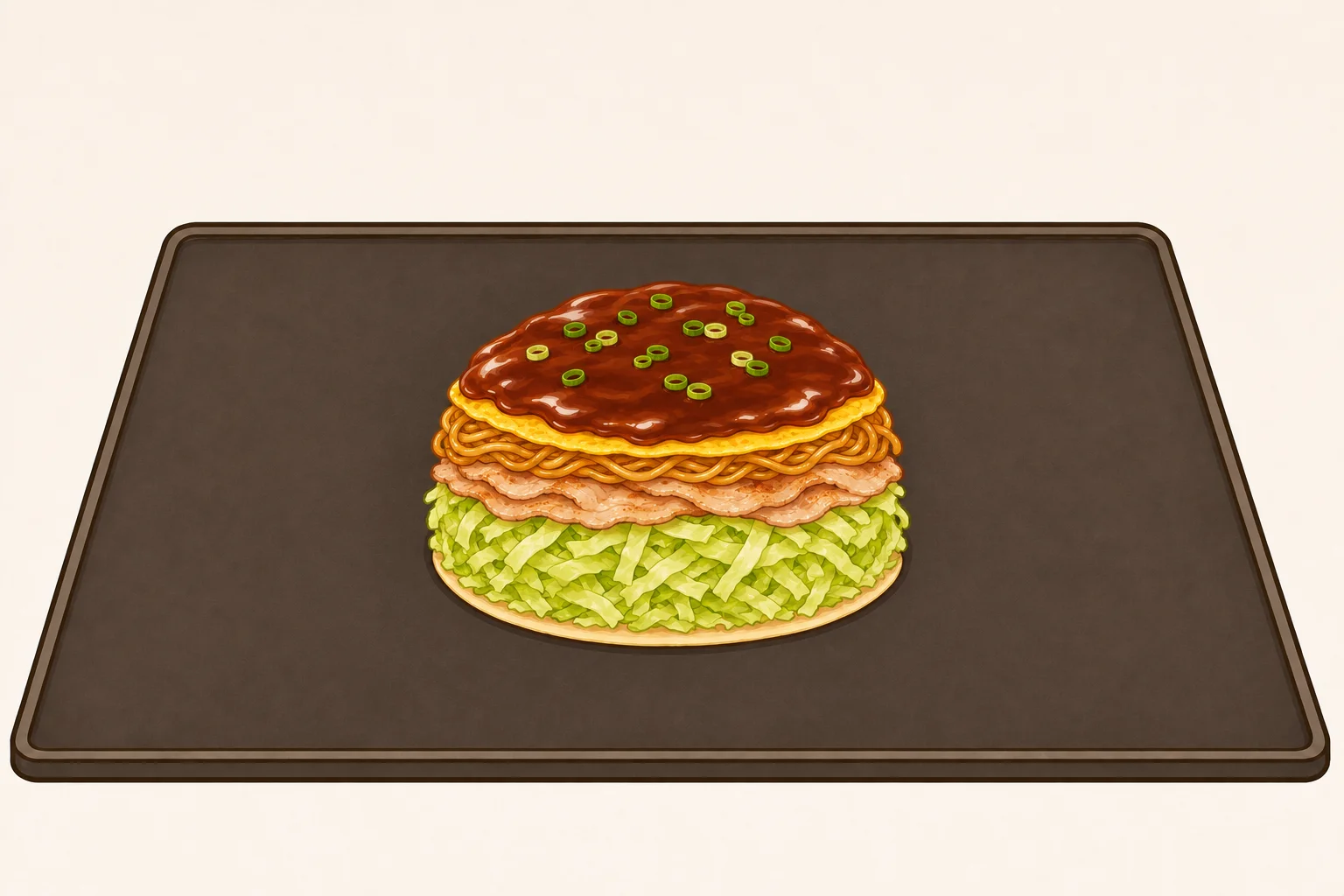 Flipped one last time, egg side up, it is brushed with sauce and topped with green onion: a tall stack of layers.
- 1Thin crepebatter spread with the back of the ladle
- 2Mound of cabbagetwo or three times the Osaka amount
- 3Bean sprouts, tenkasu, pork
- 4Flip the stackthe cabbage steams
- 5Onto yakisoba or udon
- 6Onto a circle of egg
- 7Flip once more, saucegreen onion or seaweed
Hiroshima style is layered, not mixed, with two or three times the cabbage of an Osaka okonomiyaki.
The style is bound up with the city’s history. After the atomic bombing of August 1945, Hiroshima was rubble, and people cooked issen yōshoku-style crepes on iron plates at black-market and temporary stalls. Adding cabbage and noodles made a single portion stretch into a filling meal at low cost. Around the 1950s a cluster of okonomiyaki stalls appeared in the city center, and they eventually moved together into a building in the Shintenchi area. That building is now Okonomimura, "Okonomiyaki Village," with several floors of small shops, each built around one griddle and a single row of counter seats.
Eating Hiroshima okonomiyaki is partly a matter of watching. From the counter you see the cook work with two metal spatulas, flipping and pressing in a quick, practiced rhythm. Many locals eat directly from the griddle with a small spatula, called a hera, cutting off a piece and lifting it to the mouth so the food never cools on a plate.
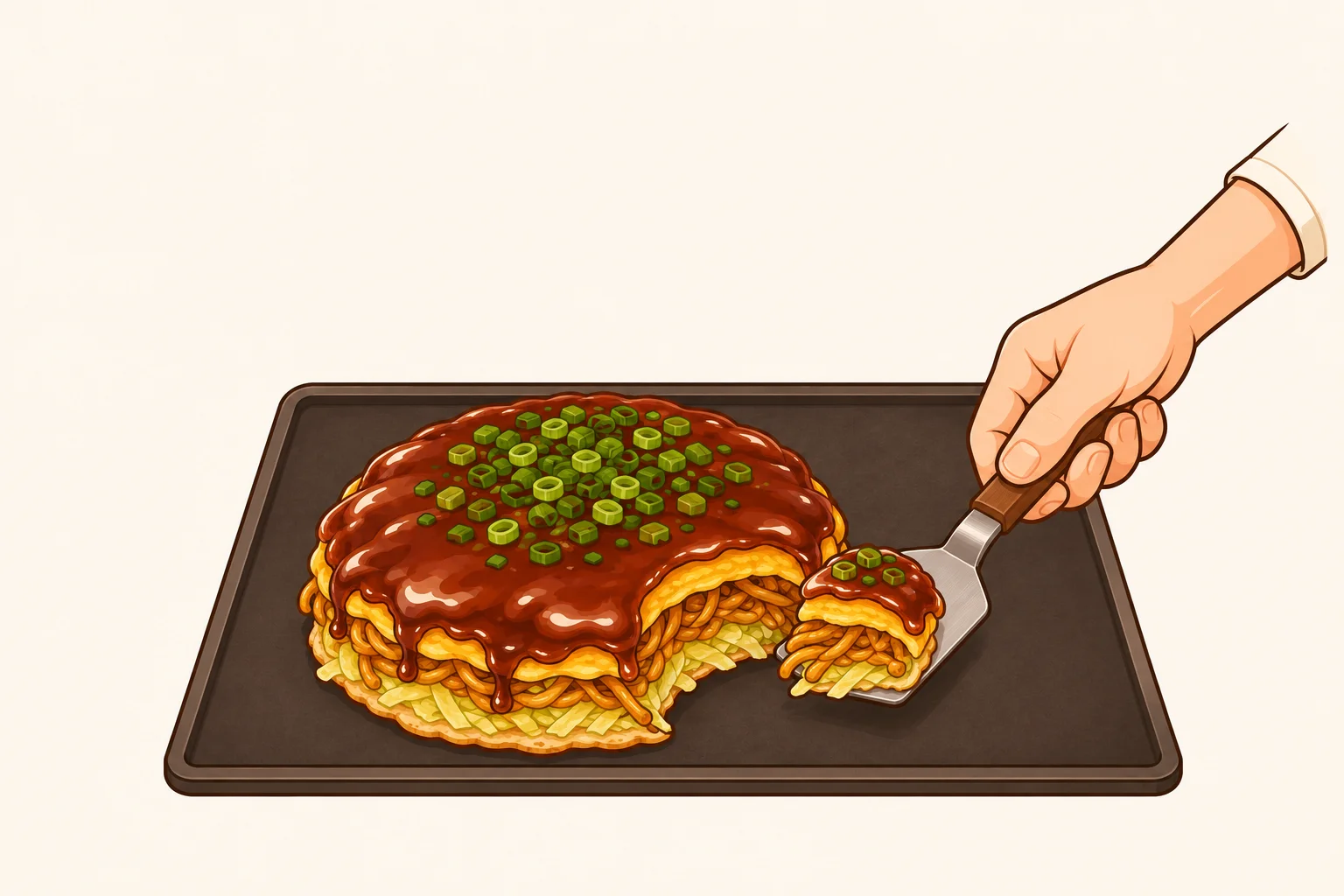
Many Hiroshima locals eat straight from the griddle, cutting off a piece with a small spatula called a hera.
Between the two great styles lie many variations. Ōsaka has negiyaki, made with a mass of green onion in place of cabbage and usually seasoned with soy sauce instead of sweet sauce; the Jūsō neighborhood is known for it. Modanyaki, "modern-yaki," is an Ōsaka okonomiyaki with fried noodles folded in. Kōbe has sobameshi, yakisoba and rice chopped and fried together on the griddle. And Tokyo kept its monjayaki: a batter as thin as soup, poured into a ring of chopped vegetables on the griddle and eaten by pressing small spatulas onto it to scrape up the crisp, sticky edges. The Tsukishima district has a whole street of monjayaki restaurants.
04Takoyaki: Turning Batter into Spheres
Takoyaki is okonomiyaki’s younger sibling, with its own family history.
Its immediate predecessor was rajioyaki, "radio-yaki," an Ōsaka street snack popular in the early 1930s: batter cooked in a griddle with rows of round hollows, filled with bits of beef tendon or konnyaku. Radio was a fashionable new technology, and the name borrowed some of its modern glamour. An Ōsaka stall-keeper named Endō Tomekichi began selling rajioyaki in 1933, the start of the shop now called Aizuya. In 1935, according to the story the shop tells, a customer from Akashi told him that back home they put octopus in it. He switched to octopus and seasoned the batter itself. Aizuya still operates in Ōsaka, and its takoyaki are served without sauce; the flavor is in the batter, and you eat them as they are.
The customer was describing Akashi’s own specialty, akashiyaki, which locals call tamagoyaki. It is made with a high proportion of egg, a little flour and a wheat starch called ukiko, so it is soft and almost custard-like, and it is dipped in a light dashi broth rather than covered in sauce. Akashi, on the Seto Inland Sea west of Kōbe, is famous for its octopus, so putting octopus inside was natural there.
Takoyaki looks simple. The difficulty is in the turning. The cast-iron plate, with its rows of hemispherical cups, is oiled and heated hard. Thin batter is poured in until it fills every cup and floods over the ridges between them. A piece of boiled octopus is dropped into each cup, followed by tenkasu, chopped red pickled ginger and green onion. When the bottom has set, the cook runs a thin pick, bamboo or steel, around the rim of each cup, tucking the spilled batter in toward the center, and rotates the half-cooked ball about ninety degrees. The raw batter still inside the cup flows out and sets against the hot iron, forming a new section of shell. Turn again, tuck again, and after several rounds a half-sphere becomes a complete ball, smooth and evenly browned. A skilled cook works with a pick in each hand, and dozens of balls seem to roll at once, which is why takoyaki stalls draw crowds who are only watching.
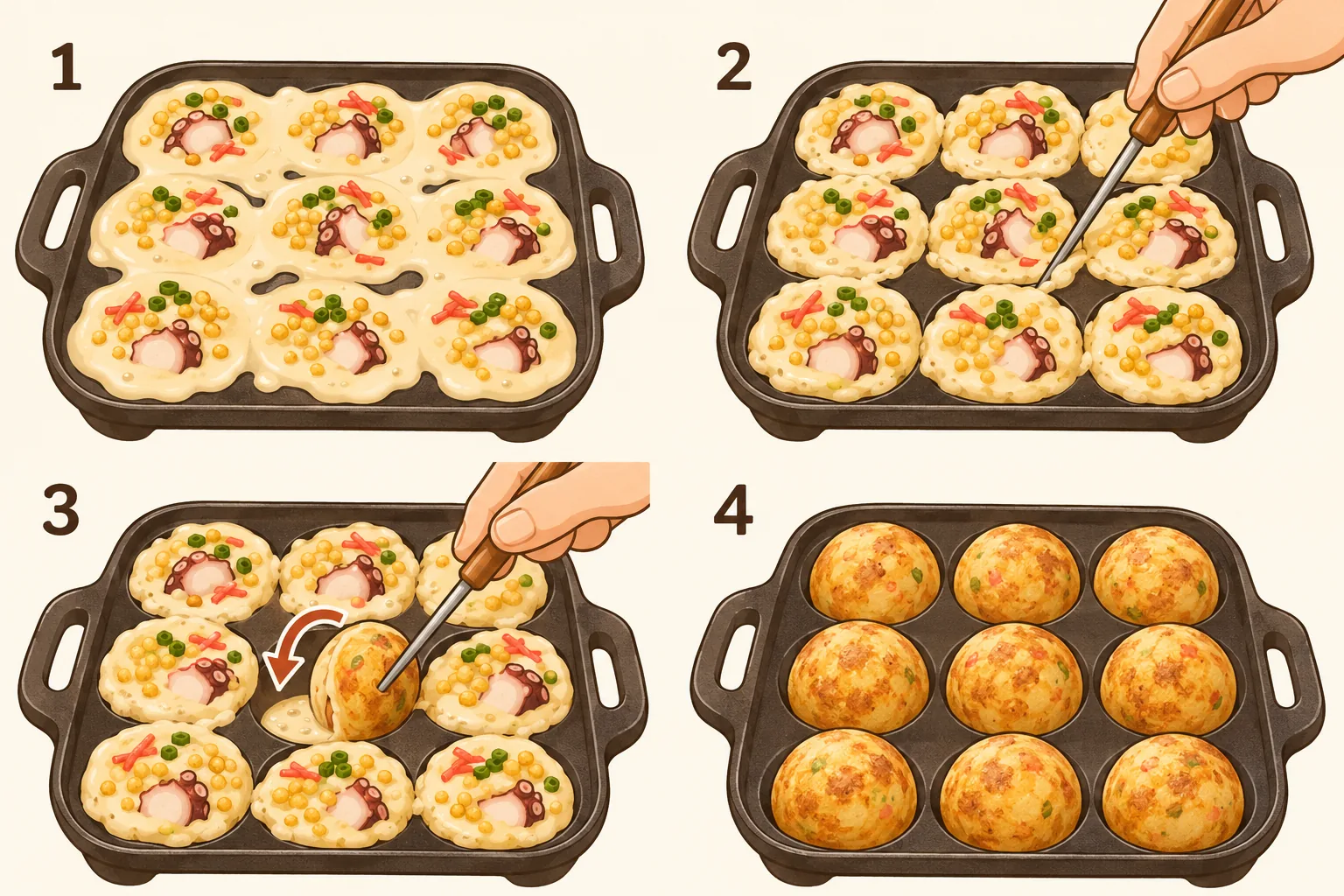
Turning takoyaki: once the bottom sets, a pick runs around each cup, turning the batter into a sphere.
A good takoyaki has a thin, crisp shell and an interior that is still almost liquid. When you bite in, a jet of steam comes out, and nearly every newcomer burns their mouth. Ōsaka people half-jokingly advise biting a small hole first to let the heat escape. The usual toppings are the same as for okonomiyaki: sauce, mayonnaise, aonori and bonito flakes. Some shops offer salt only, soy sauce, or a bowl of dashi to dip them in. A serving is usually six to twelve pieces in a boat-shaped paper tray or on a thin wooden plate, with a toothpick or two stuck in.
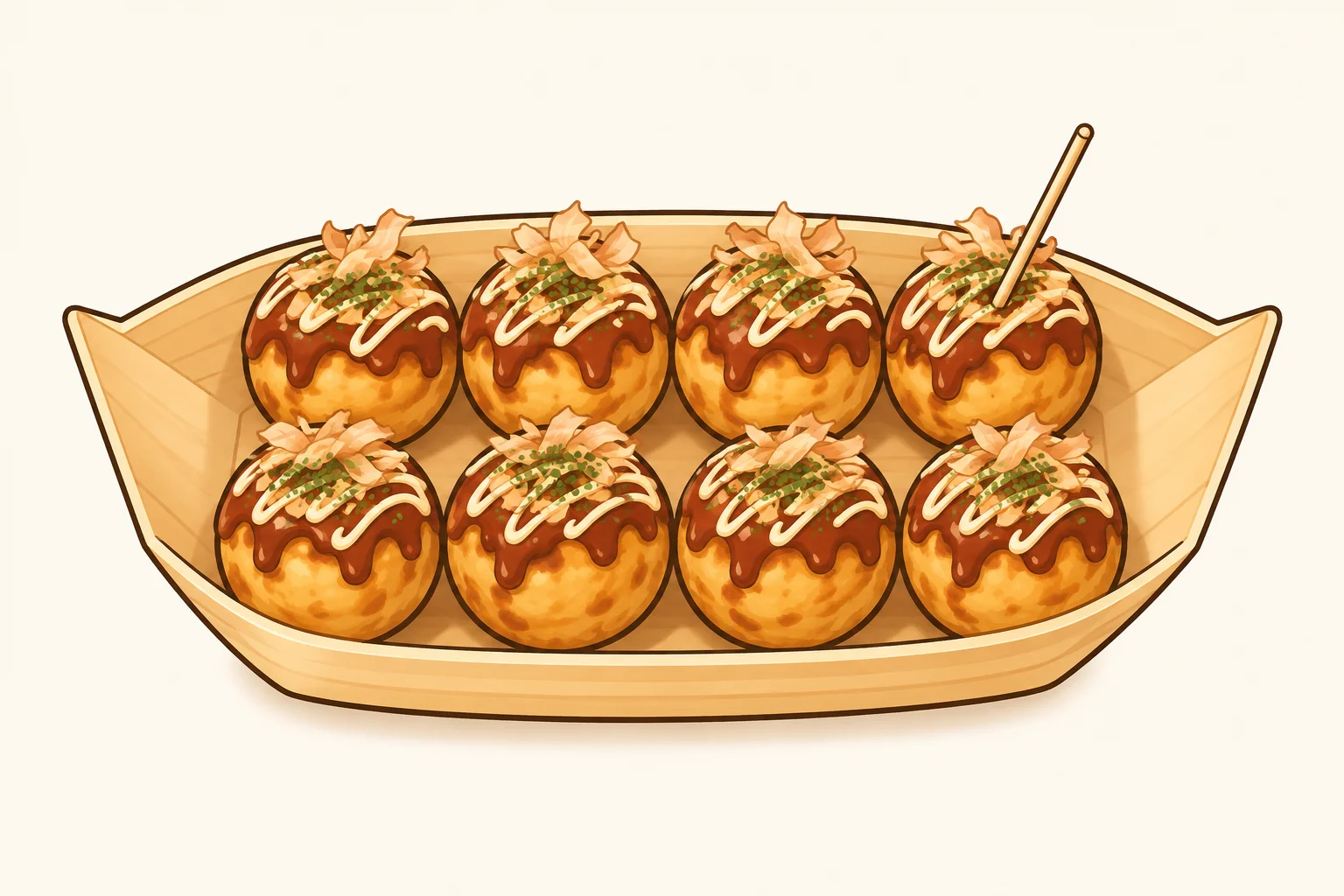
A serving of takoyaki is usually six to twelve pieces in a boat-shaped tray, with a toothpick stuck in.
In Ōsaka, takoyaki is an after-school snack and a late-night bite after drinking. Many homes own a takoyaki maker, and friends gather for a takopa, a takoyaki party, everyone taking turns with the picks. People say that in Ōsaka not knowing how to turn takoyaki is like not speaking the local dialect.
05At the Griddle
The classic Ōsaka okonomiyaki restaurant has a steel griddle set into each table. When you sit down, the staff heat it up. At some places the staff cook in front of you; at others they bring a bowl of unmixed batter and ingredients and leave the cooking to you. If you are cooking, stir the bowl thoroughly from the bottom to work in air, pour it out and shape it into a circle, and resist the urge to press it flat with the spatula. Let it cook. When small holes appear on top and the edges look dry, flip it, wait a few more minutes, flip it back and add the sauce. If you are unsure, ask; staff are usually happy to do the first flip for you.
A good first order is butatama, pork and egg, the basic Ōsaka okonomiyaki. Seafood and "mix" versions are on almost every menu. Most places also serve yakisoba, griddled vegetables and beef tendon dishes, which suit a group sharing. As of 2026, an okonomiyaki generally costs around 1,000 yen, and with a beer or oolong tea it makes an inexpensive meal. Cut it into pieces on the griddle with the spatula; you can move a piece to your plate and use chopsticks, or eat straight from the spatula as locals often do.
In Hiroshima, Okonomimura and the collected shops of Okonomiyaki Monogatari near the station are easy places to start, each with its regulars. You will be asked whether you want yakisoba or udon, and whether to add a double portion of noodles, extra green onion or cheese. Portions are large, and one is usually enough for one person. Sitting at the counter while the cook builds yours from start to finish takes ten or fifteen minutes, and the show is part of the meal.
For takoyaki you hardly need to look. Around Dōtonbori, Shinsaibashi, Shinsekai and Tennōji, nearly every busy street has a stall with a queue, and through the glass you can watch the balls being turned. Buy a tray, eat it standing in the street, and let it cool for a minute first. Try Aizuya’s plain style, then a few stalls with sauce, some crisp, some soft, and you will understand why Ōsaka people argue about which one is best.