
At a glance
What makes natto stringy, how it moved from straw bundles to factory tubs, why eastern Japan eats far more of it, and how a first-timer should eat it.
- Natto is cooked soybeans fermented with natto bacteria; the strings come from sticky polyglutamic acid and related substances.
- Old-style natto was sold wrapped in rice straw (waratsuto natto), since natto bacteria live on straw.
- In the Taishō era Hanzawa Jun developed pure-culture inoculation and temperature-controlled fermentation, making factory production possible.
- Spending on natto is highest in eastern Japan; Fukushima City ranked first on the 2022–2024 average.
- The usual way to eat it: stir until white foam forms, add the sauce and mustard, then tip it over hot rice.
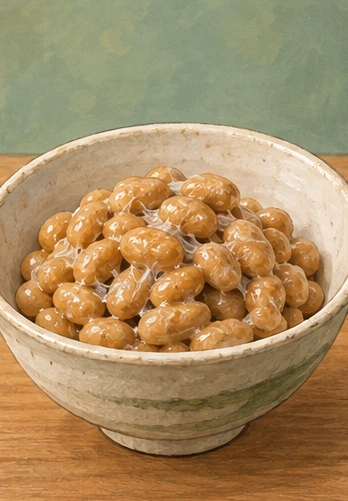
Natto is the food most likely to divide a table of visitors to Japan. It is a small heap of brown soybeans that, when you lift them with chopsticks, trail long silky threads and give off a smell somewhere between ripe cheese and ammonia. To many Japanese people, especially in the east and north of the country, it is simply breakfast: cheap, nourishing, and as ordinary as toast. This piece explains what natto is and why it behaves the way it does, how a food once sold wrapped in rice straw ended up in a plastic tub in every supermarket, why Tokyo loves it more than Ōsaka, and how to give it a fair try when you are in Japan.
01What Is in the Little Tub
The natto most Japanese people eat comes in a square white polystyrene tub about the size of a palm, usually sold in packs of three bound with film. As of 2026, a basic pack costs around ¥100 in a supermarket, while the big makers’ leading lines cost more; rising costs for ingredients and packaging have brought several rounds of price increases in recent years. Each tub holds 40 to 50 grams of whole soybeans, steamed or boiled and then fermented, with a sheet of clear plastic pressed on top. On that sheet sit two sachets: tare, a sweetened soy-based sauce often flavored with dashi, and karashi, Japanese hot mustard.
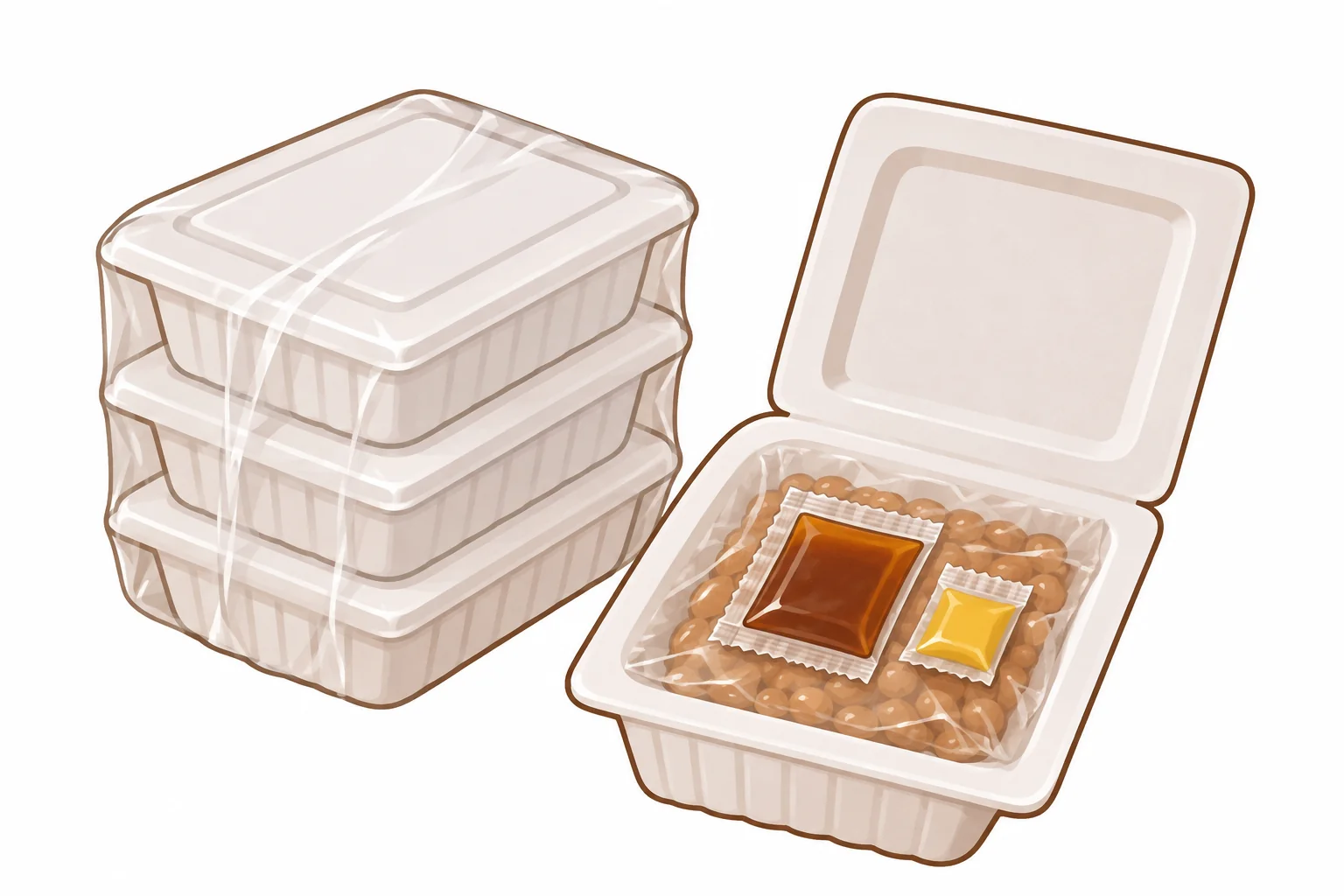
A three-pack of natto in foam tubs, one opened to show sauce and mustard sachets on the beans (illustration).
Eating it follows a ritual that barely varies from household to household. You peel off the plastic and stir the beans hard with chopsticks, always in the same direction. The more you stir, the more the sticky coating multiplies, turning from clear threads into a pale, almost frothy foam. Only then do you squeeze in the sauce and mustard, stir again, and tip the whole thing over a bowl of hot white rice. The threads never break cleanly, so people twirl their chopsticks in the air to wind them up, or simply raise the bowl to their lips.
- 1
 Stir hard in one direction inside the tub; the more you stir, the more slime forms.
- 2
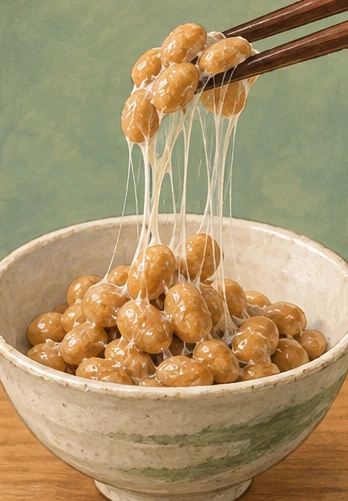 The strings won’t break cleanly—twirl your chopsticks to wind them up.
- 3With sauce and mustard mixed in, tip beans and strings over hot rice.
The order matters to a lot of people. Add the sauce first, they say, and it thins the mucilage so it never whips up properly. How many stirs is ideal is a perennial argument. The gourmet and potter Kitaōji Rosanjin wrote that natto should be worked hard with two chopsticks before anything is added, since the more threads you raise the better it tastes, and that soy sauce should then go in a few drops at a time, stirring between each; he gave no number, and the popular figure of 424 stirs is a later invention. Japanese TV shows and manufacturers still like to compare stir counts; some are said to have tested 50, 100 and 300 stirs side by side. In most homes, twenty or thirty turns is enough before breakfast.
The flavor is gentler than the reputation. The beans are soft, nutty and faintly bitter; the threads carry a savory, almost brothy depth; the sauce adds sweetness and salt; the rice softens everything. What puts people off is the aroma, which grows sharper as natto ages. Japanese shoppers can tell fresh from tired natto at a glance: small white crystals on the beans and a stinging ammonia smell mean it has been in the fridge too long.
02The Bacterium in the Straw
The strings are the work of a microbe. Bacillus subtilis var. natto, usually just called natto-kin (natto bacteria), is a strain of a common soil bacterium that thrives on dry grass and especially on rice straw. Its spores survive boiling. Wrap hot cooked soybeans in straw and keep them warm, and within a day or so the bacteria colonize the beans, break down their protein into savory amino acids, and secrete polyglutamic acid, a long-chain polymer that, together with some sugars, forms the stretchy coating.
That is why natto was traditionally made and sold in straw. Bundles of rice straw were tied at both ends into a tube and filled with cooked beans; this is waratsuto natto, straw-bundle natto. You can still buy it in Mito and around Tōhoku, the northeast of Honshū, and many people swear it tastes better than the tub kind, with a faint grassy note from the straw.
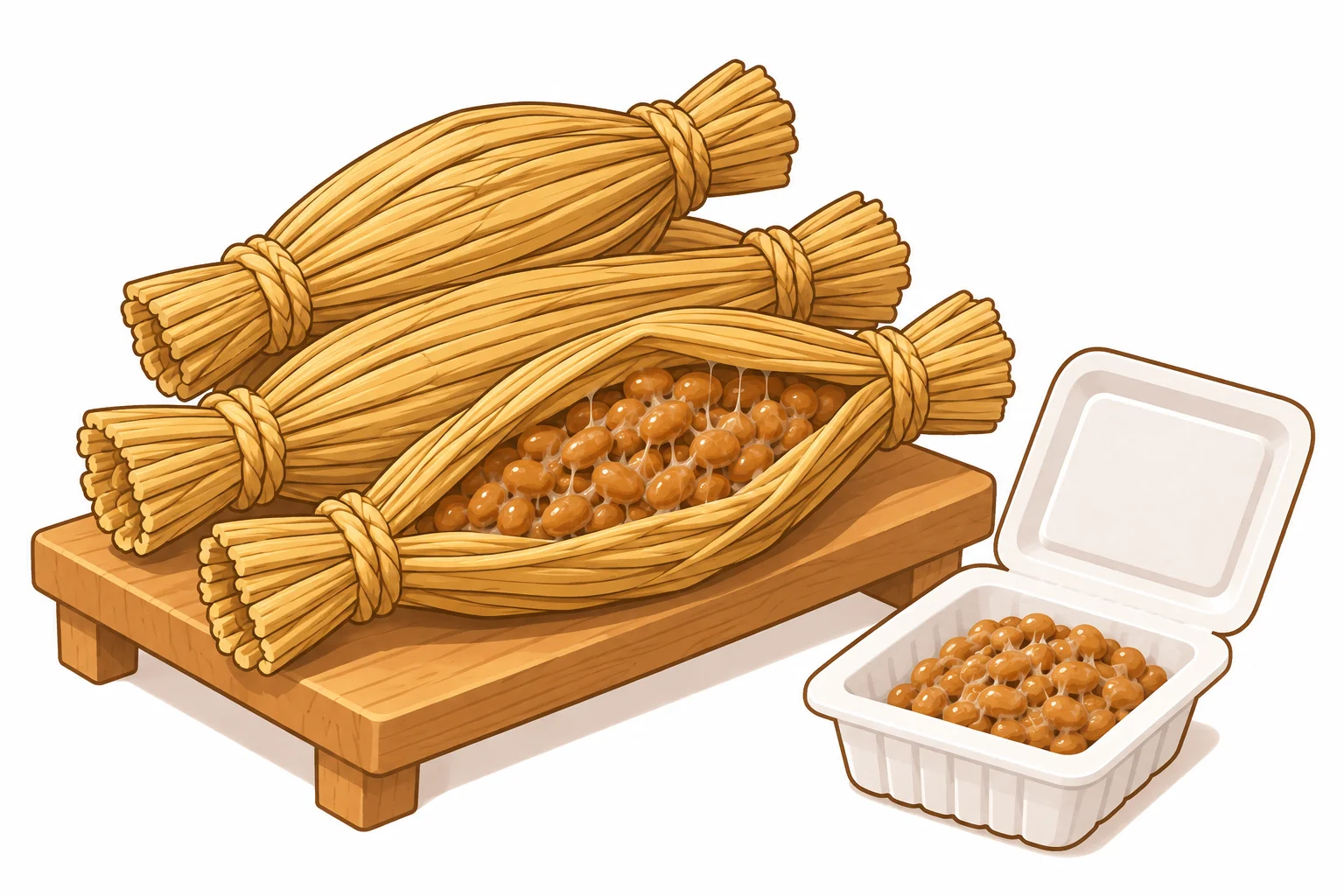
Straw-wrapped wara-tsuto natto tied at both ends, one opened to show the sticky brown beans (illustration).
Japan has several origin stories for natto, all of them legends told long after the fact. The best known credits the warrior Minamoto no Yoshiie, who campaigned in the northeast in the late eleventh century. His soldiers, the story goes, packed boiled soybeans in straw and slung them over their horses; days later the beans had turned stringy, someone tasted them, and found them good. Other versions name Prince Shōtoku or anonymous temple monks. None of these can be documented. The more sensible view is that keeping cooked beans in straw was ordinary practice in rice-growing country, and that stringy natto was discovered, probably many times over, by people nobody recorded.
The word itself causes some confusion. Japan also has an older food called natto, introduced from China and made in Buddhist temples. It is fermented with koji mold rather than bacteria, then dried and salted: black, salty, not stringy at all, and closely related to Chinese fermented black beans. Daitoku-ji natto from Kyoto and Hama natto from Hamamatsu are still made this way and are nibbled with tea or sake. To tell them apart, the stringy kind is called itohiki natto, "thread-pulling natto," and the temple kind tera natto or shiokara natto. When anyone in Japan says natto today, they almost always mean the stringy one.
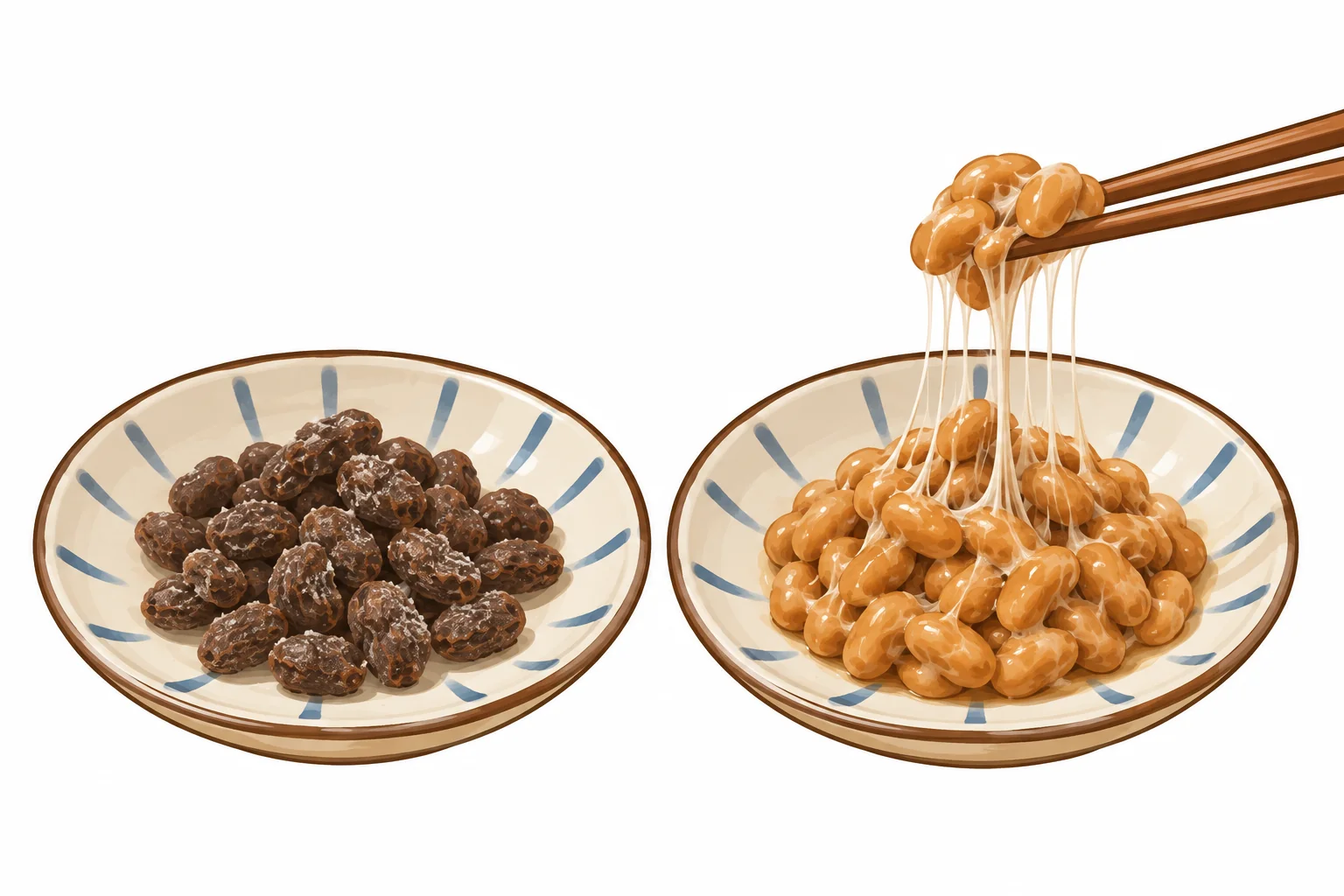
Dry, dark tera-natto that does not string, beside ordinary natto pulled into white threads with chopsticks (illustration).
03From Street Cries to Factory Fermentation
Natto became an everyday city food in the Edo period. In the early mornings of Edo, now Tokyo, vendors walked the streets with baskets on shoulder poles calling "natto, natto," part of a chorus of morning hawkers that included sellers of tofu and freshwater clams. Much of what they sold was tataki natto, chopped natto bundled with tofu and vegetables, ready to drop into miso soup as natto-jiru, a warming winter dish. Natto sellers and natto soup turn up often in comic verse and haiku of the period, and natto-jiru is a seasonal word for winter in haiku.
Straw fermentation was a gamble. The same straw might produce fine natto one day and sour, rotten beans the next if other microbes got in first. Science changed that after the Meiji Restoration. Around 1905 the agricultural chemist Sawamura Shin at Tokyo Imperial University isolated the bacterium responsible and gave it a name. In the Taishō era, Hanzawa Jun at Hokkaido Imperial University developed a method of inoculating beans with a pure culture and fermenting them in temperature-controlled rooms, reportedly including a purpose-designed fermentation room. From then on, natto no longer depended on the luck of the straw and could be made reliably, and eventually industrially.
- 1
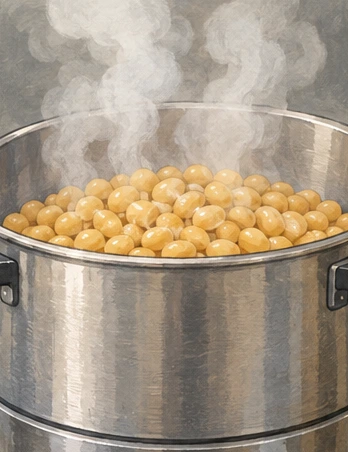 The soybeans are cooked.
- 2
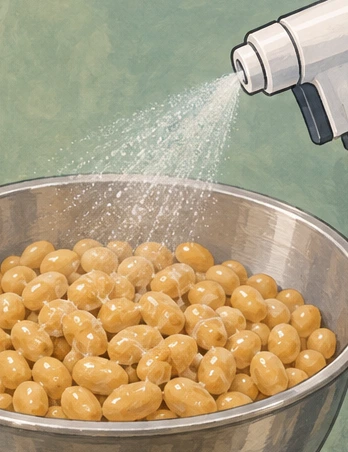 The cooked beans are inoculated with a pure natto culture instead of relying on bacteria in straw.
- 3
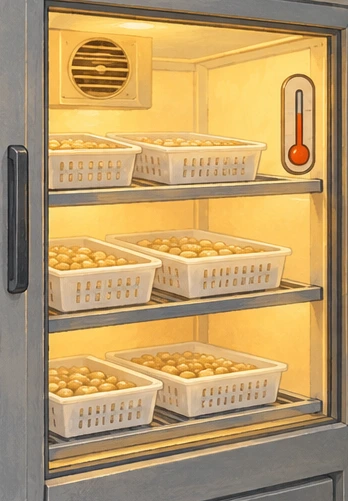 Fermentation indoors at a controlled temperature gives steady quality and allows mass production.
Packaging followed. After straw came kyōgi, thin shavings of wood folded into small triangular or rectangular parcels, then paper cartons. Around the 1960s the polystyrene tub appeared: cheap, light, stackable, and easy to keep cold, and it soon became the standard. Later, sachets of sauce and mustard tucked inside became standard, usually said to date from the 1980s, and manufacturers have kept fiddling since, with sauce packs that snap open without scissors and lids designed so you never have to touch the sticky film. Small improvements, but together they turned natto into a breakfast that needs no preparation at all.
As of the mid-2020s, the largest producer is Takano Foods in Ibaraki Prefecture, whose Okame brand is printed with the round smiling face of Okame, a comic folk mask. Mito’s Tengu Natto is a famous regional name, and supermarket fridges carry dozens of others, from basic three-packs to small-batch natto made with named domestic soybean varieties at several times the price.
04East Loves It, West Not So Much
Natto is not loved equally across Japan. The familiar line is that eastern Japan eats it and western Japan, especially the Kansai region around Ōsaka and Kyoto, does not. The government’s household spending surveys bear this out in broad strokes: the cities that spend most on natto tend to be in the east and north, with Fukushima, Morioka, Akita, Mito and Yamagata regularly near the top (in the 2022–2024 average, Fukushima ranked first and Mito fourth), while Ōsaka and Wakayama spend far less and sit at the bottom of the table.
The usual explanations are practical. The cold winters of Tōhoku and northern Kantō, plentiful straw, and the habit of fermenting beans by the hearth made natto a natural winter protein for farm households. Kansai had a sophisticated tradition of other soy foods, such as tofu and yuba (soy milk skin), and easy access to fish, so a pungent food had less to recommend it. Habit did the rest: children raised without natto rarely took it up as adults. The divide has softened a great deal in recent decades. Kansai supermarkets stock plenty of natto now, and younger people in the west eat it far more than their grandparents did.
If one place is synonymous with natto, it is Mito, the capital of Ibaraki Prefecture northeast of Tokyo. The area grows a small-seeded soybean well suited to natto. When the railway reached Mito in 1889, straw-wrapped natto began to be sold to passengers at the new station as a souvenir to take home (local tradition credits a Mito man, Sasanuma Gorō, with first selling it outside the station), and "Mito natto" became a name known across the country. There is a natto monument at the south exit of Mito Station, and straw-bundle natto is still a staple of the souvenir shops in the station and the city, and reportedly of those around the Kairakuen garden too.
Varieties are sorted mainly by bean size and processing. Large-bean natto has a fuller, meatier bite; small and extra-small beans are the most common because they mix easily with rice. Hikiwari natto is made from soybeans that are cracked and skinned before fermenting, so the pieces are tiny and the stickiness and aroma stronger. It is popular in Tōhoku and is the usual choice for sushi rolls. There are black-soybean natto and regional oddities such as Yamagata’s yukiwari natto, mixed with rice koji and salt and left to mature.
05Why Japan Eats It Every Day
The most straightforward reasons are price, convenience and nutrition. A tub costs a few dozen yen, needs no cooking, and supplies roughly as much protein as an egg. In the classic image of a balanced Japanese breakfast, natto sits alongside rice, miso soup, a piece of grilled fish and a few pickles.
Health is never far from the conversation. In the 1980s the Japanese researcher Sumi Hiroyuki reported an enzyme in natto that breaks down blood clots and named it nattokinase, and natto has been marketed as good for circulation ever since. It is also rich in vitamin K2, associated with bone health. For the same reason, patients on the anticoagulant warfarin are told by Japanese doctors not to eat natto, because vitamin K counteracts the drug; this is standard advice in Japanese hospitals.
That health halo has had its embarrassments. In 2007 a television program produced by Kansai TV claimed that natto helped people lose weight. The next day supermarket shelves across the country were stripped bare. It soon emerged that the program’s data had been fabricated, the show was canceled, and the episode remains one of Japanese broadcasting’s best-known scandals. The scale of the buying frenzy says a good deal about how closely natto is tied, in the Japanese imagination, to the idea of eating well.
July 10 is Natto Day, because 7 and 10 can be read na-ttō in Japanese. Supermarkets run promotions and makers launch new flavors. Japanese feelings about natto are a little like their feelings about rice: few people are connoisseurs, but many miss it after a while abroad.
06Trying Natto in Japan
The easiest place to meet natto is breakfast at a hotel or ryokan, a traditional Japanese inn. A Japanese-style breakfast tray often includes a tub of natto alongside a raw egg and sheets of nori; at hotel buffets it usually sits in the chilled section in neat rows. If you want to give it a real chance, do it the Japanese way. Stir until the beans are wrapped in white foam, add the sauce and mustard, stir again and spoon it over hot rice; chopped green onion helps. If the first mouthful is a struggle, crack a raw egg into the natto and mix. The yolk smooths out both the texture and the smell.
If breakfast does not include it, every supermarket and convenience store has it. A basic three-pack costs about ¥100 (as of 2026), and if your room has a microwave and a packet of rice, that is the cheapest breakfast in Japan. Convenience stores also sell natto rolls wrapped in nori and natto onigiri, both milder introductions than the tub. At a sushi counter, nattō-maki, a thin roll of natto and rice, is a classic way to finish.
Natto turns up in other dishes, too. Soba restaurants serve natto soba, cold noodles topped with natto, green onion and grated daikon. Izakaya menus offer natto fritters, natto omelets, and the much-loved neba-neba bowl, a mix of sticky things such as natto, grated yam, okra and mozuku seaweed, served as a snack with drinks. At home people stir natto into kimchi, put it on curry rice, or spread it on toast with cheese.
If you are passing through Mito, buy a straw bundle and compare it with the supermarket tub to taste what natto was before polystyrene. The only real hazard is the cleanup. The threads end up on the table, the rim of the bowl and the corners of your mouth, and Japanese diners reach for a tissue as well. When you finish, fold the film back into the tub and close the lid so the smell does not linger in your room.
You do not have to like natto. Plenty of Japanese people do not, particularly those who grew up in Kansai. But if you lift that stringy rice to your mouth one morning, winding the threads around your chopsticks as you go, you will be doing exactly what millions of people in Japan are doing at the same hour.