
At a glance
How shade-grown leaf is stone-milled into matcha, how Song-dynasty whisked tea survived in Uji, and how to drink and buy it well in Japan.
- Matcha is tencha ground to a fine powder and drunk whole, powder and water together.
- Tencha fields are shaded for about 20 days after the new buds appear, making the leaf sweeter and greener.
- Whisked powdered tea began in Song China; Eisai brought it to Japan in 1191, while in China it gradually died out.
- A stone mill produces only about 40 grams of matcha an hour, ground to particles of around 10 microns.
- As of 2024, Kagoshima had overtaken Kyoto as Japan’s largest tencha-producing prefecture.
Matcha is green tea ground into a fine powder and whisked into hot water, so that you drink the leaf itself rather than an infusion of it. Its color, its sweetness and its bitterness all come from an unusually laborious process: tea bushes are shaded for weeks before harvest, the leaves are steamed and dried flat without rolling, and the result is milled slowly between stones. The method began in Song-dynasty China, died out there, and survived in Japan for eight centuries in Zen temples, the tea fields of Uji and the tea room. It now turns up in lattes, ice cream and chocolate bars around the world. This is an account of what matcha is, why it tastes the way it does, how it traveled from the monastery to the convenience store, and how to get a good bowl of it in Japan.
01Drinking the leaf
Most tea is an infusion. Hot water draws flavor out of the leaves, the liquid is poured off, and the leaves are thrown away. Matcha skips that separation. The leaf is milled into a powder finer than flour, a small amount is whisked into water with a bamboo whisk, and the whole suspension is drunk. Everything that does not dissolve in water — chlorophyll, fiber, some of the vitamins — goes down with it. That is why a bowl of matcha is so intensely green and why it has body, a faint creaminess on the tongue, that no steeped tea has.
The raw material for matcha is called tencha. It comes from the same plant, Camellia sinensis, and the same spring shoots as the familiar Japanese green tea sencha, but the two part ways in the field. Sencha bushes grow in full sun. Tencha bushes are covered for around twenty days before picking. After harvest the leaves are steamed to stop oxidation and fix the green color — this steaming is what distinguishes Japanese green tea in general from most Chinese green teas, which are pan-fired. Sencha is then rolled and kneaded into needles. Tencha is not. It is blown dry, flat, in a tall brick oven, after which the stems and veins are separated out and only the soft leaf flesh is kept. Tencha looks like dark green flakes of nori seaweed. Only when those flakes are ground does it become matcha.
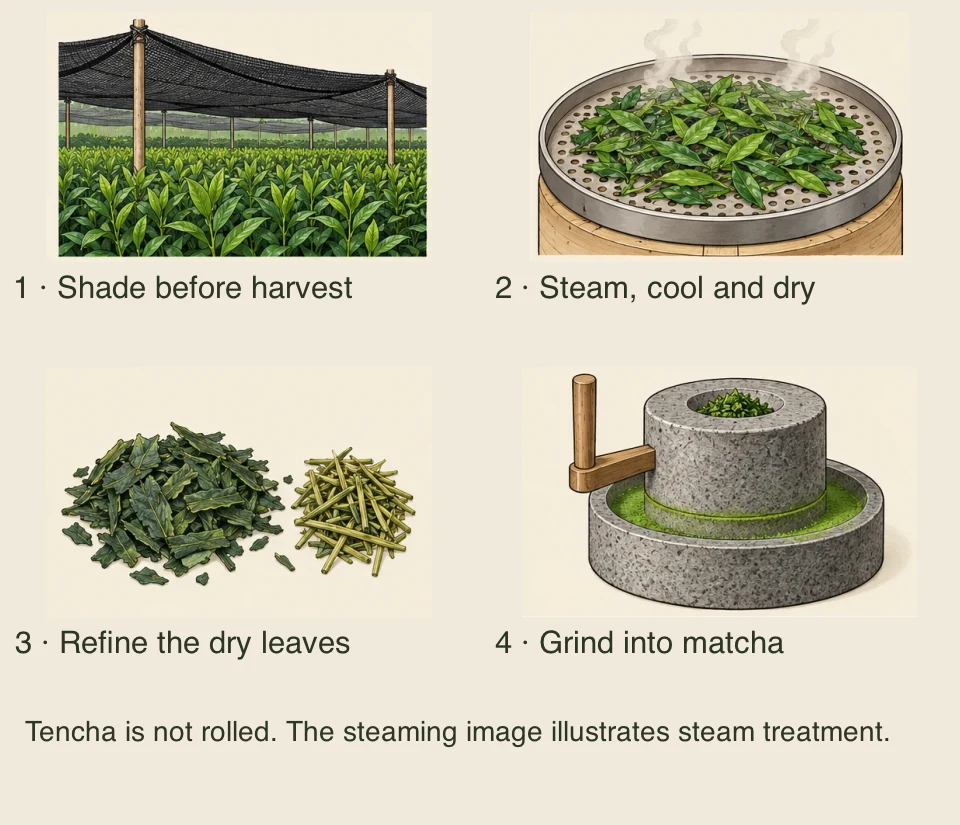
1 Shade the bushes before picking; 2 steam, cool and dry the leaf without rolling; 3 remove stems and veins, keeping the leaf flakes; 4 grind in a stone mill.
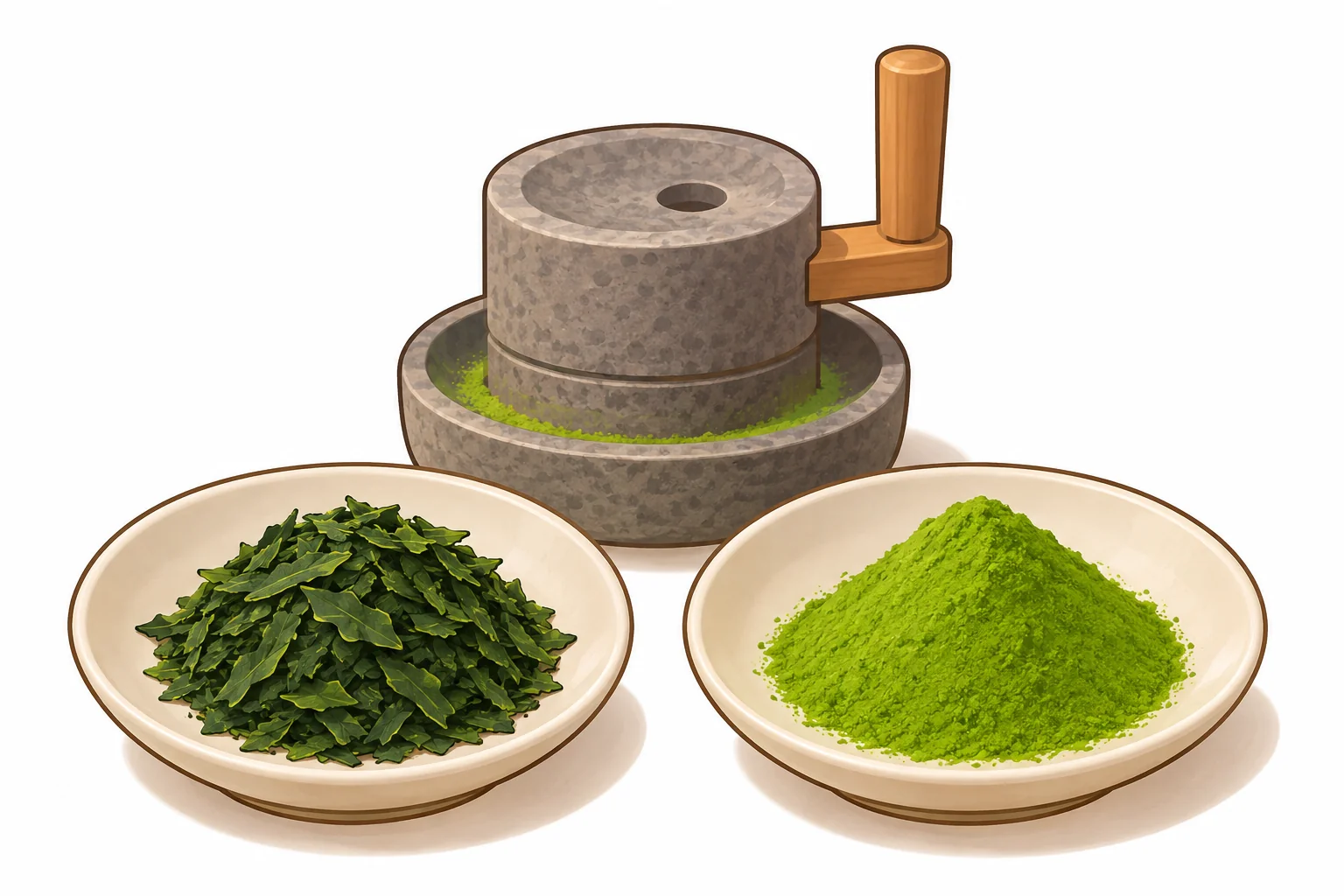
Flakes of tencha on the left, finely ground matcha on the right, a small stone mill between (illustration).
The reason for skipping the rolling is practical. Rolling breaks leaf cells and twists the leaf so that it releases flavor when infused. If the leaf is going to be pulverized anyway, rolling is pointless, and a flat, dry leaf is much easier to strip of its tough veins, which would otherwise make the powder gritty. Tea people in Japan sometimes put the difference this way: with sencha you drink the tea, with matcha you eat it.
02Why the shade matters
Shading is the heart of matcha. Tea leaves contain an amino acid called theanine, which accounts for much of the savory sweetness the Japanese call umami in tea. Theanine is made in the roots and sent up to the new shoots. When sunlight hits the leaves, theanine is gradually converted into catechins, the polyphenols that make tea astringent and bitter. Block the light, and that conversion slows; the shoots keep more theanine and develop fewer catechins. The tea becomes sweeter and less harsh. At the same time the plant, starved of light, grows thinner, broader leaves packed with extra chlorophyll, which deepens the green. Shaded tea also develops a distinctive aroma, often compared to seaweed or fresh green peas, that Japanese tea professionals call ōika, "covered aroma."
The traditional shading method is called honzu. Farmers build a framework of poles over the tea field, lay reed screens across it, and then scatter rice straw on top, adding more as the shoots grow so that the field gets steadily darker. By picking time, the light under the canopy is dim enough that you can barely make out faces. The structure has to be rebuilt every year, and the materials and labor are costly, so honzu survives only in a handful of top-end gardens, mostly around Uji. Most matcha today is grown under black synthetic netting, either draped directly over the bushes or stretched on a frame above them. Uji growers who keep to straw say that it lets the plants breathe and produces softer leaves with a more refined aroma.
An old photograph of a honzu tea garden, with pickers working under the shading canopy; date unknown
Nobody knows exactly when shade-growing began. Covered gardens were established in Uji by the late sixteenth century and the method was widespread by the Azuchi–Momoyama period; radiocarbon dating of old Uji garden soils by Kyoto Prefecture hints that it may go back to the early fifteenth century. It may have started as frost protection — a late spring frost can wreck the first flush — before growers noticed that covered tea came out sweeter and greener. The Portuguese Jesuit João Rodrigues, who arrived in Japan in 1577, described the Uji gardens covered with straw or reed awnings in his History of the Church in Japan, written in the early seventeenth century.
Good matcha uses only the first flush of the year, ichibancha, picked from late April to mid-May. The finest grades are still hand-picked. Leaves from later harvests are coarser, yellower and more bitter, and they mostly go into "culinary" matcha for sweets and drinks.
03A Chinese habit preserved in Japan
Powdered tea is a Chinese invention. In the Tang dynasty, tea was pressed into cakes, broken up and boiled in a pot, the method described in Lu Yu’s eighth-century Classic of Tea. Under the Song dynasty (960–1279), the fashionable method was diancha, "whisked tea." Cake tea was ground to a powder and put in a bowl; a little boiling water was added and stirred into a paste, then more water was poured in while the tea was beaten with a split-bamboo whisk until it frothed. Connoisseurs prized a pure white foam that clung to the sides of the bowl, and held tea competitions to judge it. The Emperor Huizong wrote a treatise on the subject. Black-glazed bowls from the Jian kilns in Fujian, which showed off the white froth, became highly valued; in Japan they came to be called tenmoku.
Japan had imported tea drinking from Tang China as early as the eighth and ninth centuries, but the habit faded. The monk Eisai (also read Yōsai) is credited with establishing it: returning from his second stay in Song China in 1191, he brought Song whisked tea with him and, by tradition, planted seeds on Mount Sefuri in northern Kyūshū. In 1211 he wrote Kissa yōjōki, "Drinking Tea for Health," which opens by calling tea a wondrous medicine for nourishing life. Another widely told story has him giving seeds to the monk Myōe of Kōzan-ji in Toganoo, northwest of Kyoto, whose tea became honcha, "true tea." By the fourteenth century warriors were gambling on tōcha, contests to pick out true tea among several samples, and the Kenmu Code of 1336 banned such gatherings. That story belongs to the tea ceremony and is told more fully there.
What the Japanese were drinking in this era was, in essence, Song whisked tea — the direct ancestor of matcha. Meanwhile China moved on. In 1391 the first Ming emperor, Zhu Yuanzhang, ordered that tribute tea be sent as loose leaves rather than pressed cakes, and over the following centuries Chinese drinkers came to steep loose leaf in hot water, the way most of the world drinks tea now. Whisked powdered tea disappeared in China. The result is one of those odd historical inversions: a Chinese visitor handed a bowl of matcha in a Kyoto tea room is drinking something closer to the tea of Su Shi’s time than anything served in China today.
04Uji, the tea town
By the fifteenth century Uji, south of Kyoto, had overtaken Toganoo. The Uji River flows down from Lake Biwa, and mist rises off it on spring mornings; the hillsides drain well and the nights are cool. Above all, Uji was close to the capital and to power. The Ashikaga shoguns favored it, and the third shogun, Ashikaga Yoshimitsu, is traditionally said to have designated seven celebrated gardens there, the "Seven Gardens of Uji." Only one, Okunoyama, is still farmed.
The real making of Uji came with the rise of the tea ceremony in the sixteenth century. Tea masters such as Sen no Rikyū turned tea drinking into a highly refined art, and the quality of the tea itself mattered enormously. Oda Nobunaga and Toyotomi Hideyoshi, the warlords who unified Japan, both patronized Uji tea, and families of official tea suppliers, ochashi, grew up there to grow, process and store tea for the powerful. The Kanbayashi family was the most prominent. Shade-growing matured in this period, and for a long time afterward only the Uji tea masters were permitted to grow covered tea, which gave Uji what amounted to a monopoly on top-grade matcha.
Under the Tokugawa shogunate, an official procession traveled every year from Edo to Uji to collect new tea and carry it back in large ceramic jars. This was the ochatsubo dōchū, the "tea-jar procession," and it was formalized in 1632 and ran until 1866, almost the end of the shogunate. Its rank was high, and commoners along the road had to clear the way. A popular explanation holds that the children’s rhyme "Zui zui zukkorobashi," with its line about the tea jar coming and shutting the door, describes villagers hiding indoors as the procession passed — an appealing story, though it is a later interpretation.
The jars point to how tea was stored. Freshly made tencha was sealed in jars in early summer and kept in cool mountain storehouses through the hot months to mellow. In autumn the jar was opened, a ritual called kuchikiri, "cutting the mouth," and the leaf was ground in a stone mill as needed. Matcha loses its aroma quickly once ground, so it was milled fresh. Today most matcha is sold already ground in sealed tins, but tea practitioners still hold kuchikiri gatherings in November, and they still call November "the tea person’s New Year."
Some Uji tea shops are astonishingly old. Tsūen, at the east end of the Uji Bridge, dates its founding to 1160, making it one of the oldest businesses of any kind in Japan; its present building dates from 1672. The teahouse is said to appear in Yoshikawa Eiji’s novel Musashi. Descendants of the Kanbayashi family still run a tea shop in Uji. Walk the approach to Byōdō-in temple today and you pass tea shop after tea shop, with the smell of roasting hōjicha drifting into the street.
05Matcha in the tea ceremony
The tea ceremony, chanoyu or sadō, deserves its own account, but matcha’s role in it shapes how the tea is graded and judged, so a few points are worth knowing.
There are two ways of preparing matcha in the ceremony. Usucha, "thin tea," is the bowl most people encounter. About 1.5 to 2 grams of powder — two scoops of the slender bamboo scoop called a chashaku — is whisked briskly with roughly 60 to 70 milliliters of hot water until a fine foam forms. Different schools whisk differently: the Urasenke school favors a dense, creamy foam covering the surface, while the Omotesenke school whisks less, leaving a patch of unfoamed tea in the center. Each guest gets a bowl of their own.
Koicha, "thick tea," is the most solemn moment of a formal tea gathering. Two to three times as much powder is used with much less water, and instead of being whisked, it is kneaded slowly with the whisk into a glossy, dark green liquid with roughly the consistency of melted chocolate. Traditionally the guests share a single bowl, each taking a few sips, wiping the rim and passing it on. Because koicha concentrates everything, only the very best, sweetest shade-grown matcha will do; an ordinary grade made this thick becomes harsh and undrinkable. This is why tea merchants grade their matcha first by whether it is suitable for koicha or only for usucha.
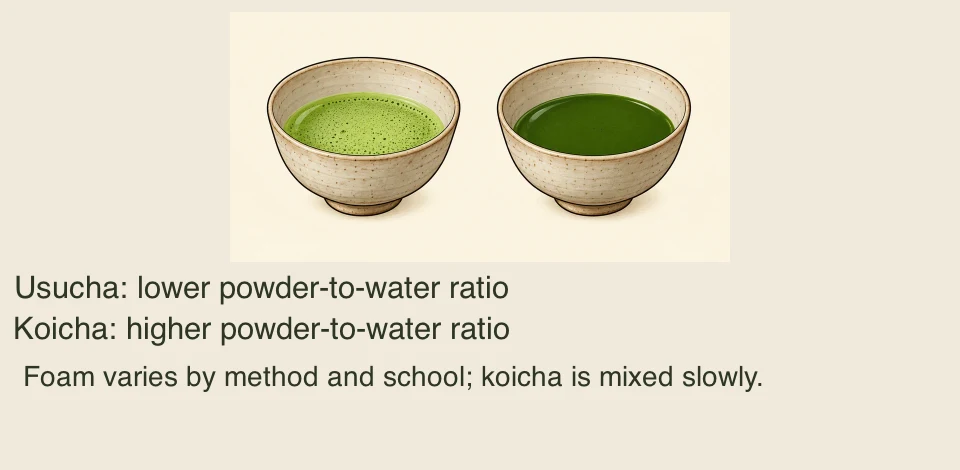
Left, frothy usucha; right, koicha, more powder and less water, kneaded slowly.
Merchants give their premium blends poetic names. Two common endings are -no-mukashi and -no-shiro. Tradition holds that mukashi names are for koicha and shiro names for usucha, and one story explains mukashi (昔) by breaking the character into components that read "twenty-first day," supposedly the date of an early harvest — a pleasing etymology of uncertain truth. When the head of a tea school endorses a particular blend, the tin will carry the words konomi, "preferred by," followed by his name.
The tools are all built around matcha. Powder is kept in a lacquered natsume or a ceramic chaire; it is measured out with the chashaku; it is whisked with a chasen, carved from a single section of bamboo split into dozens of fine tines. Most chasen are made in Takayama, in Nara Prefecture. And the bowl, the chawan, sits at the center of tea aesthetics: the hand-formed Raku bowls of Kyoto, the soft, crackled Hagi wares, the earthy Karatsu.
06How good matcha is made
Quality starts with the cultivar. Most Japanese sencha comes from a single dominant variety, Yabukita, but matcha growers favor others that respond well to shade: Asahi, Samidori, Gokō, Okumidori. Many high-end Uji matchas use Asahi or Samidori for their vivid color and deep sweetness.
Then there is blending. Leaf from the same garden and the same cultivar varies from year to year and batch to batch, so tea houses employ master blenders who combine different lots of tencha to keep each named product consistent. This, more than anything, is the craft of a tea merchant, and it is why two matchas at the same price from different shops can taste completely different.
Traditional milling uses granite millstones. The upper stone is carved with precise grooves and turned slowly — usually said to be only a few dozen revolutions a minute — because friction heat damages both color and aroma. A single mill produces only about 40 grams an hour — roughly one tin. Large producers run rooms full of stone mills around the clock. The finished powder has particles only about ten microns across, finer than flour, which is why good matcha feels silky rather than powdery in the mouth. Ball mills and air-jet mills, far faster, now produce much of the matcha used as an ingredient.
You can judge a lot by eye and nose. Good matcha is a vivid, bright jade or deep green; yellowish, grayish or dull powder is either a late, low-grade harvest or old and oxidized. It smells sweet and marine. Whisked, it makes a fine, lasting foam, and the first impression on the tongue is rich sweetness and umami, with bitterness arriving later and a long finish. Cheap matcha hits immediately with harsh bitterness and leaves the mouth dry.
Matcha is sensitive to light, heat, moisture and air. Once a tin is opened, color and aroma fade within weeks, so shops recommend keeping it in the refrigerator and finishing it within about a month. That is why it is sold in small tins of 20 or 40 grams.
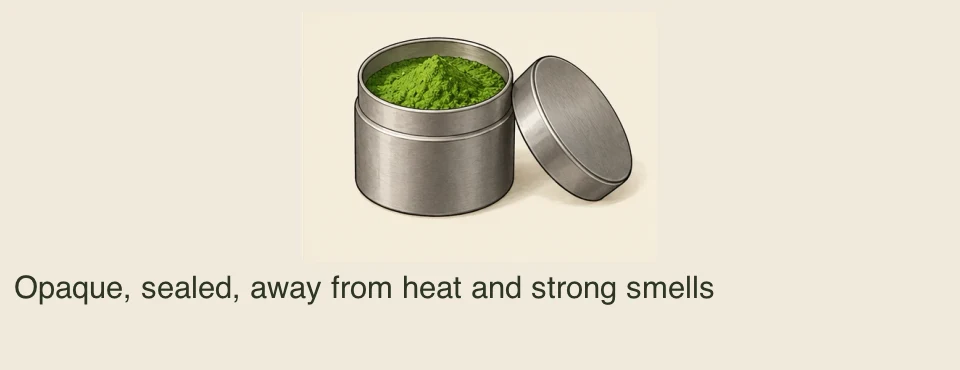
Matcha fades with light, heat and damp; refrigerate once opened and finish within about a month.
Uji is no longer the only source. Tencha is produced in Kyoto Prefecture, around Nishio in Aichi Prefecture — where tea growing took off after the Meiji era, turned mainly to tencha in the 1920s and now supplies much of the country’s ingredient-grade powder; local accounts say Nishio once ranked among the country’s top tencha producers — and in Shizuoka, Mie, Nara and Kagoshima. National tencha output roughly tripled in the decade to 2024 in response to overseas demand, and Kagoshima, growing fastest, had overtaken Kyoto as the largest tencha-producing prefecture by 2024. "Uji tea" has a formal definition: tea grown in Kyoto, Nara, Shiga or Mie prefectures and finished within Kyoto Prefecture by Kyoto businesses using Uji methods. Some statements of the definition add that Kyoto-grown leaf should be given priority.
07From tea room to ice cream
Until the nineteenth century, matcha belonged to temples, the court, the warrior class and wealthy merchants. After the Meiji Restoration of 1868 swept away the samurai and their patronage, the tea ceremony went into decline, then revived with the support of industrialist collectors and as a subject of etiquette training for young women. Through the twentieth century, tea ceremony lessons became a common accomplishment for Japanese women, and matcha entered ordinary homes, though it kept an aura of formality.
What made matcha an everyday flavor was sweets. Kyoto confectioners had long used it. Uji kintoki, shaved ice drizzled with matcha syrup and topped with sweet red beans, has long been a summer staple, by most accounts already so in the Shōwa era. Gion Tsujiri opened its Saryō Tsujiri tea café in 1978, Nakamura Tōkichi in Uji followed with its café in 2001, both serving matcha parfaits, dumplings and soft-serve; the queues outside became a sight in their own right.
From the 1990s, large companies took matcha national. Häagen-Dazs Japan’s green tea ice cream, launched in 1996 as the brand’s first flavor developed in Japan, became a long-running bestseller. Nestlé Japan’s Uji matcha Kit Kat, first sold in 2004, turned into a standard souvenir for foreign visitors. Starbucks and other coffee chains made the matcha latte a menu standard; the drink is generally thought to have caught on in Japan and elsewhere in Asia before it spread to North America and Europe. Convenience stores now stock matcha roll cakes, puddings and cookies year-round, with a burst of new products every spring.

A matcha latte and matcha cake: matcha moved from the tea room into everyday sweets and drinks.
From the 2010s, matcha became a wellness drink abroad. Its pairing of caffeine with theanine — said to give alertness without the jitters of coffee — appealed strongly in North America and Europe. Matcha cafés opened in New York, Los Angeles and London, and green lattes became a fixture of social media. By the mid-2020s overseas demand was growing faster than Japanese producers could expand. Well-known Kyoto and Uji shops imposed purchase limits of one or two tins per customer and some suspended parts of their online sales; according to press reports, some shops also stopped taking overseas orders for a time. Japanese green tea exports came to about 36.4 billion yen in 2024 and roughly doubled to about 72.1 billion yen in 2025, driven mainly by matcha and other powdered tea.
Overseas marketing often divides matcha into "ceremonial grade" and "culinary grade." These are sellers’ terms, not Japanese standards; there is no official grading of that kind in Japan. Japanese shops describe their tea more directly — for koicha, for usucha, for cooking — or simply by name and price. As a rough guide at mid-2020s prices, matcha costing upward of 2,000 to 3,000 yen for 40 grams is meant to be whisked and drunk on its own; much cheaper powder is better in lattes and baking.
08Drinking matcha in Japan
The easiest place to have a proper bowl is Kyoto. Many temples have a tea seat beside their gardens where you can sit on tatami, look out at the garden and drink a bowl of usucha with a small sweet. The area around Kōdai-ji in Higashiyama, the area around Tenryū-ji in Arashiyama, and the streets near Byōdō-in in Uji all have such places. Nobody expects visitors to know tea ceremony etiquette, but a few gestures help.
The sweet comes first, for a reason: a mouthful of sugar makes the bitterness of the tea gentler and brings out its sweetness. The bowl will be set in front of you with its decorated "front" facing you. Pick it up with your right hand, rest it on your left palm, bow slightly, and turn it clockwise twice so that the front faces away — you drink from the side, out of respect for the bowl. Finish usucha in about three and a half sips; a soft slurp on the last one signals that you have finished and is not rude. Wipe the rim where you drank with your fingers, turn the bowl back, and set it down with the front facing the host. If you want to admire the bowl, hold it low, close to the mat, so nothing breaks if it slips.
- 1The sweet first
- 2Right hand, left palm, bow
- 3Turn clockwise twicefront faces away
- 4Finish in about three and a half sipsa soft slurp on the last one
- 5Wipe the rim with your fingers
- 6Turn back, front toward the host
Turning the bowl means you drink from the side, out of respect for the bowl; turn it back before setting it down.
Uji itself is worth a trip, twenty to thirty minutes from Kyoto Station on the JR Nara Line. Some tea shops on the Byōdō-in approach let you try grinding tea on a stone mill or whisking your own bowl, and the city-run tea house Taihō-an, on the riverbank facing toward Byōdō-in, serves a bowl of usucha with a sweet. In Uji’s shops, as of the mid-2020s, matcha runs from about a thousand yen for a few tens of grams to over ten thousand for a top koicha blend; staff will often let you taste and explain which tins suit koicha and which suit usucha. In central Kyoto, Ippodo Tea on Teramachi Street, in business since 1717, has a tea room, Kaboku, where staff show you how to brew sencha or whisk matcha. Tokyo now has a crop of new-style matcha bars serving single-cultivar, single-origin matcha, compared the way coffee people compare beans.
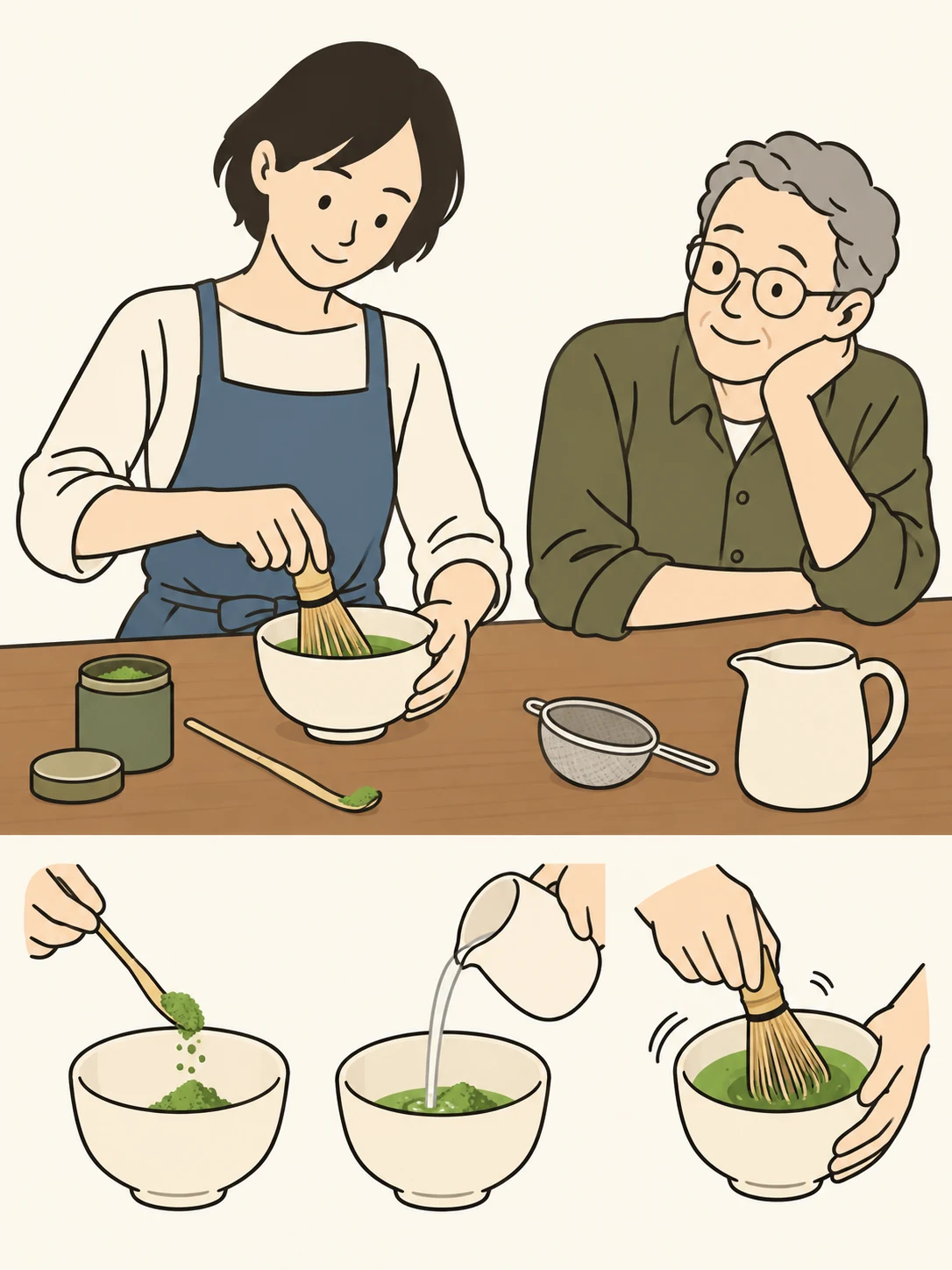
If you buy matcha to take home, choose a small tin, refrigerate it and use it quickly. To make it, you need a chasen and a wide bowl. Sift the powder first through a fine strainer, or it will clump. Use water around 70 to 80°C, not boiling, which brings out bitterness. Put the whisk to the bottom of the bowl and, moving from the wrist, beat it rapidly back and forth in an M or W pattern; in fifteen seconds or so you will have foam. Finish by drawing the whisk gently up through the center. Your first bowls will be uneven. That is normal.
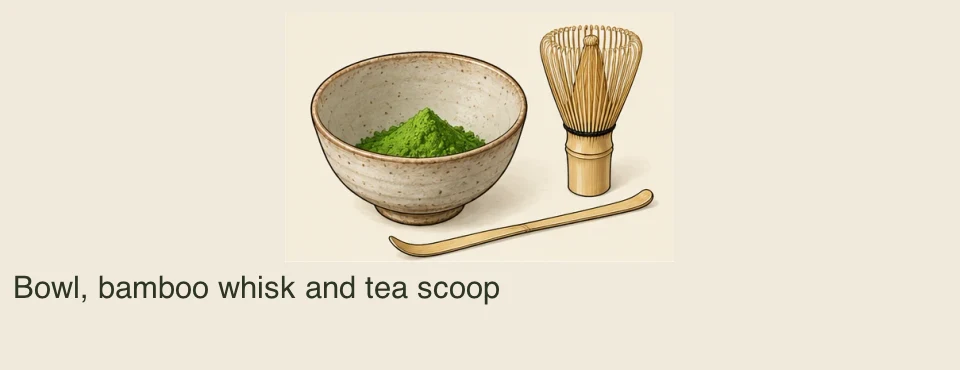
A tea bowl, a bamboo whisk (chasen) and a scoop (chashaku).
Many Japanese will tell you that matcha is an acquired taste. First-time drinkers often find it simply bitter; after a few bowls the sweetness and savoriness behind the bitterness come through, along with that aroma of green peas, nori and cut grass. It is not a drink for quenching thirst. It asks you to sit, wait for the bowl to be whisked, hold it in both hands and look at the foam before you drink.