
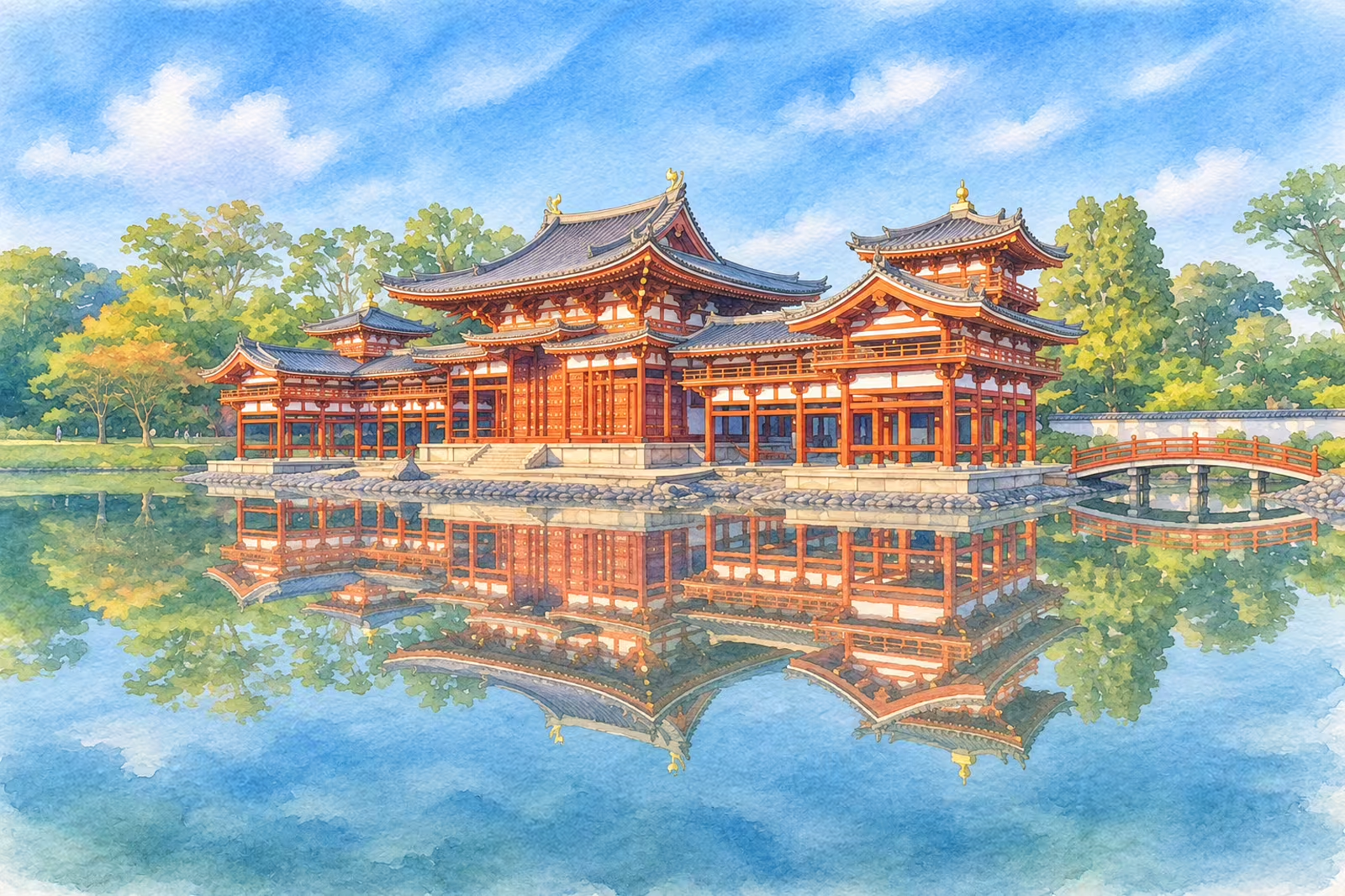
Byōdō-in stands on the west bank of the Uji River in Uji, Kyoto Prefecture. The regent Fujiwara no Yorimichi converted his father’s villa into this temple in 1052. Its Amida Hall, completed the following year and now known as the Phoenix Hall, survives together with the seated Amida Buddha inside it, the most complete surviving expression of the Pure Land faith of the Heian aristocracy. Byōdō-in was inscribed as a World Heritage Site in 1994 as part of the Historic Monuments of Ancient Kyoto, and the Phoenix Hall appears on Japan’s 10-yen coin.
01From Villa to Temple
The land is said to have passed through the hands of Minamoto no Tōru and Emperor Uda, among others, before coming to Fujiwara no Michinaga, who called it Uji-dono. After Michinaga’s death it went to his son Yorimichi. In 1052 Yorimichi turned it into a temple and named it Byōdō-in. By the reckoning of the time, that year was the first year of mappō, the age of the decline of the Buddhist law, and aristocrats longed to be reborn after death in the Western Paradise of Amida Buddha. The Amida Hall was completed in 1053.
02The Phoenix Hall and Its Images
The Amida Hall stands on an island in the Aji Pond. Wing corridors extend to either side of the central hall and a tail corridor runs behind it, so that the whole resembles a bird with outstretched wings; a pair of bronze phoenixes crowns the roof, and from the Edo period it came to be called the Phoenix Hall. The seated Amida inside is by the sculptor Jōchō, made with the joined-block technique he perfected, and is his only securely attributed surviving work. On the walls around it hang 52 Bodhisattvas on Clouds, and the walls and doors are painted with scenes of Amida’s descent to welcome the dying. The building and garden together are understood as an attempt to bring the palace of the Pure Land into this world.
In 1180 Minamoto no Yorimasa rose against the Taira in the name of Prince Mochihito; defeated at Uji, he is said to have taken his own life within Byōdō-in. During the fighting around 1336, most of the temple’s buildings burned, and only a few, including the Phoenix Hall and the Kannon Hall, survived.
03What Can Be Seen Today
The Phoenix Hall, the Amida statue, the Bodhisattvas on Clouds, the temple bell and the bronze phoenixes are all National Treasures, and the garden is a National Historic Site and Place of Scenic Beauty. The original phoenixes, the bell and half of the bodhisattvas have been moved to the Hōshōkan museum, opened in 2001. A restoration from 2012 to 2014 repainted the exterior of the Phoenix Hall according to research on its original colors. Byōdō-in belongs to no single sect today and is jointly managed by Saishō-in of the Tendai school and Jōdo-in of the Jōdo school.
Byōdō-in
01The View Across the Pond
Most visitors to Byōdō-in come through the gate, follow the path past wisteria trellises, and stop short when the pond opens in front of them. On the far side stands a building that almost every person in Japan carries in their pocket: it is the image on the ten-yen coin. A central hall sits on an island, two long corridors stretch out to either side and turn forward at the corners, small towers rise at the bends, and on the ridge of the main roof two gilded phoenixes face each other. The whole structure is reflected in the water.
Today it is called the Phoenix Hall, or Hōō-dō. When it was dedicated in 1053 it was simply the Amida Hall, a chapel built to house a gilded statue of Amida, the Buddha of the Western Paradise. Its patron was Fujiwara no Yorimichi, the most powerful man at the imperial court, and its sculptor was Jōchō, the leading Buddhist image-maker of his age. Almost everything else that once stood at Byōdō-in has gone, but the Amida Hall, its statue, and much of its interior decoration have survived for nearly a thousand years. It is the best place in Japan to see what the Heian-period aristocracy (the court culture of roughly 794 to 1185) imagined heaven to look like. Since 1994 it has been part of the UNESCO World Heritage listing "Historic Monuments of Ancient Kyoto."
02Uji, a Retreat for the Court
Uji lies about fifteen kilometers southeast of the old capital, Heian-kyō, modern Kyoto. The Uji River comes down out of the hills from Lake Biwa and slows as it reaches the plain. Mist rising off the water and the wooded hills on either bank made Uji a favorite retreat for courtiers, and it sat on the road to Nara, guarded by a bridge that was already old in the Heian period.
The land where Byōdō-in stands is traditionally said to have begun as the villa of Minamoto no Tōru, a son of Emperor Saga and a minister of the left, often cited as one of the models for Prince Genji in The Tale of Genji. The estate passed through several hands, traditionally including Emperor Uda and later the minister Minamoto no Shigenobu, before it was acquired in 998 by Fujiwara no Michinaga. Michinaga was the most successful of the Fujiwara regents, the family that controlled the throne by marrying its daughters to emperors. Several of his daughters became imperial consorts, and three of his grandsons became emperor. His villa at Uji was known as Uji-dono.
The final ten chapters of The Tale of Genji, known as the "Uji chapters," are set here. Murasaki Shikibu, its author, served in the household of Michinaga’s daughter Shōshi, so the misty, melancholy Uji of her novel belongs to the same world as the Fujiwara villa. The Tale of Genji Museum is a short walk from the temple.
03Yorimichi and the Age of the Latter Law
Michinaga died in 1027 and the Uji villa passed to his eldest son, Fujiwara no Yorimichi. Yorimichi had become regent while still in his twenties, and he held the posts of regent (sesshō) and chancellor (kanpaku) for about fifty years under three emperors. His position, though, was weaker than his father’s. He had no daughter who bore an imperial son, so the family’s grip on the succession was loosening, and in the provinces a warrior class was gaining strength. The Fujiwara were at the peak of their wealth, and the decline had already begun.
In 1052 Yorimichi turned his father’s villa into a temple and named it Byōdō-in. The date mattered. Buddhist thought in Japan divided history after the death of the historical Buddha into three ages: the age of the True Law, when teaching, practice, and enlightenment all existed; the age of the Semblance Law, when practice continued but enlightenment was rare; and the age of the Latter Law, called mappō, when only the teaching remained and no one could reach enlightenment through their own efforts. By the reckoning common in Heian Japan, mappō began in 1052.
If salvation by one’s own effort was no longer possible, the answer was to rely on the vow of Amida Buddha, who had promised to bring anyone who called on him with faith to rebirth in his Pure Land in the west. At the moment of death, it was believed, Amida would descend on clouds with a host of bodhisattvas to welcome the believer. The monk Genshin’s Essentials of Rebirth in the Pure Land (Ōjōyōshū), completed in 985, laid out the horrors of hell and the splendors of paradise in vivid detail, and it was widely read at court. Michinaga himself was a devoted follower of Amida; A Tale of Flowering Fortunes (Eiga monogatari) says he died holding cords tied to the hands of Amida statues.
The first head of the new temple was Myōson, a monk of Onjō-ji (Mii-dera), the head temple of the Jimon branch of the Tendai school. In the third month of 1053 the Amida Hall was dedicated.
04A Palace from Paradise
The sutras and paintings of the time described Amida’s Pure Land as a place of jeweled ponds full of lotus flowers, lined with towers and palaces. The Amida Hall was an attempt to build that scene in Uji.
The hall faces east. The central hall has a single main roof with a lower skirt roof (mokoshi, a pent roof wrapped around the walls) around it, so it appears to have two stories. Wing corridors run north and south and bend forward at their ends, with small towers at the corners. A tail corridor extends to the west behind the central hall. Seen from above or in front, the plan resembles a bird with its wings spread: the side corridors are the wings and the rear corridor is the tail.
The wing corridors have no practical function. Their upper floors are too low for an adult to stand in, and the railings are purely decorative. They exist to make the building look light and balanced when seen across the water. The hall stands on an island in the pond, called the Aji-ike, and it was designed to be viewed from the eastern shore.
There is a round opening in the lattice above the central doors. From the far bank, the face of Amida can be seen through it. A worshipper standing on the east bank, with the rising sun behind him, looked west across the water to the palace of paradise and the Buddha within. A saying current in the late Heian period put it this way: if you doubt paradise, go and pay your respects at the temple in Uji.
The name Phoenix Hall came later; it came into use in the early Edo period (1603–1868). It refers either to the pair of bronze phoenixes on the roof or to the bird-like shape of the building, or to both.
05Jōchō’s Amida
Inside, the main image is a seated Amida about 2.8 meters tall (it is classed as a jōroku, or "sixteen-foot," image, a conventional size category rather than a measurement), with hands resting in the meditation gesture, on a lotus throne, in front of an openwork halo and beneath an elaborate wooden canopy. It is the only surviving work that can be securely attributed to Jōchō.
Jōchō was the first Buddhist sculptor to receive an ecclesiastical rank, hokkyō, and his style set the standard for Japanese Buddhist sculpture for the next two centuries. Contemporaries praised his figures as the true model of the Buddha. The Byōdō-in Amida shows why: the face is full and calm, the body is relaxed and gently proportioned, and the drapery falls in shallow, even folds. The effect is serene rather than imposing.
The statue is made by the joined-wood technique, yosegi-zukuri, in which separate blocks are carved and fitted together and the interior is hollowed out. This made large statues lighter and less likely to crack, and allowed workshops to divide the labor. Jōchō did not invent the method, but he brought it to maturity, and it made possible the large number of big gilded statues the Heian aristocracy commissioned.
Flying celestial figures are attached to the halo. The canopy above is carved in openwork, and the pillars, beams, and ceiling of the hall were once painted all over in bright patterns. Most of this color has darkened, but studies of the surviving traces show that the interior was originally dazzling.
06Bodhisattvas on Clouds and Paintings of Descent
High on the walls of the central hall hang fifty-two small wooden figures known as the Bodhisattvas on Clouds (Unchū Kuyō Bosatsu). Each rides on a cloud. Some play instruments, including lutes, flutes, mouth organs, and drums; some dance; some hold lotus flowers or banners; some sit in prayer. They are the heavenly host that accompanies Amida when he descends to receive the dying. They date from 1053 and are thought to be the work of Jōchō’s workshop. About half of them remain in the hall; the rest are displayed in the temple museum.
The doors and walls of the hall are painted with scenes of Amida’s descent according to the nine grades of rebirth described in the Contemplation Sutra: believers are divided into three classes, each with three levels, and each receives a different kind of welcome. What makes these paintings remarkable is the setting. The hills, rivers, fields, and trees in the background are recognizably Japanese landscapes, shown through the seasons, and they are among the earliest surviving examples of yamato-e, the native Japanese style of painting. Amida comes down not to some imagined Indian or Chinese scene but to the countryside the Heian court knew.
The paintings, along with the statue and the bodhisattvas, are National Treasures. Several of the original door panels are now kept in the museum and replaced in the hall by copies.
07Growth, Battle, and Fire
The Amida Hall was only one building in what became a large temple complex. A Lotus Sutra hall followed in 1056; in 1061 Yorimichi’s daughter Kanshi, empress to Emperor Go-Reizei, built a two-story treasure pagoda (tahōtō); and a hall of the Five Great Wisdom Kings went up in 1066. Yorimichi’s descendants kept adding buildings, and at its height Byōdō-in was one of the principal temples of the regent’s house. Yorimichi spent his last years at Uji and died there in 1074 at the age of eighty-three by East Asian reckoning.
Byōdō-in is also where the Genpei War, the great civil war between the Taira and Minamoto clans, began. In 1180 Prince Mochihito and the aged warrior Minamoto no Yorimasa rose against the Taira. Pursued by a large Taira army, they fled south from Mii-dera toward Nara and made a stand at the Uji River, tearing up the planks of the Uji Bridge. The Taira forced the crossing. Mochihito escaped but was killed soon afterward; Yorimasa, then in his seventies, withdrew into Byōdō-in and took his own life. According to tradition he did so on a lawn beside the temple, sitting on a spread war fan, after writing a farewell poem comparing himself to a buried log that had never flowered. A fan-shaped patch of grass near the Kannon Hall, called the Ōgi-no-shiba, marks the traditional spot, and his grave stands beside the subtemple Saishō-in.
In 1336, during the wars between the Northern and Southern Courts, fighting between Kusunoki Masashige and the forces of Ashikaga Takauji spread to Uji; Kusunoki’s troops set fires, and most of Byōdō-in burned. The Amida Hall survived, along with the Kannon Hall, built in the early Kamakura period on the site of the original main hall, and the bell tower. After this the temple declined. The Pure Land subtemple Jōdo-in was founded in the 1490s and the Tendai subtemple Saishō-in in 1654, and from the Edo period the two have looked after Byōdō-in jointly, an arrangement that continues today. Byōdō-in itself does not belong to any sect.
08Restoration and Color
The Amida Hall has been repaired many times. The largest modern project was the Shōwa restoration of 1950 to 1957, when the hall was dismantled and rebuilt. Around 1968, to protect them, the original bronze phoenixes were taken down and replaced with replicas; the bell and the central doors were also replaced by copies in these years.
From the 1990s the garden was excavated and restored. Archaeologists found the Heian-period pebble beach (suhama) that once formed the edge of the pond, and the pond’s outline was returned to its original form. Between 2012 and 2014 the hall underwent the Heisei restoration. The roof was re-laid, and the exterior woodwork was repainted in nitsuchi, a reddish-brown earth pigment identified from traces on the building, while the phoenixes were regilded. When the scaffolding came down, many people were startled by how bright the hall looked. The color is a reconstruction of how it looked in the eleventh century.
In 2001 the temple opened its museum, the Hōshōkan, most of which is built underground so as not to spoil the view of the garden. It houses the original phoenixes, the temple bell, half of the Bodhisattvas on Clouds, and original door paintings.
09Coins, Banknotes, and Treasures
Few buildings in Japan are as familiar. The Phoenix Hall has appeared on the ten-yen coin since 1951. The phoenix from its roof was printed on the back of the 10,000-yen note issued in 2004.
The temple’s National Treasures include the Phoenix Hall itself, the Amida statue and its canopy, the Bodhisattvas on Clouds, the wall and door paintings, the pair of phoenixes, and the bronze bell. The bell is covered with relief decoration, including celestial figures and lions, and is counted with the bells of Jingo-ji and Mii-dera as one of the three famous bells of Japan; it is known for its form. The garden is designated a Historic Site and Place of Scenic Beauty, and the Kannon Hall is an Important Cultural Property.
10Walking the Grounds
From the main gate, walk along the pond until the Phoenix Hall comes into view. The best place to stand is on the east bank directly opposite the central hall. From there you can see Amida’s face through the round window. In the early morning, with the sun behind you, the hall is reflected in the water just as its builders intended.
Entry to the interior of the Phoenix Hall requires a separate ticket and is by guided group at set times, with limited numbers, so it is worth buying a ticket on arrival. Inside you can see the Amida statue, the canopy, the bodhisattvas on the walls, and the faded paintings.
Walking around the pond, you pass the Kannon Hall, the Ōgi-no-shiba where Yorimasa is said to have died, the bell tower with its replica bell, the Fudō Hall, and the subtemples Saishō-in and Jōdo-in. The Hōshōkan museum is tucked into the garden, half below ground. Inside you can see the original phoenixes up close, the details of the bell, and the bodhisattvas, each with a different face and pose.
Outside the temple, the approach along the river is lined with shops selling Uji green tea. Across the river are Ujigami Shrine, whose main hall is among the oldest surviving shrine buildings in Japan and is also a World Heritage site, and Uji Shrine. A few minutes north is the Uji Bridge, with a statue of Murasaki Shikibu nearby. Yorimichi’s ox-carriages and Yorimasa’s warriors both passed this way.