
At a glance
What Amida’s vow promises, how Hōnen and Shinran brought the chanted nenbutsu to ordinary people, and where to see Pure Land Buddhism in Kyoto, Tokyo and Nagano.
- Pure Land believers hold that anyone who sincerely calls on Amida Buddha’s name will be reborn in his Western Paradise after death.
- Namu Amida Butsu means "I take refuge in Amida Buddha"; saying the name aloud is called shōmyō nenbutsu.
- Hōnen began teaching exclusive recitation in 1175, the year the Jōdo school counts as its founding.
- Shinran taught that rebirth is entirely the work of Amida’s "other power"; counted by temples, his Jōdo Shinshū is Japan’s largest Buddhist tradition.
- Byōdō-in’s Phoenix Hall, completed in 1053 as the Pure Land on earth, appears on the 10-yen coin.
If you attend a Buddhist funeral in Japan, visit a family grave during the summer Obon festival, or simply stand near a temple at the right moment, you are likely to hear a short chant repeated over and over: Namu Amida Butsu, "I take refuge in Amida Buddha." It is the core practice of Pure Land Buddhism, the tradition that promises rebirth in a western paradise to anyone who calls on Amida with sincere trust. Pure Land is not the Buddhism most Westerners picture when they think of Japan; that is usually Zen. But measured by temples and followers, it is the largest Buddhist tradition in the country, and it shaped how Japanese people have thought about death for a thousand years. This introduction explains what Pure Land Buddhists believe, how the teaching came to Japan, what the two great founders Hōnen and Shinran taught, and where you can see it today.
01Amida and the Western Paradise
At the center of Pure Land Buddhism is a buddha called Amida in Japanese (Amitābha, "Infinite Light," or Amitāyus, "Infinite Life," in Sanskrit). According to the Larger Sutra of Immeasurable Life, long ago a monk named Dharmākara (Hōzō in Japanese) made forty-eight vows describing the kind of buddha he would become. He would create a perfect realm, a "pure land," and bring living beings into it. The most important of these, the Eighteenth Vow, states that if beings who sincerely wish to be born in his land and call on him even ten times are not born there, he will not attain enlightenment. Since the sutra says Dharmākara did become the buddha Amida, believers conclude that the vow is already in force.
The Pure Land itself, called Gokuraku ("Utmost Bliss"), is described in loving detail: ponds of the seven jewels, ground of gold, rows of jeweled trees whose leaves make music in the breeze, and lotus flowers from which the newly reborn emerge. It is not a heaven in the Christian sense so much as an ideal training ground. In this world, the reasoning goes, the path to enlightenment is long and full of distractions. In the Pure Land, nothing stands in the way, and enlightenment is assured.
Three texts, together called the Three Pure Land Sutras, carry the teaching: the Larger Sutra, which tells the story of the vows; the Contemplation Sutra, which teaches how to visualize the Pure Land and its buddha; and the Smaller Sutra (the Amida Sutra), a short description of paradise that is the text most often chanted at Japanese memorial services. Chinese masters developed the tradition, above all Shandao (Zendō in Japanese) in the seventh century, who argued that vocal recitation of Amida’s name was the practice the buddha himself had chosen. Japanese Pure Land Buddhism grows directly from Shandao.
02From Aristocratic Dreams to the Streets
Devotion to Amida arrived in Japan with Buddhism itself, but it first took serious root on Mount Hiei, the headquarters of the Tendai school outside Kyoto. The monk Ennin, returning from China in the ninth century, introduced a form of musical chanting and established a hall where monks walked around a statue of Amida for ninety days, reciting his name without stopping. In this setting, nenbutsu, the practice of keeping the buddha in mind, was a demanding monastic discipline.
The man who took it into the streets was Kūya, a tenth-century wandering holy man known as the "saint of the marketplace." He walked through Kyoto striking a small gong hung from his neck and chanting Amida’s name, while digging wells, building bridges, and cremating abandoned corpses. A famous Kamakura-period wooden statue at Rokuharamitsu-ji temple in Kyoto, attributed to the sculptor Kōshō, shows him in mid-stride, thin and leaning on a staff, with six tiny Amida figures emerging from his mouth on a wire, one for each syllable of Na-mu-A-mi-da-Butsu. It is one of the most memorable images in Japanese sculpture.
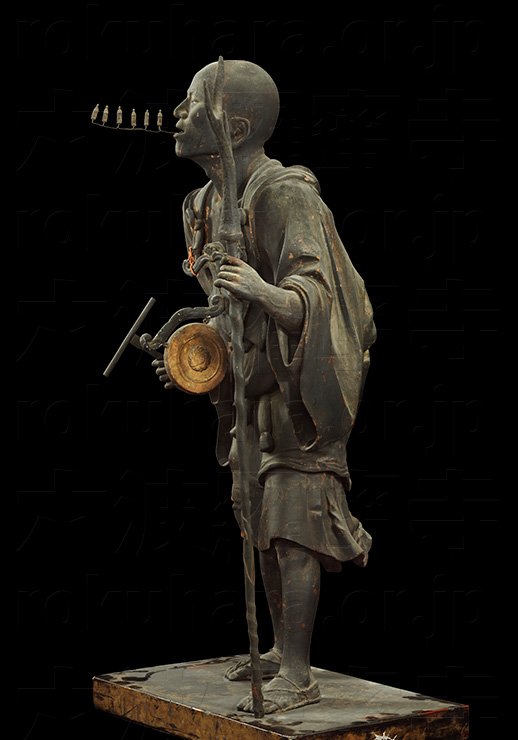
The standing statue of Kūya at Rokuharamitsu-ji, Kamakura period, attributed to Kōshō. Six tiny Amida figures issue from his mouth.
In 985 the Tendai monk Genshin completed Ōjōyōshū (The Essentials of Rebirth), a guidebook that opens with vivid descriptions of the hells before turning to the joys of paradise and the methods for reaching it. It became a bestseller among the Heian court. Aristocrats arranged their deathbeds according to its advice, placing an image of Amida to the west and holding five-colored cords tied to the statue’s hand as they died, surrounded by chanting. Paintings called raigōzu, "welcoming descent" pictures, showed Amida riding down on clouds with a retinue of bodhisattvas playing music, coming to collect the dying.
Behind this enthusiasm lay a specific fear. Buddhists believed that after the Buddha’s death his teaching would decline in stages, and that in the final age, mappō, almost no one could reach enlightenment through their own efforts. By Japanese calculation, this age began in 1052. The next year, 1053, the imperial chancellor (kanpaku) Fujiwara no Yorimichi dedicated a hall to Amida at Byōdō-in, the villa in Uji, south of Kyoto, that he had turned into a temple the year before. That hall, now called the Phoenix Hall, is an attempt to build the Pure Land on earth: a golden Amida by the master sculptor Jōchō seated inside, fifty-two small bodhisattvas riding clouds on the walls, and the whole structure reflected in a pond, as if floating across water from the far shore. It now appears on the 10-yen coin, so most people in Japan carry a picture of a Pure Land temple in their pockets.
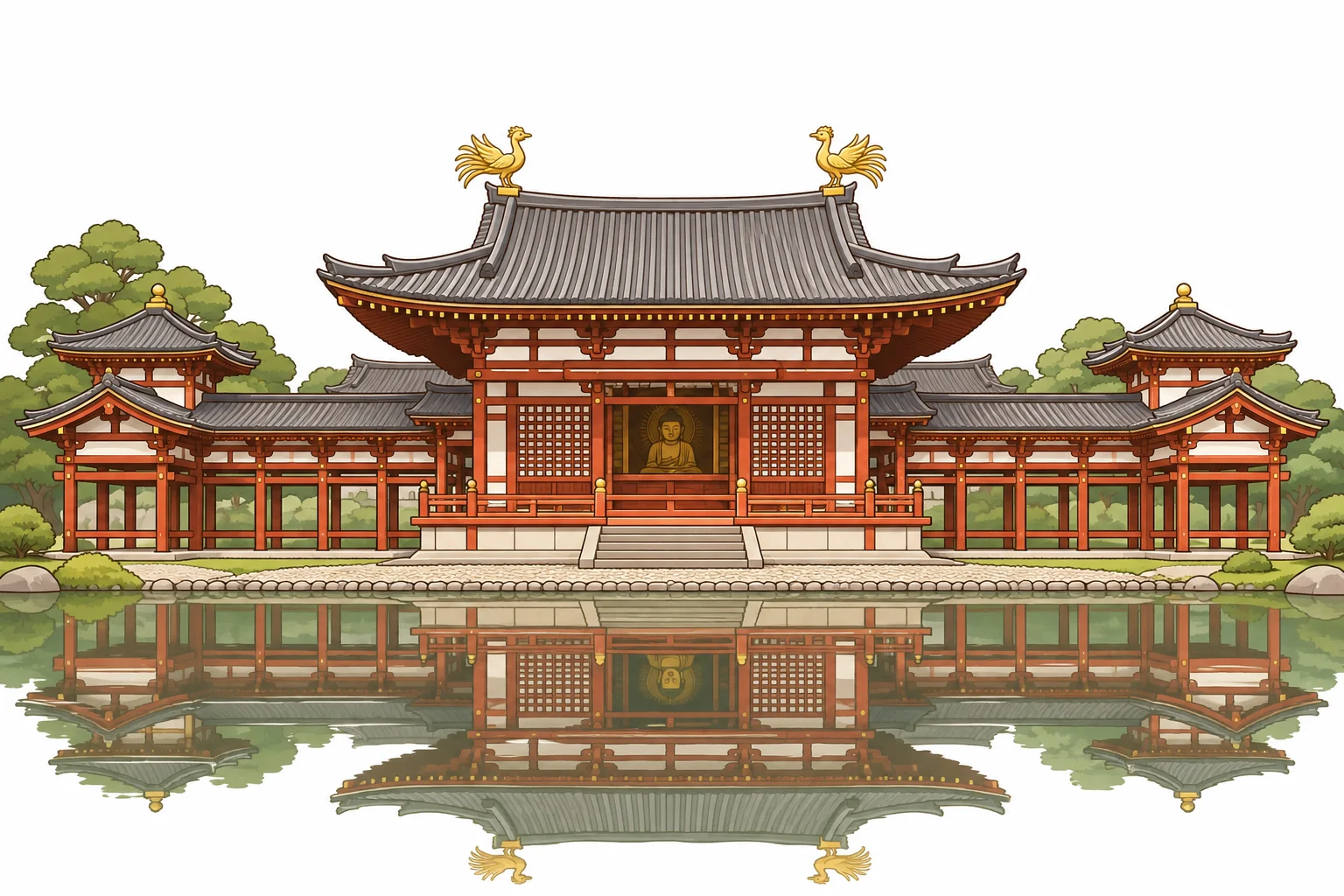
The Phoenix Hall of Byōdōin in Uji seen across its pond, wings spread and mirrored in the water (illustration).
03Hōnen and the Jōdo School: Recitation Alone
By the late twelfth century Japan was racked by civil war, famine, fire, and earthquake. Building halls and commissioning statues were forms of devotion only the rich could afford. Hōnen, born in 1133 in Mimasaka province, entered Mount Hiei as a boy and became famous for his learning, yet he could find no practice he was confident he could complete. In 1175, reading Shandao’s commentary on the Contemplation Sutra, he came across a passage saying that to recite Amida’s name single-mindedly, whether walking, standing, sitting, or lying down, without regard to how long one had practiced, was the act that truly leads to rebirth, because it accords with the buddha’s vow. He left the mountain and began teaching in Kyoto. The Jōdo school (Jōdo-shū, "Pure Land school") dates its founding to that year.
Hōnen’s message was simple and radical. In the age of decline, he argued, other practices were beyond most people’s reach, and Amida had chosen recitation precisely because everyone could do it. The rich could build pagodas and the learned could study scripture, but anyone could say Namu Amida Butsu. In 1198 he set out his reasoning in Senchakushū (Passages on the Selection of the Nenbutsu in the Original Vow), written at the request of the statesman Kujō Kanezane. Shortly before his death he summed it up in a one-sheet testament, the Ichimai kishōmon, telling followers that learning was unnecessary: simply recite the nenbutsu.
Warriors, fishermen, prostitutes, and courtiers flocked to him. The established temples of Mount Hiei and Kōfuku-ji in Nara were alarmed, since a teaching that made all other practices unnecessary threatened their reason for existing. In 1207 the court banned exclusive nenbutsu practice, executed disciples including Jūren and Anraku, and exiled Hōnen, then in his seventies, to Shikoku. He was later allowed back to Kyoto and died there in 1212. The site of his grave in the Higashiyama hills grew into Chion-in, the head temple of the Jōdo school.
After Hōnen’s death his followers split into several lines. The Chinzei branch of his disciple Benchō became the mainstream of today’s Jōdo-shū, while Shōkū’s line developed into the Seizan branches. In the Edo period the ruling Tokugawa family were Jōdo adherents and made Zōjō-ji in Edo (now Tokyo) one of their family temples; six shoguns are buried there.
04Shinran and Jōdo Shinshū: Faith and the "Evil Person"
Among the disciples exiled in 1207 was Shinran, born in 1173 in Kyoto. He had spent twenty years as a monk on Mount Hiei before joining Hōnen. Sent to Echigo, on the Sea of Japan coast, he declared himself "neither monk nor layman," married, and had children. Letters by his wife, Eshinni, are among the best sources for his life. After his pardon he did not return to the capital but spent some twenty years teaching farmers and warriors in the Kantō region, largely completing his major work Kyōgyōshinshō (Teaching, Practice, Faith, and Realization) there. He went back to Kyoto in the 1230s, kept revising the book into old age, and died in 1263 at eighty-nine (ninety by the traditional count).
Shinran pushed Hōnen’s ideas to their logical end. Rebirth, he taught, is not earned by piling up recitations. It is entirely the work of Amida’s vow, which he called tariki, "other power," as opposed to jiriki, "self power," the effort of one’s own practice. What the believer needs is shinjin, the entrusting faith in which one accepts Amida’s working. The nenbutsu then becomes an expression of gratitude for a salvation already settled, not a means of securing it.
His most famous saying, recorded by his disciple Yuien in the Tannishō, runs: "Even a good person attains birth in the Pure Land, so how much more the evil person." It sounds like permission to sin, and was criticized as such in Shinran’s own time. Its meaning is that those who think their good deeds can save them still rely on themselves, while those who know they cannot escape their own passions are exactly the people Amida’s vow was made for.
Shinran founded no great institution. His mausoleum at Ōtani in Kyoto was tended by his daughter Kakushinni, and his great-grandson Kakunyo turned it into a temple called Hongan-ji, "Temple of the Original Vow." For a long time it was small and poor. Its eighth head, Rennyo (1415–1499), changed that, writing plain-language pastoral letters (ofumi) to scattered congregations, organizing villages into study groups, and building centers at Yoshizaki on the Sea of Japan coast and at Yamashina near Kyoto. The movement, known as the Ikkō sect, grew into a political force. In 1488 armed leagues of its followers (ikkō ikki) overthrew the military governor of Kaga province, which for about a century was described as a "province held by the peasants."
In the sixteenth century Hongan-ji’s fortified headquarters at Ishiyama in Ōsaka held out against the warlord Oda Nobunaga for about ten years before a negotiated surrender in 1580. A later succession quarrel gave Tokugawa Ieyasu a chance to divide the institution: in 1602 he granted land in Kyoto to Kyōnyo, who founded Higashi (East) Hongan-ji, while the original became Nishi (West) Hongan-ji. Today the Honganji-ha (West) and Ōtani-ha (East) are the two largest of about ten Shinshū denominations. Counted by temples, Jōdo Shinshū is the largest Buddhist tradition in Japan.
Shinshū has distinctive habits. Its clergy have always married, and temples usually pass from father to son. It does not perform prayers for worldly benefits and does not sell amulets. The dead receive a hōmyō (dharma name) rather than the kaimyō given in other schools, and at funerals people avoid wishing the deceased "happiness in the other world," since in Shinshū teaching the person has already been born in the Pure Land.
05What Nenbutsu Means
The word nenbutsu originally meant "keeping the buddha in mind," a meditative practice. The Contemplation Sutra describes sixteen visualizations, beginning with gazing at the setting sun and moving on to the ground, trees, and ponds of the Pure Land and finally to Amida and his two attendant bodhisattvas, Kannon and Seishi. A Heian nobleman looking across the pond at the Phoenix Hall was practicing a version of this.
Hōnen shifted the weight to shōmyō nenbutsu, saying the name aloud. Namu is a transliteration of a Sanskrit word meaning "homage" or "taking refuge." In actual chanting the phrase is often compressed to nanmandabu or namandabu. Hōnen is said to have recited it tens of thousands of times a day, and some disciples held that more was better; others argued that a single moment of sincere faith was enough. Shinran’s teaching represents the fullest development of the second view.
Other teachers made the nenbutsu physical. Ippen (1239–1289), a wandering preacher, traveled the country handing out paper slips printed with Namu Amida Butsu and leading crowds in odori nenbutsu, dancing while chanting and beating gongs. His followers became the Ji school. Earlier, Ryōnin had founded the Yūzū Nenbutsu school, teaching that one person’s recitation and everyone else’s flow into each other. Even the Great Buddha of Kamakura, at Kōtoku-in, is a statue of Amida.
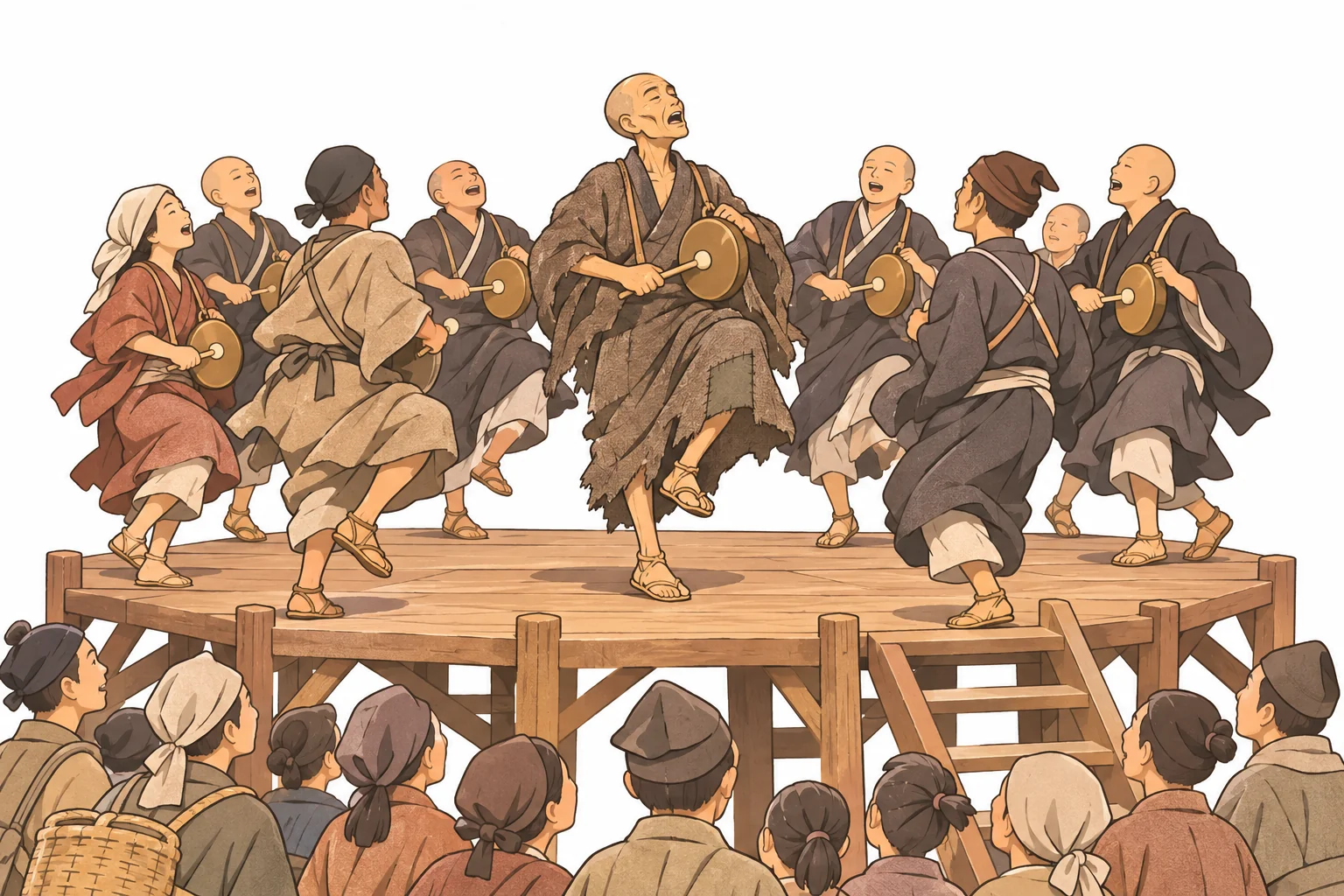
In the Kamakura period, Ippen leads monks and laypeople in a circle on a wooden stage, dancing the nenbutsu with gongs (illustration).
Pure Land was not unopposed. Nichiren, a contemporary of Shinran, denounced nenbutsu chanters as bound for the lowest hell and insisted the Lotus Sutra alone could save the nation, while Zen teachers stressed awakening through one’s own discipline. Seen together, the new Kamakura schools were answering one question: how can ordinary people be saved? Pure Land’s answer was to rely on Amida.
06Seeing Pure Land in Japan Today
For most Japanese people, Pure Land Buddhism is met through death. Many families belong to a Jōdo or Shinshū temple that handles their funerals and memorial services. The household altar (butsudan) in such homes has Amida or a scroll bearing his name at its center. The spring and autumn equinox weeks, called Higan ("the other shore"), when families visit graves, have a Pure Land logic: on those days the sun sets due west, toward Amida’s paradise.
In and around Kyoto, start with Byōdō-in in Uji. Look at the Phoenix Hall from across the pond, then go inside to see Jōchō’s Amida; the museum on the grounds displays half of the 52 original cloud-riding bodhisattvas. Chion-in in Higashiyama has one of the largest wooden temple gates in Japan and a giant bell rung by a team of monks on New Year’s Eve, a familiar scene on Japanese television. Nishi and Higashi Hongan-ji, a short walk north of Kyoto Station, have vast Founder’s Halls, carpeted with hundreds of tatami mats, that enshrine images of Shinran, and you will often find members quietly sitting through a service. Rokuharamitsu-ji’s statue of Kūya alone is worth the trip. Further south, Jōruri-ji preserves a row of nine Amida statues, one for each of the nine grades of rebirth described in the Contemplation Sutra, facing a pond with a healing buddha on the east bank: a garden laid out as a crossing from this world to the next.
In Tokyo, Zōjō-ji stands at the foot of Tokyo Tower, its great Sangedatsumon gate dating from the early Edo period. In Nagano, Zenkō-ji belongs to no single school; it is jointly maintained by Tendai and Jōdo clergy, and its hidden central image is an Amida triad. Visitors can descend beneath the main hall into the pitch-black kaidan meguri passage and feel along the wall for a metal lock said to connect them to the buddha.
At any of these temples it is enough to press your palms together before the image. If you want to join in with Namu Amida Butsu, no one will mind. Many Amida statues hold the right hand raised and the left lowered, thumb and forefinger touching: the gesture of the buddha descending to welcome the dying, which is what the whole tradition is about.