
At a glance
Masked gods who storm Oga homes on New Year’s Eve: where their name and rite come from, what happens inside a house, and where visitors can see them.
- Namahage are visiting deities of the Oga Peninsula in Akita; on the night of December 31 they burst into homes wearing demon masks and straw capes.
- The name comes from peeling off namomi, the heat blotches left by sitting too long at the hearth, so their target is idleness.
- After frightening the children, they are seated in the place of honor and served sake, exchange questions and answers with the head of the house, then leave with blessings for the new year.
- Designated an Important Intangible Folk Cultural Property in 1978, the rite was inscribed by UNESCO in 2018 as part of Raiho-shin, ritual visits of deities in masks and costumes.
- The New Year’s Eve visits are closed to tourists; visitors can see Namahage at the February Namahage Sedo Festival or at the Namahage Museum and Oga Shinzan Folklore Museum beside Shinzan Shrine.
On the last night of the year, in the fishing and farming hamlets of the Oga Peninsula in Akita Prefecture, men in straw cloaks and snarling masks pound on doors and burst into living rooms bellowing for crying children and lazy people. They are the Namahage, and although they look like demons, the families who let them in are welcoming gods. This is an introduction to who the Namahage are, where their name and their rite come from, what actually happens inside a house on December 31, and how a visitor to northern Japan can see them.
01A God with a Demon’s Face
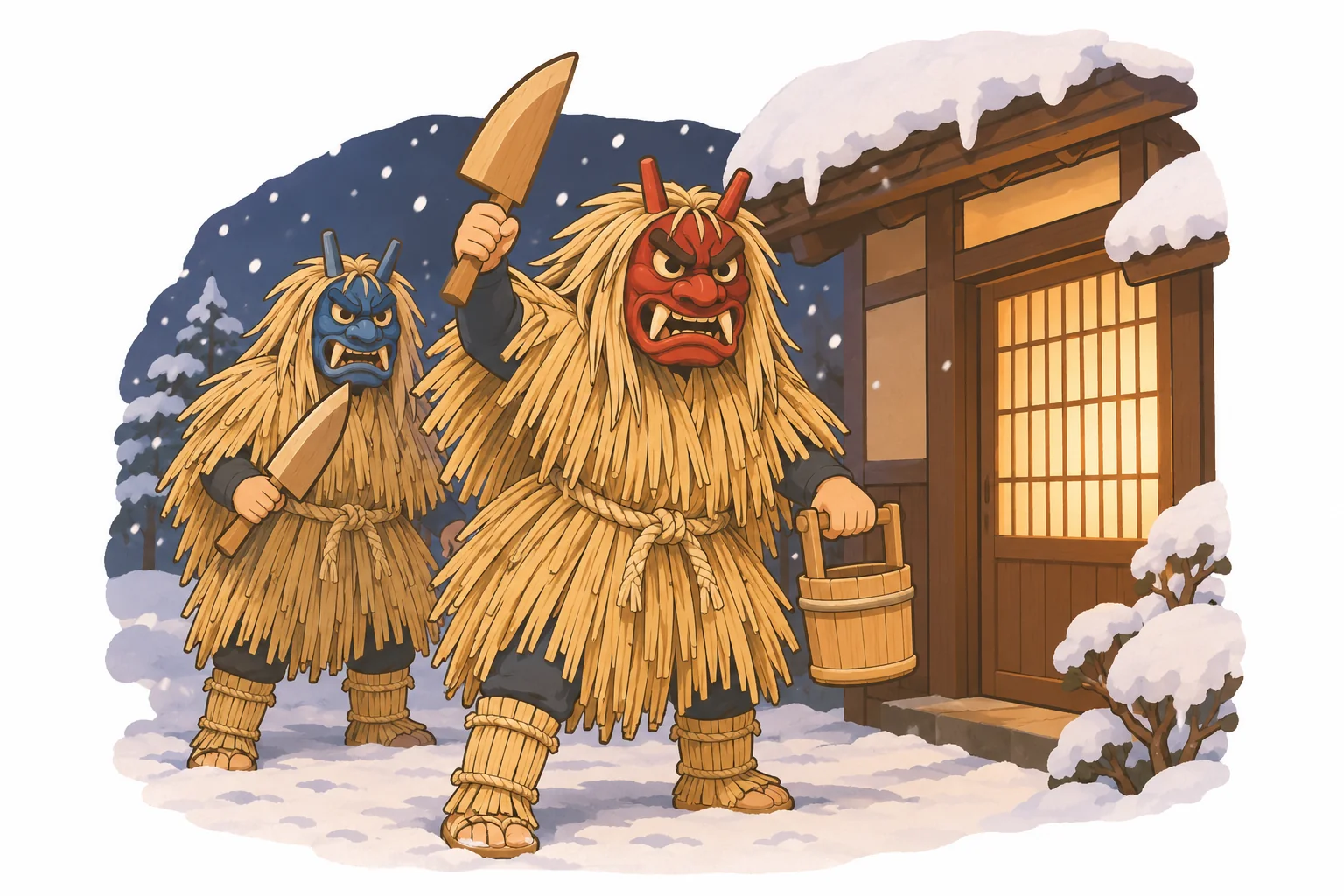
The first photograph most people see of a Namahage is alarming: a red or blue face with bared fangs and bulging eyes, a wild mane of hair, a body swallowed in layers of dried straw, and a large knife raised overhead. Elsewhere in Japan, oni (ogres or demons) are the creatures you drive out of the house with roasted soybeans at Setsubun. The Namahage are the opposite. They are invited in.
In Oga, the Namahage are understood as divine visitors who come down from the mountains at the turn of the year. They scold the idle, chase away misfortune, and leave behind a blessing for a good harvest, a good catch, and a healthy household. Japanese folklorists call beings like this raihōshin, "visiting deities": gods who arrive from somewhere outside the community, the mountains or the sea, on a fixed night of the year and go from house to house. The ethnologist Orikuchi Shinobu built a whole theory around such figures, which he called marebito, "rare visitors" from the other world, and the Namahage are among the examples most often cited.
That status shapes everything about the rite. The young men who wear the masks are not playing monsters for a crowd. For the night, they are the god’s messengers, or the god itself. Children are genuinely terrified, adults are genuinely respectful, and the head of the household prepares food and sake to receive his guests with ceremony.
02Peeling Off the Fire Blisters
The name sounds menacing, but the most widely accepted explanation is a domestic one. In the long, snowbound winters of Tōhoku, Japan’s northeast, families spent their evenings huddled at the irori, the sunken hearth in the floor. Sit too long by the fire and your shins develop red, mottled heat marks, called namomi in the local dialect. A person with namomi was a person who sat by the fire instead of working. The visiting god comes to peel those marks off, namomi wo hagu, and namomi-hagi slid in speech into namahage.
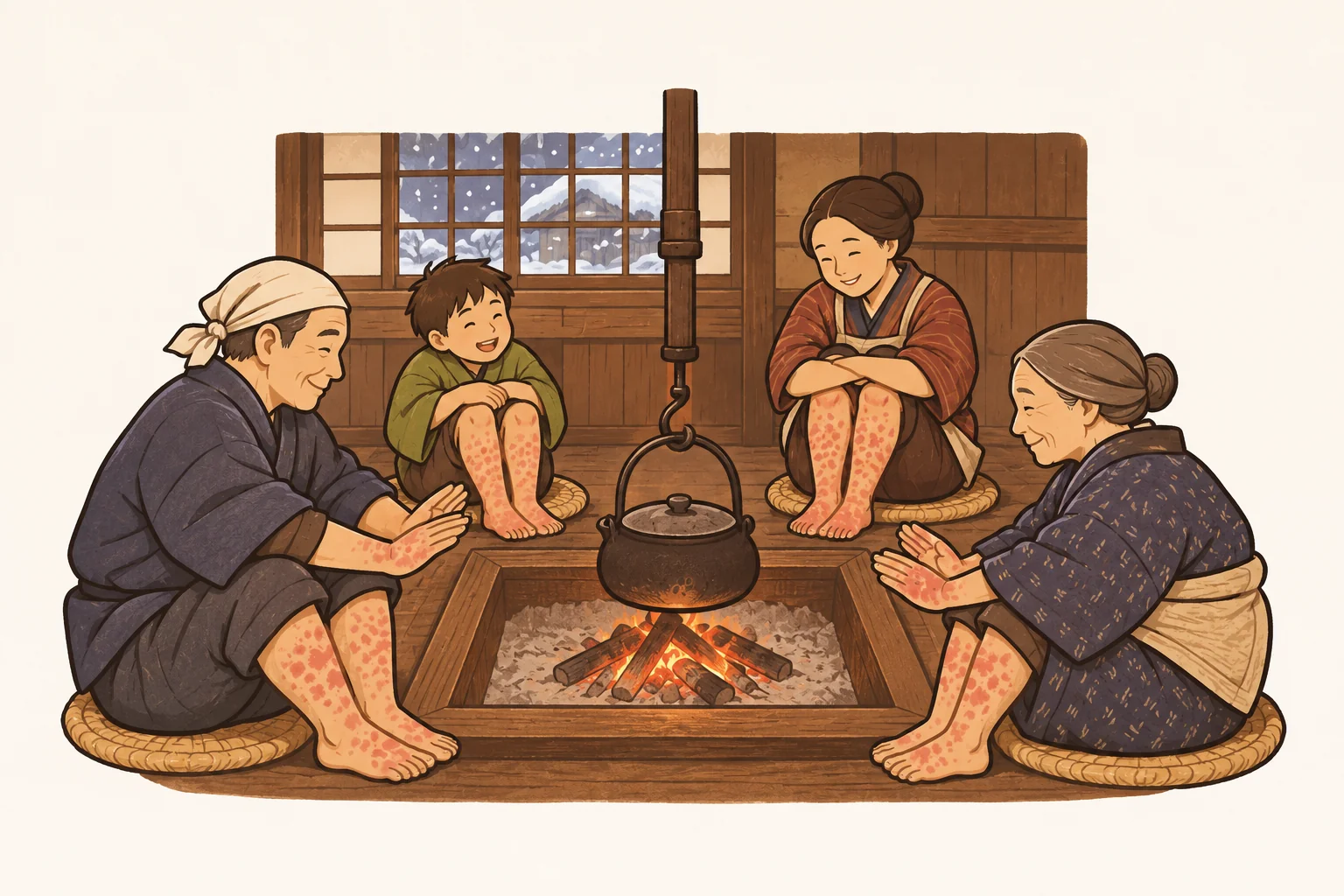
A Tōhoku winter at the irori: sitting too long by the fire leaves red namomi marks on the shins.
So the Namahage’s chief concern is diligence. They go after children who don’t listen, young people who idle, and, in the older version of the rite, new brides who don’t pull their weight. Winter was the slack season in farming villages, when snow kept everyone indoors, and that is exactly when the god arrived to check on them.
The same idea turns up along the Sea of Japan coast and across Tōhoku under related names. Yuza in Yamagata has the Amahage, the Noto Peninsula in Ishikawa has the Amamehagi, and Ōfunato in Iwate has the Suneka, whose name points to the shins. All of them are about stripping away the marks of laziness. Oga’s version is simply the best known and the most fully preserved.
03The Mountains Behind the Rite
The Oga Peninsula juts out into the Sea of Japan, and its center is a cluster of peaks, Honzan, Shinzan, and Kenashiyama, known together as the Three Mountains of Oga. They were sacred long before written records, and from early on they were a center of Shugendō (some accounts date the link to the medieval period or later), the mountain asceticism that blended Buddhist practice with older worship of mountain gods. People on the peninsula fished the sea and farmed the lowlands, and the mountains were both their water source and the home of their gods.
The most common view is that the Namahage grew out of this mountain worship: the god lives in the peaks and descends to the villages when one year gives way to the next. Another view links the rite to the year-end rounds that mountain ascetics made through villages to drive out evil and bless households, and sees something of the ascetics in the masks and straw garb. On Oga these two ideas overlap rather than compete.
Local legend tells a more colorful story. Emperor Wu of the Han dynasty, it is said, came to Oga with five bats that had turned into demons, and the demons raided the villages for crops, livestock, and young women. The villagers struck a bargain: if the demons could build a stairway of one thousand stone steps up the mountain in a single night, before the first cock crowed, the village would give them a girl every year; if they failed, they must never come down again. The demons worked furiously and had just one step left when an amanojaku, a contrary trickster spirit, imitated a rooster’s crow. Believing dawn had come, the demons stormed back into the mountains and never came down again. The 999 stone steps leading to the Gosha-dō, the five small halls of Akagami Shrine, are said to be the result, and the five halls are said to honor the five demons. No Han emperor ever reached Japan, and the tale is plainly a later invention, but it shows how firmly Oga people tied their demons to their own mountains and shrines.
The earliest description usually cited comes from Sugae Masumi, a traveling writer of the late Edo period who wandered the north for decades. Visiting Oga in the early nineteenth century, he described masked, straw-clad "Namahage" making their rounds on the night of the Little New Year and sketched them. The rite he saw looks much like the one performed today.
04One House on New Year’s Eve
The Namahage originally came on the night of Koshōgatsu, the "Little New Year" on the fifteenth day of the first lunar month. After Japan adopted the Western calendar, most districts moved the rite to December 31, which is when it happens now.
In the early evening, the young men of a district gather at the local shrine or community hall to dress. Each district has its own masks, carved from wood, built up from paper, or made from woven baskets and bark. People make them by hand from whatever is at hand. Red and blue are the classic colors, and the variety from village to village is striking. A popular saying holds that the red face is the father and the blue the mother, and some say gold and silver masks are used in places too. The straw cape is called a kede or kende, and more straw is bound around the legs. In most districts each Namahage carries a wooden deba knife, the heavy cleaver used for fish, for peeling off the fire blisters, and sometimes a wooden bucket. Some districts carry a staff hung with gohei paper streamers instead, and the Namahage of Shinzan carry nothing at all.
A man without a mask, the sakidachi, goes ahead and knocks to ask whether the household will receive the Namahage. By custom, the Namahage do not enter homes where someone has died or a child has been born in the past year; some accounts add that homes with a sick person also decline the visit. Once permission is given, the Namahage stamp and roar their way inside.
What follows is a memory every Oga child carries. The Namahage crash through the house, yanking open sliding doors and hunting for children while shouting in thick Oga dialect, "Naku ko wa inega!" ("Any crying kids here?") and "Namakemono wa inega!" ("Any lazy ones here?"). Children cling to their parents or hide in closets, howling. The Namahage know names and misdeeds: you’ve been skipping your homework, you don’t help your mother. The parents, of course, briefed them in advance.
Then the head of the household steps in. In some homes, it is said, he changes into kimono or formal clothes for the occasion. He seats the Namahage in the place of honor and serves them sake and New Year food. A ritual dialogue follows. The Namahage ask about the year, the harvest, the children’s behavior; the master assures them the children are good at heart and asks them to be lenient. The Namahage deliver their stern admonitions, agree to spare the children, pronounce a blessing for a good year and a safe household, and stamp off into the snow toward the next house. A visit, it is said, can be as short as ten minutes or so. Because sake is served at every stop, a group can only manage so many houses in a night; in Shinzan each pair of Namahage visits about 10.
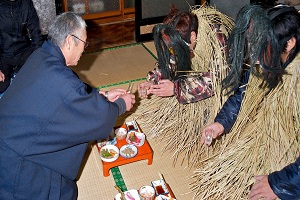
The master of the house receives the straw-caped Namahage with food and sake, and the ritual dialogue begins.
That exchange between host and god is the heart of the rite. The father is both the children’s protector and the god’s host, and the children, watching him negotiate on their behalf, learn something about the order of family and village along with the lesson to behave. Strands of straw that fall from a Namahage’s cape are considered lucky. Some people tie them around their heads to ward off colds in the coming year.
05Keeping the Gods Coming
Traditionally the Namahage were played mostly by young men of the village (by one account, originally unmarried young men), and taking part is generally seen as a rite of passage into full membership in the community. Depopulation and an aging population have made that hard to sustain. Many districts now rely on middle-aged men and people who come home for the holidays, and Oga city employees form their own Namahage group each year to make rounds in the town center. Some districts, according to reports, have brought in university students from outside the area. Oga has about 140 districts; around 2018 some 90 of them still held the rite, and reports at the end of 2025 put the number at about 70, roughly half.
Modern life has raised other questions. Some parents feel that frightening small children this badly is no longer appropriate, and some households stopped receiving the Namahage as homes were rebuilt and family life changed. On New Year’s Eve 2007 a man in Namahage costume entered the women’s bath at an inn in Oga Onsen and touched guests; by some accounts he had been drinking on his rounds. The city publicly apologized, the hot-spring association barred that district’s Namahage from the onsen area, and local organizers tightened the rules for performers. Episodes like this made the point clearly: the Namahage’s authority comes from their being gods, and without that seriousness they are just men in frightening masks.
Formal protection came early. In 1978 the Namahage of Oga were designated an Important Intangible Folk Cultural Property of Japan. In 2018 UNESCO added them to its Representative List of the Intangible Cultural Heritage of Humanity as part of a group inscription, "Raiho-shin, ritual visits of deities in masks and costumes," as one of ten rites from eight prefectures, including the Paantu of Miyako Island in Okinawa and the Amahage of Yuza. The group was built as an extension of the Toshidon of the Koshiki Islands in Kagoshima, which had been inscribed on its own in 2009. Grouped together, from the snowy north to the subtropical south, they show how widespread the custom of welcoming a god from outside once was in Japan’s farming and fishing communities.
06Seeing the Namahage
The New Year’s Eve visits are a private rite performed in people’s homes, and visitors cannot simply wander in to watch. There are three reliable ways to see the Namahage.
The most spectacular is the Namahage Sedo Festival, held at Shinzan Shrine over the Friday to Sunday that includes the second Saturday of February. It began in 1964, combining the shrine’s sedo bonfire ritual, held each January 3, with the Namahage. On a snowy night the shrine grounds are lit by a great bonfire, taiko drums start up, and a line of Namahage carrying torches comes down out of the dark mountain to dance and roar in the firelight. A priest offers them goma-mochi, rice cakes toasted over the sacred fire; the Namahage take the cakes back up the mountain, and the cakes are then cut and handed out to the crowd as a charm against fire. Oga in February is bitterly cold, so dress for it.
- 1
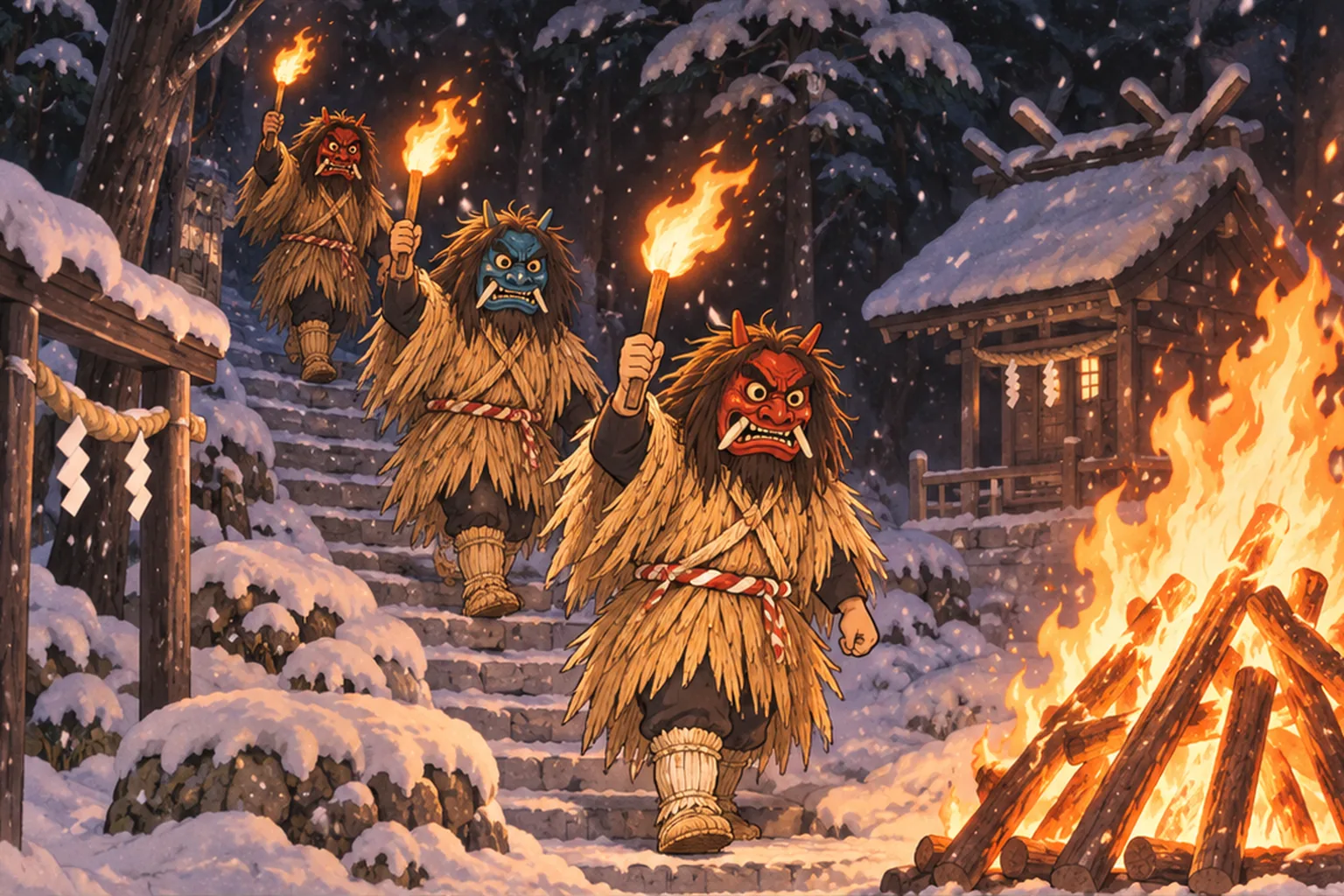 On a snowy night, Namahage carrying torches come down out of the dark mountain.
- 2
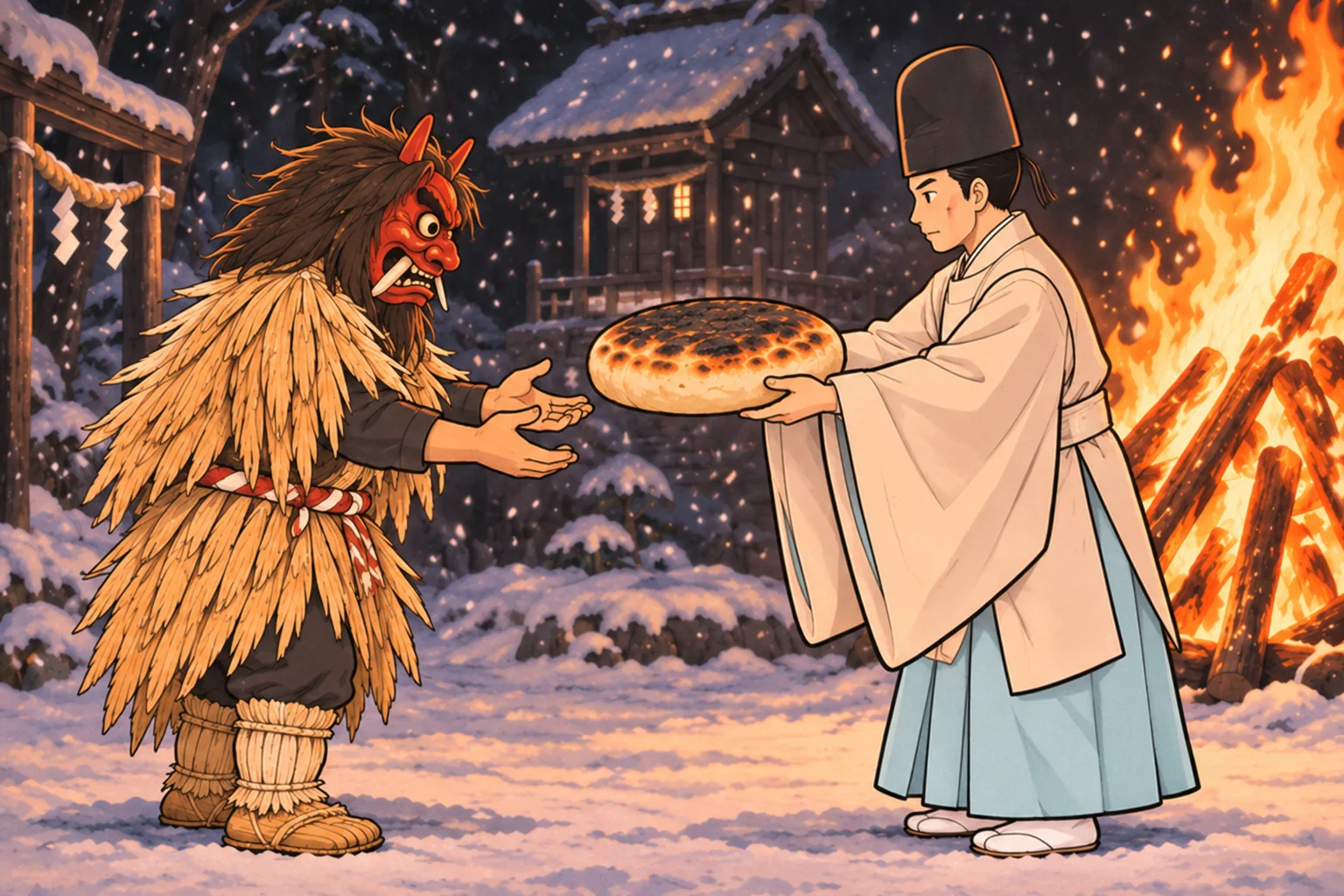 A priest offers a Namahage goma-mochi, a rice cake toasted over the sacred fire.
Year-round, the Namahage Museum next to Shinzan Shrine displays more than 150 masks actually used in districts across Oga, lined up along one wall so you can see how different they are in material and expression. Next door, the Oga Shinzan Folklore Museum occupies a traditional L-shaped Oga farmhouse, where the Shinzan district’s New Year’s Eve visit, including the dialogue with the master of the house in the local dialect, is reenacted for audiences seated on the tatami, with a guide to explain. When the Namahage come crashing through the door, adults jump too.
Oga itself is about an hour from Akita Station on the JR Oga Line, and Namahage statues greet you around the station, including, by some descriptions, a giant one out front. The Gofū community hall at Oga Onsen puts on performances of Namahage taiko drumming. While there, Cape Nyūdō at the northern tip and Toga Bay and the Ichinomegata crater lake, both formed by volcanic explosions, are worth a look, as is ishiyaki, a local dish in which fish and shellfish are cooked by dropping red-hot stones into a wooden tub of broth.
When you watch the Namahage, it helps to remember what they are. The stamping, the roaring, the chase after the children are a god doing its job. The moment that matters comes afterward, when the god sits down with a cup of sake, listens to the master of the house describe his year, and gives its blessing for the next one.