
At a glance
What Japan’s shrine charms and wooden wish plaques are, how they grew from talismans and offered horses, and how to receive and write your own.
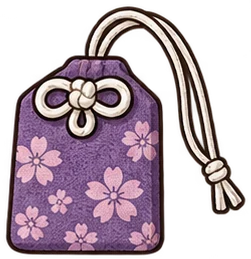
- An omamori is a small brocade pouch holding a naifu, a blessed slip of paper or wood bearing a deity’s name or a sacred text.
- People speak of receiving rather than buying an omamori; the offering, hatsuhoryō, is typically 500 to 1,000 yen as of 2026.
- A charm is usually renewed each year, and old ones go back to a shrine’s kofuda nōsho to be burned around mid-January.
- Ema began as offerings of horses: live horses were costly, so clay, wooden and finally painted horses took their place.
- Today’s ema is usually a small pentagonal board; you write your wish on the blank side and hang it on the racks beside the hall.
Almost every shrine and many temples in Japan have a small counter near the main hall where you can pick up two things: a brocade pouch the size of a matchbox, and a little wooden plaque on a red string. The pouch is an omamori, a protective charm you carry with you. The plaque is an ema, on which you write a wish and leave it hanging for the gods to read. Both cost about the same as a coffee, and both are far more woven into ordinary Japanese life than most formal religion. Plenty of people who would never call themselves religious have an omamori dangling from their school bag or rear-view mirror. This piece explains what these objects are, where they came from, and how to receive one yourself.
01The Counter by the Hall
The place where charms are given out is called the juyosho (literally "the place of bestowal") or mamorifuda-sho. It is usually a booth with a sliding window, staffed by shrine maidens, miko, in white robes and red trousers. On the ledge in front, the charms are laid out by purpose: traffic safety, household safety, academic success, passing exams, love, safe childbirth, health, good fortune, prosperity in business. Beside them sit larger paper or wooden talismans called ofuda, which are meant to be enshrined at home on a household altar, along with ema, decorated arrows called hamaya, and fortune slips.
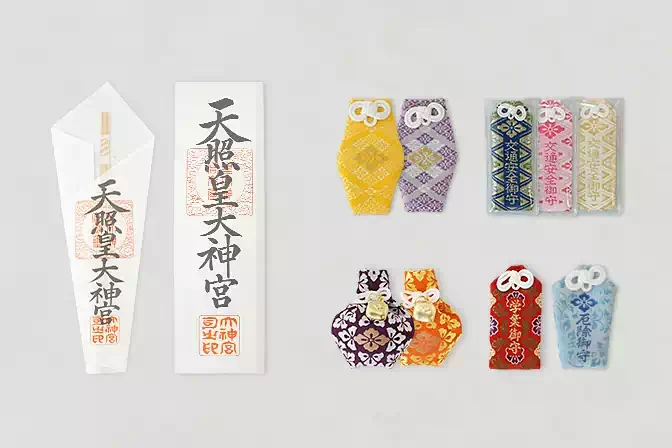
On the left, ofuda talismans for the household altar; on the right, brocade omamori sorted by purpose.
Japanese people rarely say they "buy" an omamori. The usual verbs are ukeru, to receive, or sazukaru, to be granted. The money you hand over is not a price but hatsuhoryō, an offering named after the first ears of rice once presented to the gods at harvest. This is more than politeness. In shrine thinking, an omamori is not merchandise but a small share of the deity’s presence, and the payment is a thank-you. So the charms carry a fixed figure, typically 500 to 1,000 yen as of 2026, and nobody haggles.
Buddhist temples offer charms in exactly the same way. The counters at Naritasan Shinshō-ji, Kawasaki Daishi or Sensō-ji look almost identical to a shrine’s; the difference is that the paper inside bears a Buddhist name, a sutra phrase or the name of the temple’s principal image. Most Japanese do not draw a sharp line between the two, and a bag with a shrine charm and a temple charm side by side is entirely normal.
02What Is Inside the Pouch
The outside of an omamori is a woven or embroidered fabric bag, usually with the shrine’s name and the word omamori on the front and its purpose on the back, closed at the top with an elaborate cord knot. The part that matters is inside: the naifu, a folded slip of paper or a thin sliver of wood inscribed with the name of the deity, the shrine, a sacred text or a protective formula, and ritually purified by the priests.
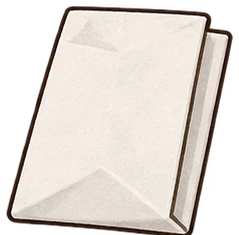
A folded paper slip, one form of the naifu, inscribed with a deity’s name or a sacred text.
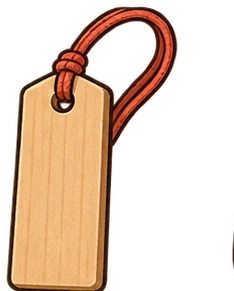
A thin sliver of wood, the other common form, likewise blessed by the priests.
The pouch is only a jacket for the naifu, and that is the reason behind the one rule nearly everyone in Japan knows: never open your omamori. Open it, the saying goes, and the protection escapes. No scripture lays this down, but it is so universally repeated that most people go their whole lives without seeing what their charm actually contains.
An omamori is also generally thought to wear out. The common understanding is that it lasts a year. At New Year, when millions make their first shrine visit of the year, hatsumōde, they receive a new charm and return last year’s. Shrines set up a box or shed called a kofuda nōsho for old charms and talismans, and burn them in a ritual fire, otakiage. In many places this happens around January 15 in a bonfire called dondo-yaki, where New Year decorations go up in flames along with the old charms. If your charm came from a distant shrine, returning it to any local shrine is usually fine; the one courtesy people tend to observe is shrine charms to shrines, temple charms to temples.
Visitors sometimes worry that carrying charms from several different shrines will make the deities jealous or cancel each other out. Japanese people rarely give this a second thought. Shinto speaks of yaoyorozu no kami, "eight million gods," and the world it describes is a crowded and tolerant one. Ask a priest and you will almost certainly be told not to worry.
03From Talisman to Brocade Bag
The omamori grew out of the much older practice of carrying talismans, slips of paper or wood bearing a sacred name or formula to ward off harm. Chinese Daoist talismans and Buddhist dhāraṇī spells both fed into the Japanese tradition, and early Japanese also wore beads, bells and certain plants for protection.
By the Heian period (794–1185), aristocrats were tucking written sutras or tiny Buddhist images into small cases or bags worn around the neck or inside their robes. These were called kakemamori, "hanging charms." Shitennō-ji temple in Ōsaka preserves Heian-period examples, little boxes wrapped in brocade, which show that even then a charm was partly a piece of jewelry.
Charms reached ordinary people on a large scale in the Edo period (1603–1868). Peace and good roads made pilgrimage a popular pastime, and groups of commoners saved up for trips to Ise, Konpira or Naritasan. A pilgrim was expected to bring something home, and the most fitting souvenir was a talisman. The oshi, agents of the Ise Shrines, traveled the country every year distributing Ise talismans to households, which helped put a shelf for Ise’s deity into homes across Japan. Charms became the thread connecting a famous shrine with believers hundreds of kilometers away.
The colorful, purpose-specific pouch you see today took shape mostly in the twentieth century, especially after the Second World War. As car ownership spread, traffic-safety charms began to hang from rear-view mirrors and taxi dashboards. As university entrance exams became fiercely competitive, exam charms became among the most common at many counters. Later came charms for love, safe delivery, health, pets, sports victories and even, at a few shrines, the safety of your computer data. Shrines now collaborate with anime franchises and local mascots on limited-edition designs that sell out within hours. To outsiders this can look like commercialization; most Japanese see it simply as the charm keeping up with the times, as it always has.
04Ema: From Real Horses to Painted Ones
The word ema is written with the characters for "picture" and "horse," and that name contains its history.
In early Japan, horses were believed to carry the gods, and a horse was among the most precious gifts one could offer a deity. When the imperial court prayed for rain, or for rain to stop, it sent live horses to particular shrines. The court chronicle Shoku Nihongi records that in 763, during a drought, a black horse was added to the offerings for the deity of Niukawakami in Yoshino. In the Heian period, Kifune (Kibune) Shrine in the hills north of Kyoto became another destination for such horses. By the rules set down in the tenth-century Engishiki, the custom was a black horse to pray for rain and a white one to pray for the rain to stop; popular retellings add that a red horse might also be offered for clear skies. Kifune Shrine today presents itself as one of the birthplaces of the ema.
Live horses were expensive, and a shrine could only keep so many. Substitutes appeared: horses modeled in clay, horses carved from wood, and finally horses painted on a wooden board. Archaeologists have excavated small board ema from around the eighth century; one from the Iba site in Hamamatsu, Shizuoka, shows a single galloping, unsaddled horse on a panel less than 10 centimeters across. By the Heian and Kamakura periods, offering a painted horse in place of a living one was well established.

A carved wooden horse, one of the substitutes for a live horse.
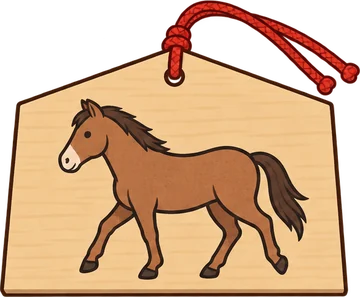
The next step: a horse painted on a wooden board and offered to the deity, the ema.
From the Muromachi period (1336–1573) onward, ema developed in two directions. Some grew enormous. Warlords, wealthy merchants and whole villages commissioned large painted panels of battles, warriors, ships or famous poets, often, it is said, from painters of the Kanō school as well as others, and hung them in dedicated ema halls, emadō. Kitano Tenmangū and Kiyomizu-dera in Kyoto both preserve such large ema: Kitano has one painted by Hasegawa Tōhaku, and Kiyomizu-dera one attributed to his son Hasegawa Kyūzō, both now designated Important Cultural Properties. Others grew small and personal. The ordinary person’s ema stopped being limited to horses and showed whatever the petitioner hoped for: the character for "eye" for someone praying to be cured of an eye disease, a sake bottle with a padlock for someone trying to quit drinking, a pair of breasts for a mother hoping for a good milk supply. These folk ema are full of humor and frankness.
The Edo period also produced a remarkable variety called sangaku. Enthusiasts of wasan, the native Japanese mathematics, painted geometry problems they had solved onto wooden tablets, complete with diagrams and answers, and hung them at shrines and temples, partly in thanks and partly as a public challenge to other mathematicians. About 800 survive, and they are now an important source for the history of Japanese mathematics.
05Ema Today
The ema you will receive today is usually a small pentagonal board with a peaked top like a roof, threaded with a red cord. The shrine’s design is printed on one side; the other is left blank for your wish. Once written, it goes onto the emakakesho, the wooden racks beside the hall, where hundreds or thousands of plaques overlap and clatter in the wind.
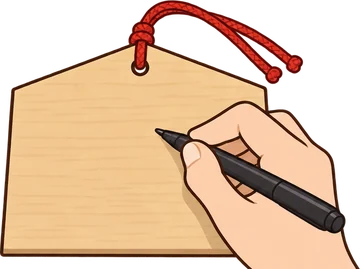
The wish goes on the blank side of the pentagonal board.
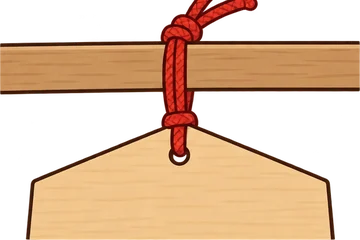
The red cord ties it onto the wooden rack beside the hall.
The pictures have long since moved beyond horses. Many shrines print the zodiac animal of the coming year, and receiving a zodiac ema at New Year is a seasonal habit. Shrines also have their own emblems. Tenmangū shrines, dedicated to the scholar Sugawara no Michizane, use an ox: according to tradition, the ox pulling his funeral cart lay down and refused to move, and he was buried on that spot. At Fushimi Inari Taisha in Kyoto, the ema are shaped like a fox’s face, left blank so you can draw in the eyes and expression yourself. Other shrines have heart-shaped, gourd-shaped or rice-paddle-shaped plaques, each tied to a local story.
The densest ema racks in Japan belong to the Tenmangū shrines, since Michizane is the patron of learning. In January and February, during exam season, the racks at Dazaifu Tenmangū in Fukuoka, Kitano Tenmangū in Kyoto and Yushima Tenjin in Tokyo bend under the weight of students’ wishes: "Pass my first-choice school," "Get into medical school at such-and-such university." Reading them is an experience in itself. What people write is startlingly direct and specific: the university, the person they want to marry, the parent they hope will recover.
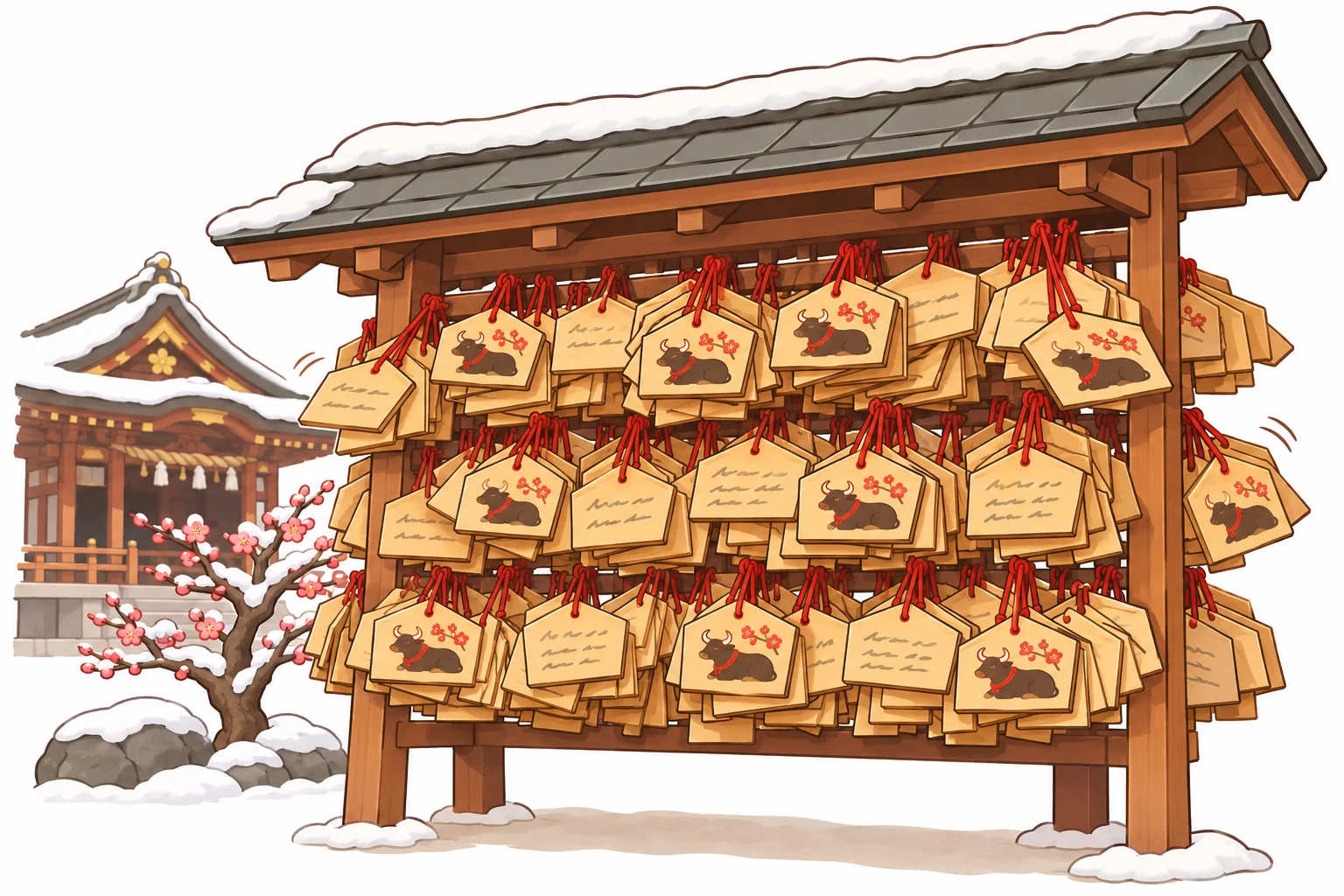
At a Tenmangū during exam season, hundreds of small pentagonal ema crowd the wooden racks (illustration).
That specificity has made privacy a concern. Some shrines now provide stickers to cover your name, or design ema so that the written side faces inward when hung. At Yasui Konpiragū in Kyoto, famous for severing bad ties, the ema list what people want to be free of: a bad relationship, an illness, drinking, a particular person. They are much heavier reading than exam wishes.
Popular culture has added its own layer. After the anime Lucky Star aired in 2007, fans flocked to Washinomiya Shrine in Saitama, the model for a shrine in the series, and covered their ema with drawings of the characters. These are known as itaema, "cringe ema," a self-mocking otaku term. At shrines that appear in anime and attract fan pilgrimages, the ema racks now often double as galleries of fan art.
06Receiving a Charm, Writing an Ema
It is good form to pray first and visit the counter afterwards. Bow lightly at the torii gate, walk to the side of the approach rather than down the center, rinse your hands and mouth at the water basin, and at the hall toss a coin into the offering box, ring the bell if there is one, and bow twice, clap twice and bow once more. Doing things the other way round is not an offense, but most Japanese feel it is more natural to greet the deity before receiving something from it.
Don’t overthink the choice. You can receive a charm for yourself or for someone else; giving omamori is a common gesture of care in Japan, and many people remember the exam charm a classmate gave them before entrance exams. Keep it on your bag, in your wallet or in your car. What matters is that it stays near you. The ofuda talismans are the ones meant for a home altar, so don’t confuse the two.
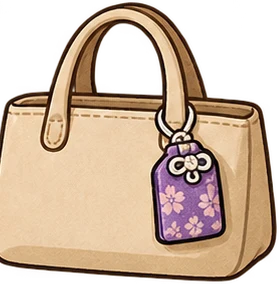
An omamori goes on your bag or in your wallet; it just needs to stay near you.
The ofuda is the talisman meant to be enshrined at home; don’t confuse the two.
To write an ema, receive a blank one at the counter; pens are usually provided nearby. Write your wish clearly and specifically on the blank side, then add your name, and some people add their address so the deity knows who is asking. Any language is fine, and you will see wishes in English, Chinese and Korean on most busy racks. Hang it up and leave it; the shrine will take the plaques down periodically and burn them with the old charms. If you like the design, it is perfectly normal to receive a second one to take home as a keepsake.
When a wish comes true, custom says you should go back and give thanks, a visit called orei-mairi. Got into the university, had a safe birth, recovered from the illness: you return, hand back the old charm and say thank you at the hall.