
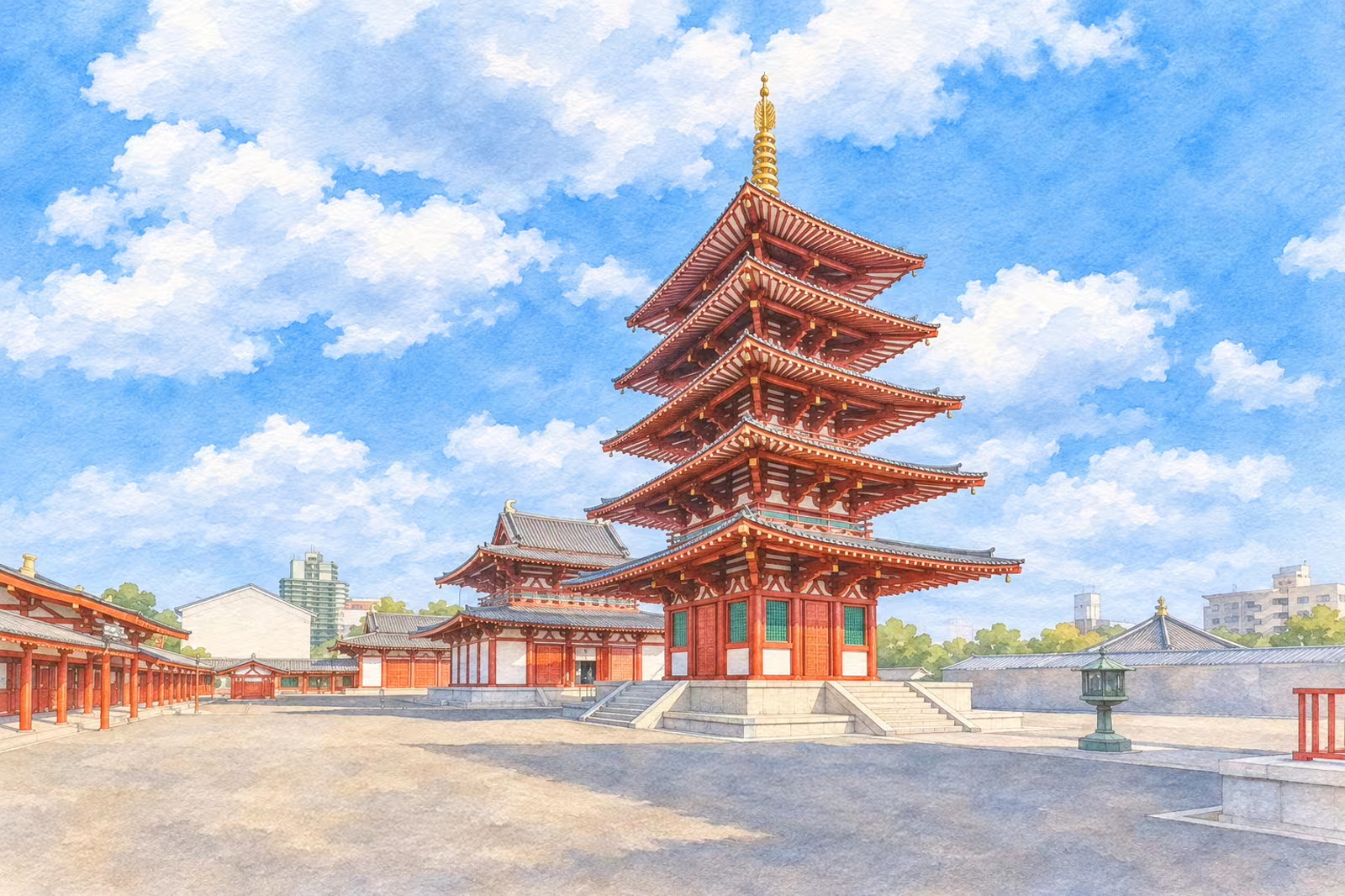
Shitennō-ji stands on the Uemachi Plateau in Tennōji Ward, Ōsaka. Tradition credits its founding to Prince Shōtoku, and it is one of the oldest state-sponsored temples in Japan. Its main buildings, the middle gate, five-story pagoda, golden hall and lecture hall, stand in a single north–south line, an arrangement known as the Shitennō-ji style. The temple has been destroyed many times and its central compound is a postwar reconstruction, but the original plan has been kept.
01Founding and the cult of Prince Shōtoku
According to the Nihon Shoki, when Soga no Umako went to war with Mononobe no Moriya in 587, the young Prince Umayado (later known as Shōtoku) vowed to build a temple to the Four Heavenly Kings if his side won. The Soga were victorious, and in 593, the first year of Empress Suiko’s reign, work began at Arahaka in Naniwa. This account comes from a chronicle compiled more than a century later and its details cannot all be confirmed, but excavations show that the temple existed by the early 7th century. Craftsmen are said to have been brought from Paekche to build it, and the construction firm Kongō Gumi, run by their descendants by tradition, has long been described as one of the oldest companies in the world.
Temple tradition also holds that the prince set up four institutions here, for religious practice, medicine, care of the sick and relief of the poor. From the Heian period on, devotion to Prince Shōtoku grew, and the temple’s west gate came to be seen as an entrance facing the Western Pure Land; many people came here to pray toward the setting sun.
02Repeated destruction and rebuilding
Shitennō-ji was burned in warfare in the 16th century, during the Ōsaka Winter Campaign of 1614 and by a lightning fire in 1801, and the Muroto Typhoon of 1934 blew down its pagoda. The air raids on Ōsaka in 1945 destroyed most of the central compound. Around 1963 the central buildings were rebuilt in reinforced concrete in the Asuka-period style. The temple once belonged to the Tendai school but became independent after the war as the head temple of the Wa school.
03What can be seen today
The Rokuji-dō hall of 1623, which survived the war, and the stone dance stage on the pond in front of it are Important Cultural Properties, as is the stone torii at the west gate, built in 1294 and associated with the monk Ninshō. The treasure house holds National Treasures including the fan-shaped Lotus Sutra albums and two swords, the Shichisei-ken and Heishi Shōrin-ken, said to have belonged to Prince Shōtoku. The Shōryō-e bugaku performed each year on the stone stage is designated an Important Intangible Folk Cultural Property.
Shitennō-ji
01A Temple on the Edge of the Old Coast
Shitennō-ji stands in Tennōji Ward in the south of central Ōsaka, on the Uemachi Plateau, a long, narrow ridge of high ground that runs from Ōsaka Castle in the north toward Sumiyoshi in the south. In ancient times the western flank of this ridge dropped down to the shore of Ōsaka Bay. Today the sea has been pushed miles away by centuries of land reclamation, and apartment blocks fill the view, but if you walk out of the temple’s west gate you can still feel the ground sloping downhill toward where the water used to be. That slope matters to the story of the temple.
The name means "Temple of the Four Heavenly Kings." Japan’s oldest official chronicle, the Nihon Shoki (Chronicles of Japan, completed in 720), records that in the first year of Empress Suiko’s reign, 593, construction of Shitennō-ji began at Arahaka in Naniwa. Naniwa was the old name for the Ōsaka area, and Arahaka was the local place name for this part of the plateau; the temple was sometimes called Arahaka-dera after it. The temple takes 593 as its founding year, which makes it one of the very first Buddhist temples built in Japan under state sponsorship, alongside Asuka-dera in the Nara basin. The modern district name Tennōji comes from the temple.
The location was deliberate. Naniwa was Japan’s front door to the continent. Envoys, monks, and craftsmen from the Korean kingdoms and China came ashore at the port of Naniwa before traveling overland to the court in Yamato. A large temple dedicated to guardian deities, standing on high ground above the harbor, greeted those arrivals and watched over the approach to the capital.
02A Vow on the Battlefield
The founding story that everyone in Japan knows begins with a war.
In the sixth century Buddhism was a new and controversial import, and two great court families took opposite sides. The Soga clan, led by Soga no Umako, championed the new faith. The Mononobe clan, led by Mononobe no Moriya, were hereditary military officials who stood for the traditional gods. Their rivalry came to a head in 587, after the death of Emperor Yōmei, in a struggle over the succession. Umako gathered a coalition of princes and nobles and marched against Moriya’s stronghold at Shibukawa in Kawachi, east of present-day Ōsaka.
Moriya’s position was strong, and the attackers were driven back three times. According to the Nihon Shoki, one of the young princes in the Soga army was Umayado, the man later revered as Prince Shōtoku (Shōtoku Taishi). Seeing the battle going badly, he cut a branch from a nurude tree (a sumac), quickly carved images of the Four Heavenly Kings, placed them in his hair, and swore that if he were granted victory he would build a temple and pagoda for the Four Kings who protect the world. Umako made a similar vow. Soon afterward Moriya was shot down from a tree by an archer, his forces scattered, and the Soga side won.
The Four Heavenly Kings are Buddhist guardian deities, one for each direction: Jikokuten in the east, Zōchōten in the south, Kōmokuten in the west, and Tamonten (also called Bishamonten) in the north. Building a temple to them meant building a temple to protect the realm.
Historians treat the details of the vow with caution. The Nihon Shoki was compiled more than a century later by a court with every reason to present Buddhism and the prince in heroic terms, and Shōtoku would have been only about thirteen or fourteen years old. Still, the link between this war, the Four Kings, and the founding of Shitennō-ji is the oldest and most central story the temple tells about itself.
03Building the Temple
A long-standing tradition says that the first Shitennō-ji was built not here but at Tamatsukuri, farther north on the plateau near the present Ōsaka Castle, and moved to Arahaka in 593. A shrine at Tamatsukuri, Morinomiya, claims to mark the original spot; another version holds that only a small hall stood at Tamatsukuri before the full temple was laid out at Arahaka. Neither is an established fact.
Archaeology suggests that building the temple took decades. Excavations in the mid-twentieth century recovered early roof tiles with lotus designs that match tiles from the first version of Hōryū-ji near Nara, known as the Wakakusa temple. Some appear to come from the same mold, and wear on the mold suggests the Hōryū-ji tiles were made first. The match implies that the main halls of Shitennō-ji went up in the early seventh century, in the generation after 593. The chronicle’s phrase "began to build" fits that picture: 593 marks the start of a long project, not a completed temple.
The builders were very likely immigrants or trained by immigrants from Paekche (Baekje), the Korean kingdom that had sent Buddhist images and scriptures to the Japanese court. Paekche also sent temple carpenters, tile makers, and painters, and the arrangement of Shitennō-ji’s buildings shows that influence clearly.
04The Shitennō-ji Layout
The single most important thing to see at Shitennō-ji is its layout.
The main buildings stand in one straight line from south to north: the Middle Gate, the Five-Story Pagoda, the Golden Hall (Kondō), and the Lecture Hall (Kōdō), enclosed by a roofed corridor. Japanese architectural historians call this the Shitennō-ji-style layout, and it is one of the oldest temple plans in Japan. Close parallels exist in Paekche temple sites in Korea.
Compare it with the other early temples. Asuka-dera put one pagoda at the center surrounded by three halls. The western precinct of Hōryū-ji places the pagoda and the Golden Hall side by side. At Shitennō-ji the pagoda stands directly in front of the Golden Hall on the central axis, which makes the pagoda, built to hold relics of the Buddha, the focus of the whole complex. That reflects the very early stage of Japanese Buddhism, when relic worship was at the heart of temple building.
The buildings you see today are modern reconstructions, but they stand on the old foundations and follow the ancient plan. If you stand at the Middle Gate and look north, the pagoda and the Golden Hall stack up one behind the other on the same axis, exactly as the designers of the seventh century intended.
05The Four Institutions
According to the Shitennōji engi, a document describing the temple’s origins, Prince Shōtoku established four institutions here. The Kyōden-in was the temple proper, for worship and study. The Seyaku-in grew medicinal herbs and gave out medicine. The Ryōbyō-in cared for the sick. The Hiden-in sheltered the poor, the orphaned, and those with no one to support them.
Whether all four existed in the prince’s lifetime cannot be proven; the account comes from a later text. But the idea shaped the temple’s identity for more than a thousand years. In the medieval period Shitennō-ji became a gathering place for the sick, the destitute, beggars, and outcasts, who came for alms and for the chance of salvation. The temple today runs a hospital, schools, and welfare facilities, and presents them as heirs to the four institutions.
06The Cult of Prince Shōtoku
After his death in 622, Prince Shōtoku grew into a figure of devotion in his own right. He came to be honored as the founder of Japanese Buddhism and believed to be an incarnation of the bodhisattva Kannon (Guanyin). Shitennō-ji, alongside Hōryū-ji, became one of the main centers of this devotion.
A turning point came in 1007, when a monk at Shitennō-ji announced the discovery, inside the Golden Hall, of a scroll said to be written in the prince’s own hand. This was the Shitennōji engi, the same origin account that describes the four institutions; it also set out the prince’s instructions for the temple and listed its landholdings. Modern scholars consider it a mid-Heian composition rather than the prince’s own work, but at the time it caused a sensation and drew pilgrims from the capital, including emperors and members of the Fujiwara regent family. In 1335 Emperor Go-Daigo made a copy in his own hand. Both the "original" scroll and Go-Daigo’s copy are now designated National Treasures.
The Shōryō-in, also called the Taishi-den or Prince’s Hall, enshrines images of Shōtoku and is the focus of this devotion. Every year on April 22 the temple holds the Shōryō-e, a memorial service for the prince, with bugaku court dances performed on a stone stage built over a pond. The temple’s musicians formed one of the three great medieval music guilds of Japan, alongside those of the imperial court in Kyoto and of the great temples of Nara, and they kept the dance repertoire alive through centuries of upheaval. The Shōryō-e bugaku is designated an Important Intangible Folk Cultural Property.
The 22nd of each month is the prince’s day and the 21st is the day of Kūkai (Kōbō Daishi), the founder of Shingon Buddhism. On both days a large flea market fills the temple grounds, and Ōsaka people call them by affectionate nicknames for the two holy men.
07The West Gate and the Setting Sun
From the late Heian period onward, Shitennō-ji became famous for something quite different from its founding story: the sunset.
Pure Land Buddhism teaches that the Buddha Amida presides over a paradise in the far west. People in Heian Japan came to believe that the west gate of Shitennō-ji faced, directly across the sea, the eastern gate of Amida’s Pure Land. On the spring and autumn equinoxes the sun sets due west, straight out from the gate and into Ōsaka Bay. Pilgrims gathered there to watch it go down and to meditate on paradise, a practice called nissōkan, "contemplating the sun," one of the meditations described in the Contemplation Sutra. Retired emperors and court nobles made the trip from Kyoto. Some devotees went further and walked into the sea, hoping to be reborn in the Pure Land.
The stone torii, a gateway of the kind usually found at Shinto shrines, stands just outside the west gate. A wooden torii stood here earlier; in 1294 the monk Ninshō of the Ritsu (Vinaya) school replaced it with the stone one that survives today, one of the oldest stone torii in Japan and an Important Cultural Property. Its tablet reads, roughly, "Here the Buddha Shakyamuni turned the wheel of the Dharma; this is the very center of the eastern gate of the Land of Bliss." A torii at a Buddhist temple is itself a sign of how freely Japanese religion combined Buddhist and native traditions.
Many of the great religious figures of medieval Japan are connected with the temple. Ippen, founder of the Ji school of Pure Land Buddhism, made a retreat here, and tradition places the start of his practice of handing out nenbutsu slips in this period; Hōnen, Shinran, and Ryōnin are also recorded or said to have stayed at the temple. The road from Kyoto to the Kumano shrines in the Kii Peninsula passed by, and many retired emperors and nobles on the Kumano pilgrimage stopped at Shitennō-ji on the way. The temple still holds nissōkan services around the equinoxes, and crowds gather at the torii to watch the sun sink through it.
08Fire after Fire
Almost nothing at Shitennō-ji is old in the way that Hōryū-ji’s buildings are old. Its history is a cycle of destruction and rebuilding.
In 836 lightning struck and burned the pagoda. In 960 a great fire destroyed most of the complex. Each time the temple was rebuilt on the same plan.
In the late sixteenth century the temple was caught up in the long war between Oda Nobunaga and the fortified Ishiyama Hongan-ji, the headquarters of the True Pure Land sect, which stood at the north end of the same plateau. Shitennō-ji was burned in 1576; sources differ on whether Nobunaga’s troops or the Hongan-ji side set the fire. Rebuilding began in earnest only after Nobunaga’s death in 1582. The Golden Hall rose again in 1584; Toyotomi Hideyoshi, who built Ōsaka Castle on the site of the Hongan-ji, took charge of a larger reconstruction from 1594; and in 1600 his son Hideyori had a five-story pagoda moved here from a temple in Yamato. Nearly all of it burned again in 1614 during the Winter Campaign of the Siege of Ōsaka. During the Summer Campaign the following year, the commander Sanada Nobushige (better known as Sanada Yukimura) made his stand at Chausuyama, a burial mound just southwest of the temple, and was killed near Yasui Shrine nearby.
In 1623 the second Tokugawa shogun, Tokugawa Hidetada, ordered a full reconstruction. Several buildings from that rebuilding survive and are Important Cultural Properties, including the Rokuji Raisan-dō (Hall of the Six Hours of Worship), the Ganzan Daishi-dō, the Gochikō-in, and the abbot’s quarters. The Stone Stage over the turtle pond was first built of wood at this time and remade in stone in 1808. In 1801 lightning struck the pagoda, and the fire destroyed the eastern half of the precinct, including the Golden Hall. The Golden Hall and the Niō Gate were rebuilt by 1812 and a new pagoda by 1813.
09Typhoon, Bombing, and Concrete
The twentieth century brought two more disasters. In September 1934 the Muroto Typhoon struck Ōsaka and blew down the Five-Story Pagoda, and the Golden Hall was badly damaged. A new pagoda was completed in 1940. Five years later, in the American air raids on Ōsaka in March 1945, incendiary bombs burned down the central compound and many other buildings, including the new pagoda.
After the war the temple rebuilt the central compound under the guidance of the architectural historian Fujishima Gaijirō. The pagoda was finished in 1959, the Golden Hall in 1961, and the whole central compound in 1963. The new buildings are reinforced concrete, but their proportions, roofs, and details are reconstructions of seventh-century style, based on excavation results and on surviving Asuka-period buildings such as those at Hōryū-ji. They are a scholarly model of what the temple looked like at its founding, built in a material that will not burn.
The temple’s affiliation has also changed. For most of its history after the Heian period it belonged to the Tendai school. Shortly after the war (sources give either 1946 or 1949) it left Tendai and became the head temple of its own denomination, the Wa-shū, named for the word wa, "harmony," from the first article of the Seventeen-Article Constitution attributed to Prince Shōtoku: "Harmony is to be valued."
10Treasures of the Prince
The temple’s treasure house holds several National Treasures. The Lotus Sutra on Painted Fan Paper is a late Heian set of fan-shaped pages on which artists first painted scenes of everyday life, from aristocrats to street vendors and women at a well, and then copied the text of the Lotus Sutra over them. It is one of the best visual records of daily life in twelfth-century Japan.
Two straight swords from the Asuka period are traditionally said to have belonged to Prince Shōtoku. The Shichiseiken, or Seven Stars Sword, has the Big Dipper and cloud patterns inlaid in gold along the blade. The Heishi Shōrin Ken bears an inscription of four characters that give it its name. They are among the oldest swords in Japan.
The two copies of the Shitennōji engi and a set of kakemamori, Heian-period amulet cases worn on the chest by aristocratic women, are also National Treasures. These objects are shown in rotation and are not always on display.
11Walking the Grounds
The best way to understand the temple is to start at the west, where the sunset pilgrims did. Stand under the stone torii and read the tablet, then turn and look west down the slope toward the vanished sea. Pass through to the West Gate, also called the Gokuraku-mon, or Gate of Paradise. Its pillars hold small bronze wheels that visitors turn as they make a prayer.
Inside, head east to the central compound and enter the corridor. From within it you can see the Middle Gate, the pagoda, the Golden Hall, and the Lecture Hall in their line. The pagoda can be climbed, and it holds relics of the Buddha. The Golden Hall enshrines the temple’s principal image, a Kuse Kannon (World-Saving Kannon), and its walls are painted with scenes from the life of the Buddha. The Lecture Hall enshrines Amida and an Eleven-Headed Kannon.
North of the compound is the Rokuji-dō, the 1623 hall that survived the 1945 air raids. In front of it is the turtle pond, crossed by the Stone Stage where the Shōryō-e dances are performed. Beside it is the Kamei-dō, the Turtle Well Hall, where water said to rise from beneath the Golden Hall pours from the mouth of a stone turtle. Visitors write the names of the dead on thin wooden slips and float them in the water as a memorial.
East of the Rokuji-dō is the Prince’s Hall, the heart of Shōtoku devotion. Farther east are the abbot’s quarters with the Garden of Paradise, designed around the imagery of the Pure Land, and the treasure house. The South Gate lies at the bottom of the central axis; from there, looking north, the whole plan of the seventh-century temple lines up in front of you.
12The Carpenters of Kongō Gumi
One last story belongs to the temple’s builders. Tradition holds that Prince Shōtoku invited carpenters from Paekche to build Shitennō-ji, among them a man known in Japanese as Kongō Shigemitsu. His descendants stayed on as the temple’s master carpenters for centuries, and the family firm, Kongō Gumi, gives its founding date as 578, which made it famous as one of the oldest companies in the world. In 2006, after financial trouble, it became a subsidiary of a larger construction group and continues to work on temples today. The founding date and the story of Shigemitsu come from family and temple tradition rather than contemporary records, but the firm’s long association with Shitennō-ji’s repeated rebuilding is real.