
At a glance
What Saichō’s Tendai school on Mount Hiei teaches, why founders of Pure Land, Zen and Nichiren Buddhism all trained there, and where to see it today.
- Tendai’s head temple is Enryaku-ji on Mount Hiei, founded by the monk Saichō at the start of the Heian period.
- Saichō went to Tang China in 804; in 806 the court granted Tendai two ordinands a year, marking its formal founding in Japan.
- Hōnen, Shinran, Eisai, Dōgen and Nichiren all trained on Mount Hiei, which is why it is called the 'mother mountain' of Japanese Buddhism.
- The present Konponchūdō, a National Treasure, was completed in 1642; its 'inextinguishable Dharma lamps’ are said to have burned since Saichō’s time.
- The thousand-day circuit practice spans seven years; only about 50 monks are recorded as completing it since Nobunaga burned the mountain.
Look northeast from almost anywhere in Kyoto and you will see Mount Hiei, a long, wooded ridge rising to about 850 meters. On top of it sits Enryaku-ji, the head temple of the Tendai school, founded at the very end of the eighth century by a monk named Saichō. For roughly four hundred years this mountain was the closest thing Japan had to a national university of religion, and nearly every founder of the later Japanese schools of Buddhism, from the Pure Land preachers to the first Zen masters, studied there before walking down and starting something new. Tendai itself is less famous abroad than Zen, but much of what visitors encounter in Japanese temples traces back to it. This is an introduction to what Tendai teaches, how it grew so powerful, and where you can still see it today.
01Saichō and the Mountain
Saichō was born around 767 in Ōmi Province, the region around Lake Biwa now called Shiga Prefecture. Mount Hiei stands on the border between Shiga and Kyoto, so in a sense he never went far from home. He became a monk as a boy and in 785 received full ordination at Tōdai-ji in Nara, the great temple of the old capital. Then, instead of making a career in Nara’s powerful monastic establishment, he went up the mountain that same year. In 788 he built a small hall there and enshrined an image of Yakushi, the Buddha of healing, that he is said to have carved himself. The hall, called Ichijō Shikan-in, would become the Konponchūdō, the main hall of Enryaku-ji.
The timing was lucky. In 794 Emperor Kanmu moved the capital to Heian-kyō, modern Kyoto, partly to escape the influence of the Nara temples. Mount Hiei happened to lie to the northeast of the new city, the direction known in Chinese-derived geomancy as the kimon, or "demon gate," from which misfortune was believed to enter. A temple on that mountain could be understood as the capital’s spiritual guard, and the young monk on Hiei found himself with imperial patrons.
In 804 Saichō sailed to Tang China with an official embassy. The same fleet carried another young monk, Kūkai, who would found the Shingon school; their careers would cross again. Saichō went to Mount Tiantai in Zhejiang, the home of the Tiantai school, whose name in Japanese is Tendai. He studied its doctrines, and along the way he also received instruction in esoteric (tantric) Buddhism, in Chan meditation, and in a set of Mahayana "bodhisattva precepts." He stayed less than a year, returning in 805 with a large collection of scriptures. In 806 the court granted Tendai the right to ordain two monks a year, which counts as the official founding of the school in Japan.
The great struggle of Saichō’s later years was over ordination. Under the existing system, a monk could only be fully ordained at a few government-approved platforms such as Tōdai-ji’s, which meant that Nara controlled who could become a Tendai monk. Saichō argued that the bodhisattva precepts alone were enough to make someone a monk, and asked to set up an independent ordination platform on Mount Hiei. Nara fought him bitterly. Permission came only in 822, traditionally said to be seven days after his death. The next year the temple received its name from the court: Enryaku-ji, after the Enryaku era in which it had been founded.
02What Tendai Teaches
The Chinese school that Saichō brought home had been systematized in the sixth century by Zhiyi, a monk who lived and taught on Mount Tiantai. Zhiyi faced a problem every Chinese Buddhist faced: a flood of scriptures from India, many apparently contradicting each other. His answer was to arrange them all into a single scheme, with each teaching suited to a particular audience at a particular stage of the Buddha’s career, culminating in the Lotus Sutra. The Lotus declares that the Buddha’s many different teachings were all "skillful means" serving one purpose: to lead every being to buddhahood. This is the doctrine of the One Vehicle (ichijō), and it is the heart of Tendai.
Tendai practice is summed up in the word shikan, a pairing of "stopping" and "seeing": calming the mind, then looking clearly at reality. Zhiyi wrote long manuals on how to do both.
What Saichō built on Mount Hiei was broader still. He combined four streams into one curriculum: Tendai doctrine based on the Lotus Sutra, esoteric ritual, meditation, and the precepts. Later generations called it a fourfold synthesis, and it is the key to understanding why Hiei became the mother of so many schools. A monk drawn to chanting the name of Amida Buddha, or to seated meditation, or to devotion to the Lotus Sutra alone, could find each of those things on the mountain. Later reformers would take one strand and make it the whole.
Saichō also fought a long written debate with Tokuitsu, a monk of the Hossō school, over whether all beings can attain buddhahood. Tokuitsu held that some beings lack the capacity entirely. Saichō insisted that everyone has buddha-nature. It sounds like an argument among specialists, but Saichō’s side won the long game: the conviction that everyone can become a buddha became the default assumption of Japanese Buddhism. Medieval Tendai thinkers pushed it further into the idea of "original enlightenment" (hongaku), the view that all beings, and even grasses and trees, are already enlightened at root. This idea seeped deep into Japanese literature and arts.
Tendai’s esoteric side is called Taimitsu, distinguished from Tōmitsu, the esoteric Buddhism of Kūkai’s Shingon school centered on Tō-ji in Kyoto. Saichō knew that Kūkai had brought back a more complete esoteric transmission than his own, and, unusually for a senior monk, he asked the younger man for help, borrowing texts and sending disciples to study with him. The relationship soured when Kūkai refused to lend a particular commentary and Saichō’s favorite disciple, Taihan, chose to stay with Kūkai. It fell to Saichō’s successors to fill out Tendai’s esoteric teaching.
03Ennin, Enchin, and a Feud
The most important of those successors was Ennin. He sailed to China in 838 on the last official Japanese embassy and stayed nearly ten years, long enough to live through the great persecution of Buddhism under Emperor Wuzong. His diary, known in English as Ennin’s Diary or the Record of a Pilgrimage to China in Search of the Law, is one of the richest eyewitness accounts of Tang society; the American scholar and diplomat Edwin Reischauer translated it and wrote a well-known book about it. Ennin brought home esoteric texts and a style of chanting Amida’s name that he had learned at Mount Wutai, and he later became zasu, the head of the Tendai school. Many temples in northern Japan claim him as their founder, including Risshaku-ji, better known as Yamadera, the "mountain temple" in Yamagata.
A little later, Enchin also studied in China and also became zasu. Their followers turned into rival factions. Toward the end of the tenth century Enchin’s line was driven off the mountain and settled at Onjō-ji, also called Mii-dera, on the shore of Lake Biwa. From then on Enryaku-ji was known as the Sanmon, the "Mountain Gate," and Onjō-ji as the Jimon, the "Temple Gate." For centuries the two sides periodically burned each other’s buildings.
The monk usually credited with bringing Hiei to its peak is Ryōgen, who served as zasu in the late tenth century. He rebuilt after a fire, reorganized study and debate, and attracted aristocratic patronage. Popular tradition credits Ryōgen with inventing the omikuji, the paper fortunes sold at shrines and temples across Japan. He is also remembered by the strange Tsuno Daishi talisman: according to legend he took the form of a horned, skeletal demon to drive away a plague, and printed images of that demon are still pasted above doorways in the Kyoto area as protection.
04The Mother Mountain
Saichō required monks to stay on the mountain for twelve years after ordination, a rule called rōzan. Monks studied scripture, practiced ritual, and debated, and Hiei became the leading center of Buddhist learning in Japan.
In the Kamakura period (1185–1333), a series of monks left the mountain and founded new movements that still shape Japanese religion. Hōnen trained on Hiei for decades before concluding that ordinary people could be saved simply by reciting the name of Amida Buddha; he founded the Jōdo (Pure Land) school. His disciple Shinran, who had spent about twenty years on Hiei, went on to found the True Pure Land school, Jōdo Shinshū, today the largest Buddhist denomination in Japan. Eisai, ordained on Hiei, traveled to Song China, and brought back Rinzai Zen and a taste for powdered green tea. Dōgen, also ordained on Hiei, went to China and founded the Sōtō school of Zen. Nichiren studied at Hiei and came away convinced that the Lotus Sutra alone held the truth, founding the school that bears his name.
Most of them left because they found the mountain too complicated, too wealthy, or too remote from ordinary people’s need for salvation. Yet what each of them took away, whether the recitation of Amida’s name, meditation, or faith in the Lotus, was already part of Saichō’s synthesis. The later schools look less like rebellions against Tendai than like single branches grown from its trunk.
05Warrior Monks and a Burning Mountain
There was another side to Hiei. From the late Heian period Enryaku-ji controlled extensive estates and kept large numbers of armed monks and temple retainers, known in later centuries as sōhei. When the temple had a grievance against the court, its forces would carry the sacred palanquins (mikoshi) of Hiyoshi Taisha, the shrine at the foot of the mountain, into the capital. Since the palanquins carried the gods themselves, no one dared touch them, and the court usually gave way. The retired emperor Shirakawa is supposed to have complained that only three things in the world defied his will: the waters of the Kamo River, the fall of the dice, and the monks of the mountain.
Hiyoshi Taisha, in the lakeside town of Sakamoto, worships Sannō, the "Mountain King," as guardian of Mount Hiei. Tendai monks developed a theology called Sannō Shintō that explained Japan’s native gods in Buddhist terms, one of the main currents of the medieval fusion of Buddhism and Shinto. The shrine’s distinctive torii gate, topped with a triangular gable, is known as the Sannō torii.
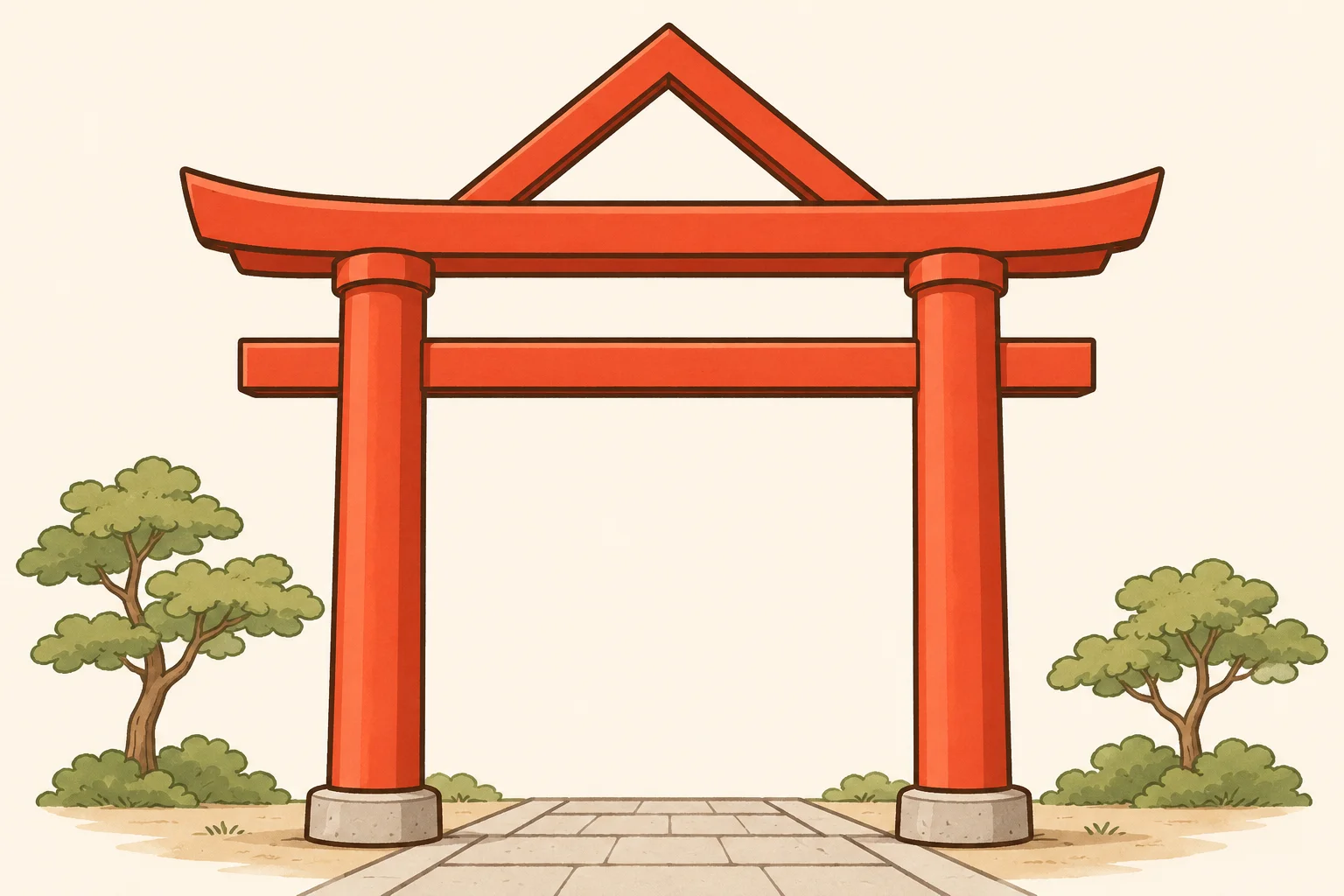
The Sannō torii of Hiyoshi Taisha is a torii gate topped with a triangular gable.
In 1571 the warlord Oda Nobunaga, whose enemies the Asai and Asakura clans had been sheltered by Enryaku-ji, attacked the mountain and burned it. The Konponchūdō and most other halls were destroyed, and contemporary accounts put the number of dead, monks and laypeople alike, in the thousands. Archaeological work in recent decades suggests that many buildings on the mountain had already fallen into disuse and that the destruction may have been smaller than the chronicles claim, but the burning of Hiei remains the defining image of Nobunaga as a destroyer of old authority.
The present Konponchūdō was rebuilt on the orders of the third Tokugawa shogun, Iemitsu, and completed in 1642. It is a National Treasure. Inside hang three lamps called the Fumetsu no Hōtō, the "inextinguishable dharma lamps." Tradition says their flame has burned since Saichō’s day. When Nobunaga’s fire put it out, it was relit from a flame that had earlier been carried to Yamadera in Yamagata. Monks top up the oil every day. A popular folk etymology connects the Japanese word yudan, "carelessness," literally "oil cut off," to the danger of letting these lamps run dry.
06Edo’s Mount Hiei
Tendai revived under the Tokugawa through a monk named Tenkai, an adviser to Tokugawa Ieyasu. After Ieyasu’s death Tenkai argued successfully that he should be deified according to Sannō Shintō as Tōshō Daigongen and enshrined at Nikkō. In 1625 Tenkai founded Kan’ei-ji in Ueno, to the northeast of Edo Castle, giving it the mountain name Tōeizan, "Mount Hiei of the East." The layout imitated Kyoto deliberately: Kan’ei-ji guarded Edo’s demon gate as Enryaku-ji guarded Kyoto’s, Shinobazu Pond stood in for Lake Biwa, an island shrine to the goddess Benten echoed Chikubushima in the lake, and the Kiyomizu Kannon Hall copied Kyoto’s Kiyomizu-dera.
Kan’ei-ji and Rinnō-ji at Nikkō were headed by imperial princes for most of the Edo period, and Kan’ei-ji served as one of the two family temples of the shoguns; six Tokugawa shoguns are buried there. In 1868, during the Boshin War, loyalist shogunate troops made their stand at Ueno, and most of the temple burned. Much of what is now Ueno Park, with its museums and zoo, was once Kan’ei-ji’s precinct.
After the Meiji government forcibly separated Buddhism from Shinto, Tendai lost much of its shrine-related role, and several branches later became independent. Today the Tendai school proper is headed by Enryaku-ji, and the Tendai family of schools as a whole counted more than 4,000 temples in the 2014 edition of the Agency for Cultural Affairs’ yearbook of religions. Onjō-ji leads the separate Tendai Jimon school.
07The Thousand-Day Circuit
The practice most associated with Mount Hiei today is the kaihōgyō, often translated as the "mountain-circling practice" and best known in its full form, the thousand-day sennichi kaihōgyō. The practitioner wears white robes, straw sandals, and a distinctive hat of woven cypress shaped like an unopened lotus flower. Setting out in the middle of the night, he walks a route of about 30 kilometers through the mountain forest, stopping to bow and chant at hundreds of halls, shrines, stones, and trees. Later stages involve longer routes. The thousand days are spread over seven years.
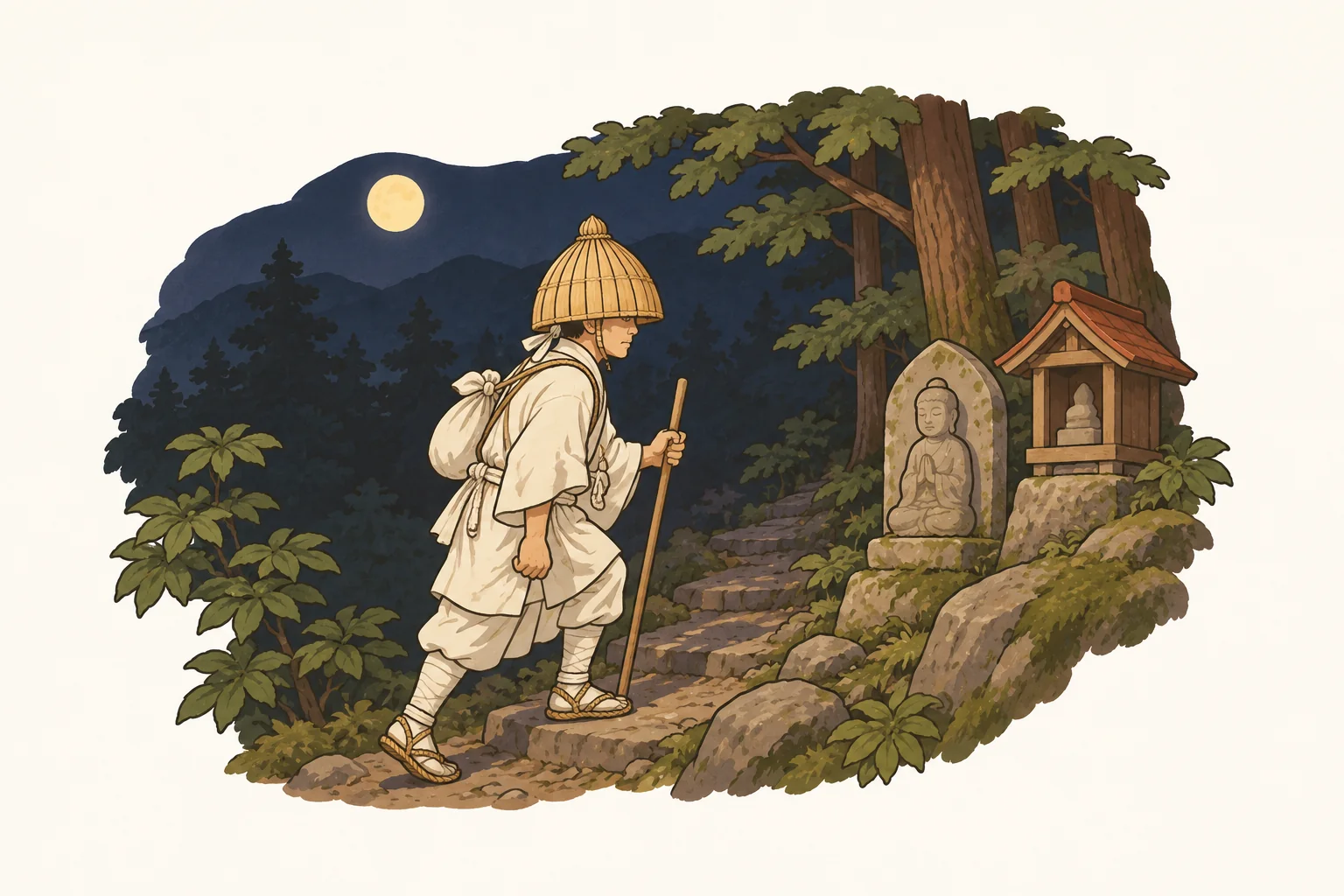
A kaihōgyō practitioner in white robes and a lotus-shaped cypress hat walking the mountain at night (illustration).
The most severe test comes after the 700th day. In the ordeal called dōiri, the monk shuts himself in the Myōōdō hall at Mudō-ji for nine days without food, water, sleep, or lying down, reciting the mantra of Fudō Myōō, the fierce guardian deity. Those who complete the full thousand days earn the title of daiajari, "great master," and are regarded as close to living embodiments of Fudō. Only around fifty people are recorded as having finished it since Nobunaga burned the mountain in 1571. Sakai Yūsai, who completed it twice in the 1970s and 1980s, became a national figure.
The practice is traced to Sōō, a ninth-century monk. On certain days of the circuit the route descends into Kyoto itself, and people kneel along the streets to receive a blessing as the monk touches their heads with his rosary. It is one of the few times the austere world of the mountain enters the city.
08Visiting Tendai Japan
Enryaku-ji is not a single building but a whole mountaintop, divided into three areas: Tōdō (the Eastern Pagoda area), Saitō (the Western Pagoda area), and Yokawa, farther north. Tōdō holds the Konponchūdō and the Great Lecture Hall, where wooden statues of Hōnen, Shinran, Eisai, Dōgen, Nichiren, and other founders who trained on the mountain stand side by side. The Konponchūdō has an unusual interior. The inner sanctuary where monks perform rituals sits about three meters below the floor where visitors stand, so the Yakushi image and the glowing lamps are at eye level with the worshipper rather than looming above. The hall has been under a major restoration since 2016, still in progress as of 2026, so expect scaffolding and a protective outer structure. From January 2026 the interior is closed to worshippers, expected to reopen in January 2028; in the meantime a stand-in Yakushi image and the dharma lamps are enshrined in the nearby Manbaidō hall. Saitō is quieter, with the Shakadō hall and a pair of halls linked by a corridor, used for walking meditation and Lotus Sutra practice. Yokawa contains the Ganzan Daishi hall, dedicated to Ryōgen and regarded as the birthplace of omikuji. Enryaku-ji is part of the UNESCO World Heritage listing for the Historic Monuments of Ancient Kyoto.
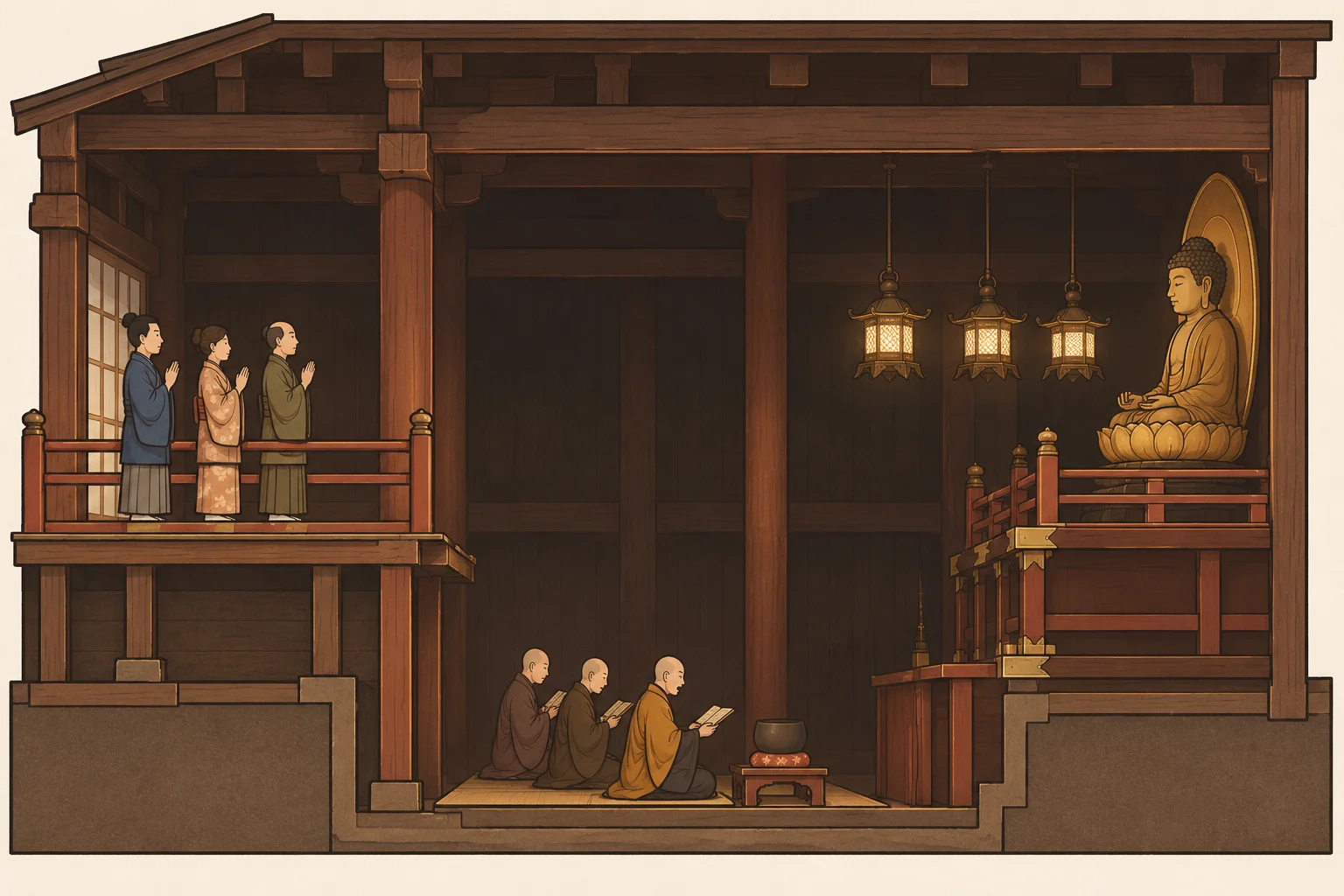
In section: the inner sanctuary lies about three meters lower, so the Yakushi image is at eye level.
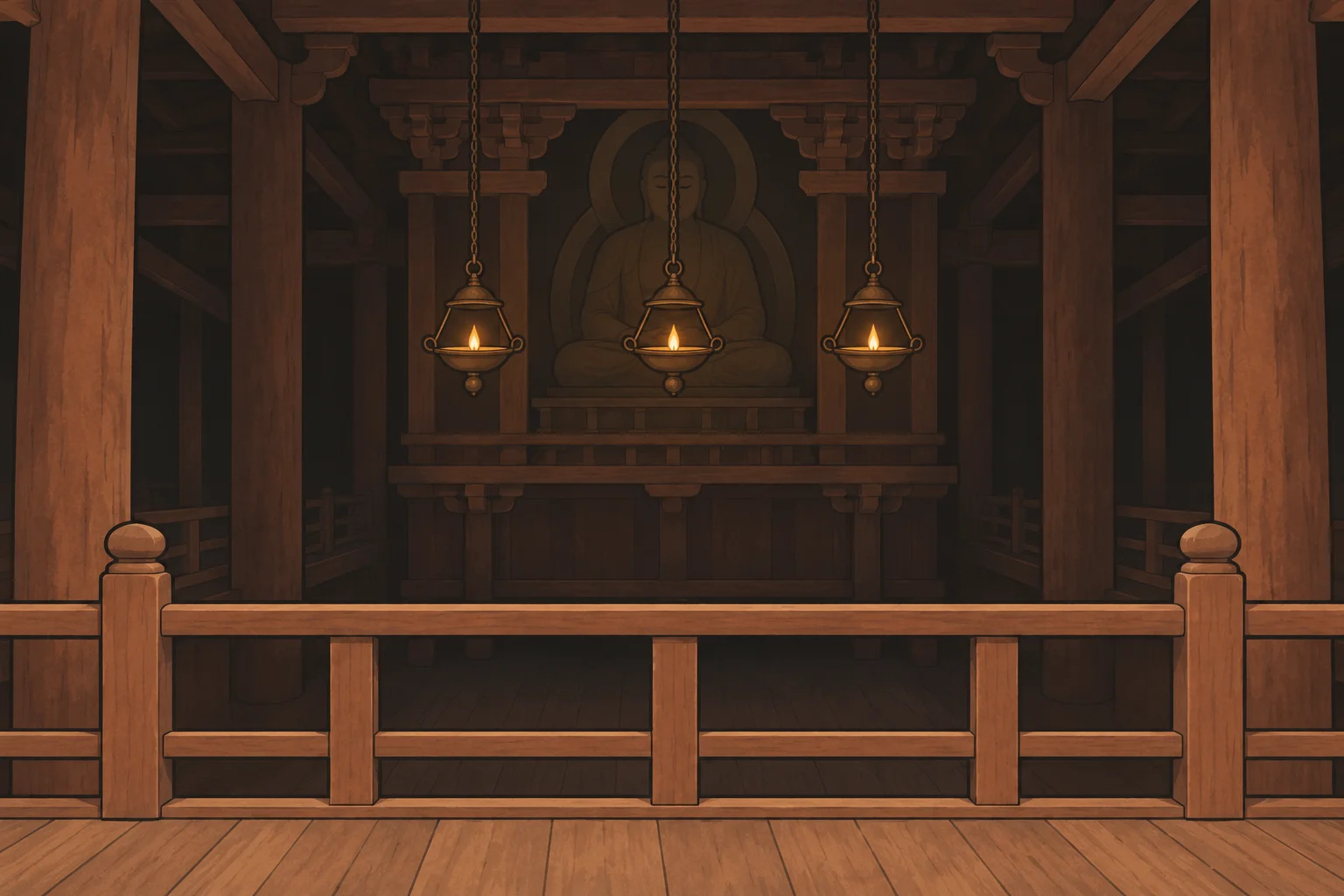
From where visitors stand: the three inextinguishable dharma lamps at eye level.
| Area | Main halls | Notes |
|---|---|---|
| Tōdō | Konponchūdō, Great Lecture Hall | statues of founders who trained here |
| Saitō | Shakadō and a pair of linked halls | quieter |
| Yokawa | Ganzan Daishi hall | farther north; birthplace of omikuji |
Enryakuji is divided into three areas linked by shuttle buses; a full day is about right.
There are several ways up. From Kyoto, the Eizan Railway runs to Yase, where a cable car and ropeway climb the mountain. From the Shiga side, the Sakamoto Cable, about two kilometers long, is, as of 2026, the longest cable car in Japan. Shuttle buses connect the three areas, and a full day is about right. At the foot of the mountain, Sakamoto is worth an hour or two: retired monks’ residences line streets bounded by stone walls built in a distinctive local style called anōshū-zumi, and Hiyoshi Taisha is spectacular in autumn foliage.
Visitors can join sessions of seated meditation or sutra copying, and stay at temple lodgings on the mountain, where dinner is vegetarian temple cuisine and the morning begins with the monks’ service.
Tendai sites are scattered across Japan. In Kyoto, Sanzen-in in the village of Ōhara is famous for its moss garden and its Amida triad. Shōren-in, Myōhō-in, and Manshu-in are monzeki temples once headed by imperial princes; the celebrated Sanjūsangendō, with its 1,001 standing Kannon statues ranged around a seated central image, belongs to Myōhō-in. In the north, Chūson-ji at Hiraizumi, with its gold-covered Konjikidō, and Yamadera, with its thousand stone steps up a cliff, are both Tendai. So are Kan’ei-ji in Ueno and Rinnō-ji at Nikkō. Sensō-ji in Asakusa was a Tendai temple until 1950, when it became independent as the head of its own small school.
Saichō left a phrase that Tendai still uses as its motto: a person who lights up one corner of the world is a treasure of the nation. Standing in the dim outer hall of the Konponchūdō, looking down at lamps that have, by tradition, been tended for twelve centuries, it is easy to see why the image stuck.