
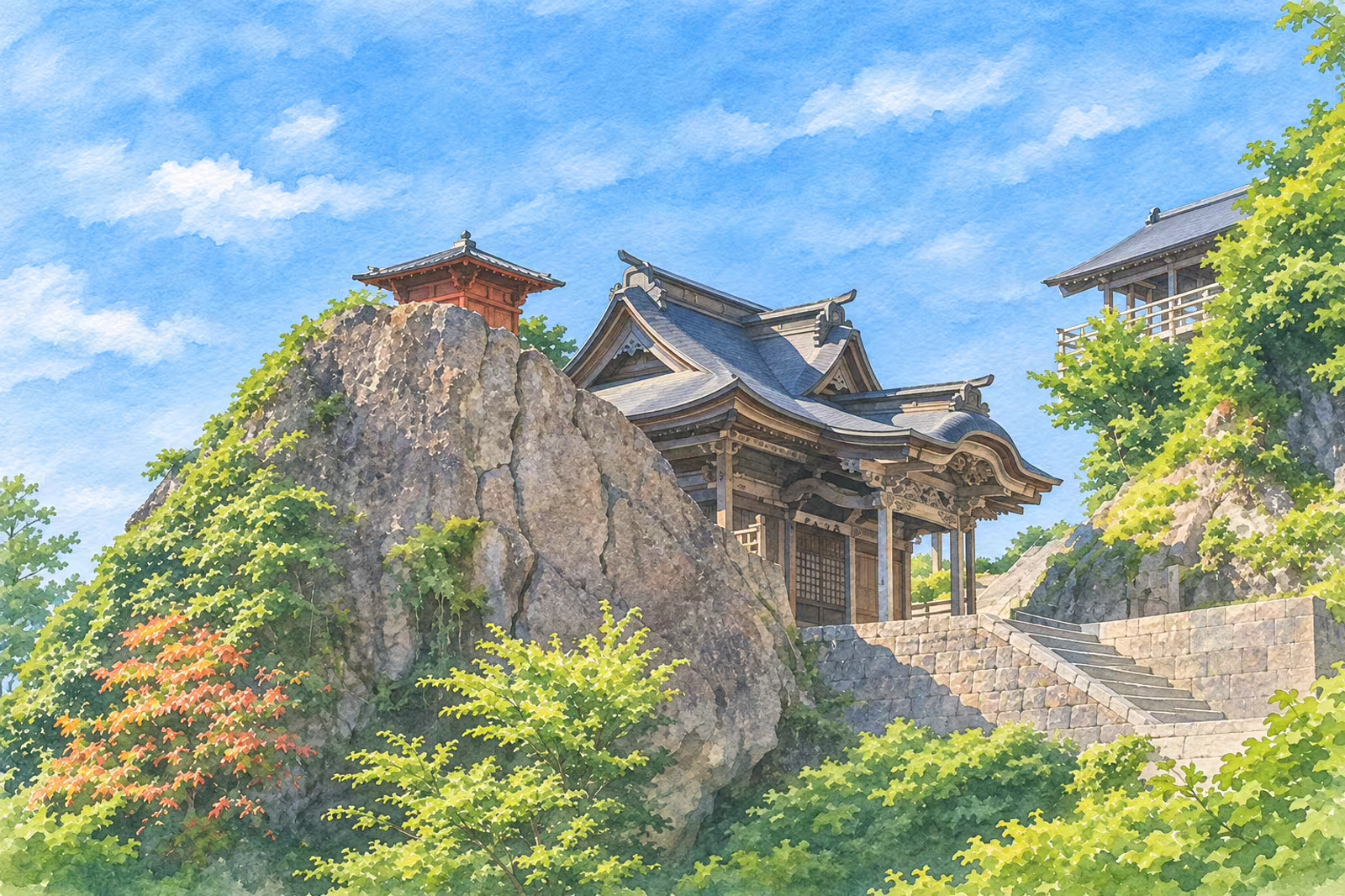
Risshaku-ji, whose formal name is Hōjusan Risshaku-ji and which is widely known as Yamadera, "the mountain temple," is a Tendai temple in the northeast of Yamagata City, Yamagata Prefecture. It is built on a steep mountain of volcanic tuff. More than a thousand stone steps climb from the foot of the hill to the inner sanctuary, past halls set into the rock face. The temple owes much of its fame to Matsuo Bashō, who wrote one of his best-known haiku here, about the stillness and the cicadas’ cry sinking into the rocks.
01Foundation and medieval fortunes
According to temple tradition, the monk Ennin (Jikaku Daishi) founded Risshaku-ji in 860 at the command of Emperor Seiwa. Whether Ennin came here in person cannot be confirmed, but a stone inscribed in 1144 to mark a ritual burial of copied sutras shows that the temple was a flourishing Tendai center by the late Heian period. A cave below the Kaisandō, the founder’s hall, is said to be Ennin’s resting place. A survey in the mid-20th century found a wooden coffin and a carved wooden head inside, and the head, believed to be a portrait of Ennin, is an Important Cultural Property. The Konponchūdō, the main hall, keeps an "undying lamp" said to have been lit from the flame at Enryaku-ji on Mount Hiei. When the temple burned in warfare in the early 16th century, the flame went out and was brought back from Mount Hiei in 1543. After Oda Nobunaga burned Mount Hiei in 1571, Enryaku-ji in turn relit its lamp from Risshaku-ji.
02Bashō’s visit
In 1689, during the journey recorded in Oku no Hosomichi (The Narrow Road to the Deep North), Bashō made a detour to Risshaku-ji at the end of the fifth lunar month, mid-July in the Western calendar. His travel account describes the quiet of the halls on the rocks, and there he composed the cicada haiku. The Semizuka, the "cicada mound" on the path, is said to hold a slip bearing his poem and was raised later in his memory.
03What can be seen today
The Konponchūdō was rebuilt in 1356 by Shiba Kaneyori and is an Important Cultural Property. It is said to be the oldest surviving building in Japan made of beech. Climbing the steps, visitors pass the Sanmon gate, the Ubadō, the Semizuka, the Niōmon gate, the Kaisandō and the small red Nōkyōdō on the cliff edge. The Godaidō offers a view over the valley, and at the top stand the Okunoin and the Daibutsuden, which houses a large Amida image. The whole temple precinct is designated a National Historic Site and Place of Scenic Beauty. It remains an active temple, where families still bring the bones or teeth of the dead up the mountain for memorial rites.
Yamadera (Risshaku-ji)
01A Temple Built Into a Cliff
Yamadera means simply "mountain temple," and that is what everyone in Yamagata calls it. The formal name is Hōjusan Risshaku-ji, "the Temple of Standing Stones on Jewel Mountain," and it belongs to the Tendai school of Buddhism, the tradition headquartered on Mount Hiei above Kyoto. The name is a description. The mountain is volcanic tuff, a soft rock that wind and water have carved into pillars, overhangs and caves. Halls and shrines sit on ledges and in hollows all the way up, some of them seemingly glued to the rock face.
For the visitor, the temple is a climb. A stone staircase of roughly a thousand steps runs from the main hall at the foot of the mountain up through cedar forest to the Oku-no-in, the inner sanctuary near the summit. Along the way are smaller halls, sub-temples, memorial stones, and thousands of small stupa shapes cut directly into the cliffs.
Two stories dominate Yamadera’s fame. The first is its founding by the monk Ennin and the "eternal flame" in its main hall, which is linked to Mount Hiei in an unusual way. The second is a single summer evening in 1689, when the poet Matsuo Bashō climbed these steps and wrote one of the best-known haiku in the Japanese language.
02Ennin and the Founding
According to the temple’s own tradition, Risshaku-ji was founded in 860 by Ennin, at the request of Emperor Seiwa. Ennin (794–864), known after death by the title Jikaku Daishi, was one of the great figures of early Japanese Buddhism. A disciple of Saichō, the founder of Japanese Tendai, he sailed to Tang China in 838 with one of the last official embassies and spent nearly ten years there. His diary of that journey, The Record of a Pilgrimage to China in Search of the Law, is one of the most important eyewitness accounts of Tang China, including the great persecution of Buddhism under Emperor Wuzong in the 840s. Back in Japan he became the third abbot of the Tendai school and brought esoteric ritual and Pure Land devotion to Mount Hiei.
Across northeastern Japan, a striking number of temples claim Ennin as founder or restorer: Chūson-ji and Mōtsū-ji at Hiraizumi, Zuigan-ji at Matsushima, the volcanic sacred site of Osorezan in the far north. Most of these claims come from later temple histories, and Ennin was in his late sixties in 860, so whether he personally traveled to this mountain in Dewa Province cannot be confirmed. What is certain is that Risshaku-ji was an established Tendai temple by the late Heian period.
A local legend tells how the mountain came to Buddhism. A hunter named Banji Bansaburō (some versions make him two brothers) met Ennin at a great boulder at the foot of the mountain, now called the Taimen-seki, the "meeting stone." Moved by the monk’s wish to spread the Dharma in the north, he gave up the mountain and stopped hunting. A small hall beside the stone holds images of the two, and a summer festival in Banji’s honor features a lion dance said to recall the animals rejoicing at the meeting. The temple’s own account says, more prosaically, that Ennin bought the land from its owner. Stories of hunters surrendering a mountain to a monk are told at many Japanese mountain temples, and they read as a memory of how Buddhism absorbed older mountain cults.
Ennin died on Mount Hiei in 864, yet Yamadera holds that his remains rest here. Below the Founder’s Hall is a cave called the Nyūjō-kutsu, "the cave of eternal meditation." When it was examined in 1948–49, investigators found a gilded wooden coffin, the bones of five people, and a carved wooden head, a portrait sculpture believed to represent Ennin and dated to the early Heian period. The head was designated an Important Cultural Property in 2006. Whether the bones or the head have anything to do with the historical Ennin is debated, but they show that people venerated this mountain as his resting place a very long time ago.
03The Flame That Went Back to Mount Hiei
In the Konpon-chūdō, the main hall at the foot of the mountain, burns the Fumetsu no Hōtō, the "inextinguishable lamp of the Dharma." Tradition says its flame was carried here at the founding from the Konpon-chūdō of Enryaku-ji, the head temple of Tendai on Mount Hiei.
The flame has, in fact, gone out. Around 1520–21, during the local wars of the Warring States period, Risshaku-ji was burned and the lamp died with it. In 1543 a monk named Enkai brought fire again from Mount Hiei and the temple was revived, with the support of the local lord Mogami Yoshimori.
Then the direction reversed. In 1571 the warlord Oda Nobunaga attacked Mount Hiei and burned Enryaku-ji to the ground, extinguishing the lamp at its source. When Enryaku-ji rebuilt its main hall, it relit its lamp with fire taken from Risshaku-ji. The flame you see at Yamadera and the one on Mount Hiei have thus each saved the other once.
04Mountain of the Dead
Beneath the Tendai institution lies an older layer of belief. In much of northeastern Japan, people held that the souls of the dead go to the mountains, and Yamadera’s crags were understood as a place where spirits gather. The custom of bringing a small portion of a deceased relative’s bones or teeth to the inner sanctuary for memorial rites continues today. On the cliffs along the path you will see iwa-tōba, rock stupas: stupa outlines carved into the stone, often with a posthumous Buddhist name, made as memorials for the dead.
By the late Heian period, many Japanese believed the world had entered mappō, the age of the decline of the Dharma. One response was to copy the Lotus Sutra under strict ritual conditions and bury it, so that the teaching would survive until the coming of the future Buddha Maitreya. Risshaku-ji preserves a stone monument above Ennin’s cave, the Nyohōkyō-sho stele, dated 1144, recording that the sutra was copied in this way and deposited in a cave on the mountain. It is an Important Cultural Property and the oldest firm evidence of the temple’s activity.
05Rebuilding and Burning in the Middle Ages
The temple’s history in the Kamakura period is thinly documented. The shogunate in Kamakura controlled appointments to its top posts, and it is generally held that the temple was converted to Zen for a time under shogunal policy, returning to Tendai in the fourteenth century.
The present Konpon-chūdō dates from 1356. It was rebuilt by Shiba Kaneyori, a member of the Ashikaga family sent north by the Muromachi shogunate as its governor in Dewa, and with the rebuilding the temple returned to Tendai. Kaneyori built a castle at Yamagata, and his descendants took the name Mogami and became the dominant warlords of the region. The hall is a single-story building with a broad hipped-and-gabled roof, and is said to be the oldest surviving building in Japan made of beech wood. It enshrines a seated Yakushi, the Buddha of healing, traditionally attributed to Ennin and kept hidden from view. The hall has been an Important Cultural Property since 1908.
The fire of 1520–21 that put out the lamp came out of fighting among local lords: the temple had sided with Date Tanemune, and his enemy Tendō Yorinaga burned its halls.
06The Mogami and the Shogunate
Recovery came with the patronage of the Mogami. Mogami Yoshiaki, the most powerful lord in Dewa at the end of the sixteenth century, sided with Tokugawa Ieyasu at the time of Sekigahara in 1600 and was rewarded with a domain of some 570,000 koku. He granted Risshaku-ji land, and a memorial hall for him and his family, the Mogami Yoshiaki Reiya, still stands opposite the sub-temple Chūshō-in.
The Mogami were dispossessed in 1622 after a succession dispute, but the temple’s standing survived. The Tokugawa shogunate confirmed its estate at 1,420 koku (some records give 2,800), a large holding for a temple in the north, and placed it under Kan’ei-ji, the great Tendai temple in Edo. In the Edo period the mountain held many sub-temples and lodgings, and a few of them, such as Shōsō-in, Konjō-in, Chūshō-in and Kezō-in, still line the path.
07Bashō’s Evening on the Mountain
In the spring of 1689, Matsuo Bashō, then 45 by Western count, left Edo with his companion Kawai Sora on the journey he would describe in The Narrow Road to the Deep North (Oku no Hosomichi). They went north through Nikkō and Shirakawa to Matsushima and Hiraizumi, then crossed the mountains west into Dewa and stayed some ten days at Obanazawa with the merchant-poet Suzuki Seifū.
People there urged them to see Risshaku-ji, a temple founded by Jikaku Daishi and especially pure and still. So the two doubled back, about seven ri (some 28 kilometers), and reached the mountain while it was still light. Sora’s travel diary dates the visit to the 27th day of the 5th month of Genroku 2, which is July 13, 1689. They left their bags at a lodging at the foot and then climbed to the halls on the heights.
Bashō’s prose describes rocks piled on rocks, old pines and cypresses, ancient earth and stone smooth with moss, temple doors shut tight on top of the crags and no sound at all. Clambering along the cliffs to worship at the halls, he felt the beauty of the scene and the stillness entering his heart. Then comes the poem:
shizukasa ya / iwa ni shimiiru / semi no koe
Stillness — / seeping into the rocks, / the cicadas’ voices.
The point is the paradox: the shrill, unbroken song makes the silence deeper, as if the sound were being absorbed by the stone. The poem did not arrive in this form. Earlier versions differ from the final text, which Bashō reached through revision after the journey.
08Which Cicada?
In the twentieth century the poem set off a famous argument. In the mid-1920s the poet Saitō Mokichi, himself a native of Yamagata Prefecture, argued that the insect was the large brown cicada (aburazemi), loud and common in summer. Komiya Toyotaka, a scholar of German literature and of Bashō, held that it was the small niiniizemi, whose thin, high trill fits the stillness of the poem and the image of sound sinking into rock.
The debate ran for years. Field observation eventually showed that in mid-July the brown cicada has not yet begun to sing in Yamagata, while niiniizemi have, and Mokichi conceded. The episode is still told as one of the pleasant quarrels of modern Japanese letters.
After Bashō, Risshaku-ji became a pilgrimage place for haiku poets. Partway up the steps stands the Semizuka, the "cicada mound," where, according to the temple, later poets who believed this was the spot that inspired Bashō buried a slip of paper bearing his poem and set up a stone over it. Monuments to later poets, Saitō Mokichi among them, line the path, and a museum dedicated to Bashō stands on a hill near the station.
09Modern Times
The Meiji government’s separation of Buddhism and Shinto and its confiscation of temple estates hit Risshaku-ji as it did temples everywhere, but worship on the mountain continued. In 1932 the whole site, mountain and buildings together, was designated a national Historic Site and Place of Scenic Beauty under the name "Yamadera." Its national Important Cultural Properties are the Konpon-chūdō, the 1144 sutra stele, the small three-story pagoda at Kezō-in, the seated wooden Yakushi, and the wooden head of Ennin.
Today Risshaku-ji is part of the Shiji Kairō, the "Four Temples Pilgrimage," together with Chūson-ji and Mōtsū-ji in Hiraizumi and Zuigan-ji in Matsushima, all linked to Ennin. In 2018 the story of Yamadera and the safflower trade of Yamagata, whose merchants were among the temple’s patrons, was recognized as a Japan Heritage story.
10Walking Up the Mountain
Cross the river from the station and the first building you reach is the Konpon-chūdō, the fourteenth-century main hall where the lamp burns. Nearby is Hie Shrine, the guardian shrine of the mountain, and a stone carved with Bashō’s poem.
The climb proper begins at the Sanmon gate. It is said that each of the steps beyond it, usually counted as 1,015, removes one worldly desire. Soon after comes the Ubadō, a small hall housing Datsueba, the old woman who in Buddhist lore strips the clothes from the dead at the river of the underworld. It marks the boundary between this world and the next: above it lies the Pure Land.
The path narrows in places, most famously at the stretch nicknamed the Shisun-michi, the "four-sun path," said to remind walkers to take life one careful step at a time. Past the Semizuka is the Mida-hora, a weathered rock face in which the outline of Amida Buddha is said to appear to those with the right connection. Above stands the Niōmon gate, rebuilt in 1848, guarded by two fierce Niō statues, with rock stupas covering the cliffs around it.
Beyond the gate the sub-temples line the path, and at the top are the Oku-no-in, formally the Nyohō-dō, which enshrines images of Shaka and Tahō Buddhas said to have been brought from China by Ennin and where ritual sutra copying still goes on, and the adjoining Daibutsu-den with its gilded Amida about five meters tall.
Turn back to the branch path to the Kaisan-dō, the Founder’s Hall, which stands on the Hyakujō-iwa crag and enshrines a wooden image of Ennin above the natural cave said to hold his remains. Perched at the very edge of the cliff beside it is the little red Nōkyō-dō, the sutra repository, which holds the Lotus Sutra copied at the inner sanctuary. It is the oldest building on the mountain, generally dated to the early Muromachi period, and appears in nearly every photograph of Yamadera. A little farther is the Godai-dō, a hall for the Five Wisdom Kings, said to have been founded thirty years after the temple and built out over the rock like a stage. Its railing gives the best view on the mountain, over the valley, the river and the village below. On the way down, look for the small three-story pagoda tucked into a cave at Kezō-in, about two and a half meters tall, inscribed 1519, and billed as the smallest three-story pagoda in Japan.
If you stand at the Godai-dō in July, you will probably hear the cicadas.