
At a glance
How season words and cuts make seventeen sounds work, how Bashō turned comic linked verse into poetry and a journey north into a book, and where senryū went instead.
- A haiku is a fixed form of seventeen sounds in a 5-7-5 pattern, built around a season word and a cutting word.
- It grew out of hokku, the opening verse of linked verse; in the Meiji era Masaoka Shiki gave it the name haiku.
- Matsuo Bashō (born 1644, died 1694) turned comic haikai into serious poetry; the old-pond poem dates from around 1686.
- In 1689 Bashō and Sora set out from Fukagawa, walking over 2,000 km in about 150 days, the journey behind Oku no hosomichi.
- Senryū uses the same 5-7-5 form but needs no season word and writes about people; it is named after the Edo judge Karai Senryū.
Most English speakers meet haiku in a school classroom, as a counting exercise: five syllables, then seven, then five. In Japan the poem is something larger and stranger. It began as the opening move in a party game of linked verse, became a serious art in the hands of one restless seventeenth-century poet, Matsuo Bashō, and today turns up on tea bottles, in newspaper columns and on prime-time television. This is an introduction to how haiku works, where it came from, what Bashō did to it, how a sister form called senryū took the same seventeen beats in a comic direction, and where a visitor to Japan can still go to find the poem in its places.
01One frog, one splash
Start with the poem every Japanese schoolchild knows:
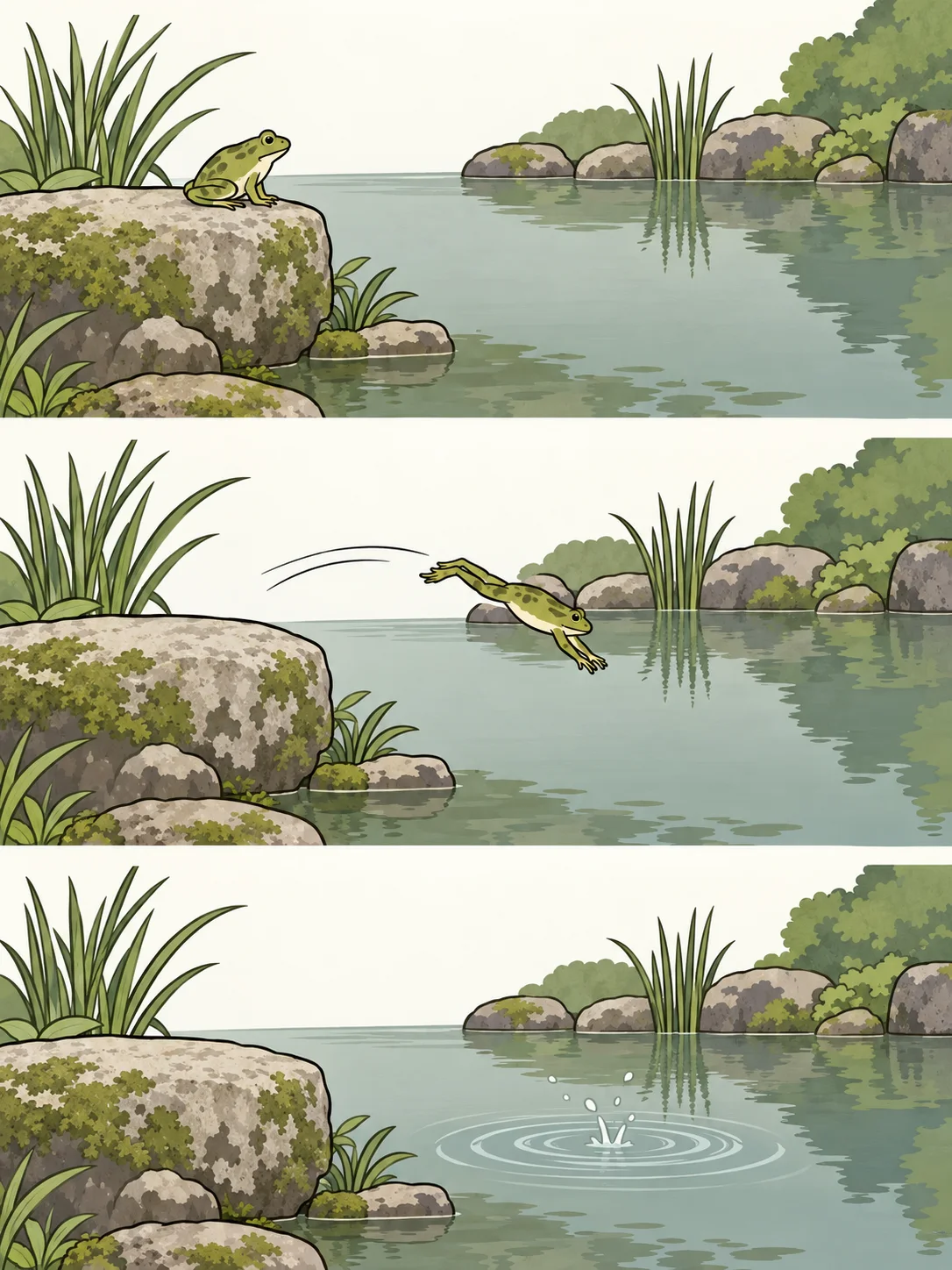
furuike ya / kawazu tobikomu / mizu no oto
An old pond. A frog jumps in. The sound of water.
That is the whole thing. There is no metaphor, no statement of feeling, no moral. Many Western readers, meeting it for the first time, wonder what the fuss is about. The answer lies in what the poem leaves out. The pond is still; the frog’s leap is a single instant of motion; the splash breaks the silence and then the silence returns, deeper than before. The poem gives you only the sound. You supply the quiet that surrounds it, and in doing so you find yourself standing at the edge of the pond. Japanese critics describe this as yohaku, the white space left on the page, or yoin, the lingering resonance after a bell has stopped.
Three conventions make this compression possible. The first is the count. Japanese verse counts on (sound units, roughly the length of a single kana character), and a haiku has five, seven and five of them. Fu-ru-i-ke-ya is five; ka-wa-zu-to-bi-ko-mu is seven; mi-zu-no-o-to is five. Because Japanese on are shorter than English syllables, a faithful seventeen-syllable English version usually says more than the original does, which is why many translators prefer a looser three-line shape.
The second convention is the kigo, or season word. "Frog" belongs to spring in the Japanese poetic calendar, so the old-pond poem is a spring poem. Cherry blossom, the cicada, autumn leaves, the first snow: each of these, dropped into a poem, carries with it the light, temperature and mood of its season. Poets keep a saijiki, a season-word almanac, on their desks. It sorts thousands of words into spring, summer, autumn, winter and New Year, each with sample poems. Some entries are obvious; others are not. The moon, unqualified, means autumn. "Mountains laughing" means spring. A season word does the work an English poet might need a full stanza to do.
The third is the kireji, or cutting word: short particles such as ya, kana and keri that have no real translation but act like a pause or an exclamation mark. Furuike ya means something like "the old pond — ah." The cut divides the poem into two parts that sit next to each other without being explained. The old pond on one side, the frog and its splash on the other. The spark happens in the gap between them. Japanese poets call this toriawase, the setting together of two things.
02Linked verse: catching the line before you
Haiku did not start life as a poem on its own. It was the first stanza of a much longer one, and to understand it you have to understand renga, linked verse.
The classical Japanese poem was the waka, thirty-one on arranged five-seven-five-seven-seven. By the late Heian period, courtiers had turned it into a game: one person composed the first three lines, another capped it with the final two. Over the Kamakura and Muromachi periods, from roughly the thirteenth to the sixteenth centuries, the game grew into a long collaborative form. A group of poets sat together, often for most of a day, and took turns adding verses: a 5-7-5, then a 7-7, then a 5-7-5 again, building to a standard length of a hundred stanzas, called a hyakuin.
The art of renga lay in linking and shifting. Each new stanza had to read as a complete poem together with the one just before it. But it also had to move away from the stanza two back, turning the sequence in a new direction. If one verse showed the spring moon, the next might put a traveler on a road under that moon, and the next might carry the traveler into an autumn mountain where the moon no longer appeared at all. A renga had no single subject. It wandered like a river. To keep it from becoming chaos, masters developed an elaborate rulebook: how many consecutive verses a season could run, where the moon and the cherry blossoms had to appear, how far apart two similar words must be.
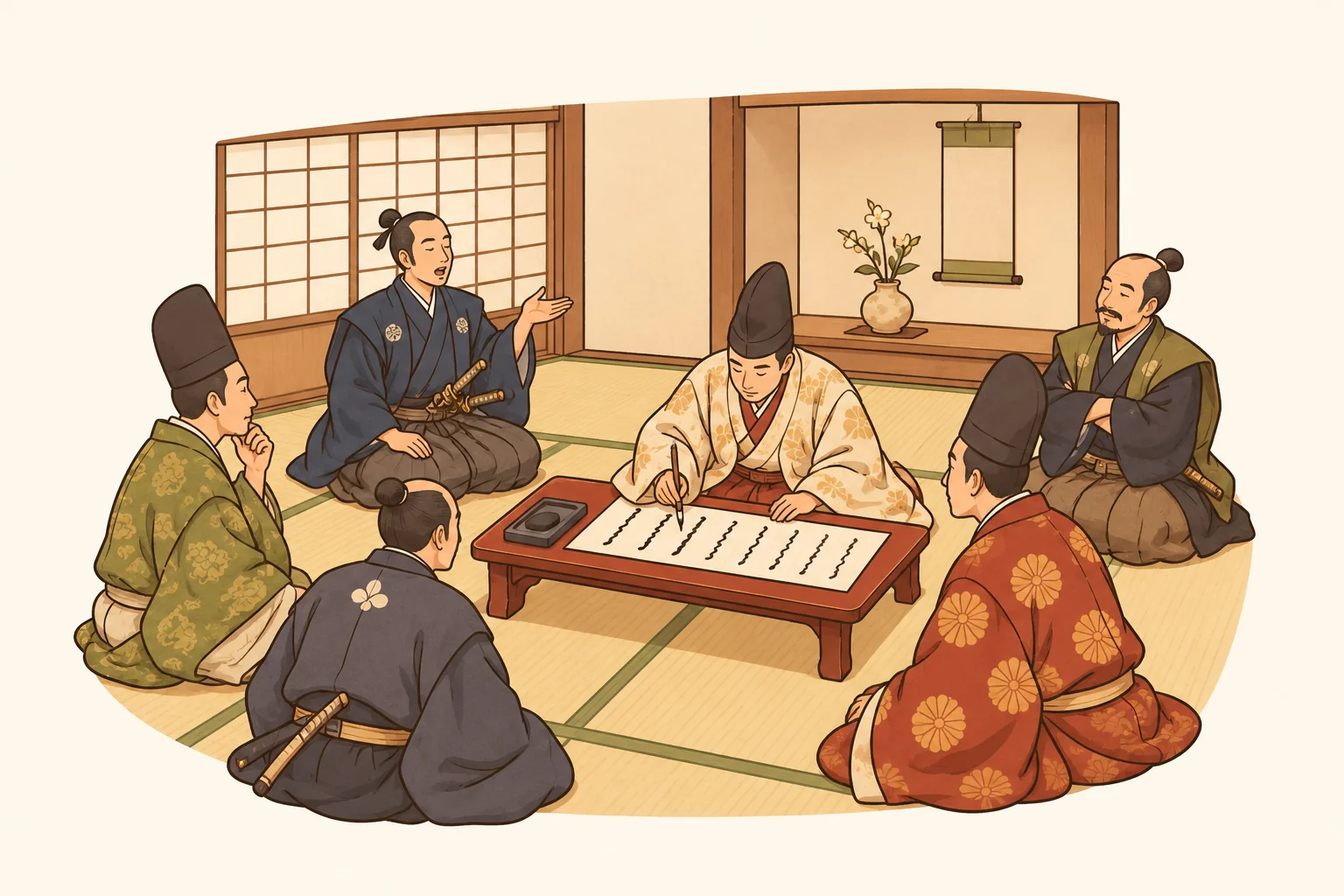
A renga session: poets sit together and take turns adding verses (illustration).
The great master of the Muromachi period was Sōgi, and the hundred-stanza sequence he composed with two of his disciples at Minase in 1488, the Minase sangin hyakuin, became the model for later generations. Renga sessions were high culture for warriors, courtiers and monks, a social occasion as much as a literary one.
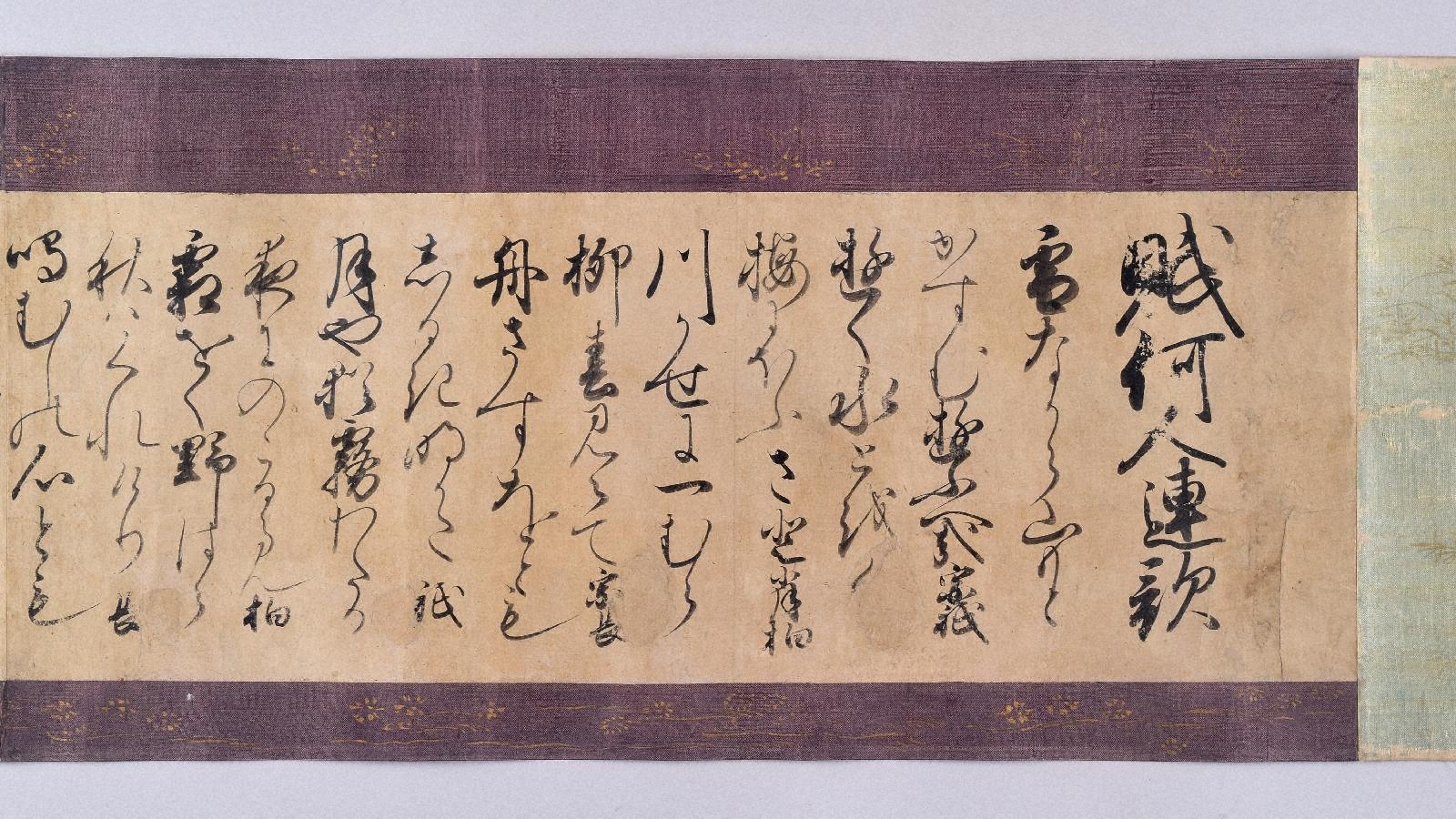
The opening of a mid-Edo copy of the Minase sangin hyakuin, composed by Sōgi and two disciples in 1488; the stanzas run on one after another.Wakayama Prefectural Museum, Minase sangin hyakuin manuscript (mid-Edo period, Public Domain Mark)
Of all the stanzas, the first carried the most weight. It was called the hokku, the "starting verse," and it was usually offered by the most honored guest. It had to name the season and the occasion, often as a greeting to the host, and it had to stand firm on its own. So it always included a season word and a cutting word. Those two requirements of the hokku are the origin of the season word and the cut in the modern haiku.
Alongside courtly renga grew a popular, comic version called haikai no renga, "playful linked verse," usually shortened to haikai. Where orthodox renga used refined classical diction, haikai admitted slang, Chinese loanwords, food, bodily functions, puns and parody. In the early seventeenth century, as peace under the Tokugawa shoguns created a prosperous urban class with time and money, haikai became a mass pastime. Matsunaga Teitoku in Kyoto codified it with his Teimon school; later Nishiyama Sōin in Ōsaka led the freer, flashier Danrin school. One Danrin poet, Ihara Saikaku, better known later as a novelist, performed marathon solo sessions; in 1684 he is said to have composed over twenty thousand verses in a single day and night. Haikai was fun, competitive and commercial. Few people thought of it as a place to put a serious life.
03Bashō: turning a game into poetry
Matsuo Bashō was born in 1644 in Iga Province, in what is now Iga city in Mie Prefecture, into a family of musokunin, rural gentry who held quasi-samurai standing without a stipend, though by his father’s time they lived as commoners in the castle town. As a young man he entered service with the Tōdō Shinshichirō household and attended its heir, Tōdō Yoshitada, who loved haikai and wrote under the name Sengin. Bashō learned the art alongside him. When Yoshitada died young in 1666, Bashō’s path in Iga closed, and some years later he moved to Edo, the shogun’s capital.
In Edo, writing as Tōsei, he built a reputation, took on students, and became a professional haikai master. That was a respectable living: judging verses, leading sessions, collecting fees. Then in 1680, in his mid-thirties, he walked away from it. He left the busy Nihonbashi area and moved into a small hut across the Sumida River in Fukagawa, then a marshy fringe of the city. A student planted a bashō tree, a Japanese banana plant, beside the hut. Its huge leaves tear easily in wind and rain, giving it a ragged, unbothered look that the poet loved. The hut became the Bashō-an, the Banana Hut, and he took its name as his own.
In Fukagawa he read the Chinese classics he admired, Zhuangzi and the Tang poets Du Fu and Li Bai, as well as the Japanese wandering poets Saigyō and Sōgi. He practiced Zen meditation and lived simply. He began to ask whether haikai, a comic form, could carry the weight of real experience the way classical waka and Chinese verse did. At the end of the twelfth lunar month of Tenna 2, in January 1683, a great fire swept Edo and burned his hut; friends built him another. The experience of loss fed his thinking.
The old-pond poem dates from around 1686, and it is often treated as the moment the Bashō style, Shōfū, came of age. Frogs had a fixed place in classical poetry: they sang, and they were paired with the yellow yamabuki flower. Bashō ignored both conventions. His frog does not sing; it jumps. There is no elegant flower, only a neglected pond. By the standards of the day this was low, ordinary material. But it was ordinary in a quiet, deep way. The form was still haikai, still everyday language. What had changed was the way of looking.
Bashō left few theoretical writings, but his students recorded a handful of ideas that later poets argued over for centuries. Sabi describes the beauty of things that have aged and grown quiet, a loneliness that is not sad but calm. Karumi, "lightness," was his late ideal: write about daily life in plain words, without strain or showing off. Fueki ryūkō, "the unchanging and the ever-changing," held that a poem must touch something permanent and also be fresh to its moment, and that these were finally the same thing.
Around him gathered a circle of disciples, among them Takarai Kikaku, Hattori Ransetsu and Mukai Kyorai. The school’s major anthologies are known as the Seven Collections of the Bashō School; the fifth, Sarumino (The Monkey’s Straw Raincoat), published in 1691, is usually considered its high point. Most of what Bashō composed in his life was linked verse, sessions with students in which he supplied a hokku and then a few stanzas among many. We call him a haiku poet because later readers lifted his starting verses out of their sequences.
He was also a traveler. From 1684 onward he made a series of journeys and wrote them up as travel sketches: Nozarashi kikō (Journal of Bleached Bones in a Field), Kashima kikō, Oi no kobumi (Knapsack Notes), Sarashina kikō. On each trip he composed poems and led haikai sessions with local poets, who welcomed him as a celebrity. For Bashō, travel was a way of placing himself in the stream of impermanence and standing where earlier poets had stood.
He fell ill on the road in Ōsaka in 1694 and died there that autumn, aged about fifty by Western count (fifty-one by the traditional count; his birth date is unknown). The last verse he composed, on his sickbed, was this one:
tabi ni yande / yume wa kareno o / kakemeguru
Sick on a journey, my dreams go wandering over withered fields.
It is usually read as his death poem. At his own request he was buried at Gichū-ji, a small temple in Ōtsu by Lake Biwa, beside the grave of the twelfth-century warrior Kiso Yoshinaka, whom he admired.
04Oku no hosomichi: how a journey became a book
Bashō’s most famous work is not a single poem but a book, Oku no hosomichi, usually translated as The Narrow Road to the Deep North.
In the spring of 1689 Bashō, then about forty-five (forty-six by the traditional count), gave up the Banana Hut to new occupants and set out from Fukagawa with his student Kawai Sora. Their goal was Oku, the far north of Honshū, which to an Edo resident was a remote and half-legendary region. They went north through Nikkō and the Shirakawa Barrier, the old gateway to the north, to Matsushima and Hiraizumi, crossed the mountains to the Sea of Japan coast, then traveled south and west along it through Kisakata, Echigo and Kanazawa, finally reaching Ōgaki in Mino Province. The trip took about 150 days and covered about 2,400 kilometers, mostly on foot. The year 1689 was also the five-hundredth memorial year, by Japanese reckoning, of the poet-monk Saigyō, who died in 1190, and many of the places Bashō wanted to see were utamakura, famous sites that had been named in classical poems for centuries.
- 1FukagawaSet out, spring 1689
- 2Nikkō
- 3Shirakawa Barrier
- 4Matsushima
- 5Hiraizumi
- 6KisakataAfter crossing to the Sea of Japan coast
- 7Echigo
- 8Kanazawa
- 9ŌgakiJourney’s end
About 150 days and 2,400 km: read in order, north, over the mountains to the Sea of Japan coast, then along it to Ōgaki.
The book opens with a line Japanese readers know by heart:
Tsukihi wa hyakudai no kakaku ni shite, yukikau toshi mo mata tabibito nari.
The months and days are travelers of a hundred ages, and the years that come and go are travelers too.
The phrase borrows from a preface by the Chinese poet Li Bai, which calls time "a passing guest of a hundred generations." Bashō goes on: boatmen and horse-drivers spend their whole lives traveling; many poets of old died on the road; he himself has long been tugged by the wind of wandering. The idea that life is a journey frames everything that follows.
The book is written in haibun, a mix of prose and haiku. A short passage of compressed, rhythmic prose sets a scene, and a poem at the end lights it up. At Hiraizumi, where the Northern Fujiwara clan had built a glittering capital in the twelfth century, Bashō found only grass. He wrote:
natsukusa ya / tsuwamonodomo ga / yume no ato
Summer grasses: all that remains of warriors’ dreams.
At Risshaku-ji, the temple known as Yamadera, "the mountain temple," whose halls cling to a cliff in Yamagata, he climbed through the stillness and wrote:
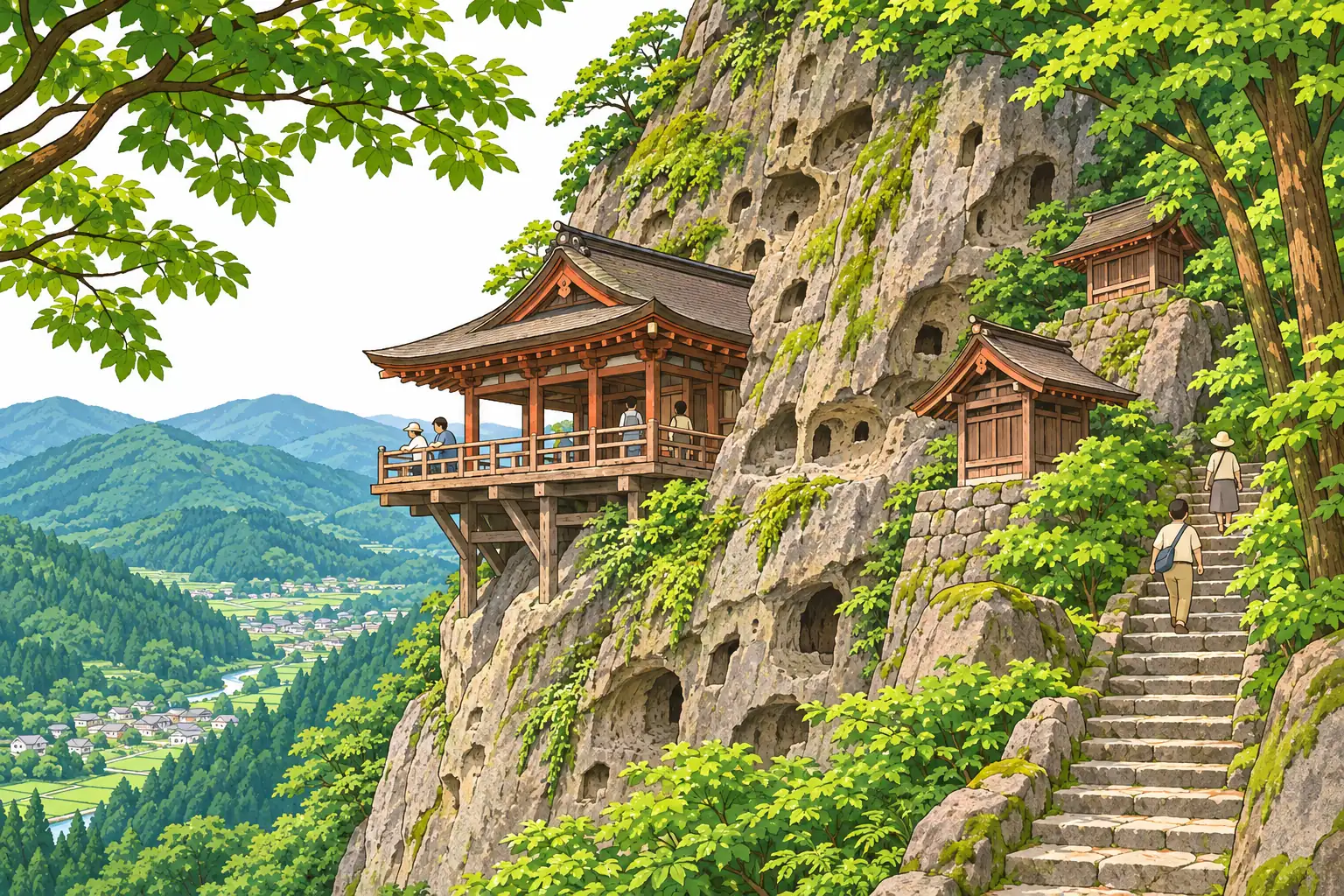
Risshaku-ji (Yamadera) in summer: wooden halls around the Godaidō cling to sheer rock above the valley (illustration).
shizukasa ya / iwa ni shimiiru / semi no koe
Such stillness: the cicada’s voice soaks into the rocks.
Japanese readers take this poem seriously enough that in the twentieth century a literary argument broke out over which species of cicada Bashō heard. The poet Saitō Mokichi argued for the loud large brown cicada; the Bashō scholar Komiya Toyotaka argued for the smaller niiniizemi, with a thinner, higher call, pointing out among other things that large brown cicadas would not yet have been singing in Yamagata at that point in early summer. Mokichi climbed the mountain more than once to check, and Komiya’s view is now the generally accepted one.
On the Mogami River, swollen by early-summer rain, he wrote samidare o / atsumete hayashi / Mogamigawa: gathering the rains of the wet season, how swift the Mogami River. On the Echigo coast, looking toward Sado Island across a dark sea, he wrote araumi ya / Sado ni yokotau / amanogawa: a rough sea, and stretching over Sado, the River of Heaven, the Milky Way.
Matsushima, a bay of pine-covered islets then considered one of the most beautiful views in Japan, gets lyrical prose in the book but no poem of Bashō’s own. A popular verse that simply repeats "Matsushima, ah Matsushima" is often attributed to him, but it is a later composition by someone else.
Why call Oku no hosomichi a work of art rather than a travel diary? Because Bashō spent years after his return rewriting it. A fair copy was not made until 1694, five years after the journey, and the book was not printed until 1702, after his death. Sora kept his own travel diary, long thought lost, which was rediscovered and published in 1943. Comparing the two shows that Bashō changed dates, rearranged the order of events and placed poems at sites other than where they were composed. At the inn at Ichiburi, the book has two young courtesans sleeping in the next room, who beg to travel with the poet the next morning; Sora’s diary, scholars point out, has no record of it, and many doubt it happened and read the scene as Bashō’s invention.
The discrepancies do not diminish the book. They show what kind of book it is. Bashō was not recording an itinerary. He was taking a real journey and shaping it: cutting the tedium, moving scenes for rhythm and contrast, building toward climaxes, setting his own steps in conversation with poets centuries dead. The journey was raw material; the book was the work. That is why travel writers still read it.
The book ends at Ōgaki, where students gathered to meet him. After a few days’ rest he set off again by boat for the shrines of Ise, with a final poem: hamaguri no / futami ni wakare / yuku aki zo. Like a clam torn from its shell, I part from my friends for Futami, and autumn too is leaving. Futami is a place near Ise, but the word also suggests the two halves of a clam, lid and body, so the book closes on a pun about separation.
05After Bashō: Buson, Issa and Shiki
After Bashō’s death haikai drifted back toward cleverness and routine. In the second half of the eighteenth century a movement to "return to Bashō" emerged, and its most gifted figure was Yosa Buson.
Buson (1716–1783) was also one of the finest painters of his time, and some of his paintings are now designated National Treasures. His poems are pictures: na no hana ya / tsuki wa higashi ni / hi wa nishi ni, a field of rape blossom, the moon in the east, the sun in the west. Or the drowsy haru no umi / hinemosu notari / notari kana, the spring sea, rising and falling, rising and falling all day long. Where Bashō is spare and solitary, Buson is luminous and full of color.
Kobayashi Issa (1763–1828) came from Kashiwabara, a village in the mountains of Shinano, today’s Nagano Prefecture. His mother died when he was small, he clashed with his stepmother, and he was sent to Edo as a teenager to make his way. Back home in later life he fought a long inheritance dispute with his half-brother, and several of his children died in infancy. His poems are colloquial, tender and often funny, and they side with the small: yasegaeru / makeru na Issa / kore ni ari, skinny frog, don’t give up, Issa is here for you. Or yare utsu na / hae ga te o suri / ashi o suru, don’t swat it! the fly is wringing its hands, wringing its feet. Japanese children often meet Issa before any other poet.
The modern haiku was named by Masaoka Shiki (1867–1902), born in Matsuyama on the island of Shikoku. In the 1890s Shiki attacked the stale verse of the established masters and argued that the hokku should be treated as an independent poem. He called it haiku, a term that had existed before but which he made standard, and he declared that linked verse was not literature. His method was shasei, "sketching from life," borrowed from Western painting: describe what is actually in front of you. One of his best-known poems is kaki kueba / kane ga naru nari / Hōryūji, I bite into a persimmon, and a bell rings out at Hōryū-ji.
Shiki contracted tuberculosis in his twenties and spent his last years bedridden in Tokyo, still writing and editing. He died in 1902, at thirty-four. His friend Yanagihara Kyokudō founded the haiku magazine Hototogisu in Matsuyama in 1897; Shiki’s disciple Takahama Kyoshi took it over and moved it to Tokyo, where it became the most influential haiku journal of the modern era. Kyoshi held to the fixed form and the season word, and preached kachō fūei, poems about flowers, birds and the natural world. His fellow disciple Kawahigashi Hekigotō went the other way, loosening the form, and from his circle came free-verse haiku that abandoned the count altogether. Its most famous practitioners were Taneda Santōka, a wandering Zen mendicant who wrote wakeittemo wakeittemo aoi yama, "going in and going in, still the green mountains," and Ozaki Hōsai, who died alone on the island of Shōdoshima and wrote seki o shitemo hitori, "even when I cough, alone."
Shiki was also a close friend of the novelist Natsume Sōseki; the two knew each other from student days in Tokyo, and Sōseki later taught in Matsuyama.
06Senryū: the same shape, a different face
Open a Japanese newspaper and you may find a column of five-seven-five verses about husbands afraid of their wives, bosses who give speeches, and grandparents who can never find their glasses. Those are not haiku. They are senryū.
Senryū share the seventeen-on form but not its concerns. Haiku descend from the hokku and look outward at nature and the season; senryū need no season word and no cutting word. Their subject is people: human weakness, vanity, family, office life, politics. Their language is colloquial, and their aim is ugachi, the sly insight that hits the nail on the head.
Senryū also came out of haikai, from a game called maekuzuke, "adding to a front verse." An organizer set a 7-7 prompt and invited people to cap it with a 5-7-5. The textbook example is the prompt "I want to cut it, I don’t want to cut it," capped by "I caught the thief, and looked: my own son." Put together they make a tiny, painful comic drama. By the mid-eighteenth century this had become an organized contest: judges set prompts, people across Edo paid a small fee to submit, and winning verses were printed and rewarded.
The most popular judge was Karai Senryū, a ward headman in Asakusa, whose selections were admired for their wit. From 1765 his best picks were published without their prompts in a series called Haifū yanagidaru, which continued long after his death, reaching its 167th volume in 1840. Read on their own, the capping verses still worked, and the form took its name from his.
Edo senryū were masters of satire. A famous one: yakunin no / ko wa niginigi o / yoku oboe, the official’s baby learns early how to grab and clutch. A baby’s grasping reflex becomes an infant’s training in taking bribes. No one is named and nothing is said outright.
Senryū is thriving today. The best known contest is the Salaryman Senryū competition run by the Dai-ichi Life insurance company since 1987, which collects verses about office and family life each year; the winners make national news and are read as an annual snapshot of the public mood. In 2022 the contest was renamed and opened beyond office workers. There are senryū columns in local papers and a popular genre of "silver senryū" by and about the elderly. If haiku is how Japan looks at nature, senryū is how it laughs at itself.
07Haiku in Japan today
Japan is often said to have several million people who write haiku regularly. Many belong to a kessha, a haiku group built around a leading poet, which publishes a monthly magazine for members’ work. The most common gathering is the kukai, the haiku meeting. Members bring poems, or write them on the spot to a set theme. The poems are copied out anonymously and circulated, everyone votes for their favorites, and only then are the authors revealed and the poems discussed. The kukai keeps something of the old renga room: you write for the people sitting around you, and your verse has to survive their eyes.
The form is also everywhere in daily life. Since 1989 the tea maker Itō En has run a haiku contest for its Oi Ocha bottled green tea; it receives well over a million entries a year, many from schoolchildren, and winning poems are printed on the bottles. On the MBS/TBS variety show Prebat!!, the haiku teacher Natsui Itsuki grades celebrities’ haiku with brutal frankness and rewrites them on air, and the segment has made the form fun for a new generation. Every August Matsuyama hosts Haiku Kōshien, a national competition in which high-school teams face off like baseball sides. Newspapers and NHK run weekly haiku sections with contributors from primary school age to their nineties.
Haiku has had its critics. In 1946, in the shadow of defeat, the scholar Kuwabara Takeo published an essay called "Second-Class Art," arguing that haiku was too short to express modern thought and was closer to a hobby than to literature. The essay stung, and many poets responded by pushing the form in new directions.
Abroad, haiku took hold early in the twentieth century. The Imagist poets read it in translation; Ezra Pound’s two-line "In a Station of the Metro" is the most famous result. After the Second World War, translations by R. H. Blyth and others reached the Beat poets, and Jack Kerouac and Gary Snyder wrote their own. Today there are haiku societies across North America and Europe, and English-language haiku is a recognized form with its own journals. Most English haiku poets no longer insist on seventeen syllables; many write shorter. Japanese poets tend to regard haiku without the Japanese season-word tradition and the rhythm of the language as a related but different kind of poem.
08Finding haiku on the ground
In Tokyo, start in Fukagawa, in Kōtō Ward. The Bashō Museum in Tokiwa stands near the site of the Banana Hut and displays his calligraphy, paintings and letters. A few minutes’ walk south, where the Onagi Canal meets the Sumida River, the museum’s annex has a small rooftop garden with a statue of the poet sitting and looking out at the water. Beside it is the little Bashō Inari shrine, said to stand on the site of the hut itself; in 1917, after a typhoon storm surge, a stone frog was dug up there, and people took it as a relic of Bashō. Whether it was his is impossible to say; the frog is now shown in the museum, and the shrine keeps a stone marking the site of the hut, along with, visitors report, a monument carved with the frog-pond poem. This whole stretch of riverbank is pleasant on foot, and it is the water Bashō looked at every day.
Bashō began the Oku no hosomichi journey by boat from Fukagawa, going up the Sumida and landing at Senju, where friends saw him off. There he wrote yuku haru ya / tori naki uo no / me wa namida, spring is leaving, the birds cry, and the fishes’ eyes are wet with tears. Senju has monuments marking the spot as the place where he first took up his writing brush for the journey.
You do not need to walk all 2,400 kilometers. Pick a few stations. At Hiraizumi in Iwate, home to the temples Chūson-ji and Mōtsū-ji, climb to the Takadachi Gikeidō, a small hall on a hill above the Kitakami River, and you are standing in the scene of "summer grasses." Yamadera in Yamagata requires a climb of around a thousand stone steps; go in summer and the cicadas really do sound as though they are seeping into the rock. There is a Bashō poem stone along the path and a Bashō memorial museum at the foot of the mountain. Take a cruise among the islands of Matsushima and you may understand why he wrote no poem there. At the end of the road, Ōgaki has a museum dedicated to the journey’s conclusion.
Bashō’s birthplace, Iga-Ueno, has a memorial museum and the Haiseiden, the "Hall of the Haiku Sage," an odd little building said to be shaped after the poet in his traveling hat and robe. His grave at Gichū-ji in Ōtsu is small and very quiet.
For Shiki, go to Matsuyama. The Shiki Memorial Museum tells the story of the man and the modern haiku. Around the city, including at Dōgo Onsen and the JR Matsuyama Station information office, you will find haiku postboxes where anyone can drop in a poem of their own. The postboxes also accept poems in other languages, and the city selects winning foreign-language haiku each year; as of 2026 the latest published results were for 2025. In the 2000s Matsuyama also gave an international award, the Masaoka Shiki International Haiku Awards, which has not been held in recent years.
Across Japan, at shrines, temples, parks and station plazas, you will see stones carved with flowing script. Very often they are kuhi, haiku stones. Bashō’s are everywhere, far too many to count easily; one estimate puts them at more than three thousand. Stop and look one up: who wrote it, in what season, and why here.
The best experience may be to write one. Cultural centers and tourism offices in many cities run haiku workshops for visitors, sometimes with brush and ink on a narrow paper card called a tanzaku. Or simply try it on the road. When something makes you stop walking, find a word that belongs to the season, set it beside the thing you saw, and say it in five, seven and five. Don’t explain it. You will find out quickly what Bashō meant by leaving the rest to the reader.