
At a glance
How a poor young Meiji woman, later on the 5,000-yen note, wrote Takekurabe and other classics in fourteen months, and where in Tokyo to find her.
- Higuchi Ichiyō (1872–1896) died at 24; for twenty years from 2004 her face was on the 5,000-yen note.
- Her most productive stretch is called the "miraculous fourteen months," from "The Last Day of the Year" in December 1894 to early 1896.
- From 1893 she ran a sundries shop for about nine months in Ryūsenji-machi beside the Yoshiwara, and what she saw there became her material.
- Takekurabe, serialized in 1895–96, follows fourteen-year-old Midori and the temple boy Nobu outside the Yoshiwara gate.
- She wrote in a mixed style: narration in elegant classical prose, dialogue in the speech of Tokyo’s backstreets.
For twenty years, anyone in Japan who paid with a 5,000-yen note was handing over the face of a young woman with a quiet expression and her hair swept back. Higuchi Ichiyō died of tuberculosis in 1896 at the age of twenty-four. She had been writing seriously for only a few years, and her best work came in a burst of roughly fourteen months. Yet the stories she produced in that time, above all Takekurabe (usually translated as Child’s Play or Growing Up), are still read as founding works of modern Japanese literature. This is an introduction to who she was, what she wrote, why Japanese readers care so much about her, and where in Tokyo you can still walk through her world.
01A Face on the Money
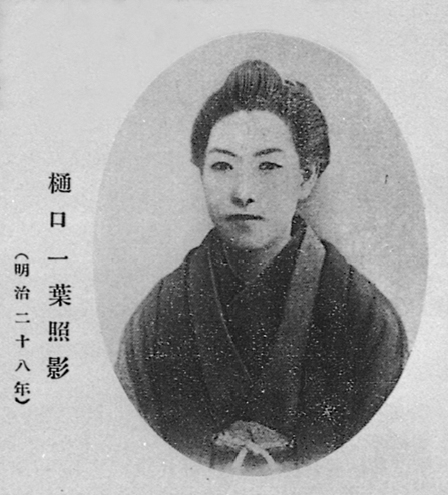
In November 2004 the Bank of Japan put Ichiyō’s portrait on the 5,000-yen note. It was the first time a modern woman’s portrait had appeared on Japanese paper money; the only woman shown before her was the legendary Empress Jingū, on government notes of the early Meiji years. The image was based on one of the few photographs of her: a round face, a high forehead, a plain kimono, an expression more composed than her age would suggest. In July 2024 a new series of notes replaced her with the educator Tsuda Umeko, but as of 2026 the old notes remain legal tender and still turn up in change.
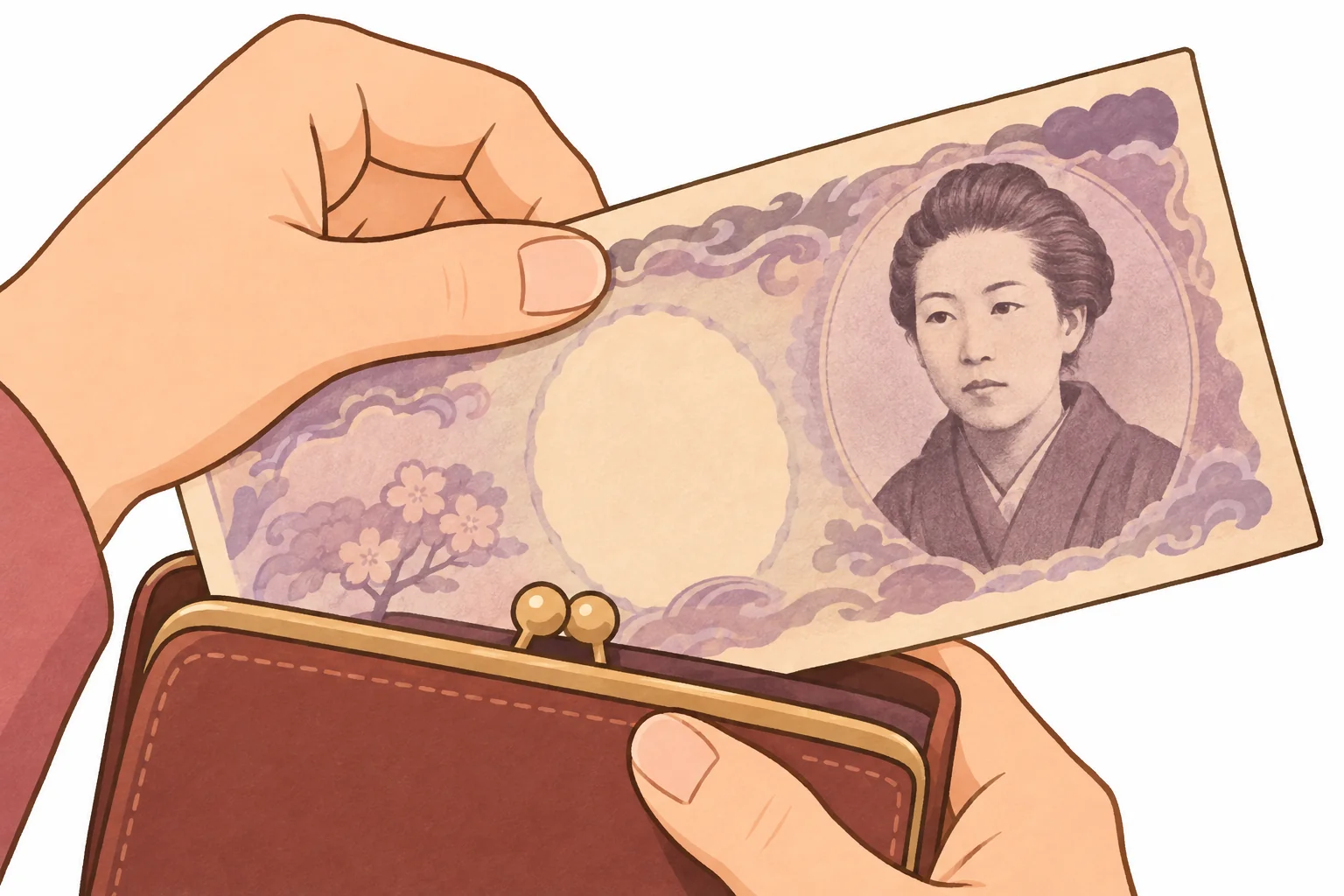
A 2004-series 5,000-yen note received in change, bearing Higuchi Ichiyō's portrait (illustration).
The choice said something about her standing. When Japanese readers list the first classics of modern literature, Ichiyō’s name sits next to Mori Ōgai and Natsume Sōseki. Her stories are short, and they are written in an elaborate, semi-classical prose that modern high school students find heavy going. Still, nearly everyone knows the outline of her life: the poverty, the brilliance, the early death. It reads like one of her own stories, a young woman trying to support her mother and sister by her pen in a city that was modernizing fast and had little room for people like her.
02The Eldest Daughter of a Fallen Family
She was born Higuchi Natsu in Tokyo in 1872. Her father, Higuchi Noriyoshi, came from a farming family in Kai Province (present-day Yamanashi). In the last years of the shogunate he went to Edo and bought the status of a low-ranking samurai retainer. The timing was unlucky. Within a few years the Meiji Restoration abolished the samurai class as a working institution, and the status he had paid for was worth very little. He worked as a minor official in the Tokyo city government and dabbled in real estate and other ventures, with mixed results.
Natsu was a bookish child, and her father encouraged her. In 1886 he enrolled her at the Haginoya, a private academy of classical poetry run by the poet Nakajima Utako. Most of the students were daughters of aristocrats and wealthy families. Natsu was the poorest girl there and felt it keenly, but she was among the best poets in the school. At the Haginoya she absorbed the Heian literary tradition, the Kokinshū anthology, The Tale of Genji, the language of court poetry. That training gave her the long, rhythmic sentences that later made her prose unmistakable.
Then the family fell apart. Her elder brother died in 1887. Her father’s business failed, and he died in 1889. At seventeen Natsu became the legal head of the household, responsible for her mother, Taki, and her younger sister, Kuniko. A marriage that had been arranged for her was called off by the other family once the Higuchis lost their footing. The three women took in sewing and washing, moved from one rented house to another, and borrowed money constantly.
03Writing for Rice Money
The idea of writing fiction came from a fellow student. In 1888 Tanabe Kaho, an older classmate at the Haginoya, published a novel, Yabu no uguisu (Warbler in the Grove), and was paid a substantial sum. Natsu saw that a woman could earn money with her pen, and she decided to try.
In 1891 she was introduced to Nakarai Tōsui, a writer of popular serial fiction for the Tokyo Asahi newspaper, and asked him to teach her. Tōsui was about a decade older, gentle and handsome, and generous with his time. He explained how newspaper fiction worked, and in 1892 he published her first story, "Yamizakura" (Flowers at Dusk), in a small literary magazine he had founded, Musashino. Around this time she began using the pen name Ichiyō, "one leaf." A well-known story claims it was a joke: Bodhidharma, the founder of Zen, was said to have crossed a river on a single reed leaf, and Bodhidharma, according to legend, had no legs. In Japanese, "having no legs" (ashi ga nai) can also mean "having no money." Whether or not she meant it, the anecdote fits her dry humor.
Her diary makes clear that she fell in love with Tōsui. But their meetings set off gossip among her classmates, and in that world an unmarried woman spending time alone with a male writer could lose her reputation entirely. In 1892, under pressure from her teacher and friends, she broke off contact with him. Her stories began to appear in more respectable literary journals, but the payments were small and irregular.
04A Sundries Shop Beside the Yoshiwara
In the summer of 1893 Ichiyō decided to give up literature and make a living in trade. She moved the family to Ryūsenji-machi in Shitaya, a neighborhood pressed right up against the Yoshiwara, Tokyo’s licensed pleasure quarter, and opened a tiny shop selling sundries and cheap sweets. Most of her customers were local children spending a coin or two on candy, paper, or incense sticks.
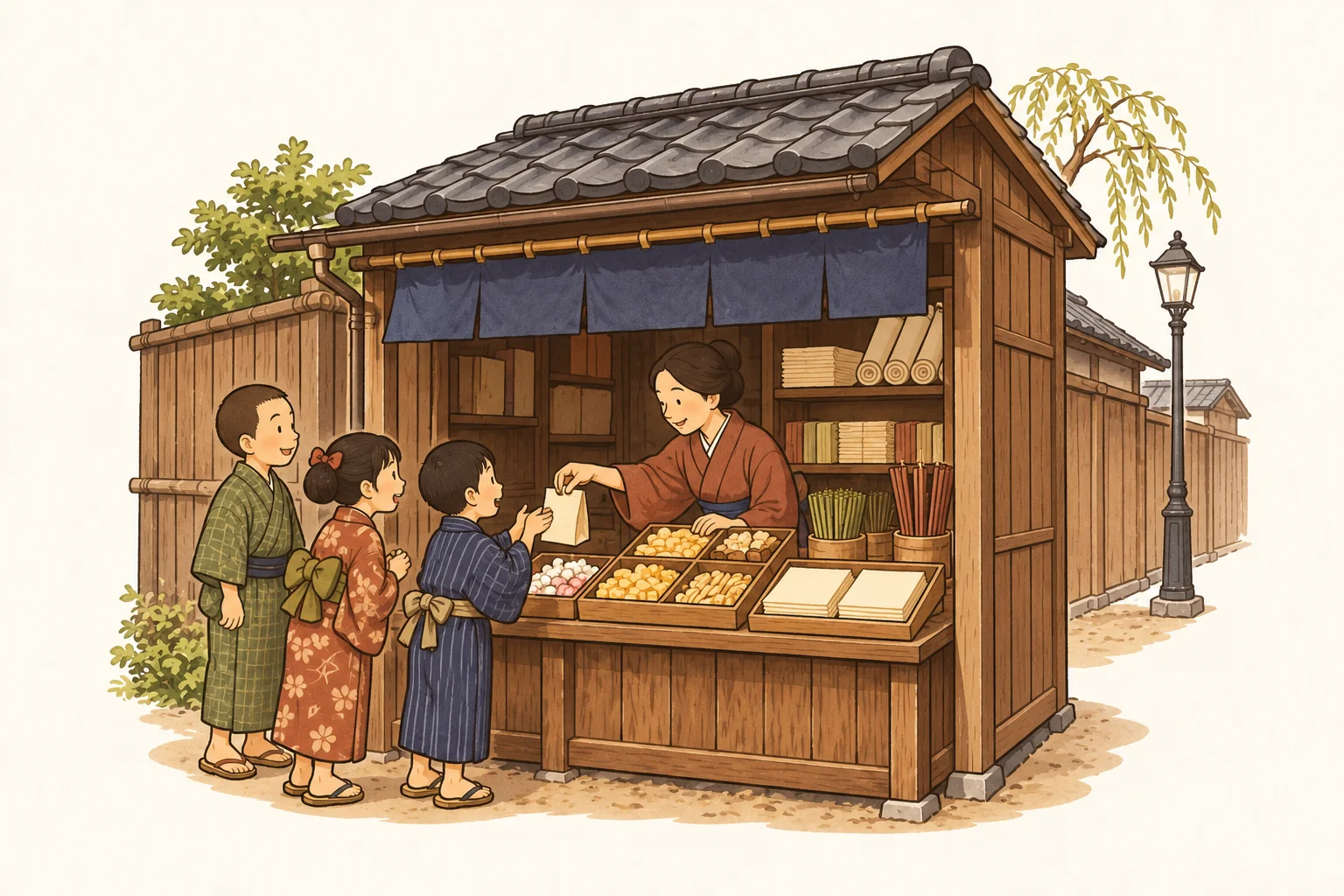
Ichiyō's tiny shop in Ryūsenji-machi, 1893, where local children bought candy, paper and incense (illustration).
As a business it failed. A competing shop opened nearby, and after about nine months, from July 1893 to April 1894, the family gave up. As an education it was the most important thing that ever happened to her. Ryūsenji-machi was the back street of the Yoshiwara, home to rickshaw men, artisans, and families who worked as servants and suppliers for the brothels. Every day Ichiyō watched their children come and go, quarrel, play, and gossip. The lights of the quarter, the willow outside its great gate, the dark moat around its walls, were all a few minutes’ walk away.
In May 1894 the family moved to Maruyama Fukuyama-chō in Hongō, into a small house near a row of cheap drinking places whose waitresses also sold sex. Between these two neighborhoods Ichiyō found nearly all the material for the work that made her name.
05Takekurabe: Growing Up Next to the Pleasure Quarter
Takekurabe was serialized in the magazine Bungakkai (Literary World) in installments from January 1895 to January 1896, and then printed in full in the magazine Bungei kurabu in April 1896. The reaction was immediate. The title means something like "comparing heights," and it alludes to a pair of poems in the Heian classic The Tales of Ise, in which a boy and girl who measured themselves against a well curb as children grow up and marry. Ichiyō borrowed the allusion for a story about two children who will never be together.
The opening sentence places the reader outside the walls of the Yoshiwara. In rough translation: it is a long way round to the willow at the great gate, but the lights of the three-story houses reflected in the black moat, and the noise that spills from them, feel close enough to touch. The children of the story live just outside, growing up to the sounds of the quarter.
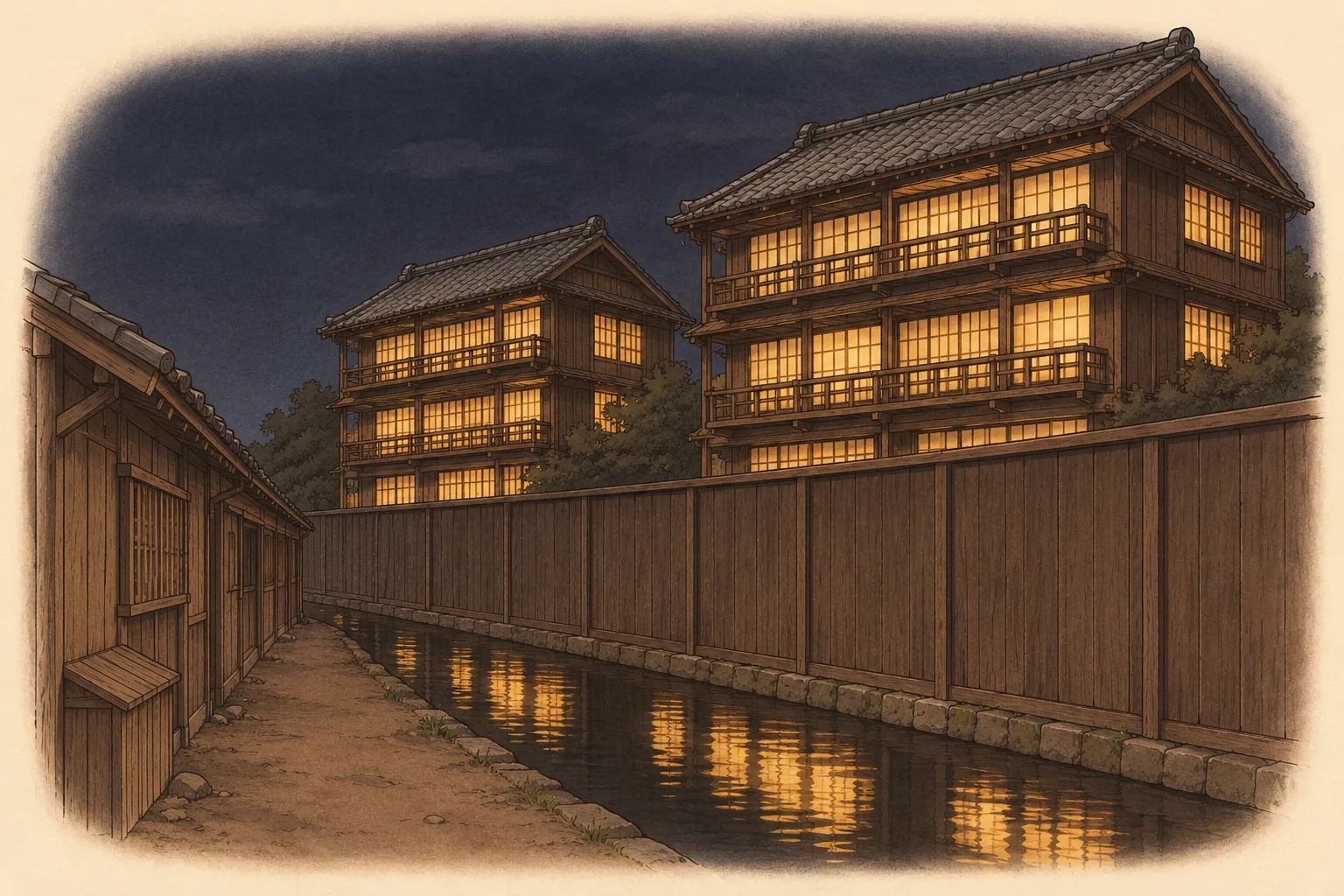
The scene that opens Takekurabe: lights of three-story houses reflected in the black moat, seen from just outside the Yoshiwara.
At the center is Midori, fourteen years old. Her elder sister is a top courtesan at a house called the Daikokuya, and Midori, spoiled and well supplied with pocket money, rules the neighborhood children like a small queen. The person she really cares about is Nobu, the shy, silent son of the priest at Ryūge-ji temple, who is expected to become a priest himself. The children are split into two gangs: the back-street gang led by Chōkichi, a fireman’s son, and the main-street gang led by Shōtarō, grandson of a moneylender. During the summer festival at the local shrine, Chōkichi’s boys raid the main-street party and humiliate Midori in front of everyone. Nobu is thought to be on Chōkichi’s side, and from then on there is an awkwardness between Midori and Nobu that neither can put into words.
The most famous scene happens in the rain. Nobu is passing Midori’s house when the thong of his wooden clog snaps, and he crouches in the street trying to fix it. Midori sees him through the lattice. Her heart races. She wants to help but cannot bring herself to speak, and in the end she simply tosses a scrap of red printed silk through the gate for him to use as a new thong. Nobu sees it and leaves it lying in the mud. Neither child says a word, and Ichiyō captures the stubbornness and shyness of adolescence with remarkable precision.
The turn comes quietly. On the day of the Tori no Ichi, the rake fair held each November at the nearby shrine, Midori appears with her hair done up for the first time in the shimada style of a grown woman. Everyone tells her how beautiful she looks, but she becomes withdrawn and stops playing with the other children. Ichiyō never says what has happened to her, though readers understand that she is being drawn toward her sister’s life. Whether the change marks her first menstruation or her first night with a client became the subject of a well-known scholarly debate in Japan in the 1980s, and both readings still have defenders. In the last scene, someone leaves an artificial narcissus at Midori’s gate one morning. She doesn’t know who brought it, but she feels a strange tenderness toward it. Later she hears that the very next day Nobu was to enter a Buddhist seminary and put on a monk’s robes.
What makes Takekurabe so strong is how little it explains. Ichiyō doesn’t denounce the Yoshiwara or arrange a rescue. She records a year of festivals, seasons, children’s fights, and silences, and inside those ordinary days her characters’ futures are settled. Mori Ōgai, the most respected critic of the day, wrote that he would not hesitate to call her a true poet, and Kōda Rohan and Saitō Ryokuu were just as warm. Rohan is said to have remarked that he would like to dole out its words five or six at a time to the writers and critics of the day, to be swallowed as a charm for improving their craft. In 1955 the director Gosho Heinosuke filmed the story with the singer Misora Hibari as Midori.
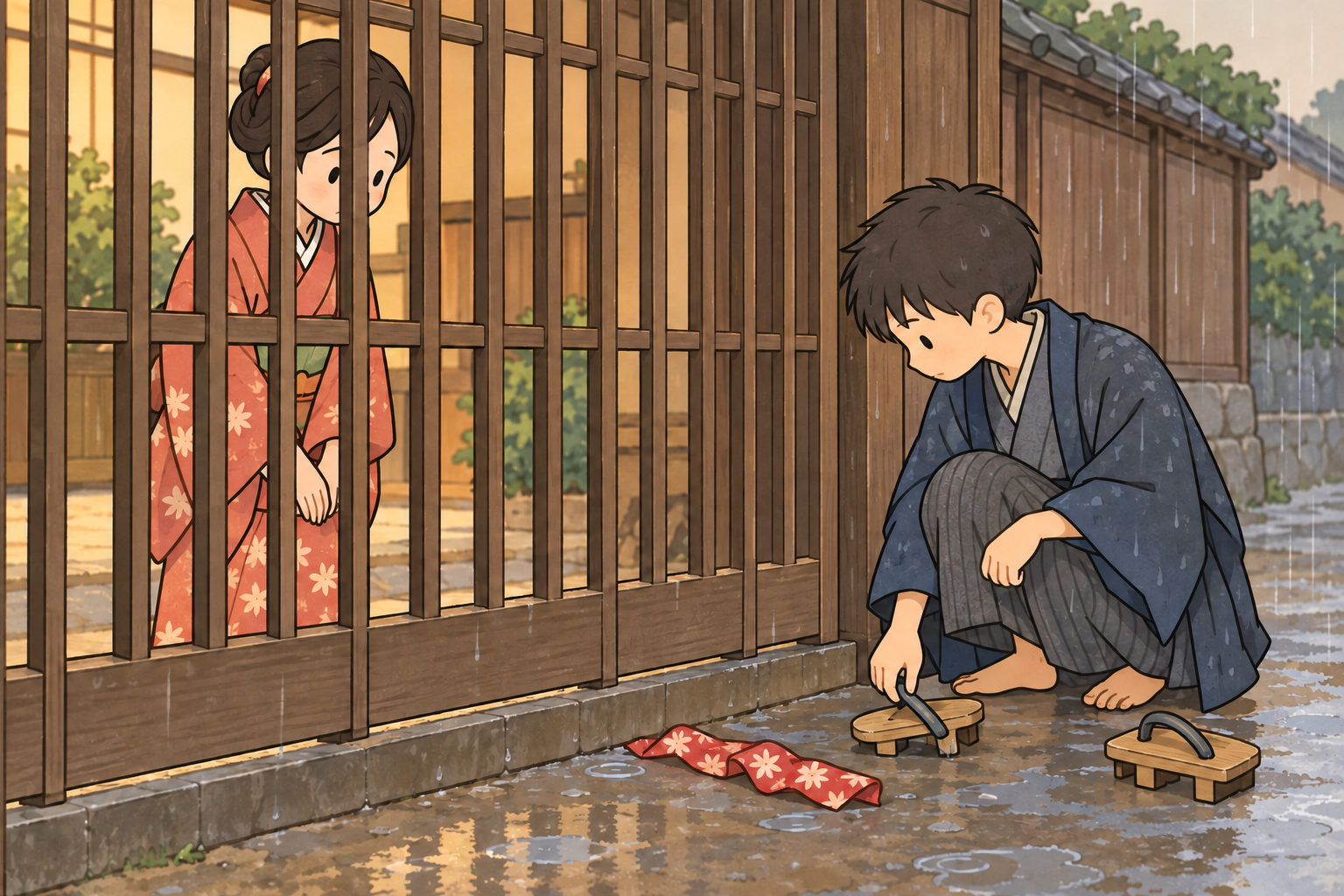
Midori stays behind the lattice while Nobu crouches in the rain over his clog; the scrap of red printed silk lies outside the gate, untouched.
06The Miraculous Fourteen Months
Japanese literary histories speak of Ichiyō’s "miraculous fourteen months," running from the publication of "Ōtsugomori" (The Last Day of the Year) in December 1894 to early 1896. In that span she produced "The Last Day of the Year," Takekurabe, "Nigorie" (Troubled Waters), "Jūsan’ya" (The Thirteenth Night), "Wakaremichi" (Separate Ways), and several others, nearly all of them now classics.
- From 1890Near Kikuzaka, Hongō, about three years
- July 1893Ryūsenji-machi: the sundries shop
- May 1894Moves to Maruyama Fukuyama-chō
- Dec. 1894“The Last Day of the Year”; the fourteen months begin
- Jan. 1895Takekurabe begins in Bungakkai
- Early 1896The fourteen months end
- Nov. 23, 1896Dies at home in Fukuyama-chō, aged 24
The “miraculous fourteen months” run from “The Last Day of the Year” in December 1894 to early 1896; she died that November.
"The Last Day of the Year" follows Omine, a maid in a wealthy household, who steals two yen on New Year’s Eve to save her impoverished uncle. "Troubled Waters" is set in a neighborhood much like Fukuyama-chō. Oriki, the proud and beautiful star of a bar called the Kikunoi, is trapped by her past and her trade, and a man who ruined himself for her ends up dead alongside her. Ichiyō leaves it open whether it was a double suicide or a murder. "The Thirteenth Night" takes place on the night of the autumn moon. Oseki, married into an official’s household, comes home to her parents intending to ask for a divorce, and her father talks her into going back. On the way, she realizes that the rickshaw man pulling her is Rokunosuke, the tobacconist’s son she secretly loved as a girl, now ruined. They talk briefly under the moon and part.
All of these stories center on women whose lives are fixed by money, marriage, and family, and Ichiyō writes their frustration without granting them easy victories. Her style was a blend of classical and colloquial: long, flowing narrative sentences in an elegant literary register, with dialogue in the living speech of Tokyo’s working districts. That style was on its way out. Within a few years, fiction written in modern colloquial Japanese would take over, and Ichiyō is often described as the last great writer to put new subject matter into the old language.
Her small house became a gathering place for young writers. The men around Bungakkai, including Hirata Tokuboku, Baba Kochō, and Togawa Shūkotsu, visited often, and Shimazaki Tōson moved in the same circle. Even Saitō Ryokuu, a critic famous for his sharp tongue, came to talk with her for hours. Fame did not bring money. Her diary from these months still records debts.
07The Diary and the End
Ichiyō kept a diary from her teens, eventually filling dozens of notebooks. It is written in the same graceful classical prose as her fiction, and it covers everything: the snobbery of the Haginoya, her longing for Tōsui, the humiliation of borrowing money, sharp judgments about her own talent and her times. Her sister Kuniko preserved it after her death, and it was later published. Many Japanese readers now consider the diary as important as the stories. For English readers, Robert Lyons Danly’s In the Shade of Spring Leaves (1981) combines a biography drawing heavily on the diary with translations of nine of her stories.
Her tuberculosis worsened in 1896. By summer she was seriously ill, and she died at home in Fukuyama-chō on November 23, at twenty-four (twenty-five by traditional count). She wrote almost nothing complete in her final months. The funeral was modest. Her grave is now at the Wadabori cemetery of Tsukiji Hongan-ji in Suginami, western Tokyo.
She was nearly a contemporary of Natsume Sōseki, but their careers never touched. When she died, Sōseki was teaching English in Kumamoto, and I Am a Cat was still nine years away.
08Finding Ichiyō in Tokyo
The best place to start is the Ichiyō Memorial Museum in Ryūsen, Taitō Ward, close to where her sundries shop once stood. Local residents campaigned to build it, and it opened in 1961; the current building dates from 2006. Inside are her unfinished handwritten draft of Takekurabe, poem slips, letters to Nakarai Tōsui and Tanabe Kaho, the stock ledger from her shop, and models of the old streetscape and of her house. Afterward, walk the neighborhood. Not far away is Ōtori Shrine, where the Tori no Ichi fair still fills the streets on the Days of the Rooster each November, with stalls selling decorated bamboo rakes, kumade, meant to rake in good fortune. This is the day Midori first wore her hair up. About twenty minutes’ walk to the southeast, a willow still stands at the crossing in front of the site of the Yoshiwara’s great gate, though not the original tree. The area remains Tokyo’s best-known red-light district, so visitors simply walk through quietly.
The other side of her life lies in Hongō, in Bunkyō Ward. The family lived near Kikuzaka for about three years from 1890, and an old well that they are said to have used still survives in a narrow lane there, and the steep alleys around it keep some of the shape of the Meiji city. Her last home in Maruyama Fukuyama-chō, now part of the Nishikata area, is marked by a memorial stone.
Several English translations are available, and Danly’s is the standard place to begin. Even in translation you can feel the way her sentences run on in a single breath, and the way her characters say almost nothing while everything is happening inside them. Read Takekurabe, then walk the narrow streets of Ryūsen in the late afternoon when the children are coming home from school, and it becomes much easier to understand why a woman who lived only twenty-four years ended up on the nation’s money.