
At a glance
Traces Japanese fiction from Meiji language experiments and the I-novel to Murakami and Convenience Store Woman, with a starter reading list and literary places to visit.
- Modern Japanese literature is only about 140 years old, born of the rapid Westernization after the Meiji Restoration.
- Tsubouchi Shōyō’s The Essence of the Novel (1885) and Futabatei Shimei’s Drifting Clouds (from 1887) launched the new novel and the vernacular style.
- The I-novel uses the author’s own life as its model; Tayama Katai’s The Quilt (1907) was the turning point.
- Kawabata Yasunari (1968) and Ōe Kenzaburō (1994) won the Nobel Prize in Literature.
- Murata Sayaka’s Convenience Store Woman won the 155th Akutagawa Prize in 2016 and has sold over two million copies in Japan.
Modern Japanese literature is barely a century and a half old, yet it has produced some of the most widely read writers in the world: Natsume Sōseki, Akutagawa Ryūnosuke, Kawabata Yasunari, Mishima Yukio, Murakami Haruki. It was born in a hurry, in the decades after Japan reopened to the West, when young writers had to invent both a new kind of story and a new kind of written language to tell it in. This guide follows that story from the first Meiji experiments through the uniquely Japanese "I-novel," the great prewar and postwar names, and on to Murata Sayaka’s Convenience Store Woman, a short, strange bestseller that asks who gets to decide what a normal life looks like. It ends with where to start reading, and where in Japan you can still walk into the world these books describe.
01Starting Over: The Novel Arrives in Meiji Japan
Japan did not lack fiction before the modern era. In the Edo period (1603–1868) Ihara Saikaku wrote witty tales of merchants and courtesans, Chikamatsu Monzaemon wrote plays about doomed lovers, and Kyokutei Bakin’s sprawling adventure The Eight Dog Chronicles ran for twenty-eight years. Lending libraries carried these books from house to house. But when the Meiji Restoration of 1868 opened the floodgates to Western learning, a generation of young intellectuals began to find this tradition stiff. Its characters, they felt, were moral types rather than people, and its plots existed to reward virtue and punish vice.
In 1885 a young graduate of Tokyo University named Tsubouchi Shōyō began publishing, in installments, The Essence of the Novel (Shōsetsu shinzui). The heart of the novel, he argued, is human feeling, and after that the manners and customs of society. The writer should observe the inner life the way a psychologist would and set it down as it is. It sounds obvious now, but it gave the old Japanese word shōsetsu a new meaning: no longer idle entertainment, but an art on a level with poetry and painting.
Shōyō’s friend Futabatei Shimei put the idea into practice. His novel Drifting Clouds (Ukigumo), published from 1887, follows Utsumi Bunzō, an honest, tongue-tied junior clerk who cannot flatter anyone and loses his government job in a round of staff cuts. Living in his uncle’s house, he watches the girl he loves, his cousin Osei, drift toward Honda Noboru, a smoother and more ambitious colleague. Nothing much happens. There is no hero and no moral resolution, only a man’s pride and hesitation. What mattered even more was the prose. Until then, written Japanese and spoken Japanese were effectively two separate languages; serious writing used classical forms or a style modeled on reading Chinese. Futabatei wrote his narration in something close to everyday speech; by his own later account, Shōyō suggested he try writing the way the rakugo storyteller San’yūtei Enchō told his stories, and Enchō’s published shorthand transcripts are generally thought to have served as his model. This was one of the first landmarks of the genbun itchi ("unifying speech and writing") movement, and the plain modern Japanese that readers take for granted today grew out of experiments like his.
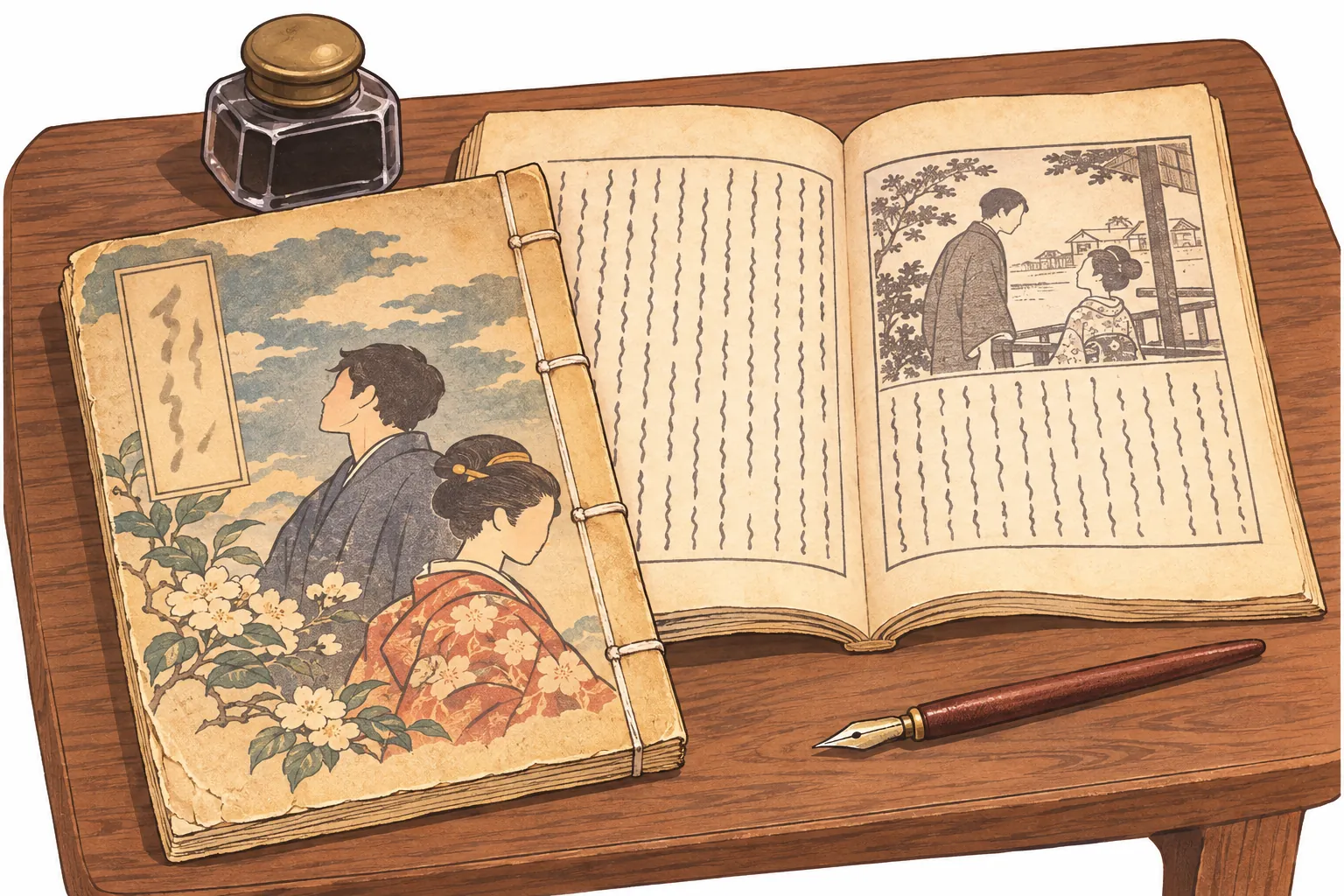
A thread-bound novel of the late 1880s with an illustrated cover, lying on a wooden desk (illustration).
Translation did just as much to reshape the language. In 1888 Futabatei published a colloquial translation of "The Rendezvous," from Turgenev’s A Sportsman’s Sketches, following the original’s word order and even its punctuation as closely as he could. Its sentences about forest light and shifting moods stunned young readers such as Tayama Katai and the future folklorist Yanagita Kunio. Others followed: Morita Shiken translated Victor Hugo, and Wakamatsu Shizuko turned Frances Hodgson Burnett’s Little Lord Fauntleroy into Shōkōshi, each testing how the new Japanese could carry the voice of a foreign novel. The beginning of modern Japanese literature was, in a sense, an engineering project: before anyone could write novels about the inner self, someone had to build a Japanese that could express one.
02Two Giants: Mori Ōgai and Natsume Sōseki
Two figures tower over late Meiji letters, and Japanese readers still pair them as the era’s great masters. Both were sent abroad by the state, and both spent their careers working out where a modern Japanese person stood between "the West" and home.
Mori Ōgai was an army doctor who studied hygiene in Germany from 1884 to 1888. Soon after returning he published "The Dancing Girl" (Maihime, 1890), the story of Ōta Toyotarō, a young official in Berlin who falls in love with a poor dancer named Elise and then abandons her, pregnant, to go home and pursue his career. The story is told in elegant classical Japanese, and its last line, in which Toyotarō thanks his friend Aizawa for rescuing his prospects while admitting that a part of him still resents him for it, has kept Japanese readers arguing for over a century about how much blame he deserves. Ōgai rose to become Surgeon General of the Army and in later life turned to historical fiction; stories such as "The Boat on the Takase River" (Takasebune) and "Sanshō the Steward" remain staples of the school curriculum.
Natsume Sōseki’s road was rougher. A scholar of English, he was sent by the Ministry of Education to London in 1900 and spent two unhappy years there, reading obsessively and coming close to a breakdown. Back in Tokyo, encouraged by the haiku poet Takahama Kyoshi, he wrote a comic piece for the haiku magazine Hototogisu narrated by a household cat who observes the pompous intellectuals around his master. I Am a Cat began serialization in 1905. The next year came Botchan, about a hot-headed young Tokyo man who takes a teaching post at a provincial middle school in Shikoku and wages war on the hypocrites on the staff. Fast, funny, and righteous, it is the Sōseki that every Japanese person knows.
In 1907 Sōseki gave up his lectureship at Tokyo Imperial University to become a staff writer for the Asahi Shimbun, and from then on his novels appeared first as newspaper serials. They grew steadily darker. Sanshirō, And Then, and The Gate follow educated young men caught between love and obligation. Kokoro (1914) is narrated partly by a student who befriends a reclusive older man he calls Sensei. In a long final letter, Sensei confesses that as a student he secretly beat his closest friend, K, to a marriage proposal to their landlady’s daughter. K killed himself. Sensei has lived with the guilt ever since, and after the death of the Meiji Emperor and the ritual suicide of General Nogi in 1912, he decides to end his own life. Kokoro is the all-time best-seller in the Shinchō paperback line, Japan’s best-known classics series, just ahead of Dazai’s No Longer Human, and extracts from it are read in high school classrooms across the country. Sōseki saw this kind of loneliness as the price of modernity: freed from family and status, the individual gains a self and finds nowhere to put it. From 1984 to 2004 his portrait was on the 1,000-yen note.
Between these two giants stands Higuchi Ichiyō, who died at twenty-four (twenty-five by the traditional count) after writing, from the poverty of Tokyo’s backstreets, stories such as "Child’s Play" (Takekurabe), about children growing up on the edge of the Yoshiwara pleasure quarter. From 2004 to 2024 she appeared on the 5,000-yen note, a reminder that Meiji literature was not only the work of men educated abroad.
03The I-Novel: Turning One’s Own Life into Fiction
If you had to name the single most distinctive feature of modern Japanese literature, many scholars would choose the shishōsetsu, usually translated "I-novel." Watakushi or shi is a formal word for "I," and an I-novel is fiction built almost directly from the author’s own life, with the narrator or protagonist standing in, thinly or not at all disguised, for the writer. Europe has autobiographical novels, of course, but nowhere else did this form dominate serious fiction for so long.
It grew out of Japanese Naturalism in the first decade of the twentieth century. Émile Zola’s naturalism was meant to study, almost scientifically, how heredity and environment shape human beings. Japanese writers took from it something different: the duty to expose the truth without ornament. In 1906 Shimazaki Tōson self-published The Broken Commandment (Hakai), about Segawa Ushimatsu, a schoolteacher in the mountain town of Iiyama who comes from a community of Japan’s hereditary outcast class. His father had ordered him never to reveal his origins; at the end he kneels before his pupils, confesses, and leaves to seek a new life elsewhere. That book was still a work of social fiction. The turn came the following year with Tayama Katai’s novella The Quilt (Futon).
Its hero, Takenaka Tokio, is a married, middle-aged writer who takes on a young female disciple, Yoshiko, falls secretly in love with her, and seethes with jealousy over her student boyfriend. In the end her father takes her home to the countryside. Tokio climbs to the upstairs room where she lived, pulls out her quilt and nightclothes, buries his face in them, breathes in her lingering scent, and weeps. Readers quickly understood that Tokio was Katai himself and that Yoshiko had a real model. For an established author to publish his most humiliating desire was a sensation, and it set a rule that shaped the next half-century: the more shameful the truth you reveal, the more sincere your literature.
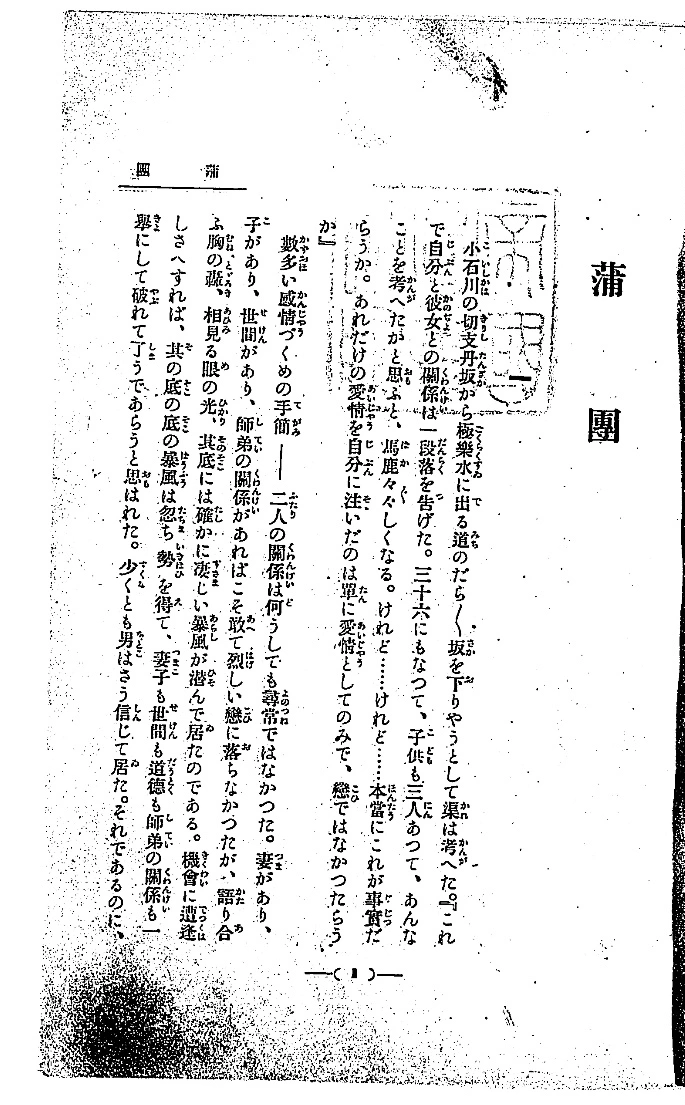
The first page of Tayama Katai’s The Quilt (Futon), as collected in Katai-shū, 1908.National Diet Library, Tayama Katai, Katai-shū (Ekifūsha, 1908)
The I-novel then split into two main currents, which the critics Itō Sei and Hirano Ken later labeled "self-destructive" and "harmonious." One was the "self-destructive" type, in which writers poured poverty, drink, affairs, and family collapse into their books, and were sometimes accused of wrecking their own lives in order to have something to write about. Kasai Zenzō is the classic case, and Dazai Osamu is often placed in this line. The other was the calmer, harmonious type, whose purest form was called the "state-of-mind novel" (shinkyō shōsetsu); its master was Shiga Naoya. In 1913 Shiga was hit by a train on Tokyo’s Yamanote Line, and he went to recover at the hot spring town of Kinosaki in Hyōgo Prefecture. The resulting story, "At Kinosaki" (1917), has no plot to speak of. From the inn he watches a dead bee lying on the roof; by the river he sees a rat with a skewer through its neck, struggling while people throw stones at it; and on a walk he idly tosses a stone and kills a newt he had not meant to hit. In a few thousand words a man who has just brushed against death looks at life and death in small creatures. Shiga’s spare, exact prose earned him the nickname "god of the novel," usually linked to the title of his story "The Shopboy’s God" (Kozō no kamisama).
Why did the I-novel flourish in Japan? Several explanations are usually offered. The literary world was small, so writers, editors, and readers often knew one another, and readers came to fiction already curious about the author’s life. Sincerity (makoto) was prized above invention, so confession felt more honest than made-up plots. And some critics argue that the modern Japanese individual was forged under heavy pressure from family and society, so writing about oneself was a way of claiming a little space of one’s own. There were always dissenters. In 1925 the novelist Kume Masao had praised the state-of-mind novel as the summit of serious art; ten years later the critic Kobayashi Hideo answered with an influential "Discourse on the I-Novel," calling for a self that opened onto society. After the war Nakamura Mitsuo, in On the Novel of Manners (1950), argued that the form had trapped Japanese literature in the writer’s own small room, cut off from society and from the power of imagination.
Yet the I-novel never died. In early 2011 Nishimura Kenta won the Akutagawa Prize for Kueki ressha ("Drudgery Train"), a raw account of his own life at nineteen as a friendless day laborer with no money; at the press conference he admitted that, tired of waiting for the result, he had been thinking of heading to a sex parlor. Japan’s huge market for personal essays, and for autobiographical manga online, comes from the same appetite: readers want to see how a real person gets through their days. Understanding the I-novel explains why Japanese readers often assume the "I" in a novel is the author, and why Dazai still has so many young fans.
- 1906Shimazaki Tōson, The Broken Commandment (still social fiction)
- 1907Tayama Katai, The Quilt: the turn
- 1913Shiga Naoya hit by a train, recovers at Kinosaki
- 1925Kume Masao praises the state-of-mind novel as the summit
- 1935Kobayashi Hideo, “Discourse on the I-Novel”
- 1950Nakamura Mitsuo, On the Novel of Manners
- 2011Nishimura Kenta wins the Akutagawa Prize for Kueki ressha
The Quilt turned Naturalism toward the I-novel; the form then split into self-destructive and harmonious currents, drew steady criticism, and never died.
04Taishō and Early Shōwa: Craftsmen and New Sensations
The Taishō era (1912–1926) was lively and varied. Its central group had formed just before it began: in 1910 graduates of the aristocratic Gakushūin school, including Mushanokōji Saneatsu, Shiga Naoya, and Arishima Takeo, founded the magazine Shirakaba ("White Birch"), devoted to individuality and humanism, which also introduced Western art to Japan, publishing a special issue on Rodin. Tanizaki Jun’ichirō went in a very different direction, beginning with the erotic, beauty-obsessed story "The Tattooer" and later, after moving to the Kansai region, writing The Makioka Sisters, a long, elegiac portrait of an old Ōsaka merchant family in decline.
The brightest short-story writer of the age was Akutagawa Ryūnosuke, one of Sōseki’s last disciples. "Rashōmon" appeared in 1915, and "The Nose" (1916) won Sōseki’s praise. Akutagawa liked to take tales from medieval collections such as the Konjaku monogatari and retell them with cool modern psychology. In "Rashōmon," a laid-off servant shelters in the ruined gate of Kyoto and finds an old woman pulling hair from corpses to make wigs; after hearing her justify herself, he strips her of her clothes and vanishes into the night. Kurosawa Akira’s 1950 film Rashomon, which won the Golden Lion at Venice the following year, combined that setting with the plot of "In a Grove" (1922), in which witnesses give contradictory accounts of the same killing, and "Rashomon" became a word in many languages for irreconcilable versions of the truth. In 1927 Akutagawa, aged thirty-five (thirty-six by the traditional count), killed himself with an overdose, leaving behind a phrase about a "vague unease" toward the future. Eight years later his friend Kikuchi Kan, founder of the publisher Bungei Shunjū, established the Akutagawa Prize in his memory, alongside the Naoki Prize for popular fiction. Both are still awarded twice a year, and the Akutagawa remains the most important gateway for new literary writers in Japan.
After the Great Kantō Earthquake of 1923, Tokyo modernized at speed: trains, cinemas, cafés, and department stores changed the rhythm of city life. In 1924 Yokomitsu Riichi, Kawabata Yasunari, and others founded the magazine Bungei jidai and became known as the New Sensationalists, using startling metaphors and film-like cuts to capture urban speed. At the same time proletarian literature rose on the left. Kobayashi Takiji’s The Crab Cannery Ship (1929) depicts brutally exploited workers on a factory ship in the Sea of Okhotsk; Kobayashi himself died in police custody in 1933, on the day of his arrest, almost certainly from torture. Remarkably, the novel became a bestseller again in 2008, when young temporary workers said it described their own lives.
Meanwhile in rural Iwate, Miyazawa Kenji was writing poems and children’s stories that almost nobody read in his lifetime; Night on the Galactic Railroad found its huge audience only after his death. By the early Shōwa era the I-novel was still the mainstream, but around it ran many tributaries: aestheticism, modernism, proletarian fiction, and fantasy.
05After the War: Ruins, Beauty, and the Nobel Prize
Defeat in 1945 left Japanese writers among burned cities and collapsed values. In 1946 Sakaguchi Ango published his essay "On Decadence," arguing that people must fall all the way down before they can find their real selves, and young readers seized on it. In 1947 Dazai Osamu wrote The Setting Sun, about the daughter of a declining aristocratic family who resolves to have a child by the man she loves; shayōzoku, "setting-sun people," became a catchword for the fallen upper class. In 1948 he finished No Longer Human, and that June he and his lover drowned themselves in the Tamagawa Aqueduct in Mitaka, western Tokyo. The first notebook’s opening confession, that the narrator has lived a life full of shame, is known to nearly every Japanese reader, and the book remains one of the best-selling paperbacks in the country.
Other writers turned the war itself into fiction. Ōoka Shōhei’s Fires on the Plain follows a starving soldier in the Philippines. Abe Kōbō’s The Woman in the Dunes (1962) traps an amateur insect collector in a house at the bottom of a sand pit, where he must shovel sand every night to survive; Teshigahara Hiroshi’s 1964 film of it won the Jury Prize at Cannes.
Mishima Yukio was the dazzling prodigy of the postwar years. He published Confessions of a Mask at twenty-four, and The Temple of the Golden Pavilion (1956) drew on the real burning of Kyoto’s Kinkaku-ji by a young acolyte in 1950: a stammering novice, crushed by the absolute beauty of the temple, decides he must destroy it. Mishima’s ornate prose won him a large readership abroad. On November 25, 1970, he and members of his private militia, the Shield Society, seized the commandant’s office at the Self-Defense Forces headquarters in Ichigaya, Tokyo. After a speech from the balcony, he committed ritual suicide. It remains one of the most shocking events in postwar Japanese history.
International recognition came late. In 1968 Kawabata Yasunari became the first Japanese writer to win the Nobel Prize in Literature, cited for narrative mastery that expresses with great sensibility the essence of the Japanese mind. The opening of Snow Country, in which a train comes out of a long tunnel at the border into a world of snow, is probably the most famous first line in Japanese fiction; the tunnel is the Shimizu Tunnel on the Jōetsu Line, and on the other side lies the hot spring town of Yuzawa in Niigata. In 1994 Ōe Kenzaburō became the second Japanese laureate. Beginning from his life with his brain-damaged son in A Personal Matter, he tied private experience to the nuclear age and Japan’s postwar democracy. Kawabata took his own life with gas in his workroom in Zushi, Kanagawa, in April 1972, and the deaths of Mishima and Kawabata less than eighteen months apart are often seen as the end of a literary era.
06From Murakami Haruki to Convenience Store Woman
In 1979 Murakami Haruki, then running a jazz bar in Tokyo, won the Gunzō new writers’ prize with Hear the Wind Sing. His prose was light and quick, full of beer, records, and American novels, and almost free of the heaviness that readers associated with Japanese literature. Norwegian Wood (1987), whose red and green two-volume set became a generational emblem, had sold more than ten million copies in Japan by 2009. The Wind-Up Bird Chronicle, Kafka on the Shore, and 1Q84 made him the most widely read Japanese novelist in the world, and every October Japanese television shows his fans, the self-described Harukists, gathering to wait for the Nobel announcement. In the same years Yoshimoto Banana’s debut Kitchen (1987), about a young woman finding her way back to life after bereavement under the light of a kitchen, joined Murakami in carrying Japanese fiction to ordinary readers everywhere.
In the twenty-first century a striking number of the Japanese writers drawing international attention have been women: Kawakami Mieko, Ogawa Yōko, Tawada Yōko, Yu Miri, and Murata Sayaka. In 2016 Murata won the 155th Akutagawa Prize for Konbini ningen, literally "convenience store human." It has sold more than two million copies in Japan, and Ginny Tapley Takemori’s English translation, Convenience Store Woman, appeared in 2018; by 2026 the book had been published in 46 countries and regions.
Its narrator, Furukura Keiko, is thirty-six. She started working part-time at a convenience store as a university student and has stayed eighteen years, unmarried and without a "proper" job. Since childhood she has never quite understood how other people expect her to react. When she and other children found a dead bird in the park, she suggested taking it home and grilling it, to her mother’s horror. Only in the convenience store did she find clear rules. The staff manual told her how to smile, how to call out irasshaimase, how to restock the rice balls and boxed lunches in the morning. She copies her coworkers’ speech patterns and clothes, and through them becomes a functioning "normal" person. But in her thirties her sister, old classmates, and friends keep asking why she hasn’t married or found a career. To make the questions stop, she lets Shiraha, a bitter, misogynistic man just fired from the store, move into her apartment as a pretend partner. Everyone around her is delighted. She, meanwhile, drifts further from the store that gave her a self.
The novel is very funny and quietly chilling. Its question is one many Japanese readers know intimately: who decides what a normal life is? Japanese has a word, seken, usually translated "society" or "the world," but it means something closer than that: the visible web of relatives, neighbors, and coworkers who watch one another and gently, relentlessly correct anyone who strays. Keiko is comfortable in the store precisely because its rules are written down. The rules of seken are never written, yet everyone is expected to obey them. Murata herself was still working shifts at a convenience store when she won the prize, and she drew on that experience. But she did not write an I-novel of self-exposure. Through a strange heroine she made ordinary expectations look bizarre. Set beside a century of I-novels, the contrast is neat: the I-novelist confesses himself to seken; Keiko turns seken itself into the thing that needs explaining.
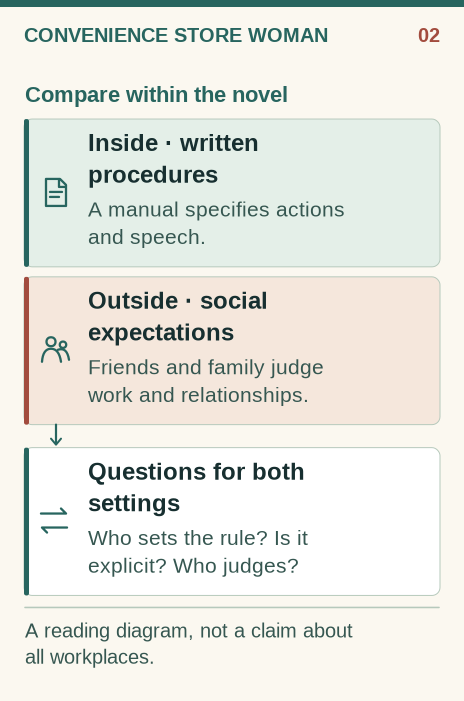
Two kinds of rule in Convenience Store Woman: the store’s are in a manual, seken’s are never written down.
07Where to Start, and Where to Find It in Japan
You don’t need to read modern Japanese literature in historical order. The easiest way in is through short pieces: Akutagawa’s "Rashōmon" and "In a Grove," or Shiga’s "At Kinosaki," each readable in half an hour. Then try Sōseki’s Botchan for comedy and Kokoro for the other side of Meiji. After that come Dazai’s No Longer Human, Kawabata’s Snow Country, Mishima’s The Temple of the Golden Pavilion, and finally Murakami and Convenience Store Woman. Read in that sequence, you may notice that for over a century Japanese fiction has kept returning to the same problem: how one person lives under the gaze of everyone else. All of these are available in English, and for those who read Japanese, the volunteer digital library Aozora Bunko offers thousands of out-of-copyright works free online.
In Japan, the easiest place to meet this literature is a bookstore. Almost every classic is in print as a bunkobon, a small paperback about the size of your palm that, as of 2026, costs a few hundred yen. Every summer since 1976 Shinchōsha has promoted its "100 Shinchō Paperbacks," and Kadokawa and Shūeisha run their own summer lists, stacked in piles at store entrances. Tokyo’s Jinbōchō district is the city’s secondhand book quarter, with about 130 shops clustered around Yasukuni-dōri, where you can find prewar first editions or a battered paperback for 100 yen.
Many writers’ homes and museums are worth a detour. In Waseda Minami-chō in Shinjuku, the Natsume Sōseki Memorial Museum recreates the study where he wrote his late novels. In Komaba Park in Meguro, the Museum of Modern Japanese Literature holds manuscripts and letters, and its café builds a menu around food that appears in famous novels. Yokohama’s Kanagawa Museum of Modern Literature sits in Harbor View Park, and the Kamakura Museum of Literature, in the former villa of the Maeda family and known for its rose garden, has been closed for major renovation since April 2023; as of 2026 it remains closed. Beyond Tokyo, Dōgo Onsen in Matsuyama is plastered with Botchan: there is the Botchan Train, a replica of the little "matchbox" locomotive Sōseki mocked in the novel, and three-colored Botchan dango sweets. Kinosaki Onsen still has the inn where Shiga Naoya stayed, and a stroll along the willow-lined canal brings back the creatures of his story. Kanazawa has museums for its "three great writers," Izumi Kyōka, Tokuda Shūsei, and Murō Saisei. In Yuzawa, the inn Takahan preserves the Kasumi room where Kawabata worked on Snow Country, and in Kanagi in Aomori, Dazai’s family mansion is open to visitors as the Shayōkan, the "Setting Sun House."
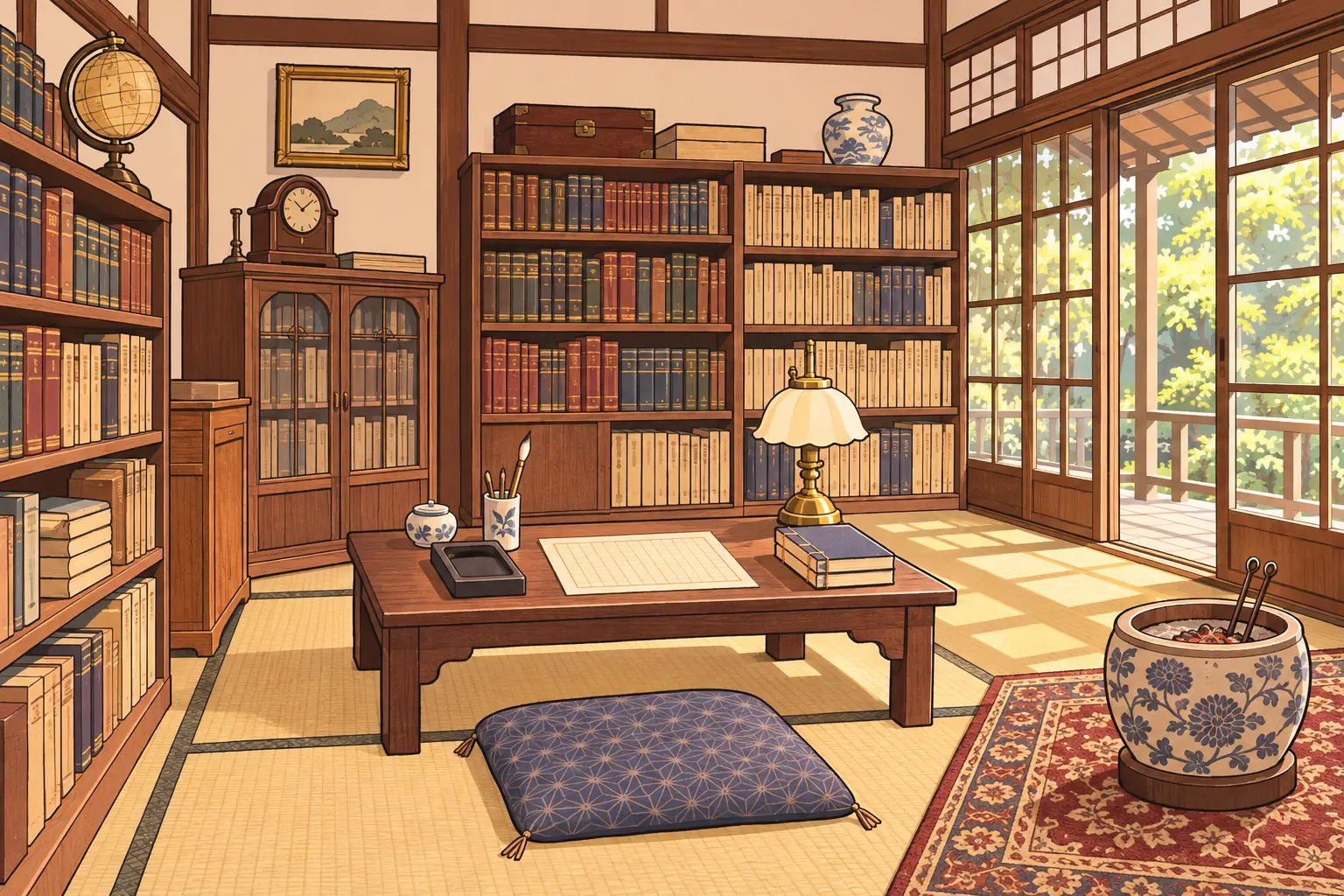
Sōseki's study as reconstructed at the Sōseki Sanbō Memorial Museum, mixing Japanese and Western elements (illustration).
If you have time for only one thing, buy a paperback of Kokoro or Convenience Store Woman in English or Japanese at a station bookstore and open it on the train. The commuters around you, heads bowed over phones and books, are exactly the people these novels have been writing about for more than a hundred years.