

At a glance
How No Longer Human is built, how closely it tracks Dazai’s troubled life, the bright, funny stories he also wrote, and where to follow him in Kanagi and Mitaka.
- Dazai was born Tsushima Shūji in 1909 into a great landowning family in Kanagi, Aomori, the tenth of eleven children.
- He tried to die five times; on June 13, 1948, he and Yamazaki Tomie went into the Tamagawa Aqueduct. He was 38.
- No Longer Human is framed by a preface, three notebooks and an afterword, and opens: "Mine has been a life of much shame."
- By 2021 the Shinchō Bunko edition had about 7.2 million copies in print, second in that imprint only to Kokoro.
- Every June 19 is Ōtōki, the Cherry Anniversary, when readers visit his grave at Zenrin-ji in Mitaka.
Dazai Osamu died at thirty-eight, in a flooded canal in suburban Tokyo, alongside the woman he loved last. He had tried to die four times before. Yet the books he left behind are not museum pieces. No Longer Human, the novel he finished weeks before his death, is one of the best-selling paperbacks in Japanese publishing history, a staple of teenage bedrooms and, lately, of anime fandoms and English-language "sad book" lists. Every June, readers still leave cherries on his grave. This is an introduction to the novel, to the man who wrote it, to the lighter and funnier writer most foreign readers never meet, and to the two places in Japan where you can walk through his life.
01"Mine has been a life of much shame"
No Longer Human (Ningen shikkaku, 1948) opens its main text with a sentence nearly every Japanese reader can recite: Haji no ōi shōgai o okutte kimashita. Donald Keene, who translated the book into English in 1958, rendered it as "Mine has been a life of much shame." The title itself is hard to carry into English. Ningen means "human being"; shikkaku means "disqualification," the word used when an athlete is thrown out of a competition. The title says, flatly, that the narrator has been disqualified from being a person.
The book is short and carefully built. A frame narrator begins by describing three photographs of a man he has never met. In the first, a boy of about ten stands among his sisters and cousins, smiling a smile so forced that the longer you look, the more it resembles a monkey’s grimace. In the second, a handsome student smiles with the same polish, and something about it feels dead. The third shows a man of no clear age in a filthy room, with no expression at all, a face you cannot forget and cannot picture once you look away. Then come three notebooks written by the man in the photographs, Ōba Yōzō, and finally a short epilogue in which the frame narrator explains how the notebooks reached him.

Preface: the narrator first describes three photographs of one man.

Main text: the man’s own three notebooks, followed by the narrator’s afterword.
Yōzō is the son of a wealthy family in the cold northeast of Japan. From childhood he feels he does not understand human beings. He cannot grasp why people get hungry or why they live in order to eat, and the casual lies adults tell one another terrify him. His solution is clowning, dōke in Japanese. He plays the fool at home and at school, falls over on purpose, makes everyone laugh, and so buys himself a little safety. He calls this his last courtship of humanity.
The scene readers tend to remember happens in a school gym. Yōzō deliberately botches a move on the horizontal bar and tumbles to the sand. The class roars. Then a dull, unremarkable boy named Takeichi comes up behind him and whispers, "You did that on purpose." Yōzō is seized with dread: someone has seen through him. For a great many readers, this is the moment the book stops being about a stranger. Anyone who has been the class clown, or the colleague who always keeps the mood light, knows the chill of being found out.
From there the notebooks slide downhill. In Tokyo, Yōzō drifts into drinking, brothels and a half-hearted role in the illegal communist movement, guided by a shallow painter friend called Horiki. He attempts a double suicide by drowning at Kamakura with a married café waitress; she dies, he survives. He lives off a single mother who edits a magazine, drawing cheap cartoons. He marries Yoshiko, a young woman so trusting that she seems to have no defenses at all, and believes he has finally been saved, until he sees her assaulted by a visiting tradesman. What breaks him is that her trust itself was the cause. He sinks into alcohol and morphine and is tricked by his family and friends into a mental hospital. The last notebook ends in a shack at a remote hot-spring village, where he lives under the care of an elderly maid. "Disqualified as a human being," he writes. "I have now ceased utterly to be a human being."
The epilogue turns the whole thing around. The frame narrator received the notebooks from the madam of a bar in Kyōbashi who knew Yōzō years earlier. Her verdict closes the book: the Yōzō she knew was honest and considerate, and if only he hadn’t drunk, no, even when he drank, he was "a good boy, an angel." A man who has spent two hundred pages convicting himself is remembered by someone else as close to divine. Neither verdict cancels the other, and the book leaves the reader holding both.
So much of Yōzō’s life matches Dazai’s own that the novel has always been read as a confession, even a suicide note. That reading misses the craft. Dazai took real events, enlarged some, cut others, rearranged their order and then framed the whole thing with a stranger’s gaze. The confession is a constructed object, made by a writer who had been turning his own life into material for fifteen years.
02The red-roofed mansion in Kanagi
Dazai was born Tsushima Shūji on June 19, 1909, in Kanagi, a farming village on the Tsugaru Peninsula at the northern tip of Honshū, in Aomori Prefecture. The Tsushima family were among the largest landowners in the region. His father, Tsushima Gen’emon, sat in the national Diet’s lower house and later in the House of Peers. Shūji was the tenth of eleven children and the sixth son, which meant he mattered very little in the family’s line of succession. His mother was in poor health, and he was raised mostly by an aunt and by a teenage maid named Take (born Chikamura, later Koshino by marriage), who, as it is usually recorded, looked after him from the age of three (the counting method is unclear) and would later become one of the warmest figures in his writing.
The house he was born in had been completed just two years earlier. It still stands: a vast two-story building with a red roof, mixing Japanese and Western rooms, rising out of rice fields and apple orchards. It had nineteen rooms, several storehouses and a staff of servants to match, by some accounts several dozen. That house shaped Dazai’s lifelong sense of himself. He was a rich man’s son who lived on family money for years, and he was ashamed of where that money came from: the rents of tenant farmers in one of the poorest regions in Japan. His later flirtation with communism grew out of that guilt more than out of any theory.
He was a bright student. At middle school in Aomori city he was already editing coterie magazines and writing fiction. In 1927 he entered the elite Hirosaki Higher School, and that summer his idol Akutagawa Ryūnosuke killed himself with an overdose of barbiturates. The teenage Shūji is said to have covered his notebooks with Akutagawa’s name and to have posed for a photograph in imitation of Akutagawa’s famous chin-on-hand portrait. He also took lessons in gidayū, the chanted narration of the puppet theater, frequented the geisha quarter and met a young geisha named Oyama Hatsuyo. In December 1929 he swallowed a large dose of sleeping pills in his lodgings. It was the first of his suicide attempts.
03Tokyo, 1930–1937: the wild decade
In 1930 he enrolled in the French literature department of Tokyo Imperial University, though he knew no French and rarely attended class. One of the first things he did in Tokyo was to call on the novelist Ibuse Masuji, whose stories he admired, and ask to become his disciple. Ibuse would spend the rest of Dazai’s life looking after him: finding him work, arranging his marriage, cleaning up after his disasters. Dazai also lent money and rooms to the underground communist movement, then the most dangerous political commitment a student could make.
- 1909Born in Kanagi, Aomori
- 1927Enters Hirosaki Higher School
- 1930Tokyo Imperial University; Kamakura in November
- 1933First publishes as Dazai Osamu
- 1935Hanging attempt, addiction, Akutagawa Prize lost
- Oct. 1936Tokyo Musashino Hospital
- 1937Minakami: both survive
- 1938Misaka Pass
- 1939Marries; moves to Mitaka
- 1945Evacuates to Kōfu, then Kanagi
- 1946Back in Mitaka
- 1947The Setting Sun
- 1948Finishes No Longer Human; June 13, Tamagawa Aqueduct
This chapter covers the Tokyo years, 1930–1937; he finished No Longer Human in 1948, shortly before his death.
In November 1930 he and Tanabe Shimeko, a waitress at a Ginza café, took sleeping drugs together on the rocks at Koyurugi Point, near Kamakura. She died. He was revived, questioned on suspicion of assisting a suicide, and never charged. The episode went almost unchanged into No Longer Human. Around the same time Hatsuyo came to Tokyo to live with him. His eldest brother, Bunji, now head of the family, agreed to let them be together on a harsh condition: Shūji would be removed from the family register, formally cut off, though the family went on sending him a monthly allowance.
He first published under the name Dazai Osamu in 1933. Nobody knows for certain why he chose it; various explanations circulated, and none is confirmed. A common one is that it was easy to say, even in the Tsugaru dialect. The stories of these years were gathered in 1936 into his first book, which he titled Bannen, "The Final Years." He was twenty-seven and meant the title seriously. He had written it, he said, as a farewell.
1935 was his worst year. He failed to graduate, failed a newspaper job interview, and in March tried to hang himself in the hills near Kamakura. Soon after, an appendectomy turned into peritonitis, and in hospital he was given Pavinal, an opioid painkiller, to which he quickly became addicted. He began borrowing money from everyone he knew to buy it. That same year his story "Gyakkō" ("Against the Current") was shortlisted for the very first Akutagawa Prize, the literary award named after his idol. It lost. One judge, Kawabata Yasunari, wrote that "ugly clouds" hung over the author’s present life and kept his talent from showing fully. Dazai answered in print with an open letter to Kawabata that included the line that he had thought of stabbing him. The next year he wrote long, pleading letters to another judge, Satō Haruo, begging for the prize. He never received it. The story of Akutagawa’s most devoted admirer failing to win the Akutagawa Prize is still one of the Japanese literary world’s favorite pieces of gossip.
In October 1936 Ibuse and others persuaded him into Tokyo Musashino Hospital, a psychiatric institution in the city, to break the addiction. He stayed about a month, and the humiliation of being, as he saw it, tricked into an asylum by people who loved him became the core of Yōzō’s third notebook. After he came out, he learned that Hatsuyo had had an affair while he was inside. In 1937 the two of them took sleeping drugs together at Minakami, a hot-spring town in Gunma. Both survived. They separated soon after.
Through all of this he kept writing, and the voice that would make him famous was already there: first person, rambling, self-mocking and wheedling at once, a single sentence able to hold an excuse, a boast and a plea. Japanese readers often say that reading Dazai feels like having someone talk softly into your ear.
04The good years: Mitaka and the funny Dazai
In 1938 Ibuse took Dazai to the Misaka Pass in Yamanashi, where he lodged at a teahouse with a famous view of Mount Fuji, and introduced him to Ishihara Michiko, a Kōfu woman who had taught history and geography at a girls’ school in Yamanashi. They married at Ibuse’s house in January 1939. Before the wedding Dazai handed Ibuse a written pledge promising to live decently. In September they moved to Mitaka, then a semi-rural suburb on the western edge of Tokyo, and Dazai lived there for the rest of his life.
The years from 1939 to the end of the war were his most stable, and English-language readers who know only No Longer Human are often surprised by what he wrote in them. Much of it is bright, tender and funny.
"One Hundred Views of Mount Fuji" (Fugaku hyakkei, 1939) records his stay at the Misaka teahouse. At first he finds Fuji vulgar, a mountain like the painting on a bathhouse wall. By the end he has written a line Japanese readers know by heart: "Fuji goes well with the evening primrose." Next to a view so grand it has become a cliché, a small yellow flower stands up straight. That is Dazai’s angle on the world in one image.
"Schoolgirl" (Joseito, 1939) follows the thoughts of a schoolgirl from waking to sleep, built from a diary a young female reader had sent him. Her flickers of self-pity, disgust and sudden happiness are caught so precisely that Kawabata, his old critic, praised it. Dazai had an unusual gift for writing in a woman’s first-person voice, a gift he would use again in "Villon’s Wife" and The Setting Sun.
"Run, Melos!" (Hashire Merosu, 1940) is the Dazai story every Japanese person knows, because it has been taught in junior high school textbooks for decades. Adapted from Friedrich Schiller’s ballad "Die Bürgschaft," it tells of a shepherd sentenced to death by a tyrant who begs three days’ leave to attend his sister’s wedding, leaving his best friend as a hostage. Floods, bandits and his own exhaustion nearly defeat him; he arrives at sunset just in time, and the tyrant is shamed into mercy. It is a story about keeping faith, and it reads like a sprint. A famous anecdote attaches to it. Dazai’s friend, the novelist Dan Kazuo, later wrote that when the two of them ran up a bill at an inn in Atami, Dazai left Dan behind as surety and went to Tokyo to raise money, then failed to return. Dan eventually found him playing shogi at Ibuse’s house, and Dazai is said to have asked him which was harder, waiting or making someone wait. Whether this episode inspired "Run, Melos!" rests on Dan’s memoir alone.
In 1944 a publisher sent Dazai home to write a travel book about his native region. Tsugaru follows him around the peninsula, drinking with old friends, and ends with a pilgrimage to the fishing village of Kodomari to find Take, the nursemaid he had not seen in some thirty years. They sit together watching a village sports day. She says very little. He writes that for the first time in his life he felt at peace. Many Japanese critics consider Tsugaru his finest book, and those last pages are among the most quietly moving in modern Japanese prose.
As the air raids on Tokyo intensified in 1945, the family evacuated first to Kōfu and then to the Tsushima house in Kanagi. That year he published Otogizōshi (Fairy Tales), playful, sharp retellings of folk tales such as "Urashima Tarō" and "Kachi-kachi Yama," a book written to make people laugh at the worst moment of the war. He also published Sekibetsu (A Fond Farewell), a novel about the Chinese writer Lu Xun’s student days at the medical school in Sendai, narrated by an imagined Japanese classmate. It was written on commission from the government’s Cabinet Information Bureau and the wartime Patriotic Association for Japanese Literature, as one of a series of novels meant to dramatize the principles of the 1943 Greater East Asia Joint Declaration, but Dazai’s Lu Xun is a lonely, troubled young man far more than a slogan.
05The last three years
Back in Mitaka from late 1946, Dazai found himself one of the most famous writers in the country. Defeated Japan was a place of black markets, ruins and collapsed certainties, and young readers wanted a voice that matched their disorientation. Critics grouped Dazai with Sakaguchi Ango, Oda Sakunosuke and Ishikawa Jun as the Buraiha, the "Decadent School," writers who distrusted both the old morality and the new democratic slogans and answered them with dissipation and irony.
The Setting Sun (Shayō, 1947) made him a sensation. It tells of an aristocratic family coming apart after the war: a gentle, refined mother who slowly dies, a son ruined by drugs and drink who kills himself, and a daughter, Kazuko, who decides to bear the child of a married novelist as her own "moral revolution." The phrase shayōzoku, "setting-sun people," entered everyday language for the declining upper class. Much of the novel was drawn from the diary of Ōta Shizuko, Dazai’s lover, who in November 1947 gave birth to his daughter. He named her Haruko, using a character from his own pen name. Ōta Haruko later became a writer herself.
That same year he met Yamazaki Tomie, a beautician living in Mitaka, who became his last companion and something like his secretary and nurse. He was very ill by then, coughing blood from tuberculosis, and still drinking heavily and writing at a furious pace. In the spring of 1948 he finished No Longer Human, working in borrowed rooms in Atami and Ōmiya. He was also writing a comic serial for the Asahi Shimbun, Goodbye, about a man trying to break off with each of his many mistresses. He had finished only thirteen installments, which the paper printed after his death.
On the night of June 13, 1948, Dazai and Tomie went into the Tamagawa Aqueduct near his house. The canal, which then carried drinking water to Tokyo, ran deep and fast, and locals are said to have called it the "man-eating river" (hitokui-gawa). According to reports at the time, the two bodies were tied together with a cord. They were found on June 19, Dazai’s thirty-ninth birthday. On his desk were drafts of Goodbye and several farewell notes. No Longer Human finished its serialization in the magazine Tenbō shortly afterward and came out as a book that summer, and readers took it as his last word.
He was buried at Zenrin-ji, a temple in Mitaka. In his story "Hanafubuki" he had admitted daydreaming that his "dirty bones" might be buried in a corner of this clean little cemetery near the grave of Mori Ōgai, the great Meiji novelist, then scolded himself for being unworthy. His grave now stands diagonally across from Ōgai’s, its inscription in Ibuse’s hand. A year after his death his friends held a memorial on June 19, the day the bodies were found and his birthday, and the writer Kon Kan’ichi named it Ōtōki, the Cherry Anniversary, after "Cherries" (Ōtō), one of his last stories. In it a father, after a quarrel with his wife, escapes to a drinking place where a plate of cherries is served. He thinks how delighted his children, who have probably never seen cherries, would be if he brought some home, and instead eats them joylessly, spitting out the pits and telling himself, like a bluff, the line that opens the story: "I would like to believe that parents are more important than children."
06Why he is still read
By 2021 the Shinchō Bunko paperback of No Longer Human had about 7.2 million copies in print, second in that imprint’s entire list only to Natsume Sōseki’s Kokoro. Dazai’s work entered the public domain in Japan in 1999, and he is a fixture near the top of the reading charts at Aozora Bunko, the free online library of out-of-copyright Japanese texts. The book has spread far beyond Japan. In China, dozens of translations have appeared, and a phrase associated with Dazai, "Born, I’m sorry," has become an online motto of a whole generation’s gloom. That phrase, in fact, is not from No Longer Human; it is the epigraph of a 1937 story, "A Standard-Bearer of the Twentieth Century," and according to Dazai’s close friend Yamagishi Gaishi it originally came from a young poet, Terauchi Jutarō.
Why him? The first answer is the clowning. Yōzō’s fear of being seen, and the exhausting comedy he performs to avoid it, needs no literary training to recognize. Japanese social life puts great weight on kūki o yomu, "reading the air," sensing and smoothing the mood of a room. Dazai wrote for the people who read the air too well and can barely breathe because of it. The relief of reading him is the relief of being told that the performance is tiring, and that other people are performing too.
The second is the voice. Dazai’s prose sounds like a confidence shared with one listener. It is frank, weak, constantly undercutting itself, and slyly funny at the moments when it seems most desperate. His self-loathing has a lightness, almost a coquettishness, that keeps it from being heavy. Readers feel understood and amused at the same time.
The third is the life. Five attempts on his own life, the women, the addiction, the lost prize, the rich family and the communist cells, the body found on his birthday: the legend is nearly as famous as the books, and it is retold endlessly.
Not everyone loves him. In December 1946 the twenty-one-year-old Mishima Yukio went to a drinking party where Dazai was holding court and told him to his face, "I dislike your literature, Mr. Dazai." Dazai’s answer survives in different versions: in one, he snapped that if Mishima disliked it he needn’t have come; in another, he said that since Mishima had come anyway, he must like it after all. Mishima later explained his hostility by saying Dazai embodied exactly the weakness he wanted to cut out of himself. Plenty of readers share his irritation and find Dazai self-pitying. The strength of that dislike is part of the fascination.
Dazai is all over contemporary Japanese pop culture. The manga and anime Bungo Stray Dogs features a character named after him, obsessed with methods of suicide, and has sent many young fans back to the originals. No Longer Human was filmed in 2009 by Arato Genjirō, starring Ikuta Tōma; in 2019 the photographer and director Ninagawa Mika made No Longer Human, with Oguri Shun as Dazai and the story told through his relationships with Michiko, Shizuko and Tomie. Itō Junji, the horror manga artist, turned the novel into a manga serialized in 2017 and 2018. The comedian Matayoshi Naoki, who won the Akutagawa Prize in 2015, discovered Dazai in junior high school and says he has read No Longer Human more than a hundred times.
If you only read one book, it will probably be No Longer Human, and Keene’s translation remains the standard English version, with a 2018 version by Mark Gibeau titled A Shameful Life. But a better route into Dazai is to start with "Run, Melos!", "One Hundred Views of Mount Fuji" and "Schoolgirl," then Tsugaru, then The Setting Sun, and only then No Longer Human. Read that way, the last novel stops looking like a suicide note and becomes what it is: the final, carefully made work of a gifted, funny and very sensitive man, written as he was using himself up.
07Visiting Kanagi and Mitaka
Dazai’s world is concentrated in two places: Kanagi in Aomori, and Mitaka in Tokyo.
To reach Kanagi, take the JR line from Aomori or Hirosaki to Goshogawara and change to the little Tsugaru Railway. In winter the line runs its Stove Train, old carriages heated by pot-bellied coal stoves on which the attendant will toast the dried squid sold on board and tear it into strips for you. A few minutes’ walk from Kanagi Station is the house where Dazai was born, now the Dazai Osamu Memorial Museum, known as Shayōkan, "the Setting Sun House." Gen’emon completed it in 1907. After postwar land reform stripped the family of its estates, the house was sold in 1948 and from 1950 ran for forty-six years as an inn under that name. The town bought it in 1996, opened it as a museum in 1998, and in 2004 it was designated a national Important Cultural Property. Inside are an enormous earth-floored entrance hall, a broad staircase (said to be of zelkova), a gilded Buddhist altar room and a Western-style parlor. Standing in it, surrounded by rice fields, you understand how Dazai could both depend on this house and be ashamed of it all his life.
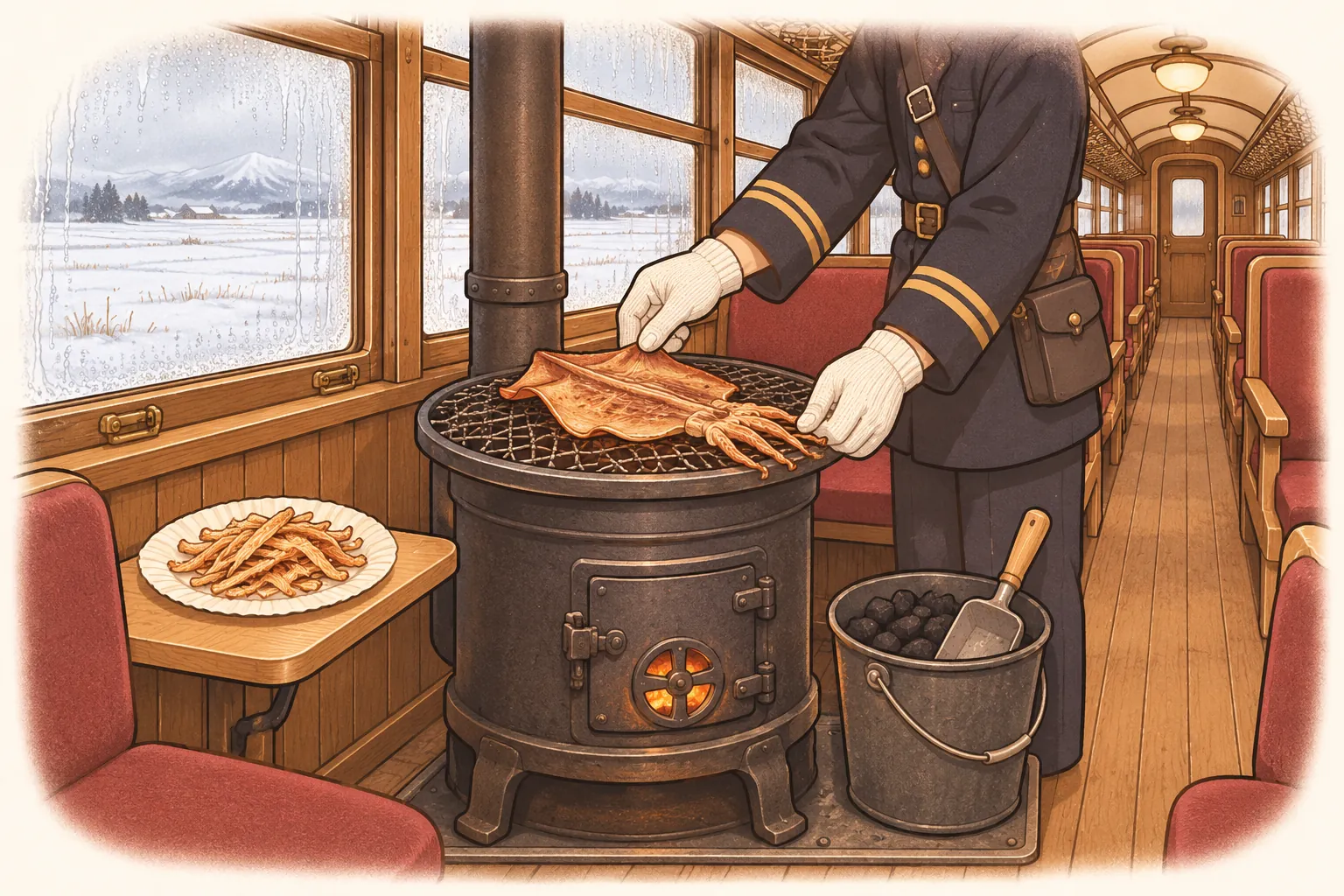
On the Tsugaru Railway’s winter Stove Train, the attendant toasts dried squid on the coal stove and tears it into strips.
Nearby is the Dazai Osamu Evacuation House, a wing added to the Tsushima estate in 1922 for his brother Bunji, where Dazai’s family lived from the summer of 1945 to November 1946 and where he wrote more than twenty works. A short drive away, Ashino Park has a literary monument carved with the Verlaine line he used as the epigraph of his early story "Leaves": the ecstasy and the anxiety of being chosen, both are in me. A phoenix sits on top. The park also has a statue of him and fills with cherry blossoms in late April and early May. Further north, at Kodomari, a small museum dedicated to Tsugaru has a bronze statue of Dazai and Take sitting side by side, as they did at the sports day. On June 19 Kanagi marks his birthday; the commemoration was long held in Ashino Park, but according to reports it moved to Shayōkan in 2023.
Mitaka is where he wrote most of his work and where he died. A three-minute walk from the south exit of JR Mitaka Station is the Dazai Osamu Literary Salon, a small space opened in 2008 on the site of the Isemoto liquor shop where he used to buy his sake; since a 2022 renovation it holds open shelves of Dazai scholarship and volunteer guides. Exhibitions of manuscripts and first editions are now held in the Dazai Osamu Exhibition Room in the city art gallery by the station’s south exit, which also recreates part of his small Mitaka house, reportedly at full scale.
The Tamagawa Aqueduct still runs along the south side of the station, now reduced to a thin stream between thick trees and a quiet footpath called the Kaze no Sanpomichi, the Wind Walk. Along it is a boulder of gyokurokuseki stone from Aomori, placed near the spot where Dazai is thought to have gone into the water. The path leads to Inokashira Park and the Ghibli Museum, so many visitors walk past the spot without knowing.
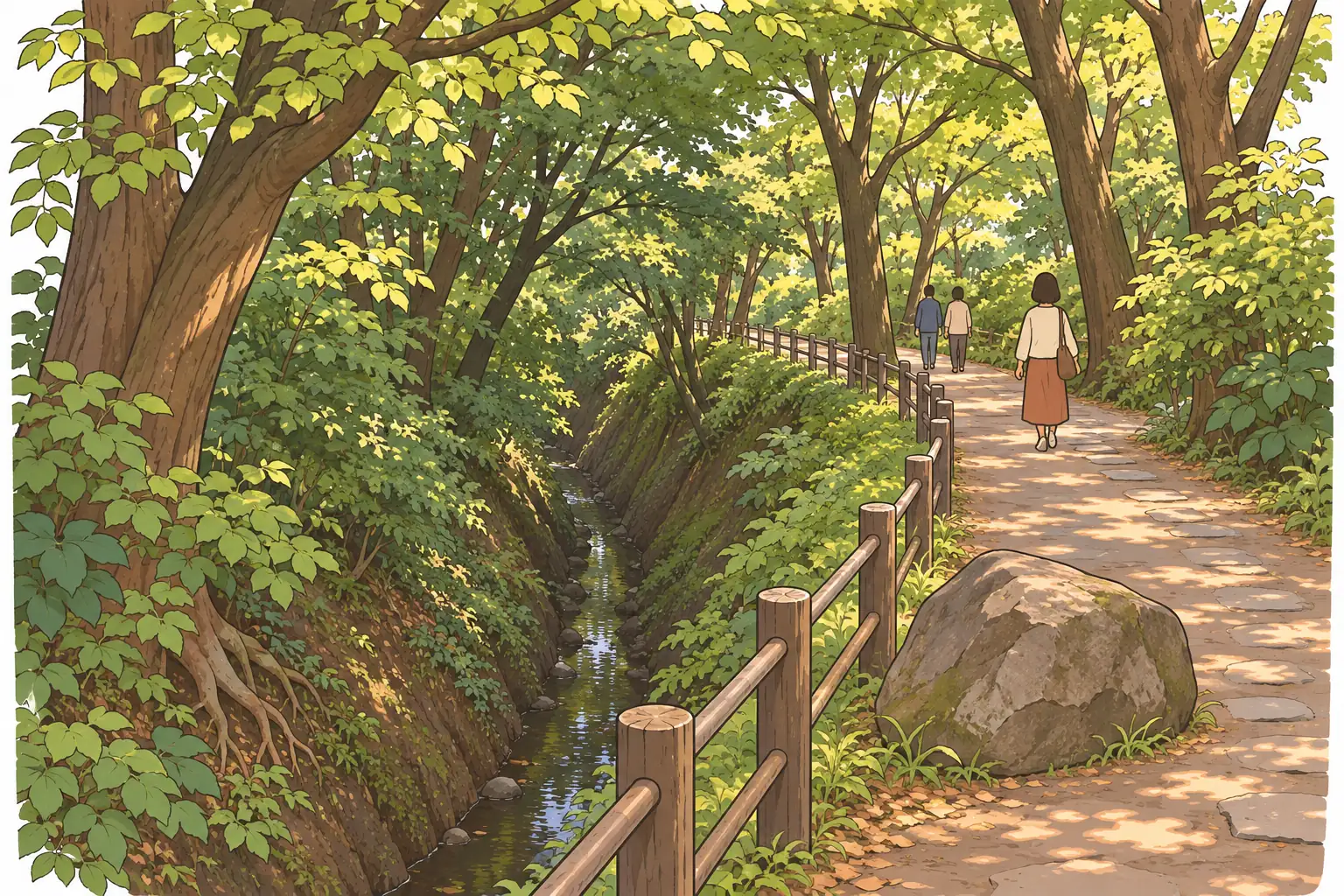
The Tamagawa Aqueduct south of Mitaka Station: a narrow, tree-lined channel beside the Kaze no Sanpomichi path (illustration).
Zenrin-ji is a fifteen-minute walk south of the station. His headstone carries only the three characters of his pen name, and Mori Ōgai’s lies diagonally opposite. On ordinary days the cemetery is quiet, with perhaps a bottle of sake, a pack of cigarettes or a few cherries left at the grave. On June 19 readers come all day, old and young, some in school uniforms, and the grave disappears under cherries, some of them pressed one by one into the carved grooves of his name.