
At a glance
Retells the bamboo princess story, from five suitors humiliated by impossible tasks to her moonlit departure, and explains how Heian tales were copied, read aloud and passed down.
- The author is unknown; it is usually dated to the late ninth or early tenth century and is the oldest surviving Japanese tale written in kana.
- The plot: Kaguya-hime, found inside a bamboo stalk, sets five noble suitors impossible tasks, refuses the emperor, and returns to the moon on the full-moon night of the eighth month.
- The "Picture Contest" chapter of The Tale of Genji calls it the ancestor of all tales, a title that has stuck ever since.
- At the end the emperor has the elixir of immortality burned on a peak in Suruga Province, a legend explaining the name of Mount Fuji.
- The original is long lost; the oldest complete manuscript dates from 1592, some six hundred years after the tale was written.
An old man splits open a glowing stalk of bamboo and finds a girl the size of his thumb inside. Within three months she is a woman of unearthly beauty; she sends five noble suitors on impossible quests, turns down the emperor himself, and on the night of the full moon is carried back to the sky. This is Taketori monogatari, The Tale of the Bamboo Cutter, better known in Japan simply as the story of Kaguya-hime. Written down more than a thousand years ago, it is the oldest surviving work of Japanese prose fiction, and The Tale of Genji called it the "ancestor of all tales." It is short, funny, and in the end quietly devastating. It is also the best place to start if you want to understand what a monogatari, a classical Japanese tale, actually was and how such stories reached us.
01The Story
The opening lines are among the most memorized sentences in Japan, and for many people they are among the first classical Japanese they study at school: "Now it is long ago, but there was once an old bamboo cutter. He went into the hills and fields to cut bamboo, which he used for all kinds of things. His name was Sanuki no Miyatsuko."
One day the old man notices a stalk glowing at its base. Inside he finds a tiny girl, about three sun (roughly nine centimeters) tall, sitting in the light. He takes her home to his wife, and from then on, whenever he cuts bamboo, he finds gold hidden in the joints. The couple grow rich. The child grows unnaturally fast, reaching womanhood in three months, and the house fills with a radiance that seems to come from her. A naming expert gives her the name Nayotake no Kaguya-hime, "the shining princess of the supple bamboo."
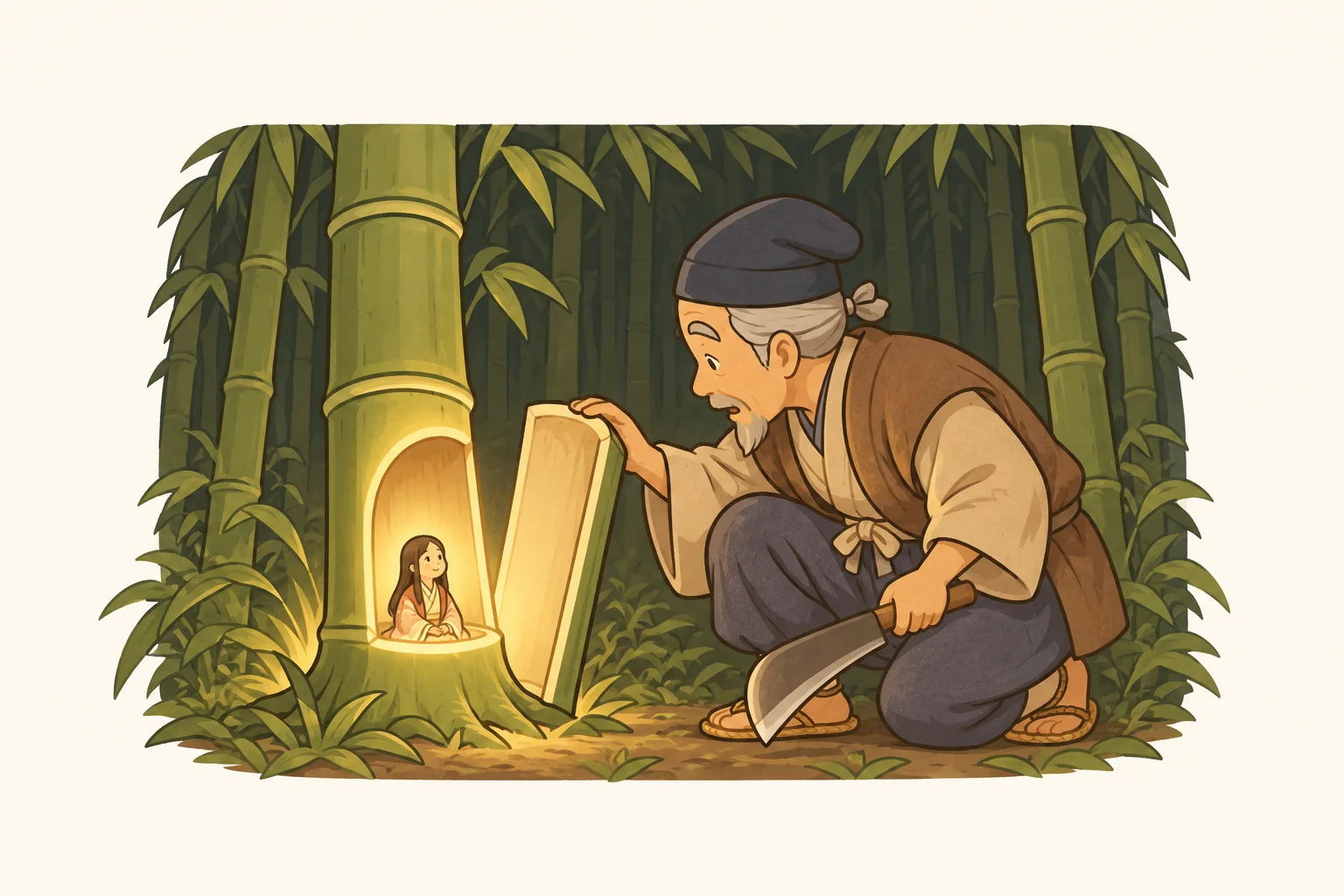
The old bamboo cutter splits a glowing stalk and finds a tiny girl about three sun tall.
Word spreads. Men of every rank haunt the fence around the house at night, peering through gaps, and the narrator jokes that this is where the word yobai, courting a woman by visiting at night, comes from. Most eventually give up, but five high-ranking nobles refuse to go away. The old man pleads with Kaguya-hime to marry one of them, and she agrees, on one condition: she will marry whoever brings her a particular treasure. Each suitor gets a different one, and each is impossible.
| Suitor | Task | Outcome |
|---|---|---|
| Prince Ishitsukuri | The Buddha’s stone begging bowl from India | Passes off an old temple bowl; it does not shine |
| Prince Kuramochi | A branch from Hōrai: silver roots, golden trunk, jewels for fruit | A craftsmen’s replica, exposed when they demand pay |
| Abe no Miushi, Minister of the Right | A robe of fire-rat fur | Bought through a Chinese merchant; burns up completely |
| Ōtomo no Miyuki, Grand Counselor | The five-colored jewel from a dragon’s neck | Goes to sea himself and is wrecked by a storm |
| Isonokami no Marotari, Middle Counselor | A swallow’s cowry shell | Falls when the rope breaks, holding droppings; dies |
Each suitor gets an impossible task; some cheat and are found out, others fail outright, and only Isonokami no Marotari dies.
Prince Ishitsukuri is told to fetch the stone begging bowl of the Buddha from India. Knowing the journey is hopeless, he lies low for a few years, then picks up a soot-blackened old bowl from a mountain temple near the capital and presents it in a brocade bag. A true relic would shine; this one does not, and she sends it back. He throws the bowl away and keeps pestering her anyway, and so, says the narrator, shameless persistence came to be called hachi wo sutsu, "throwing away the bowl," a pun on haji wo sutsu, "throwing away shame."
Prince Kuramochi must bring a branch from the mythical island of Hōrai in the eastern sea, a tree with silver roots, a golden trunk, and jewels for fruit. He makes a show of sailing off, then hides in a secret workshop where craftsmen spend more than a thousand days forging a replica. He returns with the branch and a long, vivid account of storms, sea monsters, and a mountain rising from the waves. Kaguya-hime is nearly trapped, and the old man is already preparing the bedchamber, when a group of craftsmen arrive at the gate demanding to be paid for their work.
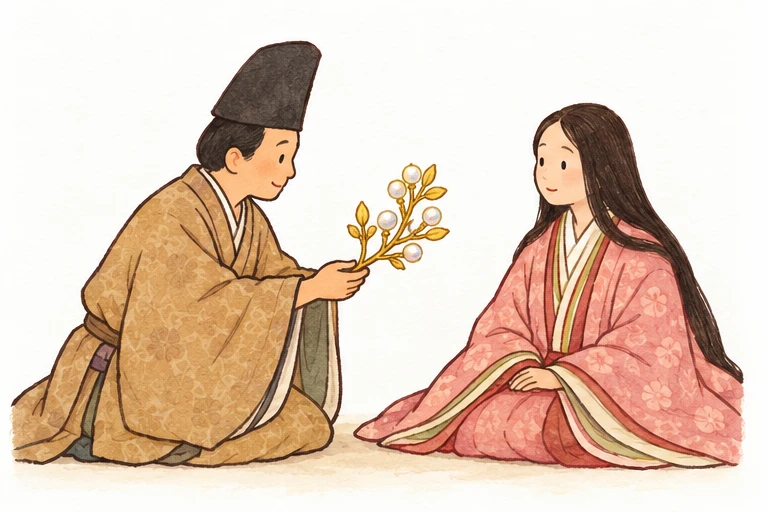
Prince Kuramochi presents the branch his craftsmen made, claiming he brought it back from a voyage.
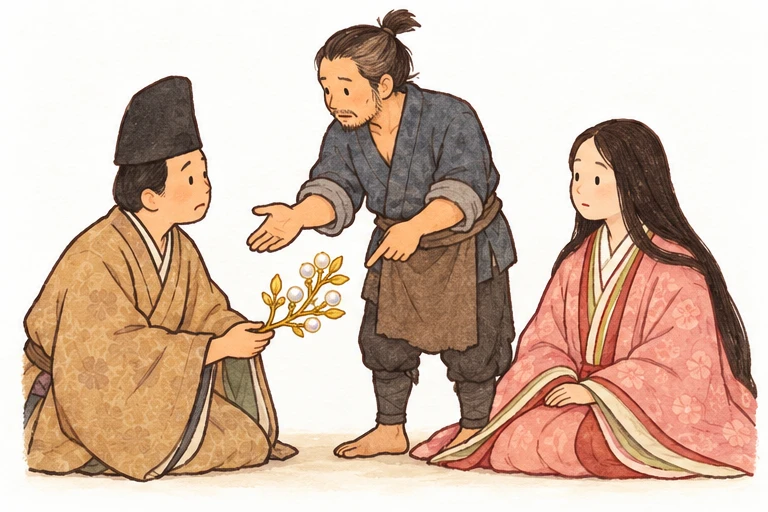
A craftsman arrives to demand his wages, and the fake is exposed on the spot.
The Minister of the Right, Abe no Miushi, is asked for a robe made from the fur of the fire-rat, a creature said to live in flames, whose pelt cannot burn. He is rich, so he simply buys one through a Chinese merchant, paying a fortune. The robe is gorgeous. Kaguya-hime holds it to a fire, and it burns up completely. Hence the word ahenashi, "a letdown," which the narrator links to the minister’s name.
The Grand Counselor Ōtomo no Miyuki is told to take the five-colored jewel from a dragon’s neck. His retainers take the travel money and vanish, so he goes to sea himself, runs into a terrible storm, and ends up prostrate in the boat, vomiting, his eyes swollen like plums. Back home, he curses Kaguya-hime as a thief who wanted him killed.
The Middle Counselor Isonokami no Marotari has to find a swallow’s cowry shell, which supposedly appears only when a swallow lays its eggs. He has himself hoisted in a basket to the rafters of a kitchen where swallows nest, grabs something, and falls when the rope breaks. When he opens his hand, he is holding old swallow droppings. The pun this time is on kai nashi, meaning both "no shell" and "no use." Of the five, he is the only one who dies of his humiliation.
02The Emperor, the Elixir, and Mount Fuji
With the suitors disposed of, the emperor himself hears of Kaguya-hime and wants her at court. She refuses, saying she will vanish if forced. He visits under the pretext of a hunting trip and tries to take her, and she turns into a shadow before his eyes; only when he promises to leave does she return to her shape. He accepts that she is not an ordinary person. For three years afterward they exchange letters and poems, and he takes no interest in other women.
Then, one spring, she begins gazing at the moon in sorrow, and by the full moon of the seventh month her grief is plain to everyone. In the eighth month, as the moon grows full again, she weeps and tells the old man the truth: she is from the Capital of the Moon, sent down to earth because of some offense, and on the fifteenth night of this month her people will come to take her home. The old man refuses to let her go, and the emperor sends 2,000 soldiers to guard the house, half on the walls and half on the roof. The old woman holds Kaguya-hime in a locked inner room.
At midnight the sky becomes brighter than day. Figures descend from the clouds on a flying carriage. The soldiers find their limbs gone limp; they cannot draw their bows. The locked doors open by themselves. Kaguya-hime writes a letter to the old couple and another to the emperor, and leaves him a jar of the elixir of immortality. Then a heavenly feather robe is put around her shoulders. Whoever wears it forgets the sorrows of the human world. She boards the carriage and is gone.
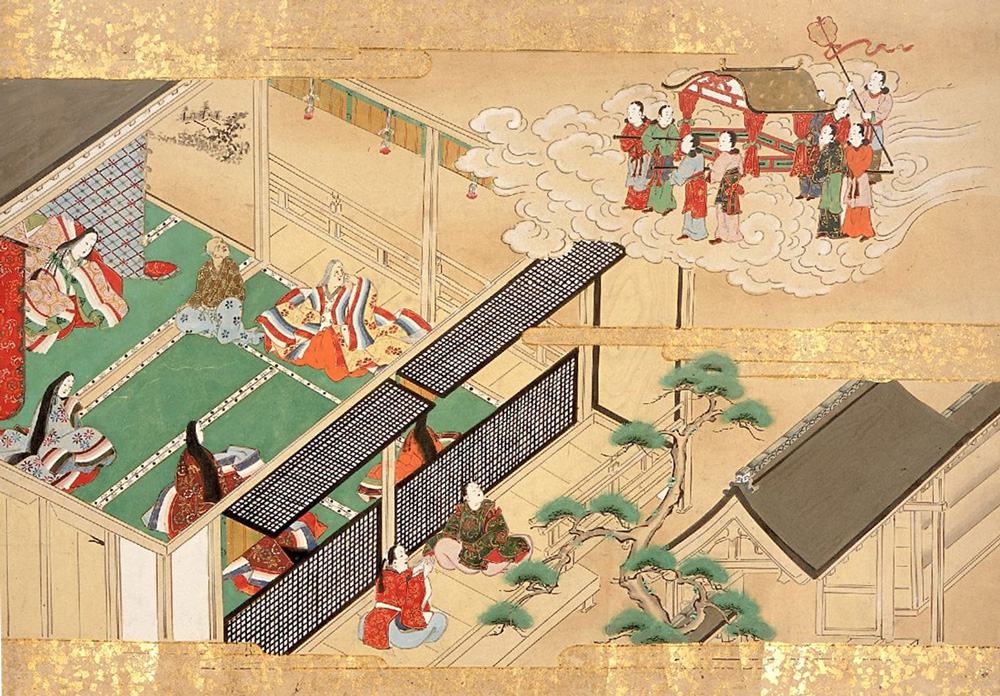
The people of the moon descend from the clouds in a flying carriage, and no one in the house can stop them. Edo-period handscroll.Rikkyo University Library, Illustrated Handscroll of The Tale of the Bamboo Cutter, second scroll, picture 5 (Edo period)
The emperor reads her letter and cannot stop grieving. What use is eternal life, he asks, if I can never see her again? He asks which mountain stands closest to heaven and is told of a great peak in Suruga Province. He sends an envoy with a large troop of soldiers to carry the letter and the elixir to the summit and burn them there. The final lines explain that because so many soldiers climbed it, the mountain was called Fuji, with a play on characters meaning "rich in warriors" and on fushi, "undying." The smoke, the narrator adds, still rises into the clouds. Mount Fuji was an active volcano in the Heian period, and other writings of the time also describe smoke rising from it; by some accounts it was a familiar sight to anyone who traveled the eastern road.
03What Kind of Book Is It?
No one knows who wrote The Bamboo Cutter or exactly when. Most scholars place it in the late ninth or early tenth century, in the early Heian period. What matters is the script. Until then, serious writing in Japan, including the official histories, was done in Chinese. The Bamboo Cutter is written in kana, the phonetic script that had only recently matured, with 15 waka poems embedded in the prose. It is the earliest surviving long narrative in written Japanese.
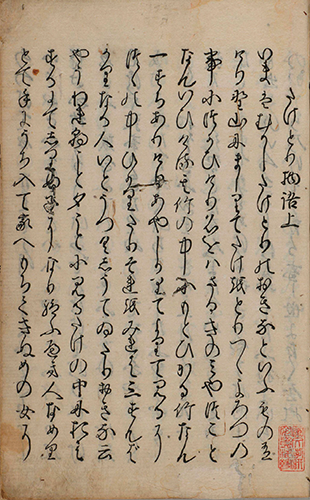
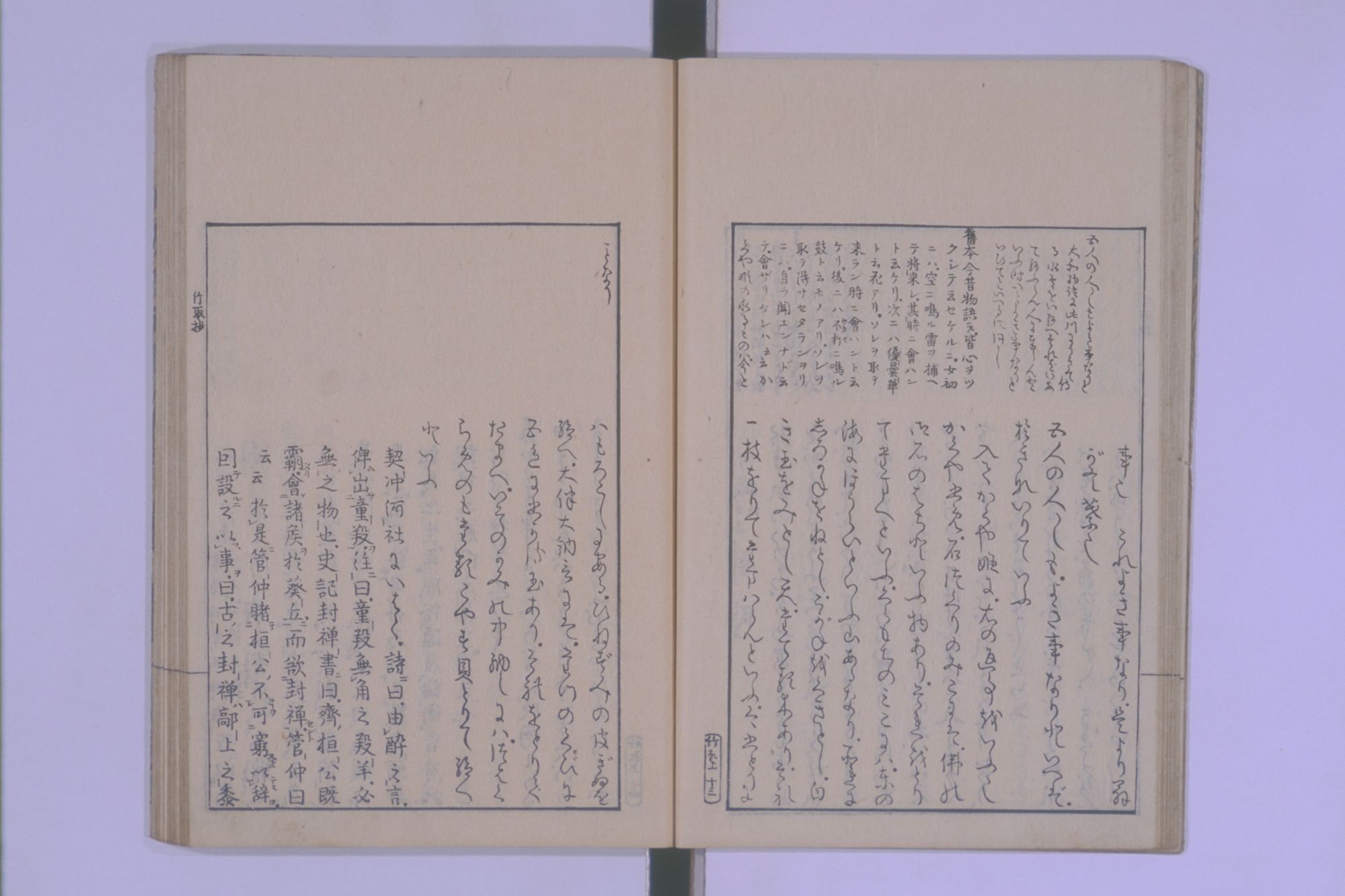
The first page of an early Edo printed edition, set almost entirely in kana and opening with "Ima wa mukashi" (Long ago).National Institute of Japanese Literature, early Edo-period printed edition of The Tale of the Bamboo Cutter
Around a century later, Murasaki Shikibu has her characters debate illustrated tales in the "Picture Contest" chapter of The Tale of Genji, and one of them calls The Bamboo Cutter "the ancestor of all tales that have come into the world." The label stuck.
Its ingredients are old. A child found inside a plant, a celestial maiden with a feather robe, a bride who sets her suitors tasks, an ascent to an immortal realm: all of these appear in folklore across East Asia, and the Man’yōshū, the eighth-century poetry anthology, already contains a long poem about an old bamboo cutter who meets nine heavenly maidens. In the early 1970s, Japanese scholars became excited by a Tibetan folk tale, "Bamboo Girl" (Banzhu guniang), said to come from the Sichuan region, published in a Chinese collection in 1957, in which a girl born from bamboo sets her suitors impossible tasks. The resemblance is striking, though which way the influence ran, if it ran at all, is still argued, and later scholars pointed out that the collection was retold for children with a free hand.
What sets the Japanese tale apart is its satire. Three of the five suitors bear the names of real men: Abe no Miushi, Ōtomo no Miyuki, and Isonokami no Maro were all senior officials at the court of Empress Jitō and Emperor Monmu around 700. Prince Kuramochi is widely read as a jab at Fujiwara no Fuhito, the architect of Fujiwara power, whose mother came from the Kuramochi clan. The author is having fun at the expense of the founding fathers of the aristocracy, showing them as frauds, cheats, and cowards. That has led to guesses that the writer was a learned man, comfortable with Chinese and Buddhist texts, and outside the Fujiwara circle. Names such as the scholar Minamoto no Shitagō and the poet-monk Henjō have been proposed, but none can be proven.
04Monogatari: How Classical Tales Were Told and Passed On
The word monogatari means, literally, "the telling of things." In the Heian period it referred to prose tales in kana, as opposed to histories and poetry in Chinese. They had low prestige; men of letters regarded them as entertainment for women and children. It was within this unregarded form that The Tale of Genji would appear.
Literary historians usually divide the early tales into two streams. "Invented tales" (tsukuri monogatari), like The Bamboo Cutter, The Tale of the Hollow Tree, and Ochikubo, tell made-up stories. "Poem tales" (uta monogatari), above all The Tales of Ise, string together short episodes, each explaining the circumstances behind a poem. Genji brought the two streams together. Later, the word stretched to cover very different things: historical tales such as Eiga monogatari and Ōkagami, war tales such as The Tale of the Heike, which was chanted by blind lute players, and anthologies of Buddhist and folk anecdotes such as Konjaku monogatari shū.
| Kind | Examples |
|---|---|
| Invented tales (tsukuri monogatari) | The Bamboo Cutter, The Tale of the Hollow Tree, Ochikubo |
| Poem tales (uta monogatari) | The Tales of Ise |
| The two streams meet | The Tale of Genji |
| Historical tales | Eiga monogatari, Ōkagami |
| War tales | The Tale of the Heike |
| Buddhist and folk anecdotes | Konjaku monogatari shū |
The invented tales and the poem tales came together in Genji; later the word stretched to cover very different things.
Before printing, a tale lived only as long as people kept copying it. A noblewoman would borrow a set of scrolls or booklets from a friend and copy them out herself or have them copied, and copyists freely corrected, trimmed, and added. That is why most Heian tales survive in several competing manuscript lines. Tales were also read aloud. A lady-in-waiting would read the text while her mistress looked at accompanying pictures, a scene described in the "Eastern Cottage" chapter of Genji itself and painted in the twelfth-century Tale of Genji handscrolls. Some see this way of looking at pictures while listening to a text as the root of the great illustrated handscrolls.
Nothing survives of The Bamboo Cutter from the Heian period. The oldest complete manuscript is dated 1592, some six hundred years after the tale was composed. In the Edo period, woodblock printing turned classical tales into commercial books, and The Bamboo Cutter circulated alongside Ise and Genji; an illustrated printed edition appeared as early as 1646, alongside hand-painted Nara ehon picture books. In modern times, usually said to be from the Meiji era on, it entered school textbooks, and through them and picture books Kaguya-hime became a nursery story.
- 1
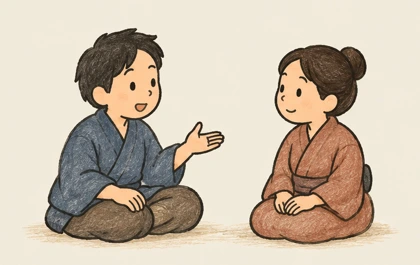 Monogatari literally means "the telling of things"; tales were often read aloud.
- 2
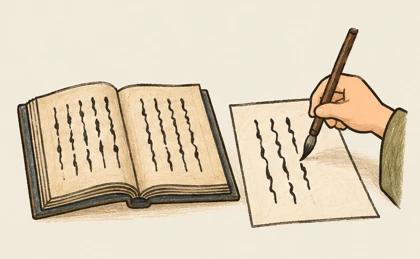 Before printing, tales survived by hand copying, and copyists freely changed words and added lines.
- 3
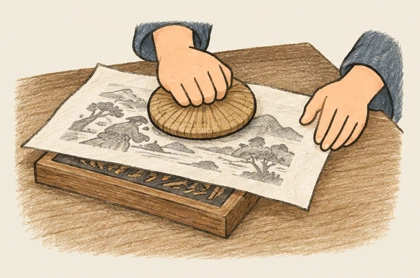 Woodblock printing in the Edo period made the tales books anyone could buy.
05Why It Still Works
The tale is short. A modern Japanese translation runs to a few dozen pages, and it can be read in an afternoon. The first half is comedy: five little satirical sketches, each building to a punchline, each suitor more ridiculous than the last. Prince Kuramochi’s elaborate adventure story, demolished by unpaid workmen at the gate, would work just as well on a modern stage.
The second half drops the jokes. The old couple raised her from a thumb-sized baby; the emperor wrote to her for three years. None of it can hold her. The moon people call the earth a place of defilement, yet Kaguya-hime does not want to leave, and it takes the feather robe, which erases her memories, to make her go. The moon is perfect, pure, and cold. What the story values is the messy human attachment she has to give up. Takahata Isao’s 2013 Studio Ghibli film The Tale of the Princess Kaguya builds its whole interpretation on this, making her longing for ordinary earthly life the emotional center.
There is also a steady refusal of power. Kaguya-hime says no to wealth, rank, and finally to the emperor. And the emperor’s last act, burning the elixir of immortality, is the tale’s own verdict: a life without the person you love is not worth having forever.
06Meeting Kaguya-hime in Japan Today
Kaguya-hime is everywhere in Japanese childhood: in picture books, school plays, and animated versions. Ichikawa Kon made a live-action film, Princess from the Moon, in 1987. When Japan launched a lunar orbiter in 2007, it was nicknamed Kaguya. And the opening sentence, Ima wa mukashi, is among the first passages of classical Japanese that many Japanese people ever learned.
Several towns claim to be the tale’s home. Kōryō in Nara Prefecture points to an ancient district called Sanuki, matching the old man’s name, and to the Sanuki Shrine within its borders; it has a Bamboo Cutter Park as well. Kyōtanabe in Kyoto Prefecture and Fuji City in Shizuoka also have sites linked to the legend, Fuji City’s tied to the mountain ending. None is a historical original, but each makes a pleasant excuse to stand in a bamboo grove and think of the story.
The easiest place to feel the light of the tale is the bamboo grove at Arashiyama, on the western edge of Kyoto. Go early, before the crowds, when the sun comes through the leaves high above and the trunks glow a pale green. And if you are in Japan in early autumn, look for tsukimi, the harvest moon viewing, when families set out rice dumplings and pampas grass on the night of the fifteenth of the eighth lunar month. That is the night she went home.
The tale is easy to find in English, in Donald Keene’s translation and others, and it rewards a read before or after watching Takahata’s film. Almost everything in the film is already there, in a story told more than a thousand years ago.