
At a glance
Two thin medieval books, one about disasters and a ten-foot hut, one a hermit’s idle jottings, and why Japanese readers still turn to them.
- Hōjōki and Tsurezuregusa are both short, and with The Pillow Book they are called Japan’s three great zuihitsu.
- Kamo no Chōmei wrote Hōjōki in 1212 in a hut about three meters square on Mount Hino.
- The first half of Hōjōki records the fire, whirlwind, move of the capital, famine and earthquake of 1177–1185.
- Kenkō’s Tsurezuregusa is usually dated to around 1330 and consists of a preface and 243 sections.
- Section 137, which prefers branches about to bloom and gardens of fallen petals, is a key text for the beauty of the incomplete.
Every Japanese student meets these two books in classical Japanese lessons at school, usually by memorizing their opening lines, in many cases, it is reported, from junior high school on. Hōjōki (An Account of My Hut, 1212) was written by Kamo no Chōmei, a disappointed shrine priest who watched Kyoto burn, starve and shake apart and then retreated to a hut ten feet square. Tsurezuregusa (Essays in Idleness, around 1330) was written by the monk Kenkō, who filled it with anything that crossed his mind: death, cherry blossoms, etiquette, drunkenness, and monks who got pots stuck on their heads. Both are short enough to read in an afternoon, and both still shape how Japanese people talk about transience, beauty and the good life. This piece explains who wrote them, what is in them, and how they belong to two Japanese literary forms, the miscellany called zuihitsu and the literary diary.
01Two Openings Everyone Knows
Hōjōki begins: "Yuku kawa no nagare wa taezu shite, shikamo moto no mizu ni arazu." The flowing river never stops, and yet the water is never the same water. Foam on the still pools vanishes and forms again, and never lasts for long. "So it is with people in the world, and with their dwellings."
Tsurezuregusa begins with a single sentence that sounds like an apology. With nothing to do all day, the author sits facing his inkstone and jots down the trivial things that drift through his mind, without order or purpose, and finds that it makes him feel strangely unhinged. Tsurezure means the long, empty boredom of having nothing to do; gusa (from kusa, grass or weeds) suggests a loose bundle of jottings. A literal title might be "Weeds of Idleness."
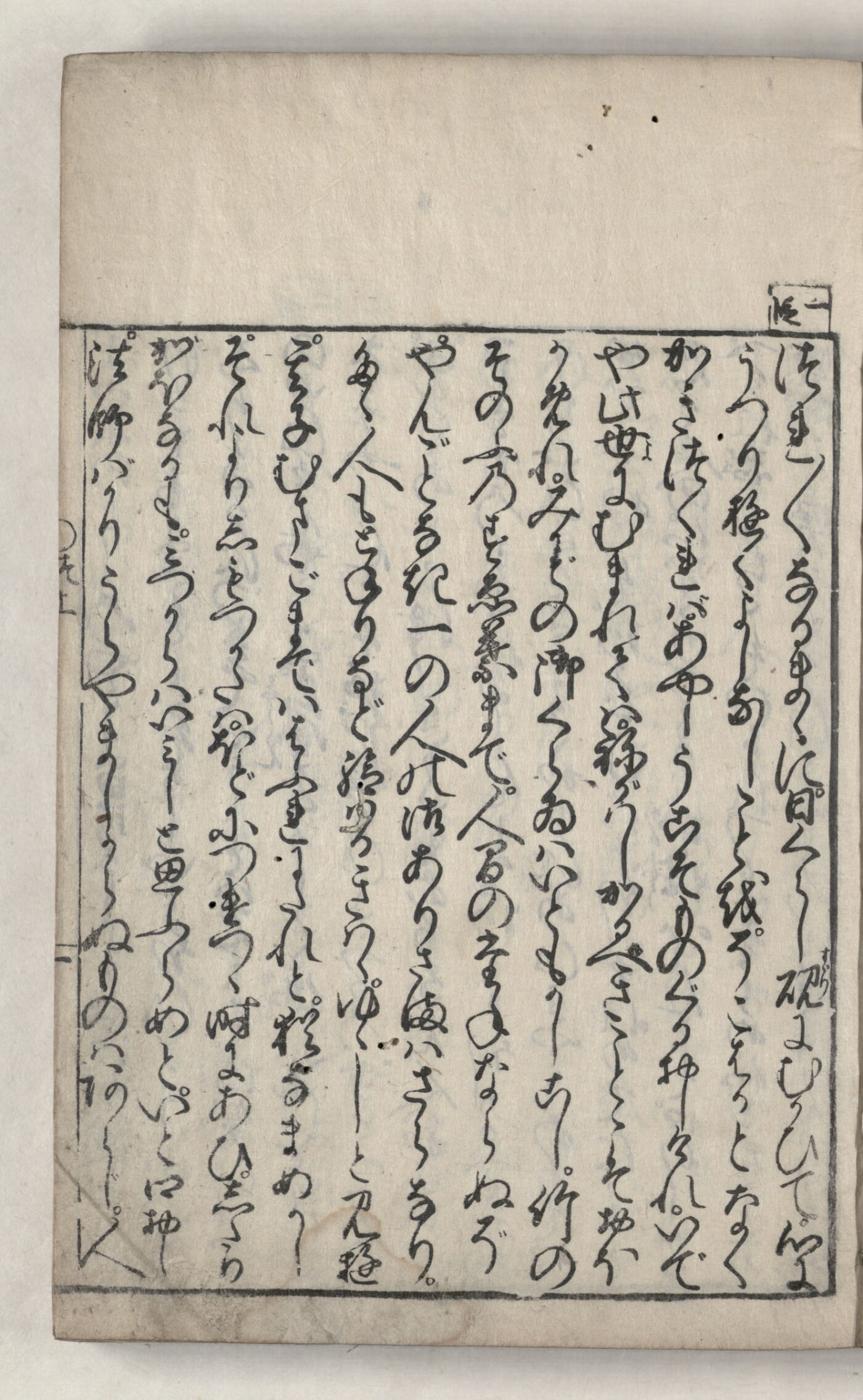
First page of a 1667 printing, opening with the preface: "Tsurezure naru mama ni..."National Institute for Japanese Language and Linguistics, Tsurezuregusa, Kanbun 7 edition (1667), CC BY 4.0 · CC BY
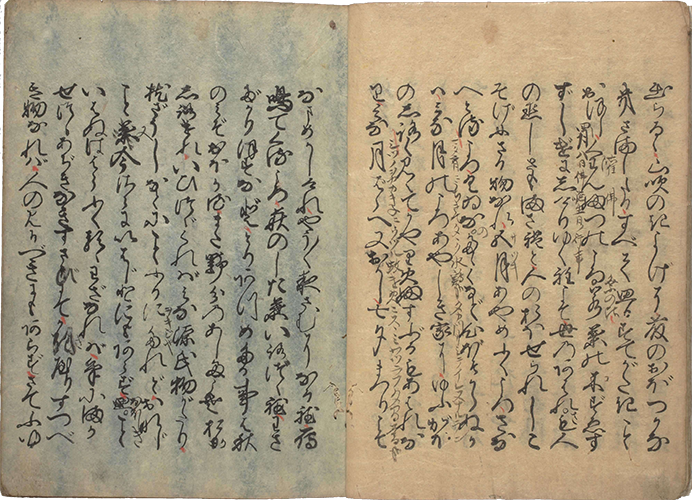
A movable-type edition from the Keichō era at the start of the Edo period, when printed editions began to multiply.National Institute of Japanese Literature, Tsurezuregusa, Keichō movable-type edition, Kokusho Database, DOI 10.20730/200009896 · Terms of use
The two openings could hardly be more different in tone. Chōmei starts with a river and a verdict on the whole world. Kenkō starts by calling his own book worthless. Yet Japanese readers pair them because both are built on mujō, the Buddhist idea of impermanence. Chōmei writes as someone who has been chased by impermanence. Kenkō writes as someone who has sat down to look at it calmly, and even to enjoy it.
Together with Sei Shōnagon’s The Pillow Book from around the year 1000, they are called the "three great zuihitsu" of classical Japan.
02Kamo no Chōmei and the Five Disasters
Chōmei was born around 1155 into the family of hereditary priests at the Shimogamo Shrine in Kyoto, one of the oldest and grandest shrines in the capital. He was a gifted poet and musician on the biwa lute, and in 1201 the retired emperor Go-Toba appointed him to the court’s Bureau of Poetry. In 1204 Go-Toba wanted to make him priest of Kawai Shrine (also called Tadasu Shrine), a subsidiary of Shimogamo closely tied to his late father, but a kinsman, Kamo no Sukekane, blocked the appointment. Chōmei, then around fifty by the traditional count, took Buddhist vows. He lived first at Ōhara, generally placed in the hills north of Kyoto (some put it in the Nishiyama hills to the west), and later at Mount Hino to the southeast, where he wrote Hōjōki in 1212. He died in 1216.
The first half of the book is a record of disasters he saw with his own eyes, and it is the part that makes the book vivid rather than merely pious. In 1177 a great fire started in the southeast of the capital and was driven by wind across the city overnight, destroying mansions of the nobility and government halls. In 1180 a whirlwind tore through the city, lifting roofs and doors into the air like leaves. That same year, the warlord Taira no Kiyomori moved the capital to Fukuhara, near modern Kōbe. People dismantled their houses and floated the timber down the river, and Kyoto emptied out, only for the court to move back within months.
- 1177Great fire
- 1180Whirlwind
- 1180Capital moved to Fukuhara
- 1181Yōwa famine (from 1181, two years)
- 1185Great earthquake
All five fell between 1177 and 1185; in two months of the famine more than 42,300 bodies were counted in the eastern half of the capital.
Then came the famine of the Yōwa era, beginning in 1181 and lasting two years. Chōmei describes people collapsing in the streets, the smell of corpses filling the city, and houses torn apart for firewood, including temple statues and fittings. He records that a monk from Ninna-ji temple went around writing the Sanskrit letter a on the foreheads of the dead to link them to the Buddha, and counted more than 42,300 bodies in the eastern half of the capital in just two months. He notices the most painful details: a baby still nursing at its dead mother’s breast; couples in which the one who loved more died first, because they gave whatever food they found to the other. In 1185 a great earthquake followed, with landslides, waves and toppled pagodas.
These years were also the years of the Genpei War between the Taira and Minamoto clans, the war told in The Tale of the Heike as a story of heroes and fallen houses. Hōjōki shows the other side: what fire, wind, hunger and earthquake did to ordinary households in the capital. That is why Chōmei pairs "people and their dwellings" in his opening. After all this, he concludes, pouring wealth and worry into building a house in the city is the most foolish thing a person can do.
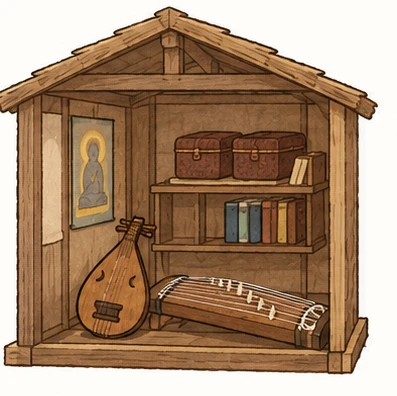
The hut was not empty: an image of Amida on one side, koto and biwa on the other, and boxes of books.
03Ten Feet Square
The title comes from the hut. A hōjō is a room one jō on each side, about three meters square, the traditional measure of a monk’s cell. Chōmei describes his: less than seven feet high, built on a simple frame with every joint fastened by latches so it could be taken apart and carried away in two carts if he wanted to move. On one side hung an image of Amida Buddha; on the other, his koto and biwa. A few boxes held books of poetry, music and Buddhist devotion. Outside, a bamboo pipe brought water to a little pool among the rocks, and the woods nearby supplied firewood.
He describes his days with obvious pleasure: listening to the cuckoo in summer and the cicadas in autumn, gathering fruit and firewood, wandering the hills with a boy from the mountain warden’s family below (ten years old in the Daifukkōji manuscript as usually read, sixteen in the common printed text, both by the traditional count). Nobody needed him and he needed nobody. He compares himself to a hermit crab that chooses a small shell because it knows its own size.
And then, in the last pages, Chōmei turns on himself. The Buddha taught that one should be attached to nothing. Isn’t loving this hut, and loving its quiet, just another attachment? He admits he has no answer. His mind, he says, cannot reply; he simply mumbles the name of Amida two or three times and lays down his brush. A book that seems to be selling the joys of retreat ends by confessing that retreat has not set him free. That honesty is a large part of why Hōjōki still feels like the voice of a real person rather than a sermon.
04Kenkō, the Idle Observer
Kenkō was born around 1283 into the Urabe family. The traditional account makes him a member of the branch that served as hereditary priests of the Yoshida Shrine in Kyoto and a minor court official in his youth, which is why he is often called Yoshida Kenkō, a name that came into use much later. Recent scholarship argues that this genealogy and career were invented in the fifteenth century by the Yoshida family to raise its prestige, and that contemporary documents show him working as a secretary for the Kanazawa branch of the Hōjō clan, moving between Kyoto and Kamakura. He took Buddhist vows around the age of thirty (the counting method is not recorded), and spent the rest of his life in and around the capital, with at least one stay in eastern Japan. In his own day he was known mainly as a poet of the conservative Nijō school. Tsurezuregusa is usually dated to around 1330, though some scholars think it was written over many years, the years when the Kamakura shogunate collapsed and the country split between rival Northern and Southern courts, yet politics barely appears in it.
The book consists of a short preface and 243 sections, some a single sentence long, some a couple of pages. There is no plot and no overall argument. Kenkō writes about old court customs, how a house should be arranged, the evils of forcing drink on guests, what makes a good friend, the proper way to behave at a festival, and the secrets of craftsmen, gamblers and horsemen. Between these he places some of the most quoted lines in Japanese literature about death.
Section 7 imagines a world where people never die: if the dews of Adashino never faded and the smoke over Toribeyama never cleared, if we lived forever, how little feeling things would have. "It is precisely because the world is uncertain that it is wonderful." Adashino and Toribeyama were the cemeteries and cremation grounds on the western and eastern edges of Kyoto, so his readers would have pictured real places. Here Kenkō turns Chōmei’s lament inside out: things are precious because they end.
Section 137 opens with a question: "Are we to look at cherry blossoms only in full bloom, at the moon only when it is cloudless?" Kenkō argues that longing for the moon on a rainy night, or staying indoors with the blinds down and not knowing that spring has passed, has its own depth. Branches about to bloom and gardens strewn with fallen petals are more worth looking at than flowers at their peak. When Japanese people talk about the beauty of the incomplete, of things in the process of arriving or departing, this passage is one of the texts they reach for. Elsewhere Kenkō quotes with approval a monk who said that a set of books looks better when the volumes do not match, and that leaving something unfinished is more interesting than making it perfect.
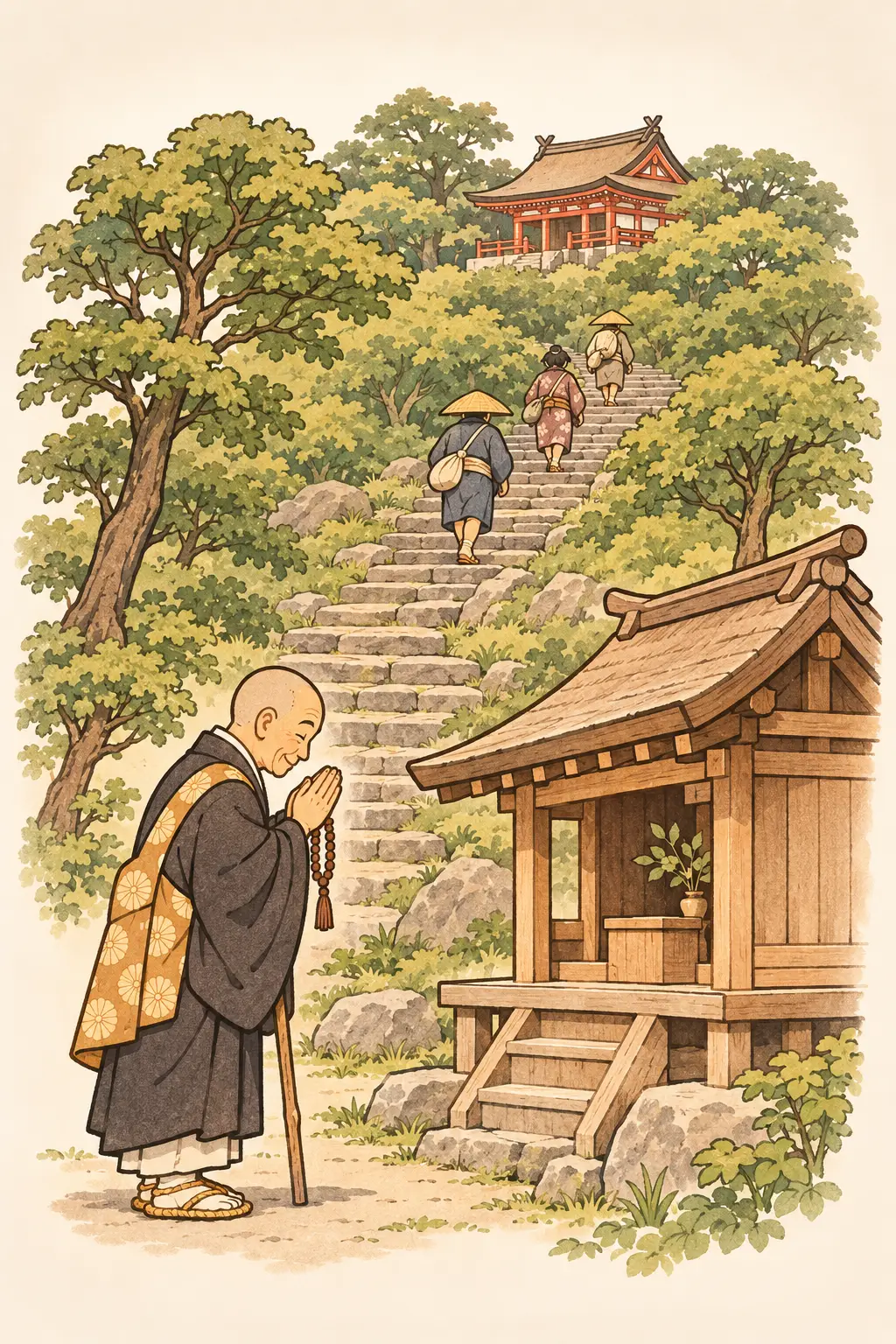
Section 52: the old monk worshipped only at the temples at the foot of the hill and went home; the shrine itself was at the top.
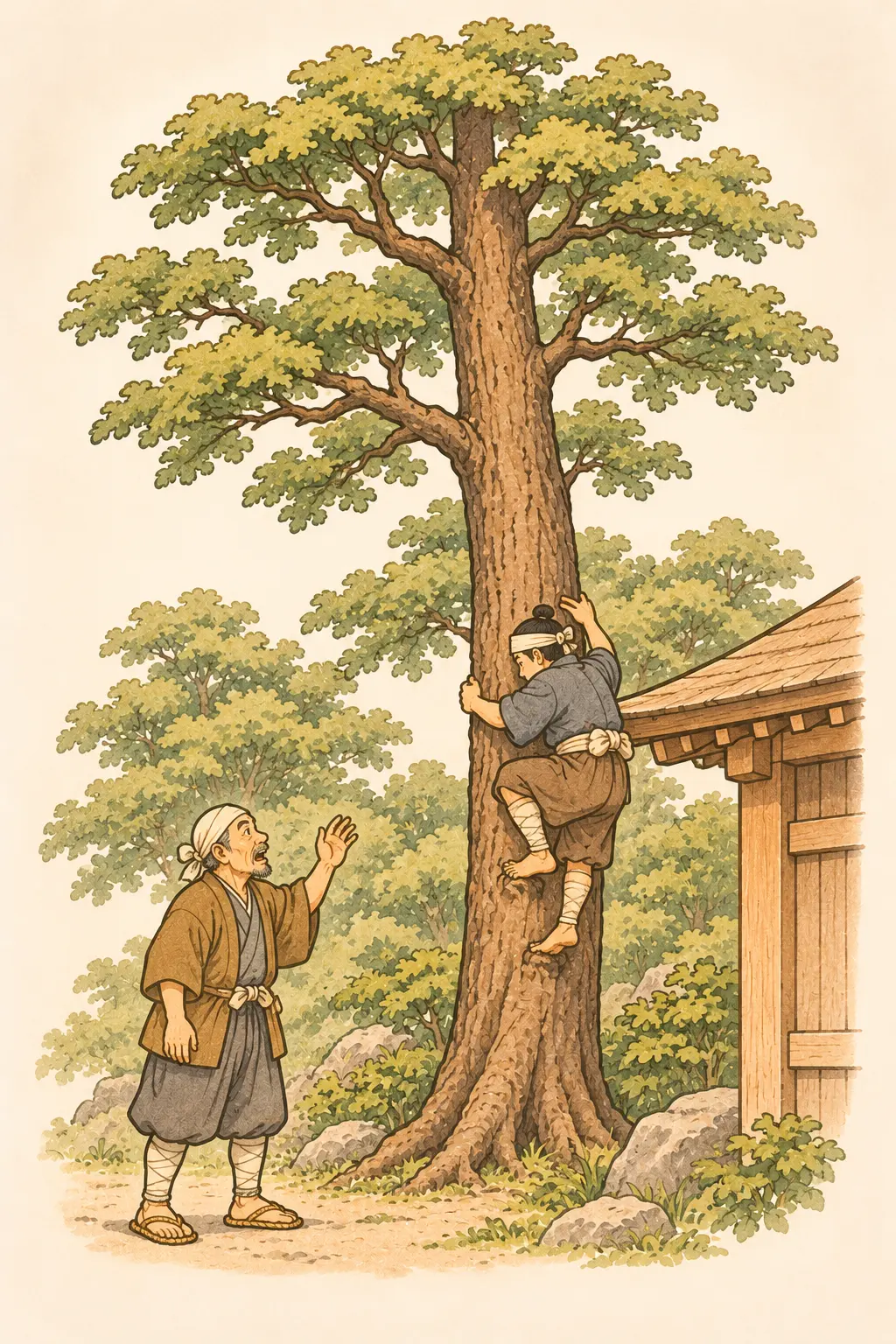
Section 109: the master climber calls out "Be careful!" only when his pupil is down to about the height of the eaves.
05Monks, Tree-Climbers and Common Sense
What made Tsurezuregusa a book for everyone, though, is not only its meditations but its gossip and practical wisdom. Many sections are tiny stories with a moral, told with a dry humor.
In Section 52, an old monk from Ninna-ji has long wanted to visit the famous Iwashimizu Hachiman Shrine. At last he walks there alone, worships at the temples at the foot of the hill, and goes home satisfied, remarking that everyone else seemed to be climbing the mountain and he wondered what was up there. The shrine itself was at the top. Kenkō’s comment: even in small things, it is good to have a guide.
In Section 53, monks at the same temple are drinking at a farewell party when one of them puts a three-legged metal pot over his head and dances. Everyone laughs until he cannot get it off. They try everything, take him to a doctor, and in the end pull it off by force, tearing his ears and nose.
In Section 109, a famous tree-climber directs a pupil cutting branches high in a tree. He says nothing while the man is in danger at the top. Only when the pupil has come down to about the height of the eaves does he call out, "Be careful!" Asked why, he says that people make mistakes not in dangerous places, where they are already careful, but once things become easy.
Short, concrete and quotable, these passages made the book useful as well as beautiful. Kenkō was barely read in his own lifetime; the oldest surviving manuscript was copied about a century later by the poet-monk Shōtetsu. But in the Edo period (1603–1868), printed editions and commentaries multiplied, and Tsurezuregusa became a standard book of practical wisdom about how to live and, by some accounts, a text for learning to read in private academies and temple schools. Today its stories turn up in school textbooks and business books alike. Kenkō himself comes across as several people at once: a monk at peace with death, a fussy guardian of old taste and etiquette, and a sharp-tongued old man with opinions on women, wine and bad manners. The fourteenth-century war chronicle Taiheiki even tells a story of him ghostwriting a love letter for the warlord Kō no Moronao, a later legend, but one that shows how worldly people imagined him to be.
06Zuihitsu: Following the Brush
Zuihitsu means "following the brush": writing wherever the brush leads. The label was applied to The Pillow Book, Hōjōki and Tsurezuregusa long after they were written, and the three are actually quite different in shape. Sei Shōnagon wrote lists ("Things That Make One’s Heart Beat Faster," "Hateful Things") alongside anecdotes of court life. Chōmei wrote a single, carefully built essay. Kenkō wrote hundreds of fragments.
What they share is a first-person voice that observes, remembers and judges, with no plot to drive it. The apparent casualness is partly an effect. Hōjōki moves in a clear arc from disaster to retreat to self-doubt. Tsurezuregusa looks random, but neighboring sections often pick up each other’s themes: a passage on houses leads into one on gardens; a reflection on death sits beside a cheerful argument for enjoying life now. The art of the zuihitsu is to arrange things so that the arrangement does not show.
The form never went away. Edo-period scholars and townsmen filled hundreds of volumes with notes on customs, curiosities and things overheard. In the twentieth century the physicist Terada Torahiko wrote essays on the science of everyday life, and the television writer Mukōda Kuniko wrote about family meals in Shōwa-era Tokyo. Walk into any Japanese bookstore today and you will find long shelves labeled essei, where novelists, actors, chefs and comedians publish collections about their daily lives. The appetite for a single person talking honestly about how they live runs straight back to these old books.
07Diaries That Became Literature
Alongside the zuihitsu runs another Japanese form built on the first person: nikki bungaku, or diary literature. In the Heian period (794–1185), male aristocrats kept diaries in Chinese, recording court ceremonies and official business for future reference. Around 935, the poet Ki no Tsurayuki returned to the capital from a governorship in Tosa province and wrote Tosa nikki (The Tosa Diary), opening with the line that he, a woman, would try her hand at the kind of diary that men keep. Writing as a fictional woman in the Japanese kana script, he described fifty-odd days of sea travel: storms, fear of pirates, poems, and grief for a young daughter who had died during his posting.
Court women took up the form and made it their own. The mother of Fujiwara no Michitsuna wrote The Kagerō Diary about twenty years of jealousy and loneliness as one of the wives of a powerful statesman. The Izumi Shikibu Diary follows a love affair; The Diary of Murasaki Shikibu records life in the empress’s household by the author of The Tale of Genji. Sarashina nikki, by a woman known as the daughter of Sugawara no Takasue, begins with a girl who longs to read Genji and ends with an aging widow looking back on dreams that came to little. None of these is a day-by-day log. They were written or reshaped years later, selecting what mattered, weaving in poems, and turning a life into a story.
That is what "diary literature" means in Japan: experience shaped into narrative. Hōjōki, with its retrospective account of a life and a hut, has a good deal of this quality. The line continues through medieval travel diaries, Matsuo Bashō’s The Narrow Road to the Deep North, and the modern "I-novel," in which writers turned their own lives into fiction. Japanese readers have long trusted that a person writing plainly about what happened to them and what they thought is worth reading.
08Finding the Recluses in Kyoto
Both books are rooted in Kyoto, and many of their places can still be visited. The easiest is the Shimogamo Shrine, set in the ancient Tadasu no Mori forest. Within its grounds stands Kawai Shrine, the very shrine whose priesthood Chōmei failed to inherit, and beside it a reconstruction of his ten-foot hut based on his own description. Standing in front of it makes the measurement real: there is room for one person to sleep, sit and pray, and not much else. The actual site of his retreat on Mount Hino, in the Hino district of Kyoto’s Fushimi ward, can be reached by a hillside path from the area around Hōkai-ji temple, where a large rock known as the Hōjōseki marks the traditional location.
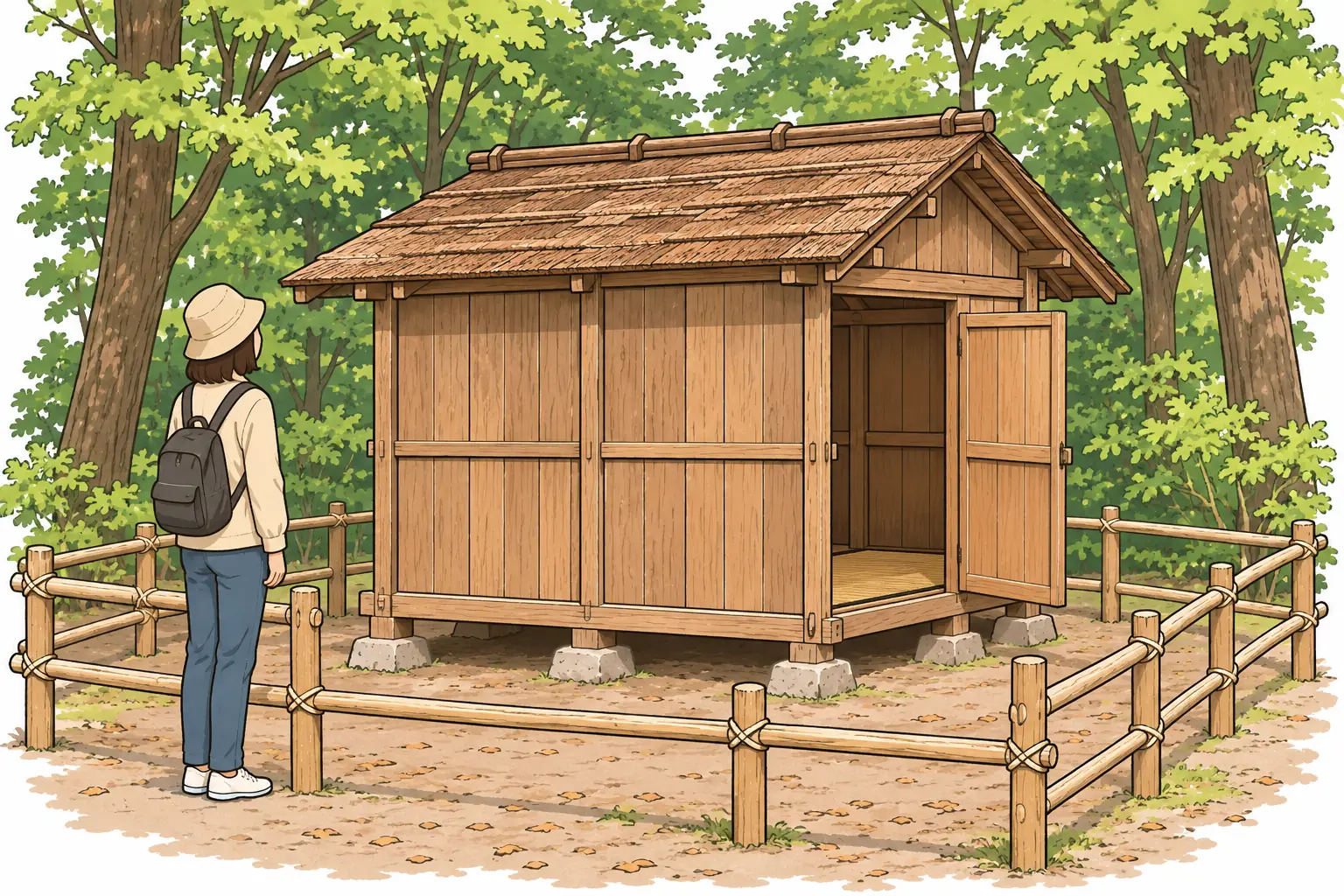
The reconstructed ten-foot-square hut at Kawai Shrine, Shimogamo, with a visitor beside it for scale (illustration).
Kenkō’s places are more scattered. Ninna-ji, home of the hapless monks in Sections 52 and 53, lies in northwest Kyoto and is famous for its late-blooming, low-growing Omuro cherry trees. The low hills of Narabigaoka just south of it are traditionally said to be where Kenkō kept a hermitage, by some accounts in his later years. Adashino survives as Adashino Nenbutsu-ji in the Sagano district, where thousands of small stone Buddhas and grave markers, gathered from the surrounding fields, stand in rows; in late August they are lit with candles for the Sentō Kuyō memorial. Toribeyama, south of Kiyomizu-dera, is still a vast cemetery. The Yoshida Shrine, traditionally said to have been served by Kenkō’s family, sits on a hill beside Kyoto University.
You do not need classical Japanese to read either book. Both are available in several English translations, often bound together, and Hōjōki can be read in an hour. Tsurezuregusa is best taken a few sections at a time. Read the river passage in front of the little hut at Shimogamo, or Section 7 among the stone Buddhas of Adashino, and the books stop being school classics and become what they were meant to be: two men talking, quietly and frankly, about how to live in a world that does not stay still.