
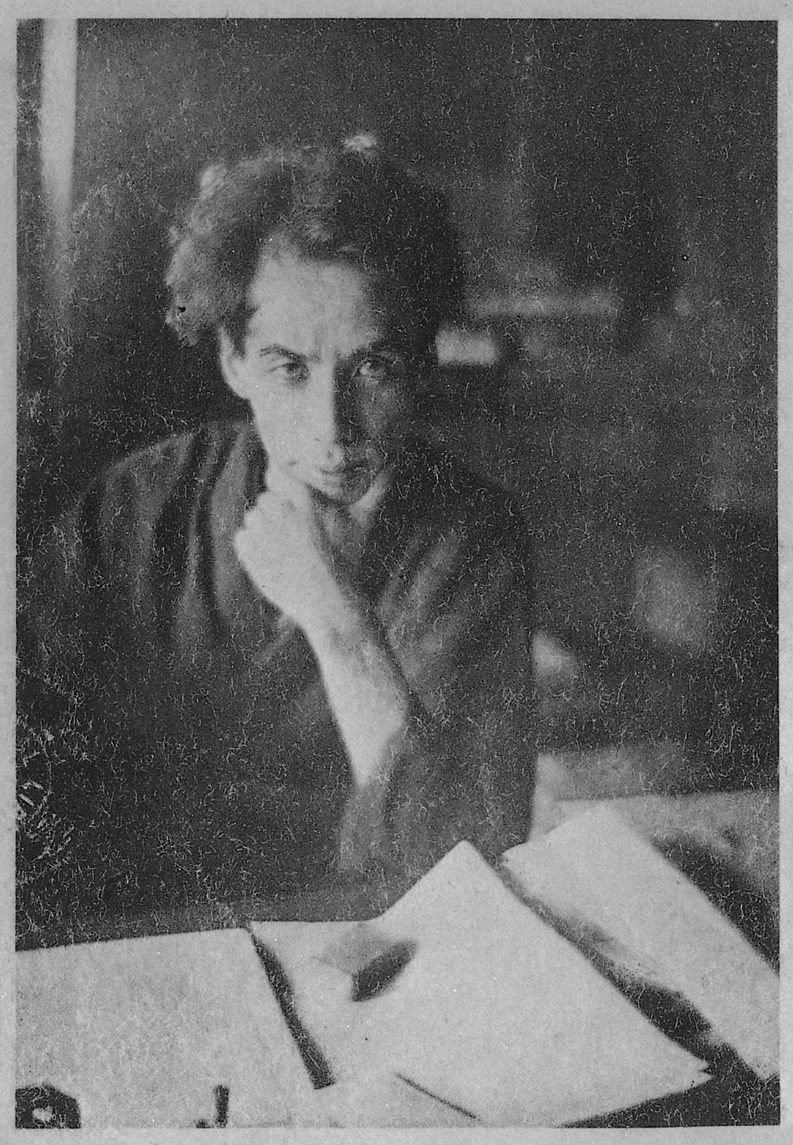
At a glance
The short-story writer behind Rashōmon and In a Grove: his life, how his servant talks himself into theft, which stories to read first, and the prize named for him.
- Akutagawa Ryūnosuke (1892–1927) died at 35 without finishing a novel; his fame rests on short stories.
- "Rashōmon" (1915), built from the Konjaku monogatari shū, has been a first-year high-school text for decades.
- He drew on Heian anecdote collections, Chinese tales and stories of Japan’s early Christians to expose the unflattering side of the mind.
- Kurosawa’s 1950 film Rashomon mainly used the plot of "In a Grove" and won the Golden Lion at Venice in 1951.
- Kikuchi Kan founded the Akutagawa Prize in 1935; it is awarded twice a year, announced in January and July.
Akutagawa Ryūnosuke died at 35 without ever finishing a novel, yet few Japanese writers are better known at home or abroad. Nearly every Japanese teenager reads his story "Rashōmon" in high school, the country’s most famous literary prize for new writers carries his name, and through Kurosawa Akira’s film the word "Rashomon" has entered English as shorthand for a story told in irreconcilable versions. His method was to take a tale that was already centuries old, strip it down, and turn it until it showed something unflattering about the human mind. This introduction covers his life, walks through "Rashōmon" and the moment its hero talks himself into theft, suggests which stories to read first, and points to the places in Japan where he can still be found.
01A Boy from Old Tokyo
Akutagawa was born on March 1, 1892, in Irifune-chō in Tokyo’s Kyōbashi Ward (today Akashi-chō, Chūō Ward), the son of a dairy businessman named Niihara Toshizō. A family story holds that he was born in the year, month, day and hour of the dragon, hence the name Ryūnosuke, "son of the dragon," though this looks like a legend added later. Within a year of his birth his mother, Fuku, became mentally ill. The baby was handed to her elder brother, Akutagawa Dōshō, and eventually adopted into that household. Her illness stayed with him: for the rest of his life he feared that he had inherited it.
The Akutagawa family lived in Honjo, on the east bank of the Sumida River, and had served the shogun’s household for generations as tea-room attendants (oku-bōzu; many biographies use the more specific title sukiya-bōzu). It was a house of old Edo tastes, with ink paintings, haikai poetry, kabuki and storytellers. The boy read Chinese classics and popular Edo fiction before he discovered Western literature, and his prose kept both strands: the compression of classical Chinese and the tight architecture of the European short story.
He was a gifted student. After the First Higher School he entered Tokyo Imperial University in 1913 to study English literature. With classmates including Kume Masao and Kikuchi Kan he revived a coterie magazine called Shinshichō (New Currents of Thought), and began publishing fiction.
02"Rashōmon": An Argument at the City Gate
In November 1915, at 23, Akutagawa published "Rashōmon" in a university literary journal. It drew almost no attention. A century later it is one of the most widely read stories in the Japanese language, a fixture of first-year high-school textbooks since the postwar decades, the piece through which many Japanese first meet modern fiction.
The raw material came from the Konjaku monogatari shū (Tales of Times Now Past), a vast collection of short anecdotes compiled in the late Heian period, around the early twelfth century. One tale tells of a would-be thief who hides in the upper story of the Rajōmon, the great southern gate of the capital, and finds an old woman pulling the hair from a corpse; he robs her and runs. Another tells of a woman who sold chopped and dried snake to palace guards as dried fish. Akutagawa joined the two and gave his main character a new predicament.
The story opens flatly: "It was one evening. A servant was waiting out the rain under the Rashōmon." Kyoto, we learn, has been battered for years by earthquakes, whirlwinds, fires and famine. The gate has fallen into ruin; foxes and thieves live in it, and unclaimed bodies are now dumped in its tower. The servant was dismissed by his master a few days ago. He has nowhere to sleep and nothing to eat tomorrow. Akutagawa gives him one physical detail, a large pimple on his right cheek that he keeps fingering as he thinks.
His choice, as he sees it, is between starving and stealing. He knows that to live he must steal, but he lacks the courage to say yes to that conclusion. Climbing into the tower to find a place to sleep, he sees by torchlight a small, gray-haired old woman crouched over the body of a dead woman, plucking out the hair one strand at a time. A hatred of all evil flares up in him. If someone asked him now whether to starve or steal, he would choose starvation without a second thought.
He draws his sword and seizes her. She explains that she is pulling out the hair to make wigs. Then she offers her reasoning. The dead woman, she says, used to cut up snakes and sell them as dried fish to the guards’ barracks. She did it so as not to starve, so it was not wrong. And what I am doing now, the old woman says, I do so as not to starve. She understood that, so she would forgive me.
While he listens, the courage he lacked a moment ago grows in him, pointing exactly the opposite way from the impulse that sent him up the ladder. "Then you won’t hold it against me if I strip you," he says. "I would starve too if I didn’t." He tears off her cypress-bark-brown robe, kicks her down onto the corpses, and carries the robe down the ladder into the night.
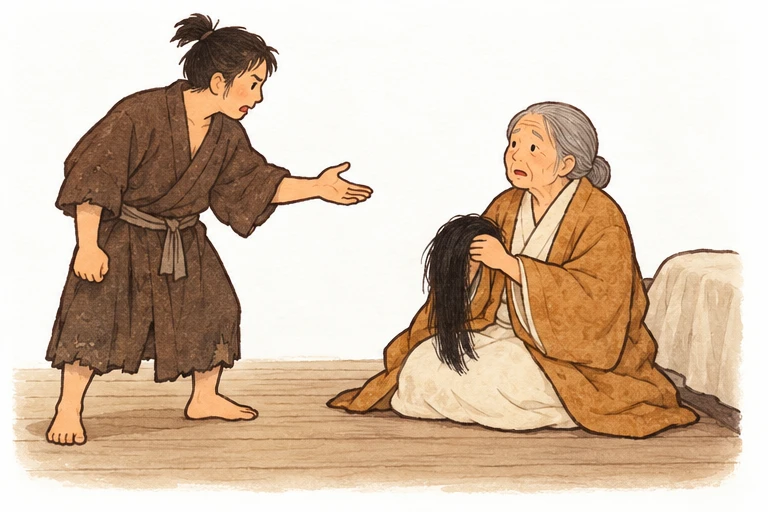
The old woman explains: she pulls the hair so as not to starve, and the dead woman would forgive her.
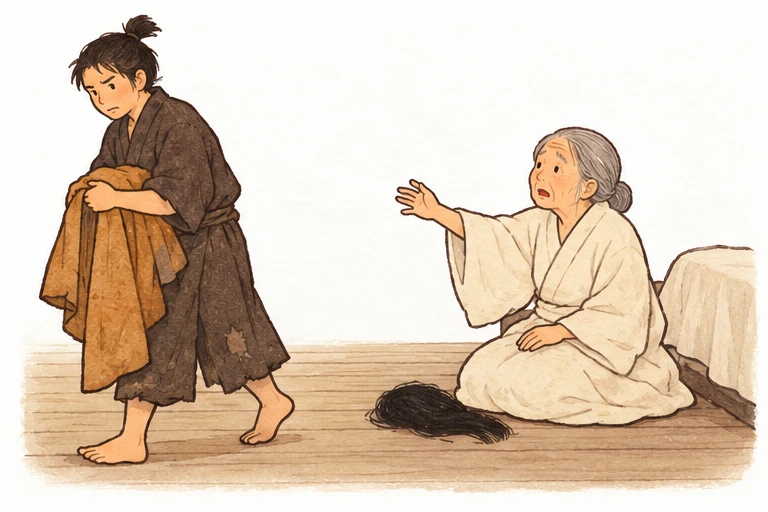
The servant uses the same reasoning, strips off her cypress-bark-brown robe and leaves.
The force of the story lies in how the change happens. The servant is not driven to theft by a new disaster. He is talked into it, and by an argument that he simply hands back to the person who made it. His moral outrage was real, but it was a mood, and it collapsed the moment someone offered him a principle: everyone here is only doing what they must. This is why teachers love the story. They can ask students exactly when the servant changes, when his hand leaves the pimple, and whether the old woman’s logic holds. The text refuses to settle it.
The ending was revised. In the first version the last line had the servant hurrying through the rain into Kyoto to commit robbery. For a later book edition Akutagawa replaced it with the old woman crawling to the top of the ladder and peering down: "Outside there was only the black depth of night. Where the servant went, no one knows." The answer is taken away, and the reader is left looking into the dark with her.
Akutagawa’s title uses the spelling Rashōmon rather than the gate’s official name, Rajōmon. The real gate stood at the southern end of Suzaku Avenue, the main north–south axis of Heian-kyō, and had collapsed by the late tenth century and was never rebuilt. The Rashōmon spelling was already current in the medieval period; a Noh play of that name tells how the warrior Watanabe no Tsuna cut off a demon’s arm at the gate. Today a small park a short walk west of Tō-ji temple holds a stone marker for the gate’s site, surrounded by houses and traffic.
03"The Nose" and a Letter from Sōseki
Late in 1915 Akutagawa began attending the Thursday salon at the home of Natsume Sōseki, the most respected novelist in Japan. In February 1916 he published "The Nose" ("Hana"), again drawn from the old anecdote collections. A high-ranking priest named Zenchi Naigu has a nose five or six inches long that hangs below his chin; a disciple must lift it with a board while he eats. He finally gets it shortened, only to find people laugh at him even more. When it grows back, he feels relieved.
Sōseki wrote him a letter praising the story’s fresh material and clean style and telling him that twenty or thirty more like it would make him a writer without peer. With that endorsement, Akutagawa was suddenly a name. The same year came "Yam Gruel" ("Imogaju"), about a low-ranking samurai whose one dream is to eat his fill of a sweet yam porridge; when a swaggering warrior finally carries him off and sets pot after pot of it before him, he feels full before he starts, forces down a little, and can manage no more. These early stories are short, end crisply, and turn on the gap between how people see themselves and how they are seen.
Sōseki died in December 1916. Akutagawa graduated, taught English at the Naval Engineering School in Yokosuka, married Tsukamoto Fumi in 1918, and in 1919 left teaching for a contract with the Osaka Mainichi newspaper that required no office hours, only manuscripts. From then on he lived by his pen.
04Old Stories, New Cruelty
Most of Akutagawa’s work is short fiction, and much of it borrows plots. The best-known group, set in the Heian court world, includes "Rashōmon," "The Nose" and "Yam Gruel." "Hell Screen" ("Jigokuhen," 1918) grew out of a few lines in the Uji shūi monogatari about a painter who watched his own house burn and learned how to paint flames. Akutagawa turned it into the story of Yoshihide, a painter commissioned by the Lord of Horikawa to paint a folding screen of hell. Yoshihide insists he must see a noblewoman burn in a carriage before he can paint it. The lord arranges it, and the woman in the carriage is Yoshihide’s own daughter. He completes the screen and then hangs himself. It is Akutagawa’s fiercest treatment of what an artist might sacrifice for his work.
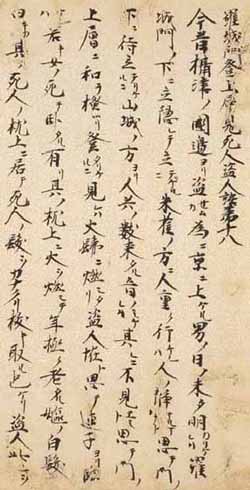
The Suzuka manuscript of the Konjaku monogatari shū: the tale of a thief who climbs the Rajōmon and finds an old woman pulling hair from a corpse.Kyoto University Library, Suzuka manuscript of the Konjaku monogatarishū (early manuscript)
He also wrote stories about Japan’s Christians of the sixteenth and seventeenth centuries, some in a mock-archaic style imitating Jesuit-era translations, and stories set in the Westernizing Tokyo of the 1880s, such as "The Ball," about an evening at the Rokumeikan. "Tangerines" ("Mikan," 1919) runs only a few pages. The narrator, irritated by a grubby country girl in his train compartment, watches her open the window at a level crossing and toss a handful of tangerines to the little brothers who have come to see her off. It is one of the rare moments of plain warmth in his work.
For the children’s magazine Akai tori (Red Bird) he wrote "The Spider’s Thread" (1918), in which the Buddha lowers a spider’s thread into hell to rescue the robber Kandata, who once spared a spider’s life. As other sinners climb up behind him, Kandata shouts that the thread is his, and it snaps. "Tu Tze-chun" ("Toshishun," 1920) reworks a Tang-dynasty Chinese tale but changes its ending: the young man still breaks his vow of silence, but now because he sees his mother, reborn as a horse, beaten before him and cannot help calling out to her, and he gladly gives up immortality to live as an ordinary man. Both stories are staples of Japanese school reading.
"In a Grove" ("Yabu no naka," 1922) is the story most foreign readers know, even if they don’t know it by name. A samurai lies dead in a bamboo thicket near Yamashina. The story consists only of seven statements: a woodcutter who found the body, a traveling monk, a constable, the dead man’s mother-in-law, then the confession of the bandit Tajōmaru, the confession of the samurai’s wife at Kiyomizu temple, and finally the dead man himself, speaking through a medium. Three people each claim to be the killer. Akutagawa never says who is telling the truth.
In 1950 Kurosawa Akira combined the plot of "In a Grove" with the ruined gate and pouring rain of "Rashōmon" and released the film Rashomon. It won the Golden Lion at the Venice Film Festival in 1951, the first time a Japanese film had taken the top prize at a major international festival, and it opened Western eyes to Japanese cinema. The "Rashomon effect" that lawyers and psychologists talk about today comes from the grove, not the gate.
05A "Vague Unease"
In 1921 the Osaka Mainichi sent Akutagawa to China, where he traveled from Shanghai through Hangzhou, Suzhou, Nanjing and Hankou to Beijing and wrote travel sketches. He came home ill, and stomach trouble, insomnia and nervous exhaustion followed him for the rest of his life. He had lived since 1914 in Tabata, in northern Tokyo, a neighborhood that had drawn so many writers and painters it became known as the Tabata writers’ village.
His late work turned inward. Kappa (1927) is narrated by a mental patient who claims to have visited a land of kappa, the water imps of Japanese folklore, and uses their society to satirize family, capitalism, religion and art; the anniversary of his death is still called Kappa-ki, Kappa Day. That year he also argued in print with Tanizaki Jun’ichirō over whether a novel needed a strong plot, Akutagawa defending fiction "without a story-like story." The posthumous "Spinning Gears" ("Haguruma") and "The Life of a Stupid Man" ("Aru ahō no isshō") are fragmented, nearly autobiographical, haunted by visions of turning cogwheels and by dread of his mother’s madness.
On July 24, 1927, at his home in Tabata, Akutagawa took an overdose of sleeping medication and died. He was 35. In a note to a friend he wrote that his motive was a "vague unease" about the future, a phrase later read as the mood of an entire generation of intellectuals at the end of the Taishō era.
06The Prize and the Legacy
In 1935 his friend Kikuchi Kan, by then the founder of the publishing house Bungei Shunjū, created two literary prizes: the Akutagawa Prize for serious literary fiction by new writers and the Naoki Prize for popular fiction. Both are awarded twice a year, in January and July, and the announcements make national news. Dazai Osamu, who idolized Akutagawa, wanted the prize desperately and publicly attacked the judge Kawabata Yasunari when he did not get it. Ōe Kenzaburō won it; Murakami Haruki, nominated twice, did not. In 2015 the comedian Matayoshi Naoki won with a novella about a struggling comic, and his book sold millions of copies.
Akutagawa is also the best-traveled of Japan’s early modern writers. The Chinese writer Lu Xun translated "The Nose" and "Rashōmon" in the early 1920s, and English readers have a fine Penguin selection, Rashōmon and Seventeen Other Stories, translated by Jay Rubin with an introduction by Murakami Haruki.
In Japan his stories are easy to find in slim paperback editions, the pocket-sized bunko books sold for a few hundred yen (as of 2026) in every bookstore. Because the stories are short and the sentences clear, they are a natural first step for learners moving from textbooks to real Japanese literature.
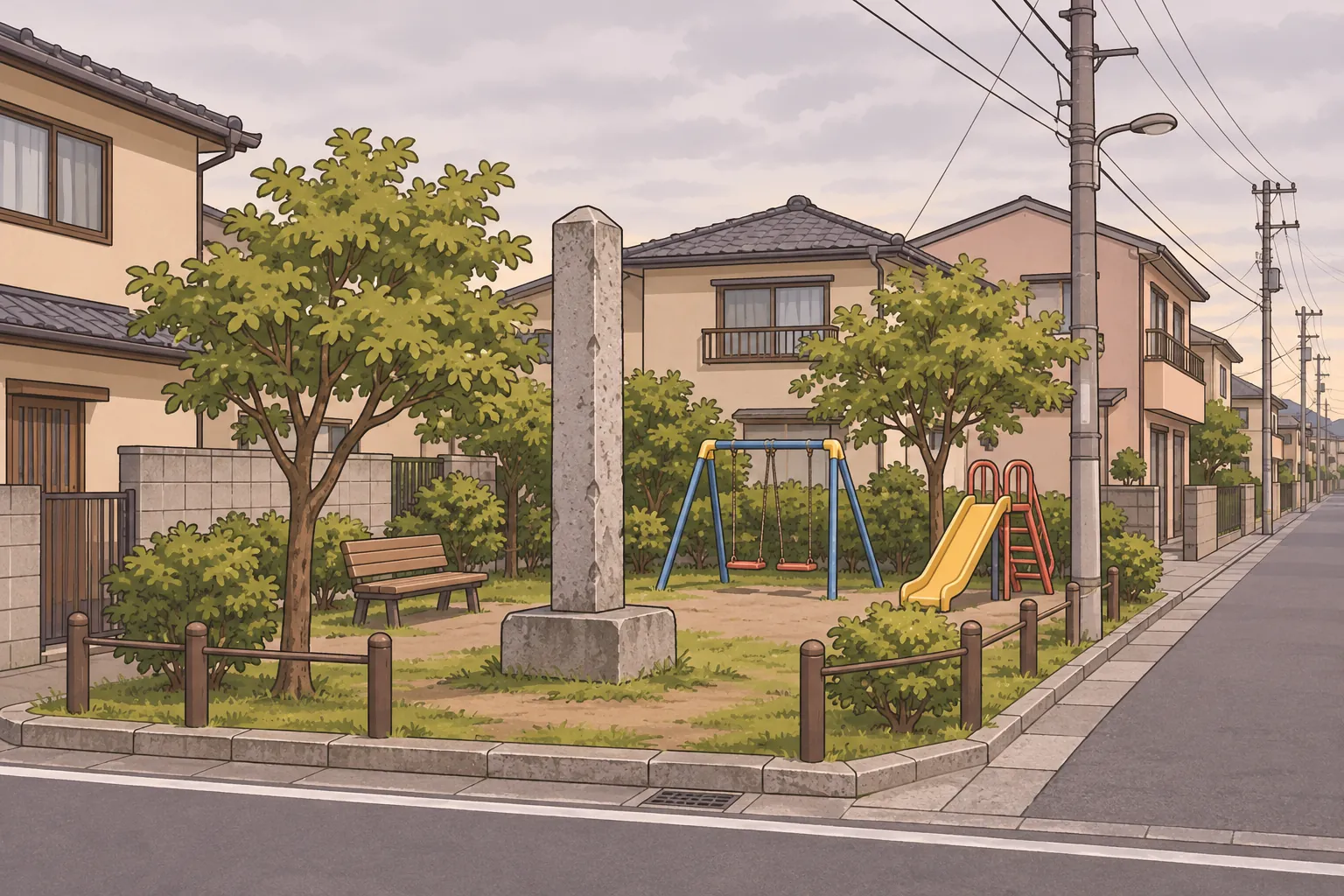
The Rashōmon site in Kyoto: a small green patch at a residential corner with a slender stone marker (illustration).
For a pilgrimage, walk from Tō-ji in Kyoto to the Rajōmon marker and stand where the servant waited out the rain. In Tokyo, the Tabata Memorial Museum of Writers and Artists in Kita Ward tells the story of Akutagawa and his neighbors. His grave is at Jigen-ji, a temple in Sugamo, and every year around July 24 readers still leave flowers there.