
At a glance
How Fujiwara no Teika’s hundred-poem anthology became Japan’s New Year card game, with key poems, competitive karuta tactics and proverb cards explained.
- The Ogura Hyakunin Isshu gathers one poem each by a hundred poets, selected by Fujiwara no Teika in the early thirteenth century.
- According to his diary Meigetsuki, in 1235 Teika chose poems to be written on paper squares for the sliding doors of Utsunomiya Yoritsuna’s villa at Saga.
- Love poems are the largest group; among the seasons autumn has sixteen, spring and winter six each, summer four.
- A set has 200 cards: reading cards with the poet’s portrait and full poem, and grabbing cards with only the lower verse in hiragana.
- Kuroiwa Ruikō held the first competitive tournament in 1904; each January the Meijin and Queen titles are decided at Ōmi Shrine.
Every January, in living rooms and school gyms across Japan, someone reads out the opening of a thousand-year-old poem and everyone else lunges at a spread of cards on the floor. The poems come from the Ogura hyakunin isshu, an anthology of one hundred classical poems by one hundred poets, chosen in the thirteenth century. The game is karuta. At its most relaxed it is a family pastime; at its most intense it is a competitive sport in which players hit the right card after hearing a single syllable. This is an introduction to the anthology, the poems worth knowing, how the poems became a card game, and the simpler proverb cards Japanese children play with alongside it.
01One Hundred Poets, One Poem Each
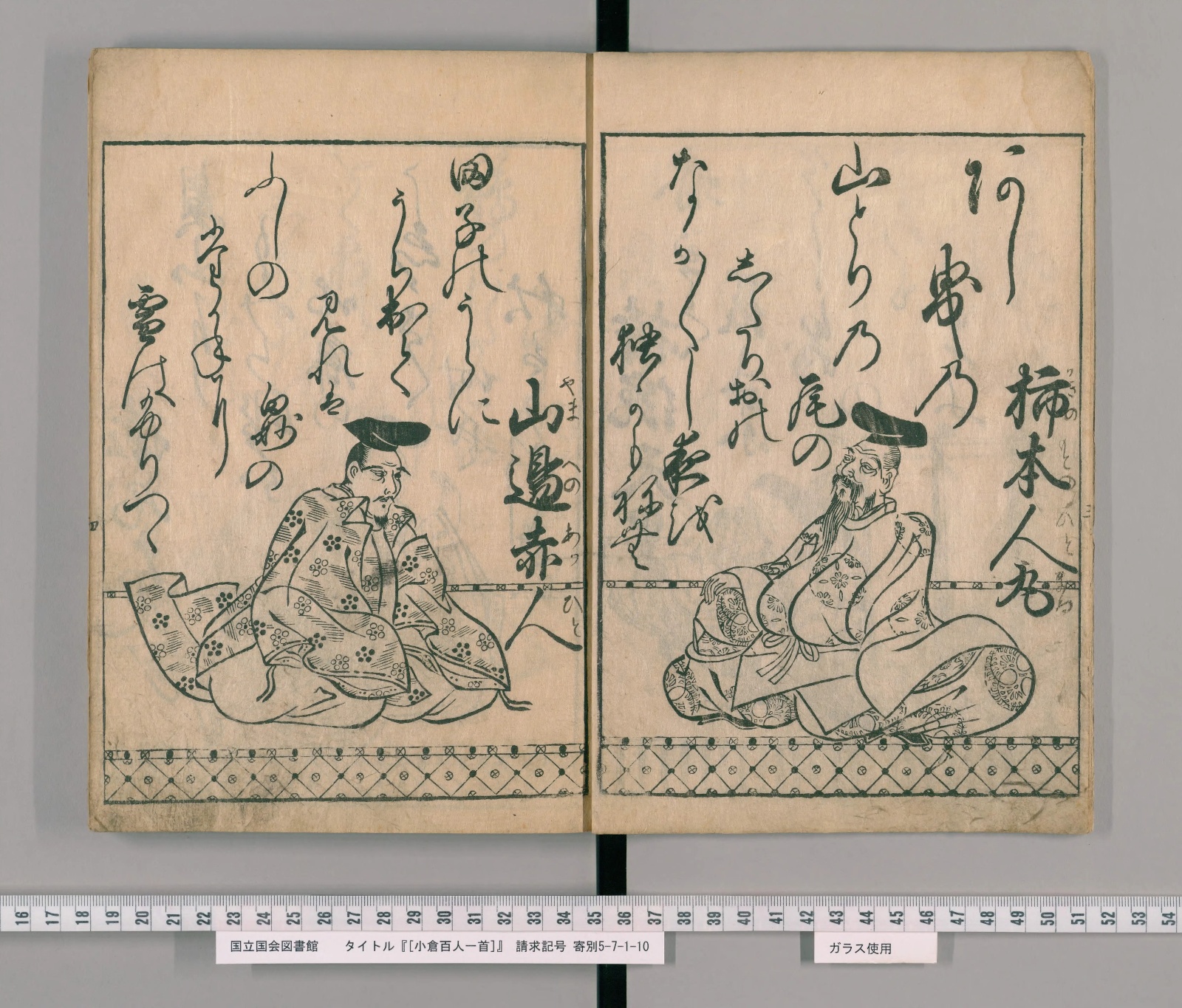
Hyakunin isshu means, quite literally, "one hundred people, one poem each." The poems are all waka, the classical Japanese verse form of thirty-one syllables arranged in five lines of 5-7-5-7-7. The first three lines are called the kami no ku, the upper verse; the last two are the shimo no ku, the lower verse. That division matters a great deal once the cards come out.
The collection runs roughly in chronological order. Poem 1 is by Emperor Tenji, who reigned in the seventh century; poem 2 is by his daughter, Empress Jitō. The last two are by the retired emperors Go-Toba and Juntoku, who lived into the thirteenth century. In between are some six hundred years of court poetry: aristocrats, Buddhist monks, ladies-in-waiting, guards officers. Many names that a reader of Japanese literature will recognize are here, including Ariwara no Narihira, Ono no Komachi, Ki no Tsurayuki, Izumi Shikibu, and the two great prose writers of the Heian court, Murasaki Shikibu, author of The Tale of Genji, and Sei Shōnagon, author of The Pillow Book.
Love dominates. Forty-three of the hundred poems are love poems, usually about waiting for someone who does not come, or longing for someone who cannot be seen. Among the seasons autumn leads with sixteen poems, against six each for spring and winter and four for summer; the rest are poems of travel, parting, and miscellaneous topics. The proportions tell you what Heian aristocrats cared about in verse: absence, the long nights of autumn, the moon behind clouds, maple leaves on a river.
- 43Love
- 16Autumn
- 6Spring
- 6Winter
- 4Summer
- 25Travel, parting, miscellaneous
One square per poem. Love leads; among the seasons, autumn.
02Teika and the Villa at Ogura
The anthology is credited to Fujiwara no Teika (1162–1241), the most authoritative poet and critic of his age and one of the compilers of the imperial anthology Shin Kokinshū. According to his diary, Meigetsuki, in 1235 he was asked by Utsunomiya Yoritsuna, a warrior from eastern Japan who had taken Buddhist vows, to select poems by poets of the past, one each, to be written on decorative paper squares and pasted onto the sliding doors of Yoritsuna’s villa at Saga, west of Kyoto. The two men were related by marriage: Yoritsuna’s daughter was the wife of Teika’s son Tameie.
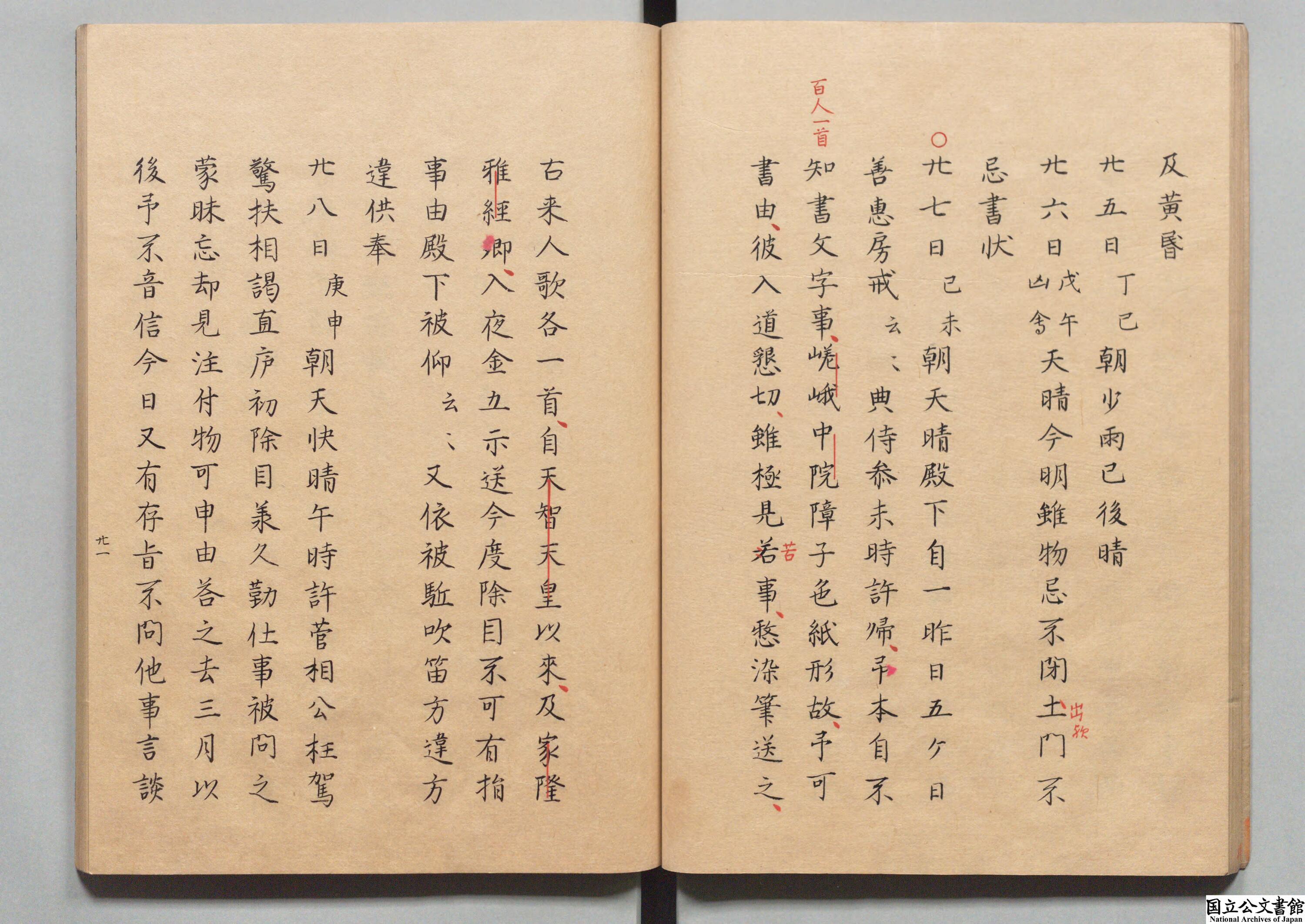
A later copy of Meigetsuki: the entry for the 27th day of the 5th month of 1235, on writing one poem each by poets of the past for the Saga villa’s door panels.National Archives of Japan, Meigetsuki (later copy, 105-0002-0014)
The villa stood near Mount Ogura, a low wooded hill above the Ōi River at Arashiyama, long famous for its autumn maples. The anthology takes its name from the mountain. Scholars generally think the hundred poems we know grew out of that commission, but the details are tangled. A closely related selection called the Hyakunin shūka survives with a slightly different list and order, and it lacks Go-Toba and Juntoku. Both emperors had been exiled after their failed rising against the Kamakura shogunate in 1221, which made them awkward names to display in a warrior’s house in the 1230s. Many scholars suspect their poems were added later, possibly by Tameie, and which version came first is still argued over.
Readers have long noticed that Teika did not always pick a poet’s most celebrated poem. One explanation is that he chose to his own taste, which favored poems with lingering overtones and layered images, poems that leave something unsaid. He included one of his own, poem 97:
Konu hito o / matsuho no ura no / yūnagi ni / yaku ya moshio no / mi mo kogaretsutsu
"Waiting for one who does not come, on the shore at Matsuho in the evening calm, I burn like the seaweed they burn for salt, my whole body smoldering." The word matsu is both part of the place name Matsuho and the verb "to wait." That kind of double meaning, called kakekotoba or pivot word, is everywhere in the collection.
03A Few Poems Worth Knowing
Poem 1, by Emperor Tenji, opens the collection in the voice of a farmer guarding the autumn harvest:
Aki no ta no / kariho no io no / toma o arami / waga koromode wa / tsuyu ni nuretsutsu
"In the autumn fields, the thatch of the temporary hut is coarse, and my sleeves are wet with dew." Later readers took it as an emperor sharing the hardships of his people, which helps explain why it stands first.
Poem 9, by Ono no Komachi, the court poet whose name became a byword for beauty:
Hana no iro wa / utsurinikeri na / itazura ni / waga mi yo ni furu / nagame seshi ma ni
"The color of the flowers has faded, while I spent my days in idle gazing, as the long rains fell." Furu means both "to pass time" and "to fall" (of rain); nagame means both "gazing" and "long rain." The cherry blossoms fade in the spring rain, and so does she.
Poem 17, by Ariwara no Narihira, was written on a painted screen showing autumn leaves on the Tatsuta River:
Chihayaburu / kamiyo mo kikazu / Tatsutagawa / karakurenai ni / mizu kukuru to wa
"Unheard of even in the age of the gods: the Tatsuta River tie-dyeing its waters deep crimson." The leaves floating on the current look to him like dyed cloth. Chihayaburu is a makurakotoba, a fixed epithet attached to the word for gods, with little meaning of its own. It is also the title of the manga that made competitive karuta fashionable, of which more below.
Poem 33, by Ki no Tomonori, is perhaps the most quoted cherry-blossom poem in Japanese:
Hisakata no / hikari nodokeki / haru no hi ni / shizugokoro naku / hana no chiruramu
"On a spring day of such gentle light, why do the blossoms scatter with such restless hearts?"
Most Japanese people can recite at least a few of these. The anthology appears in middle-school Japanese textbooks, and many schools hold karuta tournaments in winter, so memorizing poems and slapping cards are bound together in people’s school memories.
04From Poetry to Playing Cards
The cards themselves came from abroad. Portuguese traders brought playing cards to Japan in the sixteenth century, and the Japanese word karuta comes from the Portuguese carta. Japan already had an aristocratic matching game, kaiōi (later usually called kaiawase), in which clam shells painted with matching pictures, or with the two halves of a poem, were paired up. By the Edo period (1603–1868) the two ideas had merged into uta-garuta, poem cards, and the Hyakunin isshu became their standard content.
A set has two hundred cards. The hundred yomifuda, or reading cards, carry a portrait of the poet and the full poem. The hundred torifuda, or grabbing cards, carry only the lower verse, written entirely in the hiragana syllabary, with no picture. One person reads out a poem from the reading cards; everyone else searches the grabbing cards laid out on the floor for its second half and tries to touch it first. To be quick, you need to know the poems well enough that hearing the start tells you which ending to look for.
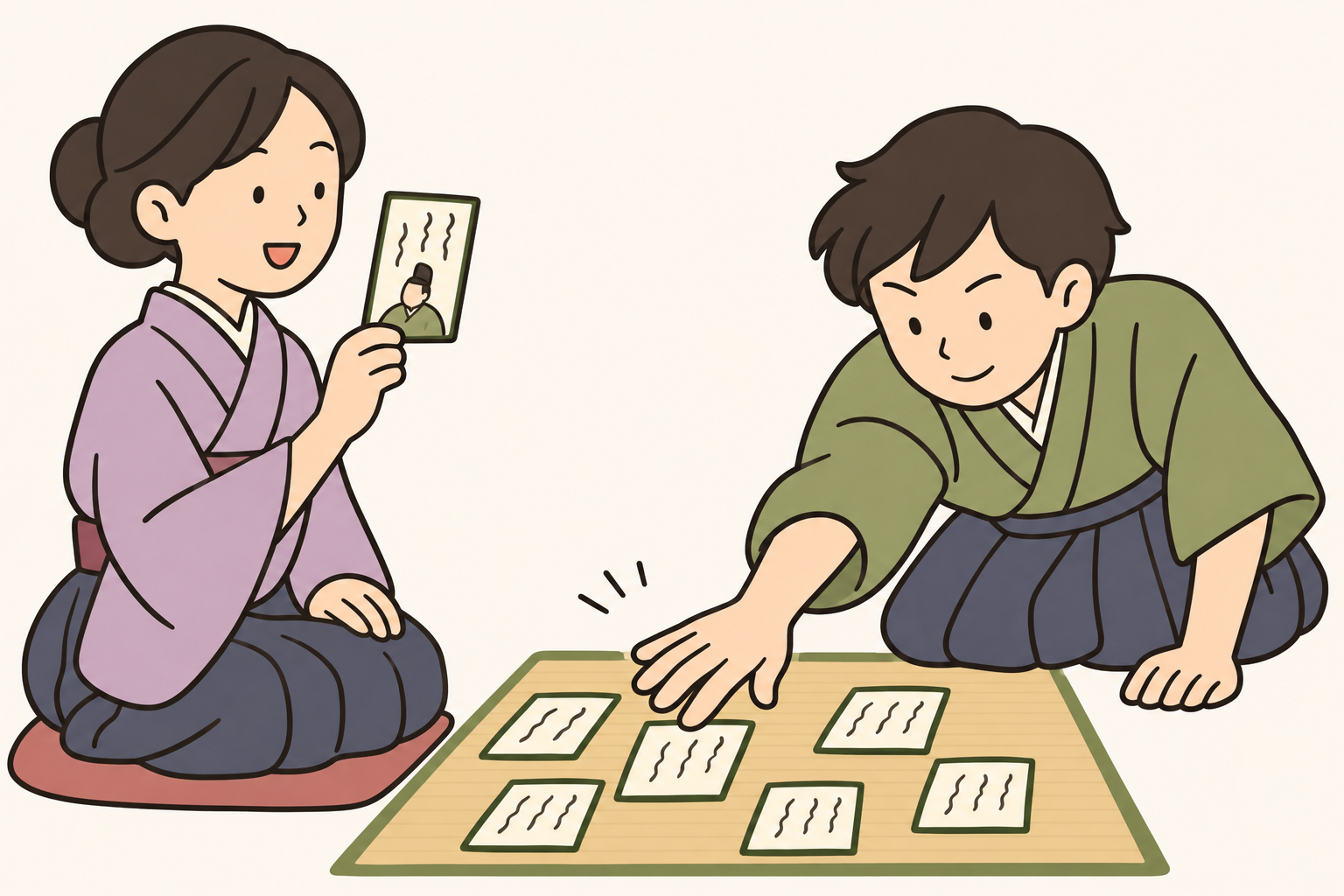
The reader recites from a reading card; the others look for the matching lower verse among the grabbing cards, and the first to touch it wins it (cards simplified).
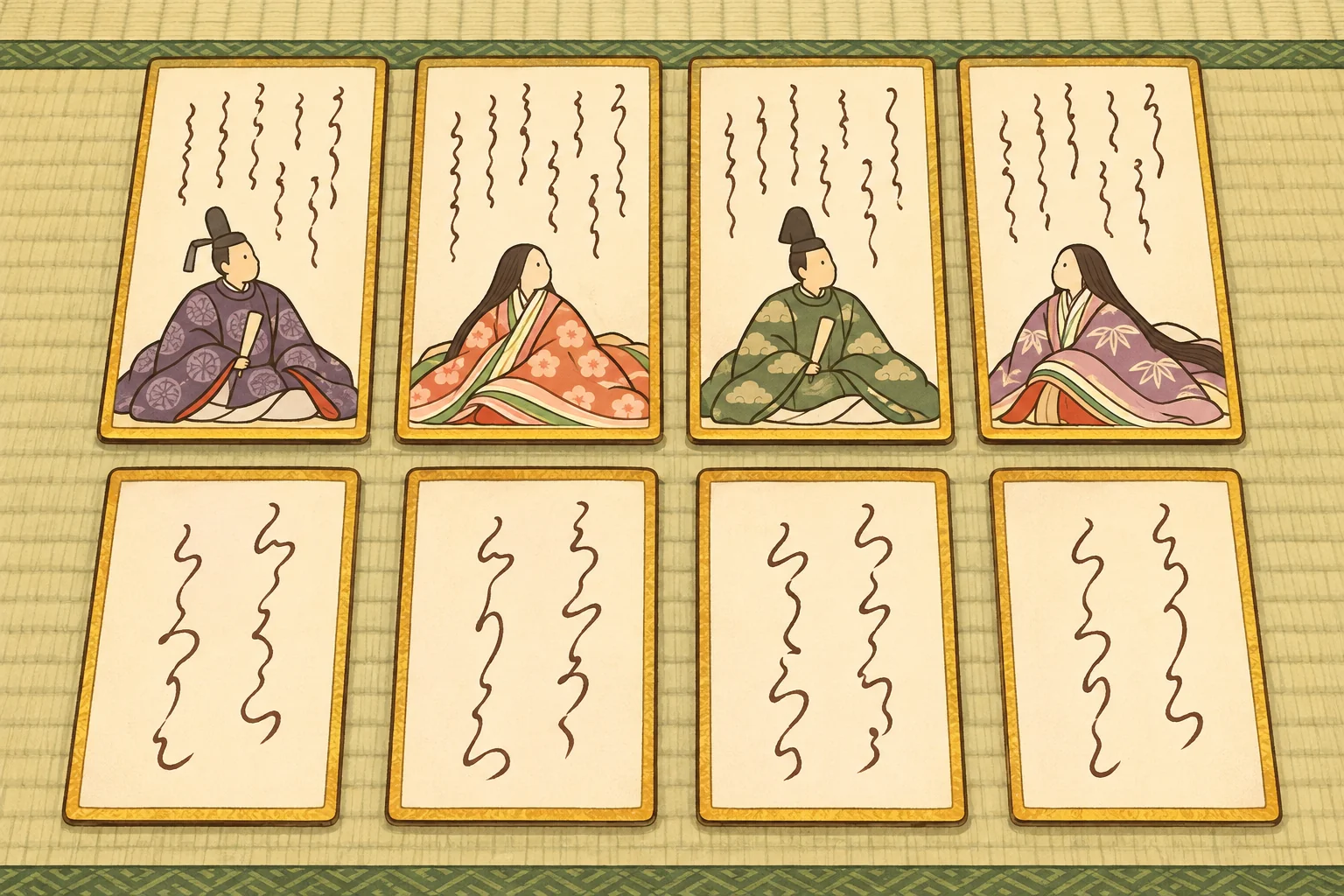
Hyakunin Isshu cards on tatami: reading cards with poets' portraits above, kana-only grabbing cards below (illustration).
In the Edo period karuta became a New Year pastime for well-off townspeople and women of samurai households, and a way for girls to learn poetry and the kana script. At home today people play several versions. In chirashi-dori all the cards are scattered and everyone grabs. In genpei gassen, named for the Genpei War of the twelfth century, two teams each lay out fifty cards. And in bōzu mekuri, which needs no knowledge of poetry at all, players draw reading cards from a face-down pile and look only at the portraits: draw a monk (bōzu) and you lose your whole hand; draw a princess and you take everything on the table. Small children love it.
Nintendo began in Kyoto in 1889 as a maker of hanafuda flower cards, and it has also made Hyakunin isshu sets.
05Competitive Karuta: Hearing One Sound and Moving
The family game became a sport in the Meiji era, largely through the journalist Kuroiwa Ruikō. In 1904 he founded the Tokyo Karuta Society and held the first competitive tournament at Nihonbashi in Tokyo, with unified rules and a standardized set of grabbing cards written entirely in hiragana. Today competitive karuta, kyōgi karuta, is governed by the All Japan Karuta Association, founded in 1948.
A match is one against one. Fifty of the hundred grabbing cards are drawn at random, and each player takes twenty-five and arranges them in three rows in front of them, a territory they can lay out however they like. The other fifty cards are "dead cards": they will be read, but they are not on the floor. Players get fifteen minutes to memorize the positions of all fifty live cards on both sides. The reader begins with a poem that is not part of the hundred, the joka or introductory poem, "Naniwazu ni / saku ya kono hana," and then reads the poems one by one in random order. If you take a card from your opponent’s side, you pass one of your own cards across to them. The first player to clear their own territory wins. Touching the wrong card, or touching a live card when a dead card is read, is a fault, and your opponent sends you a card as a penalty.
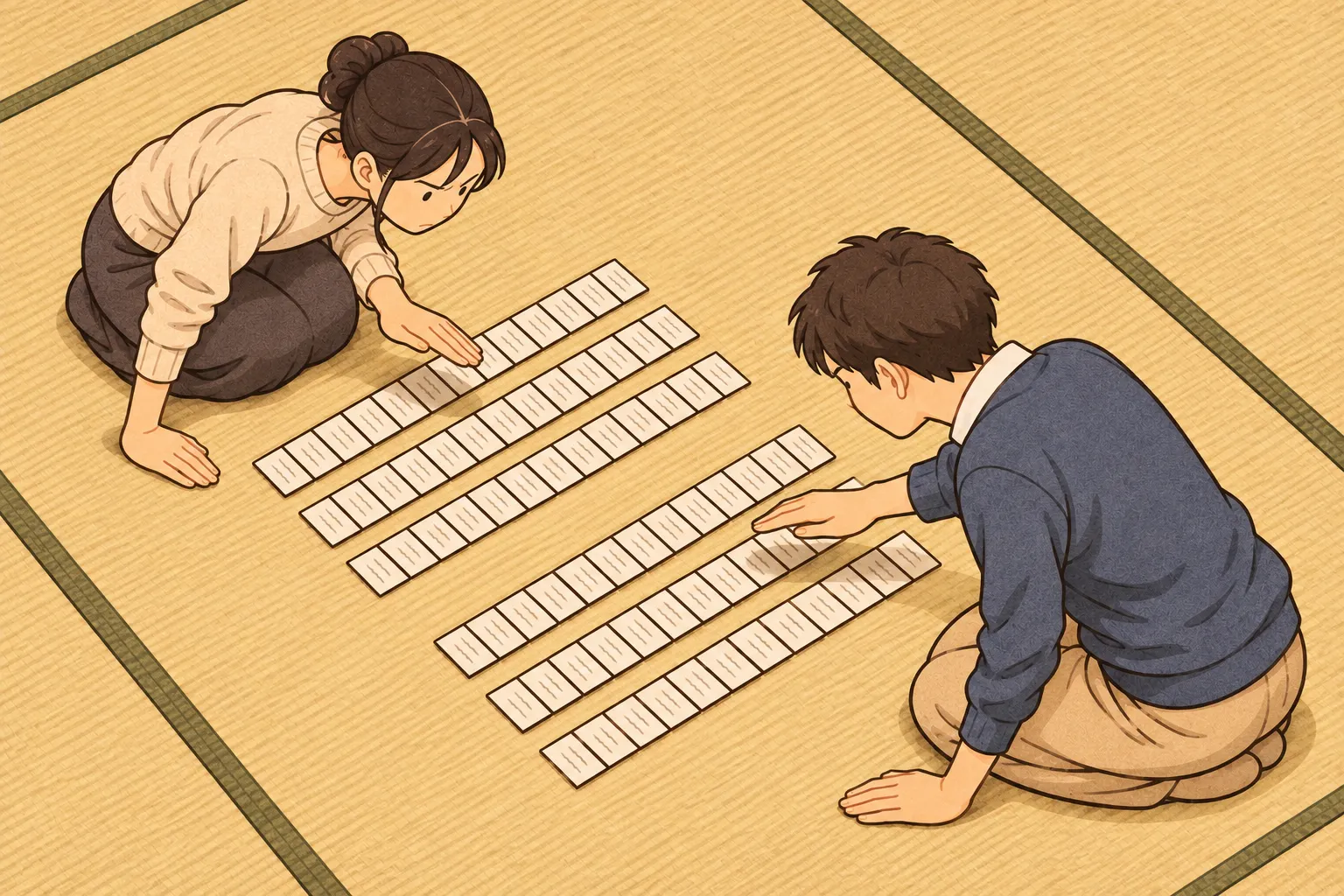
In competitive karuta, each of the two players lays out twenty-five cards in three rows in front of them.
- 25One player, 25 cards
- 25The other player, 25 cards
- 50Dead cards, 50
Half the grabbing cards are on the floor, 25 per player; the other half are dead cards, read aloud but not in play.
How can a strong player move after one sound? The answer is the kimariji, the "deciding syllables." Some poems have an opening found nowhere else in the hundred. Exactly one poem each begins with mu, su, me, fu, sa, ho, and se, and players learn them as a single nonsense word, musumefusahose. The instant the reader voices one of those syllables, the card is determined. Other poems need two or three syllables to identify, and the longest need six. Two poems, for example, both open with asaborake, and you cannot tell them apart until the next sound. The real difficulty is that kimariji change during a match. Once one of a group of poems with the same opening has been read, it will not be read again, and the deciding syllables of the others shrink. Players are recalculating the whole deck in their heads as the match goes on.
That is why the sport is often called "a martial art on tatami." Players kneel, lean forward, hands hovering over the rows. Before the reader’s first syllable has finished, a hand sweeps across the cards, often sending the target flying across the room. Reaction times among top players are fractions of a second, and a full match is physically exhausting. Players are ranked from A to E class and hold dan grades, as in judo or go.
Each January the top titles, the Meijin for men and the Queen for women, are decided at Ōmi Jingū, a shrine in Ōtsu, Shiga Prefecture, near Lake Biwa. The location is not arbitrary: the shrine is dedicated to Emperor Tenji, author of poem 1. The matches are broadcast on television and streamed online.
Much of karuta’s recent popularity among teenagers comes from Chihayafuru, a manga by Suetsugu Yuki that began at the end of 2007, about a girl determined to become Queen. Its title comes from the first line of Narihira’s Tatsuta River poem. It was adapted as an anime series and as live-action films starring Hirose Suzu, and high-school karuta clubs saw a surge of new members.
06Iroha Karuta: Proverbs for Children
Memorizing a hundred classical poems is a lot to ask of a five-year-old. From the mid-Edo period on, a simpler game appeared: iroha karuta, which replaces poems with proverbs. Iroha refers to the Iroha-uta, an old poem that uses each of the forty-seven kana syllables exactly once and long served as the Japanese alphabet. An iroha set has one pair of cards for each kana plus one for kyō, making forty-eight. The reading card has a proverb beginning with that syllable; the grabbing card shows a picture illustrating it, with the syllable printed large in the corner.
Play works the same way as with the poems: the reader recites a proverb, and the children hunt for the picture and letter that match. Because the grabbing cards have pictures and big letters, even children who can barely read can play, and they pick up the kana and a stock of proverbs as they go.
The proverbs differ by region. The Edo (Tokyo) version opens with Inu mo arukeba bō ni ataru, "Even a dog that goes out walking runs into a stick," which is why it is sometimes called inubō karuta, the dog-and-stick deck. The Kamigata version from Kyoto and Ōsaka opens with Issun saki wa yami, "One inch ahead is darkness," meaning nobody knows what the future holds. Comparing the two sets has long been a way of comparing the temperaments of east and west. The form also spawned local karuta for particular regions. The best known is Jōmō Karuta in Gunma Prefecture, whose cards celebrate local landmarks and famous people; nearly every child who grows up in Gunma knows it.
07Seeing and Playing It in Japan
To visit the anthology’s home, go to Arashiyama and Saga in western Kyoto. Several places at the foot of Mount Ogura claim to be the site of Teika’s villa, including the area around the temples Jōjakkō-ji and Nison-in. In autumn, when the maples turn, you are walking through the landscape of half the poems in the collection. Near the Togetsukyō Bridge, the Saga Arashiyama Museum of Arts and Culture, which began as Shigureden, a museum devoted to the anthology, has a permanent exhibition on its history as of 2026.
To watch competitive karuta, early January at Ōmi Jingū is the moment, though the title matches are easiest to follow on television or online. Local karuta clubs run tournaments throughout the year, and the atmosphere is striking: a hall full of people in absolute silence, the reader’s voice, and then the crack of a card being swept away.
To play, buy a Hyakunin isshu set; bookshops and toy stores put them out front in the weeks before New Year. You do not need to memorize a hundred poems to start. Begin with bōzu mekuri, then learn the seven one-syllable cards, mu-su-me-fu-sa-ho-se. The next time a reader opens her mouth, you may find your hand already moving.