
At a glance
From his miserable London years to I Am a Cat and Kokoro, how Sōseki wrote people who cannot say what matters most, and where to start reading.
- Born Natsume Kinnosuke in Edo in 1867, Sōseki lived a life that ran alongside the Meiji era.
- From 1900 he spent more than two years in London, then succeeded Lafcadio Hearn teaching English literature at Tokyo Imperial University.
- I Am a Cat made him famous in 1905; in 1907 he quit the university to write novels full time for the Asahi.
- Kokoro, serialized in 1914, is the best-selling title in the Shinchō Bunko paperback line.
- From 1984 to 2004 his portrait was on the 1,000-yen note.
From 1984 until the notes were redesigned in 2004, the face on Japan’s 1,000-yen note belonged to a novelist: a man with a neat mustache, a high collar and a slightly worried look. Natsume Sōseki is the writer nearly every Japanese person meets at school, the author of a comic novel narrated by a cat and of Kokoro, a quiet, devastating book that has sold more copies than almost any other title in Japanese paperback history. He wrote for barely a decade, yet he is the person most often credited with showing what a modern Japanese novel could be. If you want one writer who explains how Japan felt as it raced from samurai rule into the twentieth century, he is the place to start.
01A Meiji Life
Sōseki was born Natsume Kinnosuke in 1867 in Edo, the city that would be renamed Tokyo the following year. His life ran almost exactly alongside the Meiji era (1868–1912), the period when Japan abolished the samurai class, built railways and a constitution, and sent its brightest students abroad to learn from the West. He was the youngest child of an aging family and was handed over as an infant to foster parents, returning to his birth family only as a boy, when his foster parents divorced; his name was not formally restored to the Natsume family register until 1888, when he was 21. The sense of being unwanted, and of money and obligation tangled up with family love, never left his fiction.
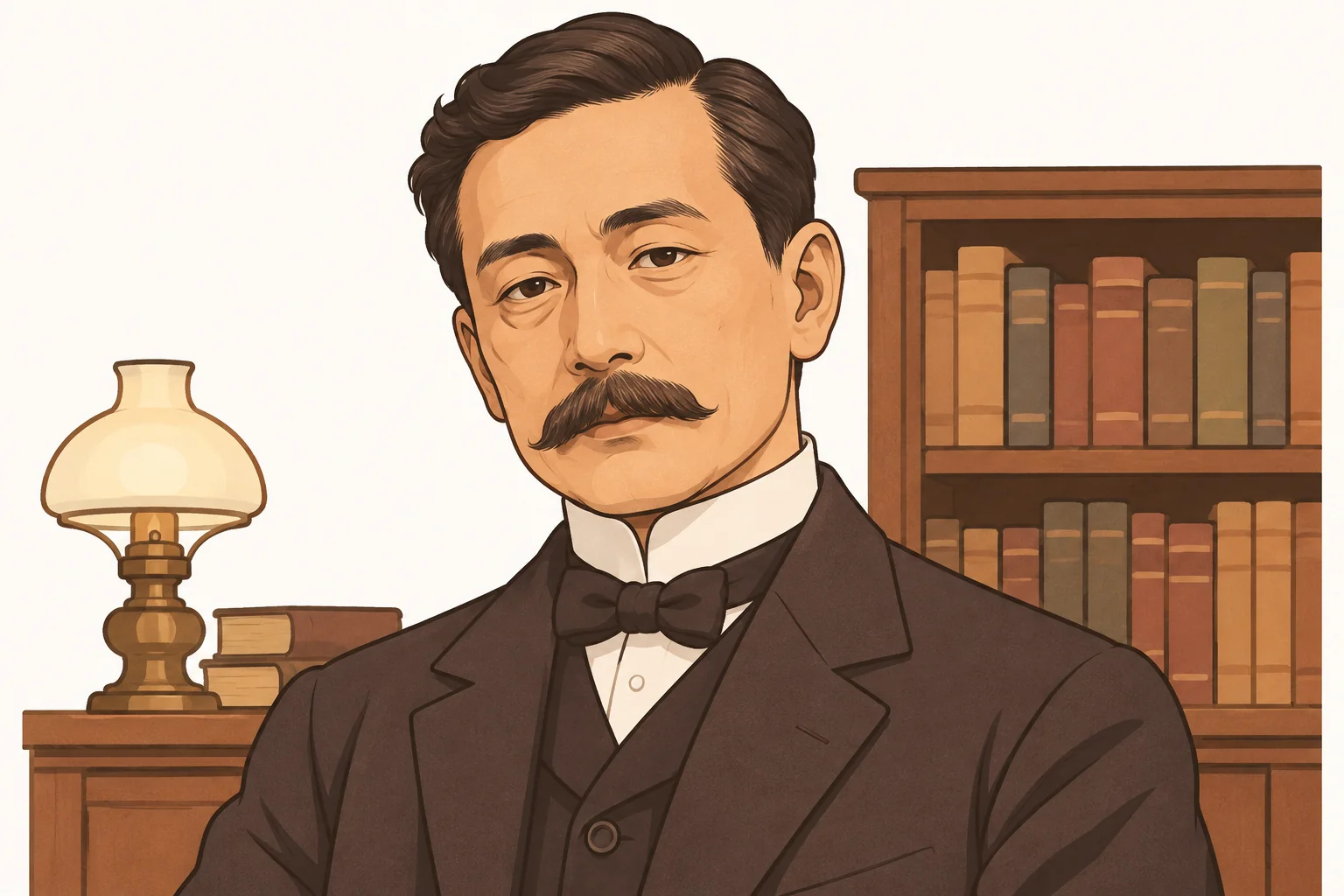
A late-Meiji gentleman in high collar and necktie, with a moustache and parted hair (illustration).
As a teenager he studied Chinese classics and wrote Chinese poetry well; he kept writing it all his life. His pen name comes from a Chinese anecdote about a man who meant to say he wanted to "pillow his head on stones and rinse his mouth in the stream," got the words backwards, and then stubbornly insisted that rinsing with stones cleans the teeth. "Sōseki," rinsing with stones, is a joke about obstinacy, and he chose it for himself.
He switched to English, and in the university preparatory school became close friends with Masaoka Shiki, the poet who would remake haiku for the modern age. Under Shiki’s influence Sōseki wrote haiku too, some 2,600 of them. In 1890 he entered the English literature course at the Imperial University (later Tokyo Imperial University). After graduating he taught English at a middle school in Matsuyama, on the island of Shikoku, and then at a higher school in Kumamoto in Kyūshū.
In 1900 the Ministry of Education sent him to Britain. The two years he spent in London were miserable. His stipend was small, he moved between cheap lodgings, and he shut himself up with books, trying to answer a question no one around him cared about: what is literature, and can a man raised on Chinese classics ever truly judge English writing? He grew so withdrawn that rumors reached Tokyo that he had gone mad. Back in Japan in 1903, he succeeded Lafcadio Hearn as lecturer in English literature at Tokyo Imperial University. His lectures, later published as Theory of Literature, tried to define literature scientifically, using psychology and sociology. Few people read it now, but the struggle behind it shaped everything he wrote afterwards.
02I Am a Cat: Humanity Seen from the Veranda
Sōseki came home depressed. His friend Takahama Kyoshi, who ran Hototogisu, the haiku magazine that had been founded around Shiki, suggested he write something for fun. The result appeared in January 1905 and opened with one of the most famous sentences in Japanese:
「吾輩は猫である。名前はまだ無い。」 (Wagahai wa neko de aru. Namae wa mada nai. "I am a cat. As yet I have no name.")
The joke is in the first word. Wagahai is a pompous, old-fashioned "I," the kind of pronoun a self-important Meiji gentleman might use. Here it comes from a stray kitten who was nearly thrown out on the day he arrived. He lives in the house of Kushami, a schoolteacher of English with a bad stomach, a habit of falling asleep over books, and a high opinion of himself. Readers have always recognized Sōseki in him.
The cat watches Kushami’s friends drop by to smoke and argue: Meitei, an aesthete who invents stories for the pleasure of fooling people; Kangetsu, a young scientist working on a paper about the physics of hanging; and the vulgar rich family next door, the Kanedas, who want to marry their daughter well. Nothing much happens. People talk about Western philosophy, marriage, suicide and the future of civilization, and do nothing at all.
- 1
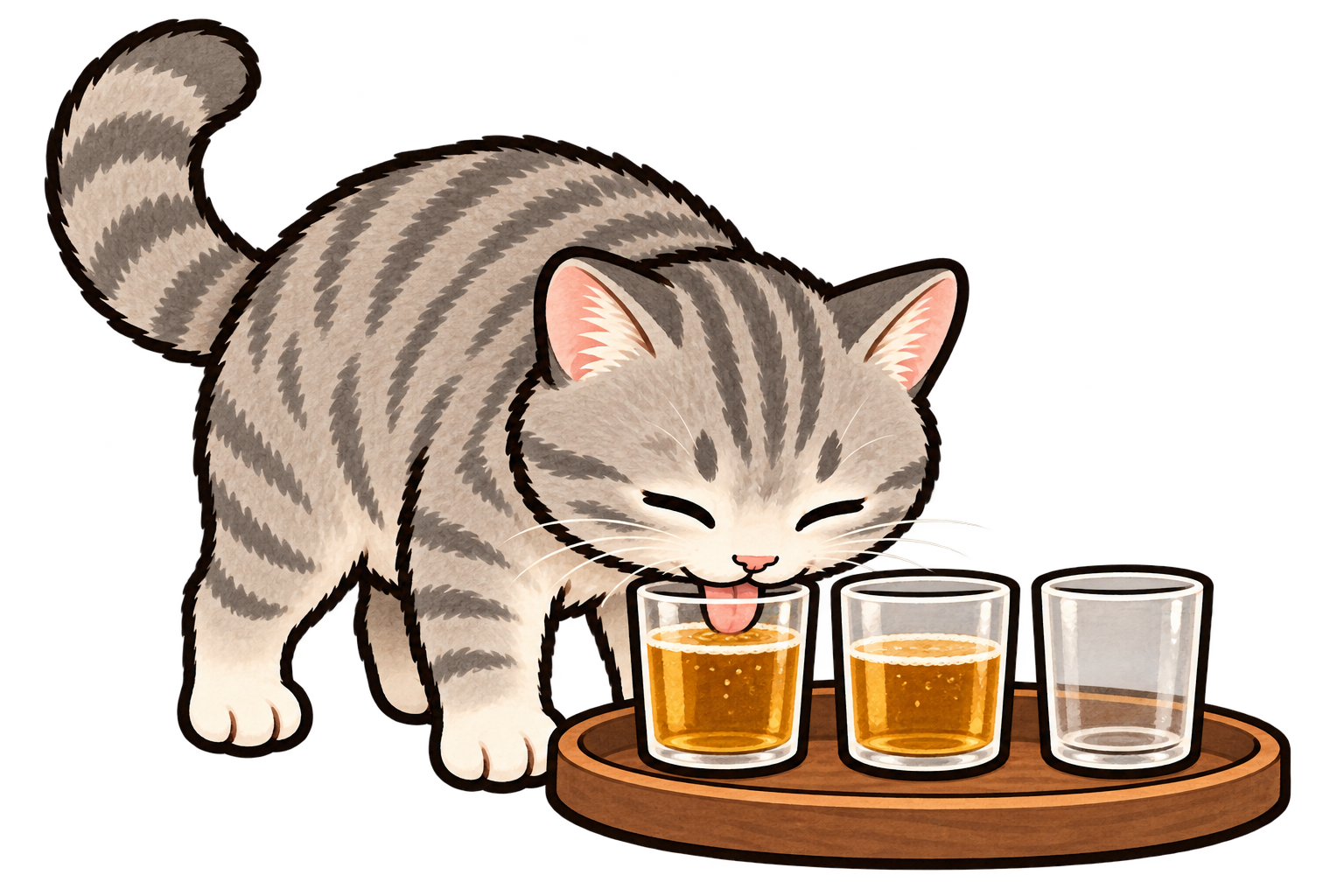 After the guests leave, the cat laps up their leftover beer.
- 2
 Drunk, it staggers.
- 3
 It falls into a water jar, cannot climb out, and drowns with a Buddhist prayer, still nameless.
The piece was meant as a one-off, but readers loved it, and Sōseki kept going until 1906, producing a long, loose novel in eleven chapters. Its pleasure is entirely in the point of view. The cat sees how absurd humans are: the hours spent on pointless debates, the polite lies, the husband who acts like a lord and is afraid of his wife. But the cat is no sage either. He fails to catch a mouse, gets rice cake stuck in his teeth, and sneaks into the Kanedas’ house to eavesdrop, and at home the whole household chases him around. The tone owes something to rakugo, Japan’s tradition of comic storytelling, and something to Laurence Sterne, whom Sōseki admired, but the worries underneath belong to educated men of the Meiji era, unsure what all their Western learning was for.
The ending turns the laughter cold. The cat laps up beer left over from a party, staggers, and falls into a water jar. Unable to climb out, he gives up, murmurs a Buddhist prayer, and drowns, still without a name. It is a good introduction to Sōseki’s way of working: comedy for a long time, then a sudden drop.
03Becoming a Novelist
I Am a Cat made him famous, and the next two years poured out of him. Botchan (1906), whose title means something like "young master," is the story of a hot-headed, honest Tokyo boy who takes a teaching job in a provincial town, clashes with a smooth deputy head called "Red Shirt," and leaves after a satisfying fistfight. It drew on Sōseki’s time in Matsuyama, and is still one of the most-read novels in Japan, short, funny and easy to love. Kusamakura (1906, translated as The Three-Cornered World and Kusamakura) follows a painter on a walking trip to a hot-spring village, thinking about art that stands apart from human feeling; its opening lines, about how reason makes you abrasive and emotion sweeps you away, are among the most quoted in Japanese, and many Japanese are said to know them by heart.
In 1907 Sōseki did something astonishing for the time. He resigned from the Imperial University and joined the Asahi Shimbun newspaper as its staff novelist. Giving up one of the most prestigious posts in the country to write serials for a daily paper looked eccentric, but it gave him a salary, a huge audience, and a rhythm: every one of his later novels first appeared in daily installments, each a few pages long, with the characters’ situations tightening by degrees.
The novels of the next few years are often grouped as a trilogy. Sanshirō (1908) follows a young man from Kumamoto through his first year at university in Tokyo: the train journey, the campus, new friends, and a sophisticated young woman, Mineko, whom he never manages to speak to honestly. It is often called the classic Japanese novel of student life, and some call it Japan’s first. In And Then (Sorekara, 1909), Daisuke lives comfortably on his father’s money until he admits he loves his friend’s wife; by the end he has lost his family’s support and the whole city seems to blaze red before his eyes. The Gate (Mon, 1910) shows a couple some years after just such a scandal, living quietly, devoted to each other and haunted by guilt. The husband goes to a Zen temple hoping for release, and stands before the gate without it opening.
In the summer of 1910, convalescing at the hot-spring town of Shuzenji on the Izu Peninsula, Sōseki vomited a great deal of blood and briefly lost consciousness. The episode, remembered as the "great illness at Shuzenji," marked a turn. The novels that followed grew darker and more inward.
04Kokoro: A Letter That Rewrites Everything Before It
Kokoro, serialized in the Asahi in 1914, is the Sōseki novel Japanese readers return to most. The title means "heart" in the widest sense: mind, feeling, spirit. It has three parts: "Sensei and I," "My Parents and I," and "Sensei’s Testament."
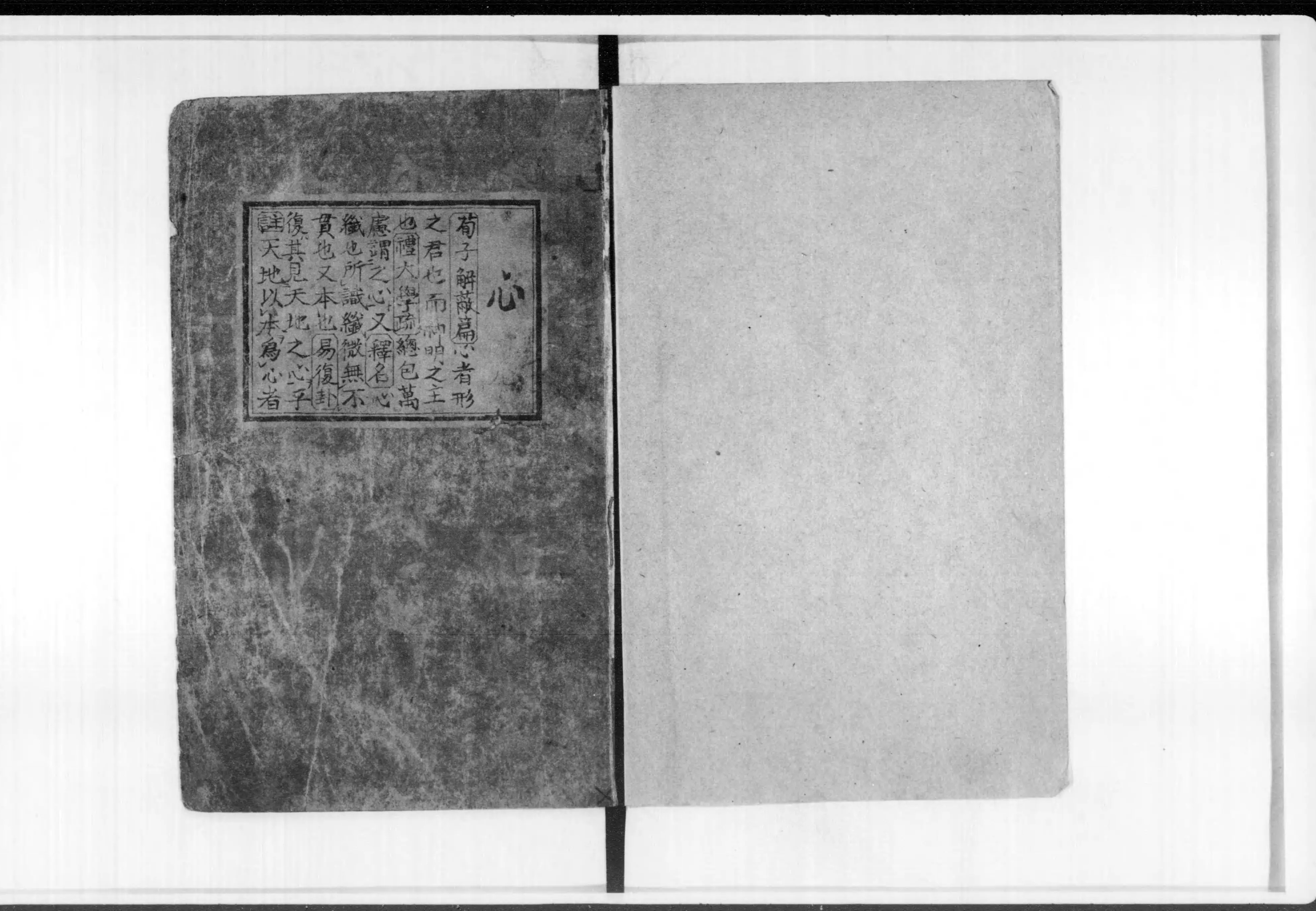
The outer cover of Kokoro as published by Iwanami Shoten in 1914.National Diet Library, Natsume Sōseki, Kokoro (Iwanami Shoten, 1914)
The first two parts are narrated by a young student. On the beach at Kamakura he notices an older man and attaches himself to him, calling him Sensei, a respectful word for teacher. Sensei has no job and lives quietly with his wife in Tokyo. Every month he visits a grave at Zōshigaya cemetery alone and will not say whose it is. He tells the student strange things: that love is a sin, that ordinary people turn bad at the decisive moment, that he cannot trust even himself. The student senses a secret but cannot reach it.
In the second part the student goes home to the countryside, where his father is dying. The Meiji emperor dies in the summer of 1912, and soon afterwards General Nogi Maresuke and his wife kill themselves on the day of the imperial funeral, following their lord in death. Then a thick envelope arrives from Sensei. Leafing to the end, the student reads a line saying that by the time this letter arrives, its writer will probably be dead. He leaves his father’s bedside and boards the train for Tokyo.
- 1Sensei and Ithe student meets Sensei at Kamakura
- 2My Parents and Ithe student at his father’s bedside; the letter arrives
- 3Sensei’s Testamentthe letter itself, a little over half the book
The third part is Sensei’s letter, a little over half the book, and it changes the meaning of every earlier scene.
The third part is the letter itself, a little over half the book. As a young man, Sensei was cheated of his inheritance by an uncle, and stopped trusting people. In Tokyo he lodged with a widow and fell in love with her daughter. He invited his friend K, a poor, fiercely ascetic student who despised all desire, to share the lodgings. K fell in love with the daughter too and confided in Sensei. Sensei said nothing of his own feelings; instead he went behind K’s back and asked the widow for her daughter’s hand. A few days later K killed himself in the next room. His suicide note blamed no one. Sensei married the daughter and lived with the secret for years, never telling his wife. When the Meiji era ended with the emperor’s death and Nogi’s suicide, Sensei decided that he too would die with "the spirit of Meiji."
What makes Kokoro unforgettable is its structure. For the first half of the book you stand outside a closed door, like the student, looking at a man who is kind, cool and puzzling. The letter opens the door, and every earlier scene changes meaning: the monthly grave visits, the tenderness and distance towards his wife, the remark that love is a sin, even why Sensei let a young stranger from the beach come close. Sōseki never shows the student arriving in Tokyo, never shows Sensei’s death. The novel ends with the letter, and the silence afterwards is the reader’s to carry.
Japanese schoolchildren usually meet Kokoro through extracts from the testament in their textbooks, often the scenes around K’s death. One line has become proverbial: K’s stern saying that a person with no ambition for spiritual growth is a fool, which Sensei later throws back at him at the moment he means to win the girl. Readers argue about whether Sensei acted from love, selfishness or simple fear, and about why he could tell the truth only in a letter to be read after his death. That inability to speak, more than any plot twist, is what the book is about.
05Thursday Afternoons and an Unfinished Novel
From 1907 Sōseki lived in Waseda-minami-chō in Tokyo, in a house his circle called Sōseki Sanbō, "Sōseki’s mountain retreat." From 1906 he kept Thursday as his day for visitors: students and young writers were welcome to drop in and talk, a gathering known as the Mokuyōkai, the Thursday Club, which carried on in the Waseda house until shortly before his death. Regulars included the critic Komiya Toyotaka, the novelist Morita Sōhei, the children’s writer Suzuki Miekichi and his former Kumamoto student, the physicist and essayist Terada Torahiko; Kume Masao came later with Akutagawa. In 1916 a university student named Akutagawa Ryūnosuke published a short story, "The Nose," and Sōseki wrote him a letter of warm praise that launched his career.
In his last years Sōseki spoke of an ideal he summed up as sokuten kyoshi, "follow heaven, abandon the self." He never set out what he meant in detail, and later admirers have read a great deal into the phrase. His final novel, Light and Dark (Meian), dissects a newly married couple’s small manipulations with almost unbearable precision. He was still writing it when a stomach ulcer, which had troubled him for years, hemorrhaged. He died at home on December 9, 1916, aged forty-nine (fifty by the traditional count), leaving the novel unfinished.
06Reading and Finding Sōseki Today
Why is he called Japan’s national writer? Partly because of his prose. His style is supple, witty and weighty, and with Mori Ōgai he is often held up as a model of modern Japanese prose; the two are generally credited with shaping the colloquial written style into the modern written language. A Japanese reader today opens his books and feels little distance across a century. Partly it is his subject. The pull between individual and family, the embarrassment of money, the admiration and unease that Western ideas brought with them: none of these went away. Writers from Akutagawa and Kawabata Yasunari to Dazai Osamu and Murakami Haruki have worked in his shadow, and Murakami wrote the introduction to Jay Rubin’s English translation of Sanshirō. Murakami is said to have spoken often of his fondness for Sanshirō and The Miner, and the teenage hero of Kafka on the Shore discusses The Miner.
One story about Sōseki is repeated everywhere, especially online. As an English teacher, it goes, he saw a student translate "I love you" literally, and told him that no Japanese person would say that; "The moon is beautiful tonight" would be enough. No source from Sōseki’s own writings or his time has ever been found for it, and it is best treated as modern folklore. It has stuck because it sounds like him: the important thing said sideways.
For English readers, a good path is to begin with Botchan, which is short and fun, move on to Sanshirō, and then read Kokoro, preferably turning back to the first part once you have finished the letter. I Am a Cat is long and loose, and best dipped into. All have been translated more than once; Meredith McKinney’s Kokoro and Jay Rubin’s Sanshirō are widely recommended. In Japanese bookshops, every major paperback imprint, Shinchō, Kadokawa and Iwanami among them, keeps his novels in print, as of 2026 for a few hundred yen each, and a cat often appears on the cover.
In Tokyo, the Natsume Sōseki Memorial Museum in Shinjuku stands on the site of the Waseda house and recreates his study and drawing room, crammed with books. In the small park behind it stands the Cat Grave, a memorial the family raised after Sōseki’s death for their cat, the model for I Am a Cat, and other pets. By local accounts it was first put up in 1921 for the Buddhist thirteenth-year memorial of the cat; the present one was restored in 1953. Near his birthplace in Kikui-chō, a sloping street is still called Natsume-zaka, after his family. His grave is in Zōshigaya Cemetery, the same place Sensei visits every month in Kokoro. In Matsuyama, the town has adopted Botchan wholeheartedly: a replica steam-style "Botchan Train" still runs on the city tram lines as of 2026, and on the top floor of the Dōgo Onsen bathhouse there is a "Botchan Room." His former house in Kumamoto is open to visitors as well. Walk between these places and the mild gentleman on the old banknote becomes something more interesting: a man who nearly broke down in a London boarding house, wrote one installment a day for the newspaper, and talked with young writers on Thursday afternoons until the light went.
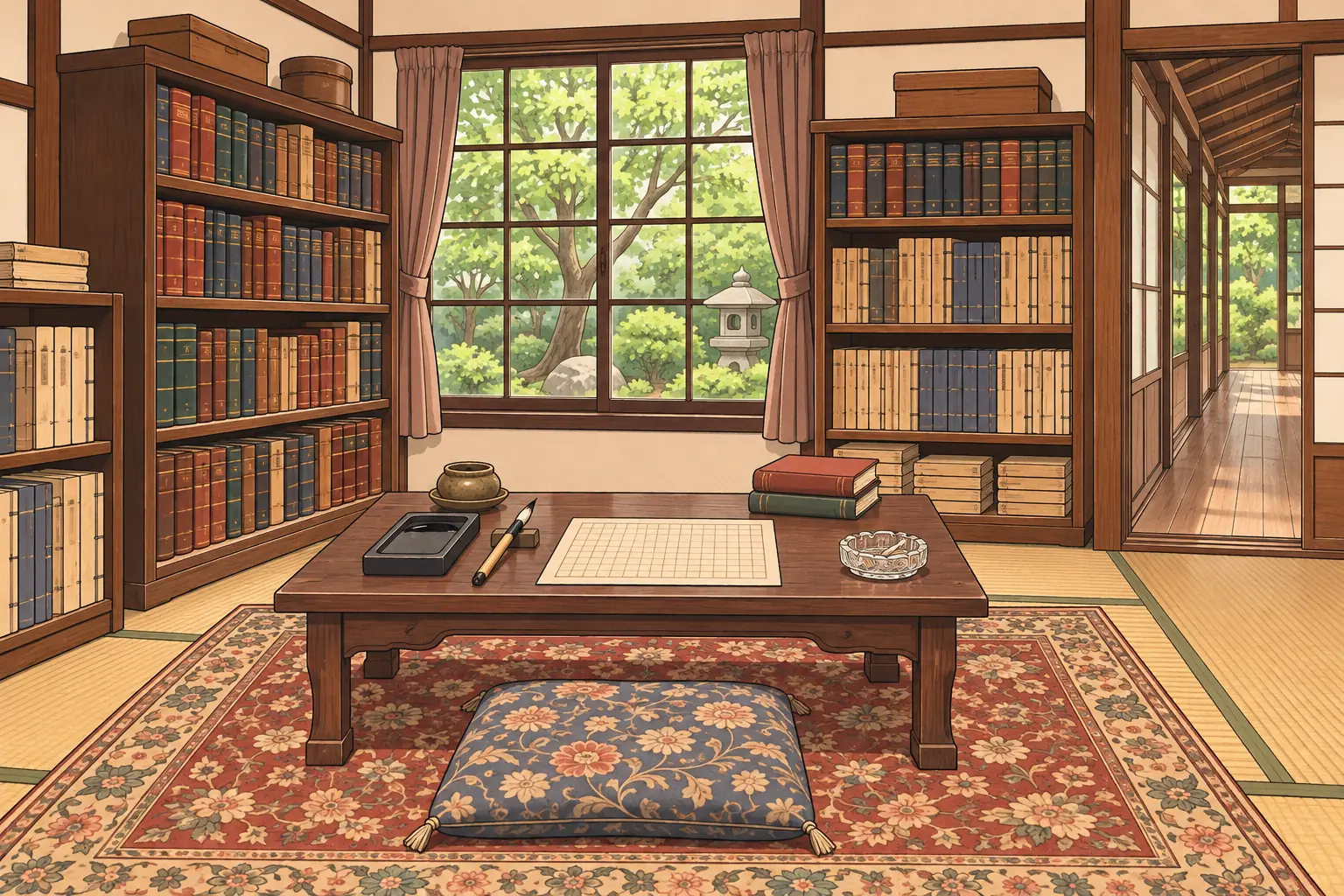
Sōseki's reconstructed study: a carpeted Japanese-Western room, low desk amid shelves of Western and thread-bound books (illustration).