
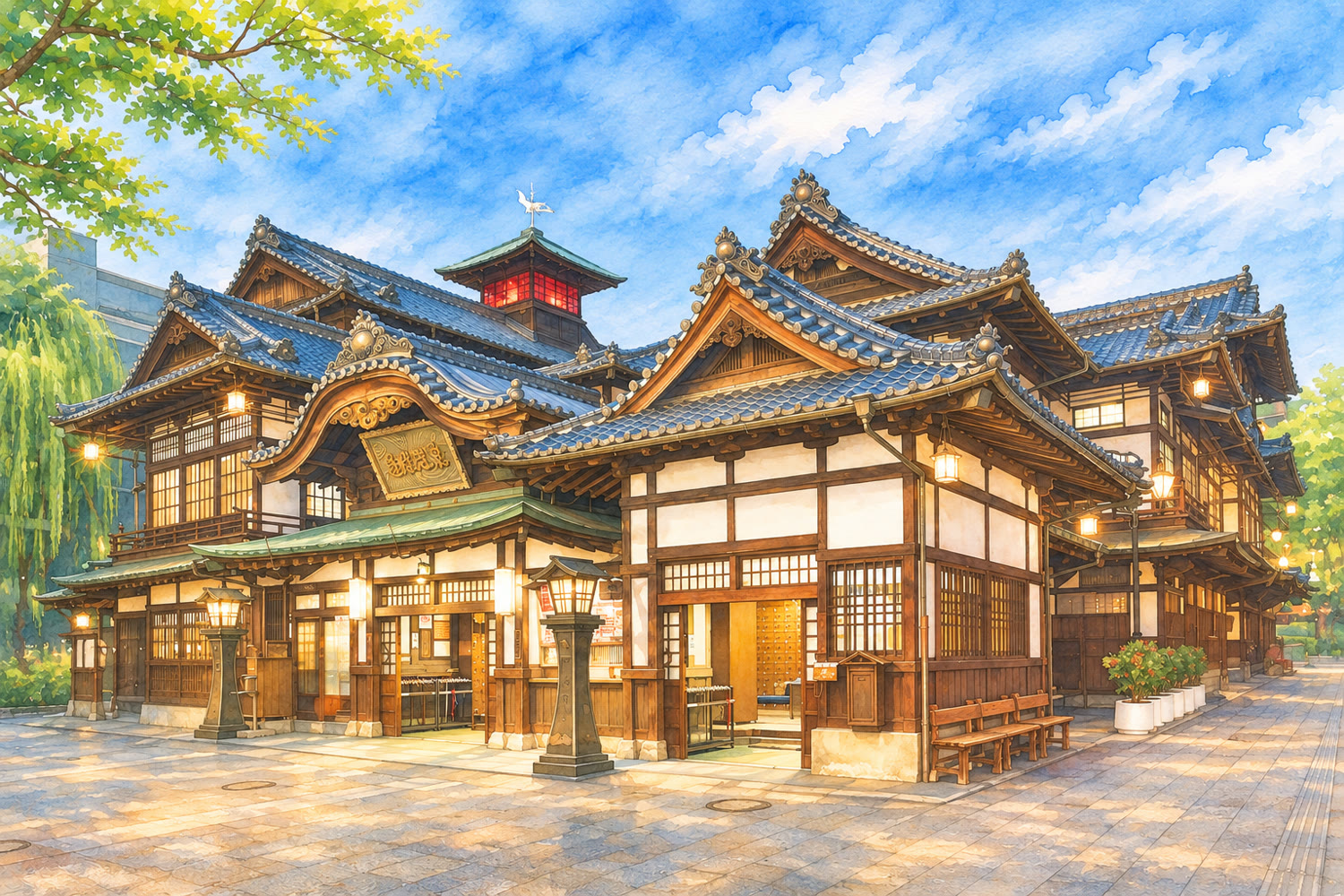
Dōgo Onsen is a hot spring district on the northeastern side of Matsuyama, Ehime Prefecture, and one of the oldest documented spas in Japan: the Nihon shoki already records imperial visits to the "hot waters of Iyo." At its center stands the Dōgo Onsen Honkan, a public bathhouse built in the Meiji period and still in use. In 1994 it became the first public bathhouse to be designated an Important Cultural Property, and Natsume Sōseki’s novel Botchan made it a household name.
01Myths and Early Records
A local myth tells how the deity Ōkuninushi brought the ailing Sukunahikona here and bathed him in the spring until he revived, stood up on a rock, and danced. The rock, called the Tama-no-ishi, is still kept beside the Honkan.
The Iyo Province Fudoki survives only in fragments quoted by later writers. One such fragment says that several emperors and empresses bathed here, and that Prince Shōtoku came in 596 with the Goguryeo monk Eji (Hyeja in Korean) and others and set up a stone inscription. The text of that inscription is preserved only in the quotation; the stone itself is lost, and scholars disagree about the date and authenticity of the text, so the prince’s visit is usually treated as tradition. The Nihon shoki is firmer: it records that Emperor Jomei stayed at a hot-spring palace in Iyo around 639, and that Empress Saimei stopped in Iyo in 661 on her way west.
02From the Middle Ages to Meiji
Ippen, founder of the Ji school of Pure Land Buddhism, was born in 1239 into the Kōno, a powerful Iyo family. Tradition places his birthplace near Hōgon-ji, a temple at the northern edge of today’s spa town. From the fourteenth to the sixteenth century the Kōno held Yuzuki Castle beside the springs; its site is now a park. Under the Tokugawa, Dōgo belonged to Matsuyama domain, whose lords maintained the baths and divided them by social rank.
In the Meiji period the first mayor of Dōgo-Yunomachi, Isaniwa Yukiya, pushed through a rebuilding. The main three-story wooden building, the Kami-no-yu Honkan, was finished in 1894, crowned by the Shinrokaku turret, where a drum still sounds the hour. A private bath for the imperial family, the Yūshinden, followed in 1899, and other wings were added later.
03Sōseki, Shiki, and the Honkan Today
Natsume Sōseki taught at a middle school in Matsuyama for about a year from 1895 and was a regular at the baths. That year his friend Masaoka Shiki, a Matsuyama native, came home to recover from illness, and the two shared Sōseki’s lodgings for more than fifty days. Botchan (1906), drawn from Sōseki’s time in Matsuyama, sends its hero to a hot spring modeled on these baths, and the Honkan has been tied to the novel ever since.
From January 2019 the Honkan underwent a conservation project while partly staying open; the whole building reopened in July 2024, and the work was finished that year. Hōgon-ji lost its main hall to fire in 2013 and has since rebuilt it. The Yuzuki Castle site and Isaniwa Shrine are close by.